LARGE BORE ENGINES
Submitted by-
Rishabh Jain (K11619)
B.Tech Mechanical
6th Sem/ 3rd Yr
CONTENTS
• What is bore.
• Significance of Engine Geometry.
• Types of Large Bore Engine.
• Working.
• Role of Piston Rings.
• Applications.
• References.
Bore, is a term used in describing a part of a piston engine. It
represents the size of the cylinder, in terms of diameter of
the cylinder in which a piston travels.
The value of a cylinder’s bore, and stroke, is used to establish the
displacement of an engine.
Displacement = Bore2 x 0.7854 x Stroke x No. f cylinders
What Is Bore
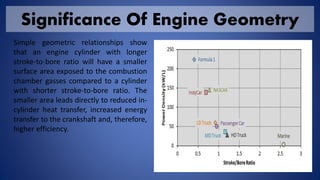
Simple geometric relationships show
that an engine cylinder with longer
stroke-to-bore ratio will have a smaller
surface area exposed to the combustion
chamber gasses compared to a cylinder
with shorter stroke-to-bore ratio. The
smaller area leads directly to reduced in-
cylinder heat transfer, increased energy
transfer to the crankshaft and, therefore,
higher efficiency.
Significance Of Engine Geometry
Types of Large Bore Engines
Large Bore Natural Gas Engine Large Bore Diesel Engine
Piston
Piston rod
Crank pin, bottom end
bearing (rotatory
motion) Journal, journal bearing
(rotatory motion)
Crosshead, crosshead
bearing (reciprocating)
Connecting rod
Piston rings
Oil pumped at
a certain
pressure
Web
Piston skirt
Stuffing box
Platform separating cylinder
from crank case
Ref: http://www.marinediesels.info/2_stroke_engine_parts/crosshead.htm
In some engines such as long and
superlong stroke engines, the piston is
not directly connected to the crank pin
via a connecting rod. The piston has a
piston rod extending from the bottom
of the piston. The piston rod is then
connected to the connecting rod at the
crosshead bearing. The crosshead
bearing has a to and fro motion and
therefore a continuous hydrodynamic
film cannot form. Therefore oil has to
be pumped to the crosshead bearing at
a predetermined pressure in order to
take the loads of compression and
combustion. The crosshead is
connected to the crank pin via a
connecting rod.
Working
Piston rings seal the combustion chamber from the
cylinder crankcase in order to prevent combustion
gases (or blow-by) penetrating the crankcase and to
prevent the lubricating oil being sprayed around in the
crankcase from penetrating the combustion chamber
.In addition, the piston rings dissipate the heat from
the piston to the cylinder and ensure the lubricating
film is evenly distributed. Therefore the main
requirements for piston rings are high resistance to
wear and corrosion and a low drop in elasticity at high
temperatures.
Role Of Piston Ring
• Marine propulsion system.
• Power plant.
Applications
• http://www.wartsila.com/docs/default-source/Power-Plants-
documents/technology/combustion-engines/introducing-the-
world's-largest-gas-engine.pdf
• http://web.ornl.gov/~webworks/cppr/y2001/rpt/122012.pdf
• http://papers.sae.org/290008/
References

Large bore engines

  • 1.
    LARGE BORE ENGINES Submittedby- Rishabh Jain (K11619) B.Tech Mechanical 6th Sem/ 3rd Yr
  • 2.
    CONTENTS • What isbore. • Significance of Engine Geometry. • Types of Large Bore Engine. • Working. • Role of Piston Rings. • Applications. • References.
  • 3.
    Bore, is aterm used in describing a part of a piston engine. It represents the size of the cylinder, in terms of diameter of the cylinder in which a piston travels. The value of a cylinder’s bore, and stroke, is used to establish the displacement of an engine. Displacement = Bore2 x 0.7854 x Stroke x No. f cylinders What Is Bore
  • 4.
    Simple geometric relationshipsshow that an engine cylinder with longer stroke-to-bore ratio will have a smaller surface area exposed to the combustion chamber gasses compared to a cylinder with shorter stroke-to-bore ratio. The smaller area leads directly to reduced in- cylinder heat transfer, increased energy transfer to the crankshaft and, therefore, higher efficiency. Significance Of Engine Geometry
  • 5.
    Types of LargeBore Engines Large Bore Natural Gas Engine Large Bore Diesel Engine
  • 6.
    Piston Piston rod Crank pin,bottom end bearing (rotatory motion) Journal, journal bearing (rotatory motion) Crosshead, crosshead bearing (reciprocating) Connecting rod Piston rings Oil pumped at a certain pressure Web Piston skirt Stuffing box Platform separating cylinder from crank case Ref: http://www.marinediesels.info/2_stroke_engine_parts/crosshead.htm In some engines such as long and superlong stroke engines, the piston is not directly connected to the crank pin via a connecting rod. The piston has a piston rod extending from the bottom of the piston. The piston rod is then connected to the connecting rod at the crosshead bearing. The crosshead bearing has a to and fro motion and therefore a continuous hydrodynamic film cannot form. Therefore oil has to be pumped to the crosshead bearing at a predetermined pressure in order to take the loads of compression and combustion. The crosshead is connected to the crank pin via a connecting rod. Working
  • 7.
    Piston rings sealthe combustion chamber from the cylinder crankcase in order to prevent combustion gases (or blow-by) penetrating the crankcase and to prevent the lubricating oil being sprayed around in the crankcase from penetrating the combustion chamber .In addition, the piston rings dissipate the heat from the piston to the cylinder and ensure the lubricating film is evenly distributed. Therefore the main requirements for piston rings are high resistance to wear and corrosion and a low drop in elasticity at high temperatures. Role Of Piston Ring
  • 8.
    • Marine propulsionsystem. • Power plant. Applications
  • 9.