How to enhance cities' role in
transitioning to sustainability and
resilience?

Urban Futures NCAR
Paty Romero-Lankao,
Sara Hughes, Dan Runfola, Josh Sperling
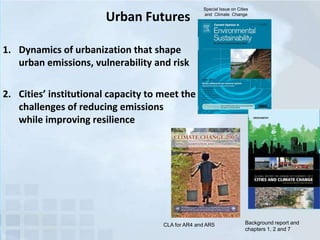
Urban Futures

Special Issue on Cities
and Climate Change

1. Dynamics of urbanization that shape
urban emissions, vulnerability and risk
2. Cities’ institutional capacity to meet the
challenges of reducing emissions
while improving resilience

CLA for AR4 and AR5

Background report and
chapters 1, 2 and 7
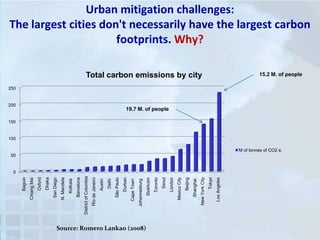
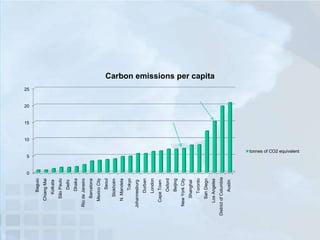
Urban mitigation challenges:
The largest cities don't necessarily have the largest carbon
footprints. Why?
Total carbon emissions by city

15.2 M. of people

250

200

19.7 M. of people

150

100
M of tonnes of CO2 e.
50

Source: Romero Lankao (2008)

Los Angeles

Tokyo

New York City

Shanghai

Beijing

Mexico City

London

Seoul

Toronto

Stokholm

Johannesburg

Cape Town

Durban

São Paulo

Delhi

Austin

Rio de Janeiro

District of Columbia

Barcelona

Kolkata

N. Mandela

San Diego

Dhaka

Oxford

Chiang Mai

Baguio

0
Austin

District of Columbia

Los Angeles

San Diego

Toronto

Shanghai

New York City

Beijing

Oxford

Cape Town

London

Durban

Johannesburg

Tokyo

N. Mandela

Stokholm

Seoul

Mexico City

Barcelona

Rio de Janeiro

Dhaka

Delhi

São Paulo

Kolkata

Chiang Mai

Baguio

Carbon emissions per capita

25

20

15

10

5
tonnes of CO2 equivalent

0
Multiple factors differences in urban GHG
emissions
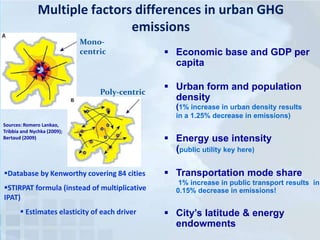
Monocentric

Poly-centric

 Economic base and GDP per
capita

 Urban form and population
density
(1% increase in urban density results
in a 1.25% decrease in emissions)

Sources: Romero Lankao,
Tribbia and Nychka (2009);
Bertaud (2009)

Database by Kenworthy covering 84 cities
STIRPAT formula (instead of multiplicative
IPAT)
 Estimates elasticity of each driver

 Energy use intensity
(public utility key here)
 Transportation mode share
1% increase in public transport results in
0.15% decrease in emissions!

 City’s latitude & energy
endowments
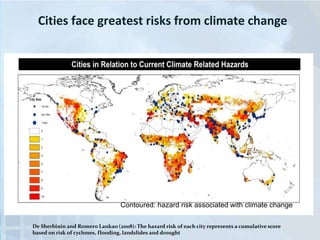
Cities face greatest risks from climate change

Contoured: hazard risk associated with climate change
De Sherbinin and Romero Lankao (2008): The hazard risk of each city represents a cumulative score
based on risk of cyclones, flooding, landslides and drought
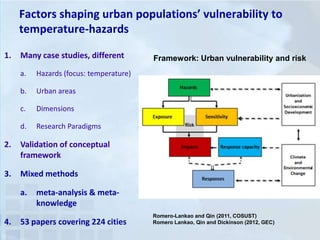
Factors shaping urban populations’ vulnerability to
temperature-hazards
1.

Many case studies, different
a.

Hazards (focus: temperature)

b.

Urban areas

c.

Dimensions

d.

Framework: Urban vulnerability and risk

Research Paradigms

2.

Validation of conceptual
framework

3.

Mixed methods
a.

4.

meta-analysis & metaknowledge

53 papers covering 224 cities

Romero-Lankao and Qin (2011, COSUST)
Romero Lankao, Qin and Dickinson (2012, GEC)
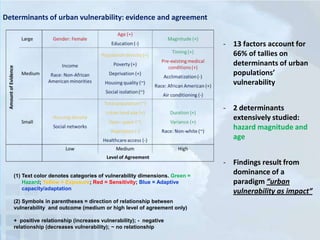
Determinants of urban vulnerability: evidence and agreement
- 13 factors account for
66% of tallies on
determinants of urban
populations’
vulnerability
- 2 determinants
extensively studied:
hazard magnitude and
age

(1) Text color denotes categories of vulnerability dimensions. Green =
Hazard; Yellow = Exposure; Red = Sensitivity; Blue = Adaptive
capacity/adaptation
(2) Symbols in parentheses = direction of relationship between
vulnerability and outcome (medium or high level of agreement only)
+ positive relationship (increases vulnerability); - negative
relationship (decreases vulnerability); ~ no relationship

- Findings result from
dominance of a
paradigm “urban
vulnerability as impact”
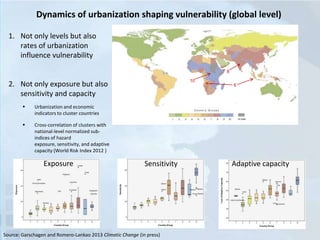
Dynamics of urbanization shaping vulnerability (global level)
1. Not only levels but also
rates of urbanization
influence vulnerability
8
Country groups
10

2. Not only exposure but also
sensitivity and capacity


Urbanization and economic
indicators to cluster countries



6

Cross-correlation of clusters with
national-level normalized subindices of hazard
exposure, sensitivity, and adaptive
capacity (World Risk Index 2012 )

Exposure

Sensitivity

Source: Garschagen and Romero-Lankao 2013 Climatic Change (in press)

Adaptive capacity
Institutional Capacity for Climate
Change Responses in Cities

Patricia Romero-Lankao, Sara Hughes (USA)
Angélica Rosas-Huerta (México), Roxana
Borquez (Chile), Daniel Gnatz,
(USA)
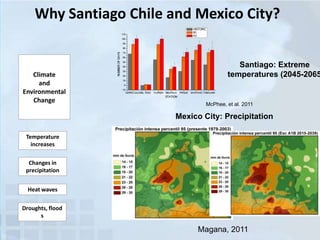
Why Santiago Chile and Mexico City?

Climate
and
Environmental
Change

Santiago: Extreme
temperatures (2045-2065

McPhee, et al. 2011

Mexico City: Precipitation
Temperature
increases
Changes in
precipitation

Heat waves
Droughts, flood
s

Magana, 2011
Why Santiago Chile & Mexico City?

• Both share similar urbanization
processes, reforms, and urban
and environmental policies
– E.g., due to population growth alone
• Mexico City: 2007- 2030 available water
per capita will diminish by 11.2% and in
Santiago by 20.3 % per capita between
2005 - 2025

• Presence of scientific groups and
multinational networks is key

Why institutional response
capacity?
• Capacity for change has received
increasing attention
• Scholarship has mostly focused on
–
–

• Yet, Frameworks distinguish between
adaptive and mitigative capacity
• Response capacity, an
alternative, refers to
–

• Yet differences also exist
– Mexico City is a frontrunner
– Santiago is a laggard

Motivations & barriers to adaptation
Attributes of institutional capacity

the broad pool of resources governmental and
nongovernmental actors can use to reduce
greenhouse gases and respond to climate
variability and change (Burch and Robinson 2007)
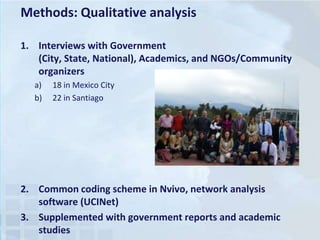
Methods: Qualitative analysis
1. Interviews with Government
(City, State, National), Academics, and NGOs/Community
organizers
a)
b)

18 in Mexico City
22 in Santiago

2. Common coding scheme in Nvivo, network analysis
software (UCINet)
3. Supplemented with government reports and academic
studies
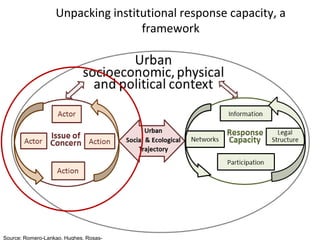
Unpacking institutional response capacity, a
framework

Source: Romero-Lankao, Hughes, Rosas-
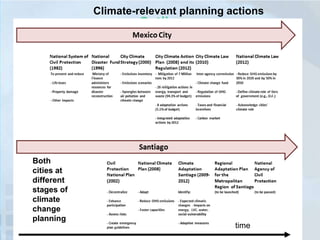
Climate-relevant planning actions

Outline

Both
cities at
different
stages of
climate
change
planning

time
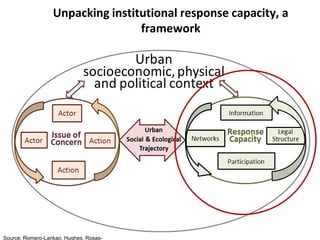
Unpacking institutional response capacity, a
framework

Source: Romero-Lankao, Hughes, Rosas-
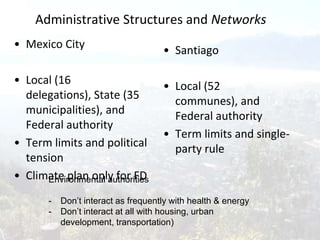
Administrative Structures and Networks
• Mexico City

• Santiago

• Local (16
delegations), State (35
municipalities), and
Federal authority
• Term limits and political
tension
• Climate plan only for FD
Environmental authorities

• Local (52
communes), and
Federal authority
• Term limits and singleparty rule

-

Don’t interact as frequently with health & energy
Don’t interact at all with housing, urban
development, transportation)
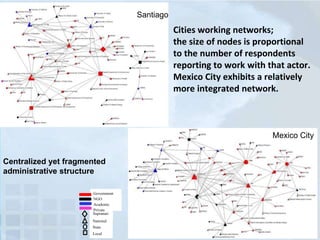
Santiago

Cities working networks;
the size of nodes is proportional
to the number of respondents
reporting to work with that actor.
Mexico City exhibits a relatively
more integrated network.

Mexico City
Centralized yet fragmented
administrative structure
Government
NGO
Academic
Private
Supranati
onal
National
State
Local
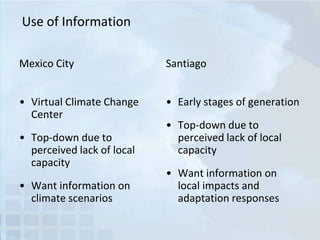
Use of Information
Mexico City

Santiago

• Virtual Climate Change
Center

• Early stages of generation

• Top-down due to
perceived lack of local
capacity
• Want information on
climate scenarios

• Top-down due to
perceived lack of local
capacity
• Want information on
local impacts and
adaptation responses
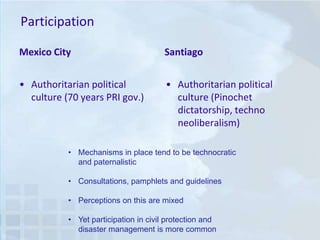
Participation
Mexico City

Santiago

• Authoritarian political
culture (70 years PRI gov.)

• Authoritarian political
culture (Pinochet
dictatorship, techno
neoliberalism)

• Mechanisms in place tend to be technocratic
and paternalistic
• Consultations, pamphlets and guidelines
• Perceptions on this are mixed
• Yet participation in civil protection and
disaster management is more common
Opportunities
• Leadership (and political ambition)
• For Mexico City institutionalization of climate into planning

• Presence of
– Influential scientific groups
– Non-governmental and international organizations
– Participation of local authorities in transnational networks

• Longer-term tradition of disaster management (although
reactive)
Constraints
• Centralized yet fragmented administrative
structure inhibits effective coordination
• Technocratic and top-down approach to
information sharing inhibits learning and
informed policy making at the city level
• Limited existing mechanisms for participation in
decision making transfer to climate change
planning
• Economic policies and efficiency dominate
Thank you!

Lankao csu october 2013

  • 1.
    How to enhancecities' role in transitioning to sustainability and resilience? Urban Futures NCAR Paty Romero-Lankao, Sara Hughes, Dan Runfola, Josh Sperling
  • 2.
    Urban Futures Special Issueon Cities and Climate Change 1. Dynamics of urbanization that shape urban emissions, vulnerability and risk 2. Cities’ institutional capacity to meet the challenges of reducing emissions while improving resilience CLA for AR4 and AR5 Background report and chapters 1, 2 and 7
  • 3.
    Urban mitigation challenges: Thelargest cities don't necessarily have the largest carbon footprints. Why? Total carbon emissions by city 15.2 M. of people 250 200 19.7 M. of people 150 100 M of tonnes of CO2 e. 50 Source: Romero Lankao (2008) Los Angeles Tokyo New York City Shanghai Beijing Mexico City London Seoul Toronto Stokholm Johannesburg Cape Town Durban São Paulo Delhi Austin Rio de Janeiro District of Columbia Barcelona Kolkata N. Mandela San Diego Dhaka Oxford Chiang Mai Baguio 0
  • 4.
    Austin District of Columbia LosAngeles San Diego Toronto Shanghai New York City Beijing Oxford Cape Town London Durban Johannesburg Tokyo N. Mandela Stokholm Seoul Mexico City Barcelona Rio de Janeiro Dhaka Delhi São Paulo Kolkata Chiang Mai Baguio Carbon emissions per capita 25 20 15 10 5 tonnes of CO2 equivalent 0
  • 5.
    Multiple factors differencesin urban GHG emissions Monocentric Poly-centric  Economic base and GDP per capita  Urban form and population density (1% increase in urban density results in a 1.25% decrease in emissions) Sources: Romero Lankao, Tribbia and Nychka (2009); Bertaud (2009) Database by Kenworthy covering 84 cities STIRPAT formula (instead of multiplicative IPAT)  Estimates elasticity of each driver  Energy use intensity (public utility key here)  Transportation mode share 1% increase in public transport results in 0.15% decrease in emissions!  City’s latitude & energy endowments
  • 6.
    Cities face greatestrisks from climate change Contoured: hazard risk associated with climate change De Sherbinin and Romero Lankao (2008): The hazard risk of each city represents a cumulative score based on risk of cyclones, flooding, landslides and drought
  • 7.
    Factors shaping urbanpopulations’ vulnerability to temperature-hazards 1. Many case studies, different a. Hazards (focus: temperature) b. Urban areas c. Dimensions d. Framework: Urban vulnerability and risk Research Paradigms 2. Validation of conceptual framework 3. Mixed methods a. 4. meta-analysis & metaknowledge 53 papers covering 224 cities Romero-Lankao and Qin (2011, COSUST) Romero Lankao, Qin and Dickinson (2012, GEC)
  • 8.
    Determinants of urbanvulnerability: evidence and agreement - 13 factors account for 66% of tallies on determinants of urban populations’ vulnerability - 2 determinants extensively studied: hazard magnitude and age (1) Text color denotes categories of vulnerability dimensions. Green = Hazard; Yellow = Exposure; Red = Sensitivity; Blue = Adaptive capacity/adaptation (2) Symbols in parentheses = direction of relationship between vulnerability and outcome (medium or high level of agreement only) + positive relationship (increases vulnerability); - negative relationship (decreases vulnerability); ~ no relationship - Findings result from dominance of a paradigm “urban vulnerability as impact”
  • 9.
    Dynamics of urbanizationshaping vulnerability (global level) 1. Not only levels but also rates of urbanization influence vulnerability 8 Country groups 10 2. Not only exposure but also sensitivity and capacity  Urbanization and economic indicators to cluster countries  6 Cross-correlation of clusters with national-level normalized subindices of hazard exposure, sensitivity, and adaptive capacity (World Risk Index 2012 ) Exposure Sensitivity Source: Garschagen and Romero-Lankao 2013 Climatic Change (in press) Adaptive capacity
  • 10.
    Institutional Capacity forClimate Change Responses in Cities Patricia Romero-Lankao, Sara Hughes (USA) Angélica Rosas-Huerta (México), Roxana Borquez (Chile), Daniel Gnatz, (USA)
  • 11.
    Why Santiago Chileand Mexico City? Climate and Environmental Change Santiago: Extreme temperatures (2045-2065 McPhee, et al. 2011 Mexico City: Precipitation Temperature increases Changes in precipitation Heat waves Droughts, flood s Magana, 2011
  • 12.
    Why Santiago Chile& Mexico City? • Both share similar urbanization processes, reforms, and urban and environmental policies – E.g., due to population growth alone • Mexico City: 2007- 2030 available water per capita will diminish by 11.2% and in Santiago by 20.3 % per capita between 2005 - 2025 • Presence of scientific groups and multinational networks is key Why institutional response capacity? • Capacity for change has received increasing attention • Scholarship has mostly focused on – – • Yet, Frameworks distinguish between adaptive and mitigative capacity • Response capacity, an alternative, refers to – • Yet differences also exist – Mexico City is a frontrunner – Santiago is a laggard Motivations & barriers to adaptation Attributes of institutional capacity the broad pool of resources governmental and nongovernmental actors can use to reduce greenhouse gases and respond to climate variability and change (Burch and Robinson 2007)
  • 13.
    Methods: Qualitative analysis 1.Interviews with Government (City, State, National), Academics, and NGOs/Community organizers a) b) 18 in Mexico City 22 in Santiago 2. Common coding scheme in Nvivo, network analysis software (UCINet) 3. Supplemented with government reports and academic studies
  • 14.
    Unpacking institutional responsecapacity, a framework Source: Romero-Lankao, Hughes, Rosas-
  • 15.
    Climate-relevant planning actions Outline Both citiesat different stages of climate change planning time
  • 16.
    Unpacking institutional responsecapacity, a framework Source: Romero-Lankao, Hughes, Rosas-
  • 17.
    Administrative Structures andNetworks • Mexico City • Santiago • Local (16 delegations), State (35 municipalities), and Federal authority • Term limits and political tension • Climate plan only for FD Environmental authorities • Local (52 communes), and Federal authority • Term limits and singleparty rule - Don’t interact as frequently with health & energy Don’t interact at all with housing, urban development, transportation)
  • 18.
    Santiago Cities working networks; thesize of nodes is proportional to the number of respondents reporting to work with that actor. Mexico City exhibits a relatively more integrated network. Mexico City Centralized yet fragmented administrative structure Government NGO Academic Private Supranati onal National State Local
  • 19.
    Use of Information MexicoCity Santiago • Virtual Climate Change Center • Early stages of generation • Top-down due to perceived lack of local capacity • Want information on climate scenarios • Top-down due to perceived lack of local capacity • Want information on local impacts and adaptation responses
  • 20.
    Participation Mexico City Santiago • Authoritarianpolitical culture (70 years PRI gov.) • Authoritarian political culture (Pinochet dictatorship, techno neoliberalism) • Mechanisms in place tend to be technocratic and paternalistic • Consultations, pamphlets and guidelines • Perceptions on this are mixed • Yet participation in civil protection and disaster management is more common
  • 21.
    Opportunities • Leadership (andpolitical ambition) • For Mexico City institutionalization of climate into planning • Presence of – Influential scientific groups – Non-governmental and international organizations – Participation of local authorities in transnational networks • Longer-term tradition of disaster management (although reactive)
  • 22.
    Constraints • Centralized yetfragmented administrative structure inhibits effective coordination • Technocratic and top-down approach to information sharing inhibits learning and informed policy making at the city level • Limited existing mechanisms for participation in decision making transfer to climate change planning • Economic policies and efficiency dominate
  • 23.

Editor's Notes

  • #4 Total emissions too. The order changes dramatically
  • #14 Talk about methods
  • #18 Talk about methods
  • #20 Talk about methods
  • #23 Talk about methods