Climate Change
Adaptation and Mitigation plans,
   policies and investments
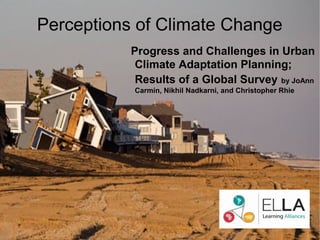
Perceptions of Climate Change
           Progress and Challenges in Urban
            Climate Adaptation Planning;
            Results of a Global Survey by JoAnn
           Carmin, Nikhil Nadkarni, and Christopher Rhie
Progress and Challenges in
                                               Urban Climate Adaptation
                                               Planning; Results of a Global
                                               Survey by JoAnn Carmin, Nikhil
                                              Nadkarni, and Christopher Rhie
                                             



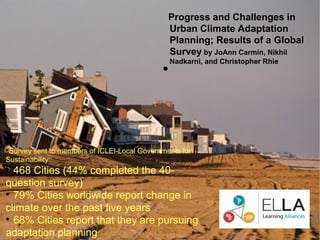
 Survey sent to members of ICLEI-Local Governments for
Sustainability

  468 Cities (44% completed the 40-
question survey)

  79% Cities worldwide report change in
climate over the past five years

  68% Cities report that they are pursuing
adaptation planning
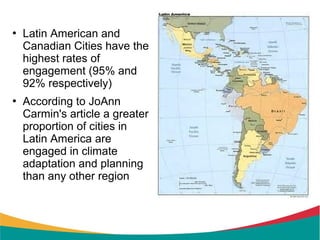
   Latin American and
    Canadian Cities have the
    highest rates of
    engagement (95% and
    92% respectively)
   According to JoAnn
    Carmin's article a greater
    proportion of cities in
    Latin America are
    engaged in climate
    adaptation and planning
    than any other region
Challenges in Adaptation Planning
1) Funding For Adaptation
85% of Cities worldwide agree that funding is one of the major challenges in advancing in
adaptation
Around 60% are not receiving any support for their adaptation activities

2) Communicating the need for adaptation to elected
officials and local departments
according to survey 7% cities believe national governments understand the realities of
adaptation (30% of National governments have no understanding of realities cities face)


3) Gaining commitments of National Government for
Local adaptation challenges
Resilient Cities: Case Studies
      Quito and Mexico City
       Working from Local to Global
Examples of climate change initiatives motived by
  endogenous factors and sustained through local actors
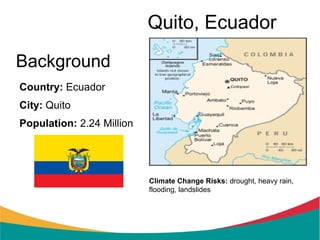
Quito, Ecuador
Background
Country: Ecuador
City: Quito
Population: 2.24 Million


                           Climate Change Risks: drought, heavy rain,
                           flooding, landslides
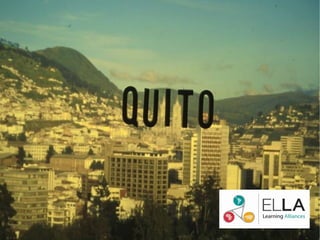
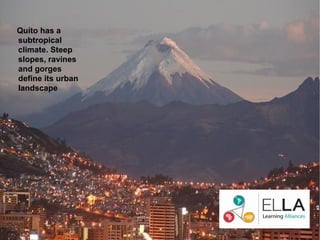
Quito has a
subtropical
climate. Steep
slopes, ravines
and gorges
define its urban
landscape
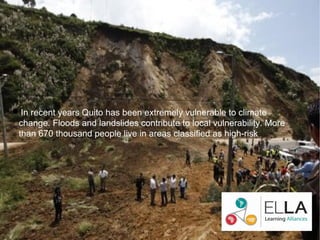
In recent years Quito has been extremely vulnerable to climate
 change. Floods and landslides contribute to local vulnerability. More
 than 670 thousand people live in areas classified as high-risk.
Quito, Ecuador
    Background
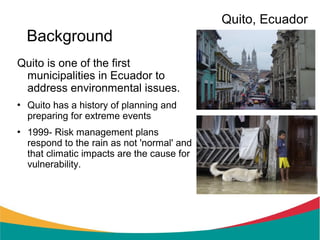
Quito is one of the first
 municipalities in Ecuador to
 address environmental issues.
   Quito has a history of planning and
    preparing for extreme events
   1999- Risk management plans
    respond to the rain as not 'normal' and
    that climatic impacts are the cause for
    vulnerability.
Quito, Ecuador

Planning for Climate Change
        Events and Actors

                     
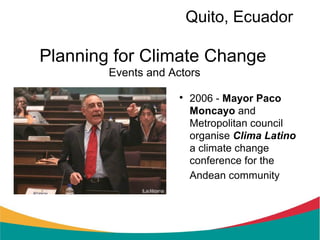
                         2006 - Mayor Paco
                         Moncayo and
                         Metropolitan council
                         organise Clima Latino
                         a climate change
                         conference for the
                         Andean community
Planning for Climate Change
                         Events and Actors
                                      Inter-Institutional Commission
                                          Key figures
                                      
                                          Municipal representatives (air and

    2007- Gonzalo Ortiz, a                water corporations)
    metropolitan Councilor receives
    support from the council and      
                                          Members from metropolitan office
    the mayor to create an Inter-         for environment
    Institutional Commission after    
                                          Members of Strategic Research
    report on temperature and             Unit
    Glacial changes
                                      Task
                                      
                                          Prepare draft on climate strategy
                                          for Quito
Quito, Ecuador
 Quito Strategy for Climate Change
              (EQCC)

    Released in Feb 2008 and formally approved by the
    Metropolitan Council in Oct 2009 the EQCC has
    become the official environmental policy in Quito *
* At the same time EQCC was approved Quito created a Climate Change
   Office within the Environmental office
Quito, Ecuador
Keys factors attributing to Quito's
success

1) Understanding climate change as a real
threat to the city

2) Strong commitment of the Local
Government

3) The advancement of local priorities-
strategy plan was a result of generating
ideas internally, experimenting and
innovating
Quito, Ecuador
       Why use Quito's example?

    No national laws, policies, or international frameworks
    guided or supported Quito's effort.

    Quito received support from bilateral funding and
    development banks but neither agencies imposed
    their personal agenda or requirements (the resources
    were used to advance already existing initiatives)

    Quito involved local NGO's
WEEK 2


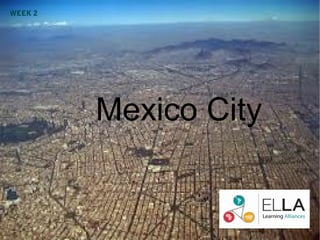
         Mexico City
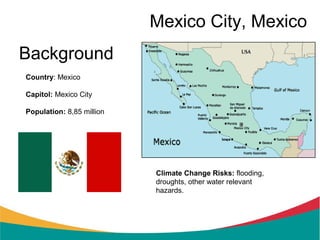
Mexico City, Mexico
Background
Country: Mexico

Capitol: Mexico City

Population: 8,85 million


                           Climate Change Risks: flooding,
                           droughts, other water relevant
                           hazards.
Mexico City, Mexico
   Background
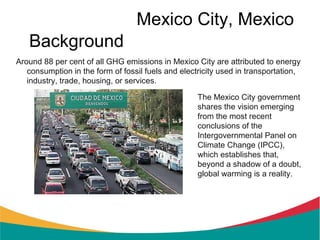
Around 88 per cent of all GHG emissions in Mexico City are attributed to energy
   consumption in the form of fossil fuels and electricity used in transportation,
   industry, trade, housing, or services.

                                                    The Mexico City government
                                                    shares the vision emerging
                                                    from the most recent
                                                    conclusions of the
                                                    Intergovernmental Panel on
                                                    Climate Change (IPCC),
                                                    which establishes that,
                                                    beyond a shadow of a doubt,
                                                    global warming is a reality.
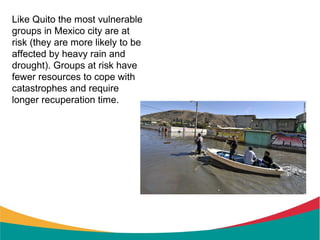
Like Quito the most vulnerable
groups in Mexico city are at
risk (they are more likely to be
affected by heavy rain and
drought). Groups at risk have
fewer resources to cope with
catastrophes and require
longer recuperation time.
Mexico City, Mexico

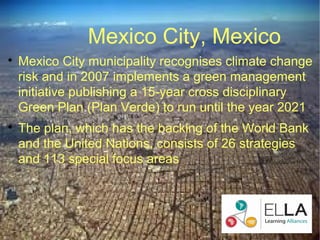
    Mexico City municipality recognises climate change
    risk and in 2007 implements a green management
    initiative publishing a 15-year cross disciplinary
    Green Plan (Plan Verde) to run until the year 2021

    The plan, which has the backing of the World Bank
    and the United Nations, consists of 26 strategies
    and 113 special focus areas
Mexico City, Mexico
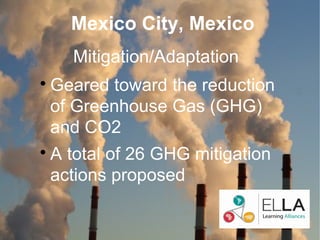
      Mitigation/Adaptation

    Geared toward the reduction
    of Greenhouse Gas (GHG)
    and CO2

    A total of 26 GHG mitigation
    actions proposed
Mexico City, Mexico

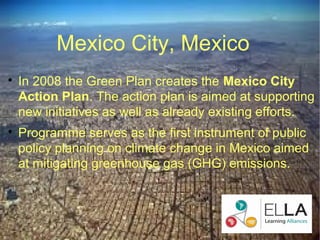
    In 2008 the Green Plan creates the Mexico City
    Action Plan. The action plan is aimed at supporting
    new initiatives as well as already existing efforts.

    Programme serves as the first instrument of public
    policy planning on climate change in Mexico aimed
    at mitigating greenhouse gas (GHG) emissions.
Mexico City, Mexico
5 objectives of Action Programme
1) To influence behavioural patterns, habits, and attitudes of the
   City's population so as to mitigate climate change
2) To attract investments and financing
3) To promote technological innovations
4) To position Mexico City and its government as national and
   international leaders in the field of mitigating greenhouse gas
   emissions
5) To set out guidelines for public policies
Climate Action Program Results

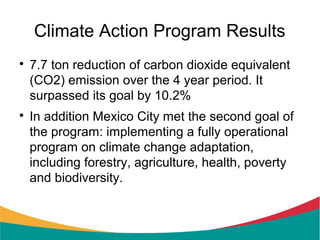
    7.7 ton reduction of carbon dioxide equivalent
    (CO2) emission over the 4 year period. It
    surpassed its goal by 10.2%

    In addition Mexico City met the second goal of
    the program: implementing a fully operational
    program on climate change adaptation,
    including forestry, agriculture, health, poverty
    and biodiversity.
Mexico City Results
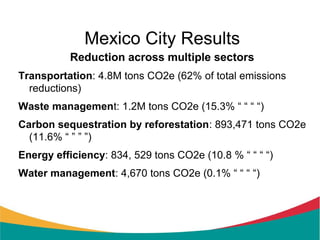
          Reduction across multiple sectors
Transportation: 4.8M tons CO2e (62% of total emissions
  reductions)
Waste management: 1.2M tons CO2e (15.3% “ “ “ “)
Carbon sequestration by reforestation: 893,471 tons CO2e
  (11.6% “ ” ” ”)
Energy efficiency: 834, 529 tons CO2e (10.8 % “ “ “ “)
Water management: 4,670 tons CO2e (0.1% “ “ “ “)
Why use Mexico City's example?

    Mexico City’s Climate Action Programme served as the first
    instrument of public policy planning on climate change in
    Mexico, and provides a foundation for the country’s
    leadership on environmental issues in the international
    arena.

    High degree of public participation and engagement in
    environment-related issues
Sources


   Carmin, J., Nadkarni, N., Rhie, C. 2012. Progress and Challenges in Urban Climate
   Adaptation Planning: Results of a Global Survey. Cambridge, MA: MIT

   Carmin,J., Anguelovski, I., Roberts, D. 2012. Urban Climate Adaptation in the Global
   South: Planning in an Emerging Domain. Journal of Planning Education and
   Research. 32(1) 18-32

   Martínez, O.V, Beatriz del Valle Cárdenas, B. V, Álvarez, S.S. (eds) 2008. Mexico
   City Climate Action Program 2008-2012/ Summary. World Bank, Washington, DC

   Final report of Mexico City’s 2008-2012 Climate Action Program
   Download available on-
   http://newswatch.nationalgeographic.com/2012/09/13/mexico-city-meets-exceeds
   -climate-action-program-goals/

   10 highlights of mexico city's climate action program
   http://www.mexicocityexperience.com/green_living/

   Mexico City: Successful environmental management
   http://www.dac.dk/en/dac-cities/sustainable-cities-2/all-cases/social-city/mexico-city-
   successful-environmental-management/
ella.practicalaction.org/

Moderated by:   Supported by:


                Managed by:

ELLA Learning Alliance on Climate Resilient Cities: Mexico City and Quito Climate Change Plans

  • 1.
    Climate Change Adaptation andMitigation plans, policies and investments
  • 2.
    Perceptions of ClimateChange Progress and Challenges in Urban Climate Adaptation Planning; Results of a Global Survey by JoAnn Carmin, Nikhil Nadkarni, and Christopher Rhie
  • 3.
    Progress and Challengesin Urban Climate Adaptation Planning; Results of a Global Survey by JoAnn Carmin, Nikhil Nadkarni, and Christopher Rhie   Survey sent to members of ICLEI-Local Governments for Sustainability  468 Cities (44% completed the 40- question survey)  79% Cities worldwide report change in climate over the past five years  68% Cities report that they are pursuing adaptation planning
  • 4.
    Latin American and Canadian Cities have the highest rates of engagement (95% and 92% respectively)  According to JoAnn Carmin's article a greater proportion of cities in Latin America are engaged in climate adaptation and planning than any other region
  • 5.
    Challenges in AdaptationPlanning 1) Funding For Adaptation 85% of Cities worldwide agree that funding is one of the major challenges in advancing in adaptation Around 60% are not receiving any support for their adaptation activities 2) Communicating the need for adaptation to elected officials and local departments according to survey 7% cities believe national governments understand the realities of adaptation (30% of National governments have no understanding of realities cities face) 3) Gaining commitments of National Government for Local adaptation challenges
  • 6.
    Resilient Cities: CaseStudies Quito and Mexico City Working from Local to Global Examples of climate change initiatives motived by endogenous factors and sustained through local actors
  • 8.
    Quito, Ecuador Background Country: Ecuador City:Quito Population: 2.24 Million Climate Change Risks: drought, heavy rain, flooding, landslides
  • 9.
    Quito has a subtropical climate.Steep slopes, ravines and gorges define its urban landscape
  • 10.
    In recent yearsQuito has been extremely vulnerable to climate change. Floods and landslides contribute to local vulnerability. More than 670 thousand people live in areas classified as high-risk.
  • 11.
    Quito, Ecuador Background Quito is one of the first municipalities in Ecuador to address environmental issues.  Quito has a history of planning and preparing for extreme events  1999- Risk management plans respond to the rain as not 'normal' and that climatic impacts are the cause for vulnerability.
  • 12.
    Quito, Ecuador Planning forClimate Change Events and Actors  2006 - Mayor Paco Moncayo and Metropolitan council organise Clima Latino a climate change conference for the Andean community
  • 13.
    Planning for ClimateChange Events and Actors Inter-Institutional Commission Key figures  Municipal representatives (air and  2007- Gonzalo Ortiz, a water corporations) metropolitan Councilor receives support from the council and  Members from metropolitan office the mayor to create an Inter- for environment Institutional Commission after  Members of Strategic Research report on temperature and Unit Glacial changes Task  Prepare draft on climate strategy for Quito
  • 14.
    Quito, Ecuador QuitoStrategy for Climate Change (EQCC)  Released in Feb 2008 and formally approved by the Metropolitan Council in Oct 2009 the EQCC has become the official environmental policy in Quito * * At the same time EQCC was approved Quito created a Climate Change Office within the Environmental office
  • 15.
    Quito, Ecuador Keys factorsattributing to Quito's success 1) Understanding climate change as a real threat to the city 2) Strong commitment of the Local Government 3) The advancement of local priorities- strategy plan was a result of generating ideas internally, experimenting and innovating
  • 16.
    Quito, Ecuador Why use Quito's example?  No national laws, policies, or international frameworks guided or supported Quito's effort.  Quito received support from bilateral funding and development banks but neither agencies imposed their personal agenda or requirements (the resources were used to advance already existing initiatives)  Quito involved local NGO's
  • 17.
    WEEK 2 Mexico City
  • 18.
    Mexico City, Mexico Background Country:Mexico Capitol: Mexico City Population: 8,85 million Climate Change Risks: flooding, droughts, other water relevant hazards.
  • 19.
    Mexico City, Mexico Background Around 88 per cent of all GHG emissions in Mexico City are attributed to energy consumption in the form of fossil fuels and electricity used in transportation, industry, trade, housing, or services. The Mexico City government shares the vision emerging from the most recent conclusions of the Intergovernmental Panel on Climate Change (IPCC), which establishes that, beyond a shadow of a doubt, global warming is a reality.
  • 20.
    Like Quito themost vulnerable groups in Mexico city are at risk (they are more likely to be affected by heavy rain and drought). Groups at risk have fewer resources to cope with catastrophes and require longer recuperation time.
  • 21.
    Mexico City, Mexico  Mexico City municipality recognises climate change risk and in 2007 implements a green management initiative publishing a 15-year cross disciplinary Green Plan (Plan Verde) to run until the year 2021  The plan, which has the backing of the World Bank and the United Nations, consists of 26 strategies and 113 special focus areas
  • 22.
    Mexico City, Mexico Mitigation/Adaptation  Geared toward the reduction of Greenhouse Gas (GHG) and CO2  A total of 26 GHG mitigation actions proposed
  • 23.
    Mexico City, Mexico  In 2008 the Green Plan creates the Mexico City Action Plan. The action plan is aimed at supporting new initiatives as well as already existing efforts.  Programme serves as the first instrument of public policy planning on climate change in Mexico aimed at mitigating greenhouse gas (GHG) emissions.
  • 24.
    Mexico City, Mexico 5objectives of Action Programme 1) To influence behavioural patterns, habits, and attitudes of the City's population so as to mitigate climate change 2) To attract investments and financing 3) To promote technological innovations 4) To position Mexico City and its government as national and international leaders in the field of mitigating greenhouse gas emissions 5) To set out guidelines for public policies
  • 25.
    Climate Action ProgramResults  7.7 ton reduction of carbon dioxide equivalent (CO2) emission over the 4 year period. It surpassed its goal by 10.2%  In addition Mexico City met the second goal of the program: implementing a fully operational program on climate change adaptation, including forestry, agriculture, health, poverty and biodiversity.
  • 26.
    Mexico City Results Reduction across multiple sectors Transportation: 4.8M tons CO2e (62% of total emissions reductions) Waste management: 1.2M tons CO2e (15.3% “ “ “ “) Carbon sequestration by reforestation: 893,471 tons CO2e (11.6% “ ” ” ”) Energy efficiency: 834, 529 tons CO2e (10.8 % “ “ “ “) Water management: 4,670 tons CO2e (0.1% “ “ “ “)
  • 27.
    Why use MexicoCity's example?  Mexico City’s Climate Action Programme served as the first instrument of public policy planning on climate change in Mexico, and provides a foundation for the country’s leadership on environmental issues in the international arena.  High degree of public participation and engagement in environment-related issues
  • 28.
    Sources Carmin, J., Nadkarni, N., Rhie, C. 2012. Progress and Challenges in Urban Climate Adaptation Planning: Results of a Global Survey. Cambridge, MA: MIT Carmin,J., Anguelovski, I., Roberts, D. 2012. Urban Climate Adaptation in the Global South: Planning in an Emerging Domain. Journal of Planning Education and Research. 32(1) 18-32 Martínez, O.V, Beatriz del Valle Cárdenas, B. V, Álvarez, S.S. (eds) 2008. Mexico City Climate Action Program 2008-2012/ Summary. World Bank, Washington, DC Final report of Mexico City’s 2008-2012 Climate Action Program Download available on- http://newswatch.nationalgeographic.com/2012/09/13/mexico-city-meets-exceeds -climate-action-program-goals/ 10 highlights of mexico city's climate action program http://www.mexicocityexperience.com/green_living/ Mexico City: Successful environmental management http://www.dac.dk/en/dac-cities/sustainable-cities-2/all-cases/social-city/mexico-city- successful-environmental-management/
  • 29.

Editor's Notes

  • #3 PHOTO http://www.boomerwarrior.org/section/politics/world-politics/
  • #4 SOURCE Carmin, J., Nadkarni, N., Rhie, C. 2012. Progress and Challenges in Urban Climate Adaptation Planning: Results of a Global Survey. Cambridge, MA: MIT PHOTO http://www.boomerwarrior.org/section/politics/world-politics/
  • #5 SOURCES Carmin, J., Nadkarni, N., Rhie, C. 2012. Progress and Challenges in Urban Climate Adaptation Planning: Results of a Global Survey. Cambridge, MA: MIT PHOTO MAP http://www.rcrwireless.com/americas/20111101/finance/gartner-latin-americas-share-of-global-it-spending-growing/
  • #6 SOURCES Carmin, J., Nadkarni, N., Rhie, C. 2012. Progress and Challenges in Urban Climate Adaptation Planning: Results of a Global Survey. Cambridge, MA: MIT
  • #8 PHOTO http://gosouthamerica.about.com/library/blquitopix.htm
  • #9 PHOTO MAP http://www.learn-spanish-help.com/map-of-ecuador.html FLAG http://althistory.wikia.com/wiki/League_of_Nations_%28Twilight_of_a_New_Era%29
  • #10 PHOTO http://www.thepolisblog.org/2010/06/cities-in-face-of-climate-change-case.html
  • #11 SOURCE Carmin,J., Anguelovski, I., Roberts, D. 2012. Urban Climate Adaptation in the Global South: Planning in an Emerging Domain. Journal of Planning Education and Research. 32(1) 18-32 PHOTO http://poleshift.ning.com/profiles/blogs/ecuador-landslide-in-quito
  • #12 PHOTO http://tibbster.blogspot.com.br/2010/06/quito.html FLOOD/QUITO http://www.huffingtonpost.com/2012/03/25/ecuador-floods-2012_n_1378506.html
  • #13 SOURCES Carmin,J., Anguelovski, I., Roberts, D. 2012. Urban Climate Adaptation in the Global South: Planning in an Emerging Domain. Journal of Planning Education and Research. 32(1) 18-32 PHOTO http://www.lahora.com.ec/index.php/noticias/show/1101198871/-1/Paco_Moncayo_presenta_proyecto_de_ley_para_garantizar_la_seguridad_ciudadana.html#.UQF6Vug5hL0
  • #14 SOURCE Carmin,J., Anguelovski, I., Roberts, D. 2012. Urban Climate Adaptation in the Global South: Planning in an Emerging Domain. Journal of Planning Education and Research. 32(1) 18-32
  • #15 SOURCE Carmin,J., Anguelovski, I., Roberts, D. 2012. Urban Climate Adaptation in the Global South: Planning in an Emerging Domain. Journal of Planning Education and Research. 32(1) 18-32
  • #16 SOURCE Carmin,J., Anguelovski, I., Roberts, D. 2012. Urban Climate Adaptation in the Global South: Planning in an Emerging Domain. Journal of Planning Education and Research. 32(1) 18-32 PHOTO http://quitonews.blogspot.com.br/
  • #18 SOURCES PHOTO http://mlbreports.com/2012/03/18/mlbinmexico/
  • #19 SOURCE PHOTO MAP http://www.explore-retire-mexico.com/mexico-history.html FLAG http://www.americapictures.net/mexico-flag.html
  • #20 SOURCE Martínez, O.V, Beatriz del Valle Cárdenas, B. V, Álvarez, S.S. (eds) 2008. Mexico City Climate Action Program 2008-2012/ Summary. World Bank, Washington, DC PHOTO http://geo-mexico.com/?p=5135
  • #21 PHOTO http://edition.cnn.com/2010/WORLD/americas/02/09/mexico.floods/index.html
  • #22 SOURCE Martínez, O.V, Beatriz del Valle Cárdenas, B. V, Álvarez, S.S. (eds) 2008. Mexico City Climate Action Program 2008-2012/ Summary. World Bank, Washington, DC PHOTO http://mlbreports.com/2012/03/18/mlbinmexico/
  • #23 SOURCE Martínez, O.V, Beatriz del Valle Cárdenas, B. V, Álvarez, S.S. (eds) 2008. Mexico City Climate Action Program 2008-2012/ Summary. World Bank, Washington, DC PHOTO http://www.sciencedaily.com/releases/2007/08/070813162438.htm
  • #24 SOURCES Martínez, O.V, Beatriz del Valle Cárdenas, B. V, Álvarez, S.S. (eds) 2008. Mexico City Climate Action Program 2008-2012/ Summary. World Bank, Washington, DC PHOTO http://mlbreports.com/2012/03/18/mlbinmexico/
  • #25 SOURCE Martínez, O.V, Beatriz del Valle Cárdenas, B. V, Álvarez, S.S. (eds) 2008. Mexico City Climate Action Program 2008-2012/ Summary. World Bank, Washington, DC
  • #26 SOURCE Final report of Mexico City’s 2008-2012 Climate Action Program
  • #27 SOURCE Final report of Mexico City’s 2008-2012 Climate Action Program