Creative Nonfiction
Quarter 1 – Module 3:
Creative Nonfiction Demystified
Learning Competencies:
1. Do a close reading of creative nonfictional texts;
2. Identify the fictional elements in the texts.
Learning Targets:
At the end of the lesson, you are expected to:
1. List down the nature and characteristics of creative nonfiction;
2. Read sample creative nonfiction works and point-out the elements of fiction
utilized by the writer.
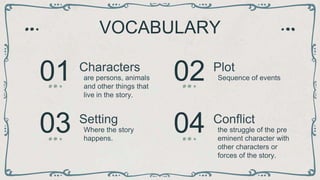
VOCABULARY
Characters
01
Setting
03
Plot
02
Conflict
04
are persons, animals
and other things that
live in the story.
Where the story
happens.
Sequence of events
the struggle of the pre
eminent character with
other characters or
forces of the story.
What is Creative
Nonfiction?
Nonfiction is writing that is based on true
events, people, places, and facts. It is a
vast category and has sub-genres: it could
be factual, like a scientific paper; it could
also be creative, like a personal essay.
Creative
Nonfiction
01
What is Creative Nonfiction?
The label “creative nonfiction” can apply to
various categories of writing, including
food, travel, memoir, personal essay, and
other hybridized forms. Its defining
characteristic is the use of literary
techniques to create a sense of artfulness
in the language, character development,
and story.
Elements of Creative Nonfiction
A. Plot is one of the basic elements of every story: put simply, plot
refers to the actual events that take place within the bounds of your
narrative.
PLOT
SCOPE, SEQUENCE, PACING
Elements of Creative Nonfiction
Characterization refers
to the development of
characters
through actions,
descriptions, and
dialogue.
Characters.
Characters bring life to the story.
Keep in mind that while human
characters are most frequently
featured in stories, sometimes
there
are non- human characters in a
story such as animals or even the
environment itself.
Characterization.
The writer’s narrative
position is informed by
point-of-view
Point of View.
Elements of Creative Nonfiction
Writers use symbols to
give meaning to
objects, or
events that are outside
of the literal.
Setting and Atmosphere.
Each story has a setting. The
setting is the place
where the story takes place.
Symbols and Symbolisms.
The writer’s narrative
position is informed by
point-of-view
Point of View.
Elements of Creative Nonfiction
is a rhetorical device
that achieves a special
effect by using
words in a distinctive
way.
Irony.
Irony is a literary device or event in
which how things seem to be is in
fact very different from how they
actually are.
VERBAL, DRAMATIC,
SITUATIONAL
(a young wife cuts off her hair in order to buy her
husband a chain for his prized watch, but the husband
sells his watch to buy his wife a
comb for her beautiful hair.)
Figures of speech.
Basically, this refers to
the communication
between characters in
the
narrative.
Dialogue.
SHORT RECALL?
FIGURES OF SPEECH
1. SIMILE
2. HYPERBOLE
3. IRONY
4. ONOMATOPOEIA
5. PERSONIFICATION
END

CREATIVE-NONFICTION-Module 3- demystified.pptx

  • 1.
    Creative Nonfiction Quarter 1– Module 3: Creative Nonfiction Demystified
  • 2.
    Learning Competencies: 1. Doa close reading of creative nonfictional texts; 2. Identify the fictional elements in the texts. Learning Targets: At the end of the lesson, you are expected to: 1. List down the nature and characteristics of creative nonfiction; 2. Read sample creative nonfiction works and point-out the elements of fiction utilized by the writer.
  • 3.
    VOCABULARY Characters 01 Setting 03 Plot 02 Conflict 04 are persons, animals andother things that live in the story. Where the story happens. Sequence of events the struggle of the pre eminent character with other characters or forces of the story.
  • 4.
    What is Creative Nonfiction? Nonfictionis writing that is based on true events, people, places, and facts. It is a vast category and has sub-genres: it could be factual, like a scientific paper; it could also be creative, like a personal essay.
  • 5.
  • 6.
    What is CreativeNonfiction? The label “creative nonfiction” can apply to various categories of writing, including food, travel, memoir, personal essay, and other hybridized forms. Its defining characteristic is the use of literary techniques to create a sense of artfulness in the language, character development, and story.
  • 7.
    Elements of CreativeNonfiction A. Plot is one of the basic elements of every story: put simply, plot refers to the actual events that take place within the bounds of your narrative. PLOT SCOPE, SEQUENCE, PACING
  • 8.
    Elements of CreativeNonfiction Characterization refers to the development of characters through actions, descriptions, and dialogue. Characters. Characters bring life to the story. Keep in mind that while human characters are most frequently featured in stories, sometimes there are non- human characters in a story such as animals or even the environment itself. Characterization. The writer’s narrative position is informed by point-of-view Point of View.
  • 9.
    Elements of CreativeNonfiction Writers use symbols to give meaning to objects, or events that are outside of the literal. Setting and Atmosphere. Each story has a setting. The setting is the place where the story takes place. Symbols and Symbolisms. The writer’s narrative position is informed by point-of-view Point of View.
  • 10.
    Elements of CreativeNonfiction is a rhetorical device that achieves a special effect by using words in a distinctive way. Irony. Irony is a literary device or event in which how things seem to be is in fact very different from how they actually are. VERBAL, DRAMATIC, SITUATIONAL (a young wife cuts off her hair in order to buy her husband a chain for his prized watch, but the husband sells his watch to buy his wife a comb for her beautiful hair.) Figures of speech. Basically, this refers to the communication between characters in the narrative. Dialogue.
  • 11.
    SHORT RECALL? FIGURES OFSPEECH 1. SIMILE 2. HYPERBOLE 3. IRONY 4. ONOMATOPOEIA 5. PERSONIFICATION
  • 12.