
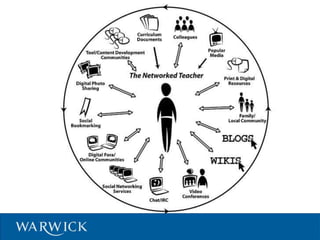
Language teaching
in the digital age.
T.MacKinnon
Senior tutor, Language Centre
Global trends in language learning.
There is a case for a reconceptualised field that is more
learner-centered, more collaborative and more
technologically driven.
The trends in language learning are moving us forward
in such a way as to empower our students to
communicate with others across the globe in real
time.
Challenges and opportunities:
• Language use
• Role of the teacher
• Digital skills
• Availability of resources
• New modes of
communication
• Teacher as learner
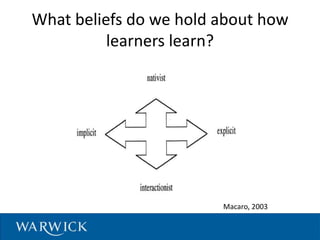
What beliefs do we hold about how
learners learn?
Macaro, 2003
T.MacKinnon, April 2010
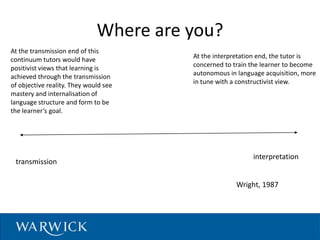
Where are you?
transmission
interpretation
At the interpretation end, the tutor is
concerned to train the learner to become
autonomous in language acquisition, more
in tune with a constructivist view.
At the transmission end of this
continuum tutors would have
positivist views that learning is
achieved through the transmission
of objective reality. They would see
mastery and internalisation of
language structure and form to be
the learner’s goal.
T.MacKinnon, April 2010
Wright, 1987
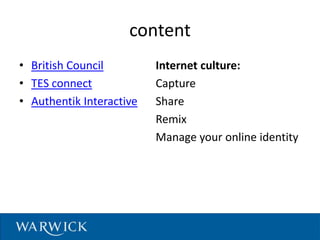
content
• British Council
• TES connect
• Authentik Interactive
Internet culture:
Capture
Share
Remix
Manage your online identity
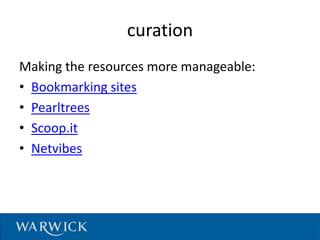
curation
Making the resources more manageable:
• Bookmarking sites
• Pearltrees
• Scoop.it
• Netvibes
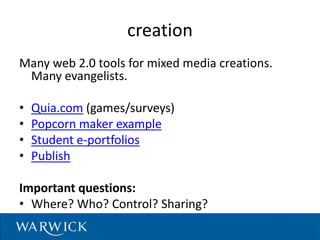
creation
Many web 2.0 tools for mixed media creations.
Many evangelists.
• Quia.com (games/surveys)
• Popcorn maker example
• Student e-portfolios
• Publish
Important questions:
• Where? Who? Control? Sharing?
communication
• Between educators: • Between students:
#edchat #ukedchat
#globalclassroom
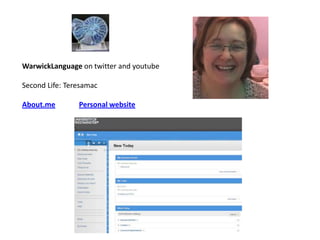
WarwickLanguage on twitter and youtube
Second Life: Teresamac
About.me Personal website
Eating elephants.
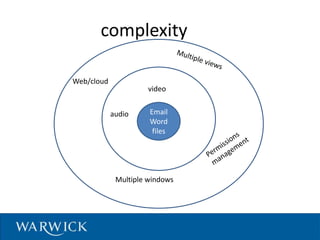
complexity
Email
Word
files
Web/cloud
audio
video
Multiple windows
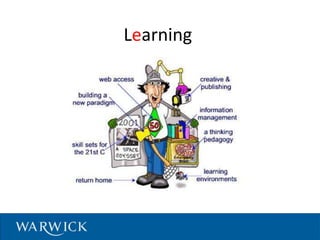
Learning
The Language Centre’s talking
mahoodle
The basic concept of the Web:
“. . . that it is an information space through which people can
communicate.
. . communicate by sharing their knowledge in a pool. . . The idea
was that everybody would be putting their ideas in, as well as
taking them out.”
Tim Berniers-Lee (considered by many as the father of the www)
28/09/2010 T.Mackinnon
Community of practice
The domain: A community of practice is not merely a club of friends or a network of
connections between people. It has an identity defined by a shared domain of
interest. Membership therefore implies a commitment to the domain, and therefore
a shared competence that distinguishes members from other people.
The community: In pursuing their interest in their domain, members engage in joint
activities and discussions, help each other, and share information. They build
relationships that enable them to learn from each other.
The practice: Members of a community of practice are practitioners. They develop a
shared repertoire of resources: experiences, stories, tools, ways of addressing
recurring problems—in short a shared practice. This takes time and sustained
interaction.
Etienne Wenger:
http://www.ewenger.com/theory/

Language teaching in the digital age

  • 1.
    Language teaching in thedigital age. T.MacKinnon Senior tutor, Language Centre
  • 2.
    Global trends inlanguage learning. There is a case for a reconceptualised field that is more learner-centered, more collaborative and more technologically driven. The trends in language learning are moving us forward in such a way as to empower our students to communicate with others across the globe in real time.
  • 3.
    Challenges and opportunities: •Language use • Role of the teacher • Digital skills • Availability of resources • New modes of communication • Teacher as learner
  • 4.
    What beliefs dowe hold about how learners learn? Macaro, 2003 T.MacKinnon, April 2010
  • 5.
    Where are you? transmission interpretation Atthe interpretation end, the tutor is concerned to train the learner to become autonomous in language acquisition, more in tune with a constructivist view. At the transmission end of this continuum tutors would have positivist views that learning is achieved through the transmission of objective reality. They would see mastery and internalisation of language structure and form to be the learner’s goal. T.MacKinnon, April 2010 Wright, 1987
  • 6.
    content • British Council •TES connect • Authentik Interactive Internet culture: Capture Share Remix Manage your online identity
  • 7.
    curation Making the resourcesmore manageable: • Bookmarking sites • Pearltrees • Scoop.it • Netvibes
  • 8.
    creation Many web 2.0tools for mixed media creations. Many evangelists. • Quia.com (games/surveys) • Popcorn maker example • Student e-portfolios • Publish Important questions: • Where? Who? Control? Sharing?
  • 9.
    communication • Between educators:• Between students: #edchat #ukedchat #globalclassroom
  • 10.
    WarwickLanguage on twitterand youtube Second Life: Teresamac About.me Personal website
  • 11.
  • 12.
  • 13.
  • 15.
    The Language Centre’stalking mahoodle The basic concept of the Web: “. . . that it is an information space through which people can communicate. . . communicate by sharing their knowledge in a pool. . . The idea was that everybody would be putting their ideas in, as well as taking them out.” Tim Berniers-Lee (considered by many as the father of the www) 28/09/2010 T.Mackinnon
  • 16.
    Community of practice Thedomain: A community of practice is not merely a club of friends or a network of connections between people. It has an identity defined by a shared domain of interest. Membership therefore implies a commitment to the domain, and therefore a shared competence that distinguishes members from other people. The community: In pursuing their interest in their domain, members engage in joint activities and discussions, help each other, and share information. They build relationships that enable them to learn from each other. The practice: Members of a community of practice are practitioners. They develop a shared repertoire of resources: experiences, stories, tools, ways of addressing recurring problems—in short a shared practice. This takes time and sustained interaction. Etienne Wenger: http://www.ewenger.com/theory/

Editor's Notes

  • #5 The horizontal axis represents the polarisation between theories of language input. Implicit input arises from natural exposure and sub-conscious processing, explicit from teaching and conscious processing. The vertical axis represents the concept of how language input is processed. Nativist implies that language learning is an innate skill, interactionist that language is a specialised form of knowledge that is acquired through interaction with the environment. He adds this observation:  “Of course polarizations are never absolute and theories as well as individuals place themselves on various stages along the continuum of these axes.” (p22)
  • #14 Contrast these 2 images – gadget man : teachers who use tech may be perceived as “techies” , others may prefer to avoid!Personally I prefer to see the e INSIDE the learning – embedded in what we do, just a tool (or ever changing tool set) which helps us find the best way to extend what we do beyond the classroom.