















:Geovanny Peña Pérez M.A. 
ELT Freelance Academic Consultant 
Oxford University Press 
Date : August 29th, 2014 
Institution : MESCyT 
From : 2:00 P.M to 4:00 P.M. 
Santo Domingo, Dom. Rep 
A Workshop by
Introduction: 
An Overview of the 
importance of using 
technology in 
ESL/EFL teaching 
Our Main Focus: 
Presentation of the 
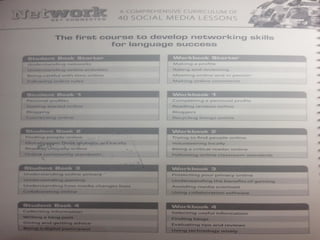
Network series and all 
of its components. 
Our Main Focus: 
Presentation of different 
sections of the Starter 
Book, and book 1, in order 
to highlight the key points 
that leads to students’ 
success when studying 
with the series. 
Conclusion: 
Closing with questions and 
feedback from the participants 
and presenter.
Think, Pair,Share 
Think for 30 seconds 
Pair and share for 30 seconds 
As an EFL/ESL teacher, what is 
your opinion about the use of 
technology in your English 
classes? Why?
“Technology will not replace teachers, but 
teachers who understand technology will 
replace those who do not.” 
— Ray Clifford
Think, Pair,Share 
Think for 30 seconds 
Pair and share for 30 seconds 
What are some advantages of 
using technology in your 
English classes?
“Use technology in the 
service of pedagogy , 
not vice-versa”. 
—Siskin & Reynolds
Technology assists and enhances language learning. 
It provides authentic examples of the target culture, connecting the 
classrooms in the D.R, (for example) to classrooms in the U.S. or other 
countries, where the target language is spoken. 
Technology tools enable teachers to differentiate instruction and adapt 
classroom activities and homework assignments, thus enhancing the 
language learning experience. 
Distant learning programs can enable language educators to expand 
language-learning opportunities to all students, regardless of where they live, 
the human and material resources available to them, or their language 
background and needs. 
Technology continues to grow in importance as a tool to assist teachers of 
foreign languages in facilitating and mediating language learning for their 
students. 
The effectiveness of any technological tool depends on the knowledge and 
expertise of the qualified language teacher who manages and facilitates the 
language learning environment.
Technology has been around in many 
forms for a long time as can be seen in the 
following photos:
Imagine how innovative tape recorders and 
typewriters must have once appeared to the 
first users… 
Before, we had Web 1.0 Which was: 
Exclusive Web designer One way Static 
In the hands of few 
Today, the story is very different…
Web 2.0
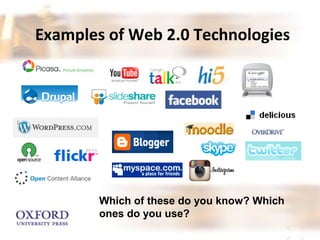
Examples of Web 2.0 Technologies 
Which of these do you know? Which 
ones do you use?
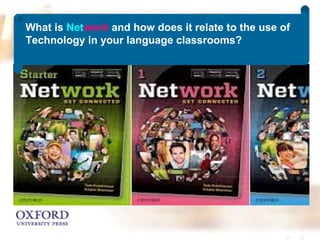
What is Network and how does it relate to the use of 
Technology in your language classrooms?
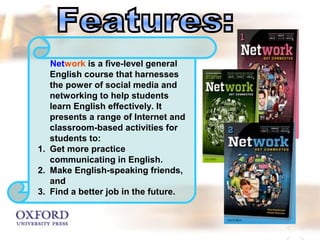
Network is a five-level general 
English course that harnesses 
the power of social media and 
networking to help students 
learn English effectively. It 
presents a range of Internet and 
classroom-based activities for 
students to: 
1. Get more practice 
communicating in English. 
2. Make English-speaking friends, 
and 
3. Find a better job in the future.
• Network uses social networking to link learners for common goals 
– shared language success and professional growth. 
• Social networking themes are incorporated through a variety of 
classroom-based and online tasks. 
• These provide an authentic and meaningful context for language 
learning. 
• Network is easy to teach and easy to learn from – the one-page, 
one-lesson, one-learning outcome approach requires minimum 
preparation and helps you to track your students' progress. 
• Additional resources include authentic video from the 
BBC Motion Gallery, iTools digital resources for interactive 
whiteboards, and Online Practice that you can assign as 
homework and track.
• One-page, one-lesson, one-outcome approach ensures 
achievement. 
• Your Network activities help students to practice 
communication in class and online. 
• Get Connected lessons build social media skills such as 
creating a personal profile and blogging in English. 
• Original BBC Motion Gallery video and authentic 
documentaries develop real-world listening skills. 
• Online Practice activities, including record and play 
back conversation activities, provide students with extra 
opportunities to develop their skills outside class. 
• Interactive teacher tools such as tracking your students' 
progress, and communicating and collaborating with them 
outside of class, help to improve learning outcomes.
NETWORK Online Practice 
 Network Online Practice offers a robust blend of extra practice content and 
teacher resources. With over 120 activities per level, including video 
activities, students can access up to 25 hours of additional practice in the 
classroom or at home. 
 Network Online Practice is ideal for self-study, enabling students to practice 
their grammar, vocabulary, speaking, and listening skills outside class. 
 Speak and record practice allows students to practice their conversation 
skills. Students record themselves as a character from the Conversation or 
Your Story pages in the Student Book then play the audio back to hear the 
dialogue in full, improving their pronunciation and fluency.
A comprehensive testing program with over 20 tests per 
level, makes it easy for you to review your students' progress 
throughout the course. The tests are automatically graded and 
reported to your class Gradebook, saving you time. 
Set up Discussions with your students on any topic and stay in 
contact with them using the Messaging and email tools. 
The online Gradebook keeps you up to date with students' learning, 
making it easy for you to track and report on progress, and letting 
you quickly identify strengths and weaknesses within a class. 
The Network Online Practice access code can be found on the inside 
back cover of the Student Book.
What are the pedagogical benefits of using social 
networking? 
There are five key benefits to deploying social media in support of 
English language teaching and learning: 
1. Turning social networking into meaningful English-practice 
opportunities. 
Social networks such as Facebook allow students to practice new language 
in an engaging environment. 
2. Maximizing authentic input. 
Social Networks provide excellent models for how language is actually 
used. Students see authentic language ranging from casual conversation 
to academic discourse. Social media in the form of tweets, posts, blogs, or 
video sharing, provide and abundant supply of real-life language.
3.Building community. 
Research shows that language learners are more likely to engage in 
the learning process and improve their skills when they have a 
network of classmate, friends, or family to talk to or practice with. 
4. Developing critical thinking skills. 
Critical thinking is necessary for 21st –century academic and professional 
success. As students engage more with social media, they develop critical 
thinking skills by making judgements about the credibility of sources of 
information. 
5. Personalizing the learning process. 
When students can relate learning to their own lives and 
experiences, they are more likely to understand and remember. 
Liking the learner’s social networks to coursework is one of the 
most meaningful ways to engage digital natives and other learners 
who participate regularly in social networking.
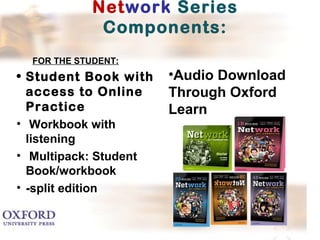
Network Series 
Components: 
FOR THE STUDENT: 
• Student Book with 
access to Online 
Practice 
• Workbook with 
listening 
• Multipack: Student 
Book/workbook 
• -split edition 
•Audio Download 
Through Oxford 
Learn
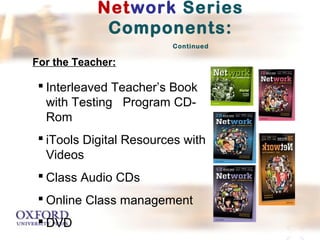
Network Series 
Components: 
Continued 
For the Teacher: 
 Interleaved Teacher’s Book 
with Testing Program CD-Rom 
 iTools Digital Resources with 
Videos 
 Class Audio CDs 
 Online Class management 
 DVD
Testing Program CD-Rom: 
Includes Print-and-go and Customizable 
Placement Tests 
Unit tests 
General Achievement Midterm and Final Exams 
Midterm and Final Exams in the style of standardized tests 
Answer Keys and Audio files
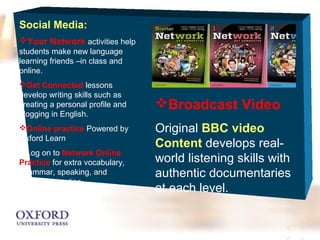
Social Media: 
Your Network activities help 
students make new language 
learning friends –in class and 
online. 
Get Connected lessons 
develop writing skills such as 
creating a personal profile and 
blogging in English. 
Online practice Powered by 
Oxford Learn 
Log on to Network Online 
Practice for extra vocabulary, 
Grammar, speaking, and 
Listening practice 
Broadcast Video 
Original BBC video 
Content develops real-world 
listening skills with 
authentic documentaries 
at each level.
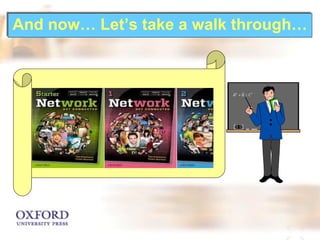
AAnndd nnooww…… LLeett’’ss ttaakkee aa wwaallkk tthhrroouugghh……
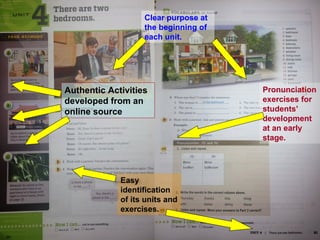
Clear purpose at 
the beginning of 
each unit. 
Pronunciation 
exercises for 
students’ 
development 
at an early 
stage. 
Authentic Activities 
developed from an 
online source 
Easy 
identification 
of its units and 
exercises.
Clear 
reference in 
the grammar 
section. 
Also 
language 
reflexion on 
easy/single 
tasks.
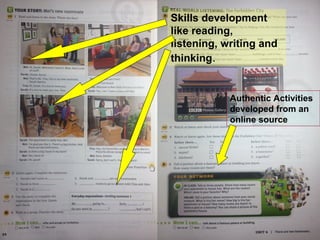
Skills development 
like reading, 
listening, writing and 
thinking. 
Authentic Activities 
developed from an 
online source
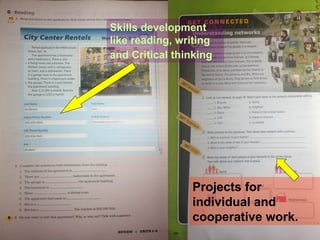
Skills development 
like reading, writing 
and Critical thinking. 
Projects for 
individual and 
cooperative work.
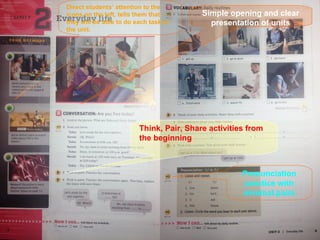
Direct students’ attention to the 
icons on the left, tells them that 
they will be able to do each task in 
the unit. 
Simple opening and clear 
presentation of units 
Think, Pair, Share activities from 
the beginning 
Pronunciation 
practice with 
minimal pairs
Clear and easy 
reference to the 
grammar contents 
and reviews 
Language practice 
with authentic 
everyday activities 
and language 
functions. 
Reinforcement of the 
language focus 
through the reading 
and writing exercises
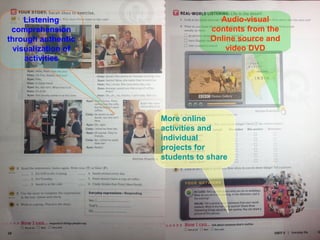
Listening 
comprehension 
through authentic 
visualization of 
activities 
Audio-visual 
contents from the 
Online source and 
video DVD 
More online 
activities and 
individual 
projects for 
students to share
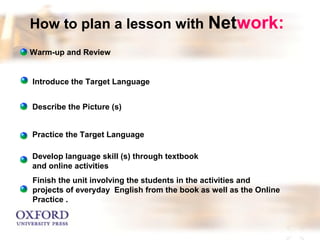
How to plan a lesson with Network: 
Warm-up and Review 
Introduce the Target Language 
Describe the Picture (s) 
Practice the Target Language 
Develop language skill (s) through textbook 
and online activities 
Finish the unit involving the students in the activities and 
projects of everyday English from the book as well as the Online 
Practice .
(NAME OF TEACHING INSTITUTION) 
L E S S O N P L A N 
Estimated Time of Lesson: Profs: . 
Teaching Point: Date: . 
Level of students: . 
Age Range: . 
Teaching Objectives: Materials to be used: 
1. 1. . 
2. 2. . 
3. 
3. . 
4. . 
5. . 
Pre-Teaching Activity Procedures Follow up/Evaluation 
Aprox. 
Time: 
Aprox. 
Time: 
. 
Aprox. 
Time:
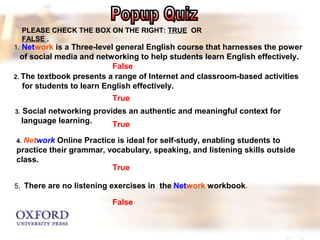
PLEASE CHECK THE BOX ON THE RIGHT: TRUE OR 
FALSE . 
1. Network is a Three-level general English course that harnesses the power 
of social media and networking to help students learn English effectively. 
False 
2. The textbook presents a range of Internet and classroom-based activities 
for students to learn English effectively. 
True 
3. Social networking provides an authentic and meaningful context for 
language learning. 
True 
4. Network Online Practice is ideal for self-study, enabling students to 
practice their grammar, vocabulary, speaking, and listening skills outside 
class. 
True 
5. There are no listening exercises in the Network workbook. 
False
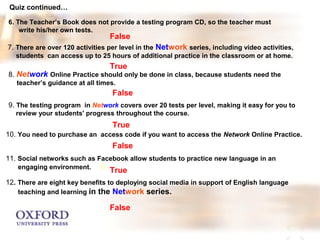
Quiz continued… 
6. The Teacher’s Book does not provide a testing program CD, so the teacher must 
write his/her own tests. 
False 
7. There are over 120 activities per level in the Network series, including video activities, 
students can access up to 25 hours of additional practice in the classroom or at home. 
True 
8. Network Online Practice should only be done in class, because students need the 
teacher’s guidance at all times. 
False 
9. The testing program in Network covers over 20 tests per level, making it easy for you to 
review your students' progress throughout the course. 
True 
False 
10. You need to purchase an access code if you want to access the Network Online Practice. 
11. Social networks such as Facebook allow students to practice new language in an 
engaging environment. 0 
True 
12. There are eight key benefits to deploying social media in support of English language 
teaching and learning in the Network series. 
False
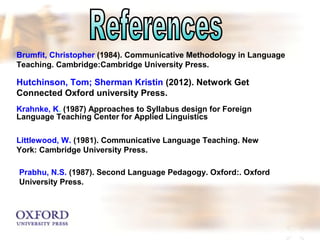
Brumfit, Christopher (1984). Communicative Methodology in Language 
Teaching. Cambridge:Cambridge University Press. 
Hutchinson, Tom; Sherman Kristin (2012). Network Get 
Connected Oxford university Press. 
Krahnke, K. (1987) Approaches to Syllabus design for Foreign 
Language Teaching Center for Applied Linguistics 
Littlewood, W. (1981). Communicative Language Teaching. New 
York: Cambridge University Press. 
Prabhu, N.S. (1987). Second Language Pedagogy. Oxford:. Oxford 
University Press.
Richards, Jack C and Theodore Rodgers (2001). Approaches and Methods in 
Language teaching. Second Edition. New York: Cambridge University Press. 
Skehan, P. (1996). Second language acquisition research and task-based instruction. 
In J. Willis and D. Willis (eds). Challenge and Change in Language Teaching. Oxford: 
Heinemann. 
Widdowson. H. (1987). Aspects of syllabus design. In M. Tickoo (ed). Language 
Syllabuses: State of the Art.: Singapore: Regional Language Centre.
 THANK YOU FOR YOUR PARTICIPATION!!! 
• Now it’s time for questions, 
feedback and Comments…
Getting Connected with Network

Getting Connected with Network

  • 1.
    :Geovanny Peña PérezM.A. ELT Freelance Academic Consultant Oxford University Press Date : August 29th, 2014 Institution : MESCyT From : 2:00 P.M to 4:00 P.M. Santo Domingo, Dom. Rep A Workshop by
  • 2.
    Introduction: An Overviewof the importance of using technology in ESL/EFL teaching Our Main Focus: Presentation of the Network series and all of its components. Our Main Focus: Presentation of different sections of the Starter Book, and book 1, in order to highlight the key points that leads to students’ success when studying with the series. Conclusion: Closing with questions and feedback from the participants and presenter.
  • 3.
    Think, Pair,Share Thinkfor 30 seconds Pair and share for 30 seconds As an EFL/ESL teacher, what is your opinion about the use of technology in your English classes? Why?
  • 4.
    “Technology will notreplace teachers, but teachers who understand technology will replace those who do not.” — Ray Clifford
  • 5.
    Think, Pair,Share Thinkfor 30 seconds Pair and share for 30 seconds What are some advantages of using technology in your English classes?
  • 6.
    “Use technology inthe service of pedagogy , not vice-versa”. —Siskin & Reynolds
  • 7.
    Technology assists andenhances language learning. It provides authentic examples of the target culture, connecting the classrooms in the D.R, (for example) to classrooms in the U.S. or other countries, where the target language is spoken. Technology tools enable teachers to differentiate instruction and adapt classroom activities and homework assignments, thus enhancing the language learning experience. Distant learning programs can enable language educators to expand language-learning opportunities to all students, regardless of where they live, the human and material resources available to them, or their language background and needs. Technology continues to grow in importance as a tool to assist teachers of foreign languages in facilitating and mediating language learning for their students. The effectiveness of any technological tool depends on the knowledge and expertise of the qualified language teacher who manages and facilitates the language learning environment.
  • 8.
    Technology has beenaround in many forms for a long time as can be seen in the following photos:
  • 9.
    Imagine how innovativetape recorders and typewriters must have once appeared to the first users… Before, we had Web 1.0 Which was: Exclusive Web designer One way Static In the hands of few Today, the story is very different…
  • 10.
  • 11.
    Examples of Web2.0 Technologies Which of these do you know? Which ones do you use?
  • 12.
    What is Networkand how does it relate to the use of Technology in your language classrooms?
  • 13.
    Network is afive-level general English course that harnesses the power of social media and networking to help students learn English effectively. It presents a range of Internet and classroom-based activities for students to: 1. Get more practice communicating in English. 2. Make English-speaking friends, and 3. Find a better job in the future.
  • 14.
    • Network usessocial networking to link learners for common goals – shared language success and professional growth. • Social networking themes are incorporated through a variety of classroom-based and online tasks. • These provide an authentic and meaningful context for language learning. • Network is easy to teach and easy to learn from – the one-page, one-lesson, one-learning outcome approach requires minimum preparation and helps you to track your students' progress. • Additional resources include authentic video from the BBC Motion Gallery, iTools digital resources for interactive whiteboards, and Online Practice that you can assign as homework and track.
  • 15.
    • One-page, one-lesson,one-outcome approach ensures achievement. • Your Network activities help students to practice communication in class and online. • Get Connected lessons build social media skills such as creating a personal profile and blogging in English. • Original BBC Motion Gallery video and authentic documentaries develop real-world listening skills. • Online Practice activities, including record and play back conversation activities, provide students with extra opportunities to develop their skills outside class. • Interactive teacher tools such as tracking your students' progress, and communicating and collaborating with them outside of class, help to improve learning outcomes.
  • 16.
    NETWORK Online Practice  Network Online Practice offers a robust blend of extra practice content and teacher resources. With over 120 activities per level, including video activities, students can access up to 25 hours of additional practice in the classroom or at home.  Network Online Practice is ideal for self-study, enabling students to practice their grammar, vocabulary, speaking, and listening skills outside class.  Speak and record practice allows students to practice their conversation skills. Students record themselves as a character from the Conversation or Your Story pages in the Student Book then play the audio back to hear the dialogue in full, improving their pronunciation and fluency.
  • 17.
    A comprehensive testingprogram with over 20 tests per level, makes it easy for you to review your students' progress throughout the course. The tests are automatically graded and reported to your class Gradebook, saving you time. Set up Discussions with your students on any topic and stay in contact with them using the Messaging and email tools. The online Gradebook keeps you up to date with students' learning, making it easy for you to track and report on progress, and letting you quickly identify strengths and weaknesses within a class. The Network Online Practice access code can be found on the inside back cover of the Student Book.
  • 18.
    What are thepedagogical benefits of using social networking? There are five key benefits to deploying social media in support of English language teaching and learning: 1. Turning social networking into meaningful English-practice opportunities. Social networks such as Facebook allow students to practice new language in an engaging environment. 2. Maximizing authentic input. Social Networks provide excellent models for how language is actually used. Students see authentic language ranging from casual conversation to academic discourse. Social media in the form of tweets, posts, blogs, or video sharing, provide and abundant supply of real-life language.
  • 19.
    3.Building community. Researchshows that language learners are more likely to engage in the learning process and improve their skills when they have a network of classmate, friends, or family to talk to or practice with. 4. Developing critical thinking skills. Critical thinking is necessary for 21st –century academic and professional success. As students engage more with social media, they develop critical thinking skills by making judgements about the credibility of sources of information. 5. Personalizing the learning process. When students can relate learning to their own lives and experiences, they are more likely to understand and remember. Liking the learner’s social networks to coursework is one of the most meaningful ways to engage digital natives and other learners who participate regularly in social networking.
  • 20.
    Network Series Components: FOR THE STUDENT: • Student Book with access to Online Practice • Workbook with listening • Multipack: Student Book/workbook • -split edition •Audio Download Through Oxford Learn
  • 21.
    Network Series Components: Continued For the Teacher:  Interleaved Teacher’s Book with Testing Program CD-Rom  iTools Digital Resources with Videos  Class Audio CDs  Online Class management  DVD
  • 22.
    Testing Program CD-Rom: Includes Print-and-go and Customizable Placement Tests Unit tests General Achievement Midterm and Final Exams Midterm and Final Exams in the style of standardized tests Answer Keys and Audio files
  • 23.
    Social Media: YourNetwork activities help students make new language learning friends –in class and online. Get Connected lessons develop writing skills such as creating a personal profile and blogging in English. Online practice Powered by Oxford Learn Log on to Network Online Practice for extra vocabulary, Grammar, speaking, and Listening practice Broadcast Video Original BBC video Content develops real-world listening skills with authentic documentaries at each level.
  • 24.
    AAnndd nnooww…… LLeett’’ssttaakkee aa wwaallkk tthhrroouugghh……
  • 28.
    Clear purpose at the beginning of each unit. Pronunciation exercises for students’ development at an early stage. Authentic Activities developed from an online source Easy identification of its units and exercises.
  • 29.
    Clear reference in the grammar section. Also language reflexion on easy/single tasks.
  • 30.
    Skills development likereading, listening, writing and thinking. Authentic Activities developed from an online source
  • 31.
    Skills development likereading, writing and Critical thinking. Projects for individual and cooperative work.
  • 32.
    Direct students’ attentionto the icons on the left, tells them that they will be able to do each task in the unit. Simple opening and clear presentation of units Think, Pair, Share activities from the beginning Pronunciation practice with minimal pairs
  • 33.
    Clear and easy reference to the grammar contents and reviews Language practice with authentic everyday activities and language functions. Reinforcement of the language focus through the reading and writing exercises
  • 34.
    Listening comprehension throughauthentic visualization of activities Audio-visual contents from the Online source and video DVD More online activities and individual projects for students to share
  • 35.
    How to plana lesson with Network: Warm-up and Review Introduce the Target Language Describe the Picture (s) Practice the Target Language Develop language skill (s) through textbook and online activities Finish the unit involving the students in the activities and projects of everyday English from the book as well as the Online Practice .
  • 36.
    (NAME OF TEACHINGINSTITUTION) L E S S O N P L A N Estimated Time of Lesson: Profs: . Teaching Point: Date: . Level of students: . Age Range: . Teaching Objectives: Materials to be used: 1. 1. . 2. 2. . 3. 3. . 4. . 5. . Pre-Teaching Activity Procedures Follow up/Evaluation Aprox. Time: Aprox. Time: . Aprox. Time:
  • 38.
    PLEASE CHECK THEBOX ON THE RIGHT: TRUE OR FALSE . 1. Network is a Three-level general English course that harnesses the power of social media and networking to help students learn English effectively. False 2. The textbook presents a range of Internet and classroom-based activities for students to learn English effectively. True 3. Social networking provides an authentic and meaningful context for language learning. True 4. Network Online Practice is ideal for self-study, enabling students to practice their grammar, vocabulary, speaking, and listening skills outside class. True 5. There are no listening exercises in the Network workbook. False
  • 39.
    Quiz continued… 6.The Teacher’s Book does not provide a testing program CD, so the teacher must write his/her own tests. False 7. There are over 120 activities per level in the Network series, including video activities, students can access up to 25 hours of additional practice in the classroom or at home. True 8. Network Online Practice should only be done in class, because students need the teacher’s guidance at all times. False 9. The testing program in Network covers over 20 tests per level, making it easy for you to review your students' progress throughout the course. True False 10. You need to purchase an access code if you want to access the Network Online Practice. 11. Social networks such as Facebook allow students to practice new language in an engaging environment. 0 True 12. There are eight key benefits to deploying social media in support of English language teaching and learning in the Network series. False
  • 40.
    Brumfit, Christopher (1984).Communicative Methodology in Language Teaching. Cambridge:Cambridge University Press. Hutchinson, Tom; Sherman Kristin (2012). Network Get Connected Oxford university Press. Krahnke, K. (1987) Approaches to Syllabus design for Foreign Language Teaching Center for Applied Linguistics Littlewood, W. (1981). Communicative Language Teaching. New York: Cambridge University Press. Prabhu, N.S. (1987). Second Language Pedagogy. Oxford:. Oxford University Press.
  • 41.
    Richards, Jack Cand Theodore Rodgers (2001). Approaches and Methods in Language teaching. Second Edition. New York: Cambridge University Press. Skehan, P. (1996). Second language acquisition research and task-based instruction. In J. Willis and D. Willis (eds). Challenge and Change in Language Teaching. Oxford: Heinemann. Widdowson. H. (1987). Aspects of syllabus design. In M. Tickoo (ed). Language Syllabuses: State of the Art.: Singapore: Regional Language Centre.
  • 42.
     THANK YOUFOR YOUR PARTICIPATION!!! • Now it’s time for questions, feedback and Comments…