Stereotyping
Taboo
Attitudes &
Values
Wajeeha Riaz 160004
Aimen Khalid 160009
Sania Raza 160036
Ammar Abdus Salam 160040
Irshad Ullah 160024
STEREOTYPING
• A stereotype is an idea or belief many people have
about a thing or group that is based upon how they look
on the outside, which may be untrue or only partly true
• It is one of the negative cultural attitude.
• Stereotypes also evolve out of fear of persons from
minority groups.
• Stereotypes arise as a way of explaining or justifying
differences between groups.
• Racial remarks, sexual remarks, and gender remarks are the
biggest stereotypes
How and why do people form
stereotypes?
• We learn stereotypes from parents (our first and most
influential teachers), significant others (e.g., peers), and the
media.
• Another explanation for how we form stereotypes comes from
research in cognitive psychology on the categorization process
• They occur as a lack of exposure to other groups, cultures etc
• People
like to,
want to,
need to categorize the world into preferably little groups.
People do so for 3 reasons
• it’s cognitively efficient - once you have categorized you no
longer need to consider information about each individual
member of the group. You can apply all of the group information
to all of its members. Categorization saves processing time.
• it satisfies the need to understand and predict the social world.
You no longer need to wonder what each individual is like
(understand), or what he or she is likely to do (predict). All of this
is contained in the stereotype.
• it’s a way to feel better about yourself; we thing our groups
(ingroups) are better than other groups (outgroups)- the
INGROUP FAVORABILITY BIAS
What do stereotypes lead to?
• Stereotypes lead to social categorization, which is one of
the reasons for prejudice attitudes (i.e. “them” and “us”
mentality) which leads to in-groups and out-groups. Most
stereotypes probably tend to convey a negative impression.
Effects of stereotyping:
• "Even after a person leaves a situation where they faced
negative stereotypes, the effects of coping with that situation
remain,“
Inzlicht said: "People are more likely to be aggressive after
they've faced prejudice in a given situation. They are more likely
to exhibit a lack of self-control.
Implicit Stereotypes
• An implicit stereotype is the unconscious attribution of
particular qualities to a member of a certain social group.
Implicit stereotypes are influenced by experience, and are
based on learned associations between various qualities and
social categories, including race or gender.
Explicit stereotypes
Explicit stereotypes are directly stated or overtly
expressed. Someone telling a friend,
"asian kids get good grades because they study all the
time,"
would be an example of an explicit stereotype.
How can we avoid stereotyping
Steps to Take to Assess and Eliminate Stereotypes
• Respect and appreciate others' differences. ...
• Consider what you have common with other people — lots
more than you think.
• Avoid making assumptions or creating labels.
• Develop empathy for the others. ...
• Educate yourself about different cultures and groups.
TABOO
“a social or religious custom prohibiting or restricting a
particular practice or forbidding association with a particular
person, place, or thing”
A taboo is a vehement prohibition of an action based on the
belief that such behavior is either too sacred or too accursed for
ordinary individuals to undertake, under threat of supernatural
punishment.
Why should we care
• It is usually rooted in moral or cultural beliefs
• A social taboo tells people what’s proper behavior and what’s
not.
• Taboo’s are important because they help us get along.
Without these rules and prohibitions we would just be a
planet of 7 million individuals doing whatever we wanted.
Common taboos
• Restrictions or ritual regulations of killing and hunting.
• Religious Taboo
• Sexual taboo
• Ritual taboo
• Cultural taboo
• Food taboos
Religious taboo
• A religious taboo is a custom adhered to , by a particular
religion that restricts or prohibits a certain action.
• It include various taboos regarding dietary restrictions ,
sociocultural taboos , dress etiquette etc.
Sexual taboo
• It means a kind of sexual behavior that is immoral, un natural
or forbidden.
• It includes
Incest
Necrophilia
Adultery
Fornication
Homosexuality
Intermarriage
Masturbation
Bestiality
Pedophilia
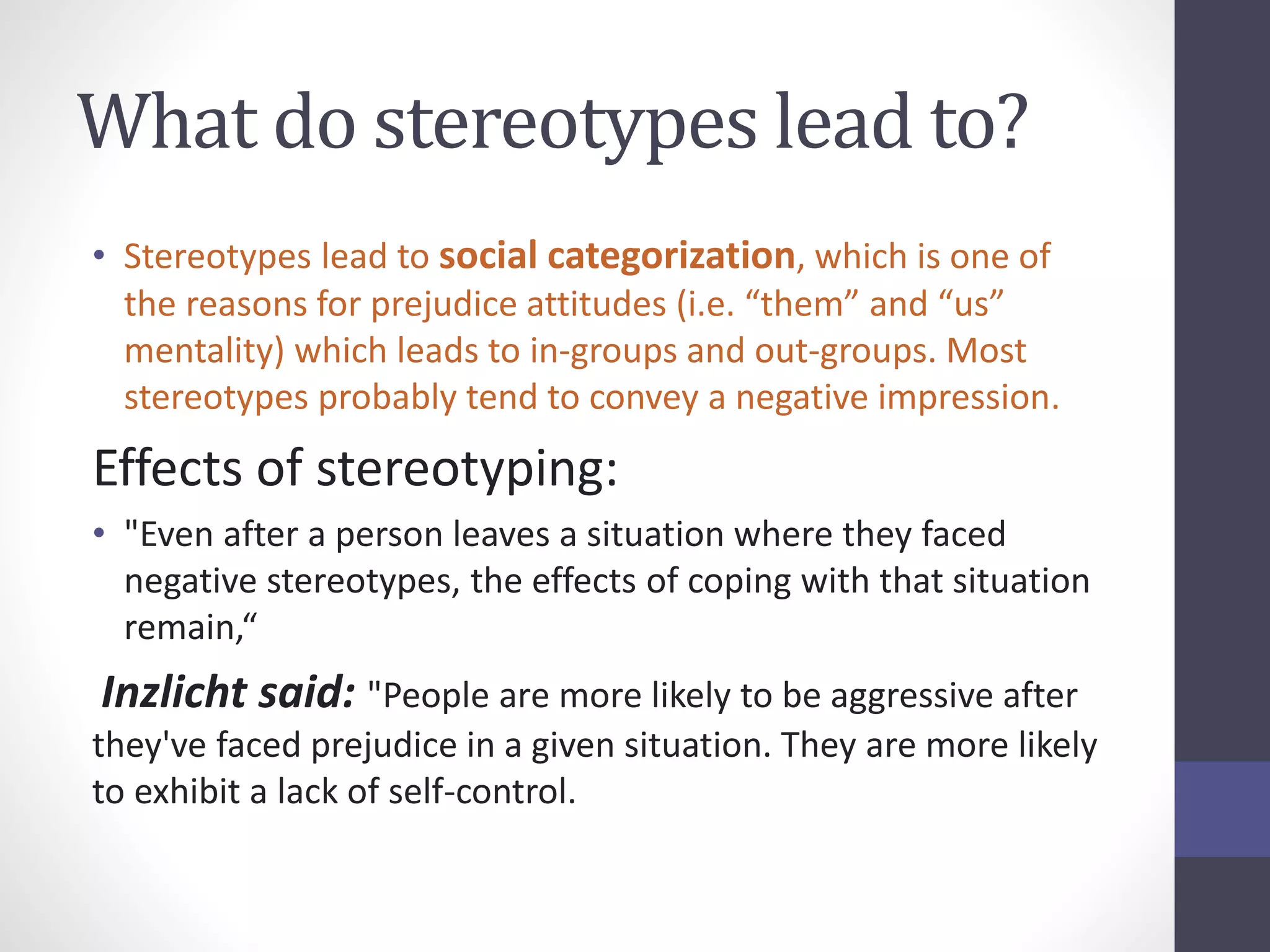
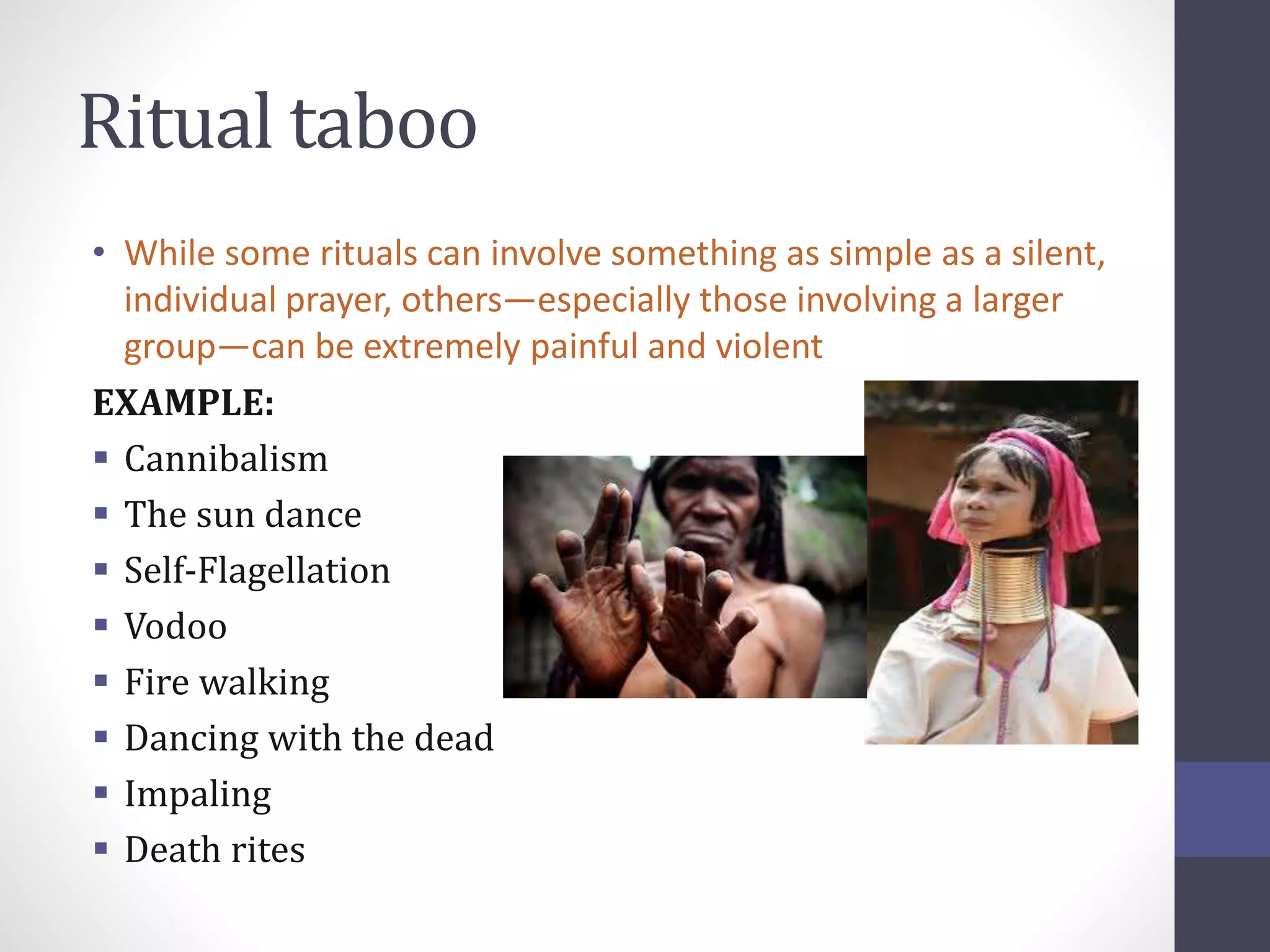
Ritual taboo
• While some rituals can involve something as simple as a silent,
individual prayer, others—especially those involving a larger
group—can be extremely painful and violent
EXAMPLE:
 Cannibalism
 The sun dance
 Self-Flagellation
 Vodoo
 Fire walking
 Dancing with the dead
 Impaling
 Death rites
Cultural taboo
• It is about particular polynesian group of people performing
sacred prohibition which make them untouchable,
unmentionable.
What words are taboo?
There are three groups of bad words:
obscenities, blasphemies, and slurs.
• Obscenities: vulgar words for sexual body parts, sexual
activities, and excrement
Blasphemy: words that religious teachings say are bad
Slurs: words that insult a person's nationality, race or body
appearance
Taboos in Islam
• Food Taboos
Various dietary laws govern what Muslims may eat, which makes
certain foods taboo. Pork is forbidden to Muslims as are foods
containing pork products. Other meats, including beef and chicken, are
also taboo if they are not slaughtered according to Islamic standards,
making them Halal, or permissible for consumption. Foods containing
blood, like black pudding, are also not allowed, along with birds of
prey and animals that consume meat.
• Alcohol
The consumption of alcohol is strictly taboo in Islam and is considered
a "great sin" in the Quran. This ban is believed to be connected to the
requirement for Muslims to pray, while sober, five times a day, leaving
little time to drink and recover from its effects before needing to
worship again. It is also believed that alcohol is banned in Islam by a
higher power due to its ability to have a negative impact on health.
• Depicting the Prophet
Though he has been included in works of art in past centuries,
Muslims usually consider creating depictions of the Prophet
Mohammed taboo. This belief has caused great strife when
Mohammed has been depicted in an unflattering light.
Generally, Islamic scholars believe that Mohammed forbade his
companions to create portraits of him. There is also a fear that if
pictures of Mohammed are made, they may be worshipped and
Muslims are only supposed to worship Allah.
Attitudes
An attitude is:
"a relatively enduring organization of beliefs, feelings, and
behavioral tendencies towards socially significant objects,
groups, events or symbols“
Structure of Attitudes
Attitudes structure can be described in terms of three
components. That is also known as ABC model of attitudes.
oAffective component: this involves a person’s feelings /
emotions about the attitude object.
For example: “I am scared of spiders”.
oBehavioral (or conative) component: the way the attitude we
have influences how we act or behave.
For example: “I will avoid spiders and scream if I see one”.
oCognitive component: this involves a person’s belief /
knowledge about an attitude object.
For example: “I believe spiders are dangerous”.
Functions of attittudes
• Knowledge
Attitudes provide meaning (knowledge) for life. The knowledge
function refers to our need for a world which is consistent and
relatively stable.
This allows us to predict what is likely to happen, and so gives us
a sense of control. Attitudes can help us organize and structure
our experience.
• Self/Ego expressive
The attitudes we express
(1) help communicate who we are and
(2) may make us feel good because we have asserted our
identity. Self-expression of attitudes can be non-verbal too:
think bumper sticker, cap, or T-shirt slogan.
• Adaptive
If a person holds and/or expresses socially acceptable attitudes,
other people will reward them with approval and social
acceptance.
For example, when people flatter their bosses or instructors
(and believe it) or keep silent if they think an attitude is
unpopular
• Ego-Defensive
The ego-defensive function refers to holding attitudes that
protect our self-esteem or that justify actions that make us feel
guilty.
Functions of attitudes
Adjustment Function Ego-Defensive function
Value-Expressive Function
Knowledge function
Functions of Attitudes
Imagine you are very patriotic about being Pakistani. This might
cause you to have an ethnocentric attitude towards everything
not Pakistani.
Imagine further that you are with a group of like-minded
friends. You say:
“Of course, there’s no other country as good as Pakistan to live
in. Other places are alright in their own way, but they can’t
compare with your mother county.”
(There are nods of approval all round. You are fitting in -
adaptive). The people in the group are wearing England football
shirts (This is the self-expression function)
Values
1. Important and lasting beliefs or ideals shared by the members
of a culture about what is good or bad and desirable or
undesirable. Values have major influence on a person's behavior
and attitude and serve as broad guidelines in all situations.
Some common business values are fairness, innovation and
community involvement.
2. The monetary worth of something in areas such as
accounting, economics, marketing or mathematics. See also
value.
How would you describe your
core values?
• Core values are the fundamental beliefs of a person or
organization. These guiding principles dictate behavior and
can help people understand the difference between right and
wrong. Core values also help companies to determine if they
are on the right path and fulfilling their goals by creating an
unwavering guide.
What are the core values of
life?
• Dependability.
• Reliability.
• Loyalty.
• Commitment.
• Open-mindedness.
• Consistency.
• Honesty.
• Efficiency.
Why are values important for
you?
Our values inform our thoughts, words and actions. Our values
are important because they help us to grow and develop. ... The
decisions we make are a reflection of our values and beliefs, and
they are always directed towards a specific purpose.
What do you mean by social
values?
Meaning of Values: In sociology, the meaning of value is
different from meaning of value in economics or philosophy.
Social values form an important part of the culture of the
society. Values account for the stability of social order. They
provide the general guidelines for social conduct.
THANKYOU 

Stereotyping, Taboo, Attitudes & Values

  • 1.
    Stereotyping Taboo Attitudes & Values Wajeeha Riaz160004 Aimen Khalid 160009 Sania Raza 160036 Ammar Abdus Salam 160040 Irshad Ullah 160024
  • 2.
    STEREOTYPING • A stereotypeis an idea or belief many people have about a thing or group that is based upon how they look on the outside, which may be untrue or only partly true • It is one of the negative cultural attitude. • Stereotypes also evolve out of fear of persons from minority groups. • Stereotypes arise as a way of explaining or justifying differences between groups. • Racial remarks, sexual remarks, and gender remarks are the biggest stereotypes
  • 3.
    How and whydo people form stereotypes? • We learn stereotypes from parents (our first and most influential teachers), significant others (e.g., peers), and the media. • Another explanation for how we form stereotypes comes from research in cognitive psychology on the categorization process • They occur as a lack of exposure to other groups, cultures etc • People like to, want to, need to categorize the world into preferably little groups.
  • 4.
    People do sofor 3 reasons • it’s cognitively efficient - once you have categorized you no longer need to consider information about each individual member of the group. You can apply all of the group information to all of its members. Categorization saves processing time. • it satisfies the need to understand and predict the social world. You no longer need to wonder what each individual is like (understand), or what he or she is likely to do (predict). All of this is contained in the stereotype. • it’s a way to feel better about yourself; we thing our groups (ingroups) are better than other groups (outgroups)- the INGROUP FAVORABILITY BIAS
  • 5.
    What do stereotypeslead to? • Stereotypes lead to social categorization, which is one of the reasons for prejudice attitudes (i.e. “them” and “us” mentality) which leads to in-groups and out-groups. Most stereotypes probably tend to convey a negative impression. Effects of stereotyping: • "Even after a person leaves a situation where they faced negative stereotypes, the effects of coping with that situation remain,“ Inzlicht said: "People are more likely to be aggressive after they've faced prejudice in a given situation. They are more likely to exhibit a lack of self-control.
  • 6.
    Implicit Stereotypes • Animplicit stereotype is the unconscious attribution of particular qualities to a member of a certain social group. Implicit stereotypes are influenced by experience, and are based on learned associations between various qualities and social categories, including race or gender. Explicit stereotypes Explicit stereotypes are directly stated or overtly expressed. Someone telling a friend, "asian kids get good grades because they study all the time," would be an example of an explicit stereotype.
  • 7.
    How can weavoid stereotyping Steps to Take to Assess and Eliminate Stereotypes • Respect and appreciate others' differences. ... • Consider what you have common with other people — lots more than you think. • Avoid making assumptions or creating labels. • Develop empathy for the others. ... • Educate yourself about different cultures and groups.
  • 8.
    TABOO “a social orreligious custom prohibiting or restricting a particular practice or forbidding association with a particular person, place, or thing” A taboo is a vehement prohibition of an action based on the belief that such behavior is either too sacred or too accursed for ordinary individuals to undertake, under threat of supernatural punishment.
  • 9.
    Why should wecare • It is usually rooted in moral or cultural beliefs • A social taboo tells people what’s proper behavior and what’s not. • Taboo’s are important because they help us get along. Without these rules and prohibitions we would just be a planet of 7 million individuals doing whatever we wanted.
  • 10.
    Common taboos • Restrictionsor ritual regulations of killing and hunting. • Religious Taboo • Sexual taboo • Ritual taboo • Cultural taboo • Food taboos
  • 11.
    Religious taboo • Areligious taboo is a custom adhered to , by a particular religion that restricts or prohibits a certain action. • It include various taboos regarding dietary restrictions , sociocultural taboos , dress etiquette etc.
  • 12.
    Sexual taboo • Itmeans a kind of sexual behavior that is immoral, un natural or forbidden. • It includes Incest Necrophilia Adultery Fornication Homosexuality Intermarriage Masturbation Bestiality Pedophilia
  • 13.
    Ritual taboo • Whilesome rituals can involve something as simple as a silent, individual prayer, others—especially those involving a larger group—can be extremely painful and violent EXAMPLE:  Cannibalism  The sun dance  Self-Flagellation  Vodoo  Fire walking  Dancing with the dead  Impaling  Death rites
  • 14.
    Cultural taboo • Itis about particular polynesian group of people performing sacred prohibition which make them untouchable, unmentionable.
  • 15.
    What words aretaboo? There are three groups of bad words: obscenities, blasphemies, and slurs. • Obscenities: vulgar words for sexual body parts, sexual activities, and excrement Blasphemy: words that religious teachings say are bad Slurs: words that insult a person's nationality, race or body appearance
  • 16.
    Taboos in Islam •Food Taboos Various dietary laws govern what Muslims may eat, which makes certain foods taboo. Pork is forbidden to Muslims as are foods containing pork products. Other meats, including beef and chicken, are also taboo if they are not slaughtered according to Islamic standards, making them Halal, or permissible for consumption. Foods containing blood, like black pudding, are also not allowed, along with birds of prey and animals that consume meat. • Alcohol The consumption of alcohol is strictly taboo in Islam and is considered a "great sin" in the Quran. This ban is believed to be connected to the requirement for Muslims to pray, while sober, five times a day, leaving little time to drink and recover from its effects before needing to worship again. It is also believed that alcohol is banned in Islam by a higher power due to its ability to have a negative impact on health.
  • 17.
    • Depicting theProphet Though he has been included in works of art in past centuries, Muslims usually consider creating depictions of the Prophet Mohammed taboo. This belief has caused great strife when Mohammed has been depicted in an unflattering light. Generally, Islamic scholars believe that Mohammed forbade his companions to create portraits of him. There is also a fear that if pictures of Mohammed are made, they may be worshipped and Muslims are only supposed to worship Allah.
  • 18.
    Attitudes An attitude is: "arelatively enduring organization of beliefs, feelings, and behavioral tendencies towards socially significant objects, groups, events or symbols“
  • 19.
    Structure of Attitudes Attitudesstructure can be described in terms of three components. That is also known as ABC model of attitudes. oAffective component: this involves a person’s feelings / emotions about the attitude object. For example: “I am scared of spiders”. oBehavioral (or conative) component: the way the attitude we have influences how we act or behave. For example: “I will avoid spiders and scream if I see one”. oCognitive component: this involves a person’s belief / knowledge about an attitude object. For example: “I believe spiders are dangerous”.
  • 20.
    Functions of attittudes •Knowledge Attitudes provide meaning (knowledge) for life. The knowledge function refers to our need for a world which is consistent and relatively stable. This allows us to predict what is likely to happen, and so gives us a sense of control. Attitudes can help us organize and structure our experience. • Self/Ego expressive The attitudes we express (1) help communicate who we are and (2) may make us feel good because we have asserted our identity. Self-expression of attitudes can be non-verbal too: think bumper sticker, cap, or T-shirt slogan.
  • 21.
    • Adaptive If aperson holds and/or expresses socially acceptable attitudes, other people will reward them with approval and social acceptance. For example, when people flatter their bosses or instructors (and believe it) or keep silent if they think an attitude is unpopular • Ego-Defensive The ego-defensive function refers to holding attitudes that protect our self-esteem or that justify actions that make us feel guilty.
  • 22.
    Functions of attitudes AdjustmentFunction Ego-Defensive function Value-Expressive Function Knowledge function Functions of Attitudes
  • 23.
    Imagine you arevery patriotic about being Pakistani. This might cause you to have an ethnocentric attitude towards everything not Pakistani. Imagine further that you are with a group of like-minded friends. You say: “Of course, there’s no other country as good as Pakistan to live in. Other places are alright in their own way, but they can’t compare with your mother county.” (There are nods of approval all round. You are fitting in - adaptive). The people in the group are wearing England football shirts (This is the self-expression function)
  • 24.
    Values 1. Important andlasting beliefs or ideals shared by the members of a culture about what is good or bad and desirable or undesirable. Values have major influence on a person's behavior and attitude and serve as broad guidelines in all situations. Some common business values are fairness, innovation and community involvement. 2. The monetary worth of something in areas such as accounting, economics, marketing or mathematics. See also value.
  • 25.
    How would youdescribe your core values? • Core values are the fundamental beliefs of a person or organization. These guiding principles dictate behavior and can help people understand the difference between right and wrong. Core values also help companies to determine if they are on the right path and fulfilling their goals by creating an unwavering guide.
  • 26.
    What are thecore values of life? • Dependability. • Reliability. • Loyalty. • Commitment. • Open-mindedness. • Consistency. • Honesty. • Efficiency.
  • 27.
    Why are valuesimportant for you? Our values inform our thoughts, words and actions. Our values are important because they help us to grow and develop. ... The decisions we make are a reflection of our values and beliefs, and they are always directed towards a specific purpose.
  • 28.
    What do youmean by social values? Meaning of Values: In sociology, the meaning of value is different from meaning of value in economics or philosophy. Social values form an important part of the culture of the society. Values account for the stability of social order. They provide the general guidelines for social conduct.
  • 29.