LANGUAGE
& Critical Thinking
“Thought is the blossom; language, the
bud; action, the fruit behind it.
-Ralph Waldo Emerson
LANGUAGE…
➤ Meanings are assigned to
words arbitrarily, and the
meaning of words in our
language can change as social
groups within the society use
them for their own purposes.
➤ An effective critical thinker
uses language that meets the
needs and expectations of the
audience, and is appropriate to
the time, place, person, and
occasion.
There are four areas of language that are important when it
comes to critical thinking.
➤ Word choice
➤ Ambiguity
➤ Definition
➤ Intensity
WORD CHOICE
➤ The meaning of words does not simply rest in the words
themselves but in the minds of the people who use and
receive them.
➤ Language is one of the most powerful agents of enculturation,
and therefore we must choose our words very carefully.
➤ Understanding is heavily related to vocabulary.
➤ Good word choice involved being able to look critically at
language and select the words that most accurately convey the
message.
AMBIGUITY
➤ When we argue, we use
language that we assume the
recipients can understand.
Arguers selecting
ambiguous language run the
risk of being misunderstood
and face rejection of their
advocated point of view.
➤ Euphemism: a less direct
term used in the place of a
more specific term which
may be considered offensive
AMBIGUITY
➤ Ambiguous language can cause confusion.
➤ Ambiguous language can lead to over-generalizing and
stereotyping. The greater the ambiguity, the more likely one is
to ignore individual differences and classify all members of
the group as being the same.
➤ Ambiguous language can lead to bypassing, which is when
people unintentionally use the same word to mean different
things or use different words to represent the same thing.
With ambiguous language, there is no real way of checking
the accuracy of the term against the actual event it is being
used to describe.
DEFINITION
➤ One way to avoid the problems caused by ambiguity is to
define your terms.
➤ Words convey two different meanings: denotative and
connotative.
➤ Denotative meaning: the way a word is generally used or the
meaning that people most frequently attach to a word
➤ Connotative meaning: the way a person emotionally
responds to a word
OTHER WAYS TO DEFINE WORDS
➤ Dictionary definition: formal definition
➤ Operational definition: definition by function or operation
➤ Definition by example: definition by citing specific instances
of a word or phrase
➤ Definition by negation: definition by telling what a word or
phrase is not
➤ Definition by etymology: definition by citing a word's
historical roots or point of origination
➤ Special definitions: use of slang or colloquialisms related to
modern English
INTENSITY
➤ The intensity level of one's language refers to the use of words
or phrases that often negatively raise the emotional level or
any communication encounter.
➤ Negative evaluative words: words that can only be
understood through a comparison with their opposite
➤ Strong emotive words: words which are used to describe
something, but really present the person's attitude toward
what is being described; goal is to get an emotional response
➤ Abusive language: use of obscenity, name calling, insults,
swear words, and off-color remarks that are usually of a racial
or sexual nature; usually for shock value
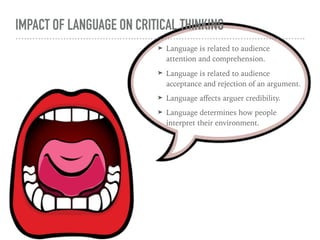
IMPACT OF LANGUAGE ON CRITICAL THINKING
➤ Language is related to audience
attention and comprehension.
➤ Language is related to audience
acceptance and rejection of an argument.
➤ Language affects arguer credibility.
➤ Language determines how people
interpret their environment.

Language in Critical Thinking

  • 1.
  • 2.
    “Thought is theblossom; language, the bud; action, the fruit behind it. -Ralph Waldo Emerson
  • 3.
    LANGUAGE… ➤ Meanings areassigned to words arbitrarily, and the meaning of words in our language can change as social groups within the society use them for their own purposes. ➤ An effective critical thinker uses language that meets the needs and expectations of the audience, and is appropriate to the time, place, person, and occasion.
  • 4.
    There are fourareas of language that are important when it comes to critical thinking. ➤ Word choice ➤ Ambiguity ➤ Definition ➤ Intensity
  • 5.
    WORD CHOICE ➤ Themeaning of words does not simply rest in the words themselves but in the minds of the people who use and receive them. ➤ Language is one of the most powerful agents of enculturation, and therefore we must choose our words very carefully. ➤ Understanding is heavily related to vocabulary. ➤ Good word choice involved being able to look critically at language and select the words that most accurately convey the message.
  • 6.
    AMBIGUITY ➤ When weargue, we use language that we assume the recipients can understand. Arguers selecting ambiguous language run the risk of being misunderstood and face rejection of their advocated point of view. ➤ Euphemism: a less direct term used in the place of a more specific term which may be considered offensive
  • 7.
    AMBIGUITY ➤ Ambiguous languagecan cause confusion. ➤ Ambiguous language can lead to over-generalizing and stereotyping. The greater the ambiguity, the more likely one is to ignore individual differences and classify all members of the group as being the same. ➤ Ambiguous language can lead to bypassing, which is when people unintentionally use the same word to mean different things or use different words to represent the same thing. With ambiguous language, there is no real way of checking the accuracy of the term against the actual event it is being used to describe.
  • 8.
    DEFINITION ➤ One wayto avoid the problems caused by ambiguity is to define your terms. ➤ Words convey two different meanings: denotative and connotative. ➤ Denotative meaning: the way a word is generally used or the meaning that people most frequently attach to a word ➤ Connotative meaning: the way a person emotionally responds to a word
  • 9.
    OTHER WAYS TODEFINE WORDS ➤ Dictionary definition: formal definition ➤ Operational definition: definition by function or operation ➤ Definition by example: definition by citing specific instances of a word or phrase ➤ Definition by negation: definition by telling what a word or phrase is not ➤ Definition by etymology: definition by citing a word's historical roots or point of origination ➤ Special definitions: use of slang or colloquialisms related to modern English
  • 10.
    INTENSITY ➤ The intensitylevel of one's language refers to the use of words or phrases that often negatively raise the emotional level or any communication encounter. ➤ Negative evaluative words: words that can only be understood through a comparison with their opposite ➤ Strong emotive words: words which are used to describe something, but really present the person's attitude toward what is being described; goal is to get an emotional response ➤ Abusive language: use of obscenity, name calling, insults, swear words, and off-color remarks that are usually of a racial or sexual nature; usually for shock value
  • 11.
    IMPACT OF LANGUAGEON CRITICAL THINKING ➤ Language is related to audience attention and comprehension. ➤ Language is related to audience acceptance and rejection of an argument. ➤ Language affects arguer credibility. ➤ Language determines how people interpret their environment.