LANGUAGE AND CRITICAL THINKING  BY: ANNA KLEYMAN
FOUR AREAS OF LANGUAGE USE ARE IMPORTANT TO CRITICAL THINKING Word Choice Ambiguity  Definition Intensity
WORD CHOICE The English language contains 500,000 usable words . 500 most common words have a combined total of more than 14,000 different meanings.  The Whorf-Sapir hypothesis maintains that the words of a particular language help to determine the way that people interpret events that occur.  The hypothesis theorizes that thoughts and behavior are determined/influenced by language.  Word choice allows us to indirectly express our real feelings.  Words affect the way an audience reacts to an argument
AMBIGUITY Ambiguous language runs the risk of being misunderstood. Ambiguous means a word or phrase has more than one meaning. Euphemism is a less direct term, used in place of a more specific term which can be considered offensive.  Euphemisms are used to clean up one’s language and should be used sparingly.  Euphemisms can increase the ambiguity level. Doublespeak = makes the bad seem goo, the negative appear positive, unpleasant appears attractive. It conceals or prevents thought.
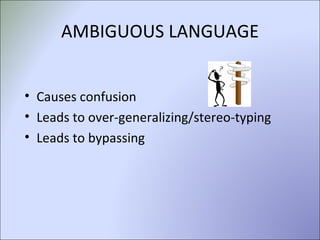
AMBIGUOUS LANGUAGE Causes confusion Leads to over-generalizing/stereo-typing Leads to bypassing
DEFINITION The primary function of a definition is to get the sender and receiver on the same semantic wavelength in order to avoid unnecessary semantic hurdles that prevent a discussion of more important issues.  Used to indicate the sense in which you use a familiar term.
MEANINGS Denotative meaning = refers to the way a word is generally used.  Connotative meaning= refers to the way a person emotionally responds to it. This is an important part of human communication.
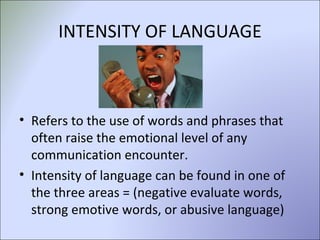
INTENSITY OF LANGUAGE Refers to the use of words and phrases that often raise the emotional level of any communication encounter.  Intensity of language can be found in one of the three areas = (negative evaluate words, strong emotive words, or abusive language)
IMPACT OF LANGUAGE ON CRITICAL THINKING Language is related to audience attention and comprehension Language is related to audience acceptance and rejection of an argument. Language affects arguer credibility. Language determines how people interpret their environment.
CONCLUSION Language choice must be matched with time, place, person and occasion for which the language is intended.  Using correct language can enhance credibility and claim adherence. Using incorrect, can damage credibility and lead to rejection of the position being advanced.

Language and Critical Thinking

  • 1.
    LANGUAGE AND CRITICALTHINKING BY: ANNA KLEYMAN
  • 2.
    FOUR AREAS OFLANGUAGE USE ARE IMPORTANT TO CRITICAL THINKING Word Choice Ambiguity Definition Intensity
  • 3.
    WORD CHOICE TheEnglish language contains 500,000 usable words . 500 most common words have a combined total of more than 14,000 different meanings. The Whorf-Sapir hypothesis maintains that the words of a particular language help to determine the way that people interpret events that occur. The hypothesis theorizes that thoughts and behavior are determined/influenced by language. Word choice allows us to indirectly express our real feelings. Words affect the way an audience reacts to an argument
  • 4.
    AMBIGUITY Ambiguous languageruns the risk of being misunderstood. Ambiguous means a word or phrase has more than one meaning. Euphemism is a less direct term, used in place of a more specific term which can be considered offensive. Euphemisms are used to clean up one’s language and should be used sparingly. Euphemisms can increase the ambiguity level. Doublespeak = makes the bad seem goo, the negative appear positive, unpleasant appears attractive. It conceals or prevents thought.
  • 5.
    AMBIGUOUS LANGUAGE Causesconfusion Leads to over-generalizing/stereo-typing Leads to bypassing
  • 6.
    DEFINITION The primaryfunction of a definition is to get the sender and receiver on the same semantic wavelength in order to avoid unnecessary semantic hurdles that prevent a discussion of more important issues. Used to indicate the sense in which you use a familiar term.
  • 7.
    MEANINGS Denotative meaning= refers to the way a word is generally used. Connotative meaning= refers to the way a person emotionally responds to it. This is an important part of human communication.
  • 8.
    INTENSITY OF LANGUAGERefers to the use of words and phrases that often raise the emotional level of any communication encounter. Intensity of language can be found in one of the three areas = (negative evaluate words, strong emotive words, or abusive language)
  • 9.
    IMPACT OF LANGUAGEON CRITICAL THINKING Language is related to audience attention and comprehension Language is related to audience acceptance and rejection of an argument. Language affects arguer credibility. Language determines how people interpret their environment.
  • 10.
    CONCLUSION Language choicemust be matched with time, place, person and occasion for which the language is intended. Using correct language can enhance credibility and claim adherence. Using incorrect, can damage credibility and lead to rejection of the position being advanced.