c
1
INTRODUCTION
 A landslide is a downward or outward movement of soil, rock
or vegetation, under the influence of gravity.
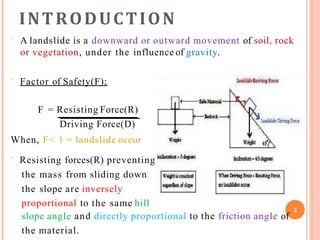
 Factor of Safety(F);
F = Resisting Force(R)
Driving Force(D)
When, F< 1 = landslide occur
 Resisting forces(R) preventing
the mass from sliding down
the slope are inversely
proportional to the same hill
slope angle and directly proportional to the friction angle of
the material.
2
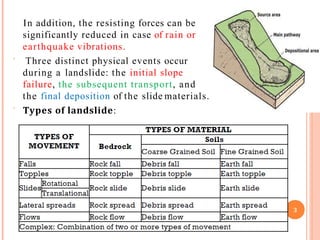
In addition, the resisting forces can be
significantly reduced in case of rain or
earthquake vibrations.
 Three distinct physical events occur
during a landslide: the initial slope
failure, the subsequent transport, and
the final deposition of the slide materials.
 Types of landslide:
3
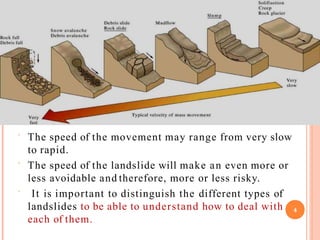
 The speed of the movement may range from very slow
to rapid.
 The speed of the landslide will make an even more or
less avoidable and therefore, more or less risky.
 It is important to distinguish the different types of
landslides to be able to understand how to deal with
each of them.
4
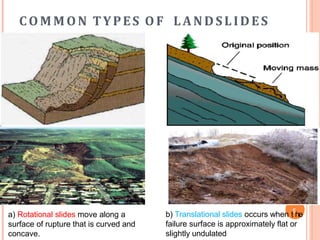
COMMON TYPES O F LANDSLIDES
a) Rotational slides move along a
surface of rupture that is curved and
concave.
b) Translational slides occurs when t
5
he
failure surface is approximately flat or
slightly undulated
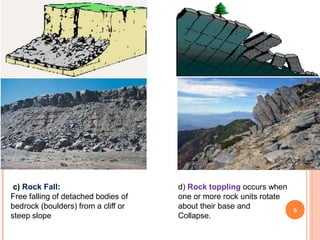
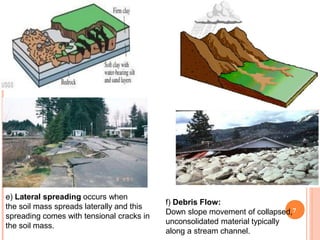
c) Rock Fall:
Free falling of detached bodies of
bedrock (boulders) from a cliff or
steep slope
d) Rock toppling occurs when
one or more rock units rotate
about their base and
Collapse.
6
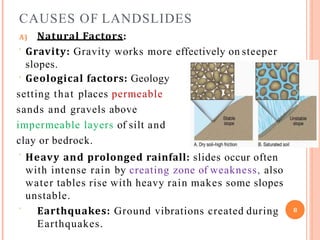
e) Lateral spreading occurs when
the soil mass spreads laterally and this
spreading comes with tensional cracks in
the soil mass.
f) Debris Flow:
Down slope movement of collapsed,7
unconsolidated material typically
along a stream channel.
CAUSES OF LANDSLIDES
A) Natural Factors:



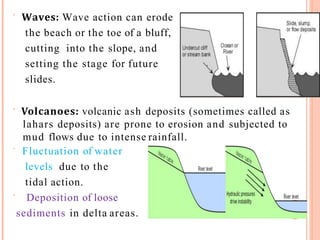
Gravity: Gravity works more effectively on steeper
slopes.
Geological factors: Geology
setting that places permeable
sands and gravels above
impermeable layers of silt and
clay or bedrock.
Heavy and prolonged rainfall: slides occur often
with intense rain by creating zone of weakness, also
water tables rise with heavy rain makes some slopes
unstable.
 Earthquakes: Ground vibrations created during
Earthquakes.
8
 Waves: Wave action can erode
the beach or the toe of a bluff,
cutting into the slope, and
setting the stage for future
slides.
 Volcanoes: volcanic ash deposits (sometimes called as
lahars deposits) are prone to erosion and subjected to
mud flows due to intense rainfall.
 Fluctuation of water
levels due to the
tidal action.
 Deposition of loose
sediments in delta areas. 9
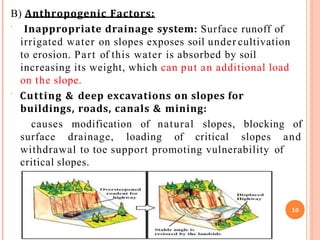
B) Anthropogenic Factors:
 Inappropriate drainage system: Surface runoff of
irrigated water on slopes exposes soil under cultivation
to erosion. Part of this water is absorbed by soil
increasing its weight, which can put an additional load
on the slope.
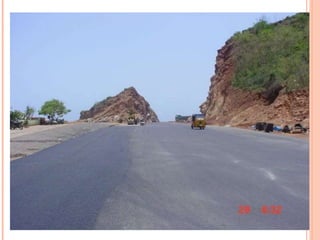
 Cutting & deep excavations on slopes for
buildings, roads, canals & mining:
causes modification of natural slopes, blocking of
surface drainage, loading of critical slopes and
withdrawal to toe support promoting vulnerability of
critical slopes.
10
11
 Change in slope/land use pattern, deforestation,
agricultural practices on steep slopes:
contributed to creep and withdrawal of toe support in
many cases.
C) Combination of factors:
 For example, an earthquake may trigger a landslide,
which in turn may dam a valley causing upstream
flooding and subsequent dam burst. This will lead to
flooding in lower catchments areas.
12
IMPACTS AND LOSSES DUE
TO LANDSLIDES
A) Direct impacts:
 Physical Damage-Debris may block roads, supply lines
(telecommunication, electricity, water, etc.) and
waterways.
 Causalities- deaths and injuries to people and
animals.
B) Indirect impacts:
 Influence of landslides in dam safety- failure of
the slopes bordering the reservoir, Flooding caused by
movements of large masses of soil into the reservoir.
13
 Landslides and flooding- Debris flow can cause
flooding by blocking valleys and stream channels,
forcing large amounts of water to backup causing
backup/ flash flood.
C) Direct losses:
 Loss of life, property, infrastructure and lifeline
facilities, Resources, farmland and places ofcultural
importance.
D) Indirect losses:
 Loss in productivity of agricultural or forest lands,
Reduced property values, Loss of revenue, Increased
cost, Adverse effect on water quality and Loss of
human productivity, 14
INDICATORS OF LANDSLIDES
PHENOMENON
A) Terrain/Morphologic Features Indicating Risk
of a Landslide-
 Steep slopes: slope with angles over 30 degrees
should be avoided if possible.
 Old landslides sites: the old landslide can be
reactivated, for example, by heavy rainfall or an
earthquake.
 New cracks or unusual bulges in the ground or street
pavements.
15
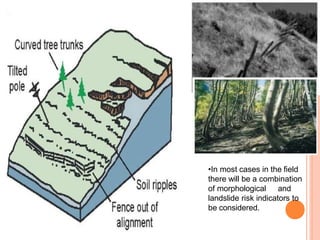
B) Landslide Risk Indicators:
 Tilting or cracking of concrete floors and foundations.



Soil moving away from foundations.
Broken water lines and other underground utilities.
Leaning telephone poles, trees, retaining walls, or
fences.
 Rapid increase in ground water levels, possibly
accompanied by increased turbidity (soil content).
 Sticking doors and windows, and visible open spaces
indicating jambs.
 Sudden decrease in ground water levels though rain
is still falling or just recently stopped.
16
•In most cases in the field
there will be a combination
of morphological and
landslide risk indicators to
be considered.
H AZARDS
A) Passive Intervention



Choose a safe location to build your home, away from
steep slopes and places where landslides have occurred
in the past.
Prevent deforestation and vegetation removal.
Avoid weakening the slope.
B) Active Preventive Intervention
 Reforestation: Root systems bind materials together
and plants do both prevent water percolation and take
water up out of the slope.


Proper water runoff must be ensured by providinga
proper canalization network.
Drainage: good ground drainage is essential to preven18t
saturation and consequent weakening. Drainage is also
needed in civil work, like retaining walls.
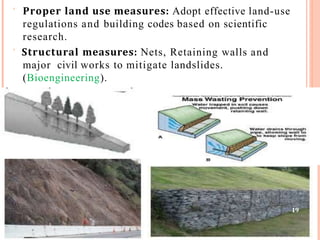
 Proper land use measures: Adopt effective land-use
regulations and building codes based on scientific
research.
 Structural measures: Nets, Retaining walls and
major civil works to mitigate landslides.
(Bioengineering).
19
C) Non- Structural measures:
 Awareness generation: Educate the public about
signs that a landslide is imminent so that personal
safety measures may be taken.
 Financial Mechanisms: Support the establishment
of landslide insurance.
 Legal and Policy: legislation to direct a
governmental or private program to reduce landslide
losses should be strengthened.
D) Landslide Hazard Mapping and Use of GIS:
 Landslide Hazard Zonation of the Vulnerable Areas.
 Use of remote sensing and ground truth data for
making landslide hazard zone map.
 Here, such maps are used to develop mitigation plans
in consultation with experts.
LANDSLIDE PREPAREDNESS AND SAFETY
MEASURES
A) Before a landslide:



Find out if landslides have happened in your area in
the past.
Look out for landslide warning signs like doors or
windows jammed for the first time, new cracks appear
in walls, bricks, foundations, retaining walls, tilt of
utility poles or trees.
Consider relocation in case your house is located in an
area particularly vulnerable to landslides. While doing
so, remember:
i) Do not build on or at the base of unstable slopes, on or
at the base of minor drainage hollows, at the base or 21
on top of an old fill slope, at the base or top of a steep
cut slope.
ii) Do not cut down trees or remove vegetation or avoid
slope weakening.
iii) If the house cannot be relocated, then ensure proper
drainage and proper retaining walls.
 Always stay alert and awake!!! Listen to
radio/television for warnings of intense rainfall, storm
and damp weather. These usually trigger
landslides/debris or mudflow.
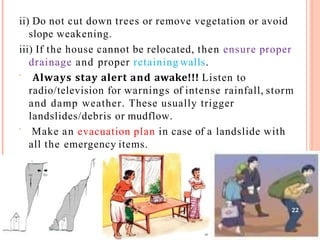
 Make an evacuation plan in case of a landslide with
all the emergency items.
22
B) During a landslide:
 Listen to any unusual sounds that
might indicate moving debris, such
as trees cracking or boulders knocking
together. A trickle of flowing or falling
mud or debris may precede larger flows.
 While you are outdoors during a landslide
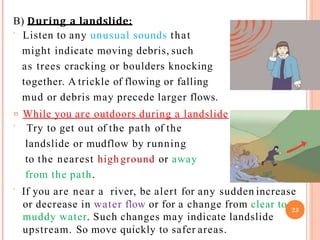
 Try to get out of the path of the
landslide or mudflow by running
to the nearest high ground or away
from the path.
 If you are near a river, be alert for any sudden increase
or decrease in water flow or for a change from clear to
muddy water. Such changes may indicate landslide
upstream. So move quickly to safer areas.
23
 If the rocks and other debris are approaching, run to
the nearest shelter such as group of trees or a building.
 While you are indoors during a landslide
 Stay inside and remain alert. Listen to radio/ television
for any update. i.e. if landslide occurs outside.
 If your house falls apart due to landslide and if there is
no escape, hold on to something strong and protect your
head.
C) After a landslide:
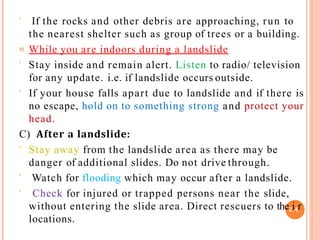
 Stay away from the landslide area as there may be
danger of additional slides. Do not drive through.
 Watch for flooding which may occur after a landslide.
 Check for injured or trapped persons near the slide,
without entering the slide area. Direct rescuers to the2i4r
locations.
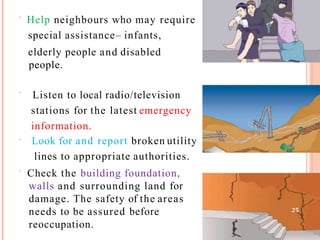
 Help neighbours who may require
special assistance– infants,
elderly people and disabled
people.
 Listen to local radio/television
stations for the latest emergency
information.
 Look for and report broken utility
lines to appropriate authorities.
 Check the building foundation,
walls and surrounding land for
damage. The safety of the areas
needs to be assured before
reoccupation.
25
REFERENCES
Landslide Hazard Manual
( www.engineering4theworld.org/LAP)
Learning to live with landslides, Ministry of
Education and National Institute of Education
Education for Social Cohesion, Disaster Risk
Management and Psycho-social Care.
Landslides Preparedness and Safety Measures,
Department of Disaster Management.
Action Plan for Landslide Risk Mitigation,
Ministry of Home Affairs , Office Memorandum,
November 3, 2004, India.
26
28
Submitted to:
Dr . C. SEENAPPA
Associate professor
Dept. of Agronomy

Landslides Basavaraddi

  • 2.
  • 3.
    INTRODUCTION  A landslideis a downward or outward movement of soil, rock or vegetation, under the influence of gravity.  Factor of Safety(F); F = Resisting Force(R) Driving Force(D) When, F< 1 = landslide occur  Resisting forces(R) preventing the mass from sliding down the slope are inversely proportional to the same hill slope angle and directly proportional to the friction angle of the material. 2
  • 4.
    In addition, theresisting forces can be significantly reduced in case of rain or earthquake vibrations.  Three distinct physical events occur during a landslide: the initial slope failure, the subsequent transport, and the final deposition of the slide materials.  Types of landslide: 3
  • 5.
     The speedof the movement may range from very slow to rapid.  The speed of the landslide will make an even more or less avoidable and therefore, more or less risky.  It is important to distinguish the different types of landslides to be able to understand how to deal with each of them. 4
  • 6.
    COMMON TYPES OF LANDSLIDES a) Rotational slides move along a surface of rupture that is curved and concave. b) Translational slides occurs when t 5 he failure surface is approximately flat or slightly undulated
  • 7.
    c) Rock Fall: Freefalling of detached bodies of bedrock (boulders) from a cliff or steep slope d) Rock toppling occurs when one or more rock units rotate about their base and Collapse. 6
  • 8.
    e) Lateral spreadingoccurs when the soil mass spreads laterally and this spreading comes with tensional cracks in the soil mass. f) Debris Flow: Down slope movement of collapsed,7 unconsolidated material typically along a stream channel.
  • 9.
    CAUSES OF LANDSLIDES A)Natural Factors:    Gravity: Gravity works more effectively on steeper slopes. Geological factors: Geology setting that places permeable sands and gravels above impermeable layers of silt and clay or bedrock. Heavy and prolonged rainfall: slides occur often with intense rain by creating zone of weakness, also water tables rise with heavy rain makes some slopes unstable.  Earthquakes: Ground vibrations created during Earthquakes. 8
  • 10.
     Waves: Waveaction can erode the beach or the toe of a bluff, cutting into the slope, and setting the stage for future slides.  Volcanoes: volcanic ash deposits (sometimes called as lahars deposits) are prone to erosion and subjected to mud flows due to intense rainfall.  Fluctuation of water levels due to the tidal action.  Deposition of loose sediments in delta areas. 9
  • 11.
    B) Anthropogenic Factors: Inappropriate drainage system: Surface runoff of irrigated water on slopes exposes soil under cultivation to erosion. Part of this water is absorbed by soil increasing its weight, which can put an additional load on the slope.  Cutting & deep excavations on slopes for buildings, roads, canals & mining: causes modification of natural slopes, blocking of surface drainage, loading of critical slopes and withdrawal to toe support promoting vulnerability of critical slopes. 10
  • 12.
  • 13.
     Change inslope/land use pattern, deforestation, agricultural practices on steep slopes: contributed to creep and withdrawal of toe support in many cases. C) Combination of factors:  For example, an earthquake may trigger a landslide, which in turn may dam a valley causing upstream flooding and subsequent dam burst. This will lead to flooding in lower catchments areas. 12
  • 14.
    IMPACTS AND LOSSESDUE TO LANDSLIDES A) Direct impacts:  Physical Damage-Debris may block roads, supply lines (telecommunication, electricity, water, etc.) and waterways.  Causalities- deaths and injuries to people and animals. B) Indirect impacts:  Influence of landslides in dam safety- failure of the slopes bordering the reservoir, Flooding caused by movements of large masses of soil into the reservoir. 13
  • 15.
     Landslides andflooding- Debris flow can cause flooding by blocking valleys and stream channels, forcing large amounts of water to backup causing backup/ flash flood. C) Direct losses:  Loss of life, property, infrastructure and lifeline facilities, Resources, farmland and places ofcultural importance. D) Indirect losses:  Loss in productivity of agricultural or forest lands, Reduced property values, Loss of revenue, Increased cost, Adverse effect on water quality and Loss of human productivity, 14
  • 16.
    INDICATORS OF LANDSLIDES PHENOMENON A)Terrain/Morphologic Features Indicating Risk of a Landslide-  Steep slopes: slope with angles over 30 degrees should be avoided if possible.  Old landslides sites: the old landslide can be reactivated, for example, by heavy rainfall or an earthquake.  New cracks or unusual bulges in the ground or street pavements. 15
  • 17.
    B) Landslide RiskIndicators:  Tilting or cracking of concrete floors and foundations.    Soil moving away from foundations. Broken water lines and other underground utilities. Leaning telephone poles, trees, retaining walls, or fences.  Rapid increase in ground water levels, possibly accompanied by increased turbidity (soil content).  Sticking doors and windows, and visible open spaces indicating jambs.  Sudden decrease in ground water levels though rain is still falling or just recently stopped. 16
  • 18.
    •In most casesin the field there will be a combination of morphological and landslide risk indicators to be considered.
  • 19.
    H AZARDS A) PassiveIntervention    Choose a safe location to build your home, away from steep slopes and places where landslides have occurred in the past. Prevent deforestation and vegetation removal. Avoid weakening the slope. B) Active Preventive Intervention  Reforestation: Root systems bind materials together and plants do both prevent water percolation and take water up out of the slope.   Proper water runoff must be ensured by providinga proper canalization network. Drainage: good ground drainage is essential to preven18t saturation and consequent weakening. Drainage is also needed in civil work, like retaining walls.
  • 20.
     Proper landuse measures: Adopt effective land-use regulations and building codes based on scientific research.  Structural measures: Nets, Retaining walls and major civil works to mitigate landslides. (Bioengineering). 19
  • 21.
    C) Non- Structuralmeasures:  Awareness generation: Educate the public about signs that a landslide is imminent so that personal safety measures may be taken.  Financial Mechanisms: Support the establishment of landslide insurance.  Legal and Policy: legislation to direct a governmental or private program to reduce landslide losses should be strengthened. D) Landslide Hazard Mapping and Use of GIS:  Landslide Hazard Zonation of the Vulnerable Areas.  Use of remote sensing and ground truth data for making landslide hazard zone map.  Here, such maps are used to develop mitigation plans in consultation with experts.
  • 22.
    LANDSLIDE PREPAREDNESS ANDSAFETY MEASURES A) Before a landslide:    Find out if landslides have happened in your area in the past. Look out for landslide warning signs like doors or windows jammed for the first time, new cracks appear in walls, bricks, foundations, retaining walls, tilt of utility poles or trees. Consider relocation in case your house is located in an area particularly vulnerable to landslides. While doing so, remember: i) Do not build on or at the base of unstable slopes, on or at the base of minor drainage hollows, at the base or 21 on top of an old fill slope, at the base or top of a steep cut slope.
  • 23.
    ii) Do notcut down trees or remove vegetation or avoid slope weakening. iii) If the house cannot be relocated, then ensure proper drainage and proper retaining walls.  Always stay alert and awake!!! Listen to radio/television for warnings of intense rainfall, storm and damp weather. These usually trigger landslides/debris or mudflow.  Make an evacuation plan in case of a landslide with all the emergency items. 22
  • 24.
    B) During alandslide:  Listen to any unusual sounds that might indicate moving debris, such as trees cracking or boulders knocking together. A trickle of flowing or falling mud or debris may precede larger flows.  While you are outdoors during a landslide  Try to get out of the path of the landslide or mudflow by running to the nearest high ground or away from the path.  If you are near a river, be alert for any sudden increase or decrease in water flow or for a change from clear to muddy water. Such changes may indicate landslide upstream. So move quickly to safer areas. 23
  • 25.
     If therocks and other debris are approaching, run to the nearest shelter such as group of trees or a building.  While you are indoors during a landslide  Stay inside and remain alert. Listen to radio/ television for any update. i.e. if landslide occurs outside.  If your house falls apart due to landslide and if there is no escape, hold on to something strong and protect your head. C) After a landslide:  Stay away from the landslide area as there may be danger of additional slides. Do not drive through.  Watch for flooding which may occur after a landslide.  Check for injured or trapped persons near the slide, without entering the slide area. Direct rescuers to the2i4r locations.
  • 26.
     Help neighbourswho may require special assistance– infants, elderly people and disabled people.  Listen to local radio/television stations for the latest emergency information.  Look for and report broken utility lines to appropriate authorities.  Check the building foundation, walls and surrounding land for damage. The safety of the areas needs to be assured before reoccupation. 25
  • 27.
    REFERENCES Landslide Hazard Manual (www.engineering4theworld.org/LAP) Learning to live with landslides, Ministry of Education and National Institute of Education Education for Social Cohesion, Disaster Risk Management and Psycho-social Care. Landslides Preparedness and Safety Measures, Department of Disaster Management. Action Plan for Landslide Risk Mitigation, Ministry of Home Affairs , Office Memorandum, November 3, 2004, India. 26
  • 28.
    28 Submitted to: Dr .C. SEENAPPA Associate professor Dept. of Agronomy