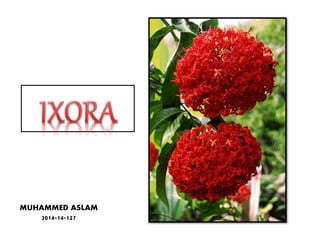
MUHAMMED ASLAM
2014-14-127
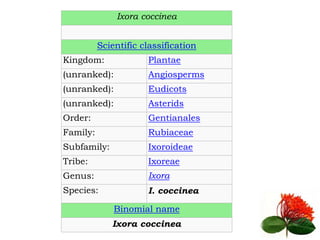
Ixora coccinea
Scientific classification
Kingdom: Plantae
(unranked): Angiosperms
(unranked): Eudicots
(unranked): Asterids
Order: Gentianales
Family: Rubiaceae
Subfamily: Ixoroideae
Tribe: Ixoreae
Genus: Ixora
Species: I. coccinea
Binomial name
Ixora coccinea
Ixora coccinea commonly known as jungle of
geranium and red ixora, is an evergreen shrub
found throughout India.
Native to Southern India and Sri Lanka
 Widely cultivated in Indonesia, Malaysia, the
Philippines, Vietnam, Cambodia, Laos and
Thailand.
It has become one of the most popular flowering
shrubs in Indian gardens and landscapes.
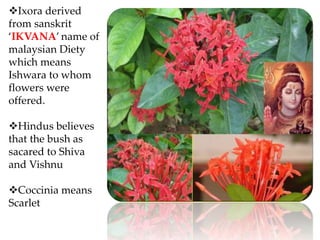
Ixora derived
from sanskrit
‘IKVANA’ name of
malaysian Diety
which means
Ishwara to whom
flowers were
offered.
Hindus believes
that the bush as
sacared to Shiva
and Vishnu
Coccinia means
Scarlet
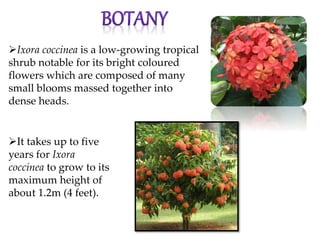
Ixora coccinea is a low-growing tropical
shrub notable for its bright coloured
flowers which are composed of many
small blooms massed together into
dense heads.
It takes up to five
years for Ixora
coccinea to grow to its
maximum height of
about 1.2m (4 feet).
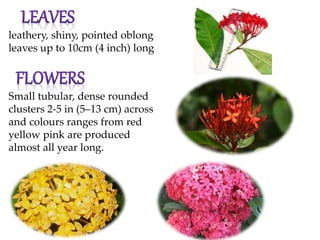
leathery, shiny, pointed oblong
leaves up to 10cm (4 inch) long
Small tubular, dense rounded
clusters 2-5 in (5–13 cm) across
and colours ranges from red
yellow pink are produced
almost all year long.
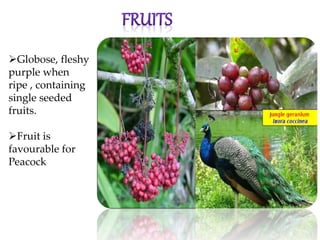
Globose, fleshy
purple when
ripe , containing
single seeded
fruits.
Fruit is
favourable for
Peacock
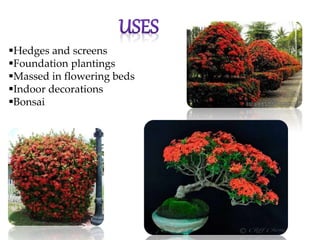
Hedges and screens
Foundation plantings
Massed in flowering beds
Indoor decorations
Bonsai
The flowers, leaves, roots, and the stem are used to treat various
ailments in the Indian traditional system of medicine, the Ayurveda, and
also in various folk medicines.
The fruits, when fully ripe, are used as a dietary source.
Plant possesses
Antioxidative,Antibacterial,Gastroprotective,HepatoprotectiveAntidiarrh
oeal, Antimutagenic,Antineoplastic Chemopreventive effects
Roots are used for stomach troubles and
dysentry
Treatment for blood shot eyes, sores and
ulcers
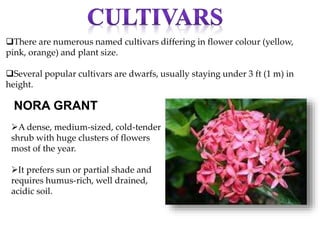
A dense, medium-sized, cold-tender
shrub with huge clusters of flowers
most of the year.
It prefers sun or partial shade and
requires humus-rich, well drained,
acidic soil.
NORA GRANT
There are numerous named cultivars differing in flower colour (yellow,
pink, orange) and plant size.
Several popular cultivars are dwarfs, usually staying under 3 ft (1 m) in
height.
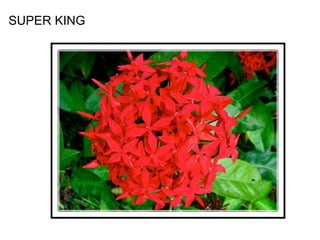
SUPER KING
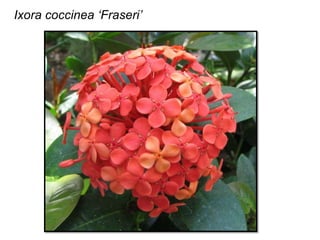
Ixora coccinea ‘Fraseri’
Light
Ixora coccinea must have at least four hours a day of direct sunlight
Tolerates some shade
Temperature
Warmth is essential.
These plants cannot tolerate temperatures below 15°C (59°F).
Water
Keep soil continuously moist, but reduce watering in the winter.
Very high humidity is preferred.
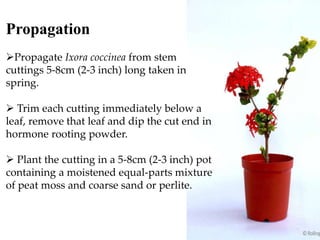
Propagation
Propagate Ixora coccinea from stem
cuttings 5-8cm (2-3 inch) long taken in
spring.
 Trim each cutting immediately below a
leaf, remove that leaf and dip the cut end in
hormone rooting powder.
 Plant the cutting in a 5-8cm (2-3 inch) pot
containing a moistened equal-parts mixture
of peat moss and coarse sand or perlite.
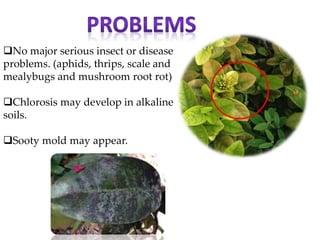
No major serious insect or disease
problems. (aphids, thrips, scale and
mealybugs and mushroom root rot)
Chlorosis may develop in alkaline
soils.
Sooty mold may appear.
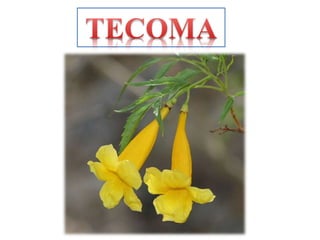
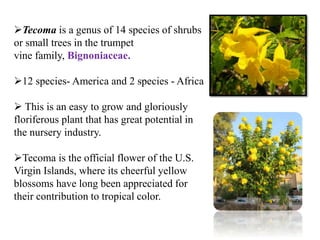
Tecoma is a genus of 14 species of shrubs
or small trees in the trumpet
vine family, Bignoniaceae.
12 species- America and 2 species - Africa
 This is an easy to grow and gloriously
floriferous plant that has great potential in
the nursery industry.
Tecoma is the official flower of the U.S.
Virgin Islands, where its cheerful yellow
blossoms have long been appreciated for
their contribution to tropical color.
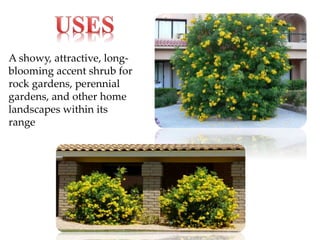
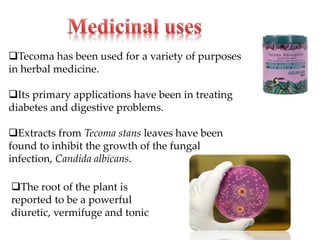
A showy, attractive, long-
blooming accent shrub for
rock gardens, perennial
gardens, and other home
landscapes within its
range
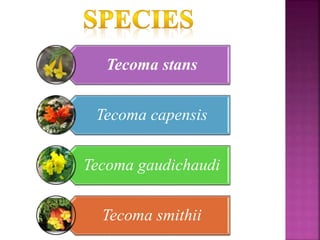
Tecoma has been used for a variety of purposes
in herbal medicine.
Its primary applications have been in treating
diabetes and digestive problems.
Extracts from Tecoma stans leaves have been
found to inhibit the growth of the fungal
infection, Candida albicans.
The root of the plant is
reported to be a powerful
diuretic, vermifuge and tonic
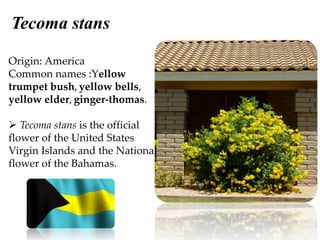
Tecoma stans
Tecoma capensis
Tecoma gaudichaudi
Tecoma smithii
Tecoma stans
Origin: America
Common names :Yellow
trumpet bush, yellow bells,
yellow elder, ginger-thomas.
 Tecoma stans is the official
flower of the United States
Virgin Islands and the National
flower of the Bahamas.
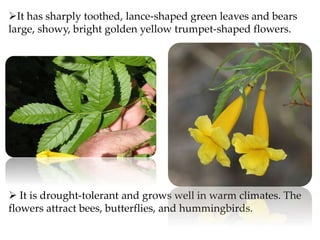
It has sharply toothed, lance-shaped green leaves and bears
large, showy, bright golden yellow trumpet-shaped flowers.
 It is drought-tolerant and grows well in warm climates. The
flowers attract bees, butterflies, and hummingbirds.
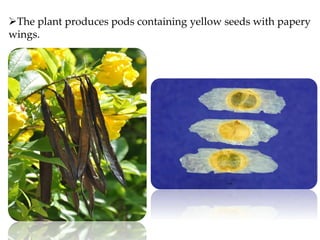
The plant produces pods containing yellow seeds with papery
wings.
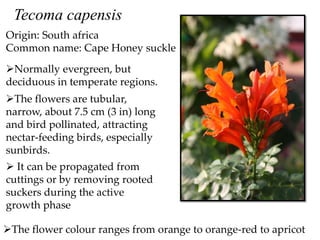
Origin: South africa
Common name: Cape Honey suckle
Normally evergreen, but
deciduous in temperate regions.
The flowers are tubular,
narrow, about 7.5 cm (3 in) long
and bird pollinated, attracting
nectar-feeding birds, especially
sunbirds.
The flower colour ranges from orange to orange-red to apricot
Tecoma capensis
 It can be propagated from
cuttings or by removing rooted
suckers during the active
growth phase
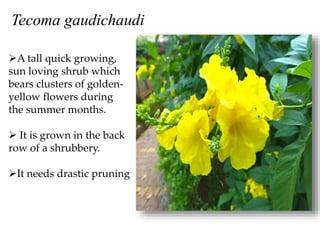
A tall quick growing,
sun loving shrub which
bears clusters of golden-
yellow flowers during
the summer months.
 It is grown in the back
row of a shrubbery.
It needs drastic pruning
Tecoma gaudichaudi
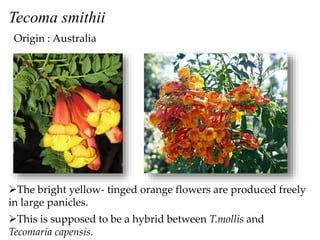
Tecoma smithii
Origin : Australia
This is supposed to be a hybrid between T.mollis and
Tecomaria capensis.
The bright yellow- tinged orange flowers are produced freely
in large panicles.
Temperature: Heat loving, but freeze sensitive.
Light: Full sun is required, will grows in an loose, open and
rangy manner if shaded even lightly.
Soil: Tecoma grows on a wide variety of soils, including sand
and lime rock.
Watering: Yellow bells responds well to regular water and
fertilizer applications during summer by producing more
vigorous growth and heightened flowering.
It is drought and semi-salt tolerant
Pruning can be done in the early spring to control shape and
size and promote new flushes of flowers
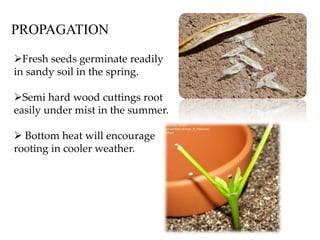
PROPAGATION
Fresh seeds germinate readily
in sandy soil in the spring.
Semi hard wood cuttings root
easily under mist in the summer.
 Bottom heat will encourage
rooting in cooler weather.
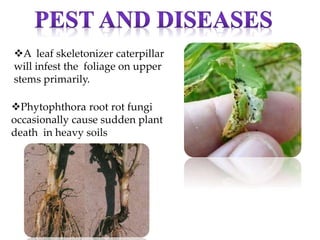
Phytophthora root rot fungi
occasionally cause sudden plant
death in heavy soils
A leaf skeletonizer caterpillar
will infest the foliage on upper
stems primarily.
Ixora and tecoma  ppt MUHAMMED ASLAM COH THRISHUR