

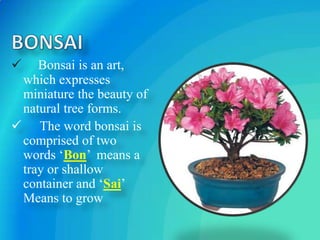
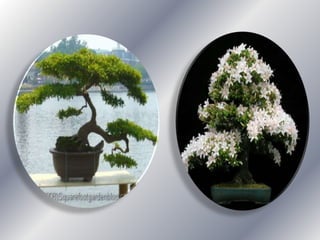
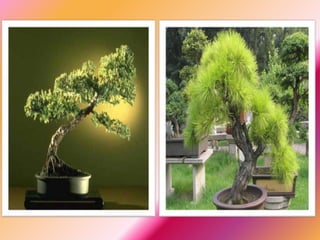
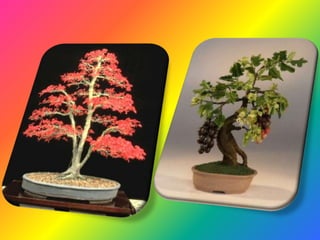
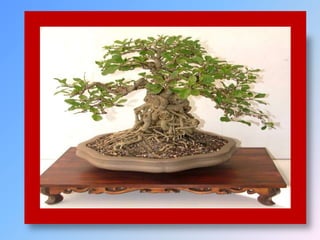
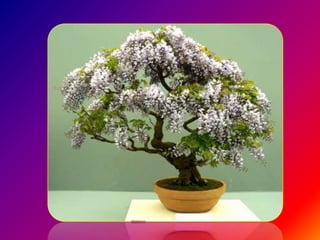
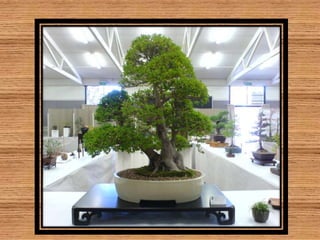
Bonsai is an art,
which expresses
miniature the beauty of
natural tree forms.
 The word bonsai is
comprised of two
words ‘Bon’ means a
tray or shallow
container and ‘Sai’
Means to grow
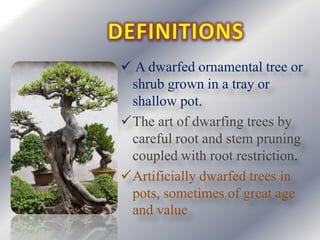
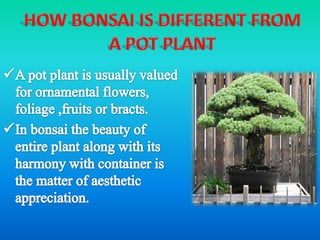
 A dwarfed ornamental tree or
shrub grown in a tray or
shallow pot.
The art of dwarfing trees by
careful root and stem pruning
coupled with root restriction.
Artificially dwarfed trees in
pots, sometimes of great age
and value
•
•
•
•

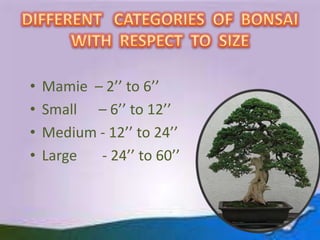
Mamie – 2’’ to 6’’
Small – 6’’ to 12’’
Medium - 12’’ to 24’’
Large
- 24’’ to 60’’
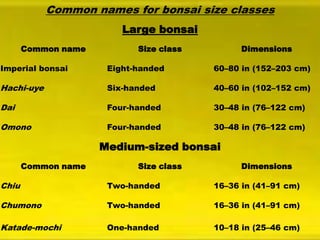
Common names for bonsai size classes
Large bonsai
Common name

Size class

Dimensions

Imperial bonsai

Eight-handed

60–80 in (152–203 cm)

Hachi-uye

Six-handed

40–60 in (102–152 cm)

Dai

Four-handed

30–48 in (76–122 cm)

Omono

Four-handed

30–48 in (76–122 cm)

Medium-sized bonsai
Common name

Size class

Dimensions

Chiu

Two-handed

16–36 in (41–91 cm)

Chumono

Two-handed

16–36 in (41–91 cm)

Katade-mochi

One-handed

10–18 in (25–46 cm)
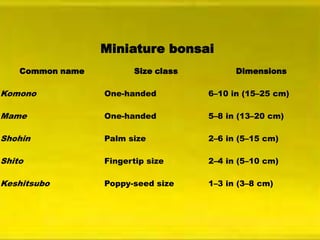
Miniature bonsai
Common name

Size class

Dimensions

Komono

One-handed

6–10 in (15–25 cm)

Mame

One-handed

5–8 in (13–20 cm)

Shohin

Palm size

2–6 in (5–15 cm)

Shito

Fingertip size

2–4 in (5–10 cm)

Keshitsubo

Poppy-seed size

1–3 in (3–8 cm)
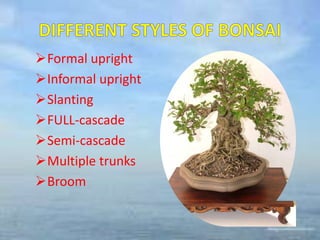
Formal upright
Informal upright
Slanting
FULL-cascade
Semi-cascade
Multiple trunks
Broom
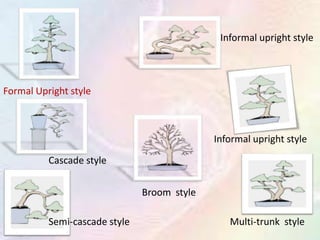
Informal upright style

Formal Upright style

Informal upright style
Cascade style

Broom style
Semi-cascade style

Multi-trunk style
•
•
•
•
•
•
•
•
•

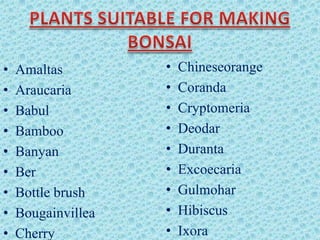
Amaltas
Araucaria
Babul
Bamboo
Banyan
Ber
Bottle brush
Bougainvillea
Cherry

•
•
•
•
•
•
•
•
•

Chineseorange
Coranda
Cryptomeria
Deodar
Duranta
Excoecaria
Gulmohar
Hibiscus
Ixora
•
•
•
•
•
•
•
•
•

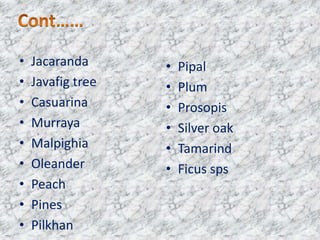
Jacaranda
Javafig tree
Casuarina
Murraya
Malpighia
Oleander
Peach
Pines
Pilkhan

•
•
•
•
•
•

Pipal
Plum
Prosopis
Silver oak
Tamarind
Ficus sps
• Lot of knowledge , perseverance and experience
is required to select a right plant.
• Plants with smaller flowers and fruits are
selected as foliage automatically gets reduced to
about 1/4th .
• Plants bearing flowers on leafless branches are
very good.
• Plants selected must be able to grow in stress
conditions of small growing medium and low
nutrients.
Coarse, well drained medium which provide
basic needs like water,oxygen and nutrition.
Equal portion of soil ,leaf mould and crushed
bricks or sand is ideal medium.
Top layer must have sufficient humus.
Conifer plants require more dry soil and fruit
trees require soil with more humus.
• BONSAI SOIL is mixture of one part loam,
two parts sphagnum peat moss, two parts
granite grit.
• Bonsai soil is much more free draining than
potting soil and doesn't contain as much
fertilizer as normal potting soil.
• It is usually available at specialist bonsai
nurseries, and even some normal nurseries stock
it.
Sludge or well rotten cow dung slurry.
Groundnut and cotton or neem cake one kg
each mixed in 5liters of water.
This is allowed to rotten or ferment for about a
month before diluting another five times.
A mug of this is given twice in a month.
A pinch of bone meal and single super
phosphate mixed is also very beneficial.
To develop in to good attractive shape .
Reduce growth by regular trimming and
pruning also restrict growth and maintain
proper balance between roots and shoots.
In one trimming not more than 1 portion of
roots or shoots are cut.
To prune correctly you must find out the
type of plant your bonsai is and research
when the best times are to prune old and
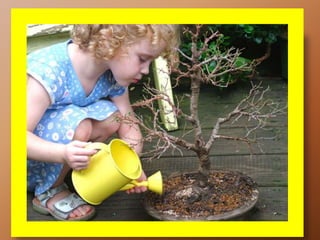
new season growth.
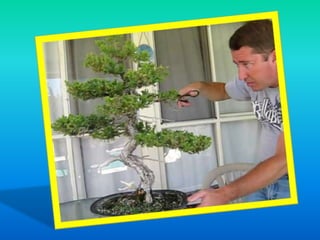
• One of the main forms of pruning for bonsai is
'finger pruning'.
• This involves pinching back new growth which
does not come within the general shape of the
bonsai or is at the top of the bonsai - helping to
encourage bushy foliage and a more tree-like
looking bonsai.
• Leaf pruning (also known as defoliation) in bonsai
is used for several deciduous and tropical plants
such as ficus or maples to reduce leaf size.
.
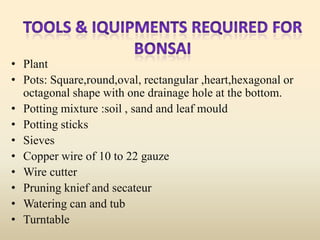
• Plant
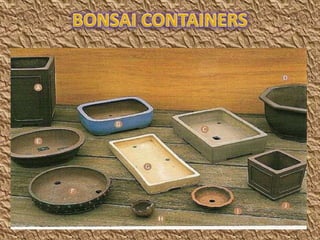
• Pots: Square,round,oval, rectangular ,heart,hexagonal or
octagonal shape with one drainage hole at the bottom.
• Potting mixture :soil , sand and leaf mould
• Potting sticks
• Sieves
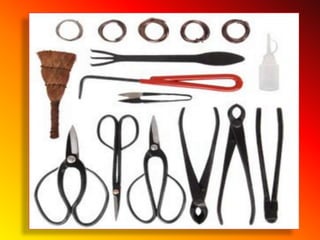
• Copper wire of 10 to 22 gauze
• Wire cutter
• Pruning knief and secateur
• Watering can and tub
• Turntable
Regular repotting of your bonsai to replace
important nutrients, 'stale soil' and allow for new
root growth is vital to your bonsai's health and
growth.
the trees should be repotted at a time when they are
most dormant - such as late autumn to early spring,
so that they are subjected to the least amount of
stress possible. Young or small bonsai require
repotting every two or three years, and older and
larger specimens less often.
To repot, carefully lift the tree out of its current pot
by tilting it to one side and trying to move it by the
base of the trunk.
• Try tapping the pot with the side of your hand to loosen
the rootball or poke a stick through the drainage holes and
'push' the rootball out.
• Next, using a chopstick, knitting needle, metal hook or
similar, remove any moss or accent plants and carefully
try to brush and untangle the roots. Start at the edge and
gradually work around. Try to 'comb' and 'tug' rather than
to 'pull' at the roots - for risk of damaging or tearing some
very important main roots.
• After this has been done - continue to shake and brush off
the soil until about one third to half of the original soil has
been removed from the edge and base of the rootball.
Cont……
• It would now be a good idea to spray the roots with
water to ensure that they do not dry out and so that they
will not have too much soil on them when it comes time
to pruning the roots.
• Prune the roots, using very sharp cutters, Start by
cutting the thick, old brown roots that have come close to
the edge of the pot and are restricting the growth of the
young 'feeder roots‘
• Next, prune the thinner roots which hang below the
depth of the pot by trimming them all into a suitable
shape that the pot will accommodate
• This should be a shape that fits comfortably into the
pot with a 1-2 cm (1/2 to 3/4 in) space between the
edges.
• Clean the original pot thoroughly or select a new
pot that is more suited to the tree and cover the
drainage holes with simple wire mesh.
• As the plant will now be unstable in the new pot as
it has nothing to anchor it - we have to make some
anchors to prevent the tree from falling over from
winds or from being moved
• Now you can place your bonsai on the mound by
gently nestling it in and spreading its roots out
evenly throughout on top of the soil.
• Add more soil up to the base of the trunk - which
should be just below the base of the pot.
• As a general rule, you should consider the origins of
a plant and how it would grow naturally.
• For example you would keep a rainforest fig in partshade with dappled sunlight (possibly under shade
cloth) which mimics the environment that it would
naturally grow .
• Generally try to keep the bonsai out of a position of
direct sunlight, where they receive good air,
circulation, relative humidity.
• Place where they are easily accessible to you for
maintenance (i.e. watering, feeding and pruning).
 Choose plants hardy suitable for local climate
condition.
 Choose simple container with adequate drainage.
 Position the plant correctly in the container.
 Do potting and repotting at right time.
 Eliminate air pockets during potting and repotting.
 Trim or prune regularly to produce a fine network
of shoots.
 Keep bonsai in open airy place.
 Give balanced nutrition and use mild fertilizers or
slow release fertilizers.
 Provide plenty of sunshine to all sides of bonsai.
Bonsai establishment and maintainance by ravikumar JN

Bonsai establishment and maintainance by ravikumar JN

  • 4.
     Bonsai is anart, which expresses miniature the beauty of natural tree forms.  The word bonsai is comprised of two words ‘Bon’ means a tray or shallow container and ‘Sai’ Means to grow
  • 5.
     A dwarfedornamental tree or shrub grown in a tray or shallow pot. The art of dwarfing trees by careful root and stem pruning coupled with root restriction. Artificially dwarfed trees in pots, sometimes of great age and value
  • 10.
    • • • • Mamie – 2’’to 6’’ Small – 6’’ to 12’’ Medium - 12’’ to 24’’ Large - 24’’ to 60’’
  • 11.
    Common names forbonsai size classes Large bonsai Common name Size class Dimensions Imperial bonsai Eight-handed 60–80 in (152–203 cm) Hachi-uye Six-handed 40–60 in (102–152 cm) Dai Four-handed 30–48 in (76–122 cm) Omono Four-handed 30–48 in (76–122 cm) Medium-sized bonsai Common name Size class Dimensions Chiu Two-handed 16–36 in (41–91 cm) Chumono Two-handed 16–36 in (41–91 cm) Katade-mochi One-handed 10–18 in (25–46 cm)
  • 12.
    Miniature bonsai Common name Sizeclass Dimensions Komono One-handed 6–10 in (15–25 cm) Mame One-handed 5–8 in (13–20 cm) Shohin Palm size 2–6 in (5–15 cm) Shito Fingertip size 2–4 in (5–10 cm) Keshitsubo Poppy-seed size 1–3 in (3–8 cm)
  • 14.
  • 15.
    Informal upright style FormalUpright style Informal upright style Cascade style Broom style Semi-cascade style Multi-trunk style
  • 17.
  • 18.
  • 19.
    • Lot ofknowledge , perseverance and experience is required to select a right plant. • Plants with smaller flowers and fruits are selected as foliage automatically gets reduced to about 1/4th . • Plants bearing flowers on leafless branches are very good. • Plants selected must be able to grow in stress conditions of small growing medium and low nutrients.
  • 20.
    Coarse, well drainedmedium which provide basic needs like water,oxygen and nutrition. Equal portion of soil ,leaf mould and crushed bricks or sand is ideal medium. Top layer must have sufficient humus. Conifer plants require more dry soil and fruit trees require soil with more humus.
  • 21.
    • BONSAI SOILis mixture of one part loam, two parts sphagnum peat moss, two parts granite grit. • Bonsai soil is much more free draining than potting soil and doesn't contain as much fertilizer as normal potting soil. • It is usually available at specialist bonsai nurseries, and even some normal nurseries stock it.
  • 23.
    Sludge or wellrotten cow dung slurry. Groundnut and cotton or neem cake one kg each mixed in 5liters of water. This is allowed to rotten or ferment for about a month before diluting another five times. A mug of this is given twice in a month. A pinch of bone meal and single super phosphate mixed is also very beneficial.
  • 28.
    To develop into good attractive shape . Reduce growth by regular trimming and pruning also restrict growth and maintain proper balance between roots and shoots. In one trimming not more than 1 portion of roots or shoots are cut. To prune correctly you must find out the type of plant your bonsai is and research when the best times are to prune old and new season growth.
  • 29.
    • One ofthe main forms of pruning for bonsai is 'finger pruning'. • This involves pinching back new growth which does not come within the general shape of the bonsai or is at the top of the bonsai - helping to encourage bushy foliage and a more tree-like looking bonsai. • Leaf pruning (also known as defoliation) in bonsai is used for several deciduous and tropical plants such as ficus or maples to reduce leaf size.
  • 32.
  • 35.
    • Plant • Pots:Square,round,oval, rectangular ,heart,hexagonal or octagonal shape with one drainage hole at the bottom. • Potting mixture :soil , sand and leaf mould • Potting sticks • Sieves • Copper wire of 10 to 22 gauze • Wire cutter • Pruning knief and secateur • Watering can and tub • Turntable
  • 38.
    Regular repotting ofyour bonsai to replace important nutrients, 'stale soil' and allow for new root growth is vital to your bonsai's health and growth. the trees should be repotted at a time when they are most dormant - such as late autumn to early spring, so that they are subjected to the least amount of stress possible. Young or small bonsai require repotting every two or three years, and older and larger specimens less often. To repot, carefully lift the tree out of its current pot by tilting it to one side and trying to move it by the base of the trunk.
  • 39.
    • Try tappingthe pot with the side of your hand to loosen the rootball or poke a stick through the drainage holes and 'push' the rootball out. • Next, using a chopstick, knitting needle, metal hook or similar, remove any moss or accent plants and carefully try to brush and untangle the roots. Start at the edge and gradually work around. Try to 'comb' and 'tug' rather than to 'pull' at the roots - for risk of damaging or tearing some very important main roots. • After this has been done - continue to shake and brush off the soil until about one third to half of the original soil has been removed from the edge and base of the rootball.
  • 40.
    Cont…… • It wouldnow be a good idea to spray the roots with water to ensure that they do not dry out and so that they will not have too much soil on them when it comes time to pruning the roots. • Prune the roots, using very sharp cutters, Start by cutting the thick, old brown roots that have come close to the edge of the pot and are restricting the growth of the young 'feeder roots‘ • Next, prune the thinner roots which hang below the depth of the pot by trimming them all into a suitable shape that the pot will accommodate
  • 41.
    • This shouldbe a shape that fits comfortably into the pot with a 1-2 cm (1/2 to 3/4 in) space between the edges. • Clean the original pot thoroughly or select a new pot that is more suited to the tree and cover the drainage holes with simple wire mesh. • As the plant will now be unstable in the new pot as it has nothing to anchor it - we have to make some anchors to prevent the tree from falling over from winds or from being moved • Now you can place your bonsai on the mound by gently nestling it in and spreading its roots out evenly throughout on top of the soil. • Add more soil up to the base of the trunk - which should be just below the base of the pot.
  • 42.
    • As ageneral rule, you should consider the origins of a plant and how it would grow naturally. • For example you would keep a rainforest fig in partshade with dappled sunlight (possibly under shade cloth) which mimics the environment that it would naturally grow . • Generally try to keep the bonsai out of a position of direct sunlight, where they receive good air, circulation, relative humidity. • Place where they are easily accessible to you for maintenance (i.e. watering, feeding and pruning).
  • 43.
     Choose plantshardy suitable for local climate condition.  Choose simple container with adequate drainage.  Position the plant correctly in the container.  Do potting and repotting at right time.  Eliminate air pockets during potting and repotting.  Trim or prune regularly to produce a fine network of shoots.  Keep bonsai in open airy place.  Give balanced nutrition and use mild fertilizers or slow release fertilizers.  Provide plenty of sunshine to all sides of bonsai.