www.oeclib.in
Submitted By:
Odisha Electronics Control Library
Seminar
On
LAMP Technology
 Introduction
 Why is LAMP a popular choice?
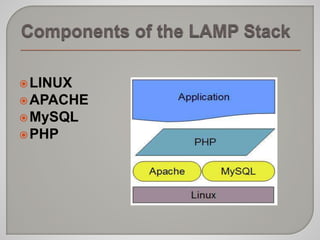
 Components of the LAMP Stack
 LINUX
 APACHE
 MySQL
 PHP
 Applying LAMP
 When not to use LAMP?
 Benefits of LAMP
 Conclusion
 Reference
 LAMP is a shorthand term for a web application
platform consisting of Linux, Apache, MySQL
and one of Perl or PHP.
 Together, these open source tools provide a
world-class platform for deploying web
applications.
 Think of a scenario wherein your business is
unable to manage its organizational data.
 You want a solution to the comprehensive data
flow taking place throughout your organization
and you want this solution in double quick time.
 In cases like these, where a business or an
organization cannot dedicate a lot of time to
problem solving, the LAMP stack is the preferred
platform for development.
LINUX
APACHE
MySQL
PHP
LINUX is presently the most commonly
used implementation of UNIX.
Built from the ground up as a UNIX work-
alike operating system for the Intel
386/486/pentium family of chips by a
volunteer team of coders on the internet
LINUX has revitalized the old-school UNIX
community and added many new converts.
 LINUX development is led by Linus
Torvalds.
 Apache is the most popular web server on the
Internet. Apache like LINUX, MySQL and PHP is
an open source project.
 Apache is based on the NCSA (National Center
for Super Computing Applications) web server.
 In 1995-1996 a group of developers coalesced
around a collection of patches to the original
NCSA web server.
 MySQL is a fast flexible Relational Database. MySQL is
the most widely used Relational Database Management
System in the world with over 4 million instances in use.
MySQL is high-performance, robust, multi-threaded and
multi user.
 Features include :Portability. Support for a wided variety
of Operating Systems and hardware
 Speed and Reliability
 Ease of Use
 Multi user support
 Scalability
 Standards Compliant
 Replication
 What's next in the field of web design? It's already here.
Today's webmasters are deluged with available
technologies to incorporate into their designs. The ability
to learn everything is fast becoming impossibility.
 The benefits of using PHP server side processing
include the following:
 Reduces network traffic.
 Avoids cross platform issues with operating systems and
web browsers.
 Can sent data to the client that isn't on the client
computer.
 Quicker loading time. After the server interprets all the
php code, the resulting page is transmitted as HTML.
Since all the tools are in place to deliver
html content to a browser it is assumed
that control of the application will be
through a browser based interface.
Using the browser and HTML as the GUI
(Graphical User Interface) for your
application is frequently the most logical
choice.
The browser is familiar and available on
most computers and operating systems.
 Storing our data: Our data is going to be
stored in the MySQL Database. One instance of
MySQL can contain many databases.
 User Interface: Although MySQL provides a
command line client that we can use to enter our
data we are going to build a friendlier interface.
 Programming: PHP is the glue that takes the
input from the browser and adds the data to the
MySQL database.
Applications not well suited for LAMP
would include applications that have a
frequent need for exchanging large
amounts of transient data or that have
particular and demanding needs for state
maintenance.
 Easy to code: Ask all developers and they will tell you that
coding is a breeze on LAMP. What this is does is that it ensures
that coding is relatively bug free and doesn’t have to go
through an exhaustive and time consuming process of fixing
the bugs.
 Easy deployment: For many developers, it’s the deployment
of a web application that becomes a tricky exercise; especially
when the programming language cannot be easily integrated
with the server and database.
 Local Development – Another huge advantage of using
LAMP is that a developer can build an app locally and then
deployed it onto the web.
While Flash, Active X, and other proprietary
elements will continue to creep in and entice
webmasters, in the end, compatibility issues
and price of development will dictate what
eventually win out in the next generation of
web design.
However, for the foreseeable future PHP,
HTML, and databases are going to be in the
future of interactive web design, and that's
where I'm placing my bets.
www.google.com
www.wikipedia.com
www.oeclib.in
Thanks

Lamp technology

  • 1.
    www.oeclib.in Submitted By: Odisha ElectronicsControl Library Seminar On LAMP Technology
  • 2.
     Introduction  Whyis LAMP a popular choice?  Components of the LAMP Stack  LINUX  APACHE  MySQL  PHP  Applying LAMP  When not to use LAMP?  Benefits of LAMP  Conclusion  Reference
  • 3.
     LAMP isa shorthand term for a web application platform consisting of Linux, Apache, MySQL and one of Perl or PHP.  Together, these open source tools provide a world-class platform for deploying web applications.
  • 4.
     Think ofa scenario wherein your business is unable to manage its organizational data.  You want a solution to the comprehensive data flow taking place throughout your organization and you want this solution in double quick time.  In cases like these, where a business or an organization cannot dedicate a lot of time to problem solving, the LAMP stack is the preferred platform for development.
  • 5.
  • 6.
    LINUX is presentlythe most commonly used implementation of UNIX. Built from the ground up as a UNIX work- alike operating system for the Intel 386/486/pentium family of chips by a volunteer team of coders on the internet LINUX has revitalized the old-school UNIX community and added many new converts.  LINUX development is led by Linus Torvalds.
  • 7.
     Apache isthe most popular web server on the Internet. Apache like LINUX, MySQL and PHP is an open source project.  Apache is based on the NCSA (National Center for Super Computing Applications) web server.  In 1995-1996 a group of developers coalesced around a collection of patches to the original NCSA web server.
  • 8.
     MySQL isa fast flexible Relational Database. MySQL is the most widely used Relational Database Management System in the world with over 4 million instances in use. MySQL is high-performance, robust, multi-threaded and multi user.  Features include :Portability. Support for a wided variety of Operating Systems and hardware  Speed and Reliability  Ease of Use  Multi user support  Scalability  Standards Compliant  Replication
  • 9.
     What's nextin the field of web design? It's already here. Today's webmasters are deluged with available technologies to incorporate into their designs. The ability to learn everything is fast becoming impossibility.  The benefits of using PHP server side processing include the following:  Reduces network traffic.  Avoids cross platform issues with operating systems and web browsers.  Can sent data to the client that isn't on the client computer.  Quicker loading time. After the server interprets all the php code, the resulting page is transmitted as HTML.
  • 10.
    Since all thetools are in place to deliver html content to a browser it is assumed that control of the application will be through a browser based interface. Using the browser and HTML as the GUI (Graphical User Interface) for your application is frequently the most logical choice. The browser is familiar and available on most computers and operating systems.
  • 11.
     Storing ourdata: Our data is going to be stored in the MySQL Database. One instance of MySQL can contain many databases.  User Interface: Although MySQL provides a command line client that we can use to enter our data we are going to build a friendlier interface.  Programming: PHP is the glue that takes the input from the browser and adds the data to the MySQL database.
  • 12.
    Applications not wellsuited for LAMP would include applications that have a frequent need for exchanging large amounts of transient data or that have particular and demanding needs for state maintenance.
  • 13.
     Easy tocode: Ask all developers and they will tell you that coding is a breeze on LAMP. What this is does is that it ensures that coding is relatively bug free and doesn’t have to go through an exhaustive and time consuming process of fixing the bugs.  Easy deployment: For many developers, it’s the deployment of a web application that becomes a tricky exercise; especially when the programming language cannot be easily integrated with the server and database.  Local Development – Another huge advantage of using LAMP is that a developer can build an app locally and then deployed it onto the web.
  • 14.
    While Flash, ActiveX, and other proprietary elements will continue to creep in and entice webmasters, in the end, compatibility issues and price of development will dictate what eventually win out in the next generation of web design. However, for the foreseeable future PHP, HTML, and databases are going to be in the future of interactive web design, and that's where I'm placing my bets.
  • 15.
  • 16.