By: Saif Khalid khan Kakar
Lecturer (Civics/Pol. Sci)
Pakistan Education Center
 Pakistan is Divided into Four temperature zones:
I. North-Western Mountainous Region. (The Temperature
of this region is characterized by Cold weather and
winter lasts for eight months.)
II. Upper Indus Plain: (This region includes areas of
Punjab and KPK province, it is characterized by hot
summers and temperature in some areas can reach 50
degrees, but winters are short and tolerable)
III. Lower Indus Plain and Coastal areas: (The Temperature
of coastal region remains moderate through out the year,
however 80 Km above the coast the temperature
matches the upper Indus plains.)
IV. Baluchistan Plateau: (most of Baluchistan province is
included in this region, this region is characterized by
extreme cold and extreme hot climate. The region is
mostly dry.)
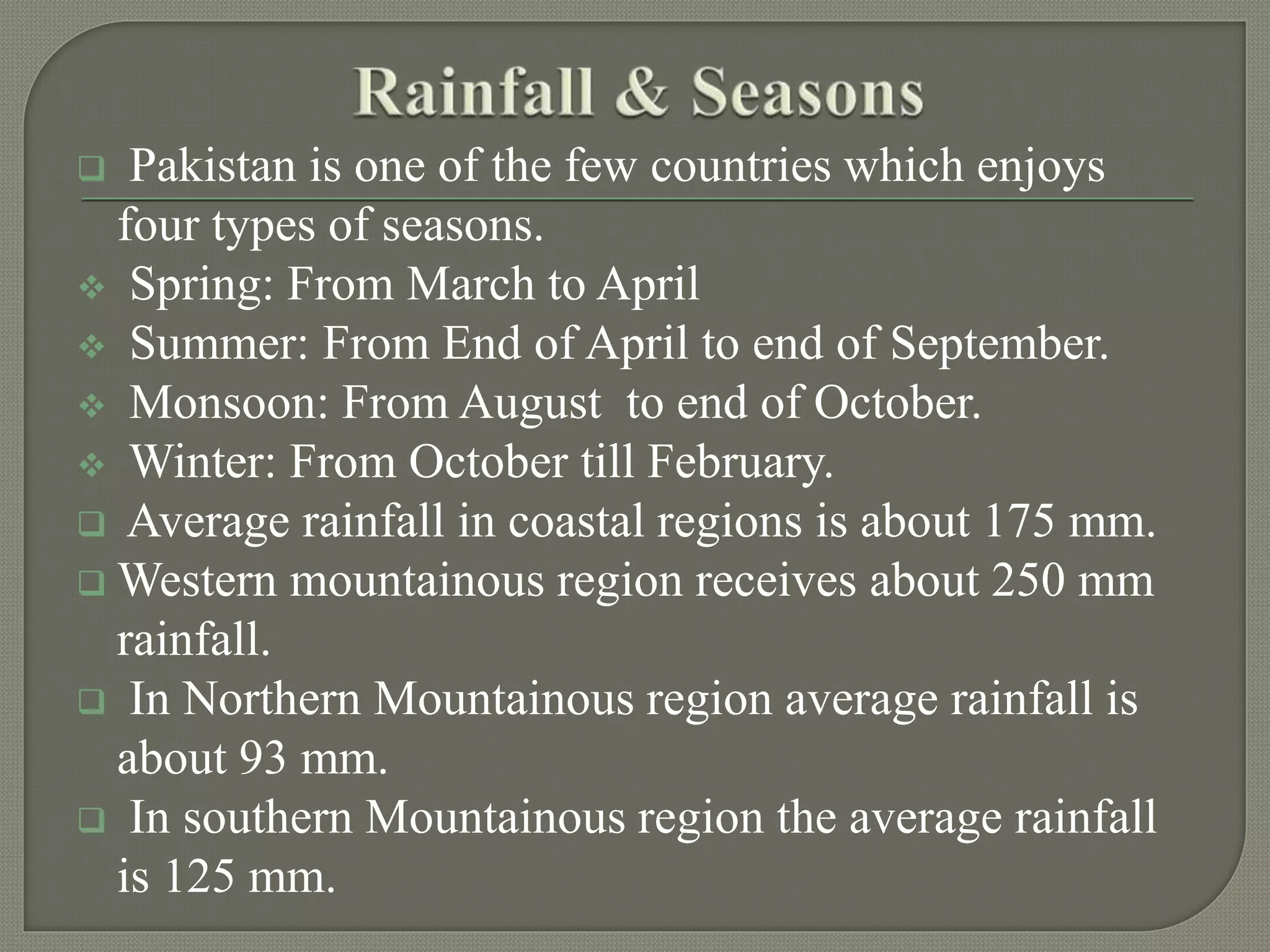
 Pakistan is one of the few countries which enjoys
four types of seasons.
 Spring: From March to April
 Summer: From End of April to end of September.
 Monsoon: From August to end of October.
 Winter: From October till February.
 Average rainfall in coastal regions is about 175 mm.
 Western mountainous region receives about 250 mm
rainfall.
 In Northern Mountainous region average rainfall is
about 93 mm.
 In southern Mountainous region the average rainfall
is 125 mm.
 The Economic growth and development in Pakistan is
not even. This uneven growth is due to Natural and poor
administrative/managerial reasons.
 In Pakistan, the population is uneven dispersed through
out the country.
 For example: population of the four provinces is as
follow: Punjab- 7.36 crore (11 Crore), Sindh- 3.41 crore
(4.7 crore), KPK- 1.77 Crore (3.5 crore), Baluchistan-
65 Lakh (1.2 Crore).
 Similarly the Gender based division of population is
Population Total 207,774,520
Males 106,443,520 Females 101,331,00
 With regards to Physical dimension:
Punjab- total area 205,344 km2 (26 % of total area of
Pakistan)
Baluchistan- total area 347,190 km2 ( 44 % of total
area of Pakistan)
Sindh- total area 140,914 km2 (17 % of total area of
Pakistan)
KPK- total area 101,741 km2 (12 % of total area of
Pakistan)
 Although Baluchistan is the largest province in size
still it has the least population and consequently the
least developed.
 Out of the six major cities of Pakistan, only one
(Quetta) is located in Baluchistan. Whereas four are
located in Punjab (Lahore, Faisalabad, Rawalpindi,
Multan) and only one in Sindh (Karachi).
 The Reason for uneven population growth is
linked to rural and urban migration. As more
facilities and better jobs are available in the
cities therefore people from towns and
villages are migrating in search of better
standard of life.
 An Economist Abdul Hamid Shahid has
stated that this current trend of rural-urban
migration in Pakistan will result in creation of
pools of rich surrounded by a ocean of
poverty.
 Modern economist are of the view that the
pattern of urbanization will only increase with
the passage of time and can only result in
disparity.
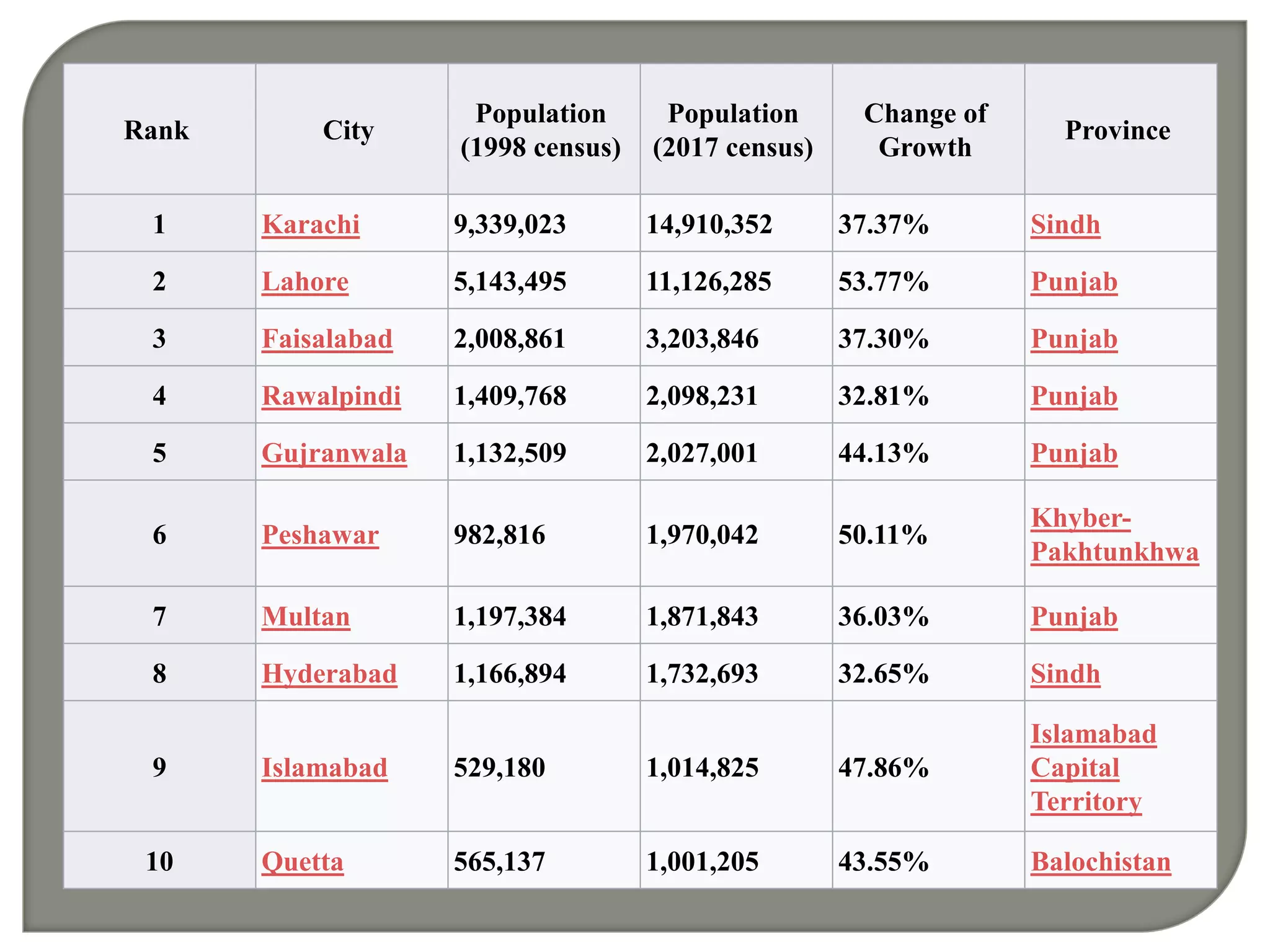
Rank City
Population
(1998 census)
Population
(2017 census)
Change of
Growth
Province
1 Karachi 9,339,023 14,910,352 37.37% Sindh
2 Lahore 5,143,495 11,126,285 53.77% Punjab
3 Faisalabad 2,008,861 3,203,846 37.30% Punjab
4 Rawalpindi 1,409,768 2,098,231 32.81% Punjab
5 Gujranwala 1,132,509 2,027,001 44.13% Punjab
6 Peshawar 982,816 1,970,042 50.11%
Khyber-
Pakhtunkhwa
7 Multan 1,197,384 1,871,843 36.03% Punjab
8 Hyderabad 1,166,894 1,732,693 32.65% Sindh
9 Islamabad 529,180 1,014,825 47.86%
Islamabad
Capital
Territory
10 Quetta 565,137 1,001,205 43.55% Balochistan
 One sad example of regional disparity
was that of east Pakistan (Bangladesh) in
which during 1959 the difference of per
capita income was 32% lower than west
Pakistan.
 According to statistics of early 2000, the
per capita income of Sindh was highest
among the four provinces. It was 3 times
higher than KPK, 1.5 times higher than
Punjab and 2 times higher than
Baluchistan.
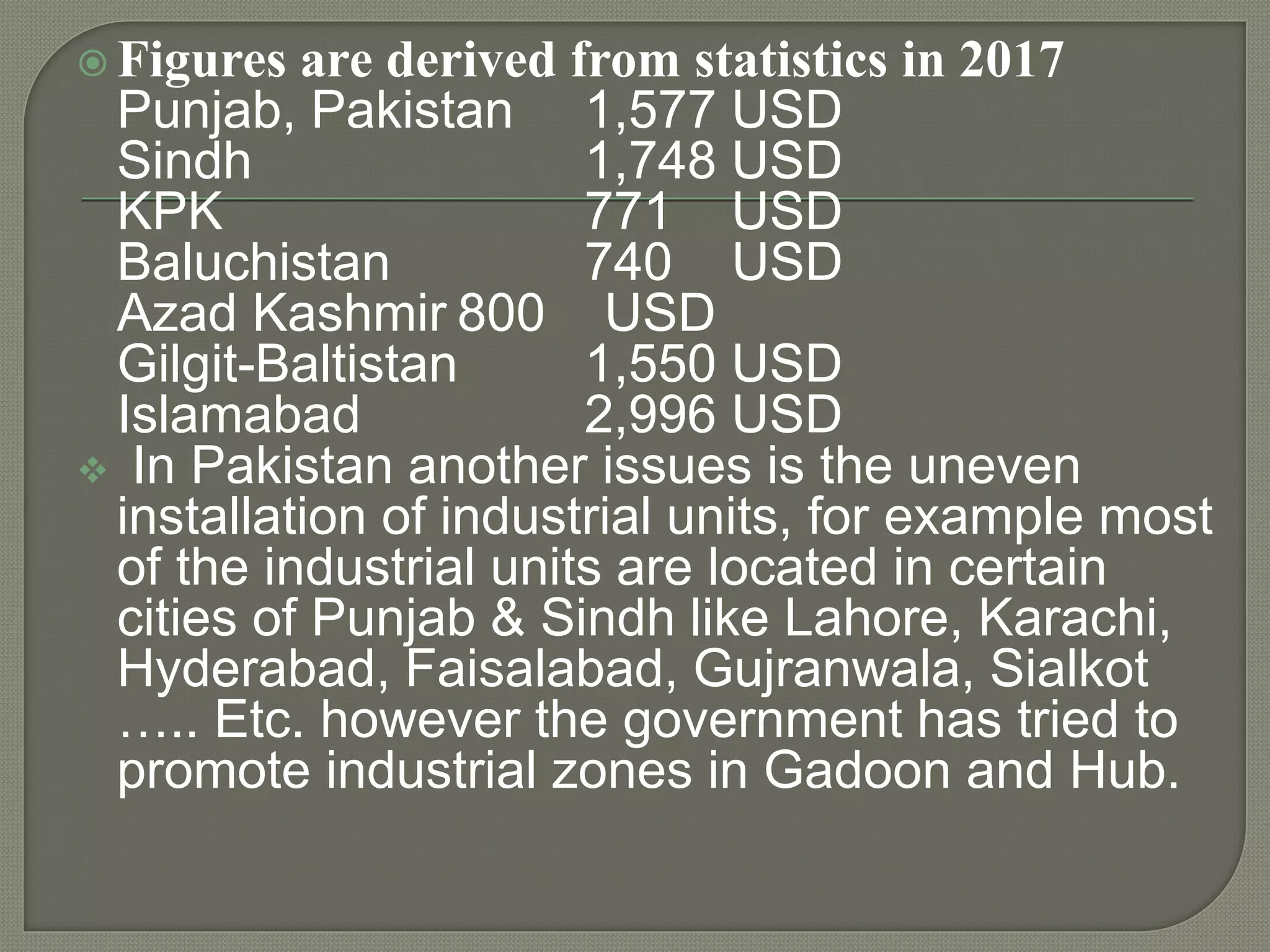
 Figures are derived from statistics in 2017
Punjab, Pakistan 1,577 USD
Sindh 1,748 USD
KPK 771 USD
Baluchistan 740 USD
Azad Kashmir 800 USD
Gilgit-Baltistan 1,550 USD
Islamabad 2,996 USD
 In Pakistan another issues is the uneven
installation of industrial units, for example most
of the industrial units are located in certain
cities of Punjab & Sindh like Lahore, Karachi,
Hyderabad, Faisalabad, Gujranwala, Sialkot
….. Etc. however the government has tried to
promote industrial zones in Gadoon and Hub.
 Another reason of uneven growth and development is
the lack of infrastructure in rural areas. This leads to
installation of industrial units near cities that have well
developed infrastructure.
 Feudalism in rural areas is also another impediment in
the path of development. The feudal land lords do not
approve of better education and other financial grants
in their area for the welfare of general public.
 As cities are not pray of feudal culture therefore the
people are more financially well-off and have more
opportunity.
 The role of bureaucracy is also an important factor in
uneven economic development because the grants are
not approved and used properly for the development of
rural areas and therefore financial cuts are always
made there in case of austerity.

Temperature zones and imbalanced economic growth and regional disparities

  • 1.
    By: Saif Khalidkhan Kakar Lecturer (Civics/Pol. Sci) Pakistan Education Center
  • 3.
     Pakistan isDivided into Four temperature zones: I. North-Western Mountainous Region. (The Temperature of this region is characterized by Cold weather and winter lasts for eight months.) II. Upper Indus Plain: (This region includes areas of Punjab and KPK province, it is characterized by hot summers and temperature in some areas can reach 50 degrees, but winters are short and tolerable) III. Lower Indus Plain and Coastal areas: (The Temperature of coastal region remains moderate through out the year, however 80 Km above the coast the temperature matches the upper Indus plains.) IV. Baluchistan Plateau: (most of Baluchistan province is included in this region, this region is characterized by extreme cold and extreme hot climate. The region is mostly dry.)
  • 4.
     Pakistan isone of the few countries which enjoys four types of seasons.  Spring: From March to April  Summer: From End of April to end of September.  Monsoon: From August to end of October.  Winter: From October till February.  Average rainfall in coastal regions is about 175 mm.  Western mountainous region receives about 250 mm rainfall.  In Northern Mountainous region average rainfall is about 93 mm.  In southern Mountainous region the average rainfall is 125 mm.
  • 5.
     The Economicgrowth and development in Pakistan is not even. This uneven growth is due to Natural and poor administrative/managerial reasons.  In Pakistan, the population is uneven dispersed through out the country.  For example: population of the four provinces is as follow: Punjab- 7.36 crore (11 Crore), Sindh- 3.41 crore (4.7 crore), KPK- 1.77 Crore (3.5 crore), Baluchistan- 65 Lakh (1.2 Crore).  Similarly the Gender based division of population is Population Total 207,774,520 Males 106,443,520 Females 101,331,00
  • 6.
     With regardsto Physical dimension: Punjab- total area 205,344 km2 (26 % of total area of Pakistan) Baluchistan- total area 347,190 km2 ( 44 % of total area of Pakistan) Sindh- total area 140,914 km2 (17 % of total area of Pakistan) KPK- total area 101,741 km2 (12 % of total area of Pakistan)  Although Baluchistan is the largest province in size still it has the least population and consequently the least developed.  Out of the six major cities of Pakistan, only one (Quetta) is located in Baluchistan. Whereas four are located in Punjab (Lahore, Faisalabad, Rawalpindi, Multan) and only one in Sindh (Karachi).
  • 7.
     The Reasonfor uneven population growth is linked to rural and urban migration. As more facilities and better jobs are available in the cities therefore people from towns and villages are migrating in search of better standard of life.  An Economist Abdul Hamid Shahid has stated that this current trend of rural-urban migration in Pakistan will result in creation of pools of rich surrounded by a ocean of poverty.  Modern economist are of the view that the pattern of urbanization will only increase with the passage of time and can only result in disparity.
  • 8.
    Rank City Population (1998 census) Population (2017census) Change of Growth Province 1 Karachi 9,339,023 14,910,352 37.37% Sindh 2 Lahore 5,143,495 11,126,285 53.77% Punjab 3 Faisalabad 2,008,861 3,203,846 37.30% Punjab 4 Rawalpindi 1,409,768 2,098,231 32.81% Punjab 5 Gujranwala 1,132,509 2,027,001 44.13% Punjab 6 Peshawar 982,816 1,970,042 50.11% Khyber- Pakhtunkhwa 7 Multan 1,197,384 1,871,843 36.03% Punjab 8 Hyderabad 1,166,894 1,732,693 32.65% Sindh 9 Islamabad 529,180 1,014,825 47.86% Islamabad Capital Territory 10 Quetta 565,137 1,001,205 43.55% Balochistan
  • 9.
     One sadexample of regional disparity was that of east Pakistan (Bangladesh) in which during 1959 the difference of per capita income was 32% lower than west Pakistan.  According to statistics of early 2000, the per capita income of Sindh was highest among the four provinces. It was 3 times higher than KPK, 1.5 times higher than Punjab and 2 times higher than Baluchistan.
  • 10.
     Figures arederived from statistics in 2017 Punjab, Pakistan 1,577 USD Sindh 1,748 USD KPK 771 USD Baluchistan 740 USD Azad Kashmir 800 USD Gilgit-Baltistan 1,550 USD Islamabad 2,996 USD  In Pakistan another issues is the uneven installation of industrial units, for example most of the industrial units are located in certain cities of Punjab & Sindh like Lahore, Karachi, Hyderabad, Faisalabad, Gujranwala, Sialkot ….. Etc. however the government has tried to promote industrial zones in Gadoon and Hub.
  • 11.
     Another reasonof uneven growth and development is the lack of infrastructure in rural areas. This leads to installation of industrial units near cities that have well developed infrastructure.  Feudalism in rural areas is also another impediment in the path of development. The feudal land lords do not approve of better education and other financial grants in their area for the welfare of general public.  As cities are not pray of feudal culture therefore the people are more financially well-off and have more opportunity.  The role of bureaucracy is also an important factor in uneven economic development because the grants are not approved and used properly for the development of rural areas and therefore financial cuts are always made there in case of austerity.