“Pakistan studies”
Objective resolution with constituent of Pakistan
Objective resolution (1949):
The Objectives Resolution was the first constitutional document that proved to
be the ‘foundation’ of the constitutional developments in Pakistan.
This resolution was moved in the constituent assembly by Mr. Liaquat Ali
Khan, the prime minister of Pakistan in March 1949.
It specify the objective and important features of the future of the constituent
of Pakistan.
The members from the districts that became part of Pakistan were declared
members of the Constituent Assembly.
The Constituent Assembly (1947-54):
The first Constituent Assembly came into existence under Indian Independence Act
1947.
The elections were held in July 1946 to decide the destiny of the All India Muslim
League (AIML)’s claim that it is the only representative party of the Indian Muslims
that desire separate homeland, Pakistan.
The number of such members was 69. It increased to 79 after the 1947 when some
states joined Pakistan and then increase in the population.
There were two major parties, Muslim League and Congress in the Assembly at that
time. This Assembly had dual functions to perform.
Features of the Objectives Resolution:
• Sovereignty of the entire Universe belongs to Allah alone
• Authority should be delegated to the State through its people under the rules
set by Allah
• Constitution of Pakistan should be framed by the Constituent Assembly
• State should exercise its powers through the chosen representatives
• Principles of democracy, freedom, equality, tolerance and social justice, as
inshore by Islam should be followed
• Muslims shall live their lives according the teaching of Quran and Sunnah
• Minorities can freely profess and practice their religion.
Features of the Objectives Resolution:
• There should be Federal form of government with the maximum autonomy for
the Units
• Fundamental rights including equality of status, of opportunity and before law,
social, economic and political justice, and freedom of thought, expression,
belief, faith, worship and association, subject to law and public morality should
be given to all the citizens of the state.
• It would be the duty of the state to safeguard the interests of minorities,
backward and depressed classes.
• Independence of judiciary should be guaranteed
• Integrity of the territory and sovereignty of the country was to be safeguarded.
Objections by Non-Muslims:
• The major objection by the Non-Muslims was that the government was trying
to mix the religion and politics that was against the spirit of democracy.
• The non-Muslims objected on the ‘Sovereignty of Allah’ and minorities’ rights,
saying it would promote inequality in the society. They were also of view that
Sharia was not adequate for the modern time.
• They feared that it would encourage the religious extremists to work for the
establishment of a ‘theocratic state.’
Constituention of Pakistan 1956:
• The first constituent was approved on January 29, 1959 and enforced on March
23, 1956. With this Pakistan had become an Islamic republic.
• The Constitution of 1956 was passed after long deliberations. It replaced the
Interim Constitution.
• It has 234 Articles and 6 Schedules.
• It declared that the name of the country would be the Islamic Republic of
Pakistan
Features of constitution 1956:
• Written Constitution
• Islamic Republic of Pakistan as a name of country
• Objectives Resolution as a preamble
• Federal System
Powers was divided between the center and the provinces. The subjects were divided
into three lists; The Federal List, The Provincial List, and the Concurrent List.
• Unicameral Legislature
Features of constitution 1956:
• parliamentary system
A parliamentary system was adopted, according to it the president was the head of
state and the Prime Minister the head of government.
• Islamic Law
No law can be made to violate Islamic principles and
teachings.
• Urdu & Bengali as a national language
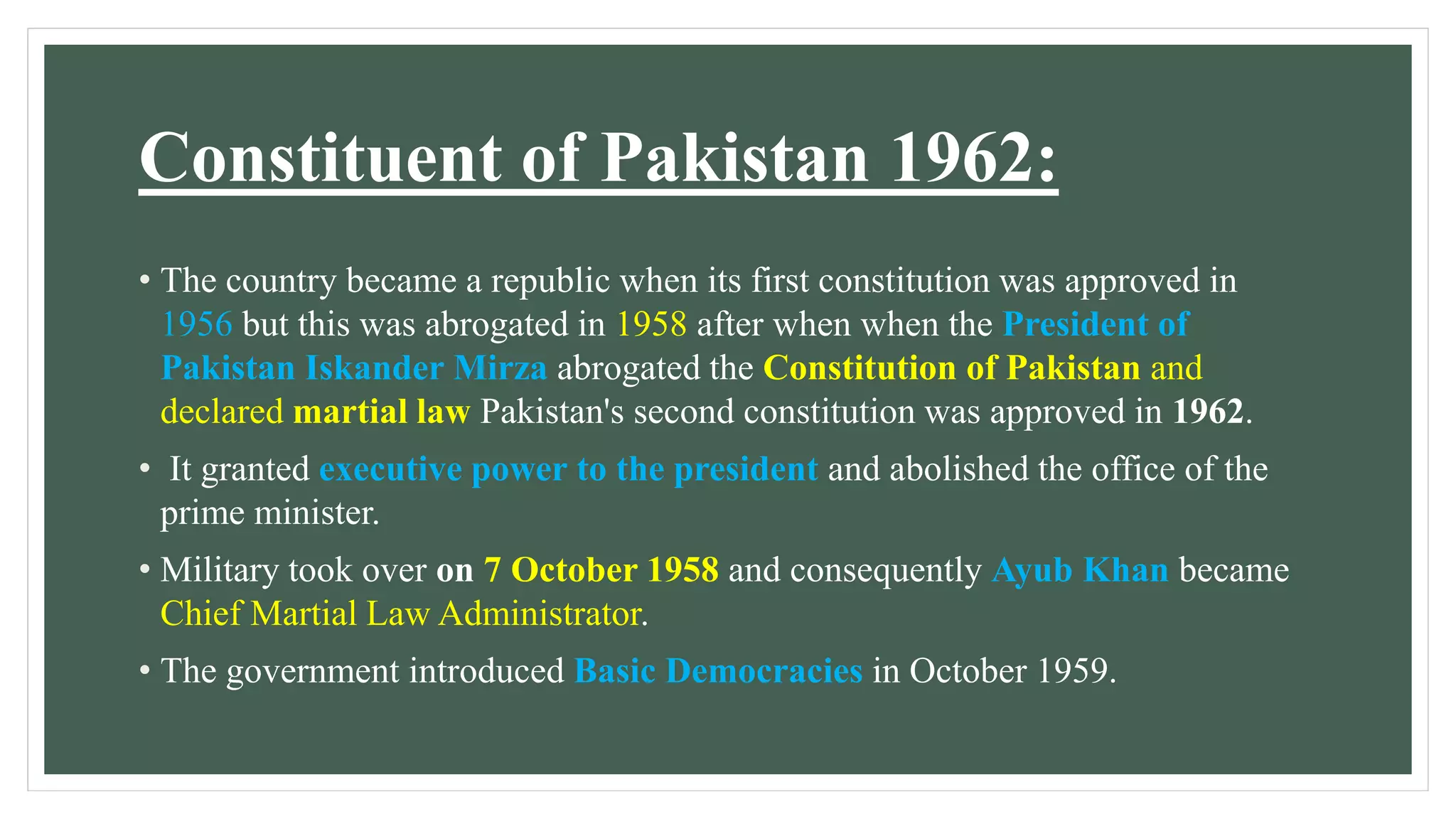
Constituent of Pakistan 1962:
• The country became a republic when its first constitution was approved in
1956 but this was abrogated in 1958 after when when the President of
Pakistan Iskander Mirza abrogated the Constitution of Pakistan and
declared martial law Pakistan's second constitution was approved in 1962.
• It granted executive power to the president and abolished the office of the
prime minister.
• Military took over on 7 October 1958 and consequently Ayub Khan became
Chief Martial Law Administrator.
• The government introduced Basic Democracies in October 1959.
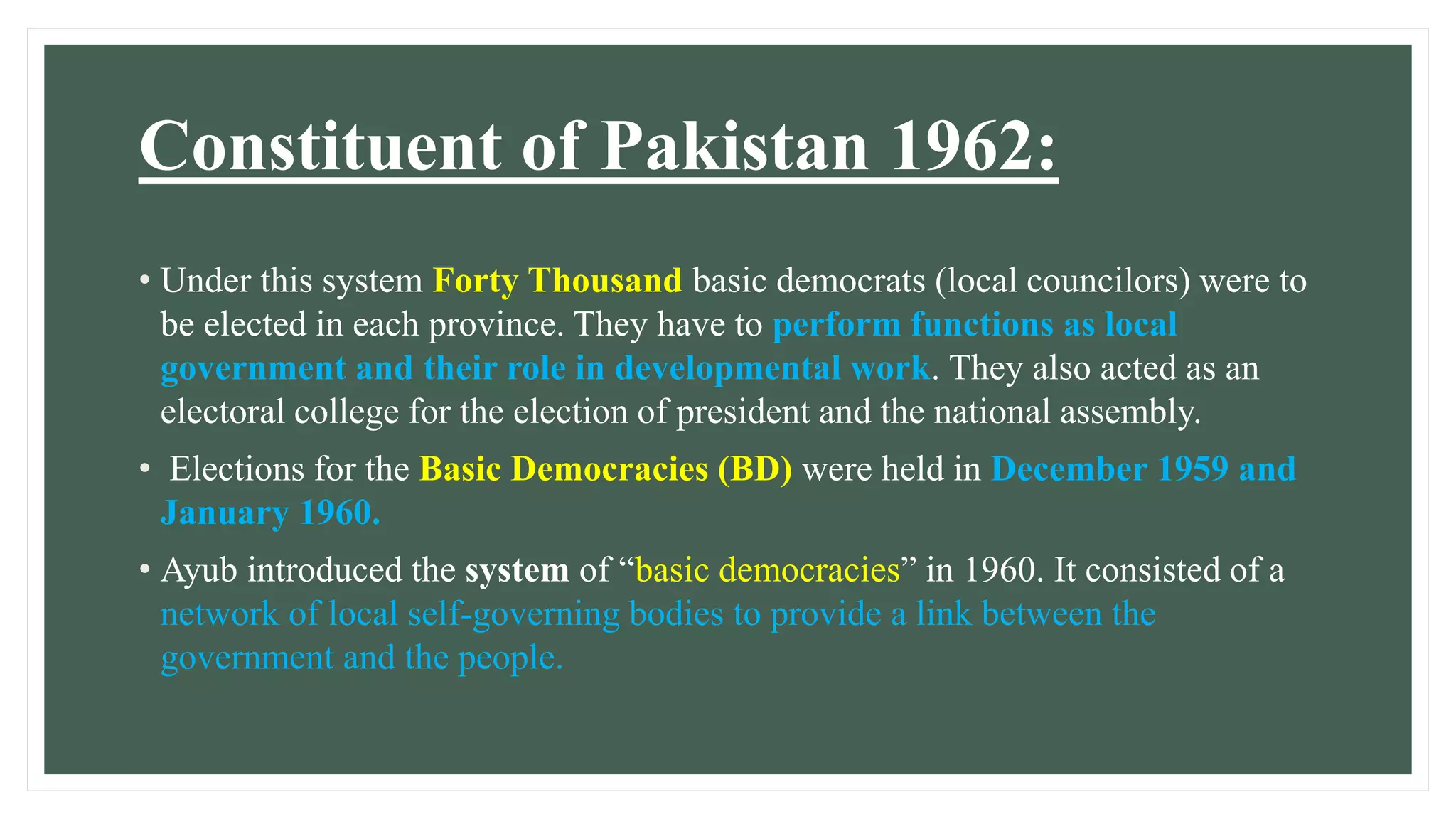
Constituent of Pakistan 1962:
• Under this system Forty Thousand basic democrats (local councilors) were to
be elected in each province. They have to perform functions as local
government and their role in developmental work. They also acted as an
electoral college for the election of president and the national assembly.
• Elections for the Basic Democracies (BD) were held in December 1959 and
January 1960.
• Ayub introduced the system of “basic democracies” in 1960. It consisted of a
network of local self-governing bodies to provide a link between the
government and the people.
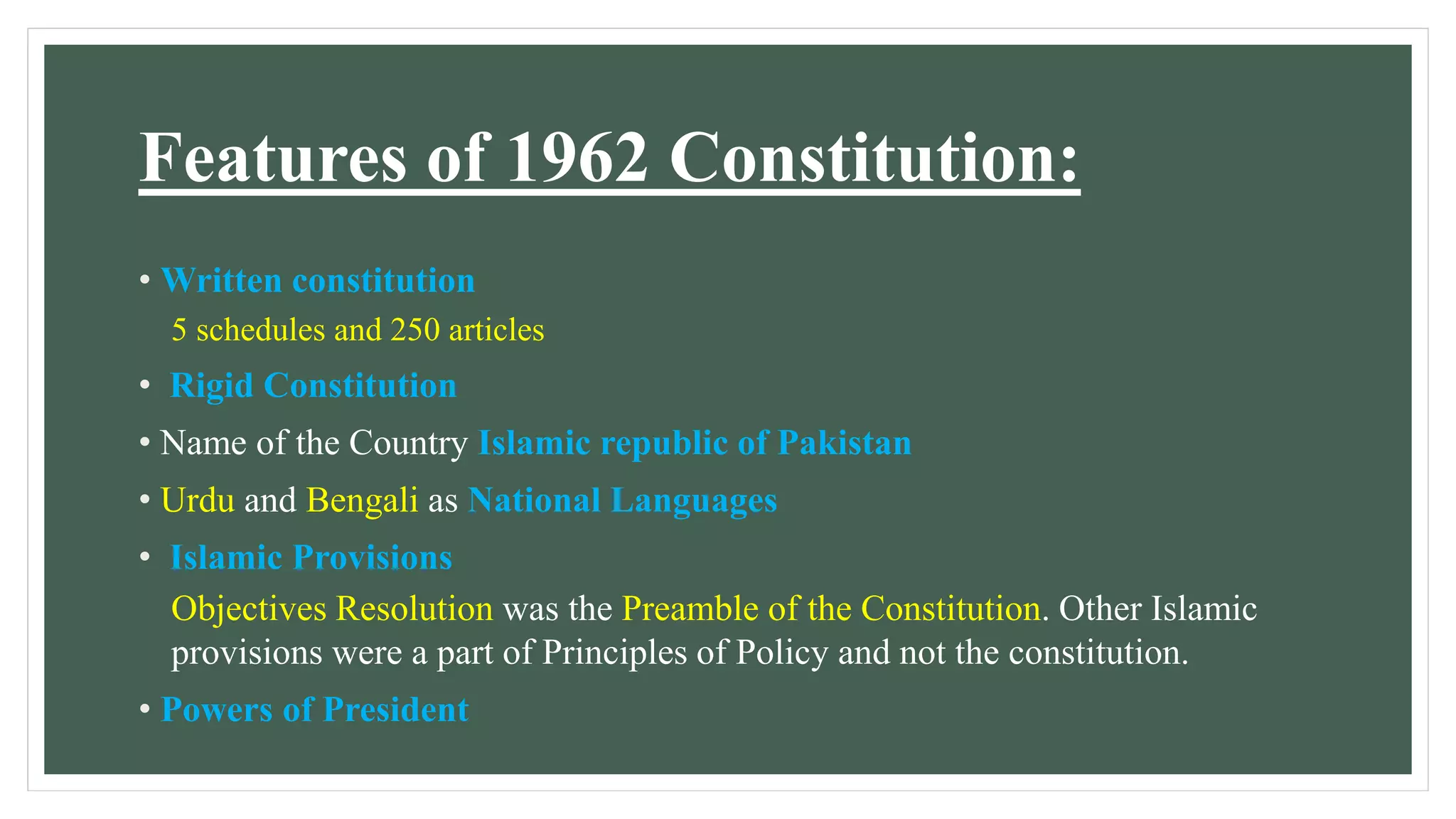
Features of 1962 Constitution:
• Written constitution
5 schedules and 250 articles
• Rigid Constitution
• Name of the Country Islamic republic of Pakistan
• Urdu and Bengali as National Languages
• Islamic Provisions
Objectives Resolution was the Preamble of the Constitution. Other Islamic
provisions were a part of Principles of Policy and not the constitution.
• Powers of President
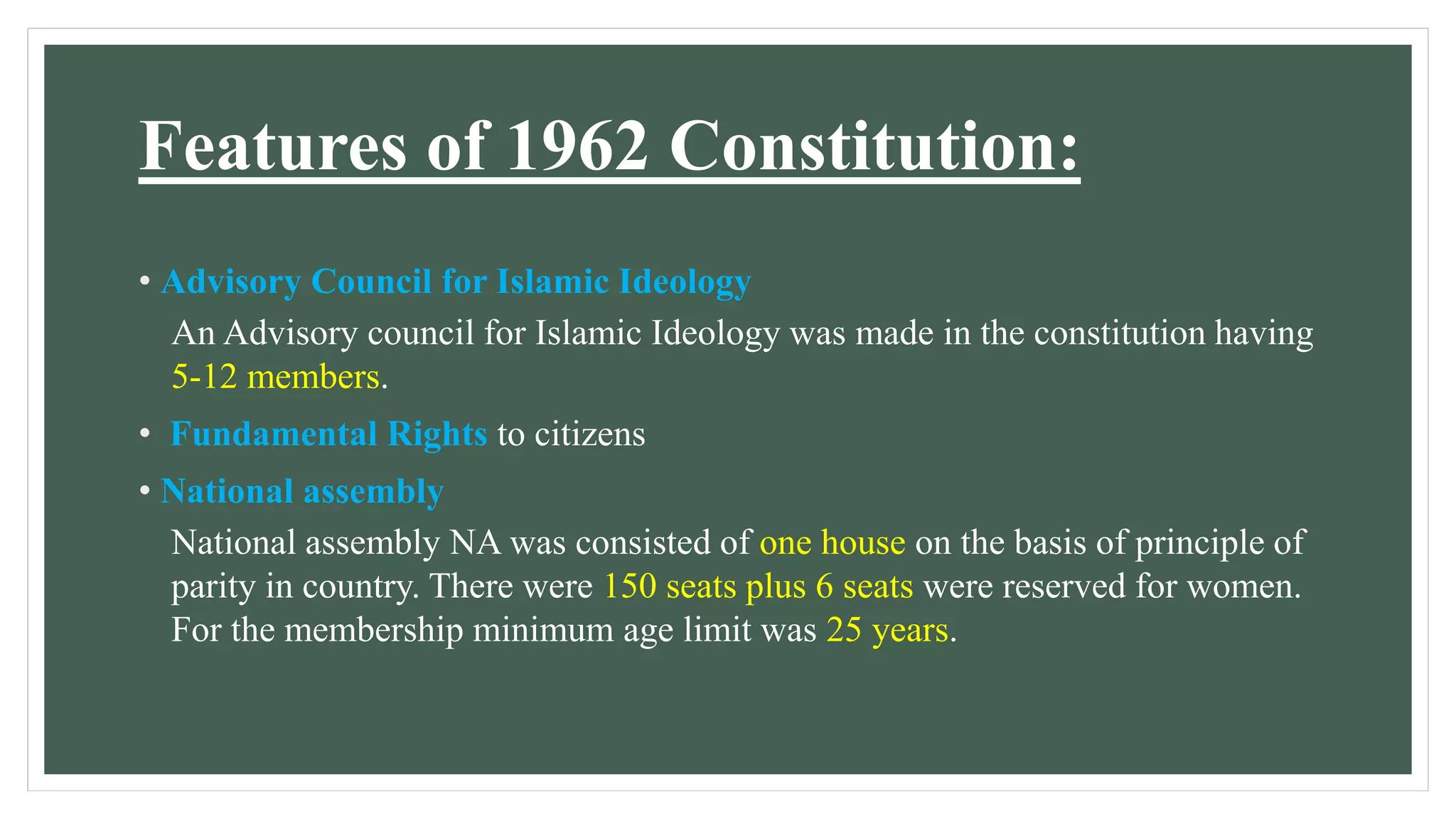
Features of 1962 Constitution:
• Advisory Council for Islamic Ideology
An Advisory council for Islamic Ideology was made in the constitution having
5-12 members.
• Fundamental Rights to citizens
• National assembly
National assembly NA was consisted of one house on the basis of principle of
parity in country. There were 150 seats plus 6 seats were reserved for women.
For the membership minimum age limit was 25 years.
Features of 1962 Constitution:
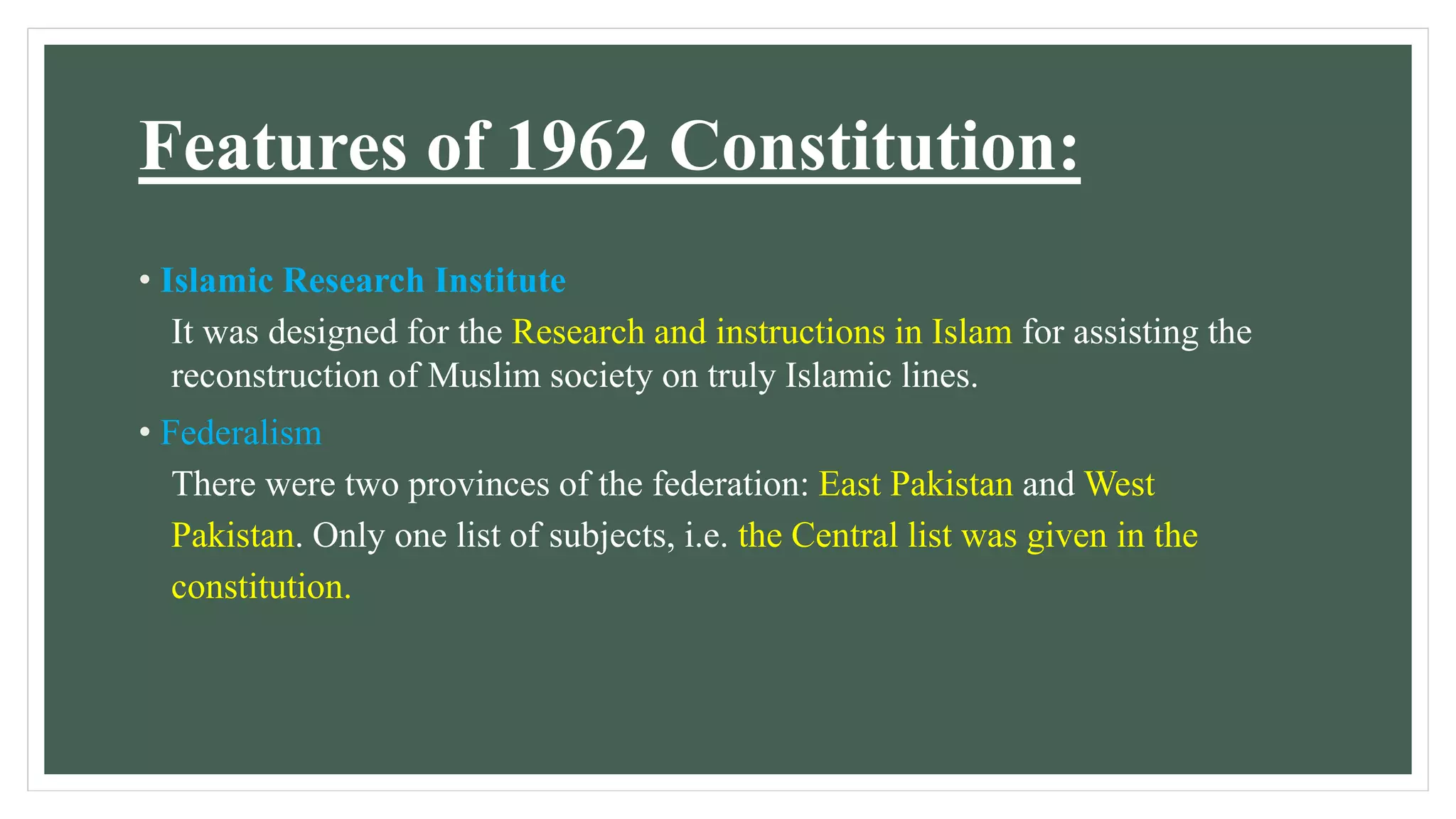
• Islamic Research Institute
It was designed for the Research and instructions in Islam for assisting the
reconstruction of Muslim society on truly Islamic lines.
• Federalism
There were two provinces of the federation: East Pakistan and West
Pakistan. Only one list of subjects, i.e. the Central list was given in the
constitution.
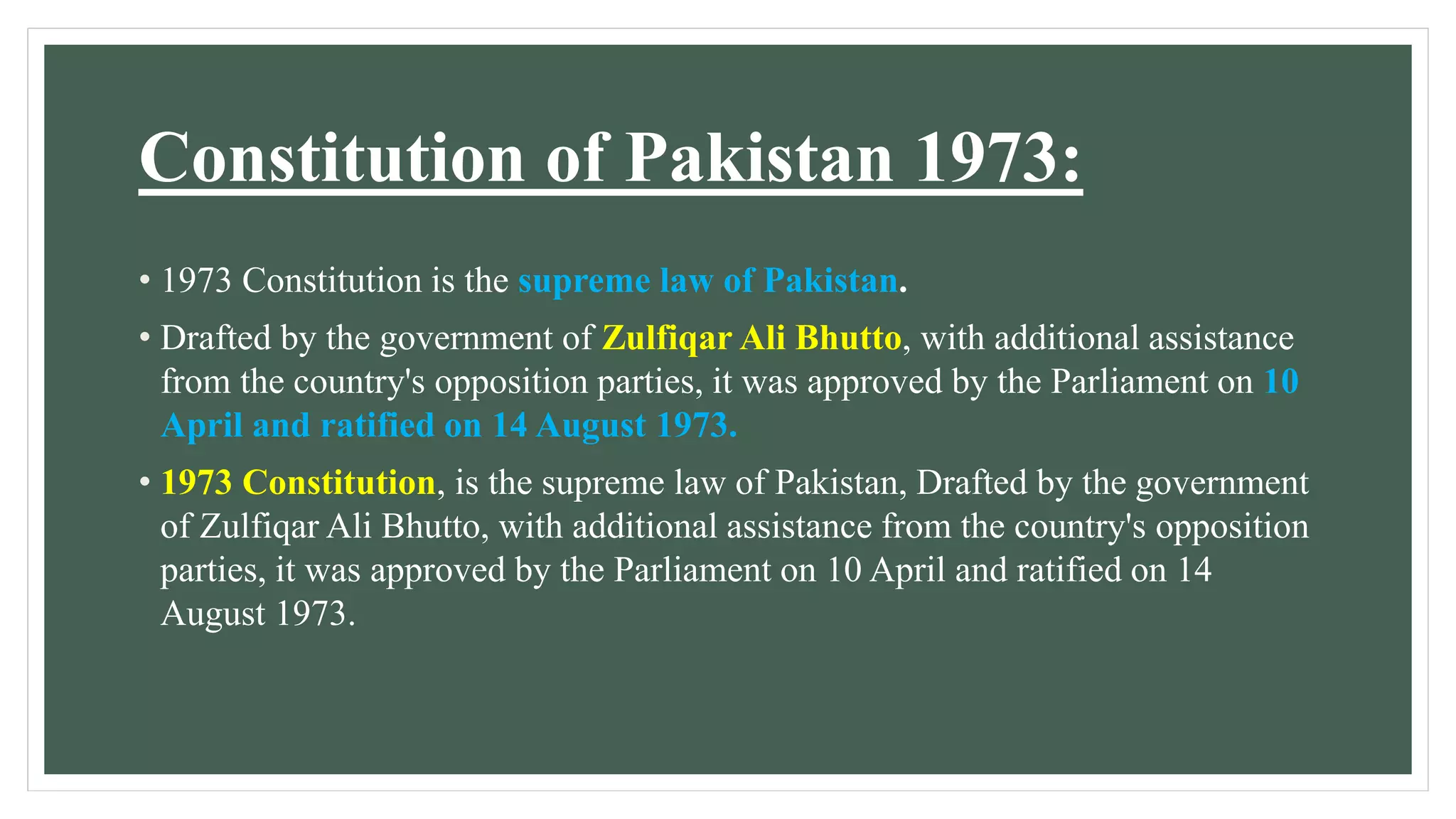
Constitution of Pakistan 1973:
• 1973 Constitution is the supreme law of Pakistan.
• Drafted by the government of Zulfiqar Ali Bhutto, with additional assistance
from the country's opposition parties, it was approved by the Parliament on 10
April and ratified on 14 August 1973.
• 1973 Constitution, is the supreme law of Pakistan, Drafted by the government
of Zulfiqar Ali Bhutto, with additional assistance from the country's opposition
parties, it was approved by the Parliament on 10 April and ratified on 14
August 1973.
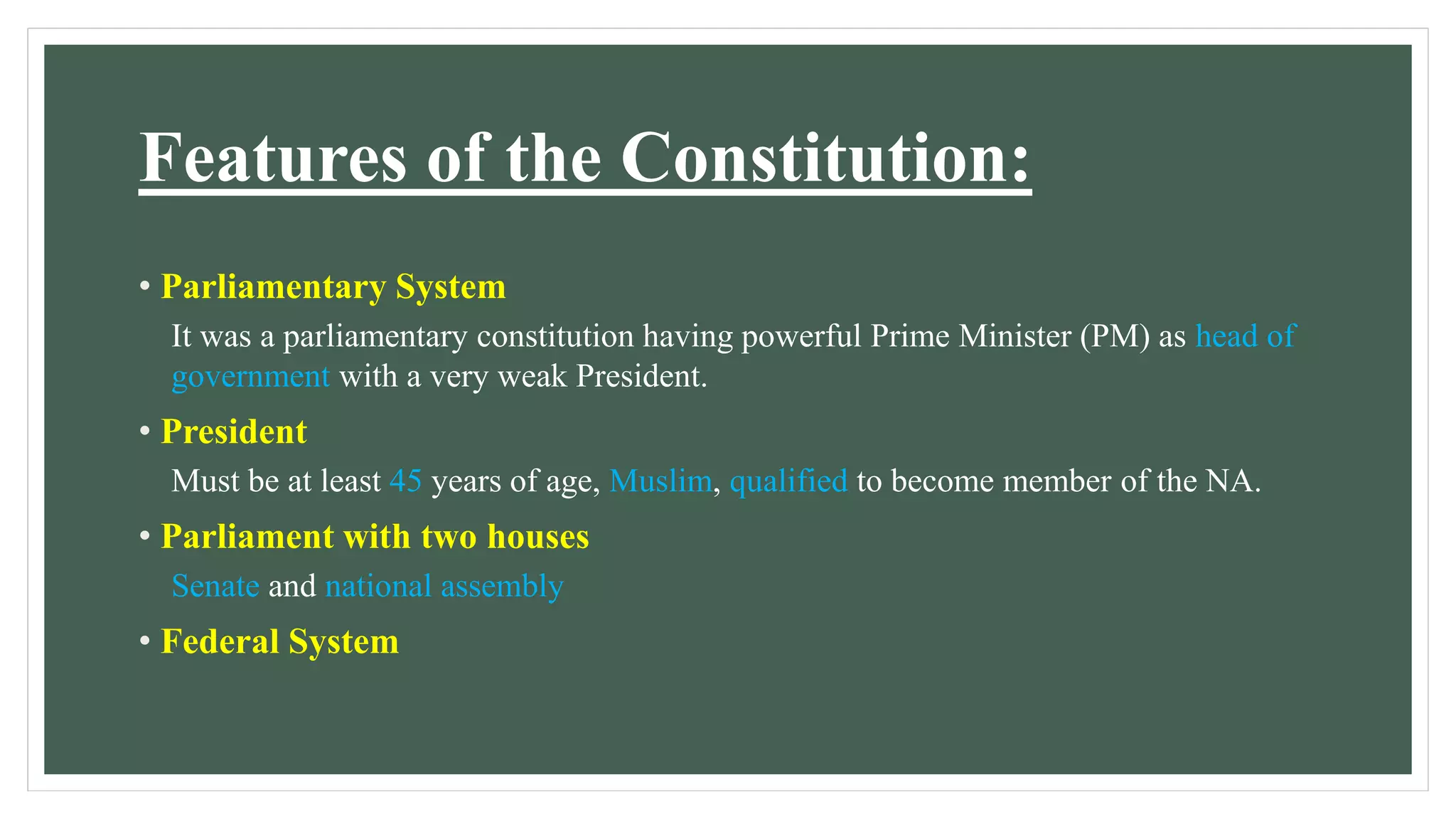
Features of the Constitution:
• Parliamentary System
It was a parliamentary constitution having powerful Prime Minister (PM) as head of
government with a very weak President.
• President
Must be at least 45 years of age, Muslim, qualified to become member of the NA.
• Parliament with two houses
Senate and national assembly
• Federal System
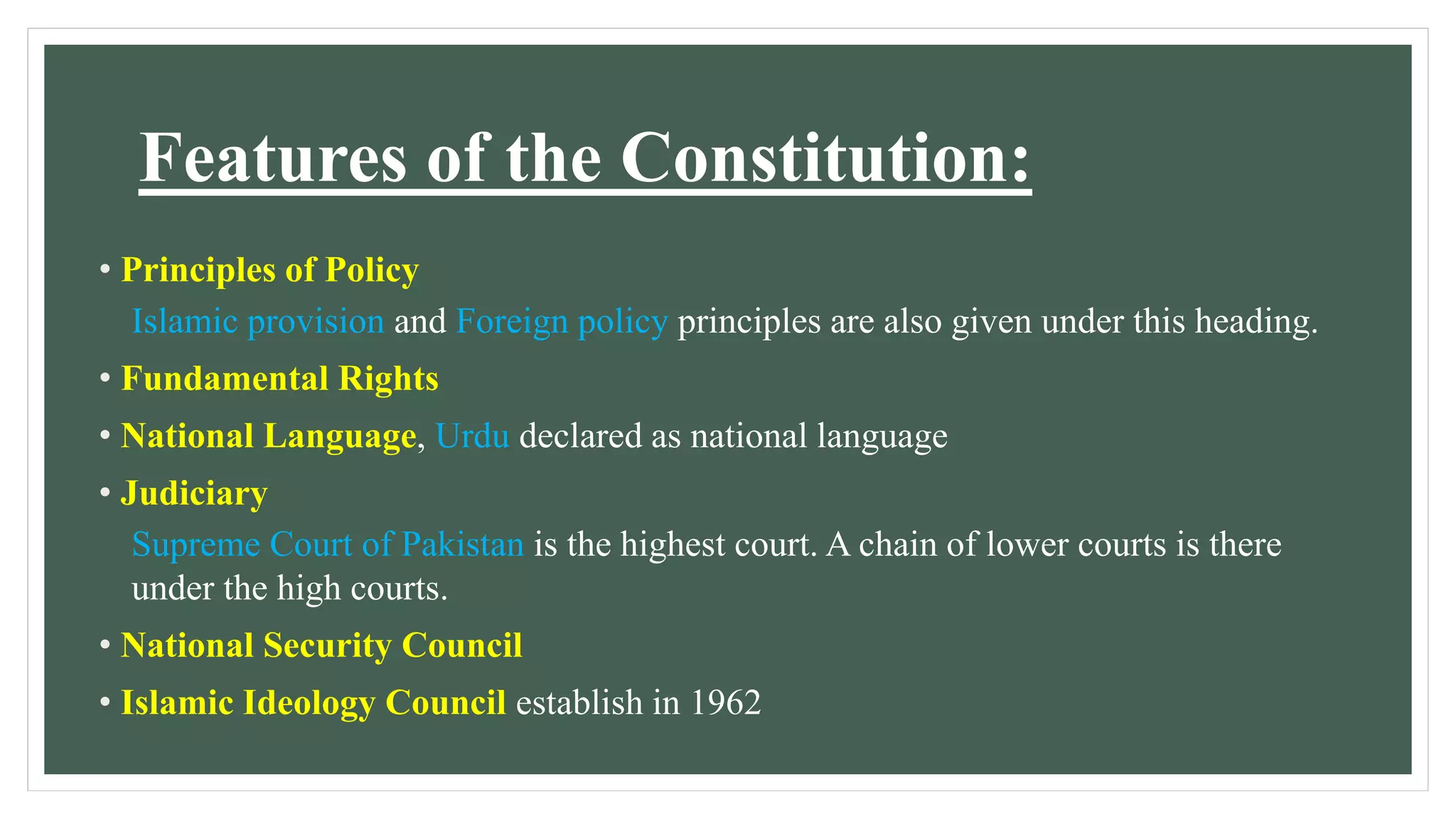
Features of the Constitution:
• Principles of Policy
Islamic provision and Foreign policy principles are also given under this heading.
• Fundamental Rights
• National Language, Urdu declared as national language
• Judiciary
Supreme Court of Pakistan is the highest court. A chain of lower courts is there
under the high courts.
• National Security Council
• Islamic Ideology Council establish in 1962
Objective resolution, 3 constitution of pakistan

Objective resolution, 3 constitution of pakistan

  • 1.
    “Pakistan studies” Objective resolutionwith constituent of Pakistan
  • 2.
    Objective resolution (1949): TheObjectives Resolution was the first constitutional document that proved to be the ‘foundation’ of the constitutional developments in Pakistan. This resolution was moved in the constituent assembly by Mr. Liaquat Ali Khan, the prime minister of Pakistan in March 1949. It specify the objective and important features of the future of the constituent of Pakistan. The members from the districts that became part of Pakistan were declared members of the Constituent Assembly.
  • 3.
    The Constituent Assembly(1947-54): The first Constituent Assembly came into existence under Indian Independence Act 1947. The elections were held in July 1946 to decide the destiny of the All India Muslim League (AIML)’s claim that it is the only representative party of the Indian Muslims that desire separate homeland, Pakistan. The number of such members was 69. It increased to 79 after the 1947 when some states joined Pakistan and then increase in the population. There were two major parties, Muslim League and Congress in the Assembly at that time. This Assembly had dual functions to perform.
  • 4.
    Features of theObjectives Resolution: • Sovereignty of the entire Universe belongs to Allah alone • Authority should be delegated to the State through its people under the rules set by Allah • Constitution of Pakistan should be framed by the Constituent Assembly • State should exercise its powers through the chosen representatives • Principles of democracy, freedom, equality, tolerance and social justice, as inshore by Islam should be followed • Muslims shall live their lives according the teaching of Quran and Sunnah • Minorities can freely profess and practice their religion.
  • 5.
    Features of theObjectives Resolution: • There should be Federal form of government with the maximum autonomy for the Units • Fundamental rights including equality of status, of opportunity and before law, social, economic and political justice, and freedom of thought, expression, belief, faith, worship and association, subject to law and public morality should be given to all the citizens of the state. • It would be the duty of the state to safeguard the interests of minorities, backward and depressed classes. • Independence of judiciary should be guaranteed • Integrity of the territory and sovereignty of the country was to be safeguarded.
  • 6.
    Objections by Non-Muslims: •The major objection by the Non-Muslims was that the government was trying to mix the religion and politics that was against the spirit of democracy. • The non-Muslims objected on the ‘Sovereignty of Allah’ and minorities’ rights, saying it would promote inequality in the society. They were also of view that Sharia was not adequate for the modern time. • They feared that it would encourage the religious extremists to work for the establishment of a ‘theocratic state.’
  • 7.
    Constituention of Pakistan1956: • The first constituent was approved on January 29, 1959 and enforced on March 23, 1956. With this Pakistan had become an Islamic republic. • The Constitution of 1956 was passed after long deliberations. It replaced the Interim Constitution. • It has 234 Articles and 6 Schedules. • It declared that the name of the country would be the Islamic Republic of Pakistan
  • 8.
    Features of constitution1956: • Written Constitution • Islamic Republic of Pakistan as a name of country • Objectives Resolution as a preamble • Federal System Powers was divided between the center and the provinces. The subjects were divided into three lists; The Federal List, The Provincial List, and the Concurrent List. • Unicameral Legislature
  • 9.
    Features of constitution1956: • parliamentary system A parliamentary system was adopted, according to it the president was the head of state and the Prime Minister the head of government. • Islamic Law No law can be made to violate Islamic principles and teachings. • Urdu & Bengali as a national language
  • 10.
    Constituent of Pakistan1962: • The country became a republic when its first constitution was approved in 1956 but this was abrogated in 1958 after when when the President of Pakistan Iskander Mirza abrogated the Constitution of Pakistan and declared martial law Pakistan's second constitution was approved in 1962. • It granted executive power to the president and abolished the office of the prime minister. • Military took over on 7 October 1958 and consequently Ayub Khan became Chief Martial Law Administrator. • The government introduced Basic Democracies in October 1959.
  • 11.
    Constituent of Pakistan1962: • Under this system Forty Thousand basic democrats (local councilors) were to be elected in each province. They have to perform functions as local government and their role in developmental work. They also acted as an electoral college for the election of president and the national assembly. • Elections for the Basic Democracies (BD) were held in December 1959 and January 1960. • Ayub introduced the system of “basic democracies” in 1960. It consisted of a network of local self-governing bodies to provide a link between the government and the people.
  • 12.
    Features of 1962Constitution: • Written constitution 5 schedules and 250 articles • Rigid Constitution • Name of the Country Islamic republic of Pakistan • Urdu and Bengali as National Languages • Islamic Provisions Objectives Resolution was the Preamble of the Constitution. Other Islamic provisions were a part of Principles of Policy and not the constitution. • Powers of President
  • 13.
    Features of 1962Constitution: • Advisory Council for Islamic Ideology An Advisory council for Islamic Ideology was made in the constitution having 5-12 members. • Fundamental Rights to citizens • National assembly National assembly NA was consisted of one house on the basis of principle of parity in country. There were 150 seats plus 6 seats were reserved for women. For the membership minimum age limit was 25 years.
  • 14.
    Features of 1962Constitution: • Islamic Research Institute It was designed for the Research and instructions in Islam for assisting the reconstruction of Muslim society on truly Islamic lines. • Federalism There were two provinces of the federation: East Pakistan and West Pakistan. Only one list of subjects, i.e. the Central list was given in the constitution.
  • 15.
    Constitution of Pakistan1973: • 1973 Constitution is the supreme law of Pakistan. • Drafted by the government of Zulfiqar Ali Bhutto, with additional assistance from the country's opposition parties, it was approved by the Parliament on 10 April and ratified on 14 August 1973. • 1973 Constitution, is the supreme law of Pakistan, Drafted by the government of Zulfiqar Ali Bhutto, with additional assistance from the country's opposition parties, it was approved by the Parliament on 10 April and ratified on 14 August 1973.
  • 16.
    Features of theConstitution: • Parliamentary System It was a parliamentary constitution having powerful Prime Minister (PM) as head of government with a very weak President. • President Must be at least 45 years of age, Muslim, qualified to become member of the NA. • Parliament with two houses Senate and national assembly • Federal System
  • 17.
    Features of theConstitution: • Principles of Policy Islamic provision and Foreign policy principles are also given under this heading. • Fundamental Rights • National Language, Urdu declared as national language • Judiciary Supreme Court of Pakistan is the highest court. A chain of lower courts is there under the high courts. • National Security Council • Islamic Ideology Council establish in 1962