By: Saif Khalid khan Kakar
Lecturer (Civics/Pol. Sci)
Pakistan Education Center
 Administrative structure of Pakistan is based on the
constitution of 1973, which clearly States in part 1:
1. Under article number 1, clause 1 that Pakistan shall be a
federal Republic and will be called the Islamic Republic of
Pakistan.
2. In clause 2 States that territories included in Pakistan are:
Paragraph (a) provinces of Baluchistan, kpk, Punjab and
Sindh.
Paragraph (b) Islamabad capital territory
Paragraph (c) federally administered tribal areas
Paragraph (d) such states and territories as or may be
included in Pakistan by accession or otherwise.
3. Part II article 7 defines the state as:
“The state means the Federal government , Majlis e
shoora/parliament provincial government, a provincial
assembly and such local or other authorities in Pakistan as are
by law empowered to impose any tax or cess.”
4. Part II chapter 2 (article 29-40) Lays down the principle
of policy for the Federal government. Which includes:
 enabling the Muslims of Pakistan individually and
collectively to order their lives in accordance with the
fundamental principles and Basic concept of Islam
 promotion of local government institutions
 parochial dissimilarity and prejudices to be
discouraged
 full participation of women in National life
 protection of minorities
 promotion of Social justice and eradication of social
evils........etc
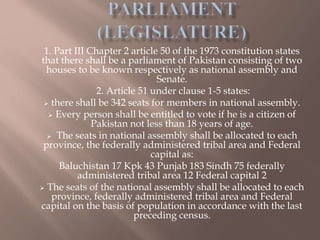
1. Part III Chapter 2 article 50 of the 1973 constitution states
that there shall be a parliament of Pakistan consisting of two
houses to be known respectively as national assembly and
Senate.
2. Article 51 under clause 1-5 states:
 there shall be 342 seats for members in national assembly.
 Every person shall be entitled to vote if he is a citizen of
Pakistan not less than 18 years of age.
 The seats in national assembly shall be allocated to each
province, the federally administered tribal area and Federal
capital as:
Baluchistan 17 Kpk 43 Punjab 183 Sindh 75 federally
administered tribal area 12 Federal capital 2
 The seats of the national assembly shall be allocated to each
province, federally administered tribal area and Federal
capital on the basis of population in accordance with the last
preceding census.
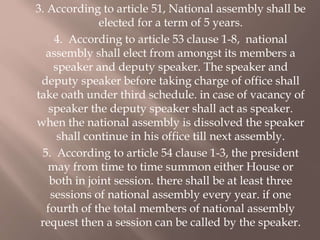
3. According to article 51, National assembly shall be
elected for a term of 5 years.
4. According to article 53 clause 1-8, national
assembly shall elect from amongst its members a
speaker and deputy speaker. The speaker and
deputy speaker before taking charge of office shall
take oath under third schedule. in case of vacancy of
speaker the deputy speaker shall act as speaker.
when the national assembly is dissolved the speaker
shall continue in his office till next assembly.
5. According to article 54 clause 1-3, the president
may from time to time summon either House or
both in joint session. there shall be at least three
sessions of national assembly every year. if one
fourth of the total members of national assembly
request then a session can be called by the speaker.
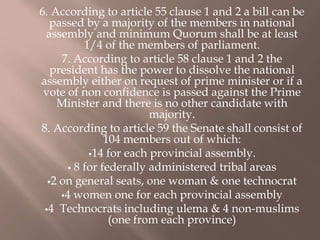
6. According to article 55 clause 1 and 2 a bill can be
passed by a majority of the members in national
assembly and minimum Quorum shall be at least
1/4 of the members of parliament.
7. According to article 58 clause 1 and 2 the
president has the power to dissolve the national
assembly either on request of prime minister or if a
vote of non confidence is passed against the Prime
Minister and there is no other candidate with
majority.
8. According to article 59 the Senate shall consist of
104 members out of which:
14 for each provincial assembly.
 8 for federally administered tribal areas
2 on general seats, one woman & one technocrat
4 women one for each provincial assembly
4 Technocrats including ulema & 4 non-muslims
(one from each province)
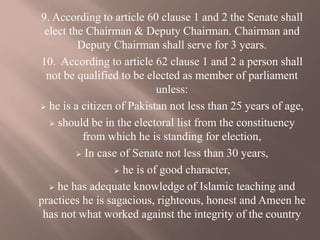
9. According to article 60 clause 1 and 2 the Senate shall
elect the Chairman & Deputy Chairman. Chairman and
Deputy Chairman shall serve for 3 years.
10. According to article 62 clause 1 and 2 a person shall
not be qualified to be elected as member of parliament
unless:
 he is a citizen of Pakistan not less than 25 years of age,
 should be in the electoral list from the constituency
from which he is standing for election,
 In case of Senate not less than 30 years,
 he is of good character,
 he has adequate knowledge of Islamic teaching and
practices he is sagacious, righteous, honest and Ameen he
has not what worked against the integrity of the country

Administrative structure and legislature

  • 1.
    By: Saif Khalidkhan Kakar Lecturer (Civics/Pol. Sci) Pakistan Education Center
  • 3.
     Administrative structureof Pakistan is based on the constitution of 1973, which clearly States in part 1: 1. Under article number 1, clause 1 that Pakistan shall be a federal Republic and will be called the Islamic Republic of Pakistan. 2. In clause 2 States that territories included in Pakistan are: Paragraph (a) provinces of Baluchistan, kpk, Punjab and Sindh. Paragraph (b) Islamabad capital territory Paragraph (c) federally administered tribal areas Paragraph (d) such states and territories as or may be included in Pakistan by accession or otherwise.
  • 4.
    3. Part IIarticle 7 defines the state as: “The state means the Federal government , Majlis e shoora/parliament provincial government, a provincial assembly and such local or other authorities in Pakistan as are by law empowered to impose any tax or cess.” 4. Part II chapter 2 (article 29-40) Lays down the principle of policy for the Federal government. Which includes:  enabling the Muslims of Pakistan individually and collectively to order their lives in accordance with the fundamental principles and Basic concept of Islam  promotion of local government institutions  parochial dissimilarity and prejudices to be discouraged  full participation of women in National life  protection of minorities  promotion of Social justice and eradication of social evils........etc
  • 5.
    1. Part IIIChapter 2 article 50 of the 1973 constitution states that there shall be a parliament of Pakistan consisting of two houses to be known respectively as national assembly and Senate. 2. Article 51 under clause 1-5 states:  there shall be 342 seats for members in national assembly.  Every person shall be entitled to vote if he is a citizen of Pakistan not less than 18 years of age.  The seats in national assembly shall be allocated to each province, the federally administered tribal area and Federal capital as: Baluchistan 17 Kpk 43 Punjab 183 Sindh 75 federally administered tribal area 12 Federal capital 2  The seats of the national assembly shall be allocated to each province, federally administered tribal area and Federal capital on the basis of population in accordance with the last preceding census.
  • 6.
    3. According toarticle 51, National assembly shall be elected for a term of 5 years. 4. According to article 53 clause 1-8, national assembly shall elect from amongst its members a speaker and deputy speaker. The speaker and deputy speaker before taking charge of office shall take oath under third schedule. in case of vacancy of speaker the deputy speaker shall act as speaker. when the national assembly is dissolved the speaker shall continue in his office till next assembly. 5. According to article 54 clause 1-3, the president may from time to time summon either House or both in joint session. there shall be at least three sessions of national assembly every year. if one fourth of the total members of national assembly request then a session can be called by the speaker.
  • 7.
    6. According toarticle 55 clause 1 and 2 a bill can be passed by a majority of the members in national assembly and minimum Quorum shall be at least 1/4 of the members of parliament. 7. According to article 58 clause 1 and 2 the president has the power to dissolve the national assembly either on request of prime minister or if a vote of non confidence is passed against the Prime Minister and there is no other candidate with majority. 8. According to article 59 the Senate shall consist of 104 members out of which: 14 for each provincial assembly.  8 for federally administered tribal areas 2 on general seats, one woman & one technocrat 4 women one for each provincial assembly 4 Technocrats including ulema & 4 non-muslims (one from each province)
  • 8.
    9. According toarticle 60 clause 1 and 2 the Senate shall elect the Chairman & Deputy Chairman. Chairman and Deputy Chairman shall serve for 3 years. 10. According to article 62 clause 1 and 2 a person shall not be qualified to be elected as member of parliament unless:  he is a citizen of Pakistan not less than 25 years of age,  should be in the electoral list from the constituency from which he is standing for election,  In case of Senate not less than 30 years,  he is of good character,  he has adequate knowledge of Islamic teaching and practices he is sagacious, righteous, honest and Ameen he has not what worked against the integrity of the country