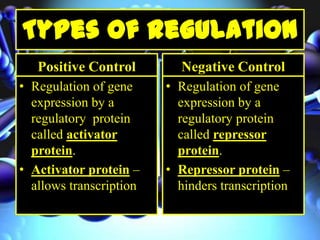
Positive Control
• Regulation of gene
expression by a
regulatory protein
called activator
protein.
• Activator protein –
allows transcription
Negative Control
• Regulation of gene
expression by a
regulatory protein
called repressor
protein.
• Repressor protein –
hinders transcription
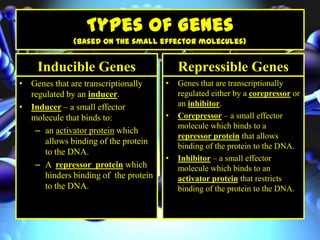
Types of Genes
(based on the small effector molecules)
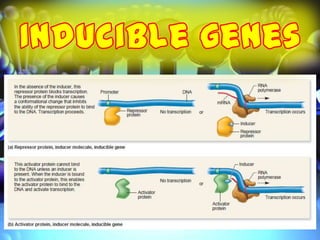
Inducible Genes
• Genes that are transcriptionally
regulated by an inducer.
• Inducer – a small effector
molecule that binds to:
– an activator protein which
allows binding of the protein
to the DNA.
– A repressor protein which
hinders binding of the protein
to the DNA.
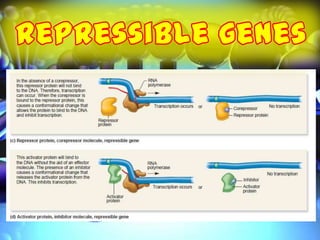
Repressible Genes
• Genes that are transcriptionally
regulated either by a corepressor or
an inhibitor.
• Corepressor – a small effector
molecule which binds to a
repressor protein that allows
binding of the protein to the DNA.
• Inhibitor – a small effector
molecule which binds to an
activator protein that restricts
binding of the protein to the DNA.
Definition and Discovery
Definition
• Refers to two or more
contigious genes and the
genetic elements that
regulate their transcription
in a coordinate fashion
• Consists of
promoter, operator, and
structural genes
• Encodes proteins (enzymes)
that have common function
Discovery
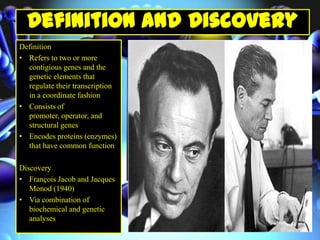
• François Jacob and Jacques
Monod (1940)
• Via combination of
biochemical and genetic
analyses
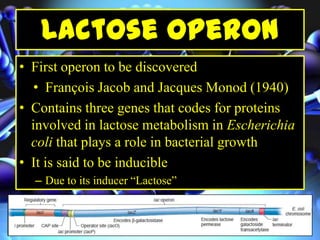
Lactose operon
• First operon to be discovered
• François Jacob and Jacques Monod (1940)
• Contains three genes that codes for proteins
involved in lactose metabolism in Escherichia
coli that plays a role in bacterial growth
• It is said to be inducible
– Due to its inducer “Lactose”
Components of the Lac Region
• Regulatory gene (LacI)
– Expresses the Lac repressor
• A regulatory protein of Lac Operon
• Responsible for the Negative Control of Lac Operon
• Lac Operon
– CAP site
• The binding site of CAP
– Catabolite Activator Protein
– Another regulatory protein of Lac Operon
– Responsible for the Positive Control of lac Operon
(Continuation)
– LacP
• Binding site of RNA Polymerase
– LacO
• Binding site of Lac repressor
– LacZ
• Encodes β-galactosidase
– LacY
• Encodes lactose permease
– LacA
• Encodes galactoside transacetylase
Lactose metabolism in Escherichia
coli
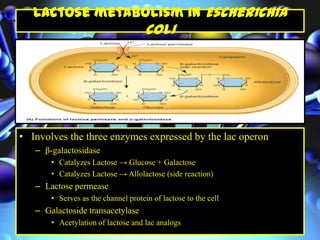
• Involves the three enzymes expressed by the lac operon
– β-galactosidase
• Catalyzes Lactose → Glucose + Galactose
• Catalyzes Lactose → Allolactose (side reaction)
– Lactose permease
• Serves as the channel protein of lactose to the cell
– Galactoside transacetylase
• Acetylation of lactose and lac analogs
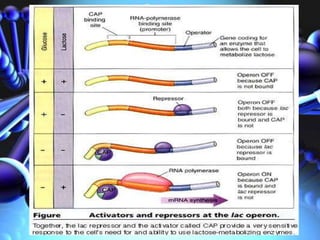
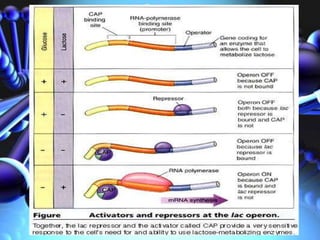
Negative Control
• Allosteric regulation
• Lac Repressor
– Responsible for the negative control of lac operon
– Presence of lactose and lac analogs
• Binding to the allosteric site
• Conformational change in the active site
• Hindrance of lac repressor binding
• Transcription occurs
– Absence of lactose and lac analogs
• Binding of lac repressor = No Transcription
Positive Control
• Catabolite repression
• CAP
– Catabolite Activator Protein
• Responsible for the positive control of lac operon
• Activated by cAMP (Cyclic Adenosine Monophosphate)
• Can be deactivated by glucose
– Inhibits adenylyl cyclase via glucose transport and a
signalling pathway
– Adenylyl cyclase catalyzes the conversion of ATP to cAMP
References
• Weaver RF. 2012. Molecular Biology 5th
Ed. New York: McGraw-Hill. 914 P.
• Karp G. 2010. Cell and Molecular Biology:
Concepts and Experiments 6th ed. New
Jersey: John Wiley & Sons, Inc. 837 P.
• Brooker RJ. 2012. Genetics: Analysis &
Principles 4th Ed. New York: McGraw-Hill.
868 P.
Lac operon

Lac operon

  • 4.
    Positive Control • Regulationof gene expression by a regulatory protein called activator protein. • Activator protein – allows transcription Negative Control • Regulation of gene expression by a regulatory protein called repressor protein. • Repressor protein – hinders transcription
  • 5.
    Types of Genes (basedon the small effector molecules) Inducible Genes • Genes that are transcriptionally regulated by an inducer. • Inducer – a small effector molecule that binds to: – an activator protein which allows binding of the protein to the DNA. – A repressor protein which hinders binding of the protein to the DNA. Repressible Genes • Genes that are transcriptionally regulated either by a corepressor or an inhibitor. • Corepressor – a small effector molecule which binds to a repressor protein that allows binding of the protein to the DNA. • Inhibitor – a small effector molecule which binds to an activator protein that restricts binding of the protein to the DNA.
  • 9.
    Definition and Discovery Definition •Refers to two or more contigious genes and the genetic elements that regulate their transcription in a coordinate fashion • Consists of promoter, operator, and structural genes • Encodes proteins (enzymes) that have common function Discovery • François Jacob and Jacques Monod (1940) • Via combination of biochemical and genetic analyses
  • 11.
    Lactose operon • Firstoperon to be discovered • François Jacob and Jacques Monod (1940) • Contains three genes that codes for proteins involved in lactose metabolism in Escherichia coli that plays a role in bacterial growth • It is said to be inducible – Due to its inducer “Lactose”
  • 13.
    Components of theLac Region • Regulatory gene (LacI) – Expresses the Lac repressor • A regulatory protein of Lac Operon • Responsible for the Negative Control of Lac Operon • Lac Operon – CAP site • The binding site of CAP – Catabolite Activator Protein – Another regulatory protein of Lac Operon – Responsible for the Positive Control of lac Operon
  • 14.
    (Continuation) – LacP • Bindingsite of RNA Polymerase – LacO • Binding site of Lac repressor – LacZ • Encodes β-galactosidase – LacY • Encodes lactose permease – LacA • Encodes galactoside transacetylase
  • 15.
    Lactose metabolism inEscherichia coli • Involves the three enzymes expressed by the lac operon – β-galactosidase • Catalyzes Lactose → Glucose + Galactose • Catalyzes Lactose → Allolactose (side reaction) – Lactose permease • Serves as the channel protein of lactose to the cell – Galactoside transacetylase • Acetylation of lactose and lac analogs
  • 17.
    Negative Control • Allostericregulation • Lac Repressor – Responsible for the negative control of lac operon – Presence of lactose and lac analogs • Binding to the allosteric site • Conformational change in the active site • Hindrance of lac repressor binding • Transcription occurs – Absence of lactose and lac analogs • Binding of lac repressor = No Transcription
  • 18.
    Positive Control • Cataboliterepression • CAP – Catabolite Activator Protein • Responsible for the positive control of lac operon • Activated by cAMP (Cyclic Adenosine Monophosphate) • Can be deactivated by glucose – Inhibits adenylyl cyclase via glucose transport and a signalling pathway – Adenylyl cyclase catalyzes the conversion of ATP to cAMP
  • 20.
    References • Weaver RF.2012. Molecular Biology 5th Ed. New York: McGraw-Hill. 914 P. • Karp G. 2010. Cell and Molecular Biology: Concepts and Experiments 6th ed. New Jersey: John Wiley & Sons, Inc. 837 P. • Brooker RJ. 2012. Genetics: Analysis & Principles 4th Ed. New York: McGraw-Hill. 868 P.