Safety and
tools
Lab Safety Notes
• BEHAVIOR IN THE LAB
• No horseplay or practical jokes in the lab
• Follow your teacher’s instruction and report problems to your
teacher immediately
• Read lab instructions and follow all procedures. Never conduct
unauthorized experiments.
• Do not eat or drink in a lab. Do not use lab equipment for eating or
drinking.
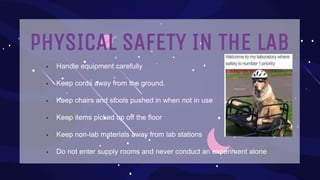
PHYSICAL SAFETY IN THE LAB
• Handle equipment carefully
• Keep cords away from the ground.
• Keep chairs and stools pushed in when not in use
• Keep items picked up off the floor
• Keep non-lab materials away from lab stations
• Do not enter supply rooms and never conduct an experiment alone
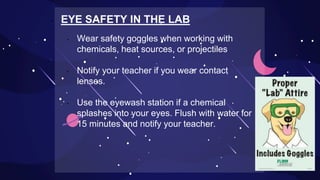
• EYE SAFETY IN THE LAB
• Wear safety goggles when working with
chemicals, heat sources, or projectiles
• Notify your teacher if you wear contact
lenses.
• Use the eyewash station if a chemical
splashes into your eyes. Flush with water for
15 minutes and notify your teacher.
SKIN SAFETY IN THE LAB
• Keep long hair tied back and avoid wearing dangling jewelry.
• Avoid loose clothing.
• Wear shoes that protect your entire foot.
• If a chemical comes into contact with your skin, rinse under water for 15
minutes and notify your teacher.
• Wash hands after every experiment or lab
HANDLING SHARPS IN THE LAB
• Handle all sharps carefully
• Always cut AWAY froom fingers and body
• Carry sharp objects with points and tips facing down and away.
Never try to catch a falling sharp object.
• Use the handles of sharp instruments for grasping.
• Notify your teacher if you are cut.
• Broken glass is to be cleaned up by your teacher. It does not go in
the trash can.
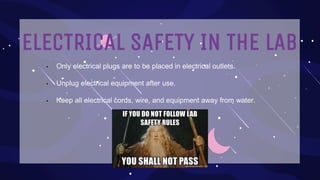
ELECTRICAL SAFETY IN THE LAB
• Only electrical plugs are to be placed in electrical outlets.
• Unplug electrical equipment after use.
• Keep all electrical cords, wire, and equipment away from water.
• HEAT SAFETY IN THE LAB
• Never look into a container you are heating
and never point the end of a test tube at
yourself or others
• Never heat a closed container
• Never leave a heat source unattended
• Use tongs or gloves to handle the equipment
that has been heated.
• Do not place hot glassware in cold water
CHEMICAL SAFETY IN THE LAB
• Read all labels before removing a chemical from the container. Consider all
chemicals dangerous.
• Only use the amount and type of chemical that is instructed by the directions.
• Never touch, taste, or smell chemicals unless instructed to do so by your
teacher.
• Never mix chemicals unless instructed to do so by your teacher.
• Keep lids on chemical containers when not in use.
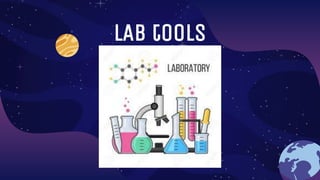
LAB tools
Scientific equipment
TOOL NAME TOOL USE TOOL PICTURE
Compound Light
Microscope
Used to enlarge an
image
Microscope Slide Supports an item being
examined under the
microscope
Beaker Holds liquids while they
are being stirred.
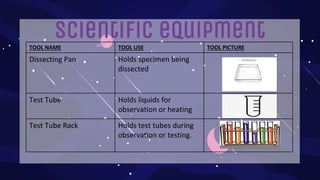
Scientific equipment
TOOL NAME TOOL USE TOOL PICTURE
Dissecting Pan Holds specimen being
dissected
Test Tube Holds liquids for
observation or heating
Test Tube Rack Holds test tubes during
observation or testing.
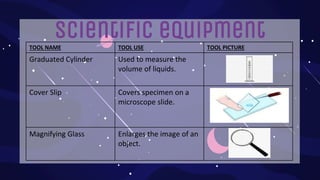
Scientific equipment
TOOL NAME TOOL USE TOOL PICTURE
Graduated Cylinder Used to measure the
volume of liquids.
Cover Slip Covers specimen on a
microscope slide.
Magnifying Glass Enlarges the image of an
object.
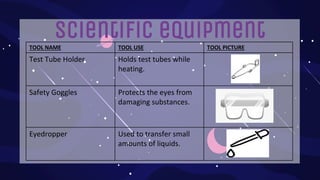
Scientific equipment
TOOL NAME TOOL USE TOOL PICTURE
Test Tube Holder Holds test tubes while
heating.
Safety Goggles Protects the eyes from
damaging substances.
Eyedropper Used to transfer small
amounts of liquids.
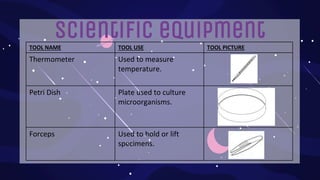
Scientific equipment
TOOL NAME TOOL USE TOOL PICTURE
Thermometer Used to measure
temperature.
Petri Dish Plate used to culture
microorganisms.
Forceps Used to hold or lift
specimens.
Scientific equipment
TOOL NAME TOOL USE TOOL PICTURE
Triple Beam Balance Used for getting the
mass of an object.
Erlenmeyer Flask Used to store solutions
Florence Flask Used to store liquids

Lab Safety and Tools

  • 1.
  • 3.
    Lab Safety Notes •BEHAVIOR IN THE LAB • No horseplay or practical jokes in the lab • Follow your teacher’s instruction and report problems to your teacher immediately • Read lab instructions and follow all procedures. Never conduct unauthorized experiments. • Do not eat or drink in a lab. Do not use lab equipment for eating or drinking.
  • 4.
    PHYSICAL SAFETY INTHE LAB • Handle equipment carefully • Keep cords away from the ground. • Keep chairs and stools pushed in when not in use • Keep items picked up off the floor • Keep non-lab materials away from lab stations • Do not enter supply rooms and never conduct an experiment alone
  • 5.
    • EYE SAFETYIN THE LAB • Wear safety goggles when working with chemicals, heat sources, or projectiles • Notify your teacher if you wear contact lenses. • Use the eyewash station if a chemical splashes into your eyes. Flush with water for 15 minutes and notify your teacher.
  • 6.
    SKIN SAFETY INTHE LAB • Keep long hair tied back and avoid wearing dangling jewelry. • Avoid loose clothing. • Wear shoes that protect your entire foot. • If a chemical comes into contact with your skin, rinse under water for 15 minutes and notify your teacher. • Wash hands after every experiment or lab
  • 7.
    HANDLING SHARPS INTHE LAB • Handle all sharps carefully • Always cut AWAY froom fingers and body • Carry sharp objects with points and tips facing down and away. Never try to catch a falling sharp object. • Use the handles of sharp instruments for grasping. • Notify your teacher if you are cut. • Broken glass is to be cleaned up by your teacher. It does not go in the trash can.
  • 8.
    ELECTRICAL SAFETY INTHE LAB • Only electrical plugs are to be placed in electrical outlets. • Unplug electrical equipment after use. • Keep all electrical cords, wire, and equipment away from water.
  • 9.
    • HEAT SAFETYIN THE LAB • Never look into a container you are heating and never point the end of a test tube at yourself or others • Never heat a closed container • Never leave a heat source unattended • Use tongs or gloves to handle the equipment that has been heated. • Do not place hot glassware in cold water
  • 10.
    CHEMICAL SAFETY INTHE LAB • Read all labels before removing a chemical from the container. Consider all chemicals dangerous. • Only use the amount and type of chemical that is instructed by the directions. • Never touch, taste, or smell chemicals unless instructed to do so by your teacher. • Never mix chemicals unless instructed to do so by your teacher. • Keep lids on chemical containers when not in use.
  • 12.
  • 13.
    Scientific equipment TOOL NAMETOOL USE TOOL PICTURE Compound Light Microscope Used to enlarge an image Microscope Slide Supports an item being examined under the microscope Beaker Holds liquids while they are being stirred.
  • 14.
    Scientific equipment TOOL NAMETOOL USE TOOL PICTURE Dissecting Pan Holds specimen being dissected Test Tube Holds liquids for observation or heating Test Tube Rack Holds test tubes during observation or testing.
  • 15.
    Scientific equipment TOOL NAMETOOL USE TOOL PICTURE Graduated Cylinder Used to measure the volume of liquids. Cover Slip Covers specimen on a microscope slide. Magnifying Glass Enlarges the image of an object.
  • 16.
    Scientific equipment TOOL NAMETOOL USE TOOL PICTURE Test Tube Holder Holds test tubes while heating. Safety Goggles Protects the eyes from damaging substances. Eyedropper Used to transfer small amounts of liquids.
  • 17.
    Scientific equipment TOOL NAMETOOL USE TOOL PICTURE Thermometer Used to measure temperature. Petri Dish Plate used to culture microorganisms. Forceps Used to hold or lift specimens.
  • 18.
    Scientific equipment TOOL NAMETOOL USE TOOL PICTURE Triple Beam Balance Used for getting the mass of an object. Erlenmeyer Flask Used to store solutions Florence Flask Used to store liquids