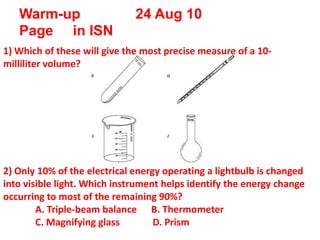
Warm-up              24 Aug 10Page     in ISN1) Which of these will give the most precise measure of a 10-milliliter volume?2) Only 10% of the electrical energy operating a lightbulbis changed into visible light. Which instrument helps identify the energy change occurring to most of the remaining 90%?	A. Triple-beam balance      B. Thermometer 				C. Magnifying glass          D. Prism
Safety Video
Lab Safety ReviewAccidents in the lab, as in the home or work place, can be prevented:Stop to think!Common sense will help, if exercisedWhat will be the consequences of what I do next?If in doubt, ask the teacher.
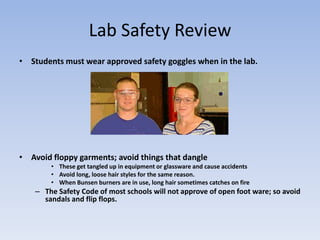
Lab Safety ReviewStudents must wear approved safety goggles when in the lab. Avoid floppy garments; avoid things that dangle   These get tangled up in equipment or glassware and cause accidentsAvoid long, loose hair styles for the same reason.When Bunsen burners are in use, long hair sometimes catches on fireThe Safety Code of most schools will not approve of open foot ware; so avoid sandals and flip flops.
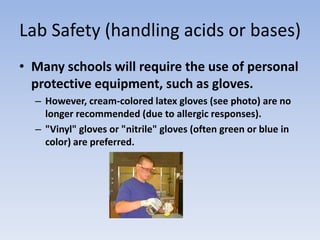
Lab Safety (handling acids or bases)Many schools will require the use of personal protective equipment, such as gloves. However, cream-colored latex gloves (see photo) are no longer recommended (due to allergic responses)."Vinyl" gloves or "nitrile" gloves (often green or blue in color) are preferred.
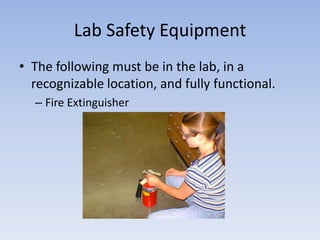
Lab Safety EquipmentThe following must be in the lab, in a recognizable location, and fully functional.Fire ExtinguisherFire Blanket
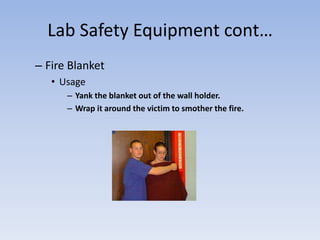
Lab Safety Equipment cont…Fire BlanketUsageYank the blanket out of the wall holder.Wrap it around the victim to smother the fire.
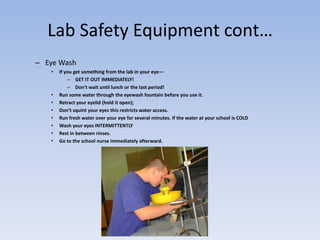
Lab Safety Equipment cont…Eye WashIf you get something from the lab in your eye—GET IT OUT IMMEDIATELY!Don't wait until lunch or the last period!Run some water through the eyewash fountain before you use it.Retract your eyelid (hold it open);Don’t squint your eyesthis restricts water access.Run fresh water over your eye for several minutes.If the water at your school is COLDWash your eyes INTERMITTENTLY Rest in between rinses.Go to the school nurse immediately afterward.
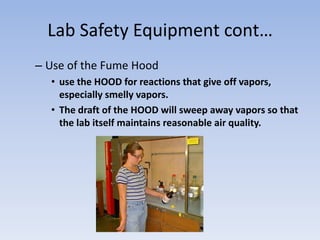
Lab Safety Equipment cont…Use of the Fume Hooduse the HOOD for reactions that give off vapors, especially smelly vapors.The draft of the HOOD will sweep away vapors so that the lab itself maintains reasonable air quality. 
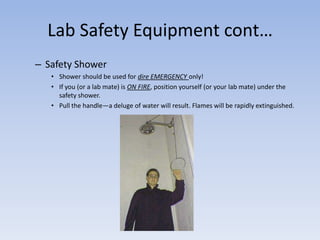
Lab Safety Equipment cont…Safety ShowerShower should be used for dire EMERGENCY only! If you (or a lab mate) is ON FIRE, position yourself (or your lab mate) under the safety shower. Pull the handle—a deluge of water will result. Flames will be rapidly extinguished.
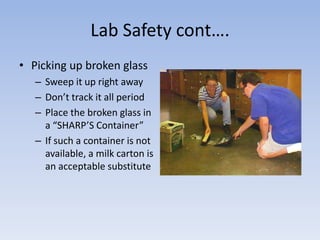
Lab Safety cont….Picking up broken glassSweep it up right awayDon’t track it all periodPlace the broken glass in a “SHARP’S Container”If such a container is not available, a milk carton is an acceptable substitute
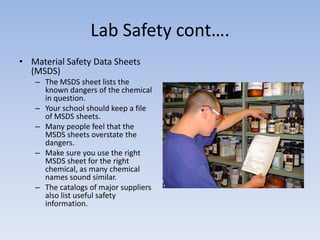
Lab Safety cont….Material Safety Data Sheets (MSDS)The MSDS sheet lists the known dangers of the chemical in question. Your school should keep a file of MSDS sheets. Many people feel that the MSDS sheets overstate the dangers. Make sure you use the right MSDS sheet for the right chemical, as many chemical names sound similar. The catalogs of major suppliers also list useful safety information.
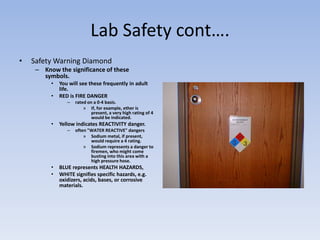
Lab Safety cont….Safety Warning DiamondKnow the significance of these symbols.You will see these frequently in adult life.RED is FIRE DANGERrated on a 0-4 basis.If, for example, ether is present, a very high rating of 4 would be indicated.Yellow indicates REACTIVITY danger.often "WATER REACTIVE" dangersSodium metal, if present, would require a 4 rating.Sodium represents a danger to firemen, who might come busting into this area with a high pressure hose.BLUE represents HEALTH HAZARDS,WHITE signifies specific hazards, e.g. oxidizers, acids, bases, or corrosive materials.
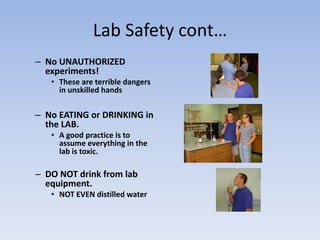
Lab Safety cont…No UNAUTHORIZED experiments!These are terrible dangers in unskilled handsNo EATING or DRINKING in the LAB.A good practice is to assume everything in the lab is toxic.DO NOT drink from lab equipment.NOT EVEN distilled water
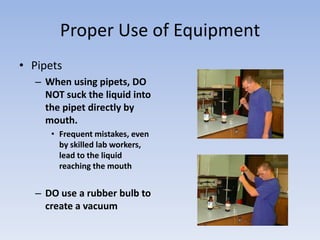
Proper Use of EquipmentPipetsWhen using pipets, DO NOT suck the liquid into the pipet directly by mouth.Frequent mistakes, even by skilled lab workers, lead to the liquid reaching the mouthDO use a rubber bulb to create a vacuum
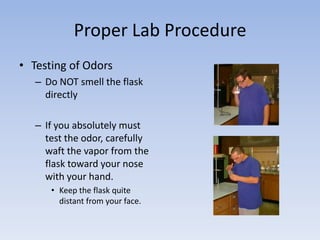
Proper Lab ProcedureTesting of OdorsDo NOT smell the flask directlyIf you absolutely must test the odor, carefully waft the vapor from the flask toward your nose with your hand. Keep the flask quite distant from your face.
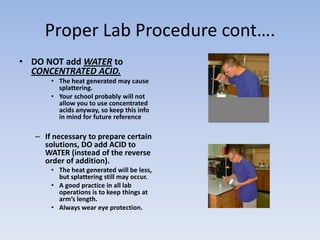
Proper Lab Procedure cont….DO NOT add WATER to CONCENTRATED ACID. The heat generated may cause splattering.Your school probably will not allow you to use concentrated acids anyway, so keep this info in mind for future referenceIf necessary to prepare certain solutions, DO add ACID to WATER (instead of the reverse order of addition).The heat generated will be less, but splattering still may occur.A good practice in all lab operations is to keep things at arm’s length.Always wear eye protection.
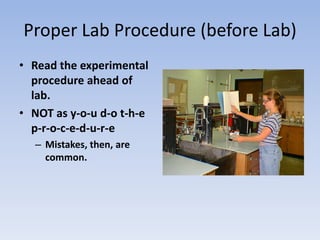
Proper Lab Procedure (before Lab)Read the experimental procedure ahead of lab.NOT as y-o-u d-o t-h-e p-r-o-c-e-d-u-r-e Mistakes, then, are common.
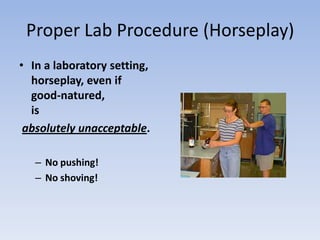
Proper Lab Procedure (Horseplay)In a laboratory setting, horseplay, even if good-natured, is                    absolutely unacceptable.No pushing!No shoving!
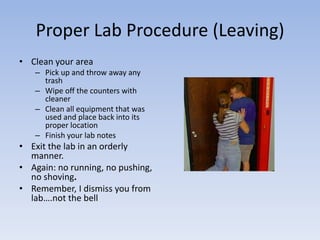
Proper Lab Procedure (Leaving)Clean your areaPick up and throw away any trashWipe off the counters with cleanerClean all equipment that was used and place back into its proper locationFinish your lab notesExit the lab in an orderly manner. Again: no running, no pushing, no shoving.Remember, I dismiss you from lab….not the bell
Safety Video

Lab Safety

  • 1.
    Warm-up 24 Aug 10Page in ISN1) Which of these will give the most precise measure of a 10-milliliter volume?2) Only 10% of the electrical energy operating a lightbulbis changed into visible light. Which instrument helps identify the energy change occurring to most of the remaining 90%? A. Triple-beam balance B. Thermometer C. Magnifying glass D. Prism
  • 2.
  • 3.
    Lab Safety ReviewAccidentsin the lab, as in the home or work place, can be prevented:Stop to think!Common sense will help, if exercisedWhat will be the consequences of what I do next?If in doubt, ask the teacher.
  • 4.
    Lab Safety ReviewStudentsmust wear approved safety goggles when in the lab. Avoid floppy garments; avoid things that dangle   These get tangled up in equipment or glassware and cause accidentsAvoid long, loose hair styles for the same reason.When Bunsen burners are in use, long hair sometimes catches on fireThe Safety Code of most schools will not approve of open foot ware; so avoid sandals and flip flops.
  • 5.
    Lab Safety (handlingacids or bases)Many schools will require the use of personal protective equipment, such as gloves. However, cream-colored latex gloves (see photo) are no longer recommended (due to allergic responses)."Vinyl" gloves or "nitrile" gloves (often green or blue in color) are preferred.
  • 6.
    Lab Safety EquipmentThefollowing must be in the lab, in a recognizable location, and fully functional.Fire ExtinguisherFire Blanket
  • 7.
    Lab Safety Equipmentcont…Fire BlanketUsageYank the blanket out of the wall holder.Wrap it around the victim to smother the fire.
  • 8.
    Lab Safety Equipmentcont…Eye WashIf you get something from the lab in your eye—GET IT OUT IMMEDIATELY!Don't wait until lunch or the last period!Run some water through the eyewash fountain before you use it.Retract your eyelid (hold it open);Don’t squint your eyesthis restricts water access.Run fresh water over your eye for several minutes.If the water at your school is COLDWash your eyes INTERMITTENTLY Rest in between rinses.Go to the school nurse immediately afterward.
  • 9.
    Lab Safety Equipmentcont…Use of the Fume Hooduse the HOOD for reactions that give off vapors, especially smelly vapors.The draft of the HOOD will sweep away vapors so that the lab itself maintains reasonable air quality. 
  • 10.
    Lab Safety Equipmentcont…Safety ShowerShower should be used for dire EMERGENCY only! If you (or a lab mate) is ON FIRE, position yourself (or your lab mate) under the safety shower. Pull the handle—a deluge of water will result. Flames will be rapidly extinguished.
  • 11.
    Lab Safety cont….Pickingup broken glassSweep it up right awayDon’t track it all periodPlace the broken glass in a “SHARP’S Container”If such a container is not available, a milk carton is an acceptable substitute
  • 12.
    Lab Safety cont….MaterialSafety Data Sheets (MSDS)The MSDS sheet lists the known dangers of the chemical in question. Your school should keep a file of MSDS sheets. Many people feel that the MSDS sheets overstate the dangers. Make sure you use the right MSDS sheet for the right chemical, as many chemical names sound similar. The catalogs of major suppliers also list useful safety information.
  • 13.
    Lab Safety cont….SafetyWarning DiamondKnow the significance of these symbols.You will see these frequently in adult life.RED is FIRE DANGERrated on a 0-4 basis.If, for example, ether is present, a very high rating of 4 would be indicated.Yellow indicates REACTIVITY danger.often "WATER REACTIVE" dangersSodium metal, if present, would require a 4 rating.Sodium represents a danger to firemen, who might come busting into this area with a high pressure hose.BLUE represents HEALTH HAZARDS,WHITE signifies specific hazards, e.g. oxidizers, acids, bases, or corrosive materials.
  • 14.
    Lab Safety cont…NoUNAUTHORIZED experiments!These are terrible dangers in unskilled handsNo EATING or DRINKING in the LAB.A good practice is to assume everything in the lab is toxic.DO NOT drink from lab equipment.NOT EVEN distilled water
  • 15.
    Proper Use ofEquipmentPipetsWhen using pipets, DO NOT suck the liquid into the pipet directly by mouth.Frequent mistakes, even by skilled lab workers, lead to the liquid reaching the mouthDO use a rubber bulb to create a vacuum
  • 16.
    Proper Lab ProcedureTestingof OdorsDo NOT smell the flask directlyIf you absolutely must test the odor, carefully waft the vapor from the flask toward your nose with your hand. Keep the flask quite distant from your face.
  • 17.
    Proper Lab Procedurecont….DO NOT add WATER to CONCENTRATED ACID. The heat generated may cause splattering.Your school probably will not allow you to use concentrated acids anyway, so keep this info in mind for future referenceIf necessary to prepare certain solutions, DO add ACID to WATER (instead of the reverse order of addition).The heat generated will be less, but splattering still may occur.A good practice in all lab operations is to keep things at arm’s length.Always wear eye protection.
  • 18.
    Proper Lab Procedure(before Lab)Read the experimental procedure ahead of lab.NOT as y-o-u d-o t-h-e p-r-o-c-e-d-u-r-e Mistakes, then, are common.
  • 19.
    Proper Lab Procedure(Horseplay)In a laboratory setting, horseplay, even if good-natured, is                    absolutely unacceptable.No pushing!No shoving!
  • 20.
    Proper Lab Procedure(Leaving)Clean your areaPick up and throw away any trashWipe off the counters with cleanerClean all equipment that was used and place back into its proper locationFinish your lab notesExit the lab in an orderly manner. Again: no running, no pushing, no shoving.Remember, I dismiss you from lab….not the bell
  • 21.