CELLS
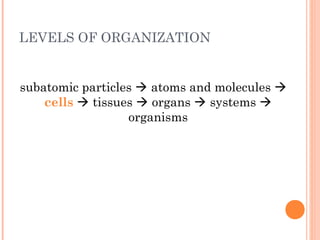
subatomic particles  atoms and molecules 
cells  tissues  organs  systems 
organisms
LEVELS OF ORGANIZATION
DISCOVERY OF CELLS
 Robert Hooke discovered cells in 1665.
 Anton Van Leeuwenhoek perfected the
construction of the compound microscope in
1674.
 Robert Brown discovered the nucleus of the
cell in 1831 and observed the streaming
movement of the cell’s cytoplasm (Brownian
movement).
DISCOVERY OF CELLS
 Felix Dujardin observed that cells are not
empty but are filled with thick, jelly-like
fluid in 1835.
 Johannes Purkinje named the jelly-like
fluid as protoplasm in 1839.
 Matthias Schleiden formulated the plant
cell theory in 1838.
 Theodor Schwann formulated the animal
cell theory in 1839.
 Rudolf Virchow concluded that all cells
must come from pre-existing cells in 1855.
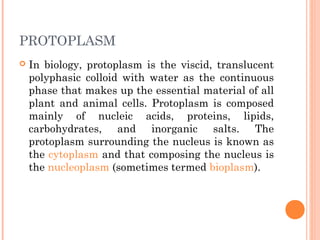
PROTOPLASM
 In biology, protoplasm is the viscid, translucent
polyphasic colloid with water as the continuous
phase that makes up the essential material of all
plant and animal cells. Protoplasm is composed
mainly of nucleic acids, proteins, lipids,
carbohydrates, and inorganic salts. The
protoplasm surrounding the nucleus is known as
the cytoplasm and that composing the nucleus is
the nucleoplasm (sometimes termed bioplasm).
DIFFERENCE BETWEEN THE
CYTOPLASM AND PROTOPLASM
 The main difference between the cytoplasm
and protoplasm is its content and function.
A protoplasm is the actual living substance
that composes the inside of the cell. A part of it
is the cytoplasm. The cytoplasm is the one that
surrounds the nucleus.
MODERN CELL THEORIES
1. All organisms are made up of cells and cell is
the basic structural unit of life.
(Matthias Schleiden and Theodor Schwann)
2. All cells must have come from pre-existing cells.
(Rudolf Virchow)
PROKARYOTIC CELL VS.
EUKARYOTIC CELL
DEFINITION OF
PROKARYOTES AND
EUKARYOTES
 Prokaryotes (from Old Greek pro- before + karyon nut
or kernel, referring to the cell nucleus, + suffix -otos, pl.
-otes; also spelled "procaryotes") are organisms without
a cell nucleus or any other membrane-bound organelles.
Most are unicellular, but some prokaryotes are
multicellular.
 Eukaryotes are organisms whose cells are organized
into complex structures by internal membranes and a
cytoskeleton. The most characteristic membrane bound
structure is the nucleus. This feature gives them their
name, (also spelled "eucaryote,") which comes from the
Greek ευ, meaning good/true, and karyon meaning nut,
refering to the nucleus. Animals, plants, fungi, and
protists are eukaryotes.
ATTRIBUTES OF
PROKARYOTIC CELL AND
EUKARYOTIC CELL
EUKARYOTIC CELL PROKARYOTIC CELL
Nucleus Present Absent
Number of
chromosomes
More than one
One--but not true
chromosome: Plasmids
Cell Type Usually multicellular
Usually unicellular (some
cyanobacteria may be
multicellular)
True
Membrane
bound Nucleus
Present Absent
Example Animals and Plants Bacteria
CONTINUATION…
EUKARYOTIC CELL PROKARYOTIC CELL
Lysosomes Present Absent
Microtubules Present Absent or rare
Endoplasmic
reticulum
Present Absent
Mitochondria Present Absent
Cytoskeleton Present May be absent
Ribosomes larger smaller
Vesicles Present Present
Golgi apparatus Present Absent
Chloroplasts Present (in plants)
Absent; chlorophyll
scattered in the cytoplasm
Vacuoles Present Present
Cell size 10-100um 1-10um
A PROKARYOTIC CELL
AN ANIMAL CELL
A PLANT CELL
CELL PARTS AND THEIR
FUNCTIONS
ORGANELLE LOCATION DESCRIPTION FUNCTION
cell wall plant *outer layer
*rigid, strong, stiff
*made of cellulose
*support (grow tall)
*protection
*allows H2O, O2, CO2
to pass into and out of
cell
cell membrane both plant
and animal
*plant - inside cell
wall
*animal - outer
layer; cholesterol
*selectively
permeable
*phospholipid
bilayer
*support & protection
*controls movement of
materials in/out of cell
*barrier between cell
and its environment
*maintains
homeostasis
Cell Wall
Cell Membrane
CONTINUATION…
ORGANELLE LOCATION DESCRIPTION FUNCTION
nucleus both plant
and animal
*large, oval *controls cell
activities
nuclear
membrane
both plant
and animal
*surrounds
nucleus
*selectively
permeable
*controls movement
of materials in/out of
nucleus
cytoplasm both plant
and animal
*clear, thick,
jellylike material
and organelles
found inside cell
membrane
*supports/protects
cell organelles
Nucleus Cytoplasm
CONTINUATION…
ORGANELLE LOCATION DESCRIPTION FUNCTION
ribosome both plant
and animal
*small bodies free
or attached to E.R.
*produces proteins
chloroplast plant *green, oval
usually containing
chlorophyll (green
pigment)
*uses energy from
sun to make food
for the plant
(photosynthesis)
vacuole plant -
few/large
animal -
small
*fluid-filled sacs *store food, water,
waste (plants need
to store large
amounts of food)
Vacuole
Chloroplast
Ribosome
CONTINUATION…
ORGANELLE LOCATION DESCRIPTION FUNCTION
lysosome plant -
uncommon
animal -
common
*small, round,
with a membrane
*breaks down larger
food molecules into
smaller molecules
*digests old cell parts
mitochondrion both plant
and animal
*bean-shaped
with inner
membranes
*breaks down sugar
molecules into energy
endoplasmic
reticulum
smooth ER
rough ER
both plant
and animal
*network of tubes
or membranes
*carries materials
through cell
*synthesizes lipids
*synthesizes proteins
Endoplasmic Reticulum
MitochondrionLysosome
CONTINUATION…
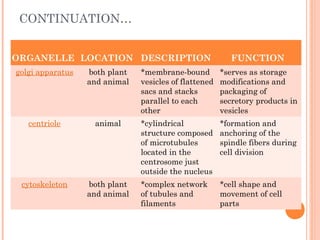
ORGANELLE LOCATION DESCRIPTION FUNCTION
golgi apparatus both plant
and animal
*membrane-bound
vesicles of flattened
sacs and stacks
parallel to each
other
*serves as storage
modifications and
packaging of
secretory products in
vesicles
centriole animal *cylindrical
structure composed
of microtubules
located in the
centrosome just
outside the nucleus
*formation and
anchoring of the
spindle fibers during
cell division
cytoskeleton both plant
and animal
*complex network
of tubules and
filaments
*cell shape and
movement of cell
parts
Golgi Apparatus Cytoskeleton
Centriole
ANIMAL CELL VS. PLANT CELL
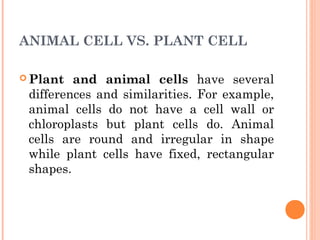
 Plant and animal cells have several
differences and similarities. For example,
animal cells do not have a cell wall or
chloroplasts but plant cells do. Animal
cells are round and irregular in shape
while plant cells have fixed, rectangular
shapes.
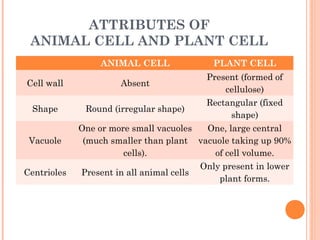
ATTRIBUTES OF
ANIMAL CELL AND PLANT CELL
ANIMAL CELL PLANT CELL
Cell wall Absent
Present (formed of
cellulose)
Shape Round (irregular shape)
Rectangular (fixed
shape)
Vacuole
One or more small vacuoles
(much smaller than plant
cells).
One, large central
vacuole taking up 90%
of cell volume.
Centrioles Present in all animal cells
Only present in lower
plant forms.
CONTINUATION…
ANIMAL CELL PLANT CELL
Mitochondria Present Present
Plastids Absent Present
Golgi
Apparatus
Present Present
Plasma
Membrane
only cell membrane
cell wall and a cell
membrane
Nucleus Present Present
CONTINUATION…
ANIMAL CELL PLANT CELL
Chloroplast
Animal cells don't have
chloroplasts
Plant cells have
chloroplasts because
they make their own
food
Cytoplasm Present Present
Endoplasmic
Reticulum
(Smooth and
Rough)
Present Present
Ribosomes Present Present
CONTINUATION…
ANIMAL CELL PLANT CELL
Microtubules/
Microfilaments
Present Present
Flagella May be found in some cells
May be found in some
cells
Lysosomes
Lysosomes occur in
cytoplasm.
Lysosomes usually not
evident.
Cilia Present It is very rare
THANK YOU…
MS. JSFLORES 

Cells

  • 1.
  • 2.
    subatomic particles atoms and molecules  cells  tissues  organs  systems  organisms LEVELS OF ORGANIZATION
  • 4.
    DISCOVERY OF CELLS Robert Hooke discovered cells in 1665.  Anton Van Leeuwenhoek perfected the construction of the compound microscope in 1674.  Robert Brown discovered the nucleus of the cell in 1831 and observed the streaming movement of the cell’s cytoplasm (Brownian movement).
  • 5.
    DISCOVERY OF CELLS Felix Dujardin observed that cells are not empty but are filled with thick, jelly-like fluid in 1835.  Johannes Purkinje named the jelly-like fluid as protoplasm in 1839.  Matthias Schleiden formulated the plant cell theory in 1838.  Theodor Schwann formulated the animal cell theory in 1839.  Rudolf Virchow concluded that all cells must come from pre-existing cells in 1855.
  • 6.
    PROTOPLASM  In biology,protoplasm is the viscid, translucent polyphasic colloid with water as the continuous phase that makes up the essential material of all plant and animal cells. Protoplasm is composed mainly of nucleic acids, proteins, lipids, carbohydrates, and inorganic salts. The protoplasm surrounding the nucleus is known as the cytoplasm and that composing the nucleus is the nucleoplasm (sometimes termed bioplasm).
  • 7.
    DIFFERENCE BETWEEN THE CYTOPLASMAND PROTOPLASM  The main difference between the cytoplasm and protoplasm is its content and function. A protoplasm is the actual living substance that composes the inside of the cell. A part of it is the cytoplasm. The cytoplasm is the one that surrounds the nucleus.
  • 8.
    MODERN CELL THEORIES 1.All organisms are made up of cells and cell is the basic structural unit of life. (Matthias Schleiden and Theodor Schwann) 2. All cells must have come from pre-existing cells. (Rudolf Virchow)
  • 9.
  • 10.
    DEFINITION OF PROKARYOTES AND EUKARYOTES Prokaryotes (from Old Greek pro- before + karyon nut or kernel, referring to the cell nucleus, + suffix -otos, pl. -otes; also spelled "procaryotes") are organisms without a cell nucleus or any other membrane-bound organelles. Most are unicellular, but some prokaryotes are multicellular.  Eukaryotes are organisms whose cells are organized into complex structures by internal membranes and a cytoskeleton. The most characteristic membrane bound structure is the nucleus. This feature gives them their name, (also spelled "eucaryote,") which comes from the Greek ευ, meaning good/true, and karyon meaning nut, refering to the nucleus. Animals, plants, fungi, and protists are eukaryotes.
  • 11.
    ATTRIBUTES OF PROKARYOTIC CELLAND EUKARYOTIC CELL EUKARYOTIC CELL PROKARYOTIC CELL Nucleus Present Absent Number of chromosomes More than one One--but not true chromosome: Plasmids Cell Type Usually multicellular Usually unicellular (some cyanobacteria may be multicellular) True Membrane bound Nucleus Present Absent Example Animals and Plants Bacteria
  • 12.
    CONTINUATION… EUKARYOTIC CELL PROKARYOTICCELL Lysosomes Present Absent Microtubules Present Absent or rare Endoplasmic reticulum Present Absent Mitochondria Present Absent Cytoskeleton Present May be absent Ribosomes larger smaller Vesicles Present Present Golgi apparatus Present Absent Chloroplasts Present (in plants) Absent; chlorophyll scattered in the cytoplasm Vacuoles Present Present Cell size 10-100um 1-10um
  • 13.
  • 14.
  • 15.
  • 16.
    CELL PARTS ANDTHEIR FUNCTIONS ORGANELLE LOCATION DESCRIPTION FUNCTION cell wall plant *outer layer *rigid, strong, stiff *made of cellulose *support (grow tall) *protection *allows H2O, O2, CO2 to pass into and out of cell cell membrane both plant and animal *plant - inside cell wall *animal - outer layer; cholesterol *selectively permeable *phospholipid bilayer *support & protection *controls movement of materials in/out of cell *barrier between cell and its environment *maintains homeostasis
  • 17.
  • 18.
    CONTINUATION… ORGANELLE LOCATION DESCRIPTIONFUNCTION nucleus both plant and animal *large, oval *controls cell activities nuclear membrane both plant and animal *surrounds nucleus *selectively permeable *controls movement of materials in/out of nucleus cytoplasm both plant and animal *clear, thick, jellylike material and organelles found inside cell membrane *supports/protects cell organelles
  • 19.
  • 20.
    CONTINUATION… ORGANELLE LOCATION DESCRIPTIONFUNCTION ribosome both plant and animal *small bodies free or attached to E.R. *produces proteins chloroplast plant *green, oval usually containing chlorophyll (green pigment) *uses energy from sun to make food for the plant (photosynthesis) vacuole plant - few/large animal - small *fluid-filled sacs *store food, water, waste (plants need to store large amounts of food)
  • 21.
  • 22.
    CONTINUATION… ORGANELLE LOCATION DESCRIPTIONFUNCTION lysosome plant - uncommon animal - common *small, round, with a membrane *breaks down larger food molecules into smaller molecules *digests old cell parts mitochondrion both plant and animal *bean-shaped with inner membranes *breaks down sugar molecules into energy endoplasmic reticulum smooth ER rough ER both plant and animal *network of tubes or membranes *carries materials through cell *synthesizes lipids *synthesizes proteins
  • 23.
  • 24.
    CONTINUATION… ORGANELLE LOCATION DESCRIPTIONFUNCTION golgi apparatus both plant and animal *membrane-bound vesicles of flattened sacs and stacks parallel to each other *serves as storage modifications and packaging of secretory products in vesicles centriole animal *cylindrical structure composed of microtubules located in the centrosome just outside the nucleus *formation and anchoring of the spindle fibers during cell division cytoskeleton both plant and animal *complex network of tubules and filaments *cell shape and movement of cell parts
  • 25.
  • 26.
    ANIMAL CELL VS.PLANT CELL  Plant and animal cells have several differences and similarities. For example, animal cells do not have a cell wall or chloroplasts but plant cells do. Animal cells are round and irregular in shape while plant cells have fixed, rectangular shapes.
  • 27.
    ATTRIBUTES OF ANIMAL CELLAND PLANT CELL ANIMAL CELL PLANT CELL Cell wall Absent Present (formed of cellulose) Shape Round (irregular shape) Rectangular (fixed shape) Vacuole One or more small vacuoles (much smaller than plant cells). One, large central vacuole taking up 90% of cell volume. Centrioles Present in all animal cells Only present in lower plant forms.
  • 28.
    CONTINUATION… ANIMAL CELL PLANTCELL Mitochondria Present Present Plastids Absent Present Golgi Apparatus Present Present Plasma Membrane only cell membrane cell wall and a cell membrane Nucleus Present Present
  • 29.
    CONTINUATION… ANIMAL CELL PLANTCELL Chloroplast Animal cells don't have chloroplasts Plant cells have chloroplasts because they make their own food Cytoplasm Present Present Endoplasmic Reticulum (Smooth and Rough) Present Present Ribosomes Present Present
  • 30.
    CONTINUATION… ANIMAL CELL PLANTCELL Microtubules/ Microfilaments Present Present Flagella May be found in some cells May be found in some cells Lysosomes Lysosomes occur in cytoplasm. Lysosomes usually not evident. Cilia Present It is very rare
  • 31.