TENDERING & PROCUREMENT
BASIC PRINCIPLES
Seema Lal & Vanessa Werden
CCW Panel Event – May 24, 2016
IS IT A TENDER?
 Competitive procurement process
 Period of irrevocability
 Process replaces negotiation with competition
CONTRACT A / CONTRACT B
 The fundamental principle of the law of tendering for
construction in Canada is that that method of contract
procurement involves two stages of contractual relationships:
R v. Ron Engineering & Construction (Eastern) Ltd.
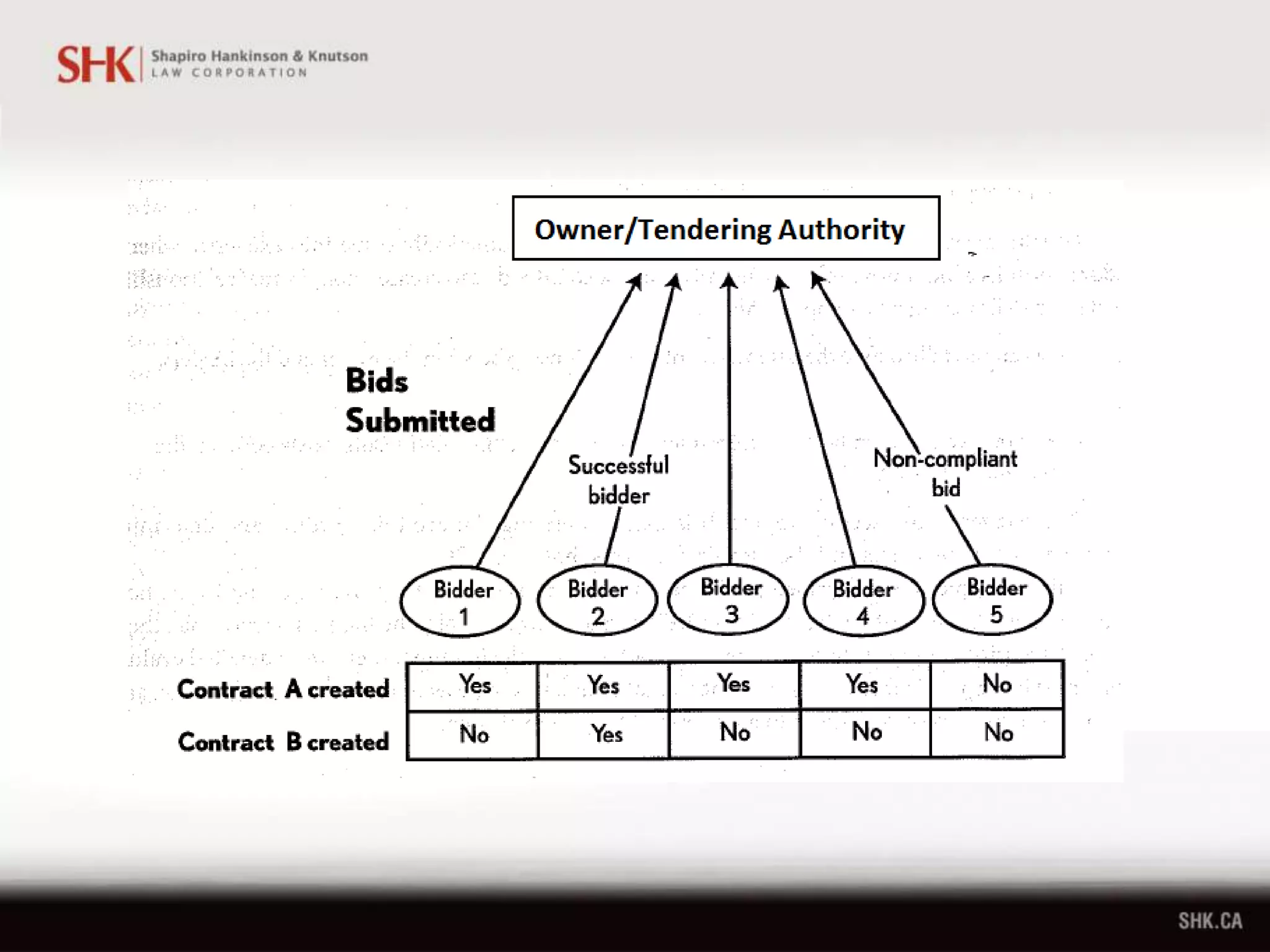
a) Contract A, which arises between the tendering authority and each
“materially compliant” bidder, the terms of which are generally as set
out in the tendering documents; and
b) Contract B, which is the tendered contract entered into between the
tendering authority and the successful bidder.
Note: Contract A only arises if bid submission is compliant with
tender documents (MJB Enterprises v Defence Construction)
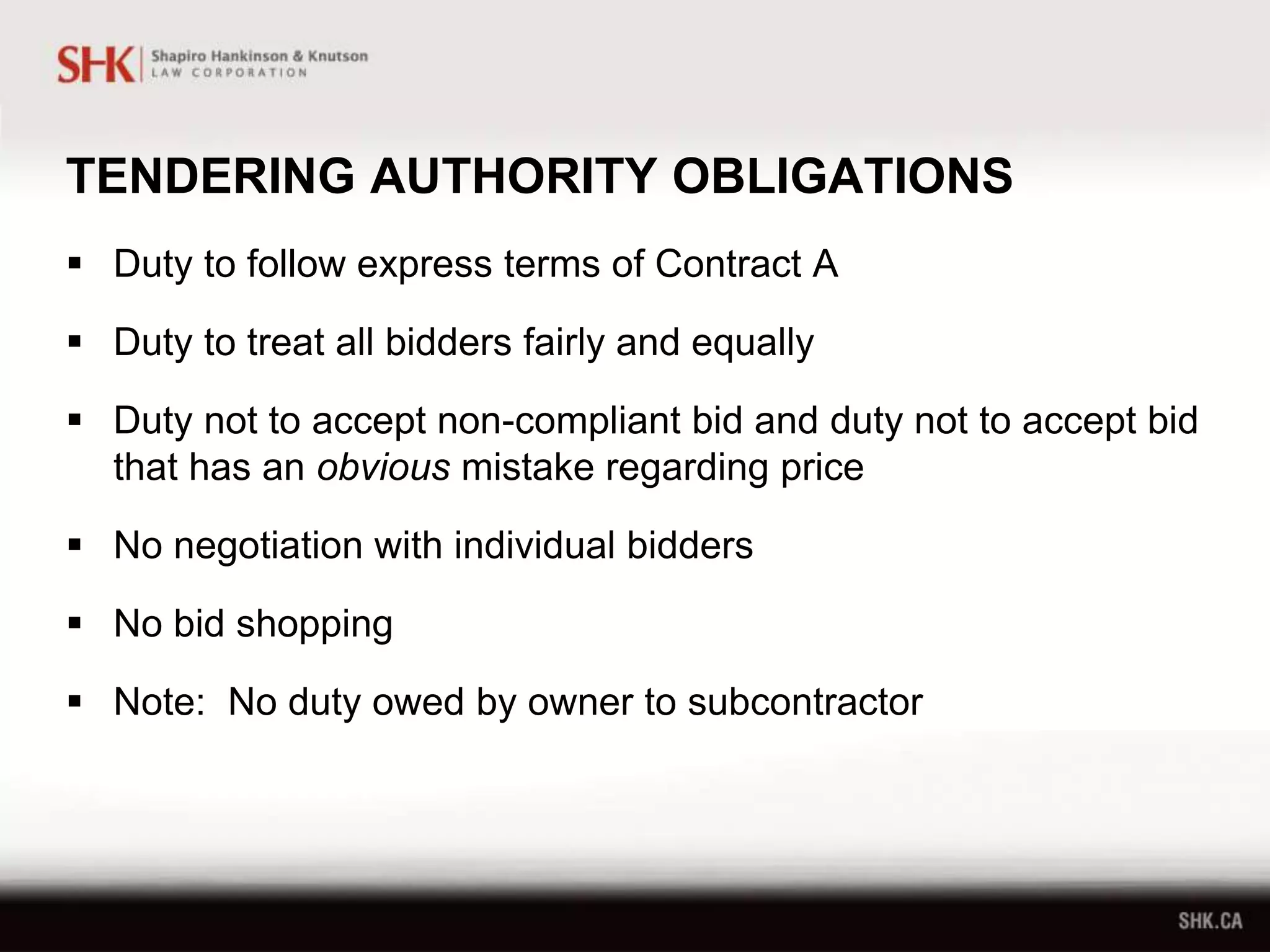
TENDERING AUTHORITY OBLIGATIONS
 Duty to follow express terms of Contract A
 Duty to treat all bidders fairly and equally
 Duty not to accept non-compliant bid and duty not to accept bid
that has an obvious mistake regarding price
 No negotiation with individual bidders
 No bid shopping
 Note: No duty owed by owner to subcontractor
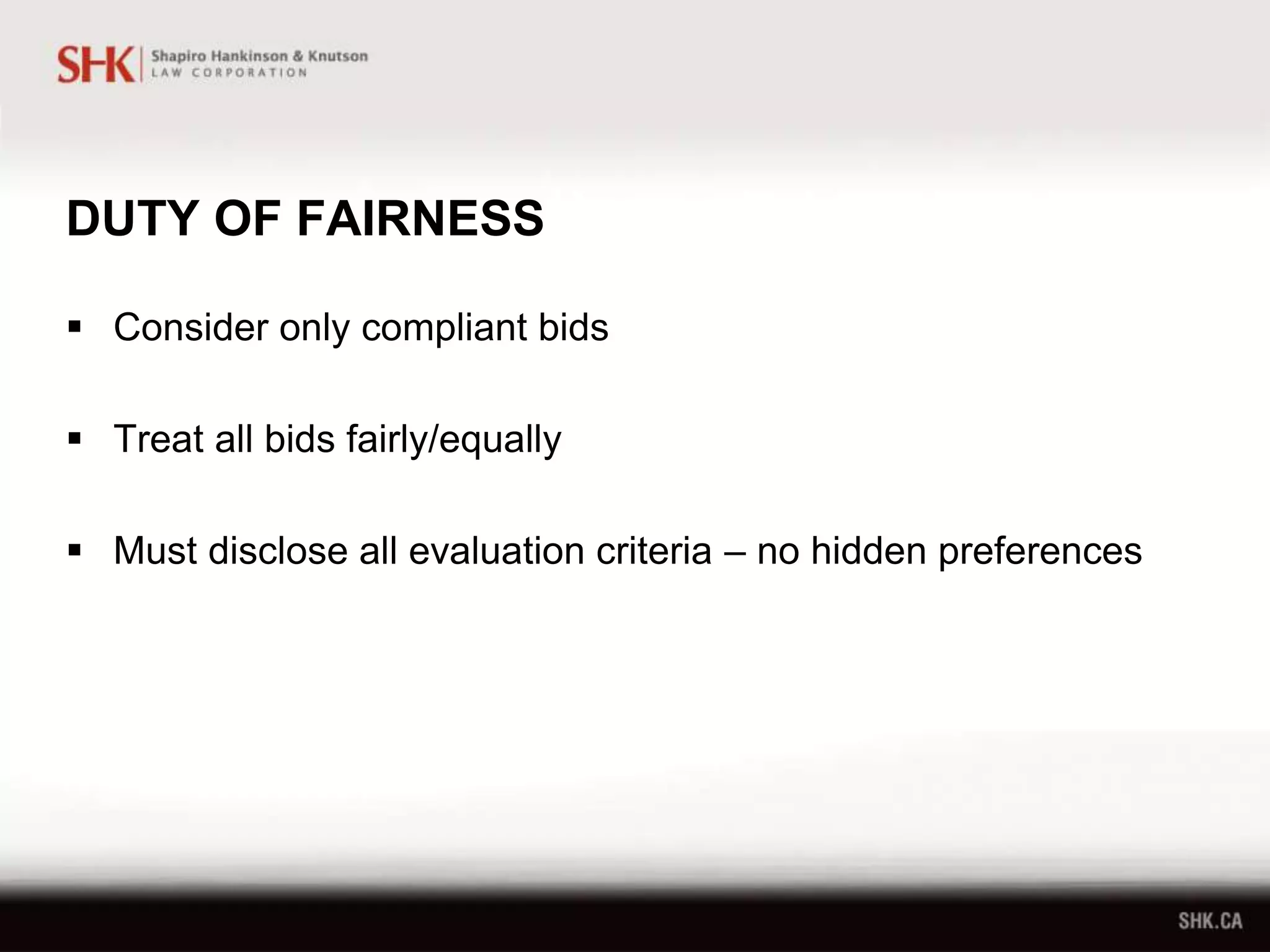
DUTY OF FAIRNESS
 Consider only compliant bids
 Treat all bids fairly/equally
 Must disclose all evaluation criteria – no hidden preferences
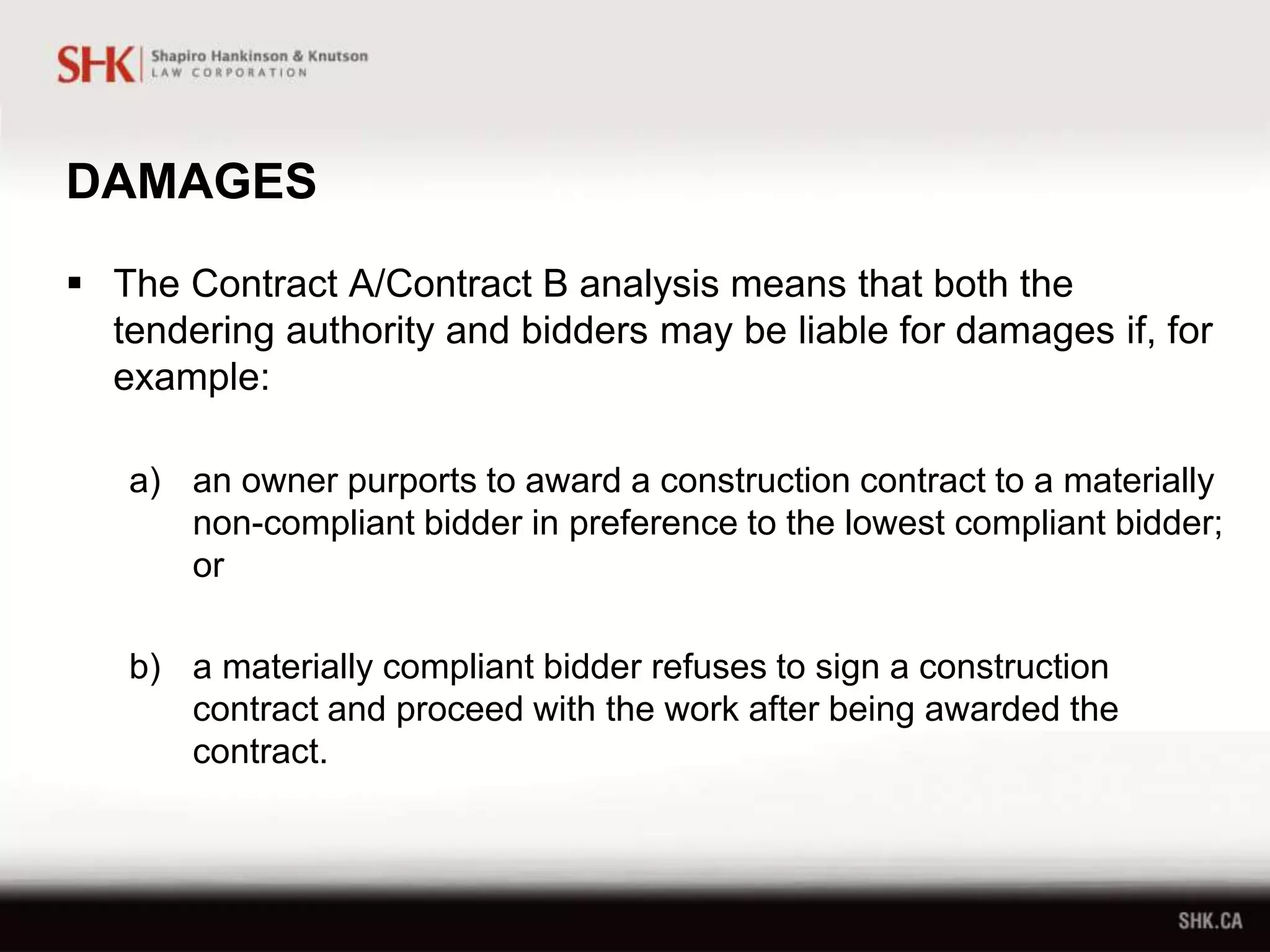
DAMAGES
 The Contract A/Contract B analysis means that both the
tendering authority and bidders may be liable for damages if, for
example:
a) an owner purports to award a construction contract to a materially
non-compliant bidder in preference to the lowest compliant bidder;
or
b) a materially compliant bidder refuses to sign a construction
contract and proceed with the work after being awarded the
contract.
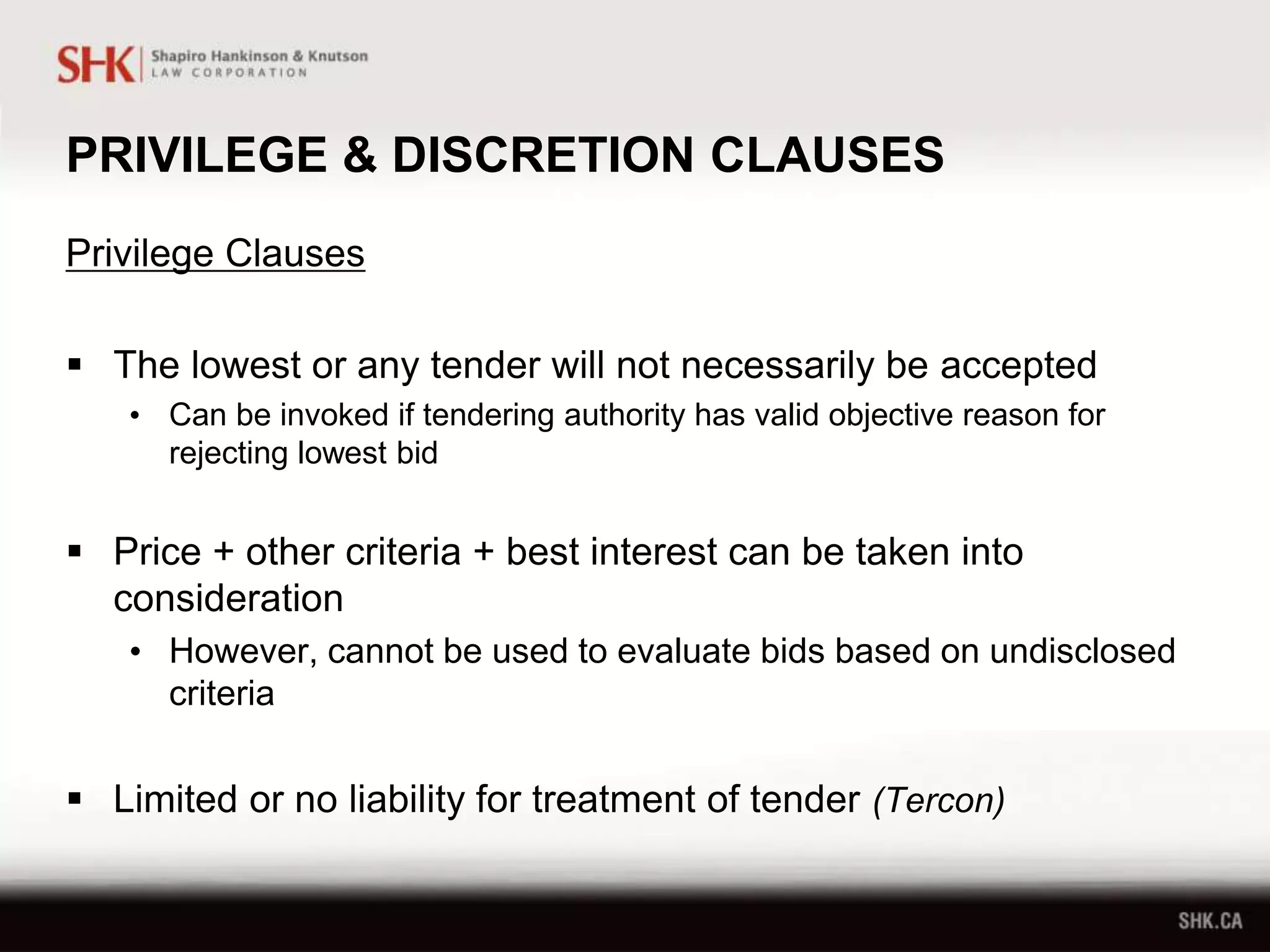
PRIVILEGE & DISCRETION CLAUSES
Privilege Clauses
 The lowest or any tender will not necessarily be accepted
• Can be invoked if tendering authority has valid objective reason for
rejecting lowest bid
 Price + other criteria + best interest can be taken into
consideration
• However, cannot be used to evaluate bids based on undisclosed
criteria
 Limited or no liability for treatment of tender (Tercon)
PRIVILEGE & DISCRETION CLAUSES
Discretion Clauses
 Permit tendering authority to waive minor defects in a bid that
is otherwise compliant
• However, material non-conformance with tender requirements
cannot be waived
PRACTICE POINTS FOR TENDER
SUBMISSIONS
 Have a basic knowledge of tendering law
 Read and understand the totality of the procurement
documents
 Clarify pre-bid questions using designated process
 Quality assurance for tender preparation
 Comply with all tender requirements
Common Problems in the Drafting of
Tender Documents
POOR DRAFTING
- Inconsistent provisions
- Inclusion of Contract B provisions
- Unclear or ungrammatical wording
- Inadequately worded privilege clauses
Common Problems…
COUNTER-PRODUCTIVE “PHILOSOPHY”
- Unreasonable privilege clauses
- Complicated tender procedures
- Mixing of negotiation with tendering
Common Problems…
LACK OF KNOWLEDGE, CARE
and ATTENTION TO DETAIL
- Lack of knowledge of tendering law
- Lack of care in setting, understanding and following
tender “rules”
Practice points for tender submissions
1. Have a basic knowledge of tendering law
2. Read and understand the totality of the procurement
documents
3. Clarify pre-bid questions using designated process
4. Quality assurance for tender preparation
5. Comply with all tender requirements
Fact Pattern
The Village of Podunk puts out to tender the construction of a new
municipal swimming pool. The tender documents state that the
lowest tender will not necessarily be accepted; that the Village
may reject any tender which contains an error, omission or
qualification; that the Village can take into account price and
previous work experience in evaluating tenders; and that tenders
are irrevocable (i.e., cannot be withdrawn) for 60 days.
The Village receives two tenders, one from Metallica Contracting
Ltd. in the amount of $300,000 and one from Anthrax
Construction Inc. in the amount of $400,000. The Village needs its
consulting engineer’s advice concerning its rights and
responsibilities in awarding the contract.
Question 1
Metallica has submitted a tender with a lower price, and has significantly
more swimming pool construction experience than Anthrax. However, the
price breakdown and the GST shown on Metallica’s Tender Form does not
total the price in Metallica’s bid. What are Podunk’s options?
(a) Podunk can accept Metallica’s tender, because the tender documents
say that the Village may, but not must, reject a tender which contains an
error.
(b) Podunk must reject Metallica’s tender, because a tender which contains
an error relating to the tender price which error is obvious on the face of
the Tender Form is incapable of acceptance.
(c) Podunk can’t accept either tender, because Metallica’s tender has an
obvious error and Anthrax’s tender is a higher price.
Question 2
For this question, assume that there is no calculation error obvious on the face of
Metallica’s Tender Form. Instead, assume that four days after the tenders are
opened but before Podunk accepts either tender, Metallica discovers an error in
its calculation of its tender price which has resulted in that price being far less
than it intended. It advises Podunk that it wishes to revoke its tender. What are
Podunk’s options?
(a) Podunk can accept Metallica’s low tender despite the alleged error, since the
error is not obvious on the face of Metallica’s Tender Form and the tender is
irrevocable for 60 days.
(b) Podunk must allow Metallica to revoke its tender, in view of the alleged error.
(c) Whether or not it allows Metallica to revoke its tender, Podunk must accept
Anthrax’s tender, in view of Metallica’s alleged error and the fact that Anthrax is
the only other tenderer.
Question 3
What are Podunk’s options if there is nothing wrong with Metallica’s
tender or work experience, but Podunk would like to award the contract
to Anthrax because of that company’s generous contributions to local
charities?
(a) Podunk can accept Anthrax’s tender for that reason, because the
Village has no positive legal duty to accept Metallica’s tender.
(b) Podunk must accept Anthrax’s tender for the public good.
(c) Podunk can’t accept Anthrax’s tender on the basis of Anthrax’s
charitable contributions, because that was not a factor identified by
the tender documents as applying to the acceptance or rejection of
tenders.
Question 4
What are the Village’s options if its budget has no more than
$250,000 for the construction of the swimming pool project?
(a) The Village can reject both tenders, because it is not required
to award a contract which it cannot afford.
(b) The Village must accept Metallica’s tender, because it is the
lowest price.
(c) The Village must negotiate with Metallica to obtain a lower
price for the reduced scope of work.
Case Law
Following Ron Engineering, three key principles in the law of tendering
emerged:
(a) Only a compliant tender can be accepted by an owner;
(b) The lowest compliant tender should be accepted; and
(c) The owner owes bidding contractors a duty of fairness in
analyzing the tender bids.
Tercon Construction Ltd. v. British Columbia
(Transportation and Highways) 2010 SCC 4
• The application of the Ron Engineering principles was
modified by the inclusion of exclusion clauses or
“privilege” clauses by owners in tendering documents.
• However, an exclusion clause does not give an owner
the ability to accept any bid; a decision to accept a bid
other than the lowest bid must be done in good faith
and based on objective reasons.
Tercon Construction
• The Supreme Court of Canada's decision in Tercon
leaves open the possibility for a properly crafted exclusion
clause to permit an owner to breach a fundamental term
of Contract "A", such as the requirement to only accept a
compliant bid.
• However, the Court stressed that such a result would
require a clear and unequivocal exclusion clause.
Bhasin v. Hrynew, 2014 SCC 71
• This decision of the Supreme Court of Canada
represents a very significant development in the law of
contract in this country, which applies equally to
tendering and other construction-related types of
contract.
• The Court confirmed as a new principle of Canadian
law that all contracting parties have a duty to perform
their contractual obligations honestly, based on the
existence of an implied term of good faith.
How has Bhasin been applied in the context
of tendering?
• Recently cited in a tendering case in the Court of
Queen’s Bench of Alberta in Elan Construction Limited
v. South Fish Creek Recreational Association, 2015
ABQB 330.
• Key take-away: The “duty of good faith” requires more
than honesty. It requires, particularly in the tendering
context, “honest, candid, forthright or reasonable
contractual performance”.
So what does it all mean?
• In the tendering context, the law requires an elevated
standard of good faith and a duty to act honestly in the
performance of contractual obligations.

Tendering and Procurement - Basic Principles

  • 1.
    TENDERING & PROCUREMENT BASICPRINCIPLES Seema Lal & Vanessa Werden CCW Panel Event – May 24, 2016
  • 2.
    IS IT ATENDER?  Competitive procurement process  Period of irrevocability  Process replaces negotiation with competition
  • 3.
    CONTRACT A /CONTRACT B  The fundamental principle of the law of tendering for construction in Canada is that that method of contract procurement involves two stages of contractual relationships: R v. Ron Engineering & Construction (Eastern) Ltd. a) Contract A, which arises between the tendering authority and each “materially compliant” bidder, the terms of which are generally as set out in the tendering documents; and b) Contract B, which is the tendered contract entered into between the tendering authority and the successful bidder. Note: Contract A only arises if bid submission is compliant with tender documents (MJB Enterprises v Defence Construction)
  • 5.
    TENDERING AUTHORITY OBLIGATIONS Duty to follow express terms of Contract A  Duty to treat all bidders fairly and equally  Duty not to accept non-compliant bid and duty not to accept bid that has an obvious mistake regarding price  No negotiation with individual bidders  No bid shopping  Note: No duty owed by owner to subcontractor
  • 6.
    DUTY OF FAIRNESS Consider only compliant bids  Treat all bids fairly/equally  Must disclose all evaluation criteria – no hidden preferences
  • 7.
    DAMAGES  The ContractA/Contract B analysis means that both the tendering authority and bidders may be liable for damages if, for example: a) an owner purports to award a construction contract to a materially non-compliant bidder in preference to the lowest compliant bidder; or b) a materially compliant bidder refuses to sign a construction contract and proceed with the work after being awarded the contract.
  • 8.
    PRIVILEGE & DISCRETIONCLAUSES Privilege Clauses  The lowest or any tender will not necessarily be accepted • Can be invoked if tendering authority has valid objective reason for rejecting lowest bid  Price + other criteria + best interest can be taken into consideration • However, cannot be used to evaluate bids based on undisclosed criteria  Limited or no liability for treatment of tender (Tercon)
  • 9.
    PRIVILEGE & DISCRETIONCLAUSES Discretion Clauses  Permit tendering authority to waive minor defects in a bid that is otherwise compliant • However, material non-conformance with tender requirements cannot be waived
  • 10.
    PRACTICE POINTS FORTENDER SUBMISSIONS  Have a basic knowledge of tendering law  Read and understand the totality of the procurement documents  Clarify pre-bid questions using designated process  Quality assurance for tender preparation  Comply with all tender requirements
  • 11.
    Common Problems inthe Drafting of Tender Documents POOR DRAFTING - Inconsistent provisions - Inclusion of Contract B provisions - Unclear or ungrammatical wording - Inadequately worded privilege clauses
  • 12.
    Common Problems… COUNTER-PRODUCTIVE “PHILOSOPHY” -Unreasonable privilege clauses - Complicated tender procedures - Mixing of negotiation with tendering
  • 13.
    Common Problems… LACK OFKNOWLEDGE, CARE and ATTENTION TO DETAIL - Lack of knowledge of tendering law - Lack of care in setting, understanding and following tender “rules”
  • 14.
    Practice points fortender submissions 1. Have a basic knowledge of tendering law 2. Read and understand the totality of the procurement documents 3. Clarify pre-bid questions using designated process 4. Quality assurance for tender preparation 5. Comply with all tender requirements
  • 15.
    Fact Pattern The Villageof Podunk puts out to tender the construction of a new municipal swimming pool. The tender documents state that the lowest tender will not necessarily be accepted; that the Village may reject any tender which contains an error, omission or qualification; that the Village can take into account price and previous work experience in evaluating tenders; and that tenders are irrevocable (i.e., cannot be withdrawn) for 60 days. The Village receives two tenders, one from Metallica Contracting Ltd. in the amount of $300,000 and one from Anthrax Construction Inc. in the amount of $400,000. The Village needs its consulting engineer’s advice concerning its rights and responsibilities in awarding the contract.
  • 16.
    Question 1 Metallica hassubmitted a tender with a lower price, and has significantly more swimming pool construction experience than Anthrax. However, the price breakdown and the GST shown on Metallica’s Tender Form does not total the price in Metallica’s bid. What are Podunk’s options? (a) Podunk can accept Metallica’s tender, because the tender documents say that the Village may, but not must, reject a tender which contains an error. (b) Podunk must reject Metallica’s tender, because a tender which contains an error relating to the tender price which error is obvious on the face of the Tender Form is incapable of acceptance. (c) Podunk can’t accept either tender, because Metallica’s tender has an obvious error and Anthrax’s tender is a higher price.
  • 17.
    Question 2 For thisquestion, assume that there is no calculation error obvious on the face of Metallica’s Tender Form. Instead, assume that four days after the tenders are opened but before Podunk accepts either tender, Metallica discovers an error in its calculation of its tender price which has resulted in that price being far less than it intended. It advises Podunk that it wishes to revoke its tender. What are Podunk’s options? (a) Podunk can accept Metallica’s low tender despite the alleged error, since the error is not obvious on the face of Metallica’s Tender Form and the tender is irrevocable for 60 days. (b) Podunk must allow Metallica to revoke its tender, in view of the alleged error. (c) Whether or not it allows Metallica to revoke its tender, Podunk must accept Anthrax’s tender, in view of Metallica’s alleged error and the fact that Anthrax is the only other tenderer.
  • 18.
    Question 3 What arePodunk’s options if there is nothing wrong with Metallica’s tender or work experience, but Podunk would like to award the contract to Anthrax because of that company’s generous contributions to local charities? (a) Podunk can accept Anthrax’s tender for that reason, because the Village has no positive legal duty to accept Metallica’s tender. (b) Podunk must accept Anthrax’s tender for the public good. (c) Podunk can’t accept Anthrax’s tender on the basis of Anthrax’s charitable contributions, because that was not a factor identified by the tender documents as applying to the acceptance or rejection of tenders.
  • 19.
    Question 4 What arethe Village’s options if its budget has no more than $250,000 for the construction of the swimming pool project? (a) The Village can reject both tenders, because it is not required to award a contract which it cannot afford. (b) The Village must accept Metallica’s tender, because it is the lowest price. (c) The Village must negotiate with Metallica to obtain a lower price for the reduced scope of work.
  • 20.
    Case Law Following RonEngineering, three key principles in the law of tendering emerged: (a) Only a compliant tender can be accepted by an owner; (b) The lowest compliant tender should be accepted; and (c) The owner owes bidding contractors a duty of fairness in analyzing the tender bids.
  • 21.
    Tercon Construction Ltd.v. British Columbia (Transportation and Highways) 2010 SCC 4 • The application of the Ron Engineering principles was modified by the inclusion of exclusion clauses or “privilege” clauses by owners in tendering documents. • However, an exclusion clause does not give an owner the ability to accept any bid; a decision to accept a bid other than the lowest bid must be done in good faith and based on objective reasons.
  • 22.
    Tercon Construction • TheSupreme Court of Canada's decision in Tercon leaves open the possibility for a properly crafted exclusion clause to permit an owner to breach a fundamental term of Contract "A", such as the requirement to only accept a compliant bid. • However, the Court stressed that such a result would require a clear and unequivocal exclusion clause.
  • 23.
    Bhasin v. Hrynew,2014 SCC 71 • This decision of the Supreme Court of Canada represents a very significant development in the law of contract in this country, which applies equally to tendering and other construction-related types of contract. • The Court confirmed as a new principle of Canadian law that all contracting parties have a duty to perform their contractual obligations honestly, based on the existence of an implied term of good faith.
  • 24.
    How has Bhasinbeen applied in the context of tendering? • Recently cited in a tendering case in the Court of Queen’s Bench of Alberta in Elan Construction Limited v. South Fish Creek Recreational Association, 2015 ABQB 330. • Key take-away: The “duty of good faith” requires more than honesty. It requires, particularly in the tendering context, “honest, candid, forthright or reasonable contractual performance”.
  • 25.
    So what doesit all mean? • In the tendering context, the law requires an elevated standard of good faith and a duty to act honestly in the performance of contractual obligations.