Tutorial in DEBS’14
Speaker: Opher Etzion
co-authors: Sarit Arcushin and Fabiana Fournier
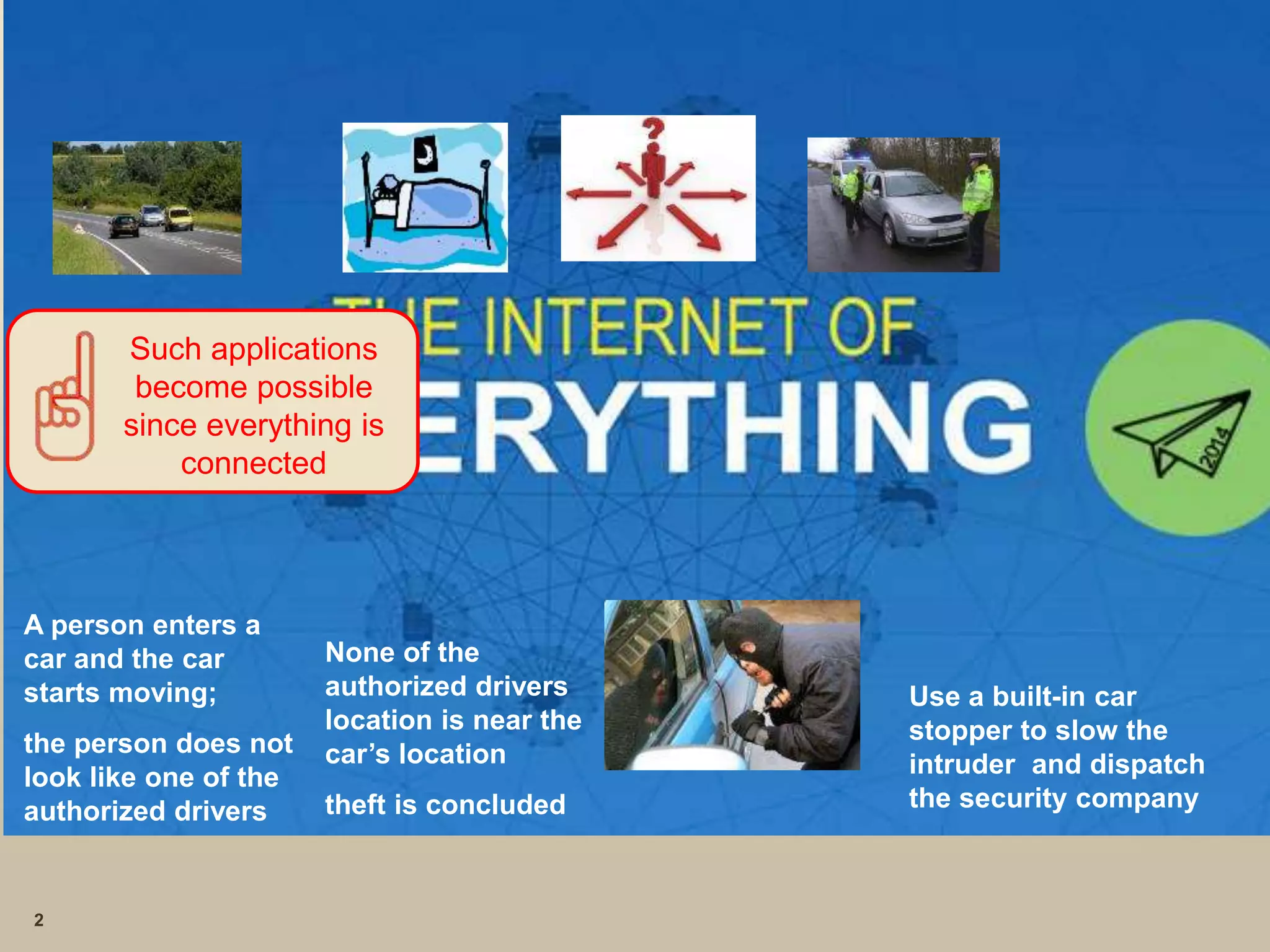
None of the
authorized drivers
location is near the
car’s location
theft is concluded
Use a built-in car
stopper to slow the
intruder and dispatch
the security company
A person enters a
car and the car
starts moving;
the person does not
look like one of the
authorized drivers
Such applications
become possible
since everything is
connected
2
OUTLINE
What stands behind the buzzwords?
The ubiquitous nature of the Internet of Everything
A futuristic view of the Internet of Everything
What do we need to do in order to make the Internet
of Everything really happen?
3
PAST
PRESENT
FUTURE
COMMAND
Topic 1
What stands behind the buzzards:
Internet of Things
Internet of Everything
and where does event processing get into the
picture?
4
PAST
PRESENT
FUTURE
COMMAND
5
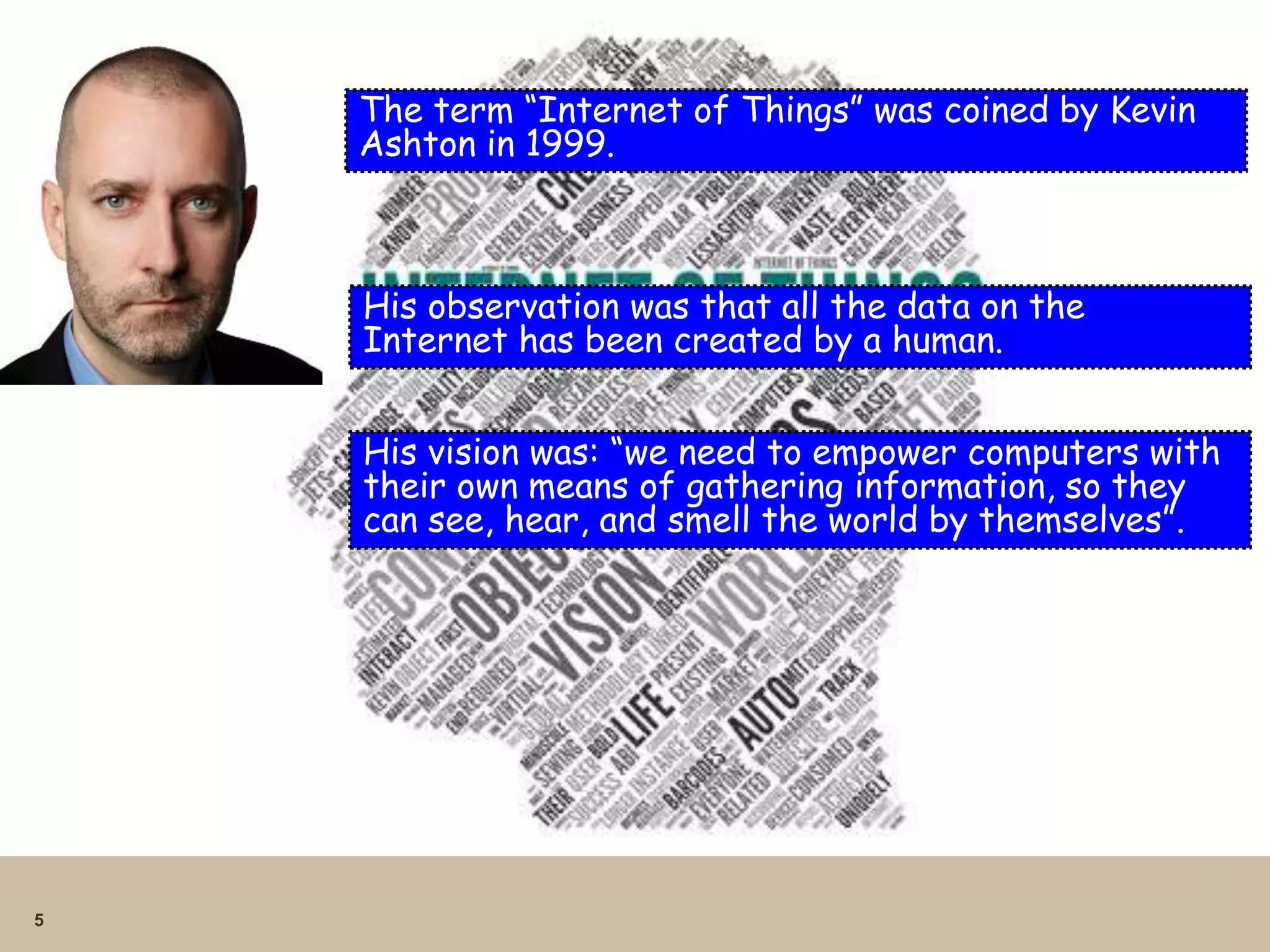
The term “Internet of Things” was coined by Kevin
Ashton in 1999.
His observation was that all the data on the
Internet has been created by a human.
His vision was: “we need to empower computers with
their own means of gathering information, so they
can see, hear, and smell the world by themselves”.
6
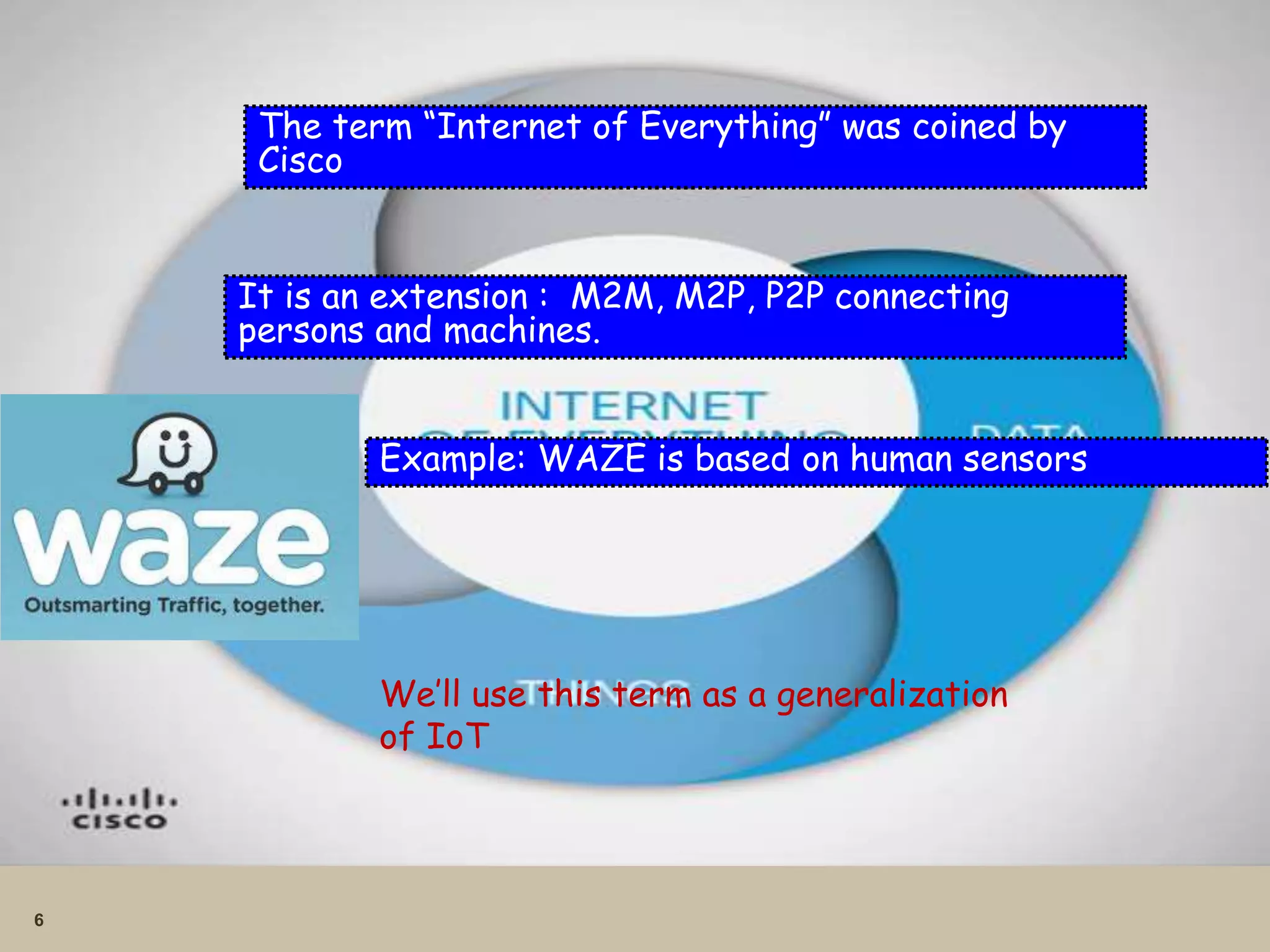
The term “Internet of Everything” was coined by
Cisco
It is an extension : M2M, M2P, P2P connecting
persons and machines.
Example: WAZE is based on human sensors
We’ll use this term as a generalization
of IoT
7
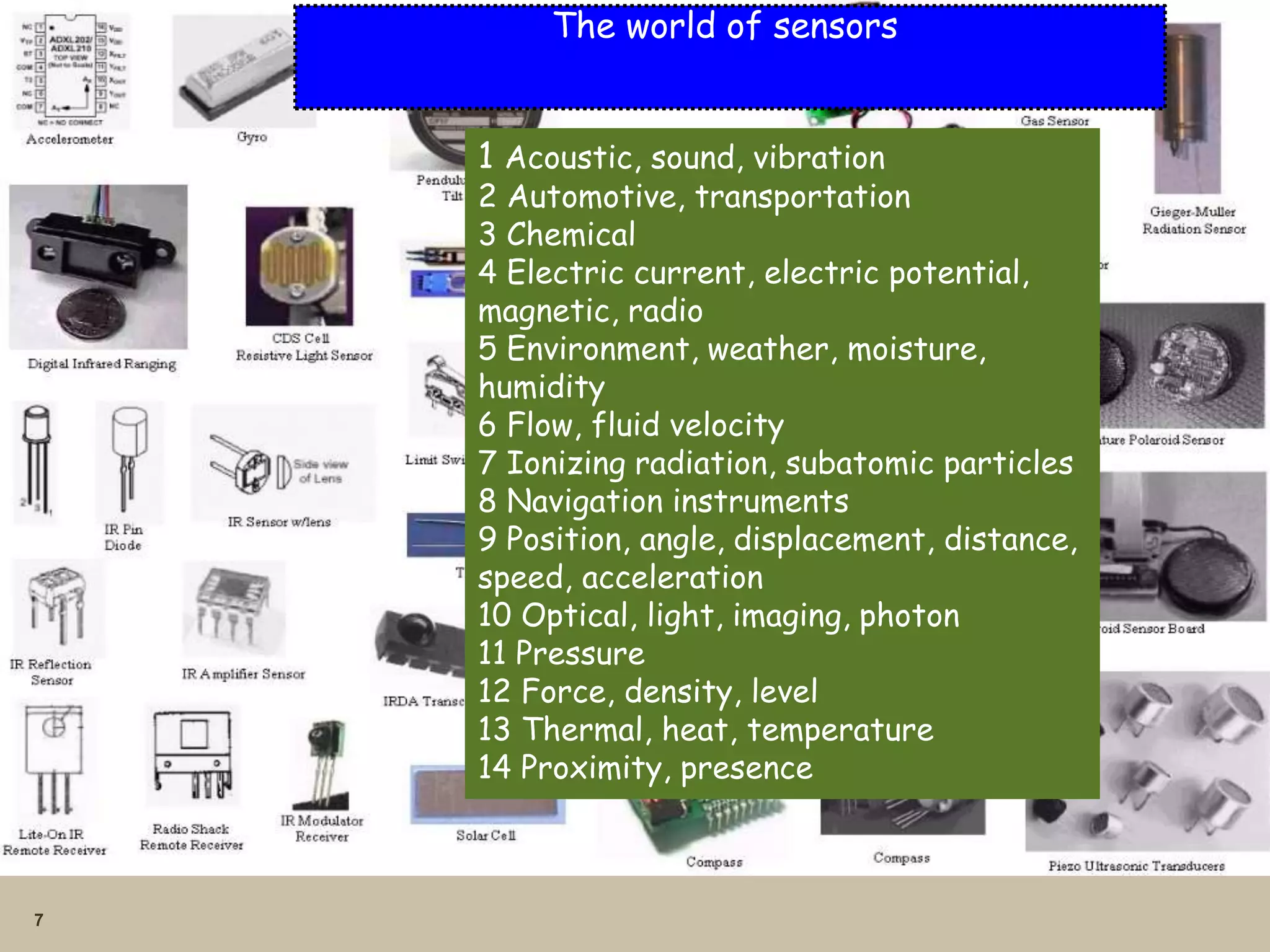
The world of sensors
1 Acoustic, sound, vibration
2 Automotive, transportation
3 Chemical
4 Electric current, electric potential,
magnetic, radio
5 Environment, weather, moisture,
humidity
6 Flow, fluid velocity
7 Ionizing radiation, subatomic particles
8 Navigation instruments
9 Position, angle, displacement, distance,
speed, acceleration
10 Optical, light, imaging, photon
11 Pressure
12 Force, density, level
13 Thermal, heat, temperature
14 Proximity, presence
8
The value of sensors
Kevin Ashton: “track and count everything, and
greatly reduce waste, loss, and cost. We could
know when things needs replacing, repairing or
recalling, and whether they were fresh or past
their best”
The value is in the ability to know and react in a
timely manner to situations that are detected by
sensors
“There is no Internet of Things yet”
9
Sarah Rotman Epps
Oct 17, 2013
The Forrester report entitled “There is no
Internet of Things Yet” asserts that while much
of the sensor technology exists, each sensor lives
in isolation, while multi sensor system is difficult
to construct
10
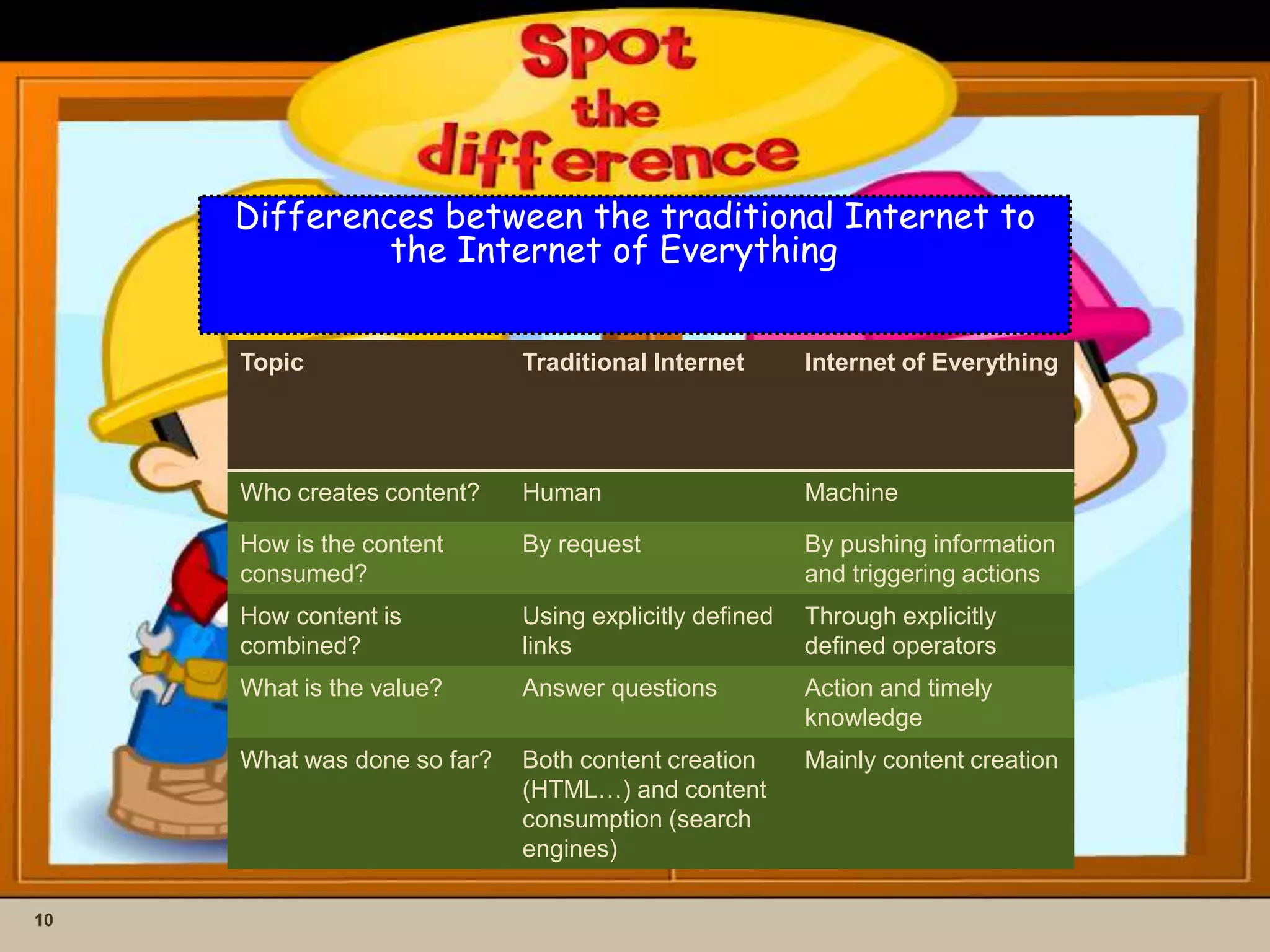
Differences between the traditional Internet to
the Internet of Everything
Topic Traditional Internet Internet of Everything
Who creates content? Human Machine
How is the content
consumed?
By request By pushing information
and triggering actions
How content is
combined?
Using explicitly defined
links
Through explicitly
defined operators
What is the value? Answer questions Action and timely
knowledge
What was done so far? Both content creation
(HTML…) and content
consumption (search
engines)
Mainly content creation
11
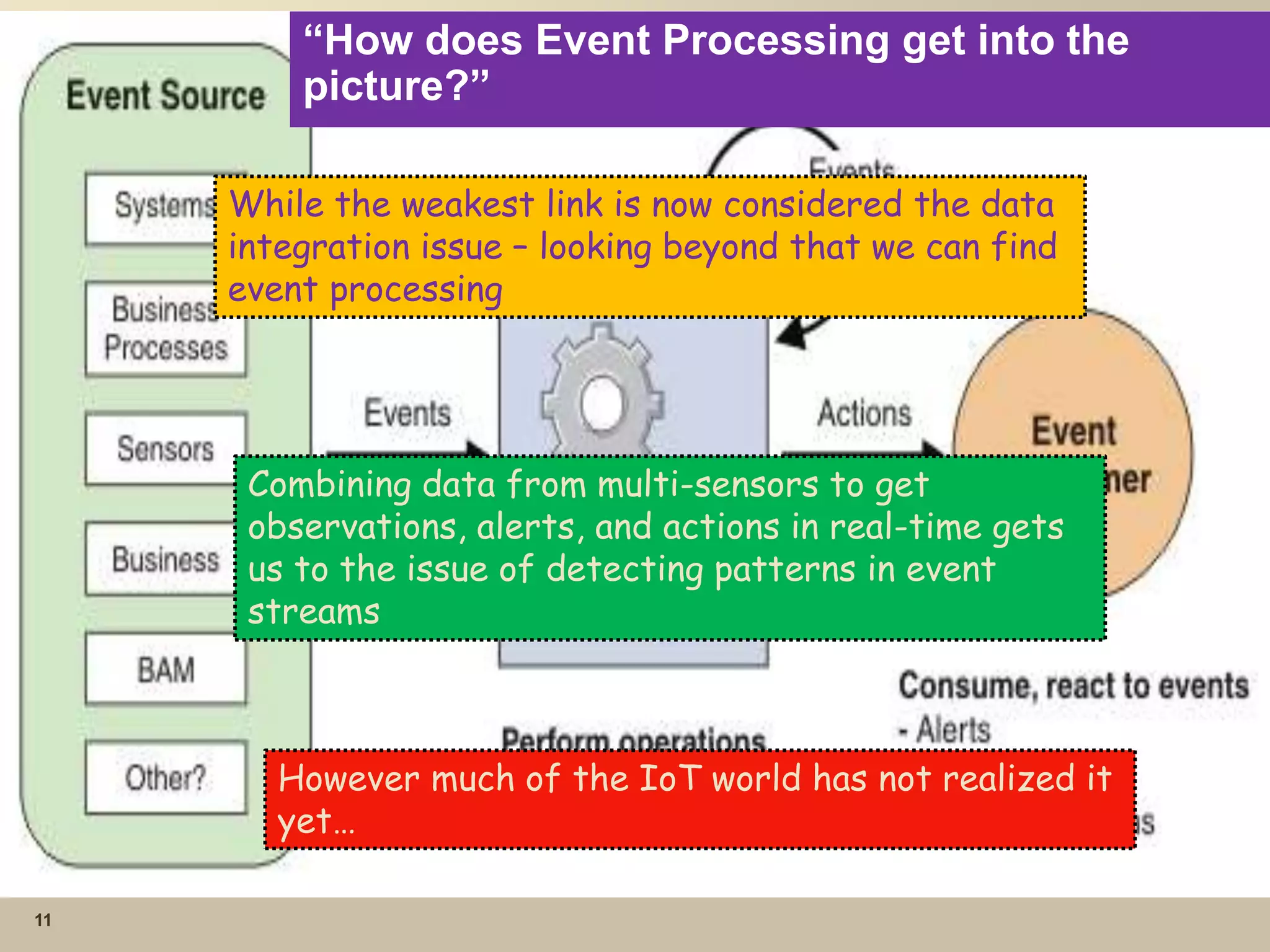
“How does Event Processing get into the
picture?”
While the weakest link is now considered the data
integration issue – looking beyond that we can find
event processing
Combining data from multi-sensors to get
observations, alerts, and actions in real-time gets
us to the issue of detecting patterns in event
streams
However much of the IoT world has not realized it
yet…
12
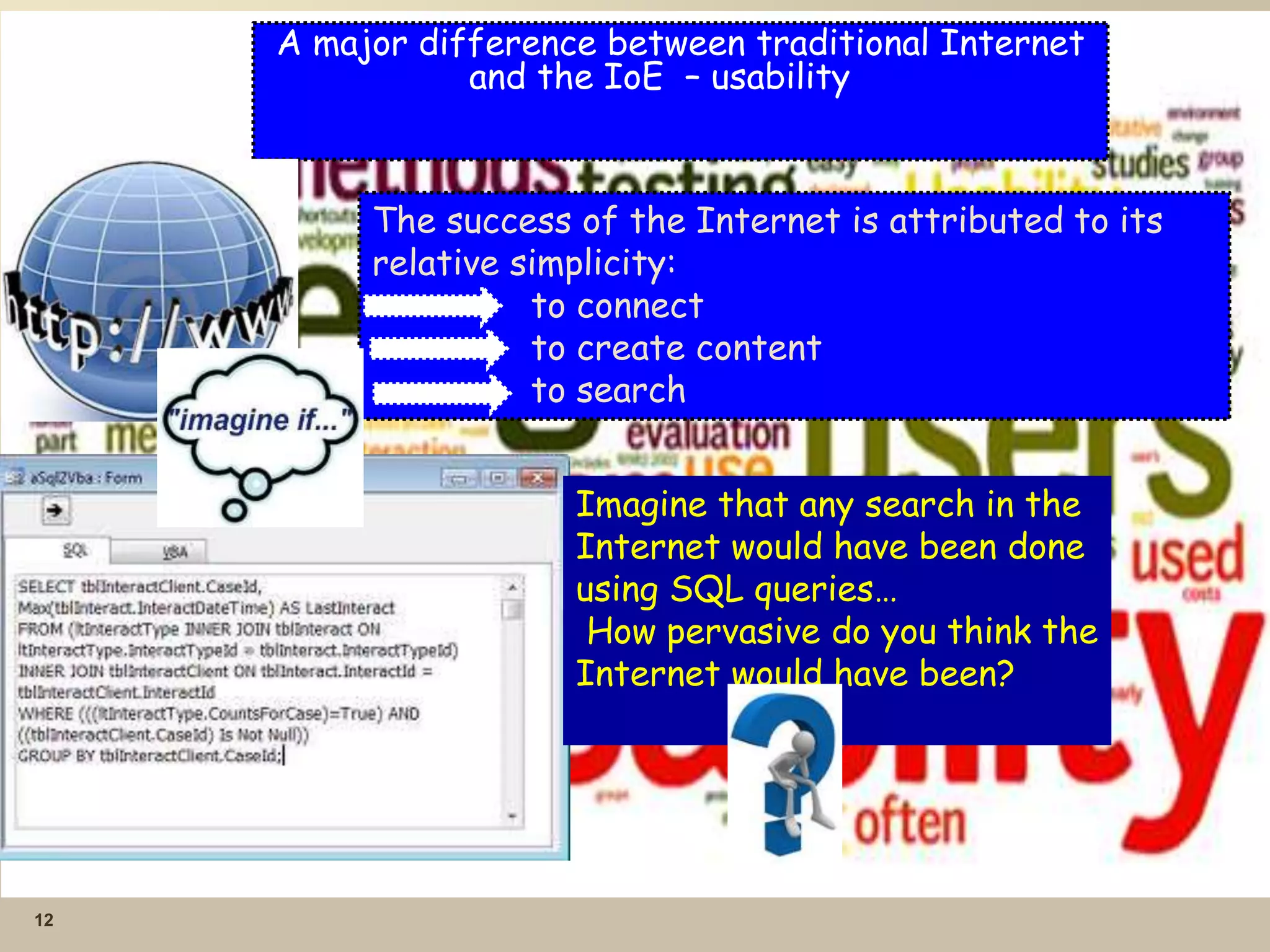
A major difference between traditional Internet
and the IoE – usability
The success of the Internet is attributed to its
relative simplicity:
to connect
to create content
to search
Imagine that any search in the
Internet would have been done
using SQL queries…
How pervasive do you think the
Internet would have been?
For situational awareness….
Languages are actually more complex than
SQL
13
// Large cash deposit
insert into LargeCashDeposit
select * from Cash deposit where amount > 100,000
// Frequent (At least three) large cash deposits
create context AccountID partition by accountId on Cash deposit;
Context AccountID
Insert into FrequentLargeCashDeposits select count(*) from LargeCashDeposit
having count(*)>3;
// Frequent cash deposits followed by transfer abroad
Context AccountID
insert into SuspiciousAccount select * from pattern [
every f=FrequentCashDeposit -> t=TransferAbroad where timer.within(10 days)]
TOPIC II:
The ubiquitous nature of the Internet
of Everything
Examples from different areas
14
PAST
PRESENT
FUTURE
COMMAND
15
The Internet of Everything is applicable to
virtually anything…
In this presentation we discuss applications in:
Aiding the elderly, healthcare, agriculture, smart
cities, environment and sustainability, retail,
industrial applications,, home automation, and
examples of applications for the ordinary
person
16
17
The Internet of Everything for the elderly
18
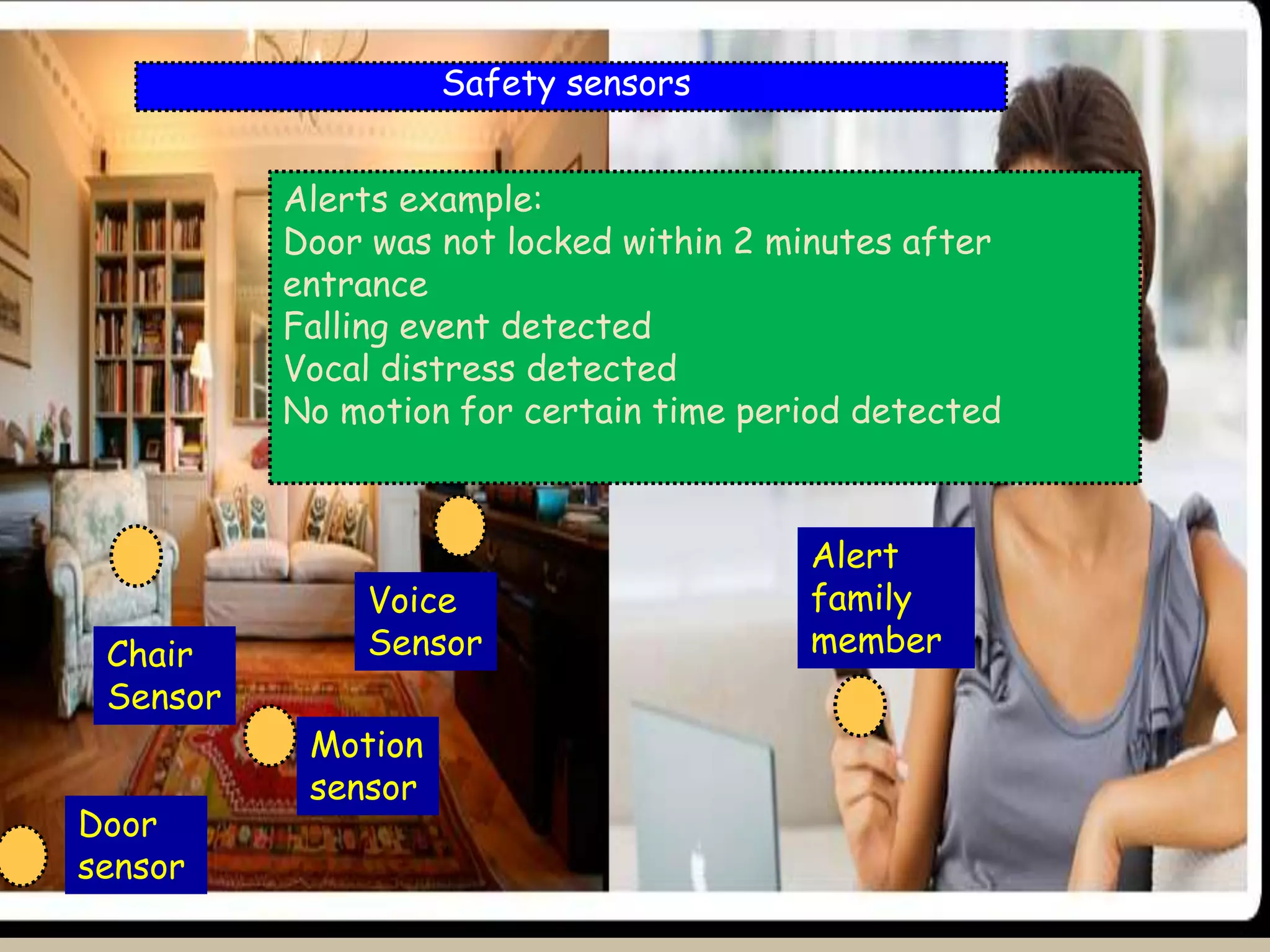
Safety sensors
Motion
sensor
Door
sensor
Chair
Sensor
Voice
Sensor
Alert
family
member
Alerts example:
Door was not locked within 2 minutes after
entrance
Falling event detected
Vocal distress detected
No motion for certain time period detected
19
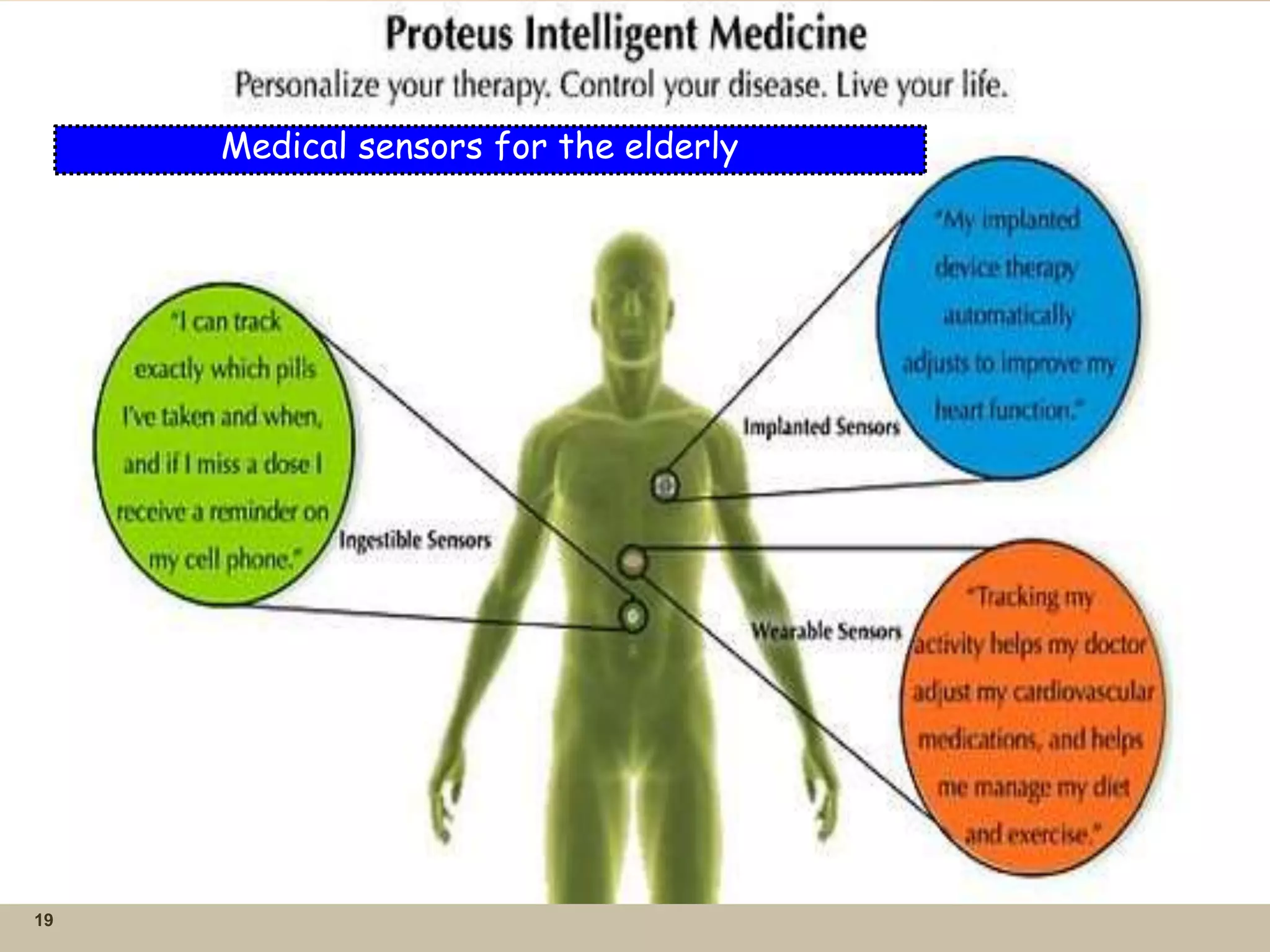
Medical sensors for the elderly
20
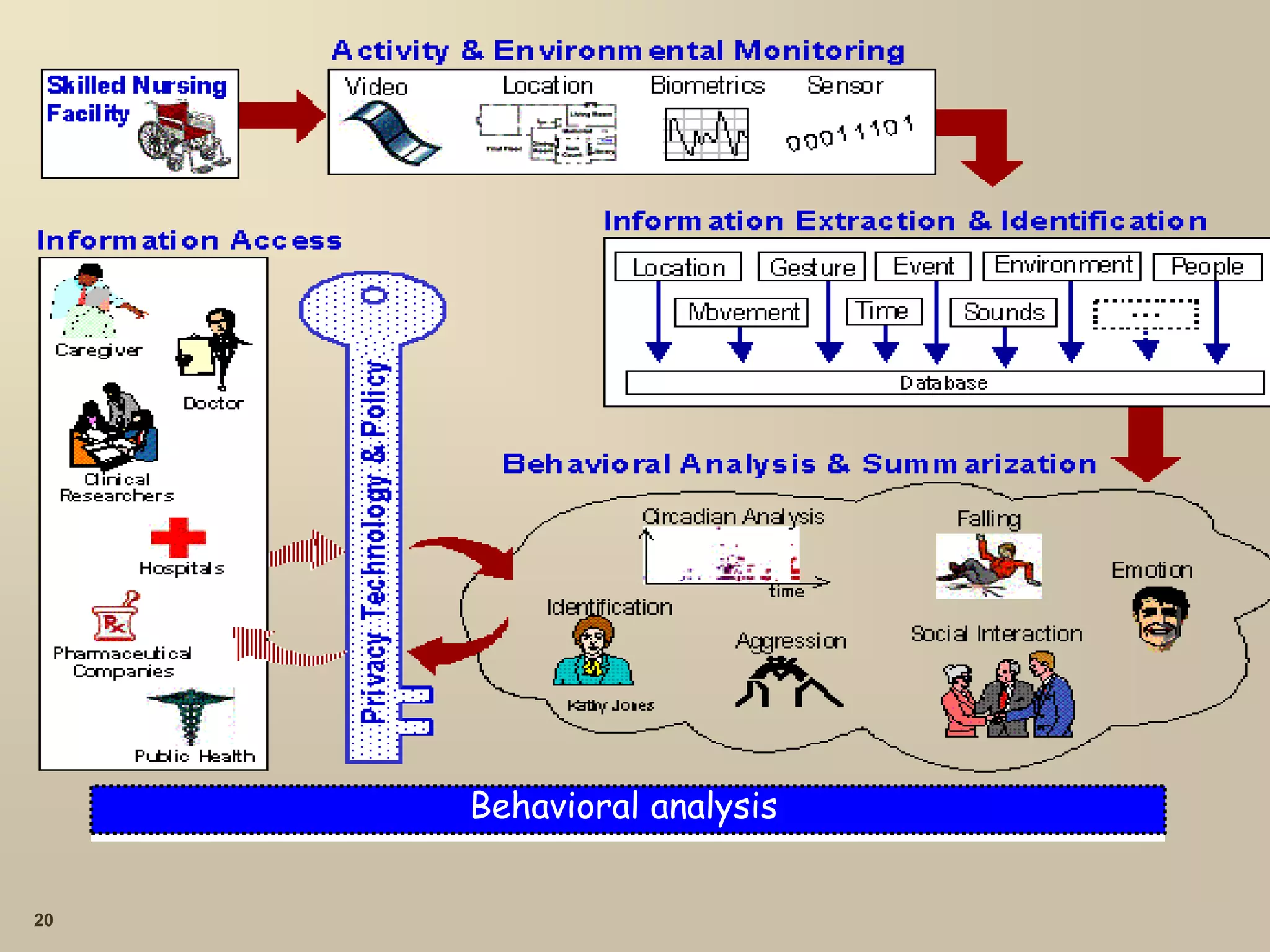
Behavioral analysis
21
The Internet of Everything in healthcare
22
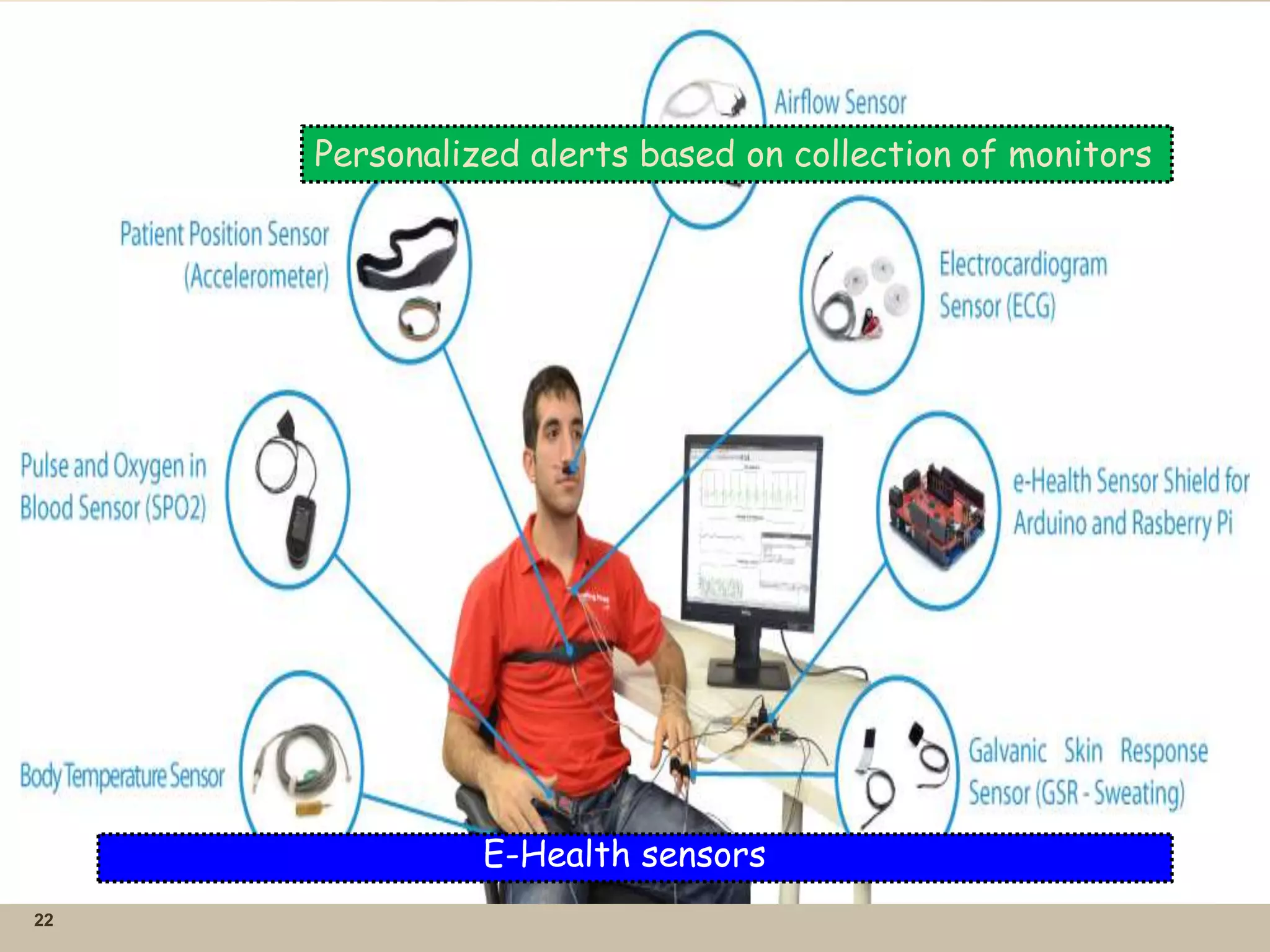
E-Health sensors
Personalized alerts based on collection of monitors
23
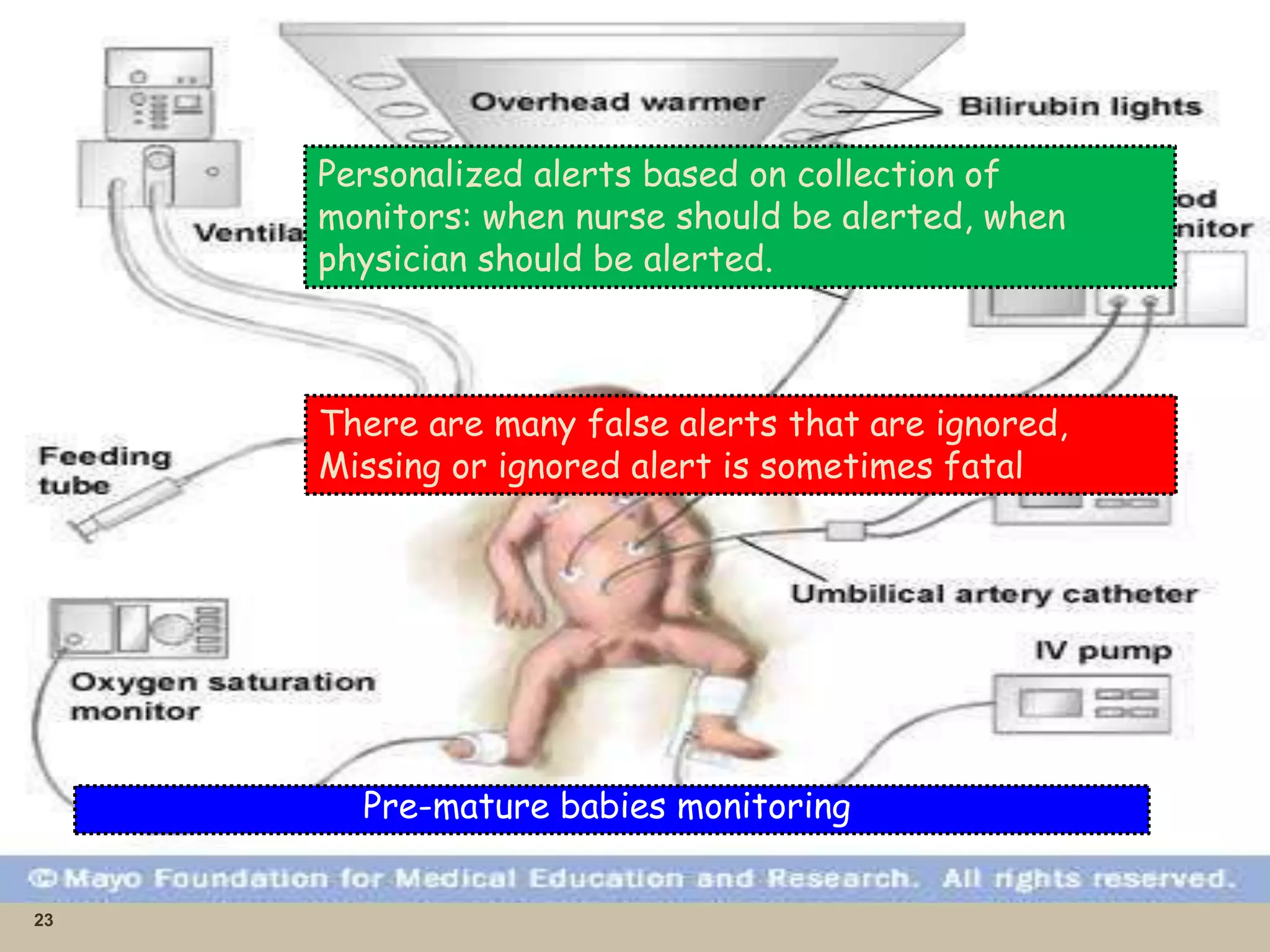
Pre-mature babies monitoring
Personalized alerts based on collection of
monitors: when nurse should be alerted, when
physician should be alerted.
There are many false alerts that are ignored,
Missing or ignored alert is sometimes fatal
24
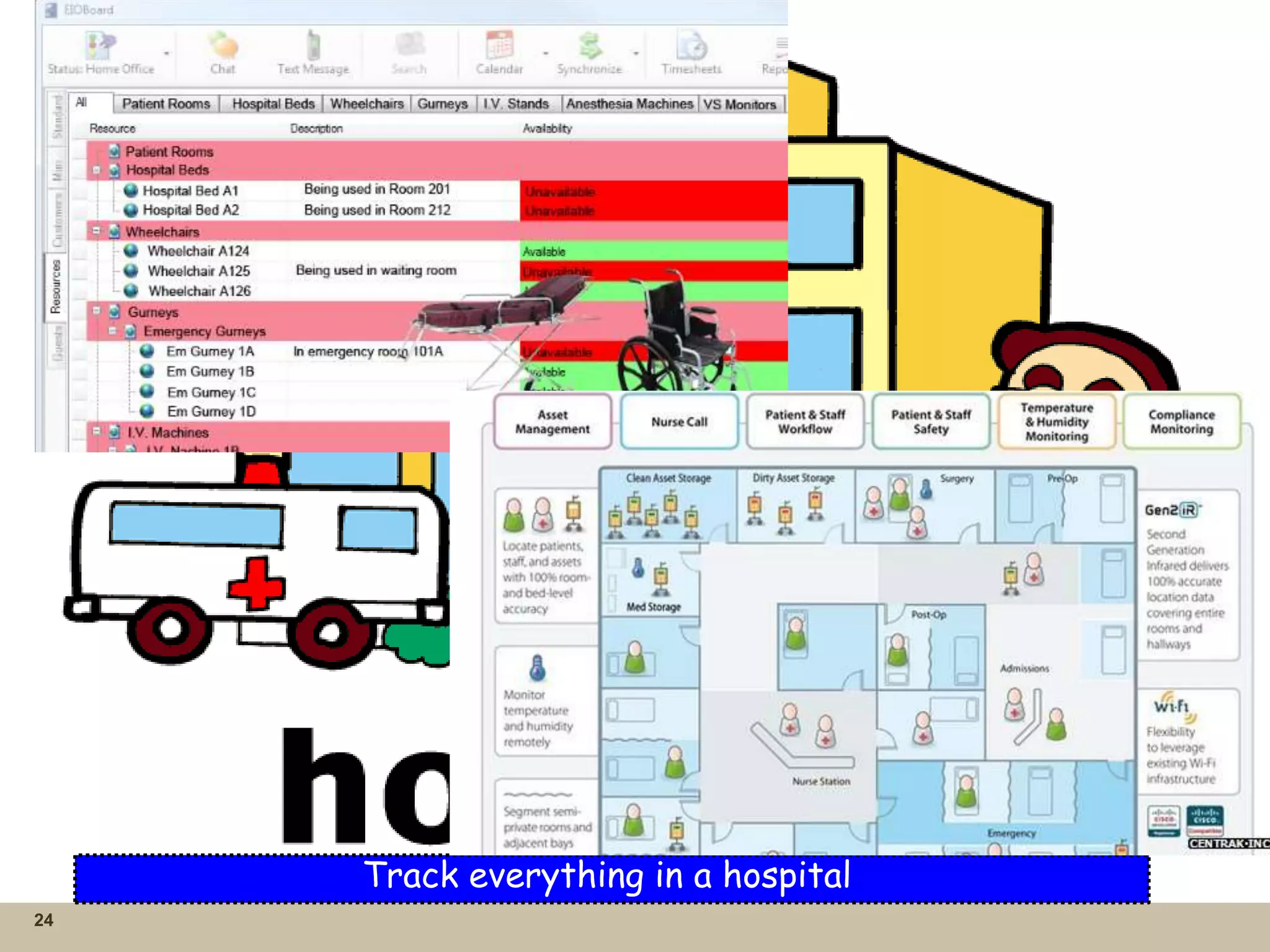
Track everything in a hospital
25
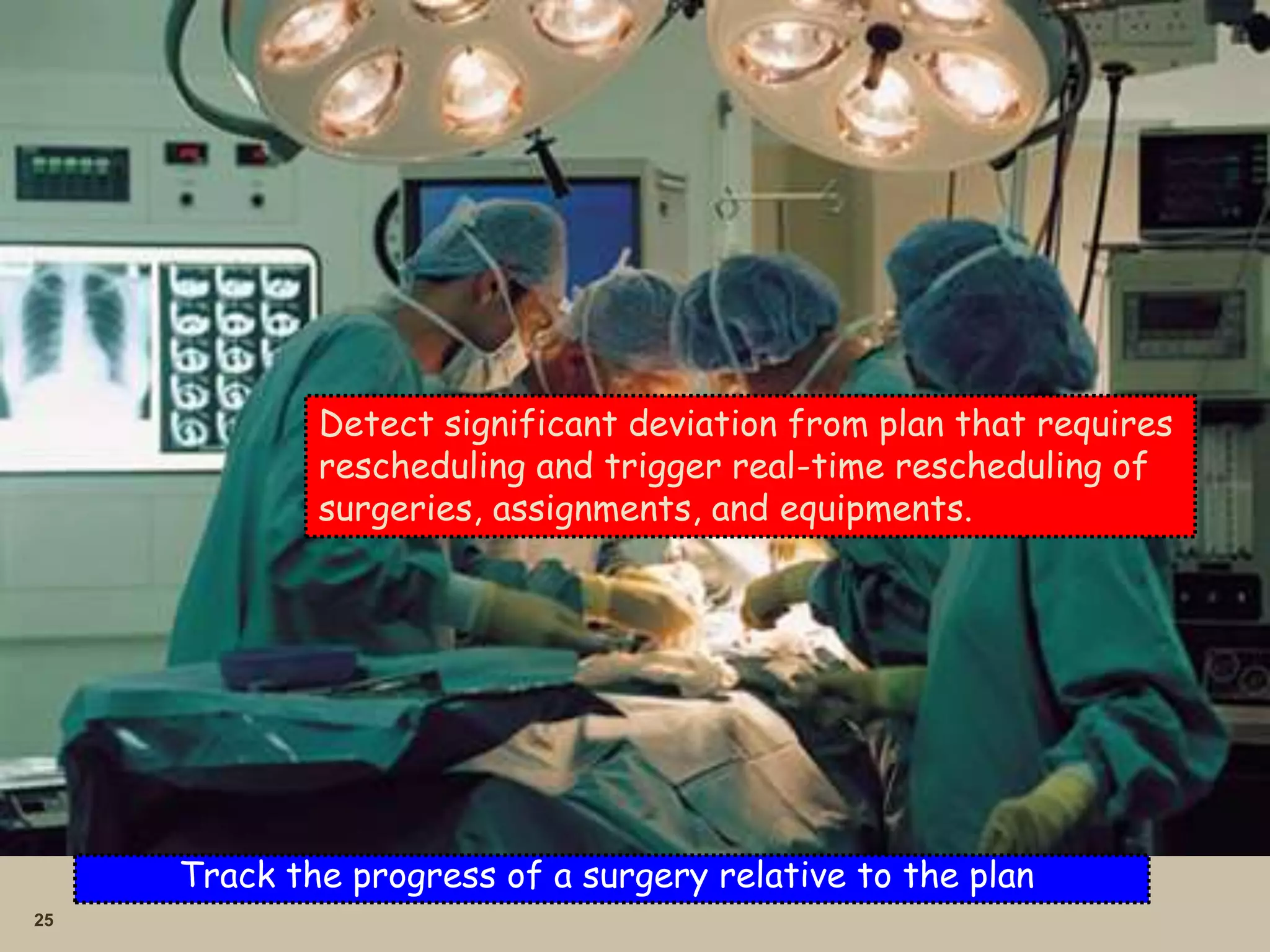
Track the progress of a surgery relative to the plan
Detect significant deviation from plan that requires
rescheduling and trigger real-time rescheduling of
surgeries, assignments, and equipments.
26
The Internet of Everything in agriculture
27
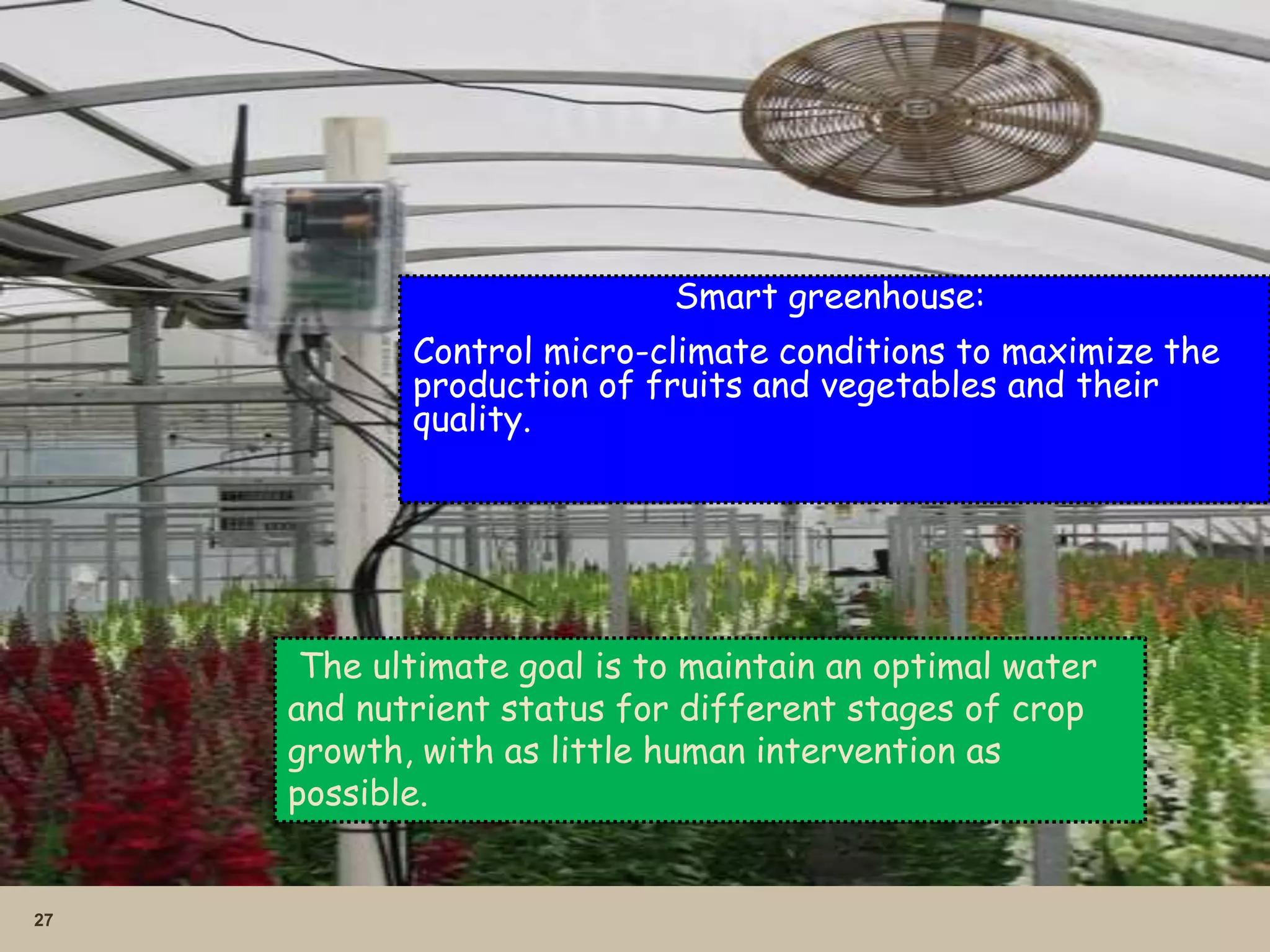
Smart greenhouse:
Control micro-climate conditions to maximize the
production of fruits and vegetables and their
quality.
The ultimate goal is to maintain an optimal water
and nutrient status for different stages of crop
growth, with as little human intervention as
possible.
28
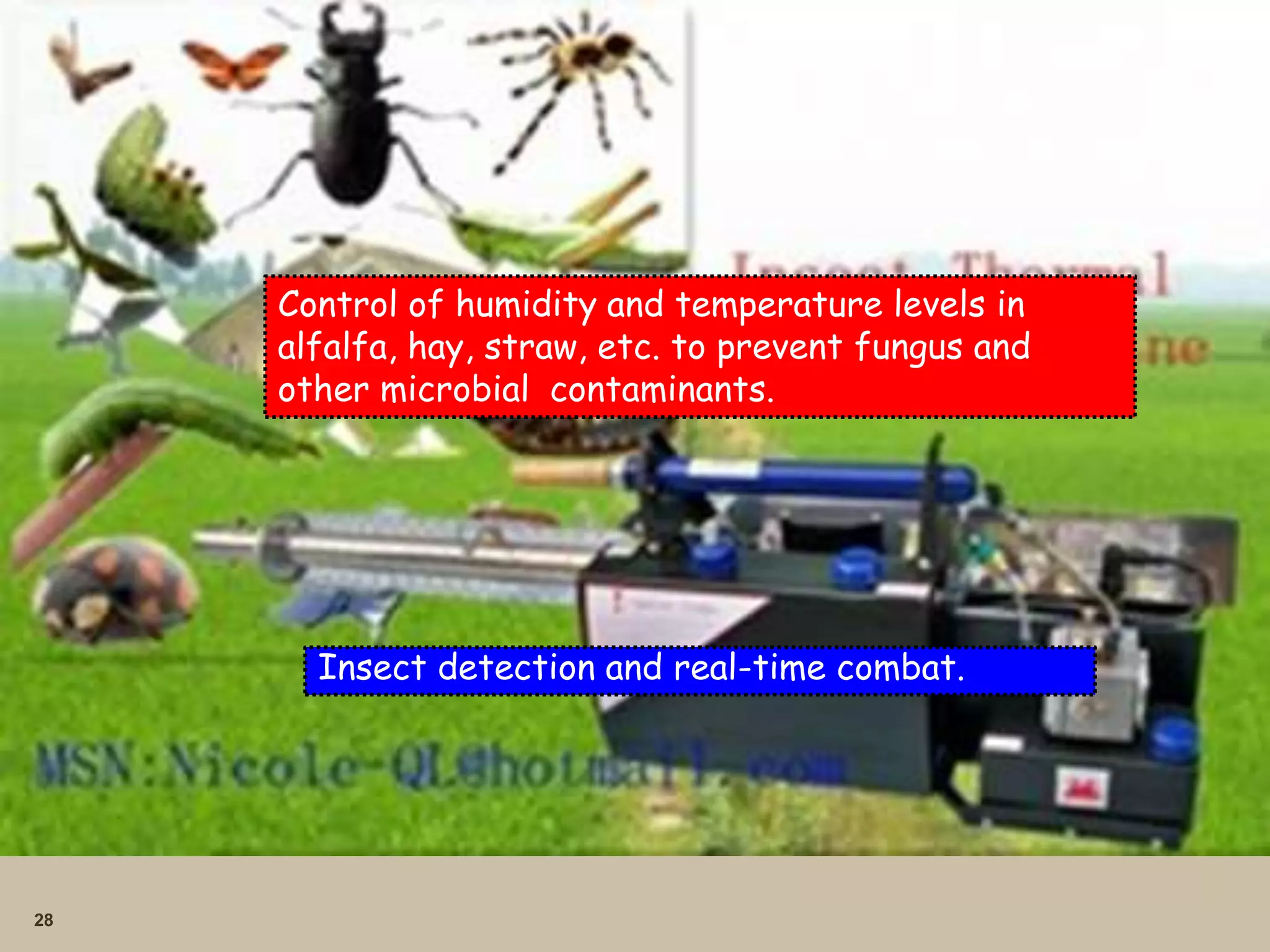
Control of humidity and temperature levels in
alfalfa, hay, straw, etc. to prevent fungus and
other microbial contaminants.
Insect detection and real-time combat.
29
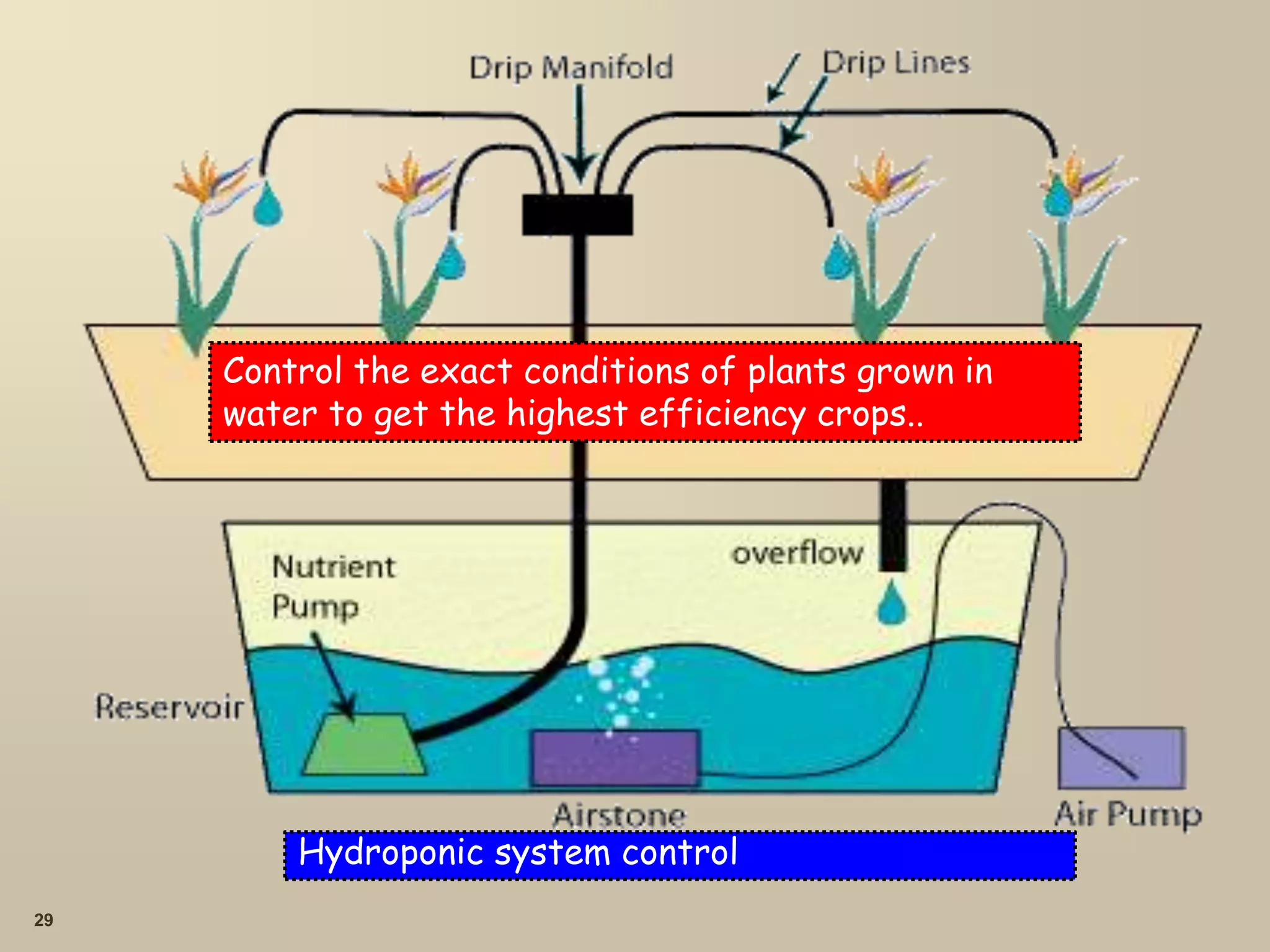
Hydroponic system control
Control the exact conditions of plants grown in
water to get the highest efficiency crops..
30
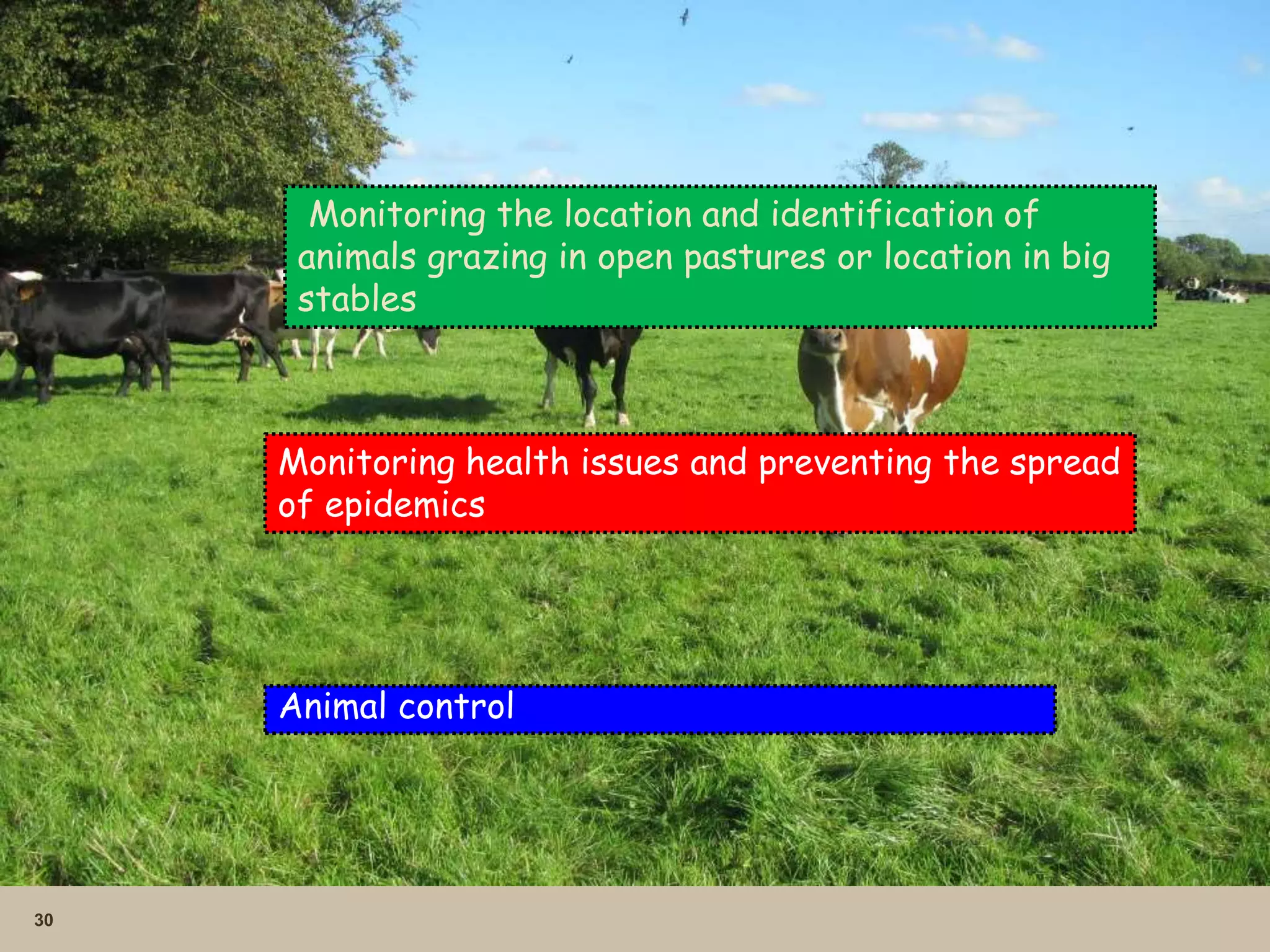
Animal control
Monitoring the location and identification of
animals grazing in open pastures or location in big
stables
Monitoring health issues and preventing the spread
of epidemics
31
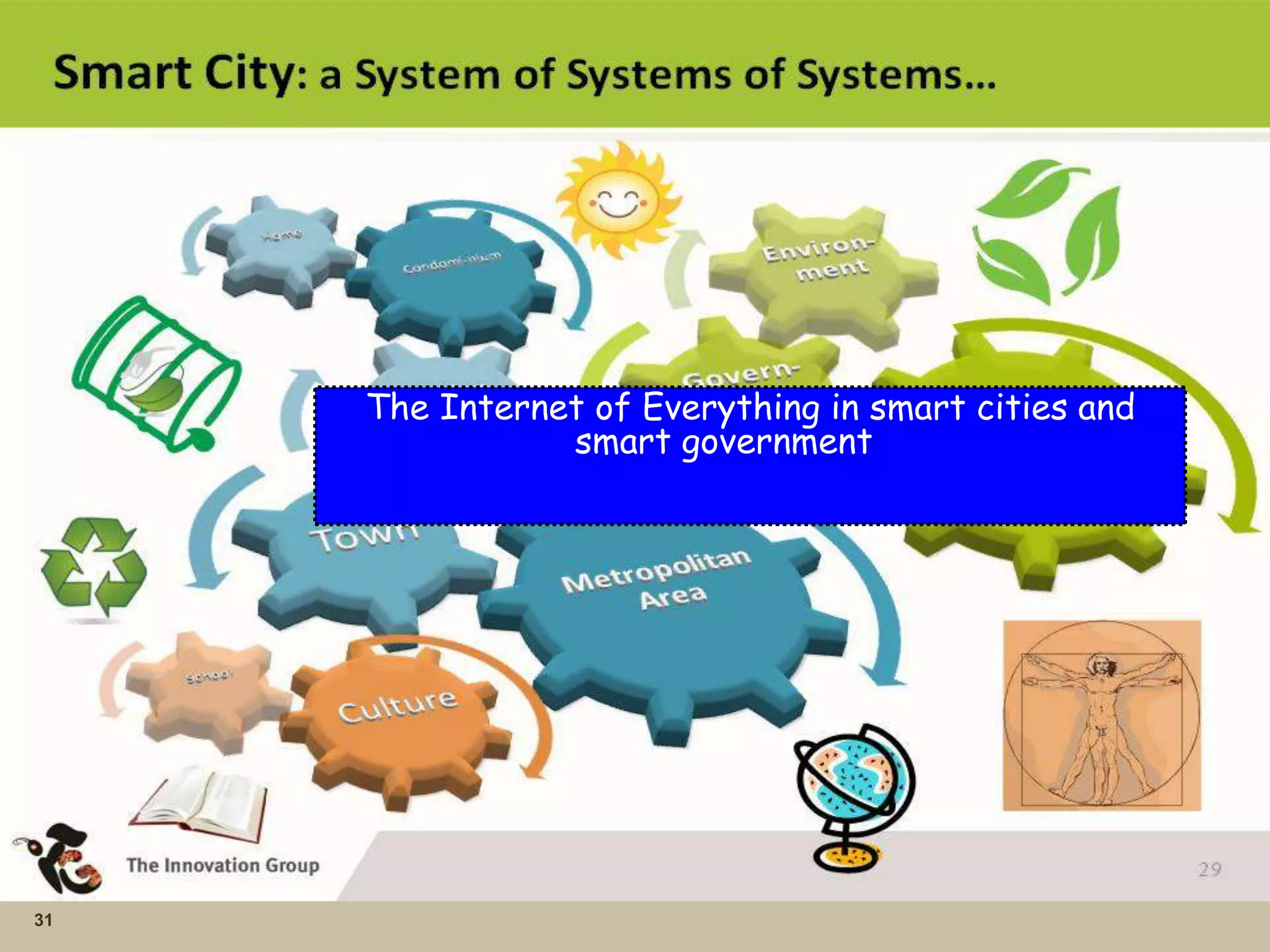
The Internet of Everything in smart cities and
smart government
32
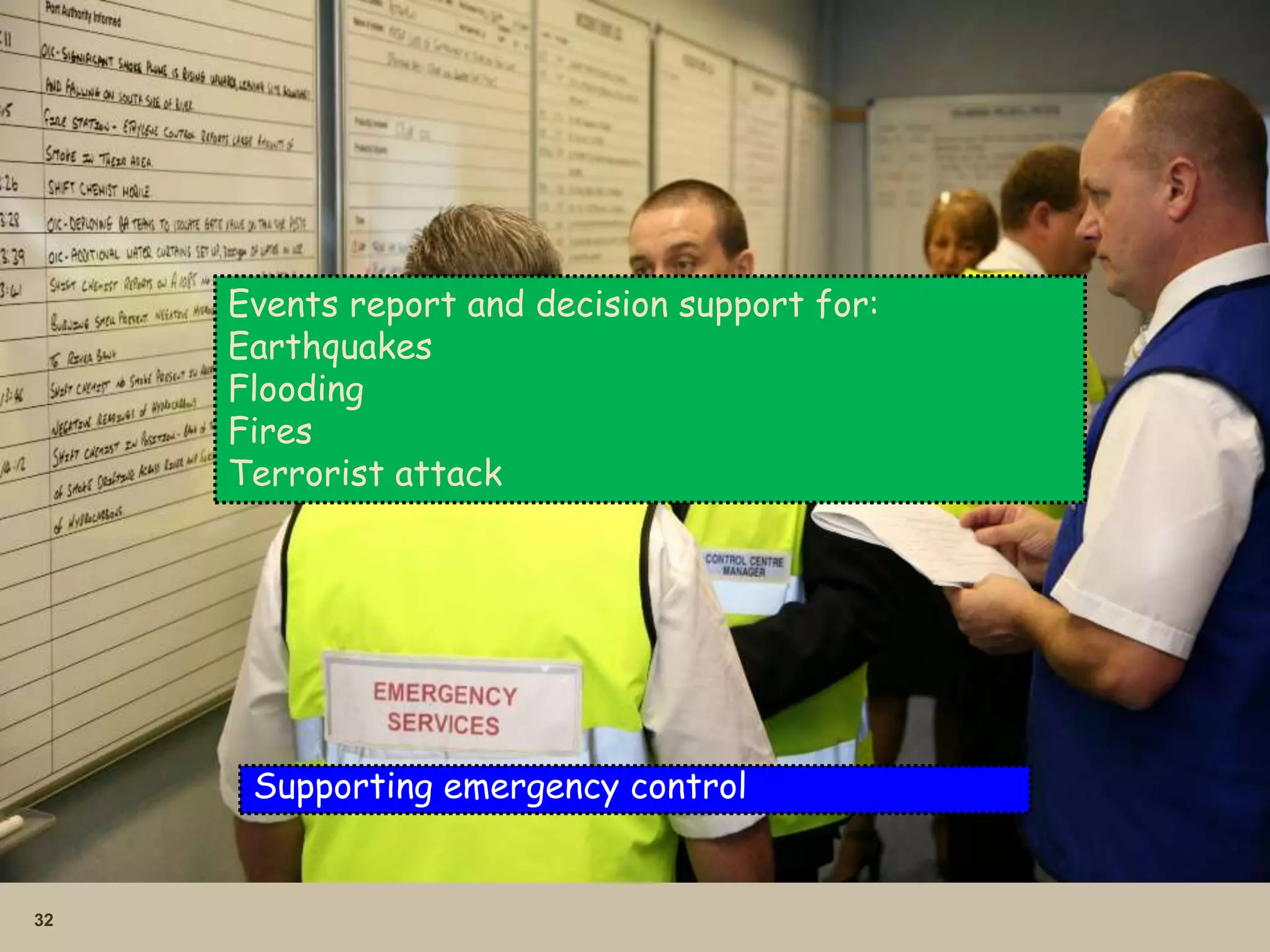
Supporting emergency control
Events report and decision support for:
Earthquakes
Flooding
Fires
Terrorist attack
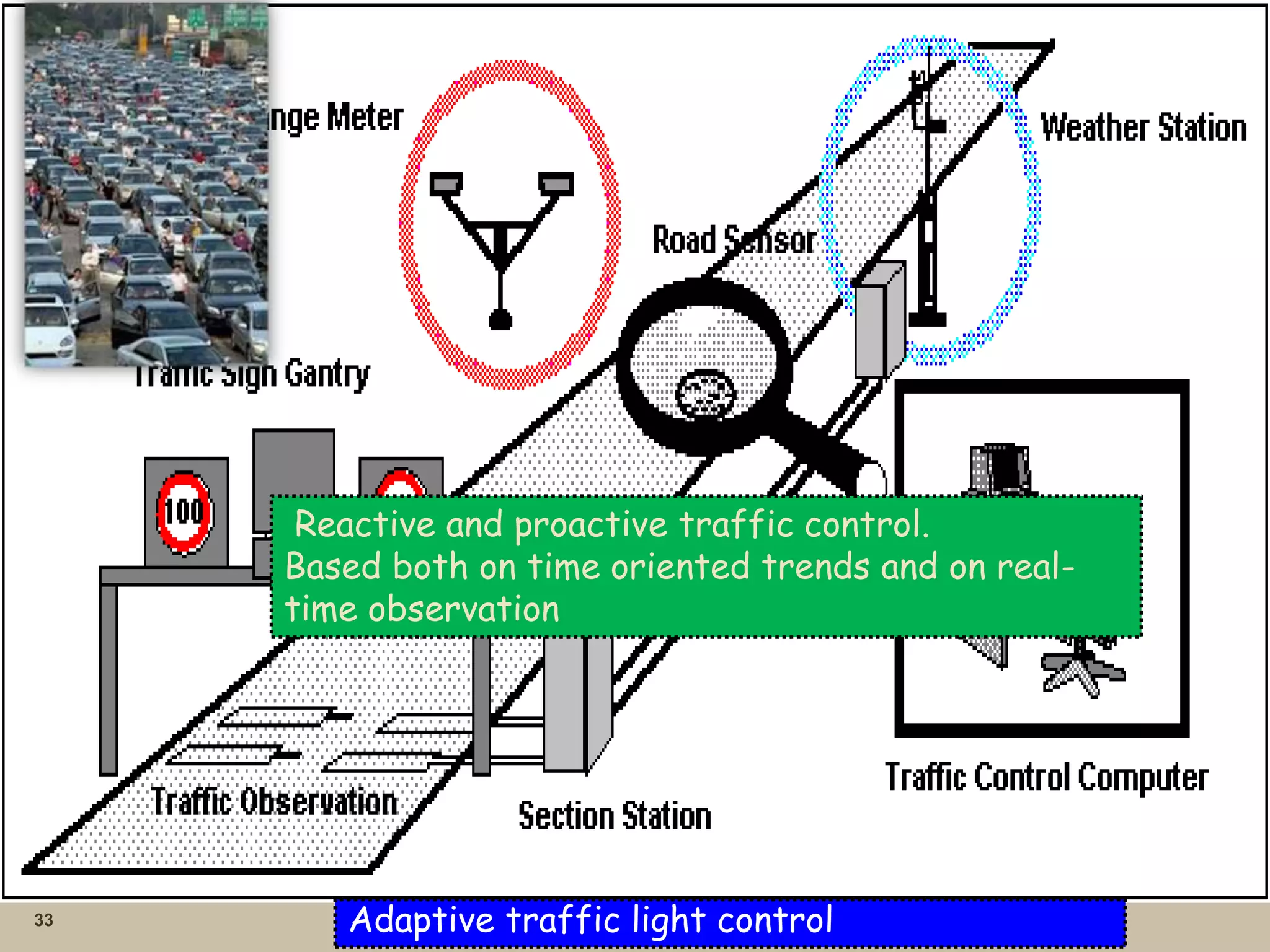
33 Adaptive traffic light control
Reactive and proactive traffic control.
Based both on time oriented trends and on real-
time observation
34
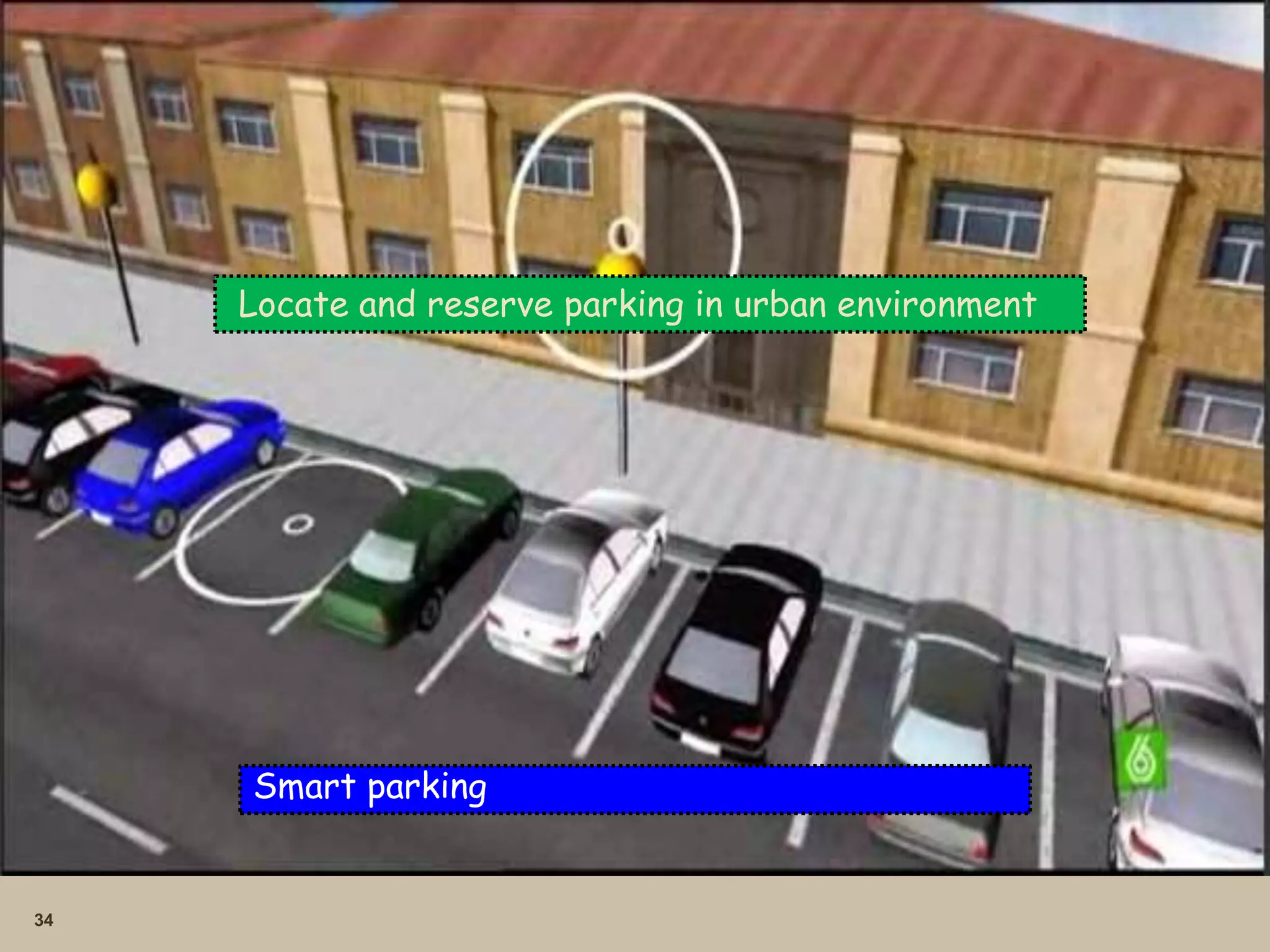
Smart parking
Locate and reserve parking in urban environment
35
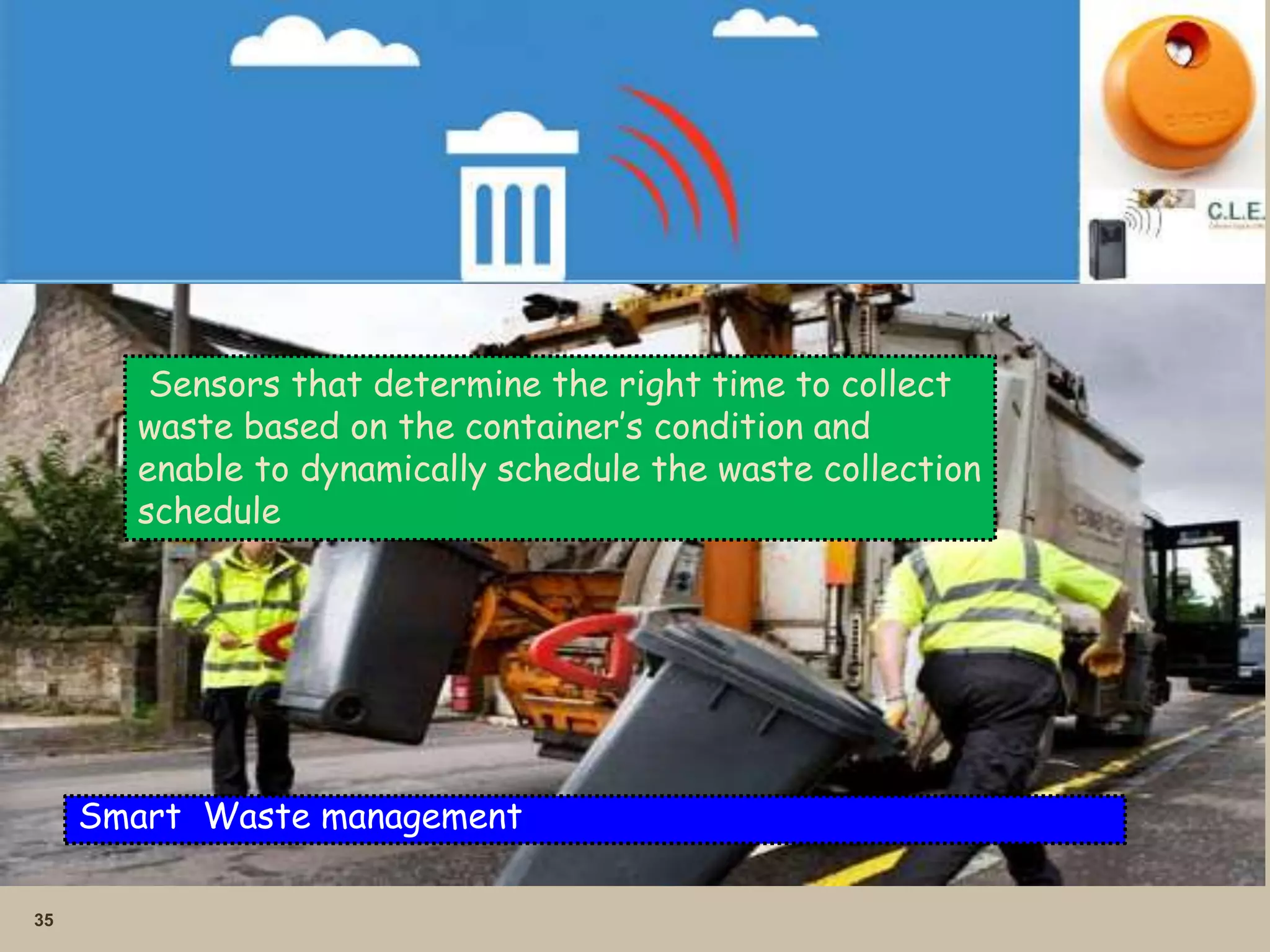
Smart Waste management
Sensors that determine the right time to collect
waste based on the container’s condition and
enable to dynamically schedule the waste collection
schedule
36
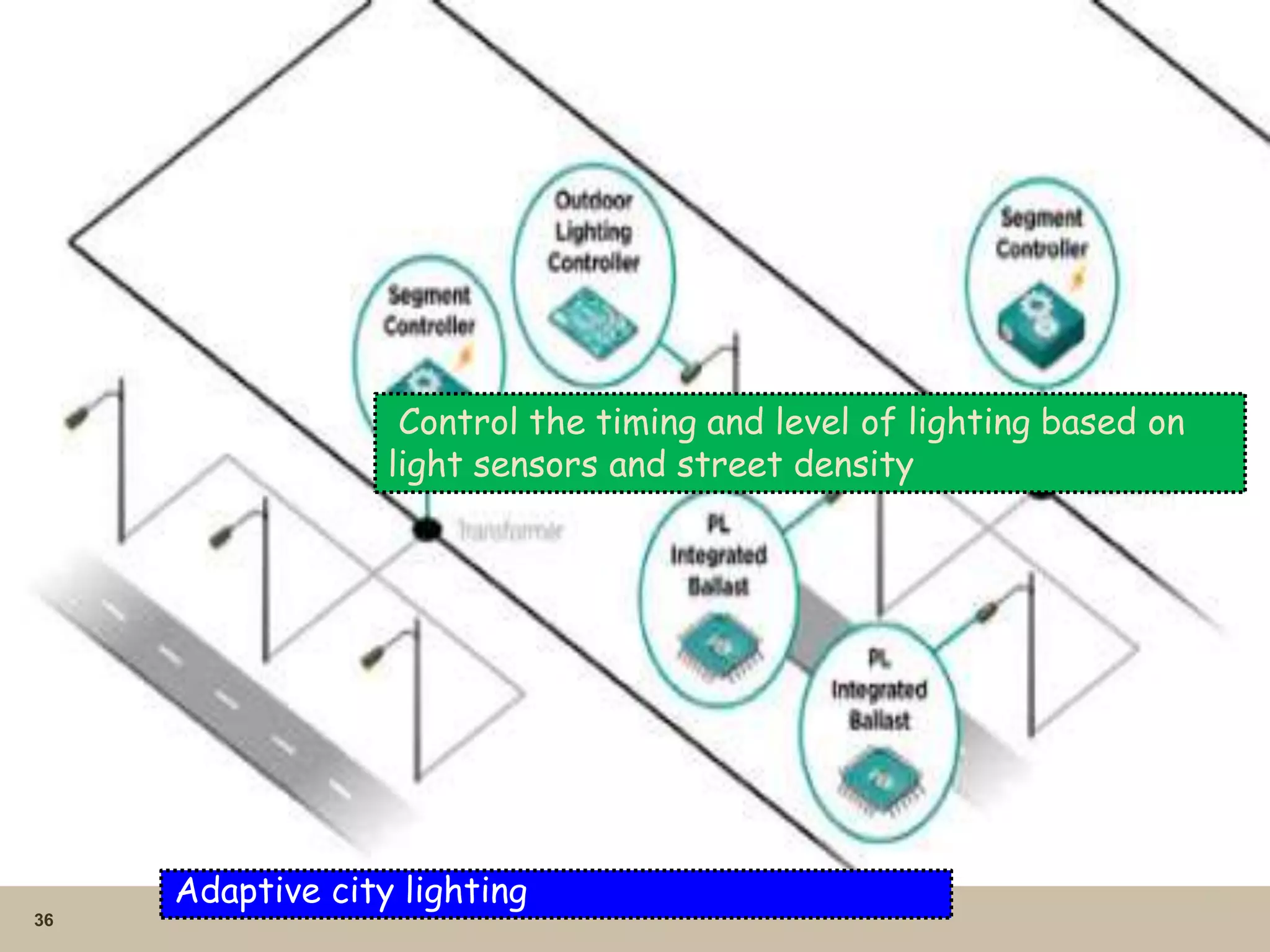
Adaptive city lighting
Control the timing and level of lighting based on
light sensors and street density
37
The Internet of Everything in environment and
sustainability systems
38
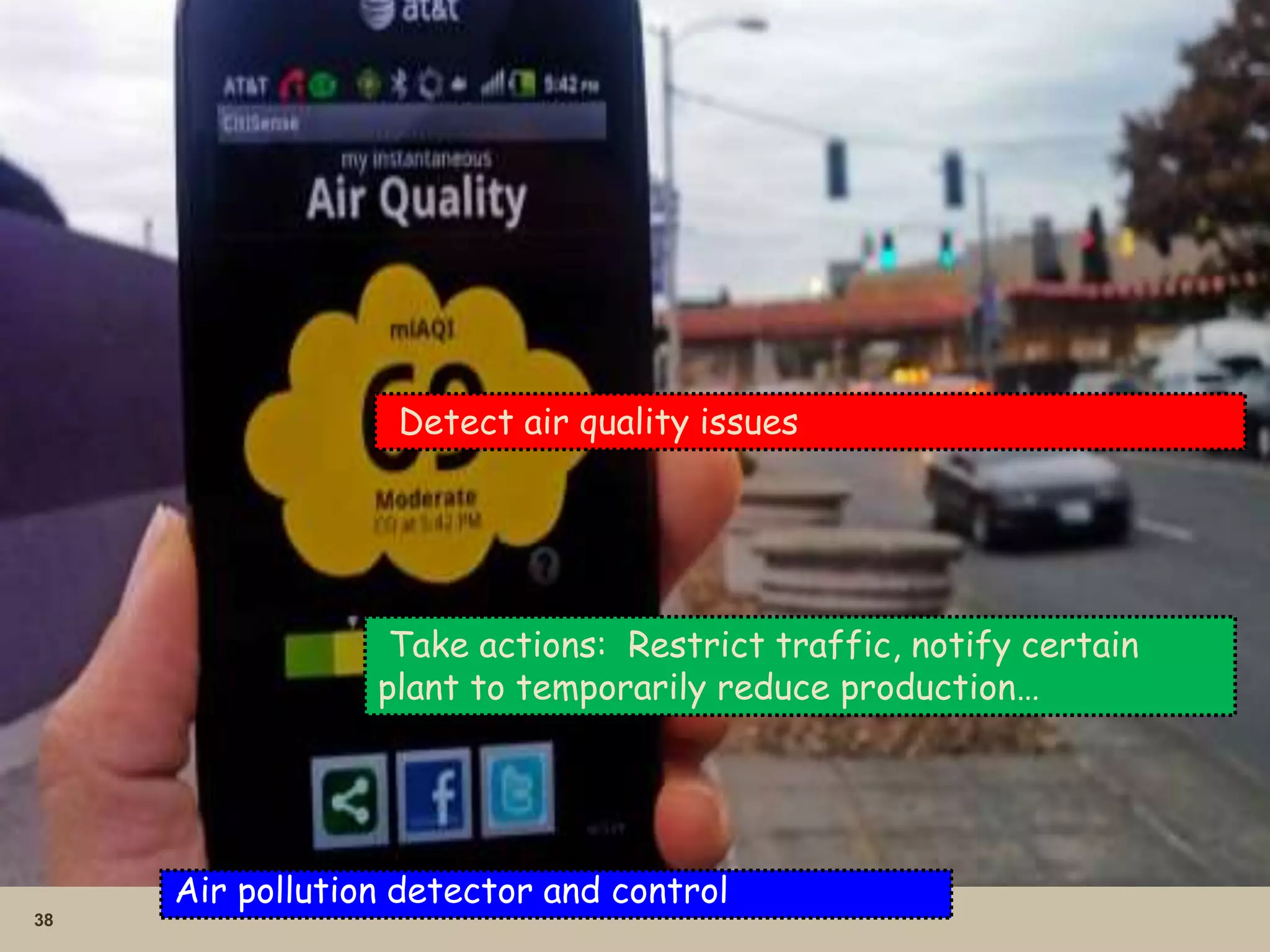
Air pollution detector and control
Detect air quality issues
Take actions: Restrict traffic, notify certain
plant to temporarily reduce production…
39
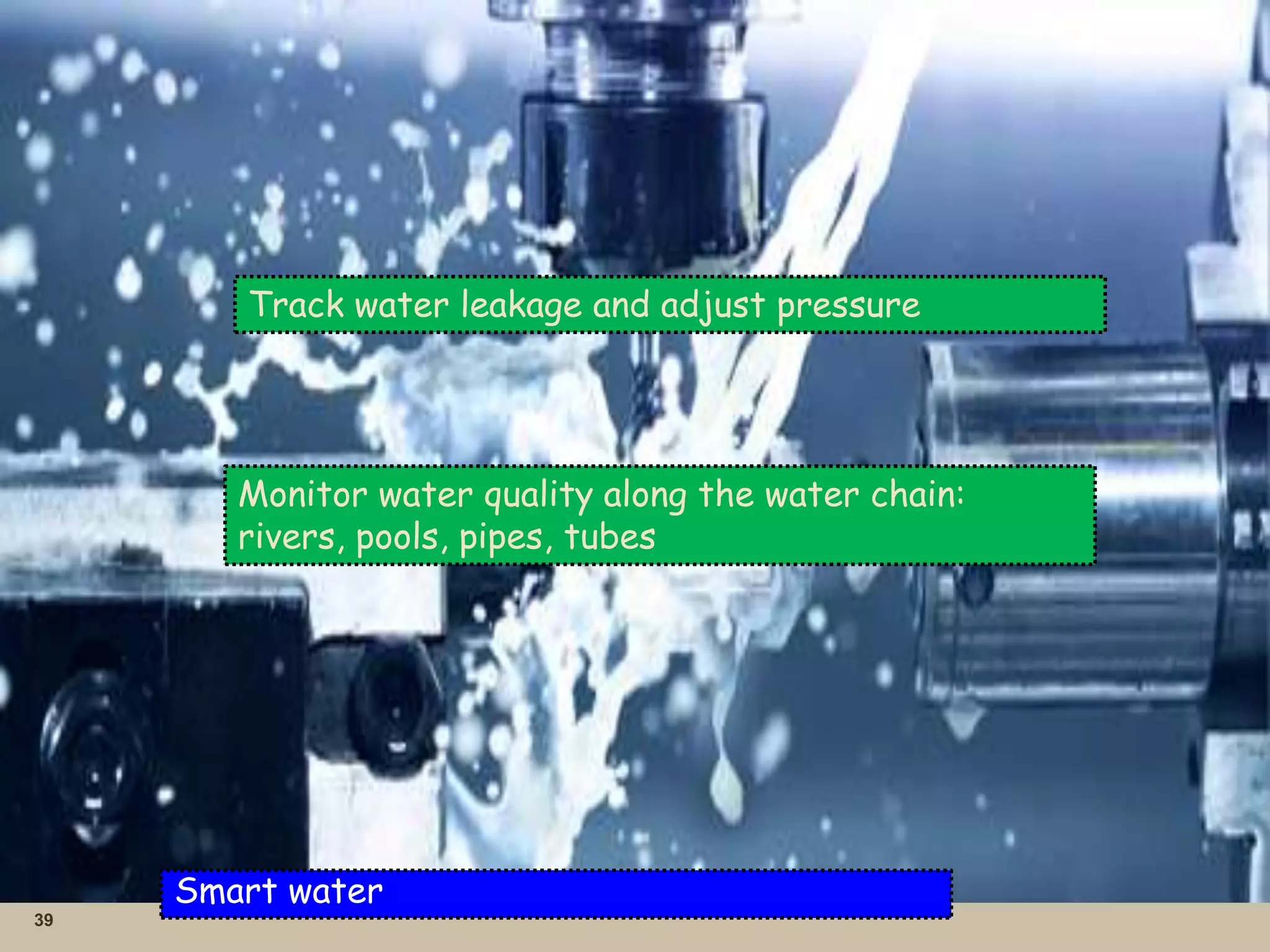
Smart water
Track water leakage and adjust pressure
Monitor water quality along the water chain:
rivers, pools, pipes, tubes
40
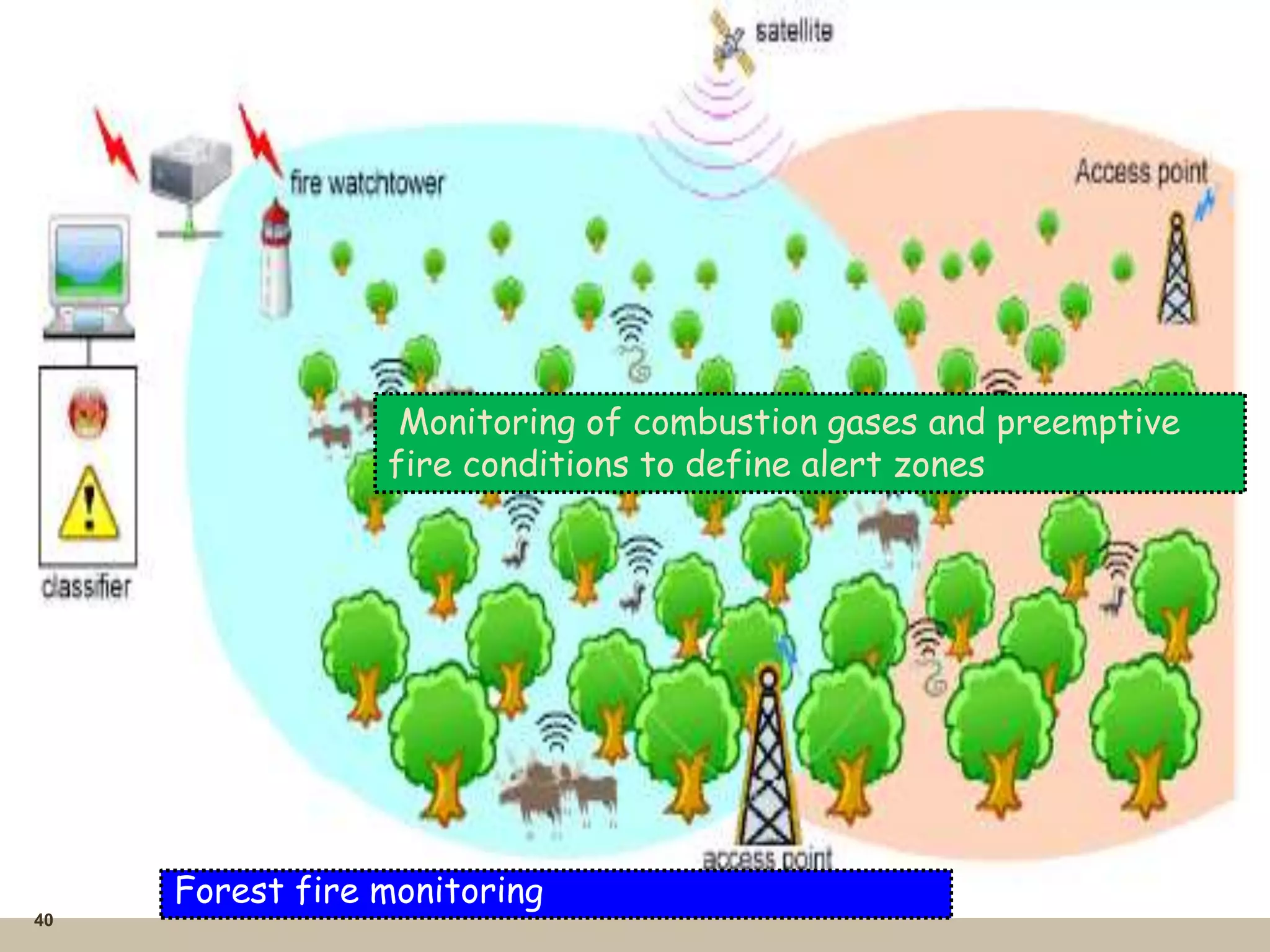
Forest fire monitoring
Monitoring of combustion gases and preemptive
fire conditions to define alert zones
41
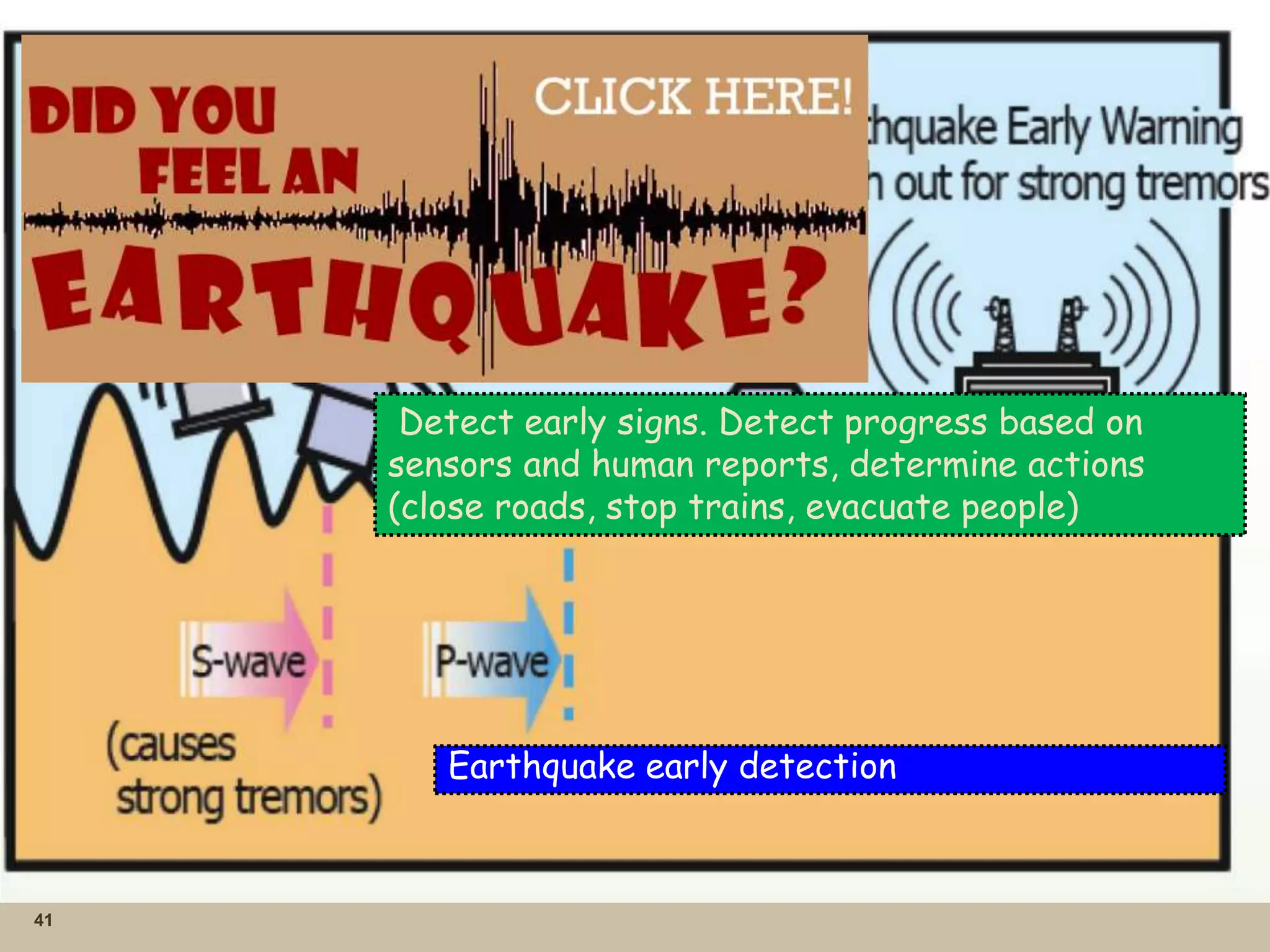
Earthquake early detection
Detect early signs. Detect progress based on
sensors and human reports, determine actions
(close roads, stop trains, evacuate people)
42
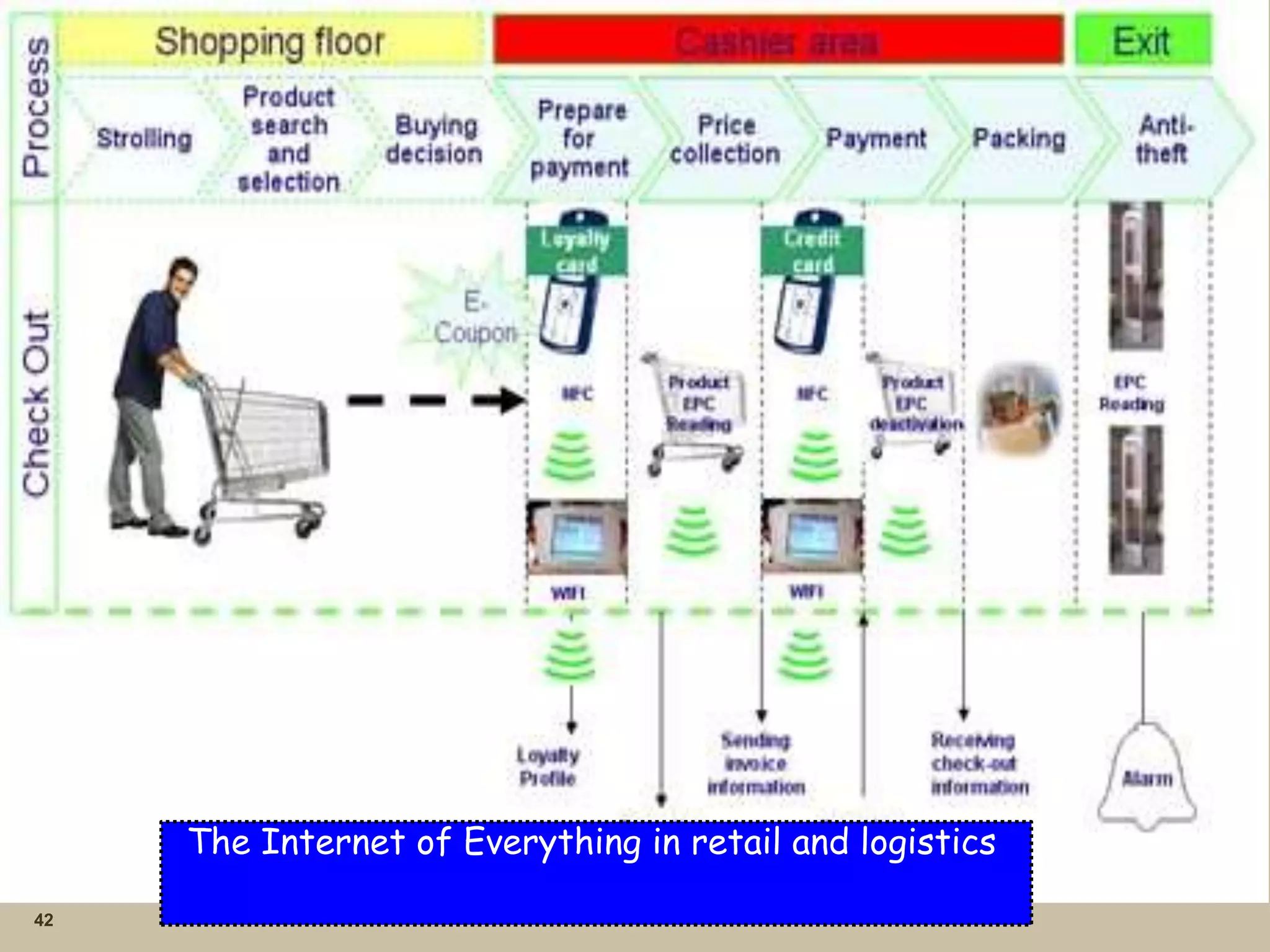
The Internet of Everything in retail and logistics
43
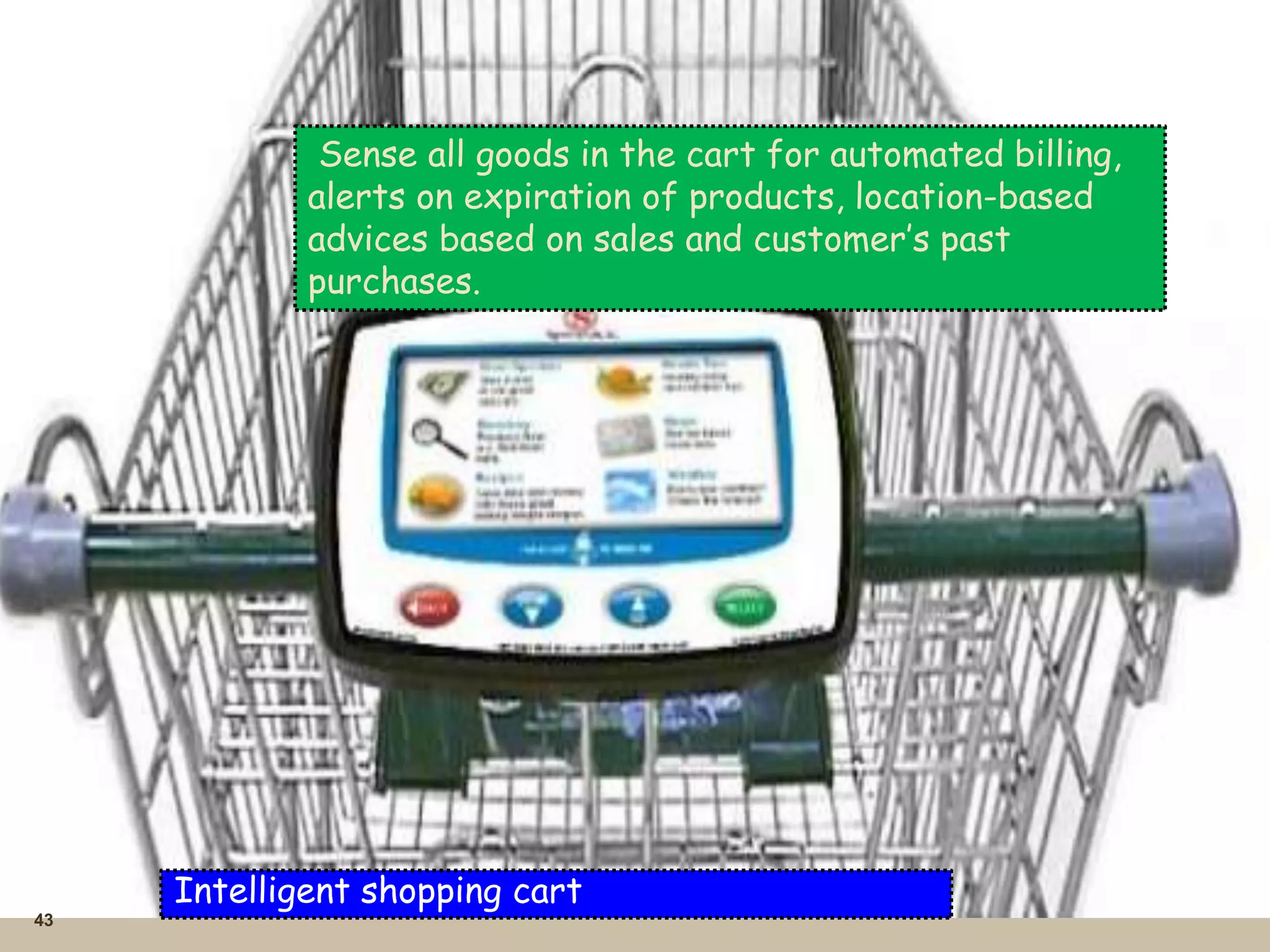
Intelligent shopping cart
Sense all goods in the cart for automated billing,
alerts on expiration of products, location-based
advices based on sales and customer’s past
purchases.
44
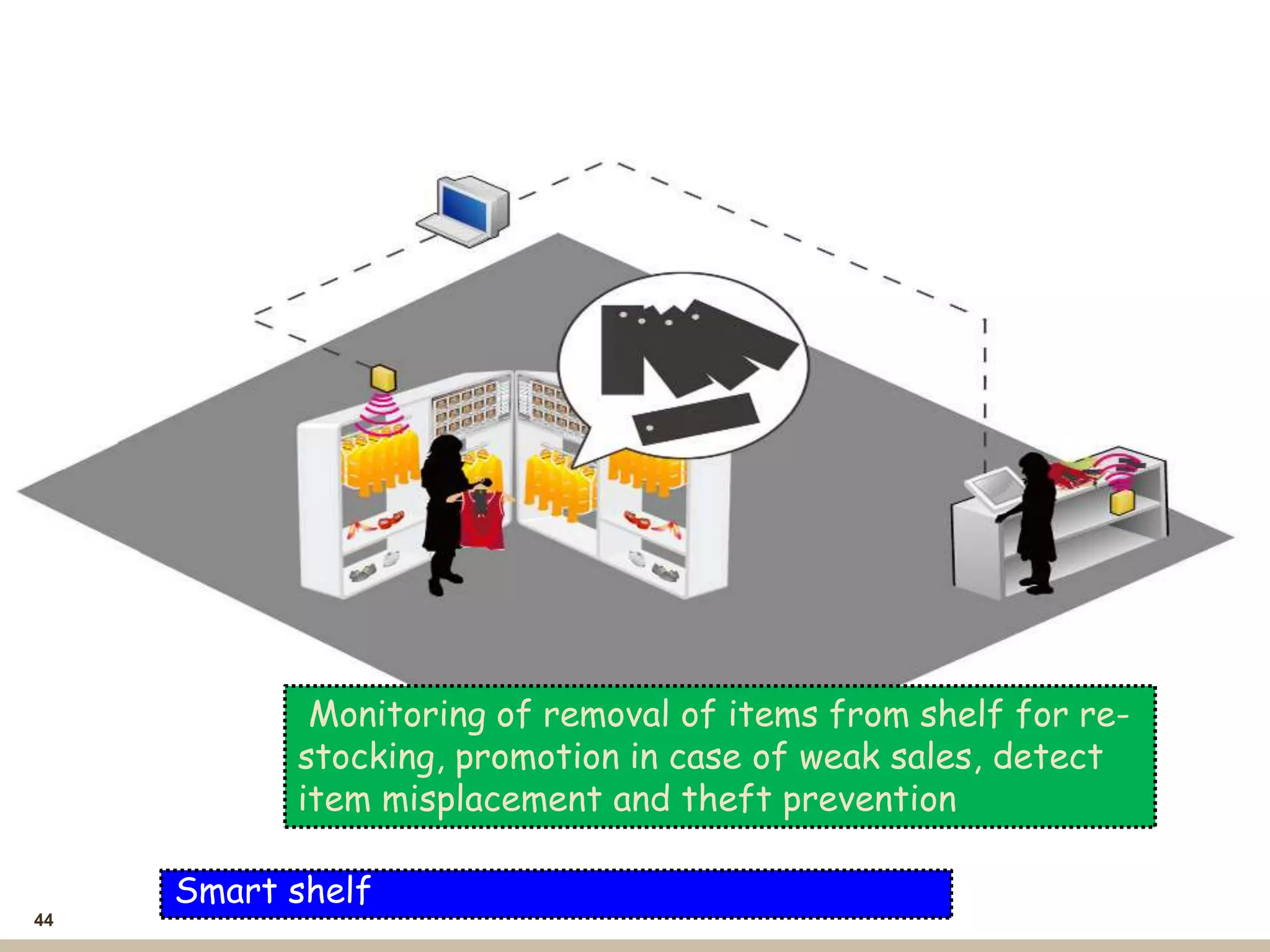
Smart shelf
Monitoring of removal of items from shelf for re-
stocking, promotion in case of weak sales, detect
item misplacement and theft prevention
45
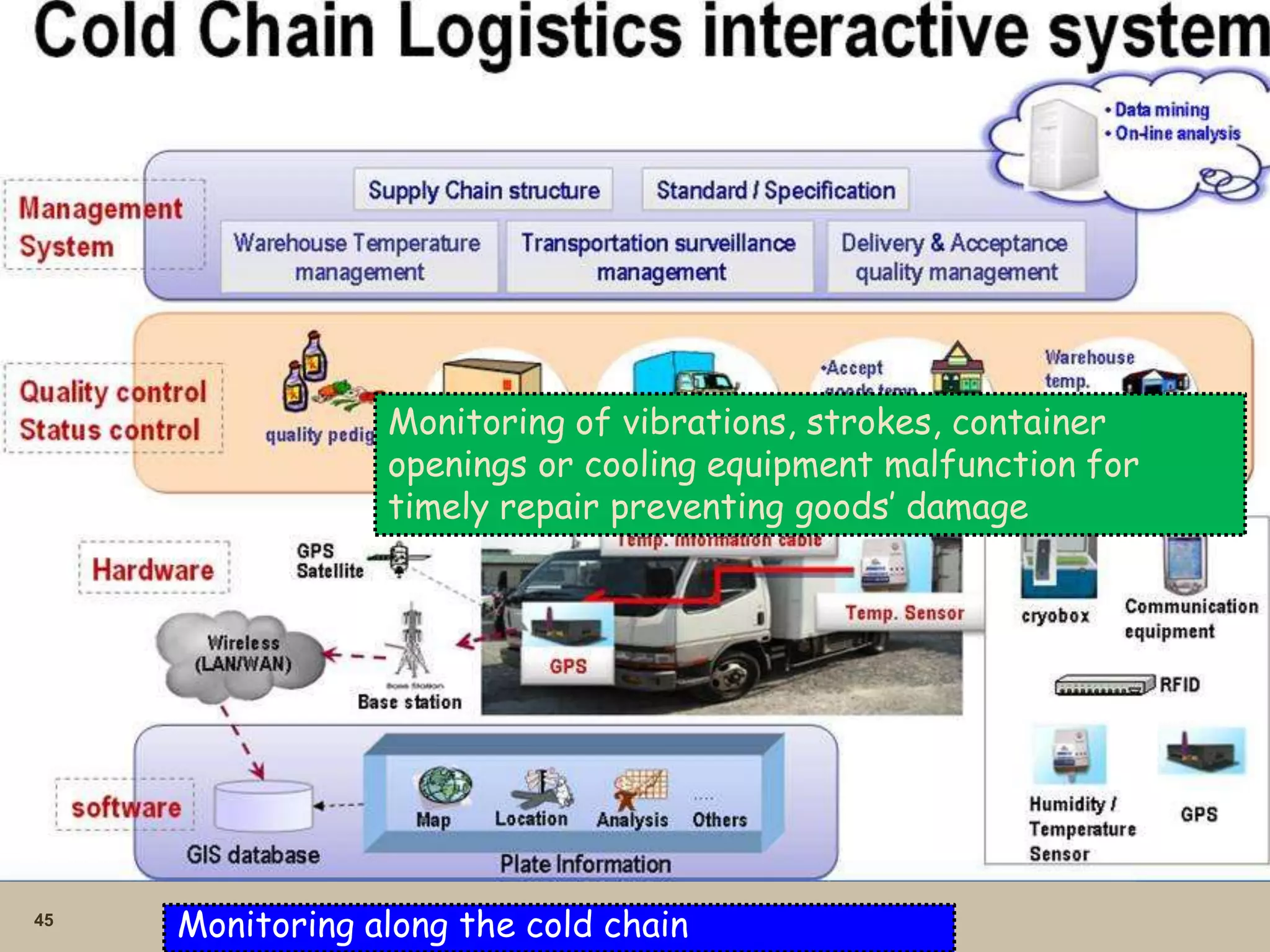
Monitoring along the cold chain
Monitoring of vibrations, strokes, container
openings or cooling equipment malfunction for
timely repair preventing goods’ damage
46
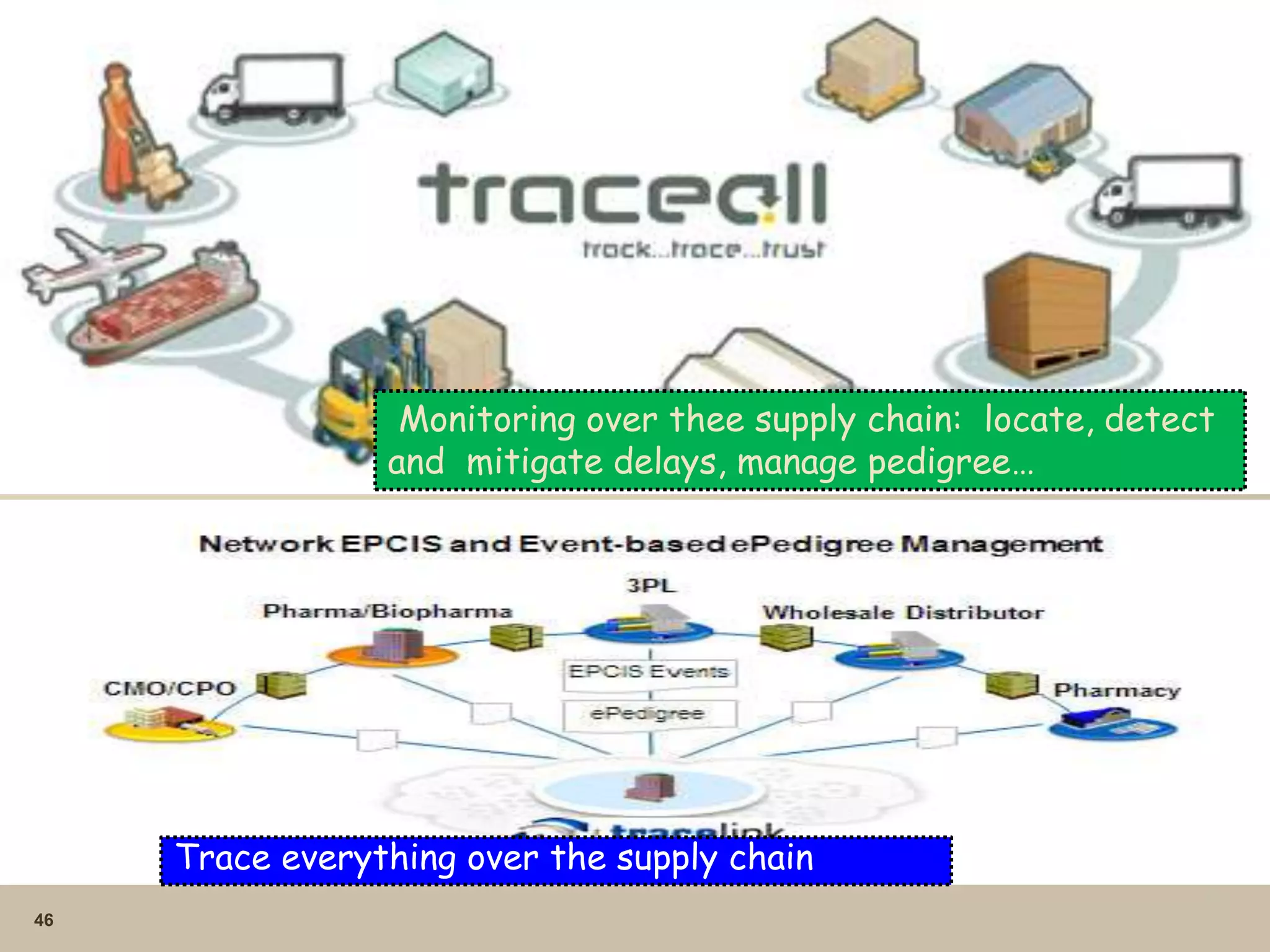
Trace everything over the supply chain
Monitoring over thee supply chain: locate, detect
and mitigate delays, manage pedigree…
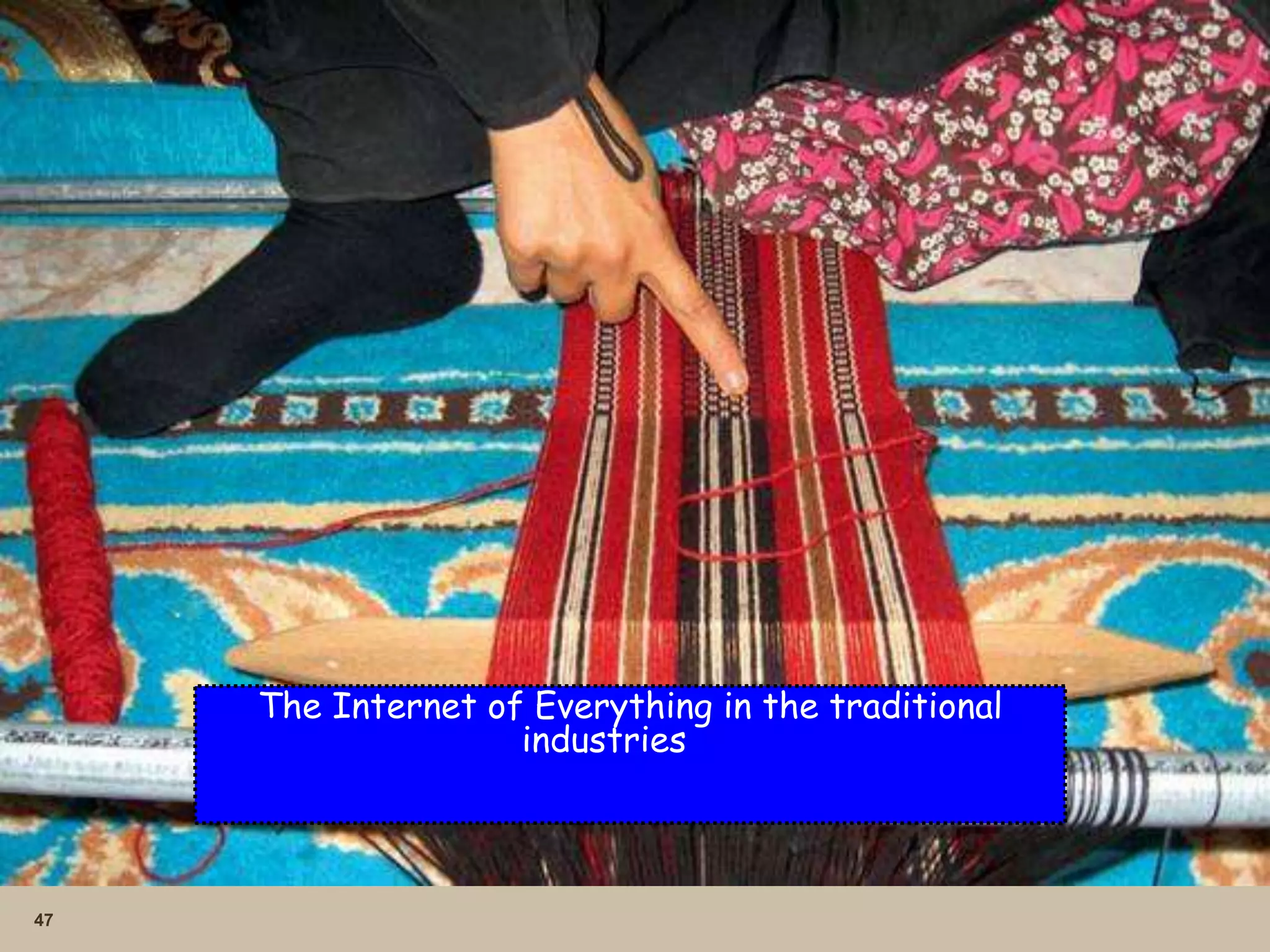
47
The Internet of Everything in the traditional
industries
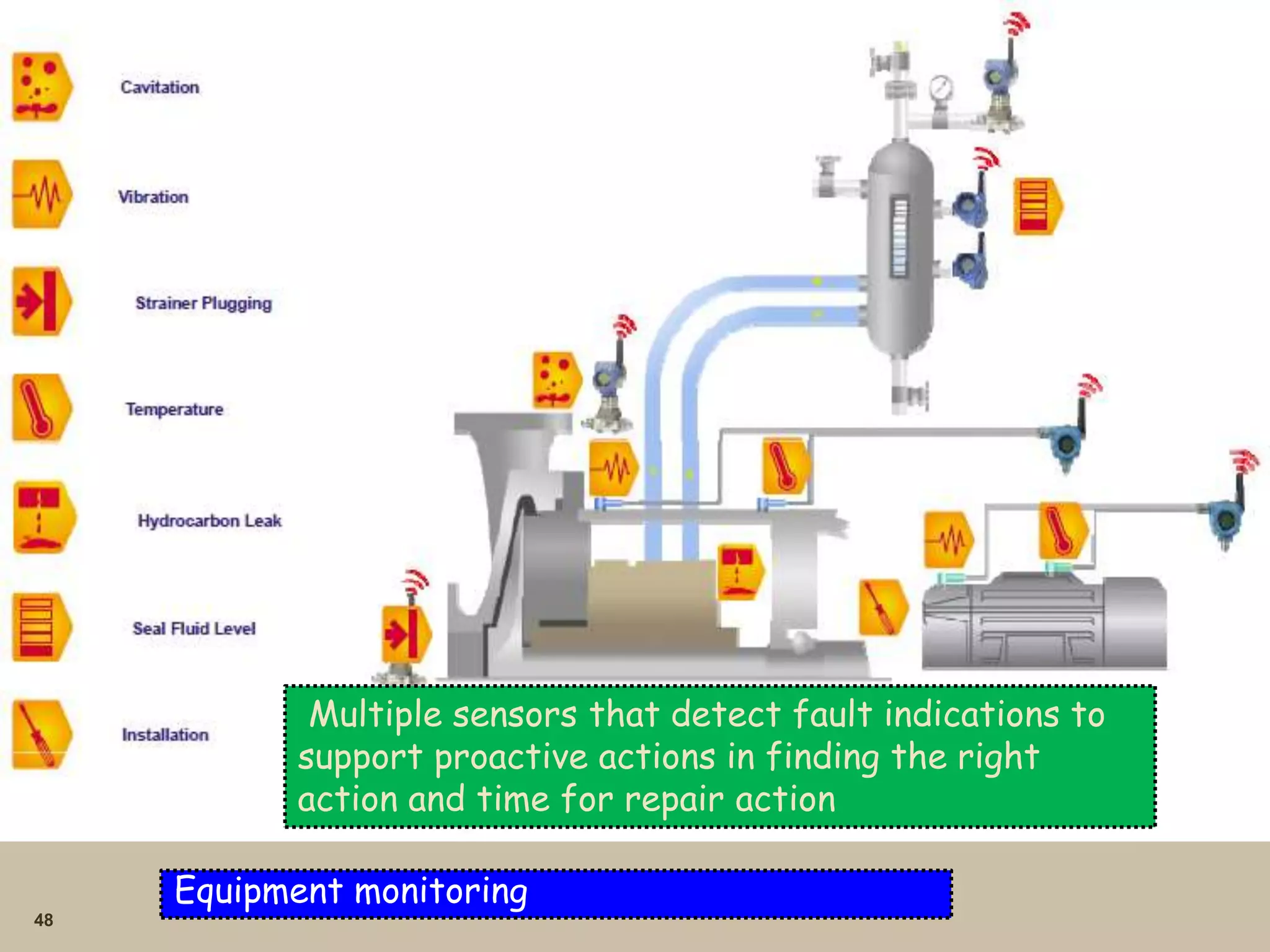
48
Equipment monitoring
Multiple sensors that detect fault indications to
support proactive actions in finding the right
action and time for repair action
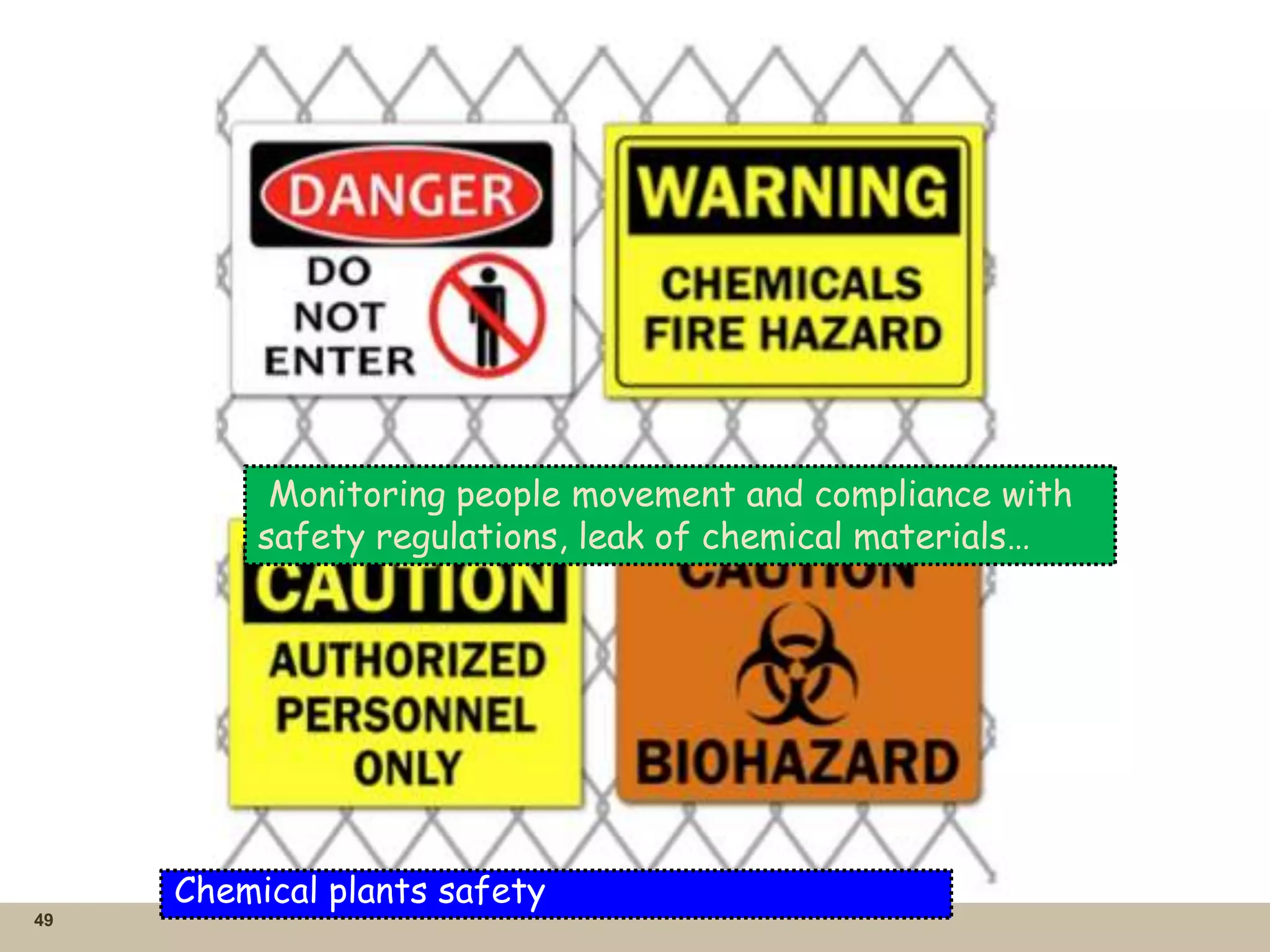
49
Chemical plants safety
Monitoring people movement and compliance with
safety regulations, leak of chemical materials…
50
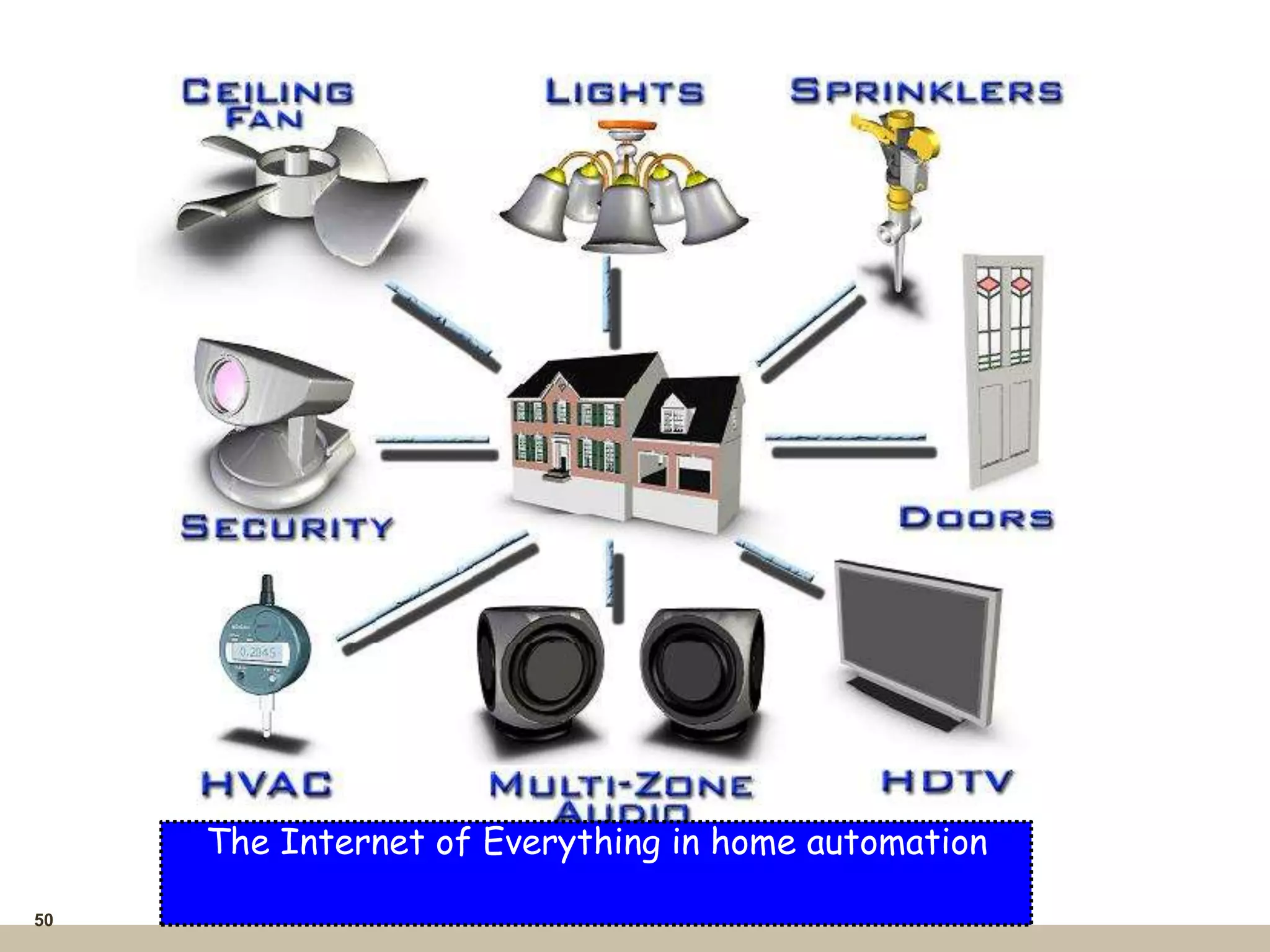
The Internet of Everything in home automation
51
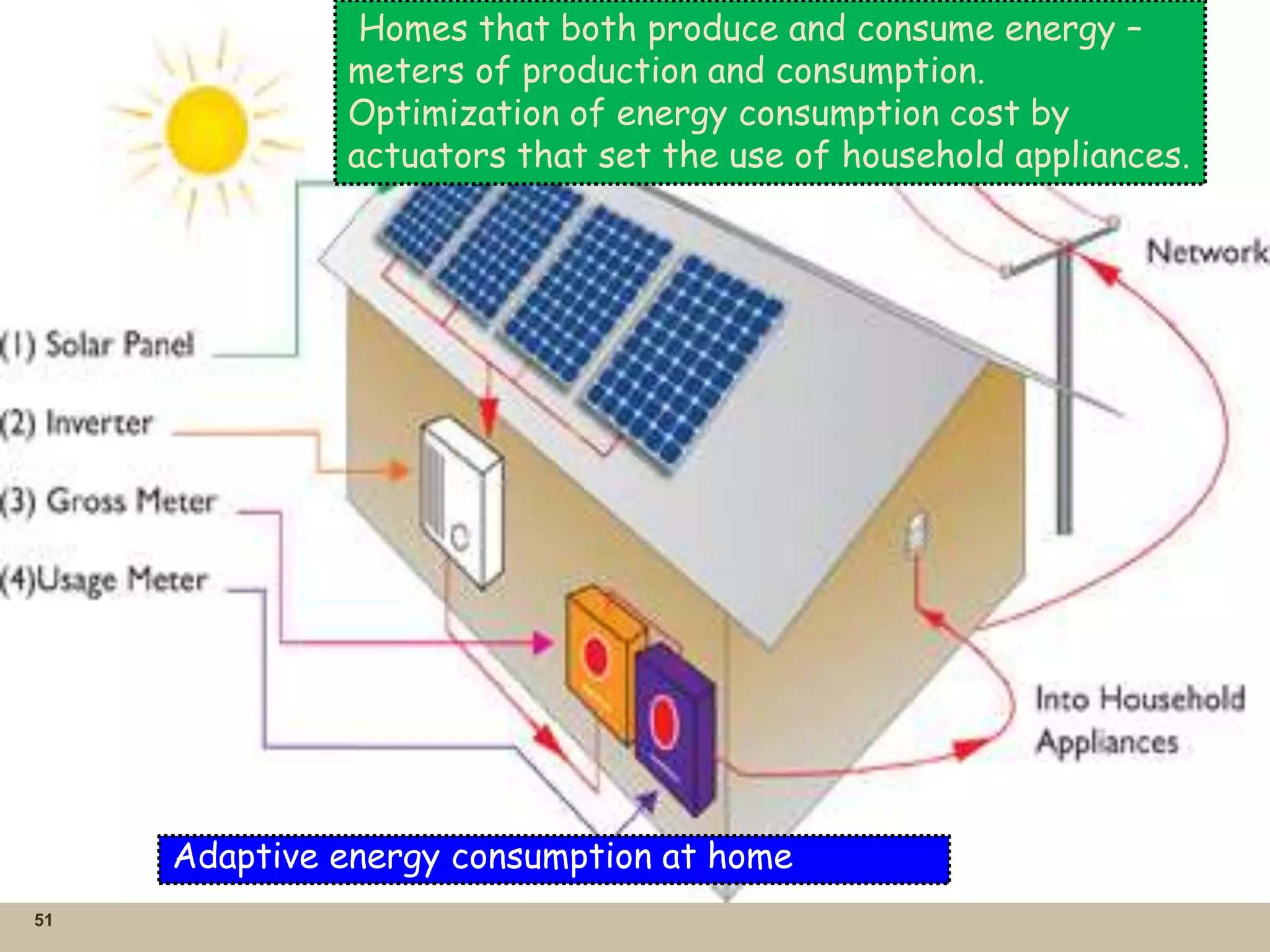
Adaptive energy consumption at home
Homes that both produce and consume energy –
meters of production and consumption.
Optimization of energy consumption cost by
actuators that set the use of household appliances.
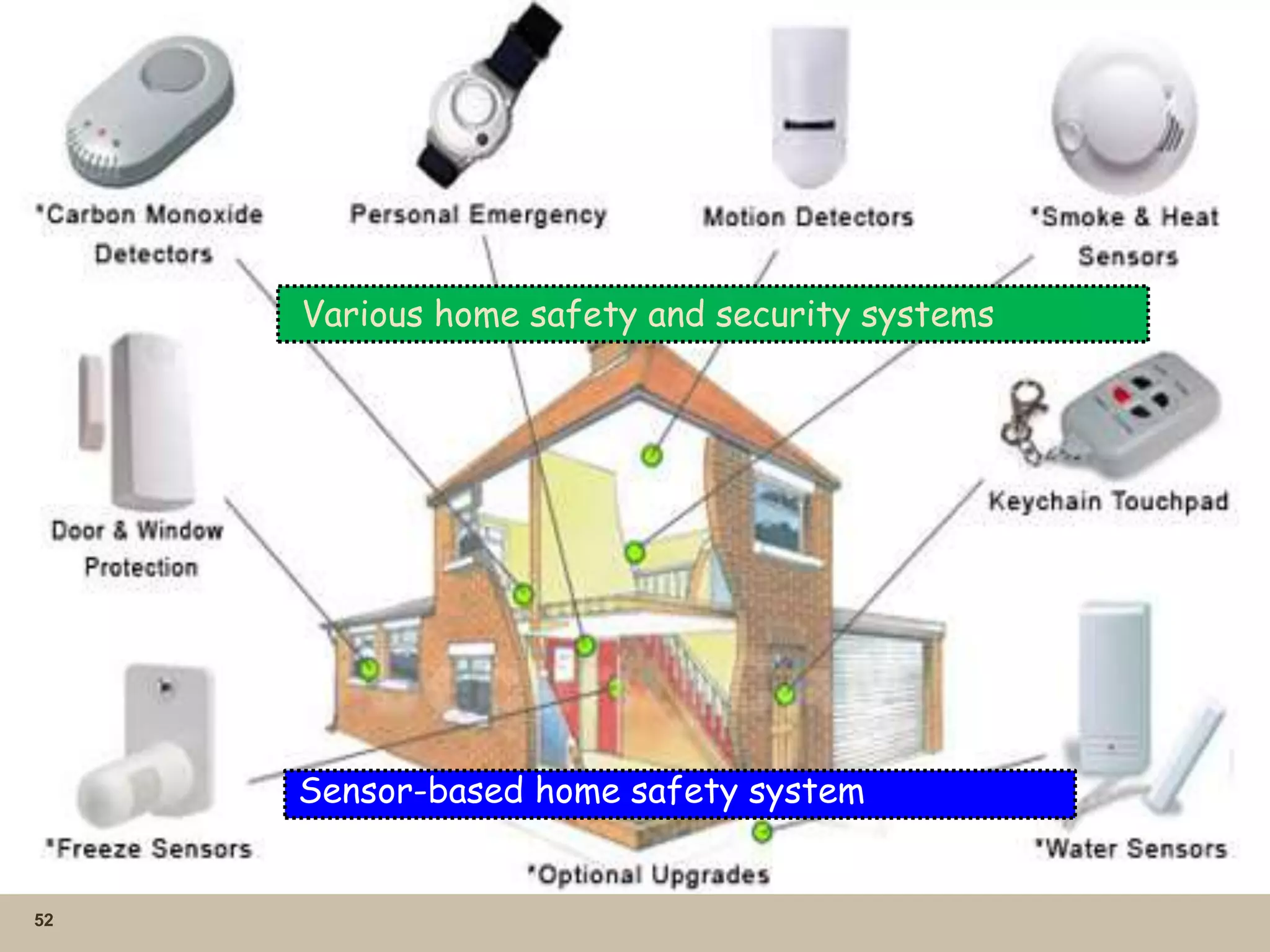
52
Sensor-based home safety system
Various home safety and security systems
53
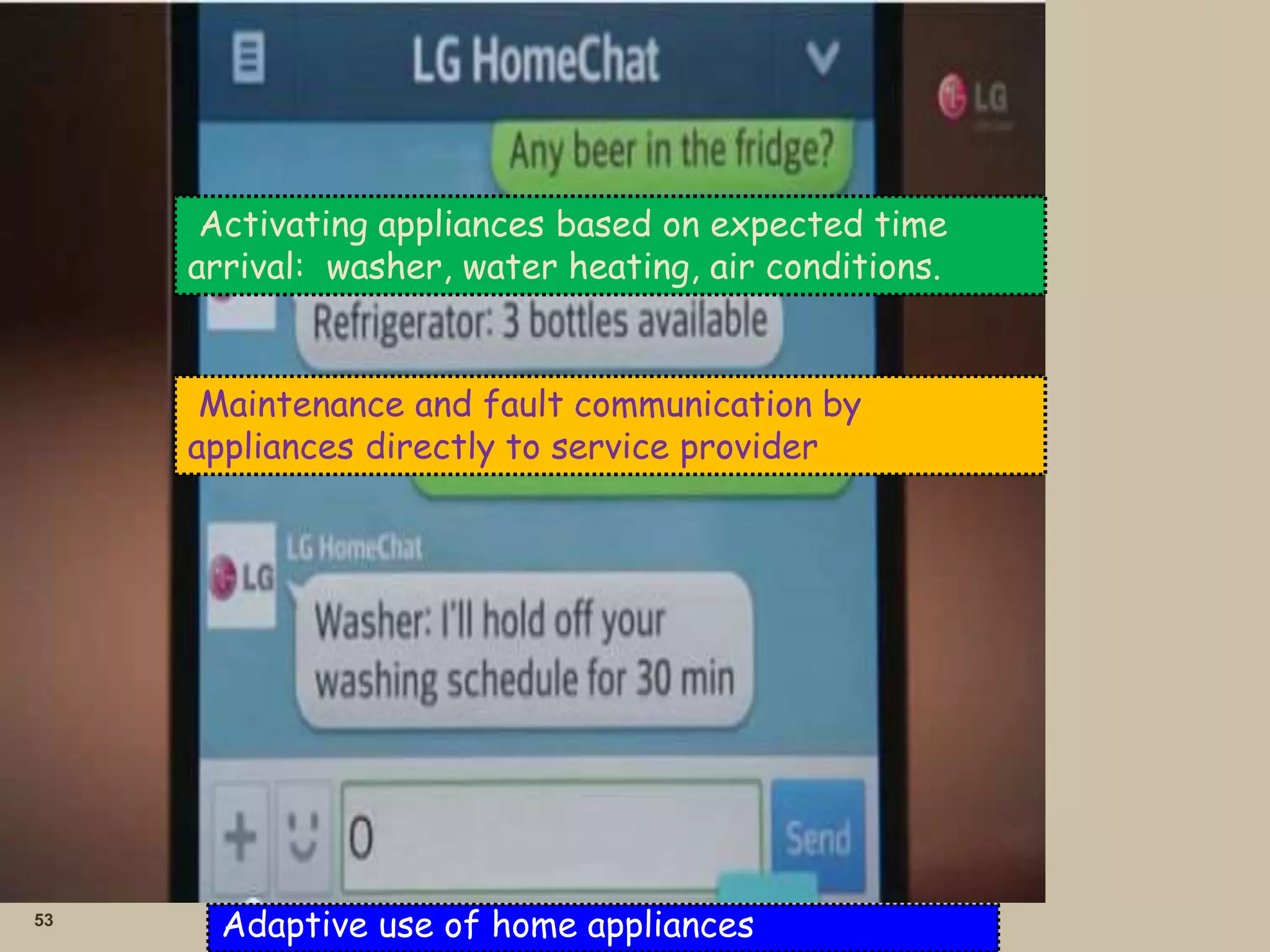
Adaptive use of home appliances
Activating appliances based on expected time
arrival: washer, water heating, air conditions.
Maintenance and fault communication by
appliances directly to service provider
54
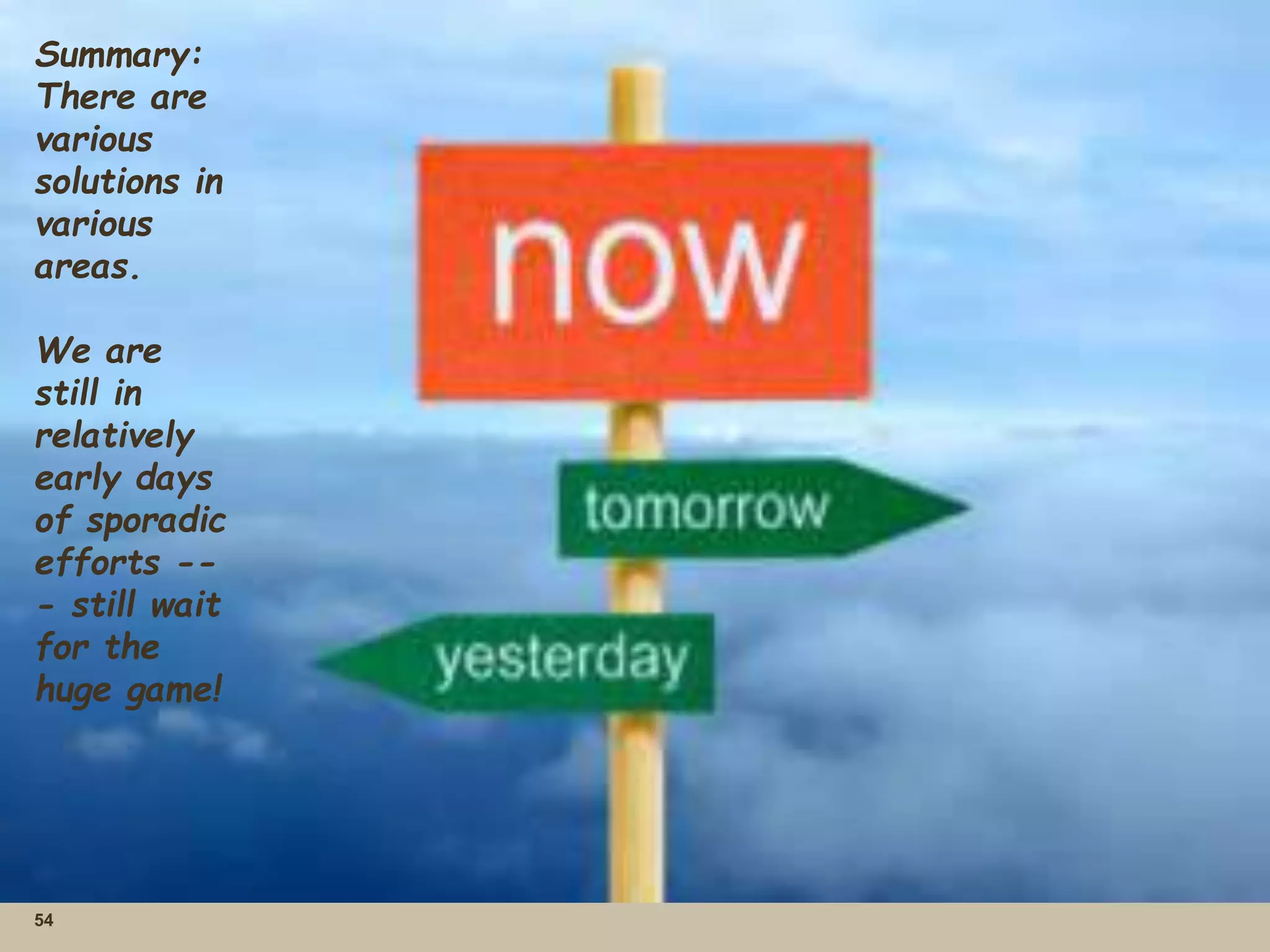
Summary:
There are
various
solutions in
various
areas.
We are
still in
relatively
early days
of sporadic
efforts --
- still wait
for the
huge game!
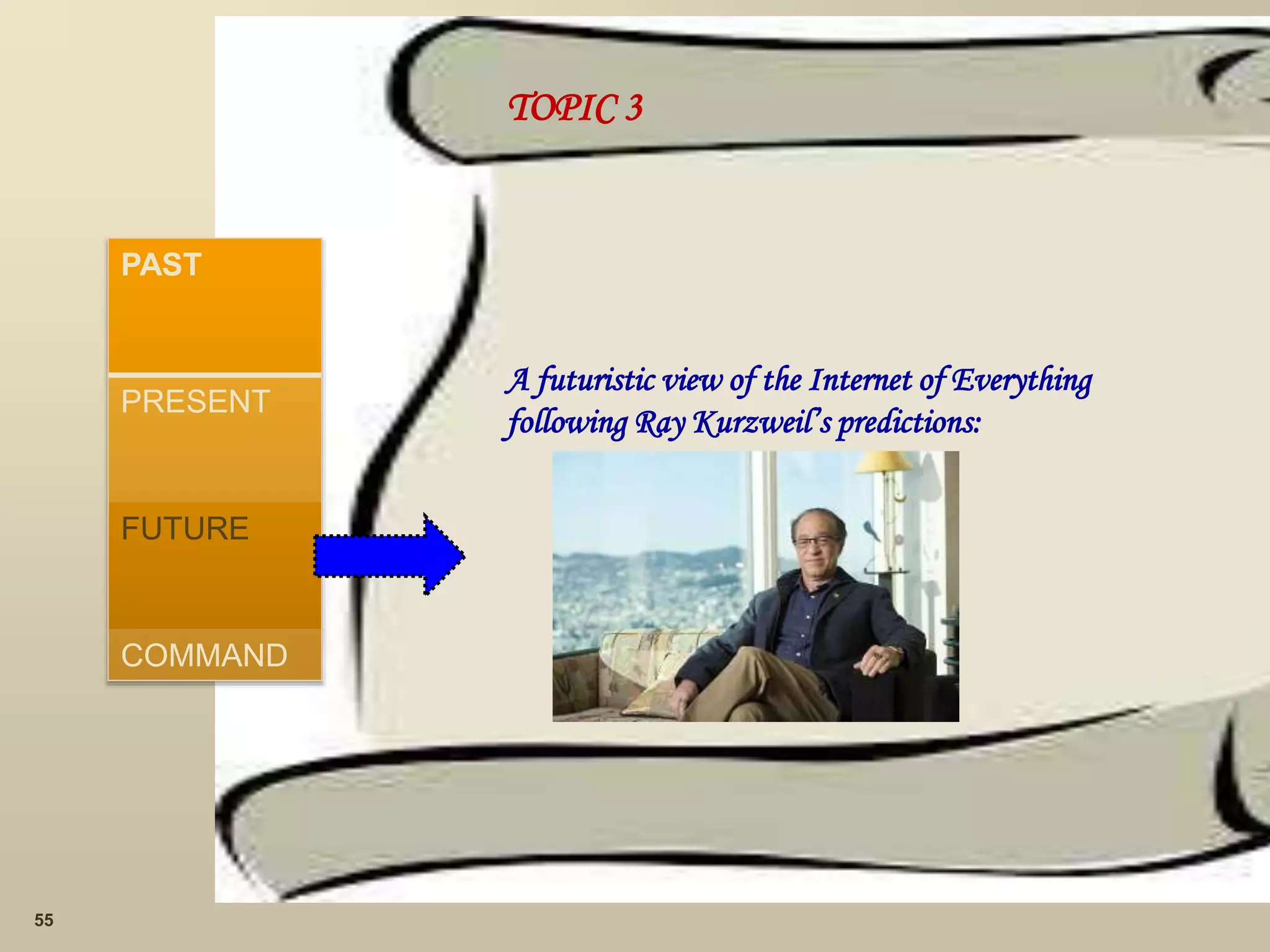
TOPIC 3
A futuristic view of the Internet of Everything
following Ray Kurzweil’s predictions:
55
PAST
PRESENT
FUTURE
COMMAND
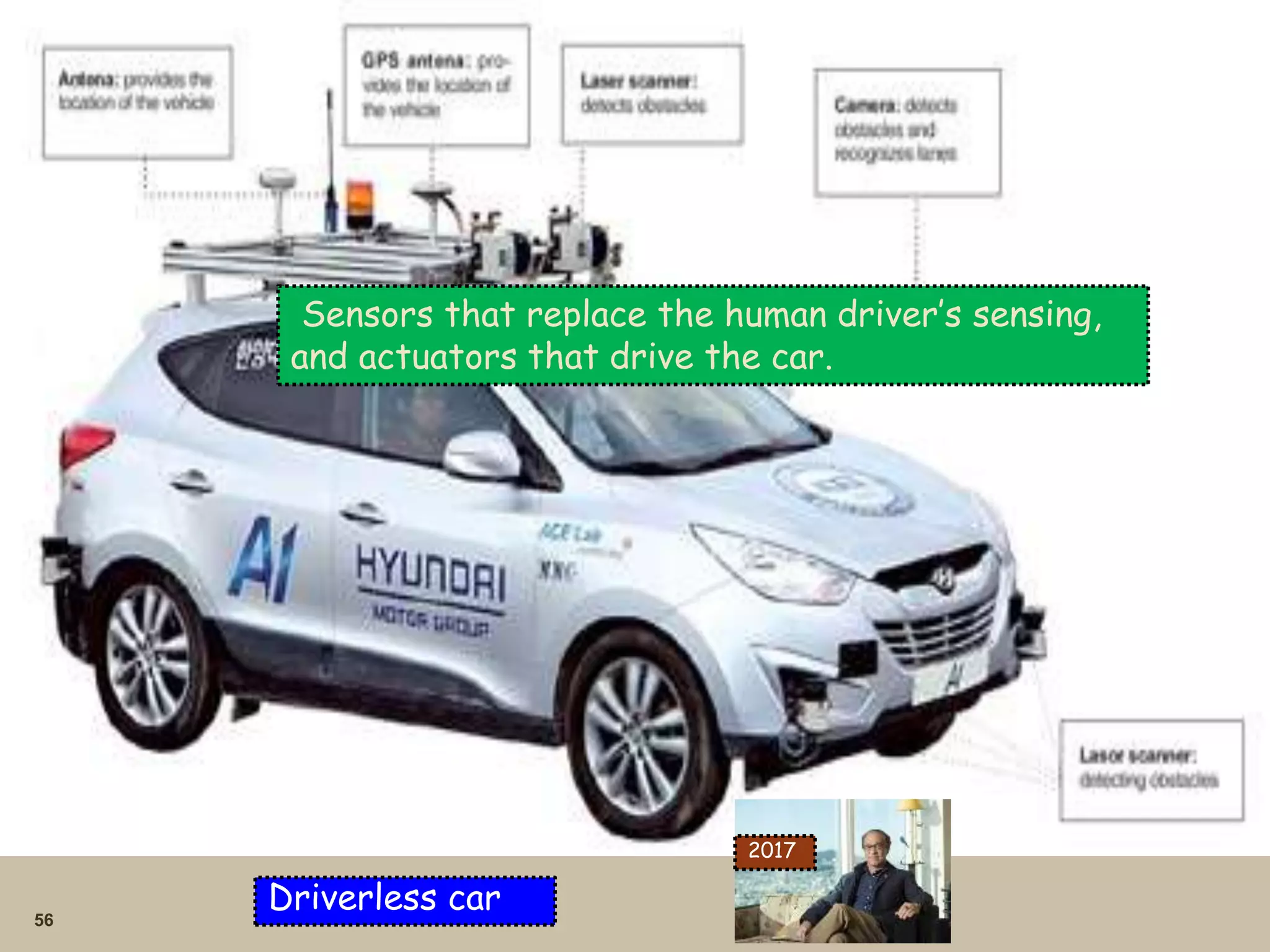
56
Driverless car
Sensors that replace the human driver’s sensing,
and actuators that drive the car.
2017
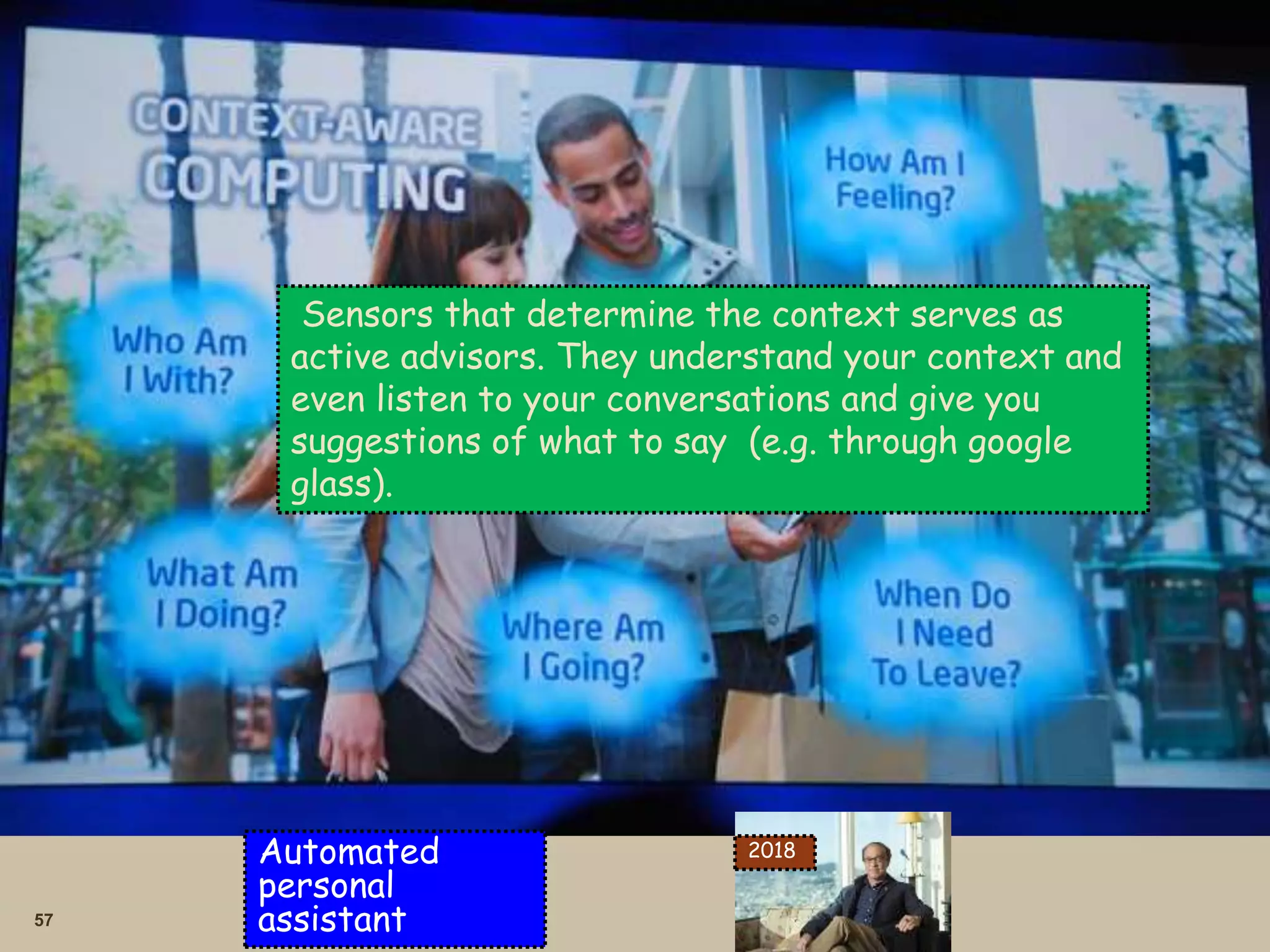
57
Automated
personal
assistant
Sensors that determine the context serves as
active advisors. They understand your context and
even listen to your conversations and give you
suggestions of what to say (e.g. through google
glass).
2018
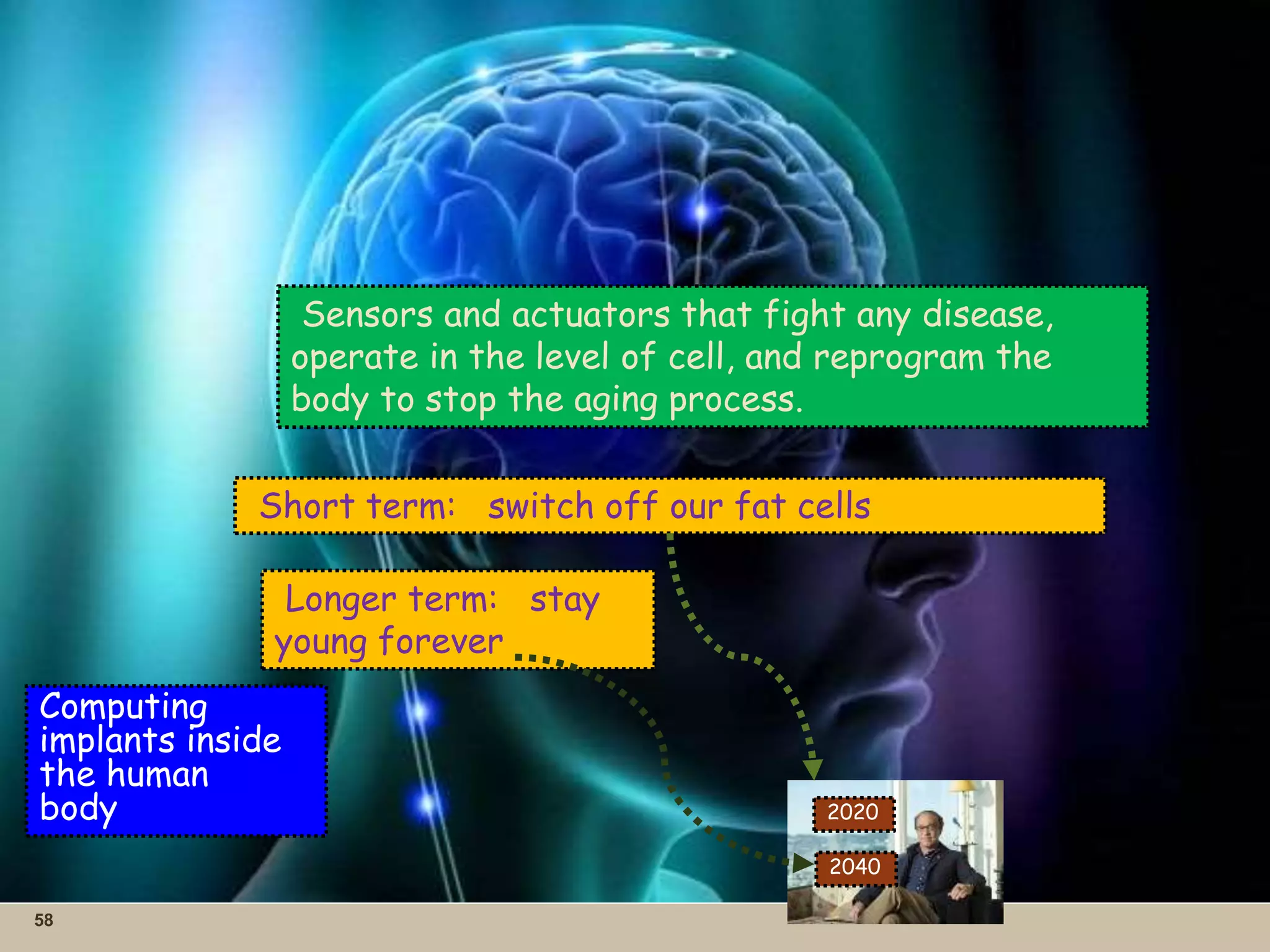
58
Computing
implants inside
the human
body
Sensors and actuators that fight any disease,
operate in the level of cell, and reprogram the
body to stop the aging process.
2020
2040
Short term: switch off our fat cells
Longer term: stay
young forever
59
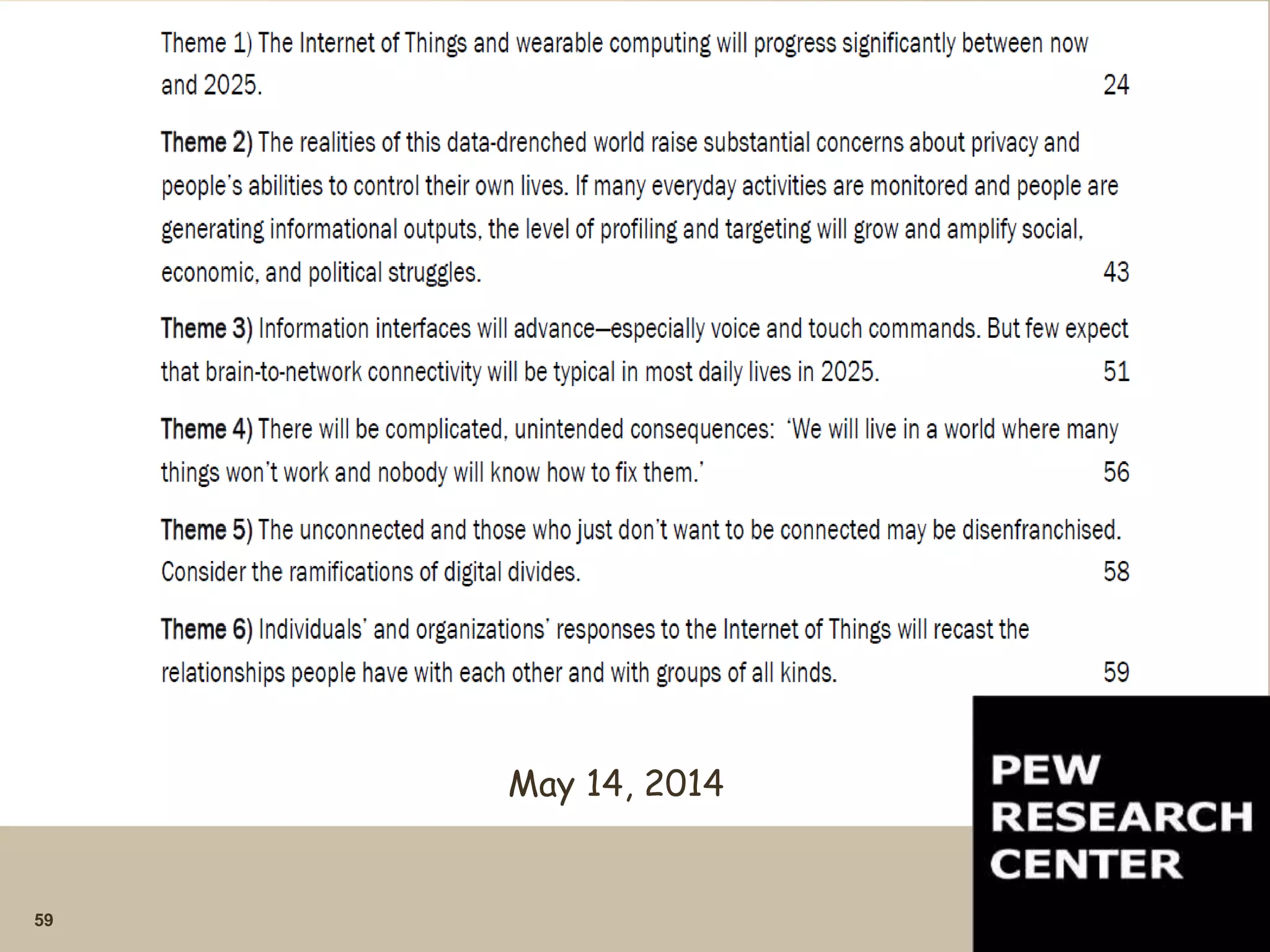
May 14, 2014
60
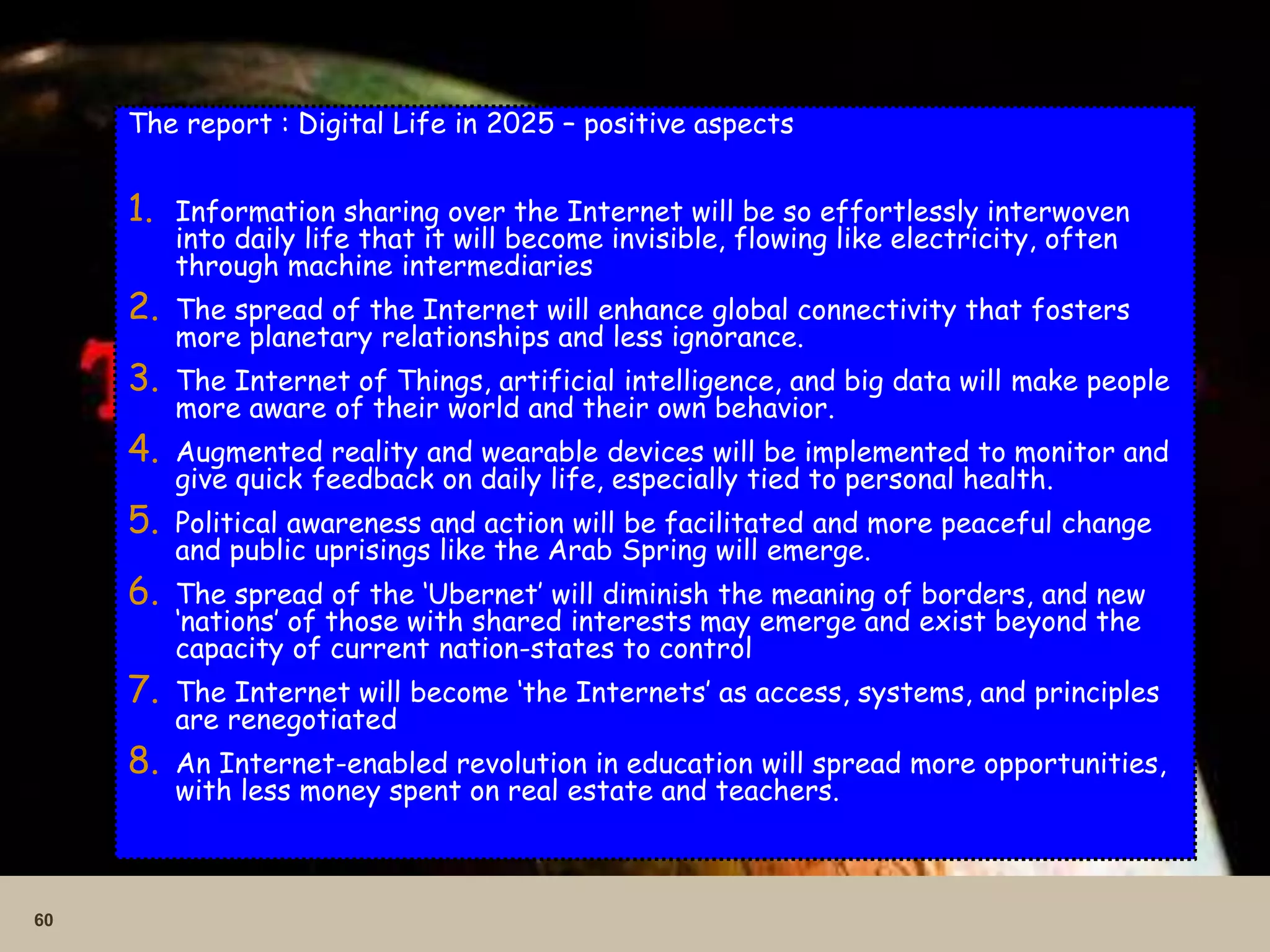
The report : Digital Life in 2025 – positive aspects
1. Information sharing over the Internet will be so effortlessly interwoven
into daily life that it will become invisible, flowing like electricity, often
through machine intermediaries
2. The spread of the Internet will enhance global connectivity that fosters
more planetary relationships and less ignorance.
3. The Internet of Things, artificial intelligence, and big data will make people
more aware of their world and their own behavior.
4. Augmented reality and wearable devices will be implemented to monitor and
give quick feedback on daily life, especially tied to personal health.
5. Political awareness and action will be facilitated and more peaceful change
and public uprisings like the Arab Spring will emerge.
6. The spread of the ‘Ubernet’ will diminish the meaning of borders, and new
‘nations’ of those with shared interests may emerge and exist beyond the
capacity of current nation-states to control
7. The Internet will become ‘the Internets’ as access, systems, and principles
are renegotiated
8. An Internet-enabled revolution in education will spread more opportunities,
with less money spent on real estate and teachers.
61
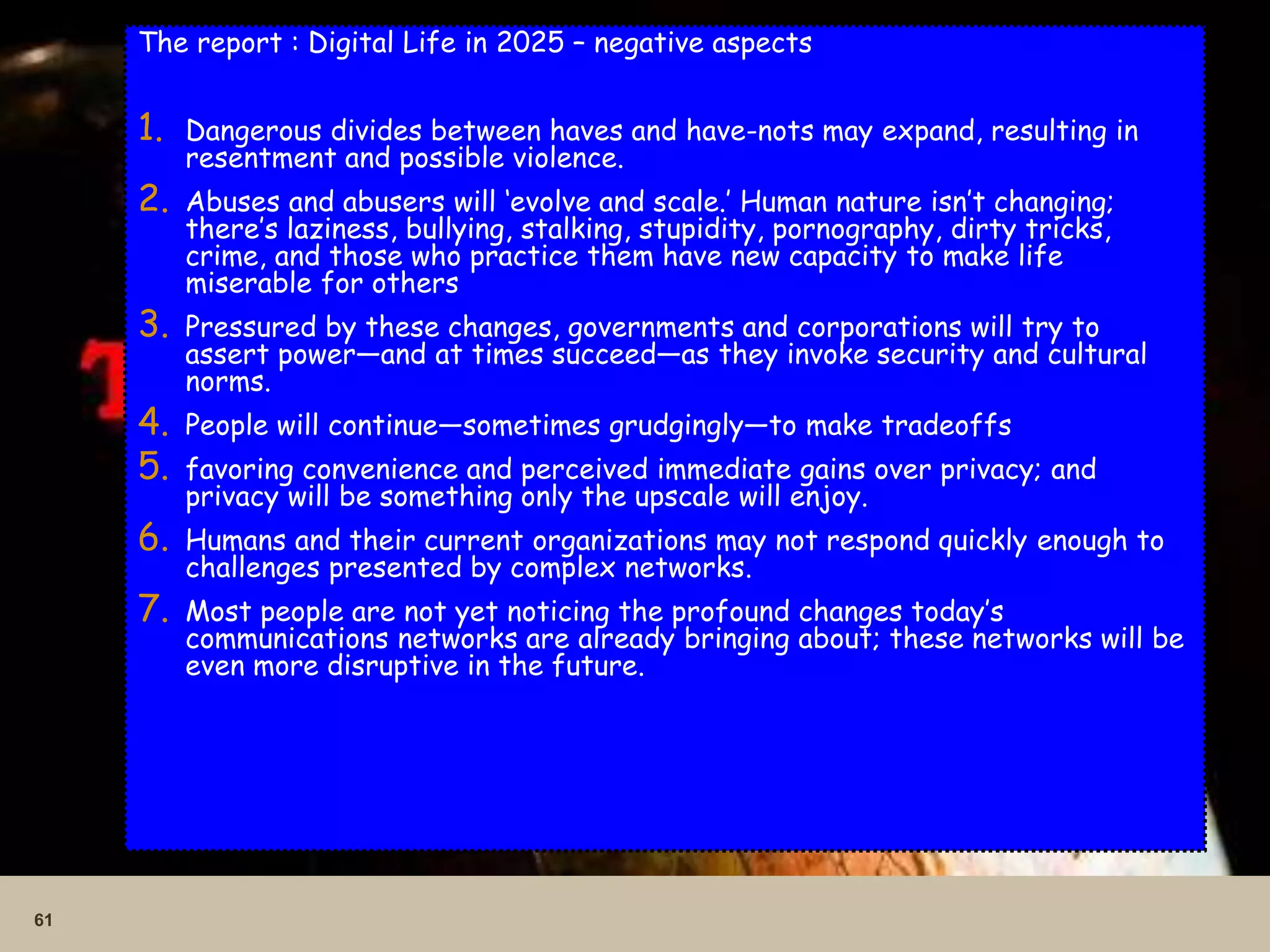
The report : Digital Life in 2025 – negative aspects
1. Dangerous divides between haves and have-nots may expand, resulting in
resentment and possible violence.
2. Abuses and abusers will ‘evolve and scale.’ Human nature isn’t changing;
there’s laziness, bullying, stalking, stupidity, pornography, dirty tricks,
crime, and those who practice them have new capacity to make life
miserable for others
3. Pressured by these changes, governments and corporations will try to
assert power—and at times succeed—as they invoke security and cultural
norms.
4. People will continue—sometimes grudgingly—to make tradeoffs
5. favoring convenience and perceived immediate gains over privacy; and
privacy will be something only the upscale will enjoy.
6. Humans and their current organizations may not respond quickly enough to
challenges presented by complex networks.
7. Most people are not yet noticing the profound changes today’s
communications networks are already bringing about; these networks will be
even more disruptive in the future.
62
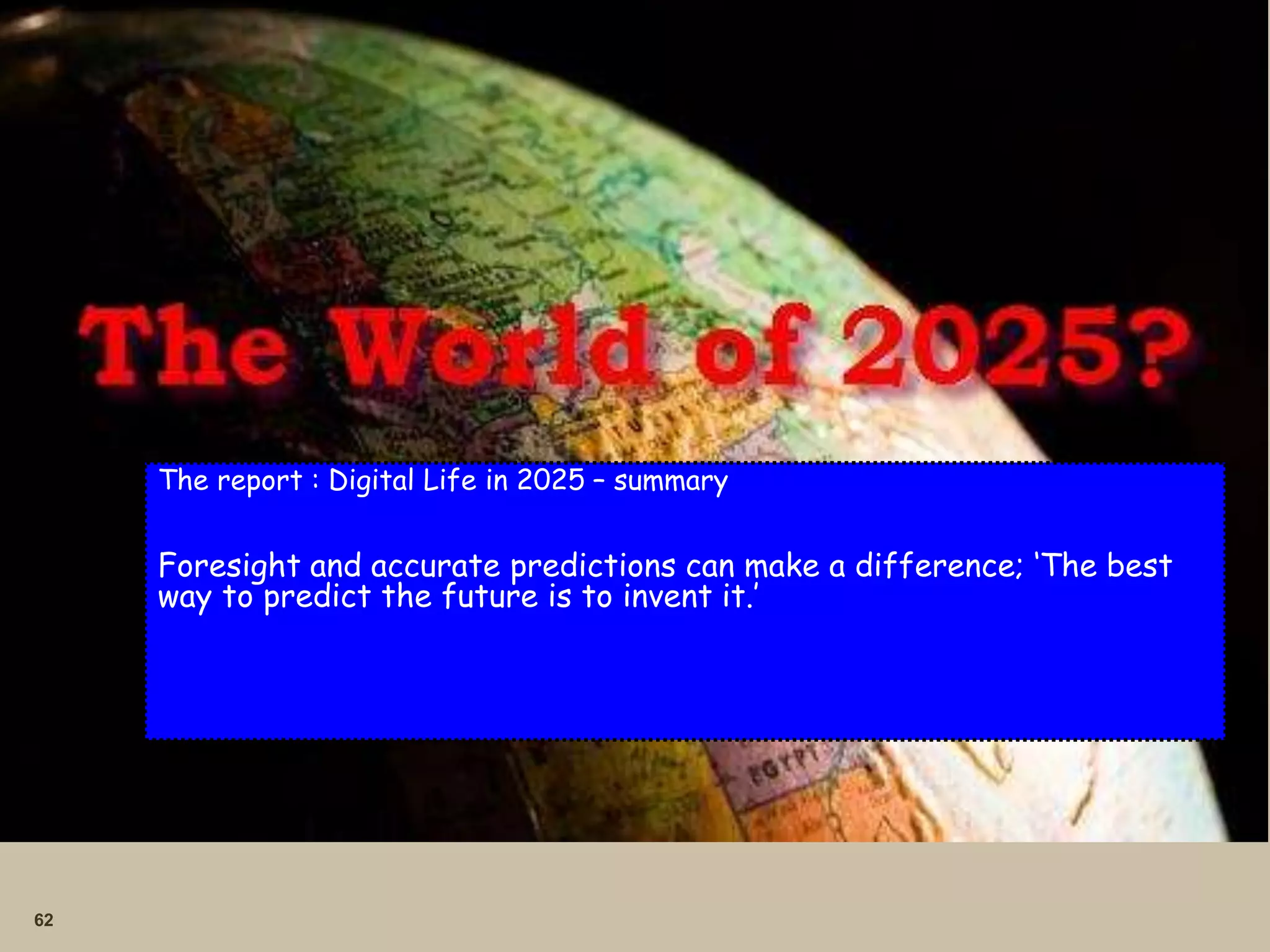
The report : Digital Life in 2025 – summary
Foresight and accurate predictions can make a difference; ‘The best
way to predict the future is to invent it.’
63
Summary: The Internet of Everything participates in many of
the predictions about the future, including Kurzweil’s
singularity.
The responsibility is upon us to create this future…
TOPIC 4
What do we need to do in order to make the Internet
of Everything really happen?
64
PAST
PRESENT
FUTURE
COMMAND
RECALL: “There is no Internet of Things yet”
65
Sarah Rotman Epps
Oct 17, 2014
In this part of the tutorial we discuss how to
mitigate the obstacles in the way of the Internet
of Things
66
Internet of things – what’s holding us back
Chris Murphy,
InformationWeek,
May 5, 2014
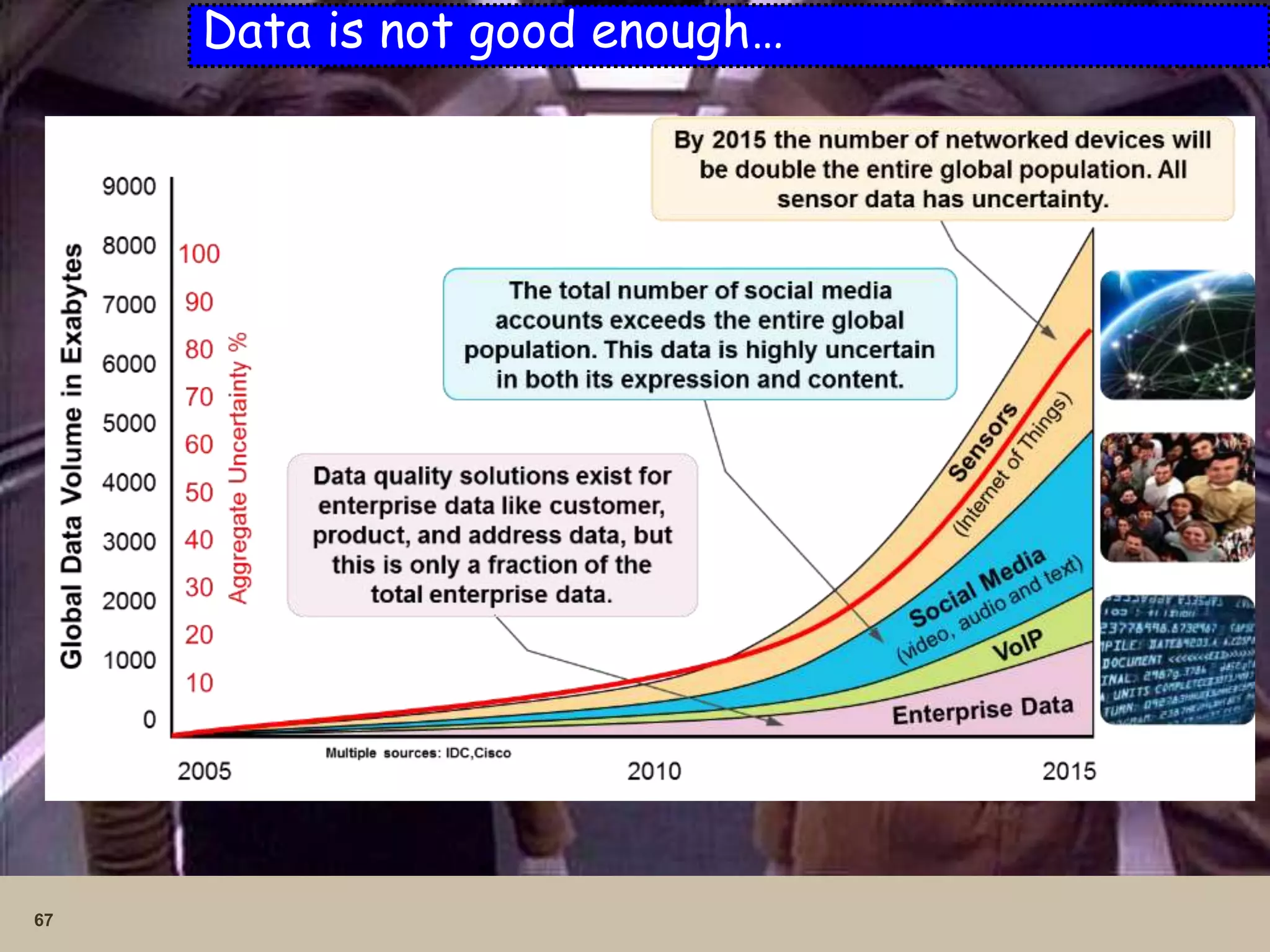
1.The data is not good enough
2.Networks aren't ubiquitous
3.Integration is tougher than analysis
4.More sensor innovation needed
5.Status quo security doesn't cut it
We’ll concentrate on these topics – with special
emphasis on the democratization of use
67
Data is not good enough…
68
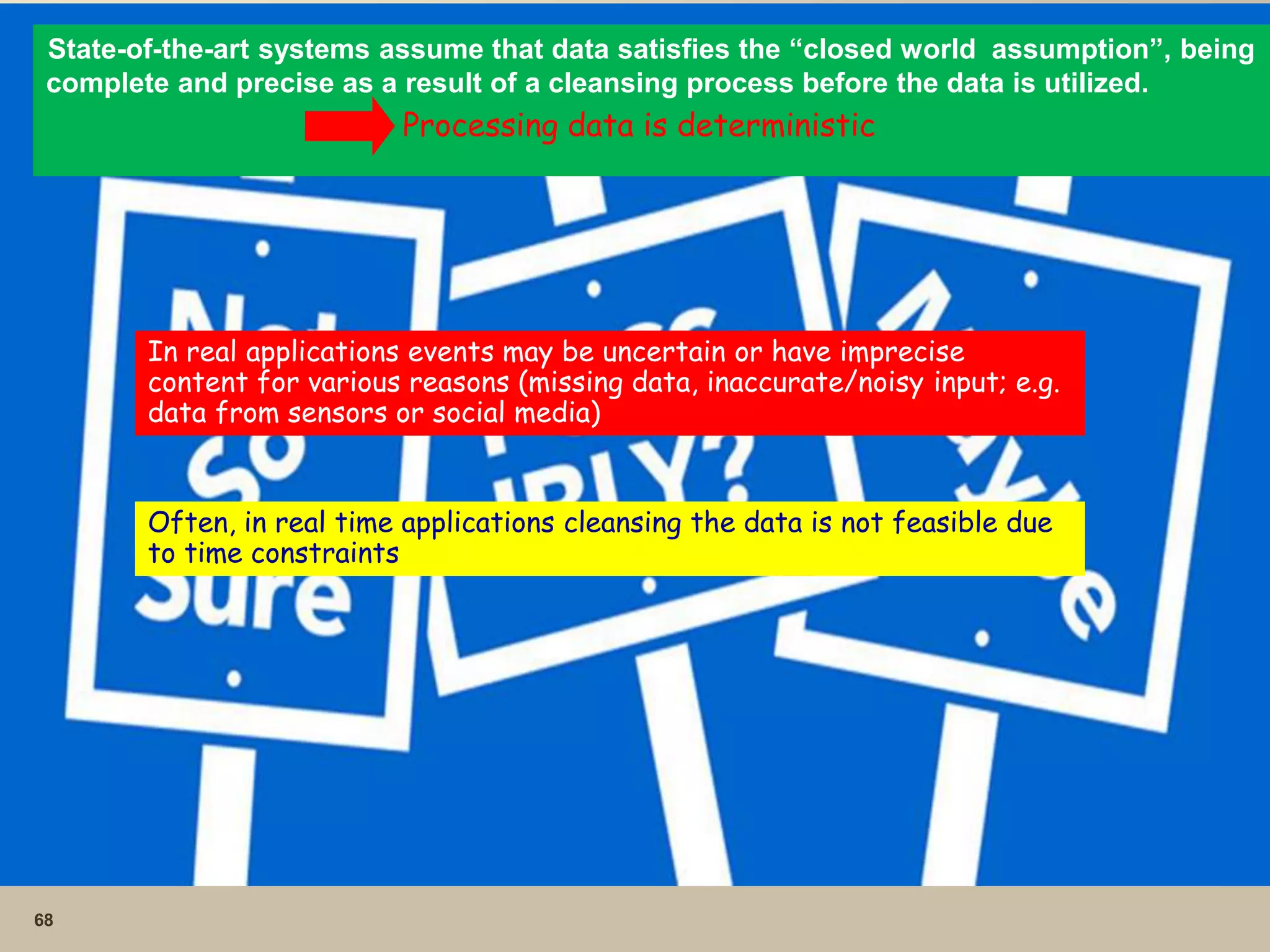
State-of-the-art systems assume that data satisfies the “closed world assumption”, being
complete and precise as a result of a cleansing process before the data is utilized.
Processing data is deterministic
In real applications events may be uncertain or have imprecise
content for various reasons (missing data, inaccurate/noisy input; e.g.
data from sensors or social media)
Often, in real time applications cleansing the data is not feasible due
to time constraints
69
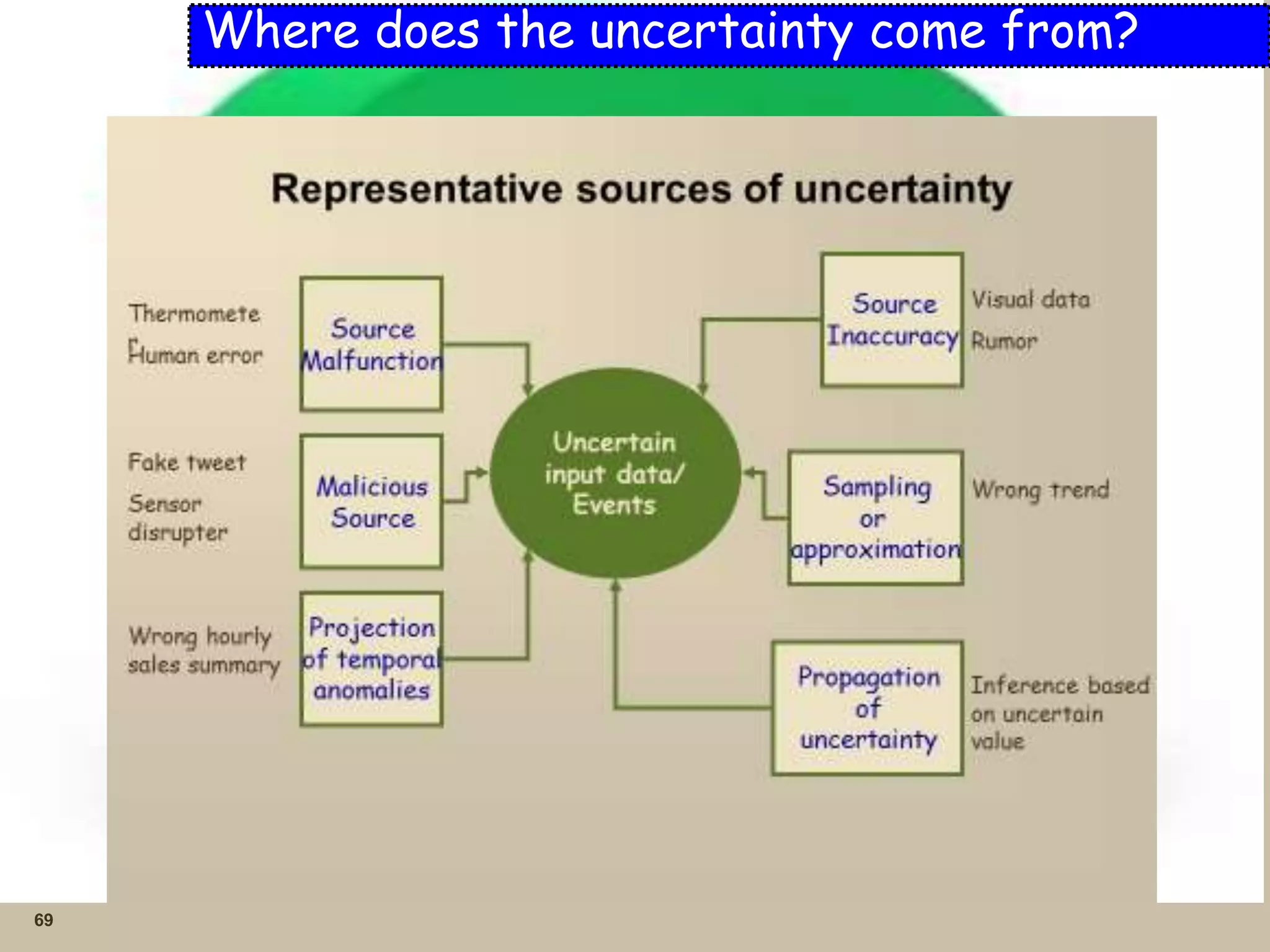
Where does the uncertainty come from?
70
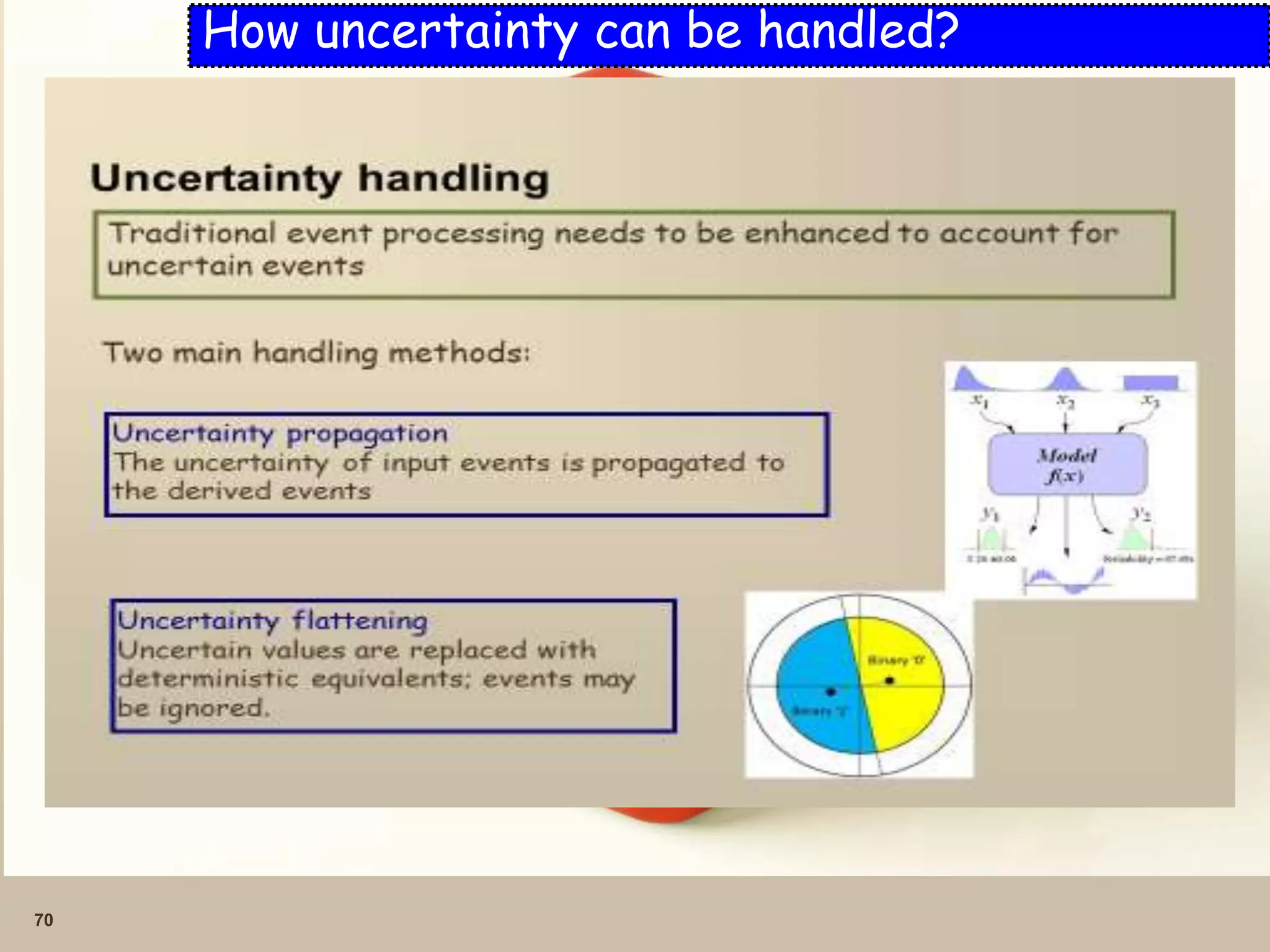
How uncertainty can be handled?
71
Example of uncertainty handling
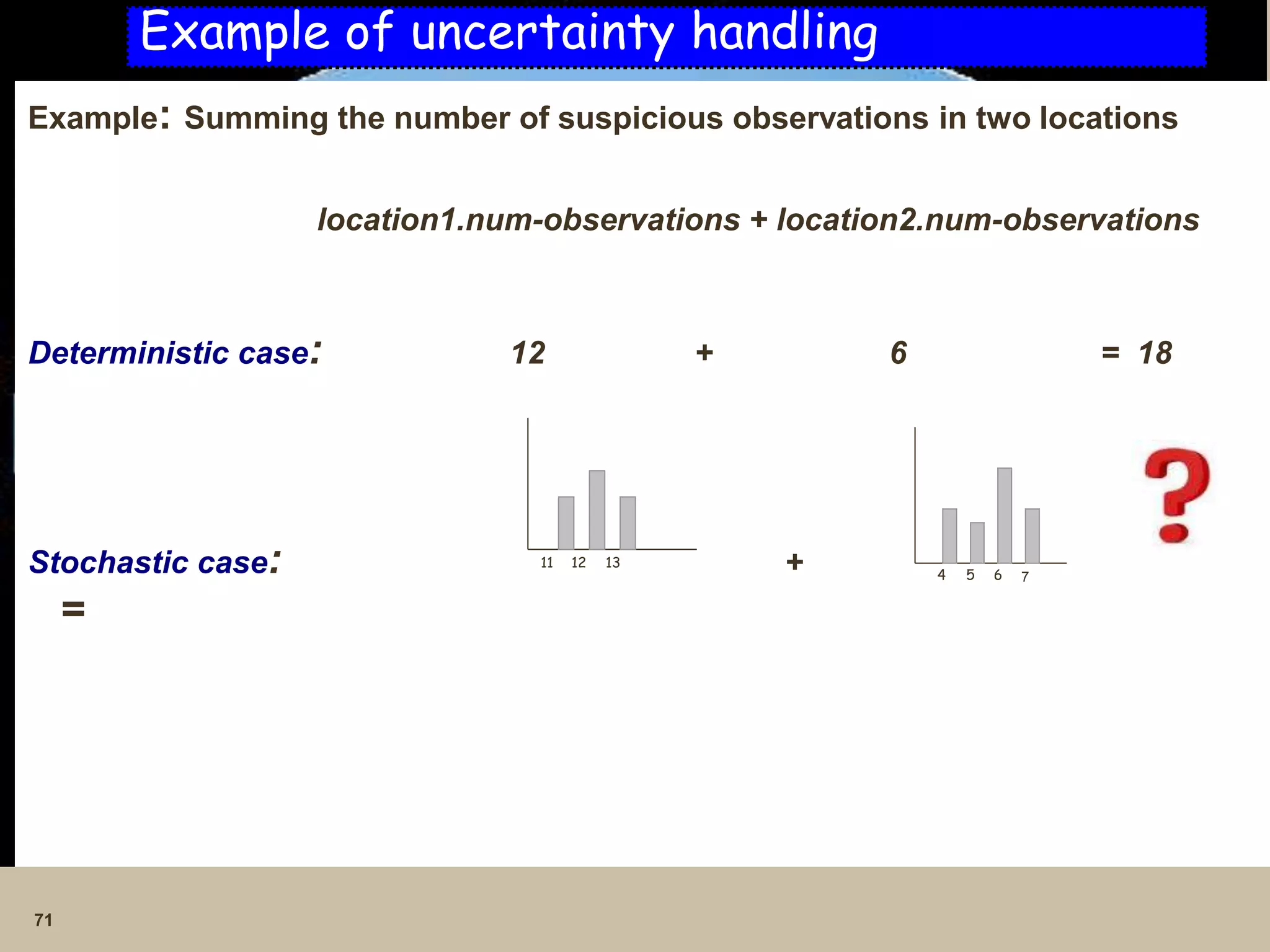
Example: Summing the number of suspicious observations in two locations
location1.num-observations + location2.num-observations
Deterministic case: 12 + 6 = 18
Stochastic case: +
=
12 1311
5 64 7
72
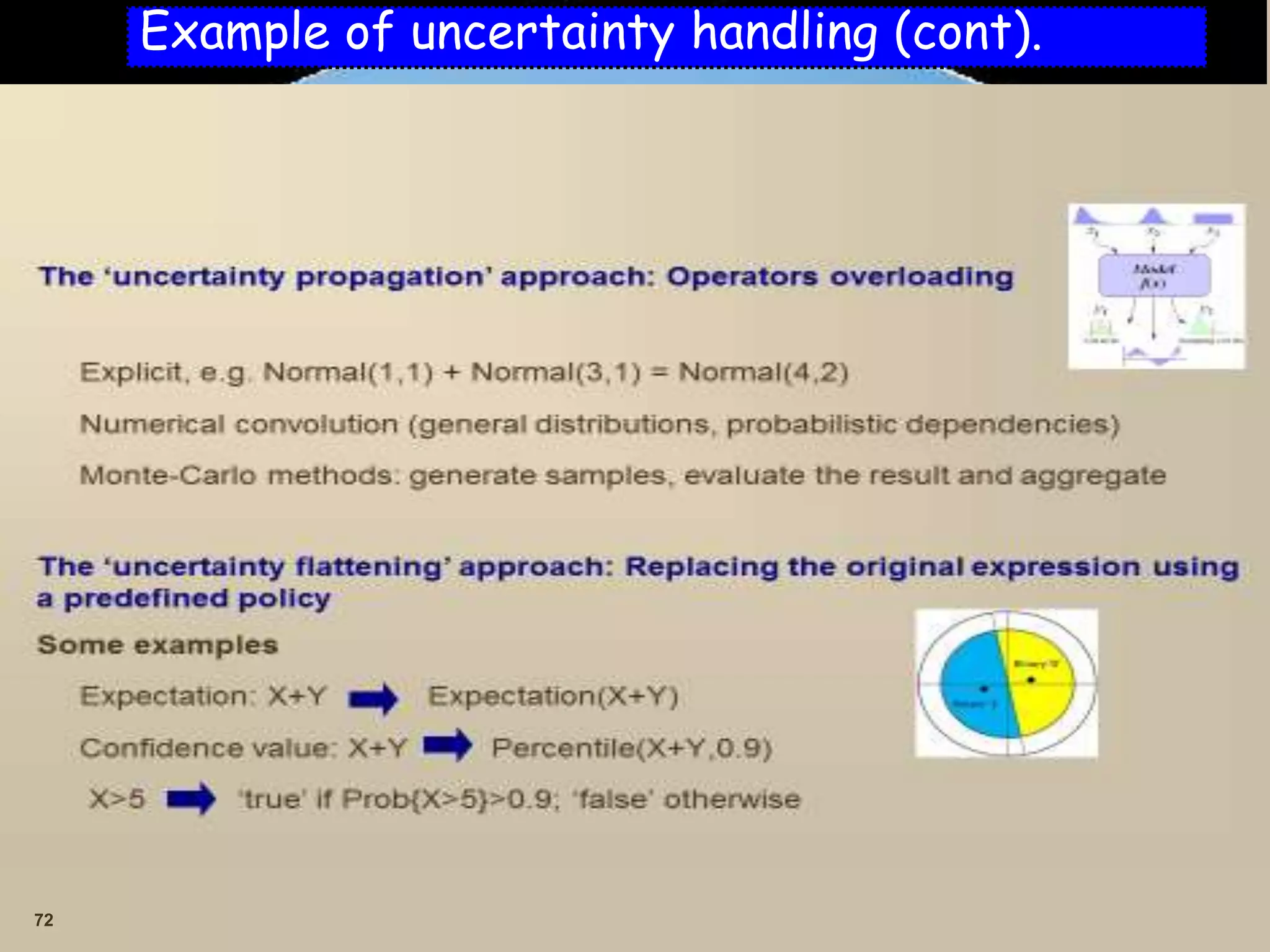
Example of uncertainty handling (cont).
73
Security considerations of IoE
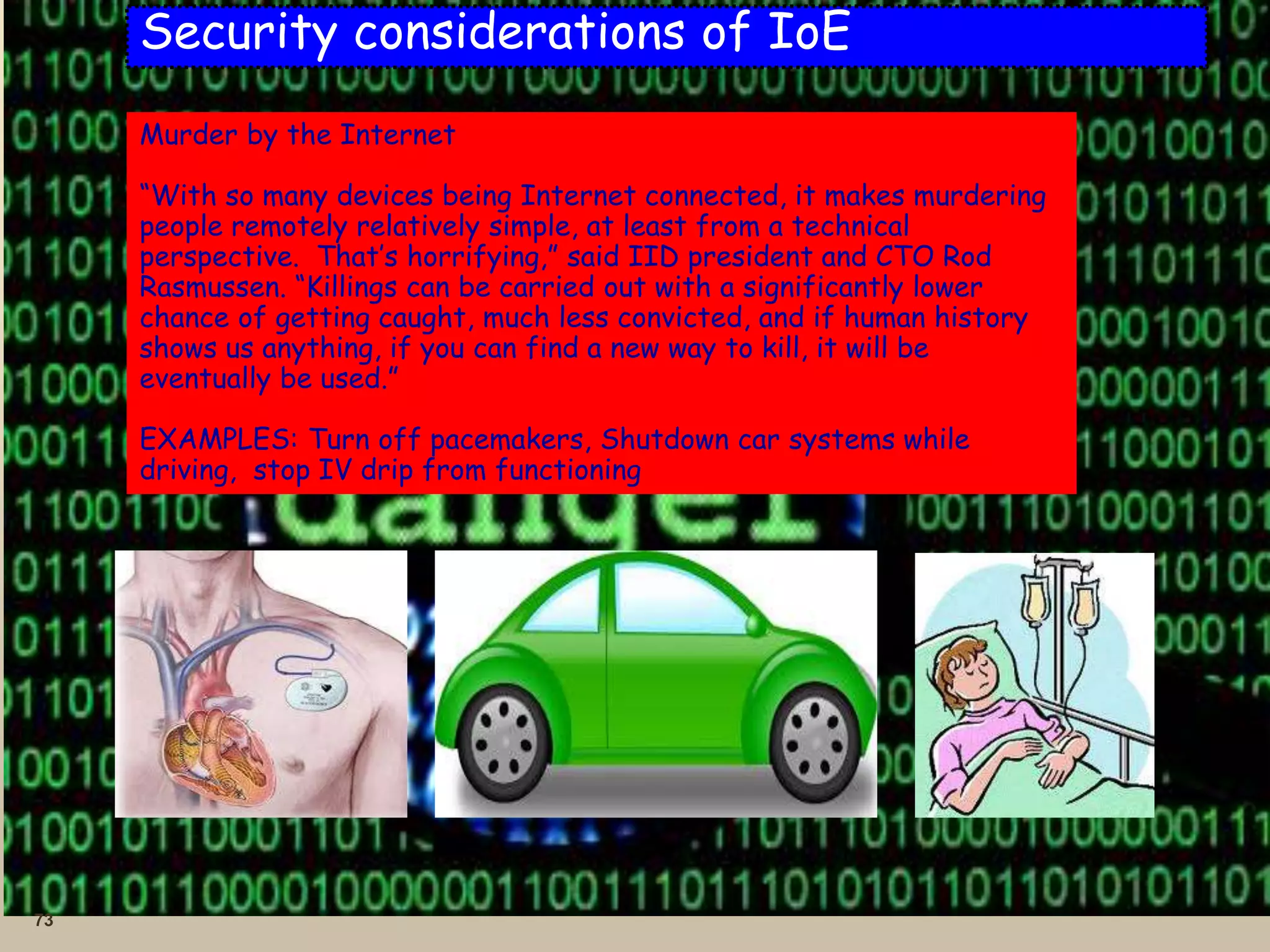
Murder by the Internet
“With so many devices being Internet connected, it makes murdering
people remotely relatively simple, at least from a technical
perspective. That’s horrifying,” said IID president and CTO Rod
Rasmussen. “Killings can be carried out with a significantly lower
chance of getting caught, much less convicted, and if human history
shows us anything, if you can find a new way to kill, it will be
eventually be used.”
EXAMPLES: Turn off pacemakers, Shutdown car systems while
driving, stop IV drip from functioning
74
Privacy considerations of IoE
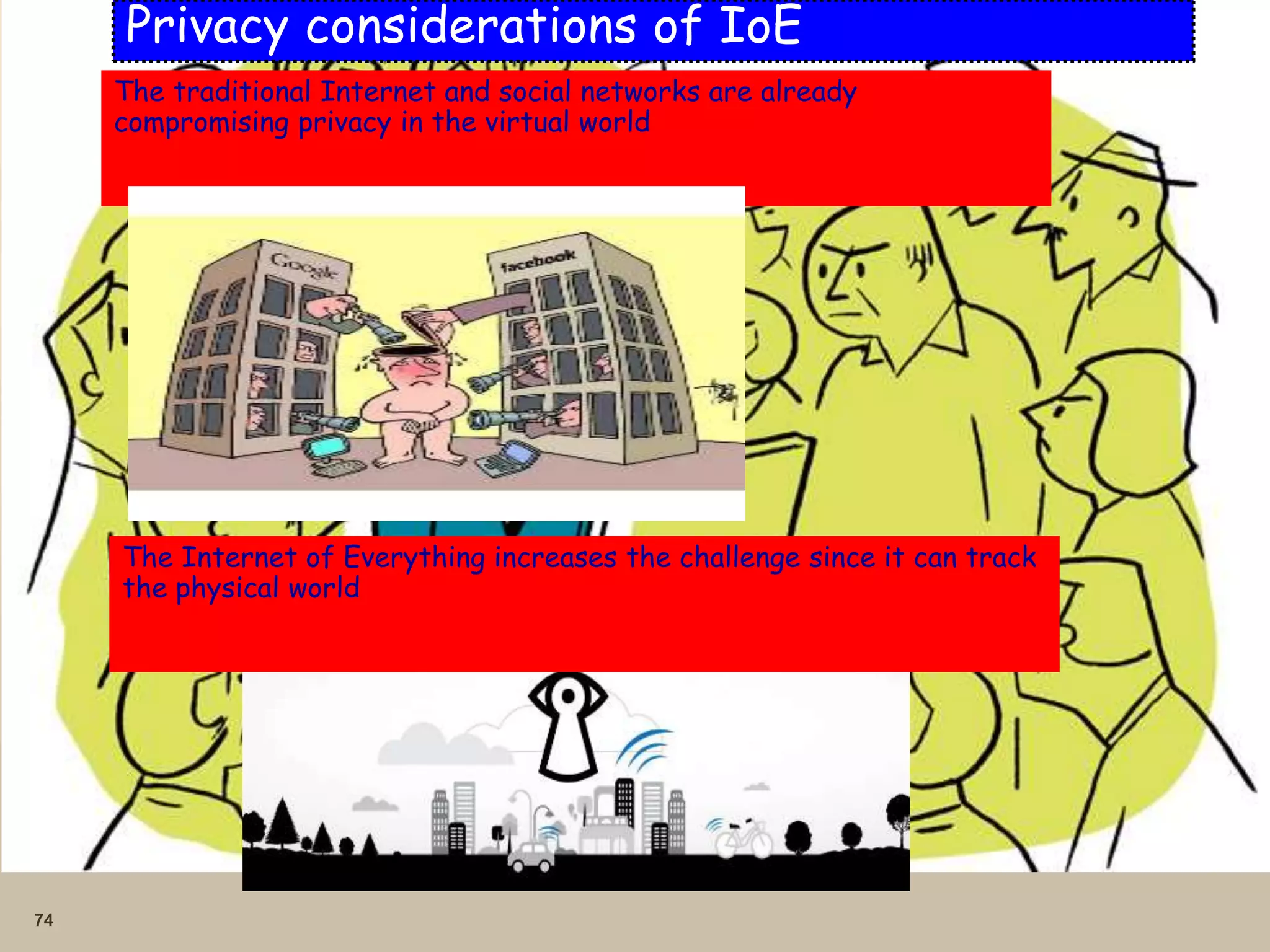
The traditional Internet and social networks are already
compromising privacy in the virtual world
The Internet of Everything increases the challenge since it can track
the physical world
75
Democratization of use in Internet of
Everything
Challenges:
Integration of sensors and actuators
Personalization of situation detection
Pervasive use
76
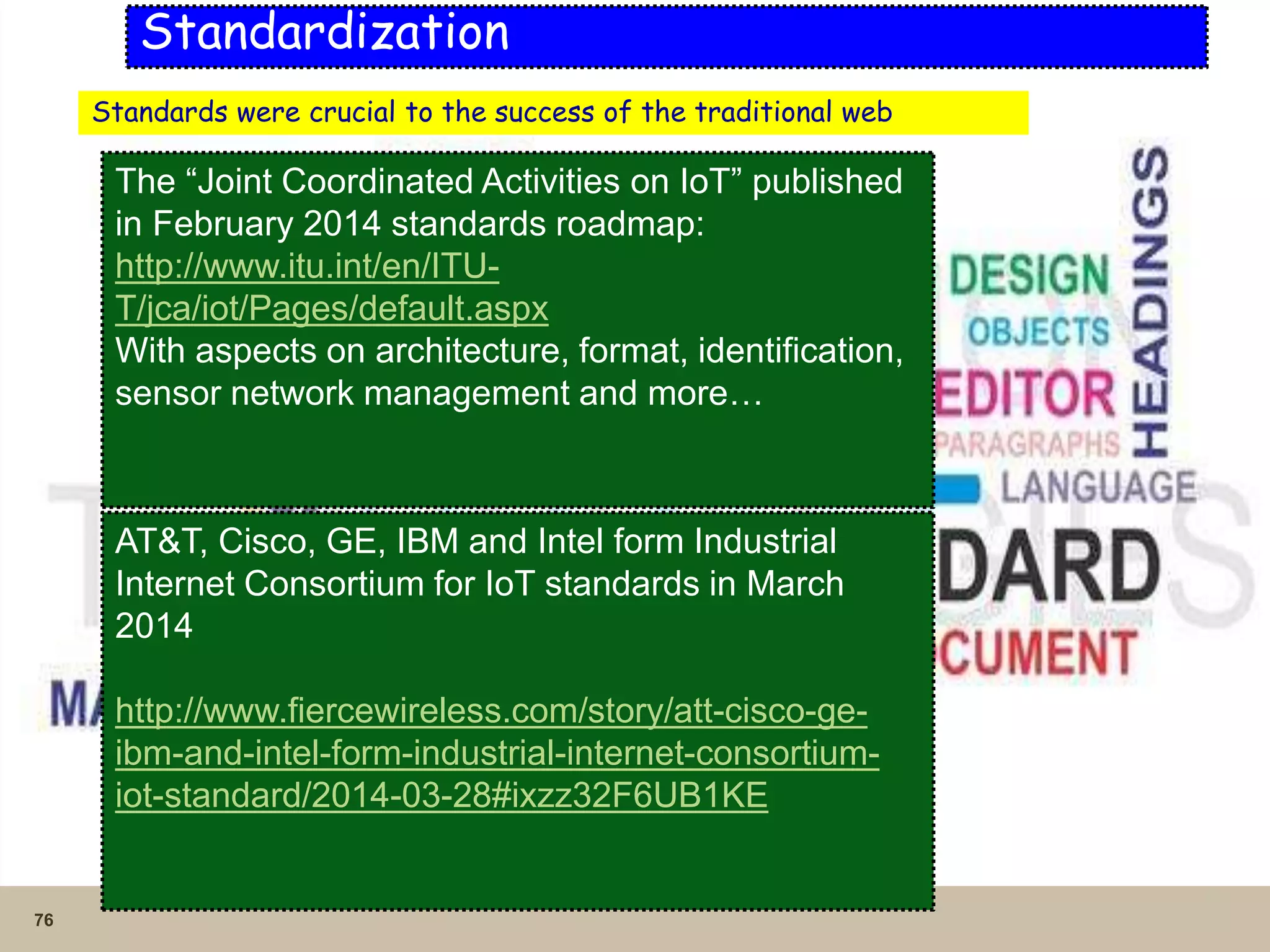
Standardization
Standards were crucial to the success of the traditional web
The “Joint Coordinated Activities on IoT” published
in February 2014 standards roadmap:
http://www.itu.int/en/ITU-
T/jca/iot/Pages/default.aspx
With aspects on architecture, format, identification,
sensor network management and more…
AT&T, Cisco, GE, IBM and Intel form Industrial
Internet Consortium for IoT standards in March
2014
http://www.fiercewireless.com/story/att-cisco-ge-
ibm-and-intel-form-industrial-internet-consortium-
iot-standard/2014-03-28#ixzz32F6UB1KE
77
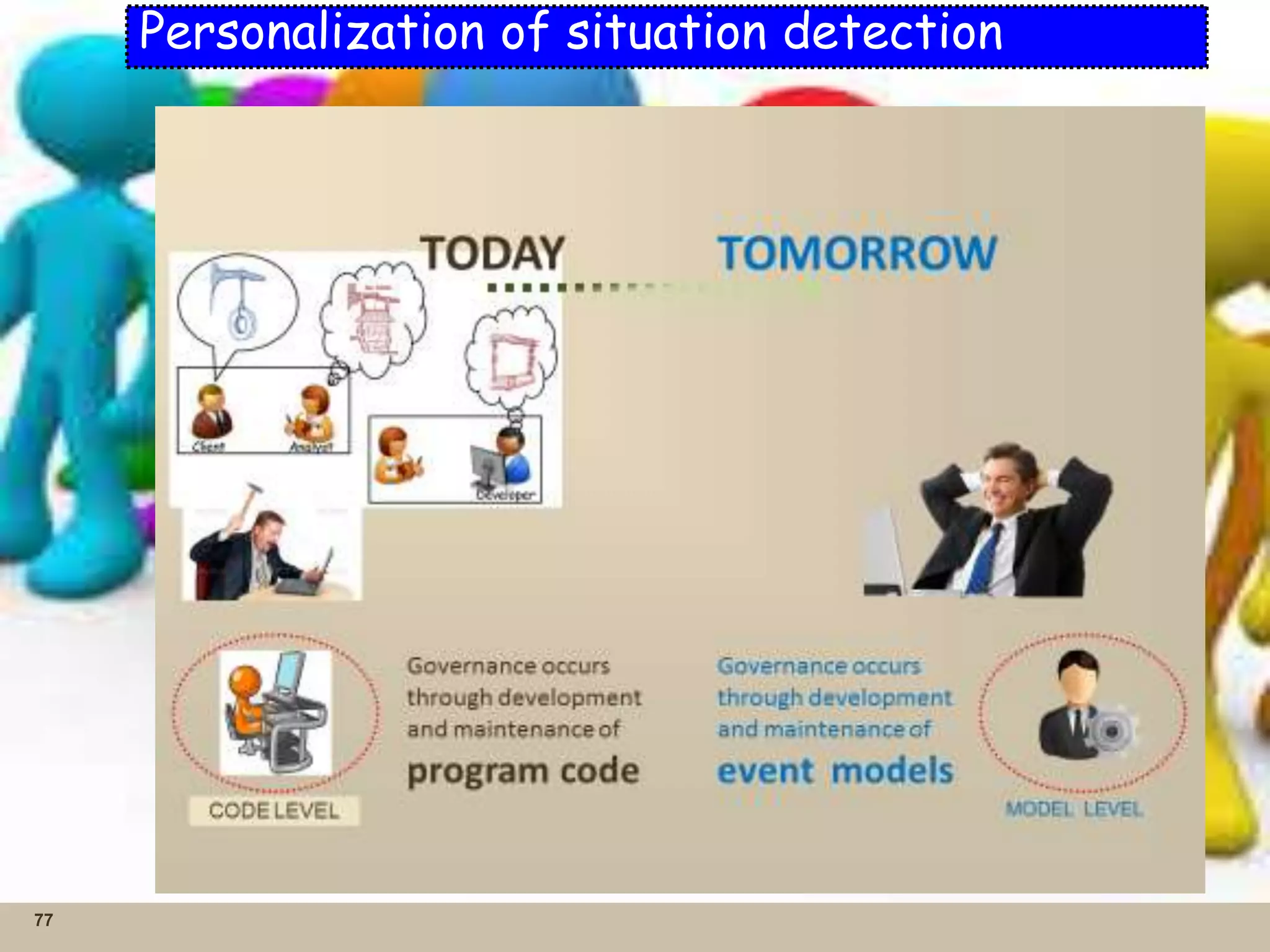
Personalization of situation detection
Eliminating noise from the model
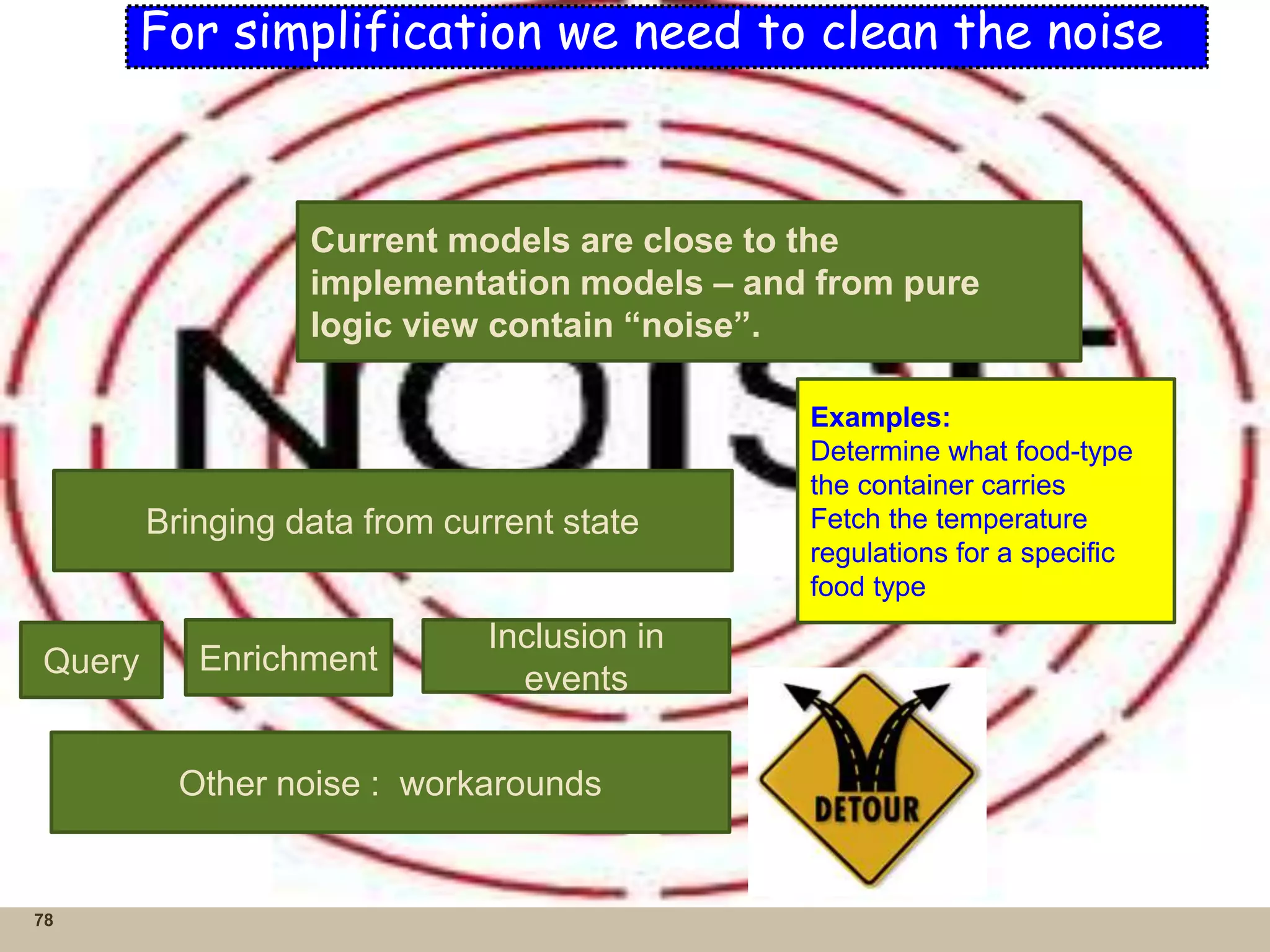
Current models are close to the
implementation models – and from pure
logic view contain “noise”.
Bringing data from current state
Query Enrichment
Inclusion in
events
Examples:
Determine what food-type
the container carries
Fetch the temperature
regulations for a specific
food type
Other noise : workarounds
78
For simplification we need to clean the noise
79
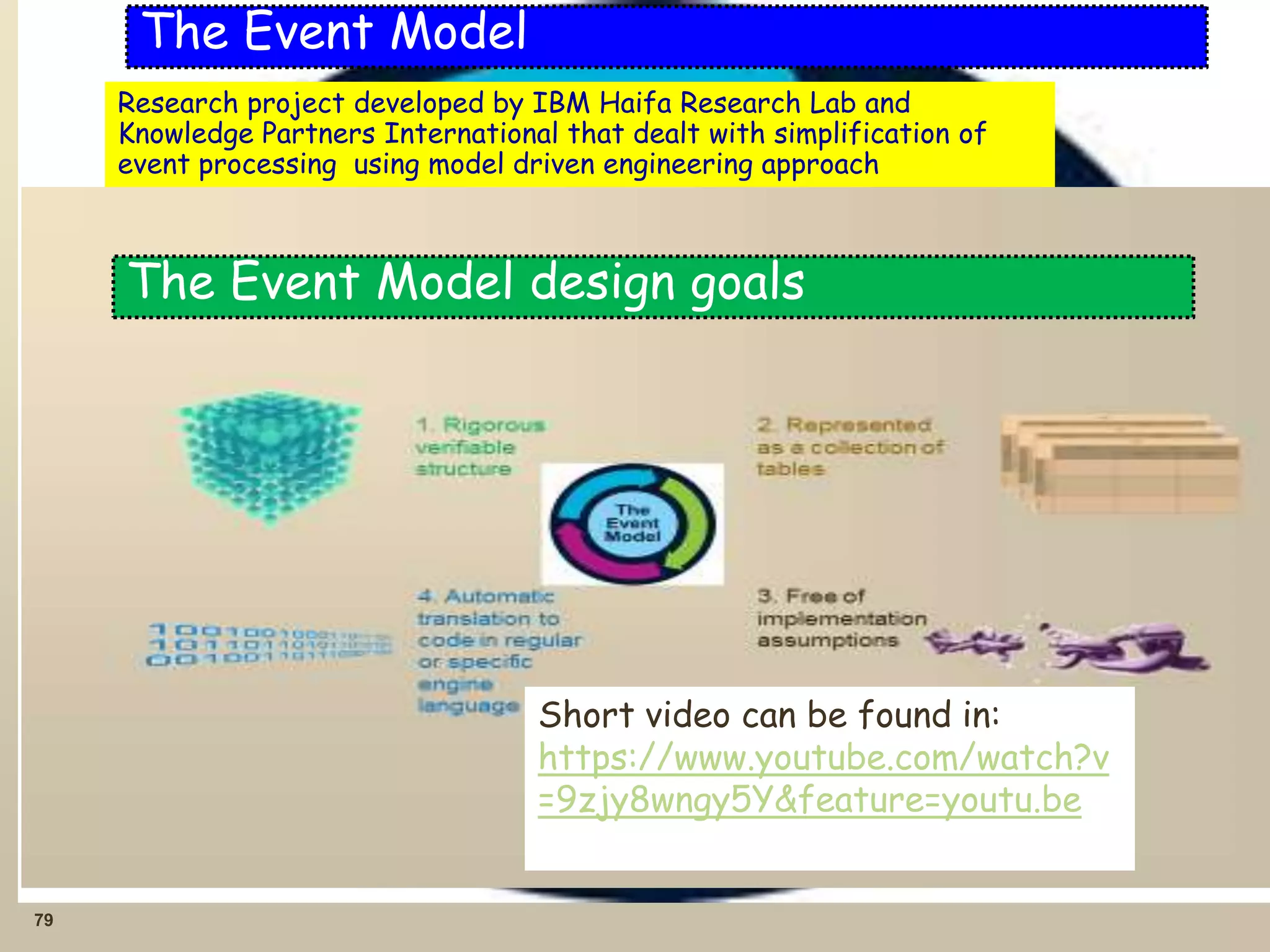
The Event Model
Research project developed by IBM Haifa Research Lab and
Knowledge Partners International that dealt with simplification of
event processing using model driven engineering approach
The Event Model design goals
Short video can be found in:
https://www.youtube.com/watch?v
=9zjy8wngy5Y&feature=youtu.be
80
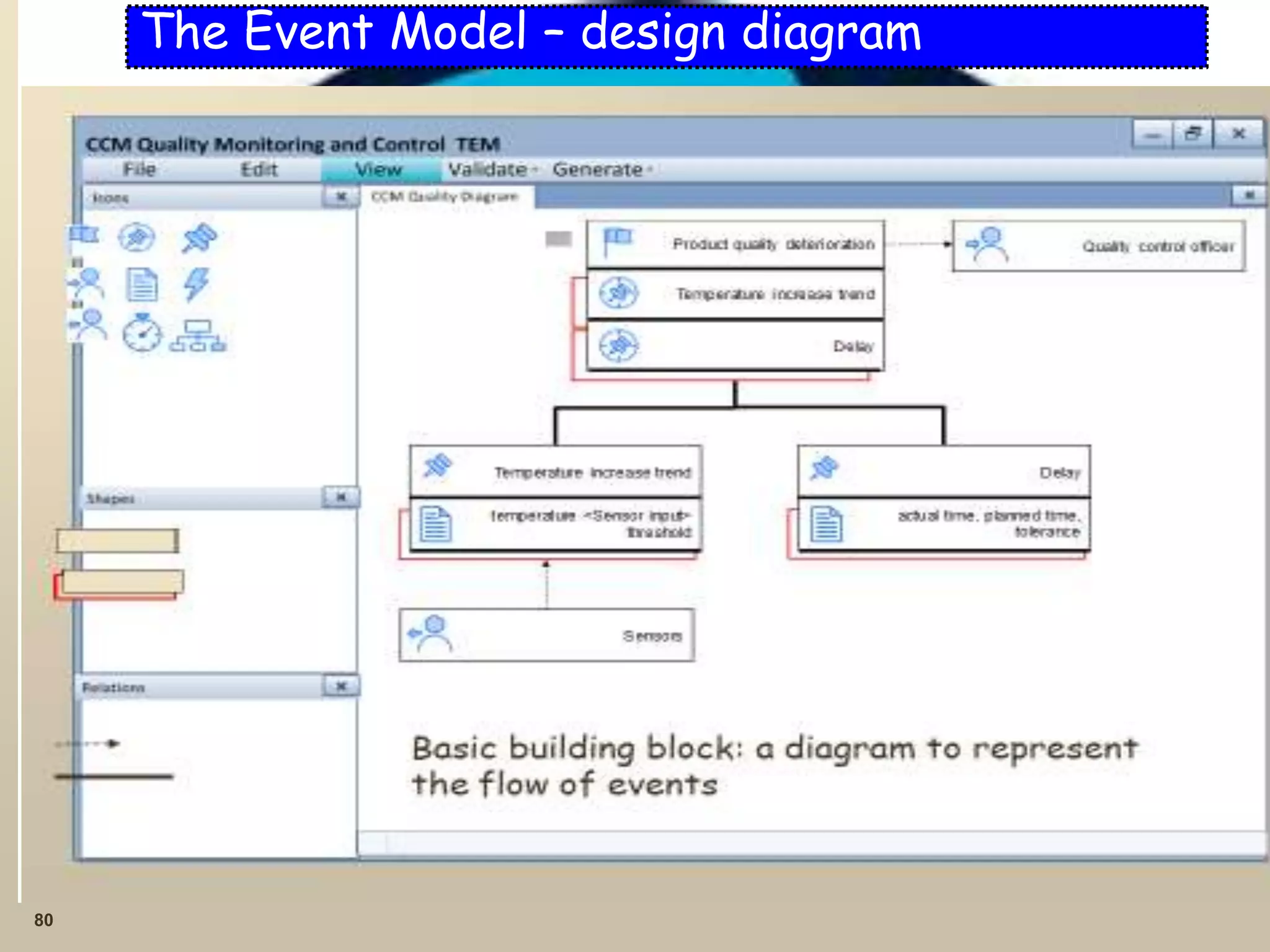
The Event Model – design diagram
81
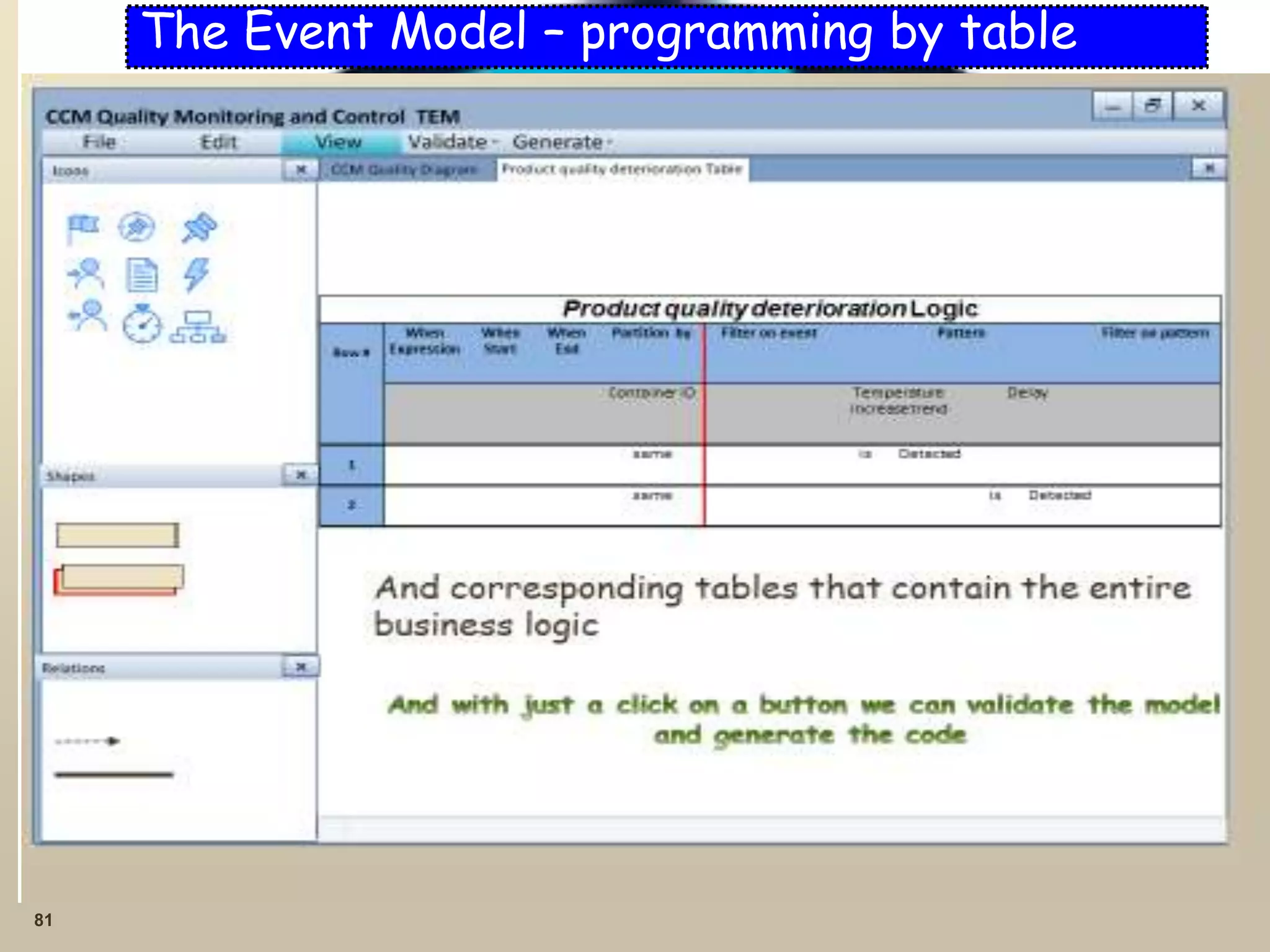
The Event Model – programming by table
82
83
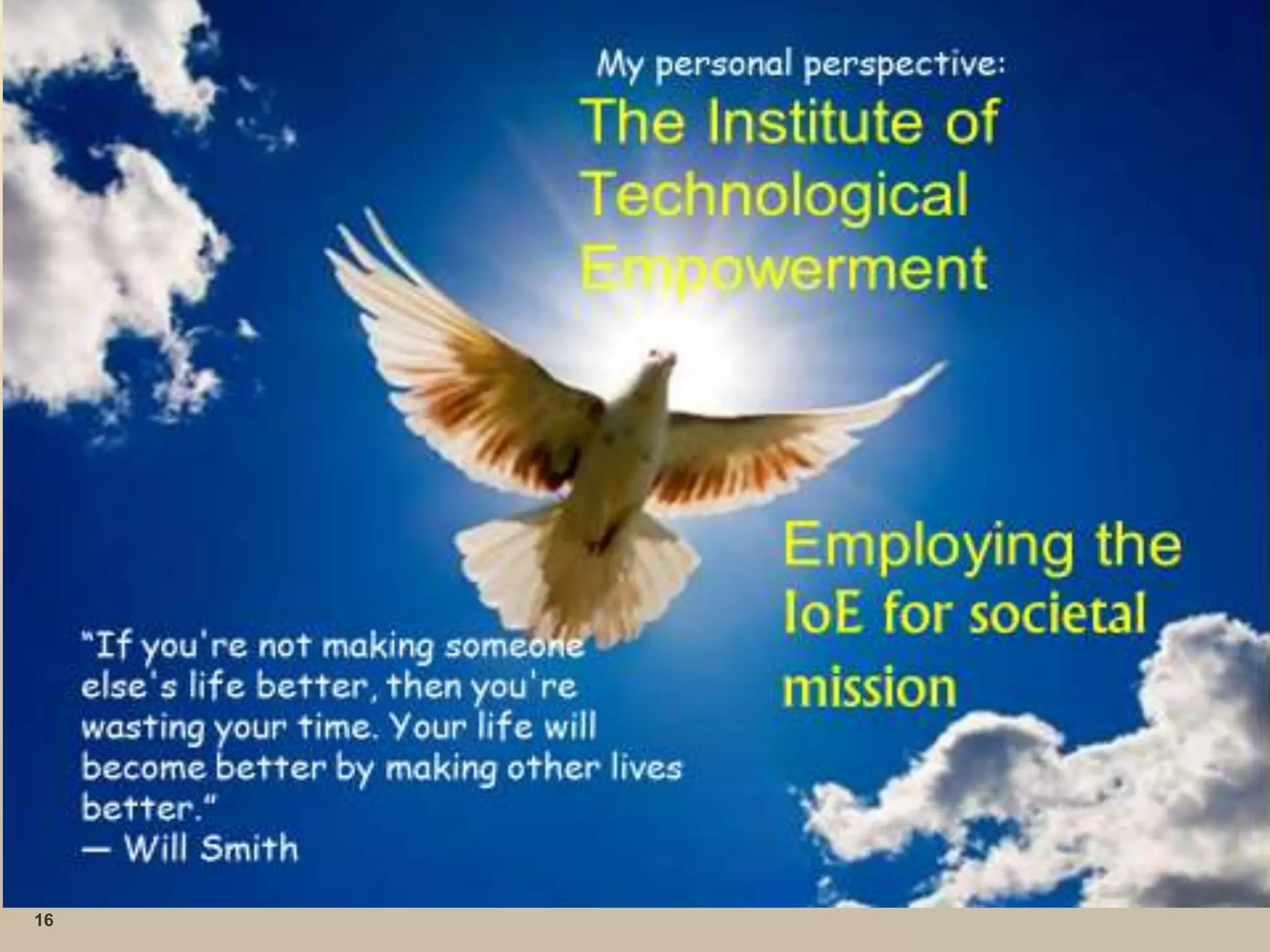
The Institute of Technological
Empowerment is a societal-
academic initiative aimed to
empower populations in the
Israeli periphery and
developing countries using
advanced technologies
The institute’s activity is
based on: multi-disciplinary
research, implementation of
projects in the field, and
education program – both
academic and popular
84
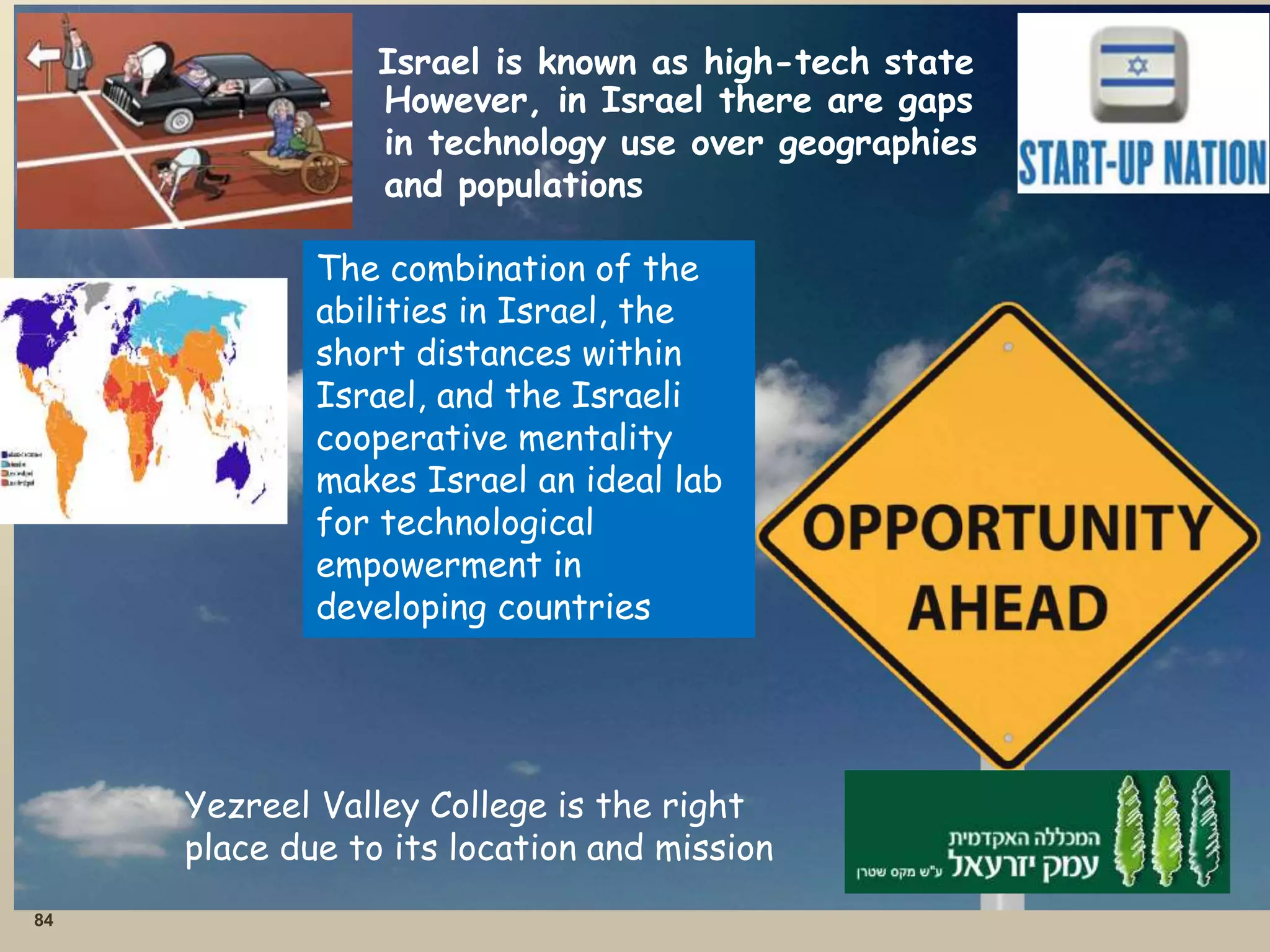
Israel is known as high-tech state
However, in Israel there are gaps
in technology use over geographies
and populations
The combination of the
abilities in Israel, the
short distances within
Israel, and the Israeli
cooperative mentality
makes Israel an ideal lab
for technological
empowerment in
developing countries
Yezreel Valley College is the right
place due to its location and mission
85
Research excellence center
Technology oriented research – smart sensor-
based systems. Collaboration with leading
researchers around the globe
Human oriented research – accessibility of
technology use and customization to larger
populations – cognitive, anthropological and
sociological
Research in the target areas: healthcare,
agriculture, manufacturing…
86
Major tool: senior project of students in YVC,
other Israeli academic programs, and
developing countries (including mixed
teams).
Based on infrastructure of hardware and
software that will be contributed by
technology partners
The projects will be synergetic with the
research activities
Each project will generate a prototype that
will be tested in the field. The aspiration is
to productize each project by start-ups,
technology partners, or the institute’s
staff.
87
Developing undergraduate and graduate
curriculum that will combine technology,
human related studies and domain knowledge
Aiding developing countries to employ such
programs
Educating the community through specialized
programs
Second chance programs to convert academics
in various fields
88
My main motivation is to use the experience and
knowledge I have accumulated over the years to make a
better world

DEBS 2014 tutorial on the Internet of Everything.

  • 1.
    Tutorial in DEBS’14 Speaker:Opher Etzion co-authors: Sarit Arcushin and Fabiana Fournier
  • 2.
    None of the authorizeddrivers location is near the car’s location theft is concluded Use a built-in car stopper to slow the intruder and dispatch the security company A person enters a car and the car starts moving; the person does not look like one of the authorized drivers Such applications become possible since everything is connected 2
  • 3.
    OUTLINE What stands behindthe buzzwords? The ubiquitous nature of the Internet of Everything A futuristic view of the Internet of Everything What do we need to do in order to make the Internet of Everything really happen? 3 PAST PRESENT FUTURE COMMAND
  • 4.
    Topic 1 What standsbehind the buzzards: Internet of Things Internet of Everything and where does event processing get into the picture? 4 PAST PRESENT FUTURE COMMAND
  • 5.
    5 The term “Internetof Things” was coined by Kevin Ashton in 1999. His observation was that all the data on the Internet has been created by a human. His vision was: “we need to empower computers with their own means of gathering information, so they can see, hear, and smell the world by themselves”.
  • 6.
    6 The term “Internetof Everything” was coined by Cisco It is an extension : M2M, M2P, P2P connecting persons and machines. Example: WAZE is based on human sensors We’ll use this term as a generalization of IoT
  • 7.
    7 The world ofsensors 1 Acoustic, sound, vibration 2 Automotive, transportation 3 Chemical 4 Electric current, electric potential, magnetic, radio 5 Environment, weather, moisture, humidity 6 Flow, fluid velocity 7 Ionizing radiation, subatomic particles 8 Navigation instruments 9 Position, angle, displacement, distance, speed, acceleration 10 Optical, light, imaging, photon 11 Pressure 12 Force, density, level 13 Thermal, heat, temperature 14 Proximity, presence
  • 8.
    8 The value ofsensors Kevin Ashton: “track and count everything, and greatly reduce waste, loss, and cost. We could know when things needs replacing, repairing or recalling, and whether they were fresh or past their best” The value is in the ability to know and react in a timely manner to situations that are detected by sensors
  • 9.
    “There is noInternet of Things yet” 9 Sarah Rotman Epps Oct 17, 2013 The Forrester report entitled “There is no Internet of Things Yet” asserts that while much of the sensor technology exists, each sensor lives in isolation, while multi sensor system is difficult to construct
  • 10.
    10 Differences between thetraditional Internet to the Internet of Everything Topic Traditional Internet Internet of Everything Who creates content? Human Machine How is the content consumed? By request By pushing information and triggering actions How content is combined? Using explicitly defined links Through explicitly defined operators What is the value? Answer questions Action and timely knowledge What was done so far? Both content creation (HTML…) and content consumption (search engines) Mainly content creation
  • 11.
    11 “How does EventProcessing get into the picture?” While the weakest link is now considered the data integration issue – looking beyond that we can find event processing Combining data from multi-sensors to get observations, alerts, and actions in real-time gets us to the issue of detecting patterns in event streams However much of the IoT world has not realized it yet…
  • 12.
    12 A major differencebetween traditional Internet and the IoE – usability The success of the Internet is attributed to its relative simplicity: to connect to create content to search Imagine that any search in the Internet would have been done using SQL queries… How pervasive do you think the Internet would have been?
  • 13.
    For situational awareness…. Languagesare actually more complex than SQL 13 // Large cash deposit insert into LargeCashDeposit select * from Cash deposit where amount > 100,000 // Frequent (At least three) large cash deposits create context AccountID partition by accountId on Cash deposit; Context AccountID Insert into FrequentLargeCashDeposits select count(*) from LargeCashDeposit having count(*)>3; // Frequent cash deposits followed by transfer abroad Context AccountID insert into SuspiciousAccount select * from pattern [ every f=FrequentCashDeposit -> t=TransferAbroad where timer.within(10 days)]
  • 14.
    TOPIC II: The ubiquitousnature of the Internet of Everything Examples from different areas 14 PAST PRESENT FUTURE COMMAND
  • 15.
    15 The Internet ofEverything is applicable to virtually anything… In this presentation we discuss applications in: Aiding the elderly, healthcare, agriculture, smart cities, environment and sustainability, retail, industrial applications,, home automation, and examples of applications for the ordinary person
  • 16.
  • 17.
    17 The Internet ofEverything for the elderly
  • 18.
    18 Safety sensors Motion sensor Door sensor Chair Sensor Voice Sensor Alert family member Alerts example: Doorwas not locked within 2 minutes after entrance Falling event detected Vocal distress detected No motion for certain time period detected
  • 19.
  • 20.
  • 21.
    21 The Internet ofEverything in healthcare
  • 22.
    22 E-Health sensors Personalized alertsbased on collection of monitors
  • 23.
    23 Pre-mature babies monitoring Personalizedalerts based on collection of monitors: when nurse should be alerted, when physician should be alerted. There are many false alerts that are ignored, Missing or ignored alert is sometimes fatal
  • 24.
  • 25.
    25 Track the progressof a surgery relative to the plan Detect significant deviation from plan that requires rescheduling and trigger real-time rescheduling of surgeries, assignments, and equipments.
  • 26.
    26 The Internet ofEverything in agriculture
  • 27.
    27 Smart greenhouse: Control micro-climateconditions to maximize the production of fruits and vegetables and their quality. The ultimate goal is to maintain an optimal water and nutrient status for different stages of crop growth, with as little human intervention as possible.
  • 28.
    28 Control of humidityand temperature levels in alfalfa, hay, straw, etc. to prevent fungus and other microbial contaminants. Insect detection and real-time combat.
  • 29.
    29 Hydroponic system control Controlthe exact conditions of plants grown in water to get the highest efficiency crops..
  • 30.
    30 Animal control Monitoring thelocation and identification of animals grazing in open pastures or location in big stables Monitoring health issues and preventing the spread of epidemics
  • 31.
    31 The Internet ofEverything in smart cities and smart government
  • 32.
    32 Supporting emergency control Eventsreport and decision support for: Earthquakes Flooding Fires Terrorist attack
  • 33.
    33 Adaptive trafficlight control Reactive and proactive traffic control. Based both on time oriented trends and on real- time observation
  • 34.
    34 Smart parking Locate andreserve parking in urban environment
  • 35.
    35 Smart Waste management Sensorsthat determine the right time to collect waste based on the container’s condition and enable to dynamically schedule the waste collection schedule
  • 36.
    36 Adaptive city lighting Controlthe timing and level of lighting based on light sensors and street density
  • 37.
    37 The Internet ofEverything in environment and sustainability systems
  • 38.
    38 Air pollution detectorand control Detect air quality issues Take actions: Restrict traffic, notify certain plant to temporarily reduce production…
  • 39.
    39 Smart water Track waterleakage and adjust pressure Monitor water quality along the water chain: rivers, pools, pipes, tubes
  • 40.
    40 Forest fire monitoring Monitoringof combustion gases and preemptive fire conditions to define alert zones
  • 41.
    41 Earthquake early detection Detectearly signs. Detect progress based on sensors and human reports, determine actions (close roads, stop trains, evacuate people)
  • 42.
    42 The Internet ofEverything in retail and logistics
  • 43.
    43 Intelligent shopping cart Senseall goods in the cart for automated billing, alerts on expiration of products, location-based advices based on sales and customer’s past purchases.
  • 44.
    44 Smart shelf Monitoring ofremoval of items from shelf for re- stocking, promotion in case of weak sales, detect item misplacement and theft prevention
  • 45.
    45 Monitoring along thecold chain Monitoring of vibrations, strokes, container openings or cooling equipment malfunction for timely repair preventing goods’ damage
  • 46.
    46 Trace everything overthe supply chain Monitoring over thee supply chain: locate, detect and mitigate delays, manage pedigree…
  • 47.
    47 The Internet ofEverything in the traditional industries
  • 48.
    48 Equipment monitoring Multiple sensorsthat detect fault indications to support proactive actions in finding the right action and time for repair action
  • 49.
    49 Chemical plants safety Monitoringpeople movement and compliance with safety regulations, leak of chemical materials…
  • 50.
    50 The Internet ofEverything in home automation
  • 51.
    51 Adaptive energy consumptionat home Homes that both produce and consume energy – meters of production and consumption. Optimization of energy consumption cost by actuators that set the use of household appliances.
  • 52.
    52 Sensor-based home safetysystem Various home safety and security systems
  • 53.
    53 Adaptive use ofhome appliances Activating appliances based on expected time arrival: washer, water heating, air conditions. Maintenance and fault communication by appliances directly to service provider
  • 54.
    54 Summary: There are various solutions in various areas. Weare still in relatively early days of sporadic efforts -- - still wait for the huge game!
  • 55.
    TOPIC 3 A futuristicview of the Internet of Everything following Ray Kurzweil’s predictions: 55 PAST PRESENT FUTURE COMMAND
  • 56.
    56 Driverless car Sensors thatreplace the human driver’s sensing, and actuators that drive the car. 2017
  • 57.
    57 Automated personal assistant Sensors that determinethe context serves as active advisors. They understand your context and even listen to your conversations and give you suggestions of what to say (e.g. through google glass). 2018
  • 58.
    58 Computing implants inside the human body Sensorsand actuators that fight any disease, operate in the level of cell, and reprogram the body to stop the aging process. 2020 2040 Short term: switch off our fat cells Longer term: stay young forever
  • 59.
  • 60.
    60 The report :Digital Life in 2025 – positive aspects 1. Information sharing over the Internet will be so effortlessly interwoven into daily life that it will become invisible, flowing like electricity, often through machine intermediaries 2. The spread of the Internet will enhance global connectivity that fosters more planetary relationships and less ignorance. 3. The Internet of Things, artificial intelligence, and big data will make people more aware of their world and their own behavior. 4. Augmented reality and wearable devices will be implemented to monitor and give quick feedback on daily life, especially tied to personal health. 5. Political awareness and action will be facilitated and more peaceful change and public uprisings like the Arab Spring will emerge. 6. The spread of the ‘Ubernet’ will diminish the meaning of borders, and new ‘nations’ of those with shared interests may emerge and exist beyond the capacity of current nation-states to control 7. The Internet will become ‘the Internets’ as access, systems, and principles are renegotiated 8. An Internet-enabled revolution in education will spread more opportunities, with less money spent on real estate and teachers.
  • 61.
    61 The report :Digital Life in 2025 – negative aspects 1. Dangerous divides between haves and have-nots may expand, resulting in resentment and possible violence. 2. Abuses and abusers will ‘evolve and scale.’ Human nature isn’t changing; there’s laziness, bullying, stalking, stupidity, pornography, dirty tricks, crime, and those who practice them have new capacity to make life miserable for others 3. Pressured by these changes, governments and corporations will try to assert power—and at times succeed—as they invoke security and cultural norms. 4. People will continue—sometimes grudgingly—to make tradeoffs 5. favoring convenience and perceived immediate gains over privacy; and privacy will be something only the upscale will enjoy. 6. Humans and their current organizations may not respond quickly enough to challenges presented by complex networks. 7. Most people are not yet noticing the profound changes today’s communications networks are already bringing about; these networks will be even more disruptive in the future.
  • 62.
    62 The report :Digital Life in 2025 – summary Foresight and accurate predictions can make a difference; ‘The best way to predict the future is to invent it.’
  • 63.
    63 Summary: The Internetof Everything participates in many of the predictions about the future, including Kurzweil’s singularity. The responsibility is upon us to create this future…
  • 64.
    TOPIC 4 What dowe need to do in order to make the Internet of Everything really happen? 64 PAST PRESENT FUTURE COMMAND
  • 65.
    RECALL: “There isno Internet of Things yet” 65 Sarah Rotman Epps Oct 17, 2014 In this part of the tutorial we discuss how to mitigate the obstacles in the way of the Internet of Things
  • 66.
    66 Internet of things– what’s holding us back Chris Murphy, InformationWeek, May 5, 2014 1.The data is not good enough 2.Networks aren't ubiquitous 3.Integration is tougher than analysis 4.More sensor innovation needed 5.Status quo security doesn't cut it We’ll concentrate on these topics – with special emphasis on the democratization of use
  • 67.
    67 Data is notgood enough…
  • 68.
    68 State-of-the-art systems assumethat data satisfies the “closed world assumption”, being complete and precise as a result of a cleansing process before the data is utilized. Processing data is deterministic In real applications events may be uncertain or have imprecise content for various reasons (missing data, inaccurate/noisy input; e.g. data from sensors or social media) Often, in real time applications cleansing the data is not feasible due to time constraints
  • 69.
    69 Where does theuncertainty come from?
  • 70.
  • 71.
    71 Example of uncertaintyhandling Example: Summing the number of suspicious observations in two locations location1.num-observations + location2.num-observations Deterministic case: 12 + 6 = 18 Stochastic case: + = 12 1311 5 64 7
  • 72.
    72 Example of uncertaintyhandling (cont).
  • 73.
    73 Security considerations ofIoE Murder by the Internet “With so many devices being Internet connected, it makes murdering people remotely relatively simple, at least from a technical perspective. That’s horrifying,” said IID president and CTO Rod Rasmussen. “Killings can be carried out with a significantly lower chance of getting caught, much less convicted, and if human history shows us anything, if you can find a new way to kill, it will be eventually be used.” EXAMPLES: Turn off pacemakers, Shutdown car systems while driving, stop IV drip from functioning
  • 74.
    74 Privacy considerations ofIoE The traditional Internet and social networks are already compromising privacy in the virtual world The Internet of Everything increases the challenge since it can track the physical world
  • 75.
    75 Democratization of usein Internet of Everything Challenges: Integration of sensors and actuators Personalization of situation detection Pervasive use
  • 76.
    76 Standardization Standards were crucialto the success of the traditional web The “Joint Coordinated Activities on IoT” published in February 2014 standards roadmap: http://www.itu.int/en/ITU- T/jca/iot/Pages/default.aspx With aspects on architecture, format, identification, sensor network management and more… AT&T, Cisco, GE, IBM and Intel form Industrial Internet Consortium for IoT standards in March 2014 http://www.fiercewireless.com/story/att-cisco-ge- ibm-and-intel-form-industrial-internet-consortium- iot-standard/2014-03-28#ixzz32F6UB1KE
  • 77.
  • 78.
    Eliminating noise fromthe model Current models are close to the implementation models – and from pure logic view contain “noise”. Bringing data from current state Query Enrichment Inclusion in events Examples: Determine what food-type the container carries Fetch the temperature regulations for a specific food type Other noise : workarounds 78 For simplification we need to clean the noise
  • 79.
    79 The Event Model Researchproject developed by IBM Haifa Research Lab and Knowledge Partners International that dealt with simplification of event processing using model driven engineering approach The Event Model design goals Short video can be found in: https://www.youtube.com/watch?v =9zjy8wngy5Y&feature=youtu.be
  • 80.
    80 The Event Model– design diagram
  • 81.
    81 The Event Model– programming by table
  • 82.
  • 83.
    83 The Institute ofTechnological Empowerment is a societal- academic initiative aimed to empower populations in the Israeli periphery and developing countries using advanced technologies The institute’s activity is based on: multi-disciplinary research, implementation of projects in the field, and education program – both academic and popular
  • 84.
    84 Israel is knownas high-tech state However, in Israel there are gaps in technology use over geographies and populations The combination of the abilities in Israel, the short distances within Israel, and the Israeli cooperative mentality makes Israel an ideal lab for technological empowerment in developing countries Yezreel Valley College is the right place due to its location and mission
  • 85.
    85 Research excellence center Technologyoriented research – smart sensor- based systems. Collaboration with leading researchers around the globe Human oriented research – accessibility of technology use and customization to larger populations – cognitive, anthropological and sociological Research in the target areas: healthcare, agriculture, manufacturing…
  • 86.
    86 Major tool: seniorproject of students in YVC, other Israeli academic programs, and developing countries (including mixed teams). Based on infrastructure of hardware and software that will be contributed by technology partners The projects will be synergetic with the research activities Each project will generate a prototype that will be tested in the field. The aspiration is to productize each project by start-ups, technology partners, or the institute’s staff.
  • 87.
    87 Developing undergraduate andgraduate curriculum that will combine technology, human related studies and domain knowledge Aiding developing countries to employ such programs Educating the community through specialized programs Second chance programs to convert academics in various fields
  • 88.
    88 My main motivationis to use the experience and knowledge I have accumulated over the years to make a better world