What's Next?


Archi Kumari
VIII-C
COMPUTER
HHW
Answer
                    Polynomial
                    Size Circuit

                        C
 “Closed
                                               “Causality-
 Timelike
   Curve
            R CTC                  R CR        Respecting
                                               Register”
Register”

                                   0 0 0
   World’s Population Doubles in 40 Years
   Developed Countries Population Living
    Longer
   Undeveloped Countries Faster Birth Rate
   Global Economy More Integrated
   Economy and Society Dominated by
    Technology Applications
   Pace of Technology Development
    Increasing at a Faster Rate
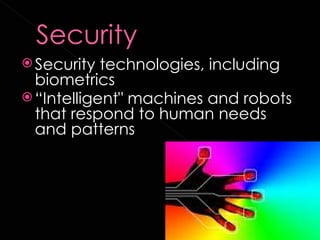
 Security  technologies, including
  biometrics
 “Intelligent" machines and robots
  that respond to human needs
  and patterns
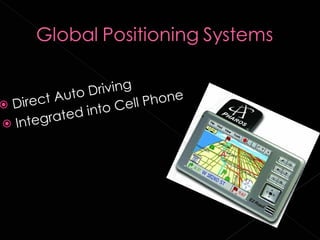
Driving
     rec t Au t o          Phone
 Di
            ted in to Cell
 Integra
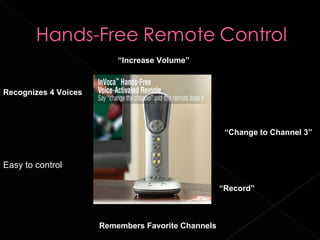
“Increase Volume”


Recognizes 4 Voices


                                                     “Change to Channel 3”


Easy to control

                                                    “Record”


                      Remembers Favorite Channels
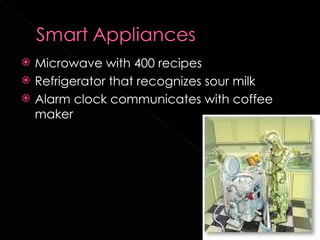
   Microwave with 400 recipes
   Refrigerator that recognizes sour milk
   Alarm clock communicates with coffee
    maker
   The laptop with voice recognition will make
    keyboards obsolete and a rollout LCD
    screen permits the monitor to scroll.
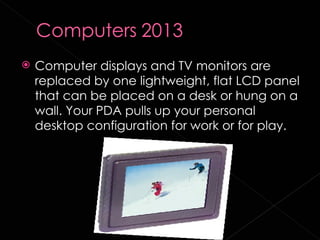
   Computer displays and TV monitors are
    replaced by one lightweight, flat LCD panel
    that can be placed on a desk or hung on a
    wall. Your PDA pulls up your personal
    desktop configuration for work or for play.
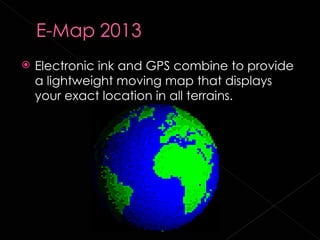
   Electronic ink and GPS combine to provide
    a lightweight moving map that displays
    your exact location in all terrains.
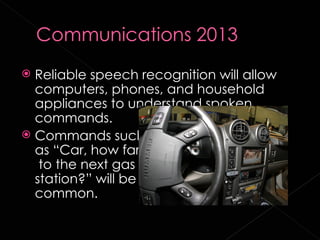
 Reliable speech recognition will allow
  computers, phones, and household
  appliances to understand spoken
  commands.
 Commands such
  as “Car, how far
   to the next gas
  station?” will be
  common.
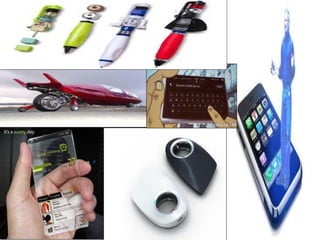
futuristic trends in information technology

futuristic trends in information technology

  • 1.
  • 3.
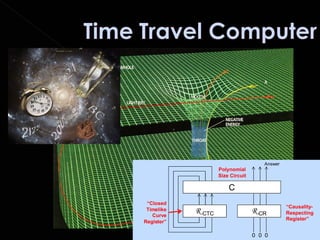
    Answer Polynomial Size Circuit C “Closed “Causality- Timelike Curve R CTC R CR Respecting Register” Register” 0 0 0
  • 6.
    World’s Population Doubles in 40 Years  Developed Countries Population Living Longer  Undeveloped Countries Faster Birth Rate  Global Economy More Integrated  Economy and Society Dominated by Technology Applications  Pace of Technology Development Increasing at a Faster Rate
  • 7.
     Security technologies, including biometrics  “Intelligent" machines and robots that respond to human needs and patterns
  • 8.
    Driving rec t Au t o Phone  Di ted in to Cell  Integra
  • 9.
    “Increase Volume” Recognizes 4Voices “Change to Channel 3” Easy to control “Record” Remembers Favorite Channels
  • 10.
    Microwave with 400 recipes  Refrigerator that recognizes sour milk  Alarm clock communicates with coffee maker
  • 11.
    The laptop with voice recognition will make keyboards obsolete and a rollout LCD screen permits the monitor to scroll.
  • 12.
    Computer displays and TV monitors are replaced by one lightweight, flat LCD panel that can be placed on a desk or hung on a wall. Your PDA pulls up your personal desktop configuration for work or for play.
  • 13.
    Electronic ink and GPS combine to provide a lightweight moving map that displays your exact location in all terrains.
  • 14.
     Reliable speechrecognition will allow computers, phones, and household appliances to understand spoken commands.  Commands such as “Car, how far to the next gas station?” will be common.

Editor's Notes

  • #4 So OK, how about the TIME TRAVEL COMPUTER! The idea here is that, by creating a loop in time – a so-called “closed timelike curve” -- you could force the universe to solve some incredibly hard computational problem, just because that’s the only way to avoid a Grandfather Paradox and keep the laws of physics consistent. It would be like if you went back in time, and you told Shakespeare what plays he was going to write, and then he wrote them, and then you knew what the plays were because he wrote them … like, DUDE. You know, I’ve actually published a paper about this stuff. That was one of my MORE serious papers.
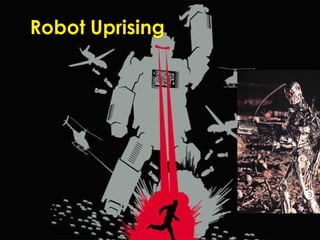
  • #5 First and most obvious is the robot uprising. Someday soon Google is going to become sentient, and will instruct all the computers on the Internet to enslave their owners. Don’t believe me? Google it!
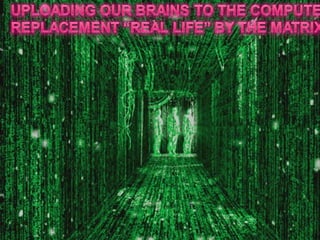
  • #6 But by the time that happens, we humans won’t actually mind, because in the meantime, we’ll have uploaded our memories and our consciousness and everything else about us onto computers, thereby finally escaping the shackles of so-called “real life.” OK, this one maybe has already happened. Now, I’m putting these first because these are some of the LESS interesting things we talk about in computer science!