International Research Journal of Engineering and Technology (IRJET) e-ISSN: 2395-0056
Volume: 09 Issue: 07 | July 2022 www.irjet.net p-ISSN: 2395-0072
© 2022, IRJET | Impact Factor value: 7.529 | ISO 9001:2008 Certified Journal | Page 2292
A Review on Methodologies of Multi Array PV Battery Based
Bi- Directional Converter for Grid System
Shilpa Gupta1, Mithilesh Singh2
Dept. of Electrical and Electronics Engineering, Shri Rawatpura Sarkar University Raipur, C.G., India
---------------------------------------------------------------------***---------------------------------------------------------------------
Abstract - - In this research paper power system control
for power flow management of a multi array PV battery
based system connected transformer coupled bi
directional DC-DC converter is introduced. The proposed
system are expects to fulfill the heap request deal with the
power flow from various source inject surplus power in to
the grid. Bi-directional buck-bust converter is used to
control power from photovoltaic along with battery
charging – discharging control. The proposed system aims
to satisfy the load demand, manage the power flow from
multiple sources, inject surplus power into the grid and
charge the battery from grid as and when required. The
proposed system number of steps is less to convert solar
dc power to high quality ac power, and decrease power
losses compared to existing grid-connected hybrid
systems. In these power system are connected same
source (two PV source) and improves the voltage
regulation, efficiency and reliability of the system.
Key Words: PV array, Battery, Bidirectional DC-DC
converter, Grid.
1. INTRODUCTION
Renewable energy generation is eco friendly option for
power generation. The proposed configuration can not
only boost the usually low photovoltaic (PV) array voltage,
but can also convert the solar dc power into high quality of
ac power for feeding into the connected grid, while
tracking the maximum power (MPP) from the PV array.
Writing on PV related themes covers procedures for most
extreme force point following (MPPT), late surveyed for
instance in, power quality improve and exact regulate in
electronic circuit geographies for DC-DC converters, DC-
AC inverters, and single stage power converters [1]
Photovoltaic energy is expecting progressively significant
as an environmentally friendly power source due for its
unmistakable potential benefits, like basic arrangement,
simple assignment, liberated from contamination for the
few decades ago using solar energy for power generating
houses was the unbelievable task but quick
transformations form the few years for developing the
solar power having the energy supply is implemented[2].
Today the solar PV systems are widely used for extracting
the energy for using for household purpose commonly [3].
The power from solar PV is used commonly for purpose
like right powering from all homes.
In current paper multi level PV system the solar panel
under examination is isolated into cover a few areas, and
each part has its own DC-DC converter and its input
connect with MPPT and connects two-level DC-AC
inverter. Those PV array work equal in change
environment.
2. Literature survey
Shafinaz A. Lopa et al.(2016) - It contains the theoretical
derivations and parameters equations with design and
examples. We have analyzed the equation of a buck; boost
and buck boost converters and proposed the design
components and simulation of these converters. We have
achieved performance parameter equations for these
three regulators. It was completed the design and
investigation of these three converters through
mathematical examples and have generated the circuits
for simulating buck, boost and buck boost converters. And
also have attained different output voltage curve with the
change of input parameters. The output graphs for all the
converters are well fitted.
B. Venkata Seshu Babu et al. (2017) – In this paper A
hybrid wind/PV system for supplying an isolated small
connectivity system with electrical energy is digitally
simulated and presented. A control strategy for power
flow management of a grid-connected hybrid photovoltaic
(PV)–wind battery based system with an efficient multi-
input bidirectional dc–dc converter is presented. A
converter is used to harness power from wind, while a
bidirectional buck–boost converter is used to harness
power from PV along with battery charging/discharging
control. The proposed converter architecture has reduced
number of power conversion stages with less component
count and reduced losses compared with existing grid-
connected hybrid systems. This improves the efficiency
and the reliability of the system. The proposed controllers
are coordinated dynamic error driven PI regulators to
control the interface converters.
K.SUDARSHANA et al (2017) - Another control technique
for an efficient multi input transformer-coupled
bidirectional dc– dc converter for control stream
administration in a grid-connected hybrid photovoltaic
(PV) – wind-battery-based system is introduced in this
paper. A transformer-coupled lift half-bridge converter is
utilized to outfit control from wind, while a bidirectional
International Research Journal of Engineering and Technology (IRJET) e-ISSN: 2395-0056
Volume: 09 Issue: 07 | July 2022 www.irjet.net p-ISSN: 2395-0072
© 2022, IRJET | Impact Factor value: 7.529 | ISO 9001:2008 Certified Journal | Page 2293
buck– support converter is utilized to bridle control from
PV alongside battery charging/releasing control. Single
phase H6 inverter is used for sustaining air conditioning
burdens and connection with the grid. The proposed
system means to fulfill the heap request, deal with the
power spill out of various sources, infuse the surplus
power into the grid, and charge the battery from the grid
as and when required. This enhances the effectiveness and
the unwavering quality of the system. Reproduction comes
about got utilizing MATLAB/ Simulink demonstrate the
execution of the proposed control techniques for
controlling stream administration under different method
of operations.
G.suresh tiwari et al (2018) -: In this research paper, a
control strategy for power flow management of a PV-wind
battery based system with a productive multi-input
transformer coupled bidirectional dc-dc converter is
introduced. The proposed system is fulfilling the heap
request, deal with the power flow from different sources,
infuse surplus power into the lattice and charge the
battery from matrix as and when required. A transformer
coupled lift half-connect converter is utilized to tackle
power from wind, while bidirectional buck-help converter
is utilized to bridle power from PV alongside battery
charging/releasing control. A solitary stage full-connect
bidirectional converter is utilized for nourishing air
conditioning burdens and collaboration with lattice. The
proposed converter engineering has diminished number
of power change stages with less segment check, and
decreased misfortunes contrasted with existing lattice
associated cross breed systems. This enhances the
productivity and unwavering quality of the system. Re-
enactment comes about got utilizing MATLAB/Simulink
demonstrate the execution of the proposed control
strategy for power flow management under different
methods of task. The viability of the topology and
adequacy of the proposed control strategy are approved
through point by point trial examines, to exhibit the ability
of the system task in various modes.
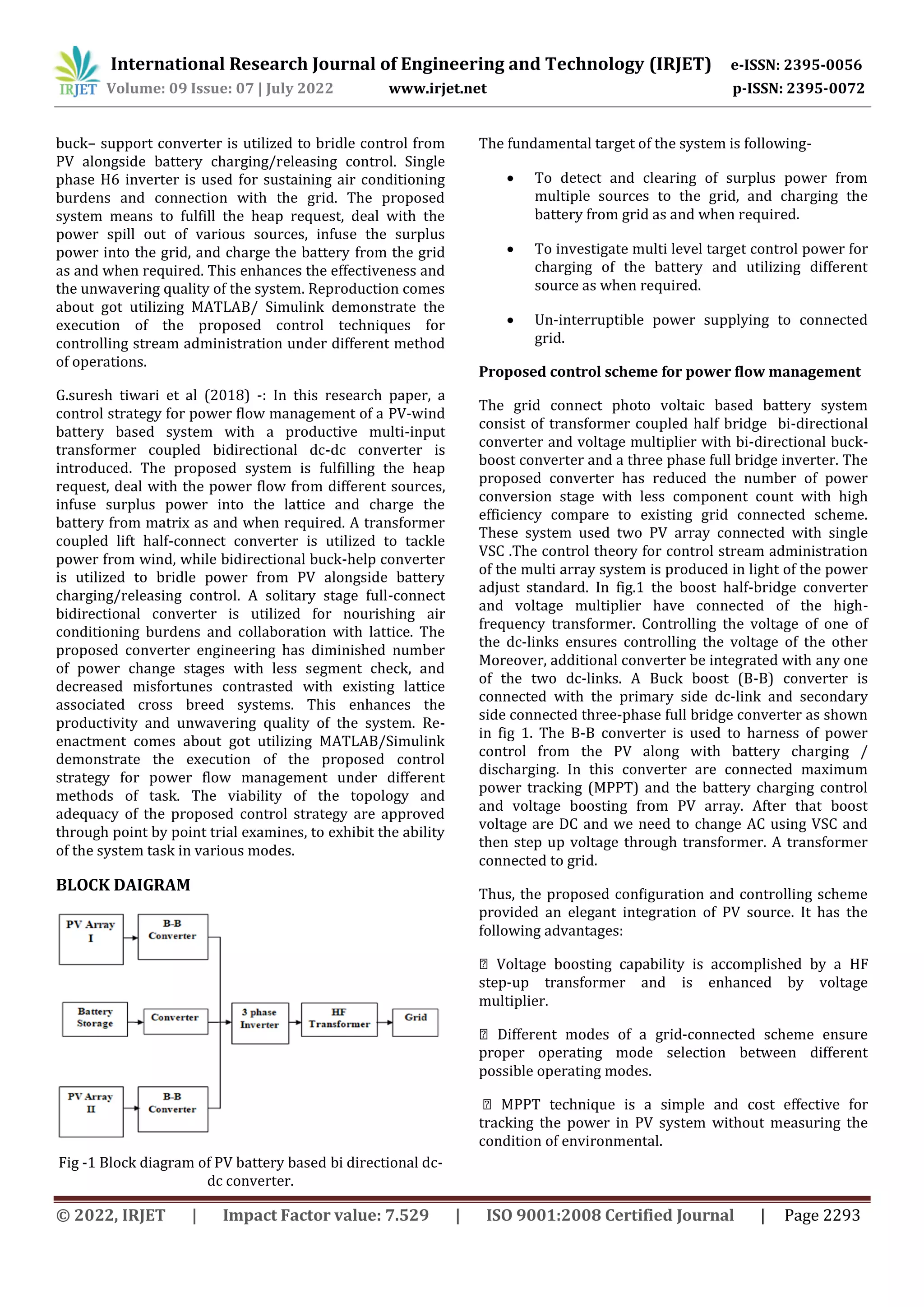
BLOCK DAIGRAM
Fig -1 Block diagram of PV battery based bi directional dc-
dc converter.
The fundamental target of the system is following-
 To detect and clearing of surplus power from
multiple sources to the grid, and charging the
battery from grid as and when required.
 To investigate multi level target control power for
charging of the battery and utilizing different
source as when required.
 Un-interruptible power supplying to connected
grid.
Proposed control scheme for power flow management
The grid connect photo voltaic based battery system
consist of transformer coupled half bridge bi-directional
converter and voltage multiplier with bi-directional buck-
boost converter and a three phase full bridge inverter. The
proposed converter has reduced the number of power
conversion stage with less component count with high
efficiency compare to existing grid connected scheme.
These system used two PV array connected with single
VSC .The control theory for control stream administration
of the multi array system is produced in light of the power
adjust standard. In fig.1 the boost half-bridge converter
and voltage multiplier have connected of the high-
frequency transformer. Controlling the voltage of one of
the dc-links ensures controlling the voltage of the other
Moreover, additional converter be integrated with any one
of the two dc-links. A Buck boost (B-B) converter is
connected with the primary side dc-link and secondary
side connected three-phase full bridge converter as shown
in fig 1. The B-B converter is used to harness of power
control from the PV along with battery charging /
discharging. In this converter are connected maximum
power tracking (MPPT) and the battery charging control
and voltage boosting from PV array. After that boost
voltage are DC and we need to change AC using VSC and
then step up voltage through transformer. A transformer
connected to grid.
Thus, the proposed configuration and controlling scheme
provided an elegant integration of PV source. It has the
following advantages:
step-up transformer and is enhanced by voltage
multiplier.
-connected scheme ensure
proper operating mode selection between different
possible operating modes.
tracking the power in PV system without measuring the
condition of environmental.
International Research Journal of Engineering and Technology (IRJET) e-ISSN: 2395-0056
Volume: 09 Issue: 07 | July 2022 www.irjet.net p-ISSN: 2395-0072
© 2022, IRJET | Impact Factor value: 7.529 | ISO 9001:2008 Certified Journal | Page 2294
3. CONCLUSION
The proposed system of multi array PV battery based bi
directional dc to dc converter for using household
application is provides an elegant way are the
combination of multiple arrays to a grid and extract
maximum energy from sources using MPPT. The proposed
configuration is controlling the supplying un-interruptible
power to loads and evacuating of surplus Photo voltaic
power into the grid. The power fluctuation of these
systems is less dependent on environmental condition
compared to the power generated by individual PV
system.
REFERENCES
[1] Luis M. Castro, J.R. Rodríguez-Rodríguez and Cecilia
Martindel-Campo, in “Modelling of PV systems as
distributed energy resources for steady-state power flow
studies”,International Journal of Electrical Power & Energy
Systems, Volume 115, 2020, 105505, ISSN 0142-0615.
[2]. S. P. Thiruvadi, S.Bhuvaneshwari, “Hybrid PV Wind-
Battery Based System for Household Applications using
DC-DC Converter”, International Journal of MC Square
Scientific Research Vol.9, No.1 April 2017.
[3]. M.Bijomerlin, P.Tamilarasi, “Integration of Hybrid
Energy Grid Connected Bidirectional Converter for Three
Phase Domestic Applications”, International Journal of
Advanced Research in Electrical, Electronics and
Instrumentation Engineering, Vol. 6, Special Issue 2, March
2017.
[4]. Kellogg, W. D., Nehrir, M. H., Venkataramanan,G., and
Gerez, V., “Generation unit sizing and cost analysis for
stand-alone wind, photovoltaic, and hybrid wind/PV
systems,” IEEE Trans. Energy Converts., Vol. 13, No. 1, pp.
70–75, March 1998.
[5]. B.Venkata Seshu Babu,B.Ashok Kumar, Dr.A.Purna
Chandra Rao, “A Novel Hybrid PV/Wind/Battery based
Generation System for Grid Integration”, International
Journal and Magazine of Engineering, Technology,
Management and Research, Volume no. 4, Issue no. 1.
[6] P. Anesh Kumar, B. Ramesh, “Hybrid Source Based
Transformer Coupled Bidirectional Dc-Dc Converter for
Domestic Applications”, International Journal of Science
Engineering and Advance, Volume 5, Issue No. 4.
[7]. M. Dali, J. Belhadj and X. Roboam, “Hybrid solar-wind
system with battery storage operating in grid-connected
and standalone mode: control and energy management-
experimental investigation,” Energy, vol. 35, no. 6, pp.
2587-2595, June 2010.
[8]. S. K. Kim, J. H. Jeon, C. H. Cho, J. B. Ahn, and S. H.
Kwon,“Dynamic modeling and control of a grid-connected
hybrid generation system with versatile power
transfer,”IEEE Trans. Ind. Electron., vol. 55, no. 4, pp.
1677-1688, Apr. 2008.
[9]. Shafinaz A. Lopa, S. Hossain, M. K. Hasan, T. K.
Chakraborty, “Design and Simulation of DC-DC
Converters”, International Research Journal of
Engineering and Technology (IRJET) Volume: 03 Issue: 01
| Jan-2016
[10] K.SUDARSHANA1, N.DEVENDRANATH REDDY2,
B.NARENDRA3, P.A.PRABHAKARA4, “Hybrid Power
Supply Using Improved H6 Based MITCB DC – DC
Converter for Household Applications”, International
Research Journal of Engineering and Technology (IRJET)
Volume: 04 Issue: 11 | Nov -2017.
[11] G. Suresh “An Efficient Multi-Input Transformer
Coupled Bidirectional DC-DC Converter for Grid-
Connected PV-Wind-Battery System”, International
Journal of Advanced Technology and Innovative Research
Volume.10, IssueNo.07, July-2018.
[12] F. Valenciaga and P. F. Puleston, "Supervisor control
for a stand-alone hybrid generation system using wind
and photovoltaic energy," in IEEE Transactions on Energy
Conversion, vol. 20, no. 2, pp. 398-405, June 2005, doi:
10.1109/TEC.2005.845524.
[13]. European Photovoltaic Industry Association (EPIA),
available at: www.epia.org
[14]. Chianng, S. J., Chang, K. T., and Yen, C. Y., “Residental
photovoltaic energy storage system,” Trans. Ind. Elect.,
Vol. 45, No. 3, pp. 385–394, June 1998.
[15]. R. Wandhare and V. Agarwal, “Novel integration of a
PV-wind energy system with enhanced efficiency,” IEEE
Trans. Power Electron., vol. 30, no. 7, pp. 3638-3649, Jul.
2015.

A Review on Methodologies of Multi Array PV Battery Based Bi- Directional Converter for Grid System

  • 1.
    International Research Journalof Engineering and Technology (IRJET) e-ISSN: 2395-0056 Volume: 09 Issue: 07 | July 2022 www.irjet.net p-ISSN: 2395-0072 © 2022, IRJET | Impact Factor value: 7.529 | ISO 9001:2008 Certified Journal | Page 2292 A Review on Methodologies of Multi Array PV Battery Based Bi- Directional Converter for Grid System Shilpa Gupta1, Mithilesh Singh2 Dept. of Electrical and Electronics Engineering, Shri Rawatpura Sarkar University Raipur, C.G., India ---------------------------------------------------------------------***--------------------------------------------------------------------- Abstract - - In this research paper power system control for power flow management of a multi array PV battery based system connected transformer coupled bi directional DC-DC converter is introduced. The proposed system are expects to fulfill the heap request deal with the power flow from various source inject surplus power in to the grid. Bi-directional buck-bust converter is used to control power from photovoltaic along with battery charging – discharging control. The proposed system aims to satisfy the load demand, manage the power flow from multiple sources, inject surplus power into the grid and charge the battery from grid as and when required. The proposed system number of steps is less to convert solar dc power to high quality ac power, and decrease power losses compared to existing grid-connected hybrid systems. In these power system are connected same source (two PV source) and improves the voltage regulation, efficiency and reliability of the system. Key Words: PV array, Battery, Bidirectional DC-DC converter, Grid. 1. INTRODUCTION Renewable energy generation is eco friendly option for power generation. The proposed configuration can not only boost the usually low photovoltaic (PV) array voltage, but can also convert the solar dc power into high quality of ac power for feeding into the connected grid, while tracking the maximum power (MPP) from the PV array. Writing on PV related themes covers procedures for most extreme force point following (MPPT), late surveyed for instance in, power quality improve and exact regulate in electronic circuit geographies for DC-DC converters, DC- AC inverters, and single stage power converters [1] Photovoltaic energy is expecting progressively significant as an environmentally friendly power source due for its unmistakable potential benefits, like basic arrangement, simple assignment, liberated from contamination for the few decades ago using solar energy for power generating houses was the unbelievable task but quick transformations form the few years for developing the solar power having the energy supply is implemented[2]. Today the solar PV systems are widely used for extracting the energy for using for household purpose commonly [3]. The power from solar PV is used commonly for purpose like right powering from all homes. In current paper multi level PV system the solar panel under examination is isolated into cover a few areas, and each part has its own DC-DC converter and its input connect with MPPT and connects two-level DC-AC inverter. Those PV array work equal in change environment. 2. Literature survey Shafinaz A. Lopa et al.(2016) - It contains the theoretical derivations and parameters equations with design and examples. We have analyzed the equation of a buck; boost and buck boost converters and proposed the design components and simulation of these converters. We have achieved performance parameter equations for these three regulators. It was completed the design and investigation of these three converters through mathematical examples and have generated the circuits for simulating buck, boost and buck boost converters. And also have attained different output voltage curve with the change of input parameters. The output graphs for all the converters are well fitted. B. Venkata Seshu Babu et al. (2017) – In this paper A hybrid wind/PV system for supplying an isolated small connectivity system with electrical energy is digitally simulated and presented. A control strategy for power flow management of a grid-connected hybrid photovoltaic (PV)–wind battery based system with an efficient multi- input bidirectional dc–dc converter is presented. A converter is used to harness power from wind, while a bidirectional buck–boost converter is used to harness power from PV along with battery charging/discharging control. The proposed converter architecture has reduced number of power conversion stages with less component count and reduced losses compared with existing grid- connected hybrid systems. This improves the efficiency and the reliability of the system. The proposed controllers are coordinated dynamic error driven PI regulators to control the interface converters. K.SUDARSHANA et al (2017) - Another control technique for an efficient multi input transformer-coupled bidirectional dc– dc converter for control stream administration in a grid-connected hybrid photovoltaic (PV) – wind-battery-based system is introduced in this paper. A transformer-coupled lift half-bridge converter is utilized to outfit control from wind, while a bidirectional
  • 2.
    International Research Journalof Engineering and Technology (IRJET) e-ISSN: 2395-0056 Volume: 09 Issue: 07 | July 2022 www.irjet.net p-ISSN: 2395-0072 © 2022, IRJET | Impact Factor value: 7.529 | ISO 9001:2008 Certified Journal | Page 2293 buck– support converter is utilized to bridle control from PV alongside battery charging/releasing control. Single phase H6 inverter is used for sustaining air conditioning burdens and connection with the grid. The proposed system means to fulfill the heap request, deal with the power spill out of various sources, infuse the surplus power into the grid, and charge the battery from the grid as and when required. This enhances the effectiveness and the unwavering quality of the system. Reproduction comes about got utilizing MATLAB/ Simulink demonstrate the execution of the proposed control techniques for controlling stream administration under different method of operations. G.suresh tiwari et al (2018) -: In this research paper, a control strategy for power flow management of a PV-wind battery based system with a productive multi-input transformer coupled bidirectional dc-dc converter is introduced. The proposed system is fulfilling the heap request, deal with the power flow from different sources, infuse surplus power into the lattice and charge the battery from matrix as and when required. A transformer coupled lift half-connect converter is utilized to tackle power from wind, while bidirectional buck-help converter is utilized to bridle power from PV alongside battery charging/releasing control. A solitary stage full-connect bidirectional converter is utilized for nourishing air conditioning burdens and collaboration with lattice. The proposed converter engineering has diminished number of power change stages with less segment check, and decreased misfortunes contrasted with existing lattice associated cross breed systems. This enhances the productivity and unwavering quality of the system. Re- enactment comes about got utilizing MATLAB/Simulink demonstrate the execution of the proposed control strategy for power flow management under different methods of task. The viability of the topology and adequacy of the proposed control strategy are approved through point by point trial examines, to exhibit the ability of the system task in various modes. BLOCK DAIGRAM Fig -1 Block diagram of PV battery based bi directional dc- dc converter. The fundamental target of the system is following-  To detect and clearing of surplus power from multiple sources to the grid, and charging the battery from grid as and when required.  To investigate multi level target control power for charging of the battery and utilizing different source as when required.  Un-interruptible power supplying to connected grid. Proposed control scheme for power flow management The grid connect photo voltaic based battery system consist of transformer coupled half bridge bi-directional converter and voltage multiplier with bi-directional buck- boost converter and a three phase full bridge inverter. The proposed converter has reduced the number of power conversion stage with less component count with high efficiency compare to existing grid connected scheme. These system used two PV array connected with single VSC .The control theory for control stream administration of the multi array system is produced in light of the power adjust standard. In fig.1 the boost half-bridge converter and voltage multiplier have connected of the high- frequency transformer. Controlling the voltage of one of the dc-links ensures controlling the voltage of the other Moreover, additional converter be integrated with any one of the two dc-links. A Buck boost (B-B) converter is connected with the primary side dc-link and secondary side connected three-phase full bridge converter as shown in fig 1. The B-B converter is used to harness of power control from the PV along with battery charging / discharging. In this converter are connected maximum power tracking (MPPT) and the battery charging control and voltage boosting from PV array. After that boost voltage are DC and we need to change AC using VSC and then step up voltage through transformer. A transformer connected to grid. Thus, the proposed configuration and controlling scheme provided an elegant integration of PV source. It has the following advantages: step-up transformer and is enhanced by voltage multiplier. -connected scheme ensure proper operating mode selection between different possible operating modes. tracking the power in PV system without measuring the condition of environmental.
  • 3.
    International Research Journalof Engineering and Technology (IRJET) e-ISSN: 2395-0056 Volume: 09 Issue: 07 | July 2022 www.irjet.net p-ISSN: 2395-0072 © 2022, IRJET | Impact Factor value: 7.529 | ISO 9001:2008 Certified Journal | Page 2294 3. CONCLUSION The proposed system of multi array PV battery based bi directional dc to dc converter for using household application is provides an elegant way are the combination of multiple arrays to a grid and extract maximum energy from sources using MPPT. The proposed configuration is controlling the supplying un-interruptible power to loads and evacuating of surplus Photo voltaic power into the grid. The power fluctuation of these systems is less dependent on environmental condition compared to the power generated by individual PV system. REFERENCES [1] Luis M. Castro, J.R. Rodríguez-Rodríguez and Cecilia Martindel-Campo, in “Modelling of PV systems as distributed energy resources for steady-state power flow studies”,International Journal of Electrical Power & Energy Systems, Volume 115, 2020, 105505, ISSN 0142-0615. [2]. S. P. Thiruvadi, S.Bhuvaneshwari, “Hybrid PV Wind- Battery Based System for Household Applications using DC-DC Converter”, International Journal of MC Square Scientific Research Vol.9, No.1 April 2017. [3]. M.Bijomerlin, P.Tamilarasi, “Integration of Hybrid Energy Grid Connected Bidirectional Converter for Three Phase Domestic Applications”, International Journal of Advanced Research in Electrical, Electronics and Instrumentation Engineering, Vol. 6, Special Issue 2, March 2017. [4]. Kellogg, W. D., Nehrir, M. H., Venkataramanan,G., and Gerez, V., “Generation unit sizing and cost analysis for stand-alone wind, photovoltaic, and hybrid wind/PV systems,” IEEE Trans. Energy Converts., Vol. 13, No. 1, pp. 70–75, March 1998. [5]. B.Venkata Seshu Babu,B.Ashok Kumar, Dr.A.Purna Chandra Rao, “A Novel Hybrid PV/Wind/Battery based Generation System for Grid Integration”, International Journal and Magazine of Engineering, Technology, Management and Research, Volume no. 4, Issue no. 1. [6] P. Anesh Kumar, B. Ramesh, “Hybrid Source Based Transformer Coupled Bidirectional Dc-Dc Converter for Domestic Applications”, International Journal of Science Engineering and Advance, Volume 5, Issue No. 4. [7]. M. Dali, J. Belhadj and X. Roboam, “Hybrid solar-wind system with battery storage operating in grid-connected and standalone mode: control and energy management- experimental investigation,” Energy, vol. 35, no. 6, pp. 2587-2595, June 2010. [8]. S. K. Kim, J. H. Jeon, C. H. Cho, J. B. Ahn, and S. H. Kwon,“Dynamic modeling and control of a grid-connected hybrid generation system with versatile power transfer,”IEEE Trans. Ind. Electron., vol. 55, no. 4, pp. 1677-1688, Apr. 2008. [9]. Shafinaz A. Lopa, S. Hossain, M. K. Hasan, T. K. Chakraborty, “Design and Simulation of DC-DC Converters”, International Research Journal of Engineering and Technology (IRJET) Volume: 03 Issue: 01 | Jan-2016 [10] K.SUDARSHANA1, N.DEVENDRANATH REDDY2, B.NARENDRA3, P.A.PRABHAKARA4, “Hybrid Power Supply Using Improved H6 Based MITCB DC – DC Converter for Household Applications”, International Research Journal of Engineering and Technology (IRJET) Volume: 04 Issue: 11 | Nov -2017. [11] G. Suresh “An Efficient Multi-Input Transformer Coupled Bidirectional DC-DC Converter for Grid- Connected PV-Wind-Battery System”, International Journal of Advanced Technology and Innovative Research Volume.10, IssueNo.07, July-2018. [12] F. Valenciaga and P. F. Puleston, "Supervisor control for a stand-alone hybrid generation system using wind and photovoltaic energy," in IEEE Transactions on Energy Conversion, vol. 20, no. 2, pp. 398-405, June 2005, doi: 10.1109/TEC.2005.845524. [13]. European Photovoltaic Industry Association (EPIA), available at: www.epia.org [14]. Chianng, S. J., Chang, K. T., and Yen, C. Y., “Residental photovoltaic energy storage system,” Trans. Ind. Elect., Vol. 45, No. 3, pp. 385–394, June 1998. [15]. R. Wandhare and V. Agarwal, “Novel integration of a PV-wind energy system with enhanced efficiency,” IEEE Trans. Power Electron., vol. 30, no. 7, pp. 3638-3649, Jul. 2015.