International Research Journal of Engineering and Technology (IRJET) e-ISSN: 2395-0056
Volume: 06 Issue: 06 | June 2019 www.irjet.net p-ISSN: 2395-0072
© 2019, IRJET | Impact Factor value: 7.211 | ISO 9001:2008 Certified Journal | Page 527
A Review on Grid Connected Multi Array PV Battery Based Bi-
Directional DC – DC Converter
Yogesh Tiwar1, Gokul Kumar Dewangan2
Dept. of Electrical and Electronics Engineering, Shri Shankaracharya Group of Institutions, Junwani, Bhilai,
C.G., India
------------------------------------------------------------------------***-------------------------------------------------------------------------
Abstract: In this project, a control strategy for power flow management of a grid-connected to photo voltaic
battery based system with an efficient multi-input transformer coupled bidirectional dc-dc converter is
presented. The proposed system aims to satisfy the load demand, manage the power flow from different
sources, inject surplus power into the grid and charge the battery from grid as and when required. Bidirectional
buck-boost converter is used to harness power from PV along with battery charging/discharging control. A
single-phase full-bridge bidirectional converter is used for feeding ac loads and interaction with grid. The
proposed converter architecture has reduced number of power conversion stages with less component count,
and reduced losses compared to existing grid-connected hybrid systems. This improves the efficiency and
reliability of the system
Keywords: PV Battery, DC-DC Converter, Grid, Bidirectional Converter
Literature Survey:
G. Suresh (2018) In this paper, a control strategy for
power flow management of a lattice associated cross
breed PV-wind battery based system with a
productive multi-input transformer coupled
bidirectional dc-dc converter is introduced. The
proposed system expects to fulfil the heap request,
deal with the power flow from various sources, infuse
surplus power into the lattice and charge the battery
from matrix as and when required. A transformer
coupled lift half-connect converter is utilized to tackle
power from wind, while bidirectional buck-help
converter is utilized to bridle power from PV
alongside battery charging/releasing control. A
solitary stage full-connect bidirectional converter is
utilized for nourishing air conditioning burdens and
collaboration with lattice. The proposed converter
engineering has diminished number of power change
stages with less segment check, and decreased
misfortunes contrasted with existing lattice
associated cross breed systems. This enhances the
productivity and unwavering quality of the system.
Re-enactment comes about got utilizing
MATLAB/Simulink demonstrate the execution of the
proposed control strategy for power flow
management under different methods of task. The
viability of the topology and adequacy of the
proposed control strategy are approved through point
by point trial examines, to exhibit the ability of the
system task in various modes.
Ramendra Kumar et al. (2018) Hybrid power system
will be utilised to decrease energy storage wants.
There's increasing interest for the use of exchange or
property power sources to accomplish good and ease
power for Residential Application the PV-wind hybrid
system restores the foremost reduced cost esteems to
stay up an identical level of DPSP once contrasted
with independent solar and wind systems. For all
heap requests the levelised energy taken a toll for PV-
wind hybrid system is reliably below that of
independent solar PV or wind system. The PV-wind
hybrid various is techno financially possible for
provincial zap. This paper proposes a completely
unique incorporated device topology for interfacing
between the energy storage system and therefore the
dc transport for a personal micro grid application The
planned coordinated full-bridge dc–dc device displays
the incidental to elements: low range of dynamic
gadgets contrasted with the converters usually
connected to comparative applications, low data and
International Research Journal of Engineering and Technology (IRJET) e-ISSN: 2395-0056
Volume: 06 Issue: 06 | June 2019 www.irjet.net p-ISSN: 2395-0072
© 2019, IRJET | Impact Factor value: 7.211 | ISO 9001:2008 Certified Journal | Page 528
yield current swell, high voltage proportion, duplex
power stream, and galvanic disengagement.
Keywords: Battery charge control, full-bridge
bidirectional converter, hybrid system, solar
photovoltaic (PV), coupled boost dual half-bridge
bidirectional converter, wind energy.
M. Bijomerlin et al. (2017) The efficient use of hybrid
energy for three phase domestic applications is
presented in this paper. The proposed hybrid system
manages the power flow from solar-wind-battery
sources and the battery is charged when required
from the grid. The proposed converter consists of a
half bridge converter to harness the power from solar
and battery through bidirectional buck-boost
converter and power from wind through the diode
rectifier. The highfrequency transformer and voltage
multiplier step up the voltage to feed three-phase
loads by means of a three-phase inverter. Simulation
results for various operating modes are obtained
using MATLAB. The improved voltage performance of
the various operating modes is validated and results
are obtained.
P. Anesh Kumar et al. (2017) Hybrid power system
can be utilized to decrease energy storage necessities.
There is expanding interest for the utilization of
exchange or sustainable power sources to accomplish
perfect and ease power for Residential Application
the PV-wind hybrid system restores the most reduced
unit cost esteems to keep up a similar level of DPSP
when contrasted with independent solar and wind
systems. For all heap requests the levelised energy
taken a toll for PV-wind hybrid system is dependably
lower than that of independent solar PV or wind
system. The PV-wind hybrid alternative is techno
financially feasible for provincial zap. This paper
proposes a novel incorporated converter topology for
interfacing between the energy storage system and
the dc transport for a private microgrid application
The proposed coordinated full-bridge dc–dc converter
displays the accompanying elements: low number of
dynamic gadgets contrasted with the converters
generally connected to comparative applications, low
information and yield current swell, high voltage
proportion, bidirectional power stream, and galvanic
disengagement.
Hekmatullah et al. (2017) The main problem in the
electrical system is the load demand by using the
renewable and non-renewable sources we are
satisfying the load demand. The power flow between
the load and renewable energy sources is difficult so
we gone for multi-input transformer coupled
bidirectional dcdc converter. This maintains the
power flow between the load, grid and renewable
sources. But the harmonics is main problem in the
conventional model to overcome that problem we are
going for the multilevel transformer in this paper,
which can be observed in matlab/simulink software.
S. Pardha Saradhi et al. (2017)in this project, a control
strategy for power flow management of a grid-
connected hybrid PV-wind-battery based system with
an efficient multi-input transformer coupled
bidirectional dc-dc converter is presented. The aim of
our project is to satisfy the load demand, manage the
power flow from different sources, inject surplus
power into the grid and charge the battery from grid
as and when required. A transformer coupled boost
half-bridge converter is used to harness power from
wind, while bidirectional buck-boost converter is
used to harness power from PV along with battery
charging/discharging control. A single-phase full-
bridge bidirectional converter is used for feeding ac
loads and interaction with grid. The proposed
converter architecture has reduced number of power
conversion stages with less component count, and
reduced losses compared to existing grid-connected
hybrid systems. Then we are going to test the single
phase multilevel converter to feed ac loads and
interaction with grid.
B. Venkata Seshu Babu et al. (2017) A hybrid wind/PV
system for supplying an isolated small community
with electrical energy is digitally simulated and
presented in this paper. a control strategy for
power flow management of a grid-connected hybrid
photovoltaic (PV)–windbattery-based system with
an efficient multi-input bidirectional dc–dc
converter is presented. A converter is used to
International Research Journal of Engineering and Technology (IRJET) e-ISSN: 2395-0056
Volume: 06 Issue: 06 | June 2019 www.irjet.net p-ISSN: 2395-0072
© 2019, IRJET | Impact Factor value: 7.211 | ISO 9001:2008 Certified Journal | Page 529
harness power from wind, while a bidirectional
buck–boost converter is used to harness power
from PV along with battery charging/discharging
control. The proposed converter architecture has
reduced number of power conversion stages with
less component count and reduced losses compared
with existing grid-connected hybrid systems. This
improves the efficiency and the reliability of the
system. The proposed controllers are coordinated
dynamic error driven PI regulators to control the
interface converters.
K.Sudarshana et al. (2017) Another control technique
for an efficient multi input transformer-coupled
bidirectional dc– dc converter for control stream
administration in a grid-connected hybrid
photovoltaic (PV)– wind-battery-based system is
introduced in this paper. A transformer-coupled lift
half-bridge converter is utilized to outfit control from
wind, while a bidirectional buck– support converter is
utilized to bridle control from PV alongside battery
charging/releasing control. A single-phase H6
inverter is utilized for sustaining air conditioning
burdens and connection with the grid. The proposed
system means to fulfill the heap request, deal with the
power spill out of various sources, infuse the surplus
power into the grid, and charge the battery from the
grid as and when required. Additionally, the proposed
converter design has decreased number of energy
transformation stages with less segment tally and
diminished misfortunes contrasted and existing grid-
connected hybrid systems. This enhances the
effectiveness and the unwavering quality of the
system. Reproduction comes about got utilizing
MATLAB/Simulink demonstrate the execution of the
proposed control technique for control stream
administration under different methods of operation.
Shafinaz A. Lopa et al. (2016) Another control
technique for an efficient multi input transformer-
coupled bidirectional dc– dc converter for control
stream administration in a grid-connected hybrid
photovoltaic (PV)– wind-battery-based system is
introduced in this paper. A transformer-coupled lift
half-bridge converter is utilized to outfit control from
wind, while a bidirectional buck– support converter is
utilized to bridle control from PV alongside battery
charging/releasing control. A single-phase H6
inverter is utilized for sustaining air conditioning
burdens and connection with the grid. The proposed
system means to fulfill the heap request, deal with the
power spill out of various sources, infuse the surplus
power into the grid, and charge the battery from the
grid as and when required. Additionally, the proposed
converter design has decreased number of energy
transformation stages with less segment tally and
diminished misfortunes contrasted and existing grid-
connected hybrid systems. This enhances the
effectiveness and the unwavering quality of the
system. Reproduction comes about got utilizing
MATLAB/Simulink demonstrate the execution of the
proposed control technique for control stream
administration under different methods of operation.
P. Dhanaselvi et al. (2017) proposed hybrid system
provides an elegant integration of PV and wind source
to extract maximum energy from the two sources. It is
realized by a novel multi-input transformer coupled
bidirectional dc-dc converter followed by a
conventional full bridge inverter. A versatile control
strategy which achieves better utilization of PV, wind
power, battery capacities without effecting life of
battery and power flow management in a grid
connected hybrid PV-wind-battery based system
feeding ac loads is presented. Detailed simulation
studies are carried out to ascertain the viability of the
scheme, by placing multilevel inverter we observer
the improvement.
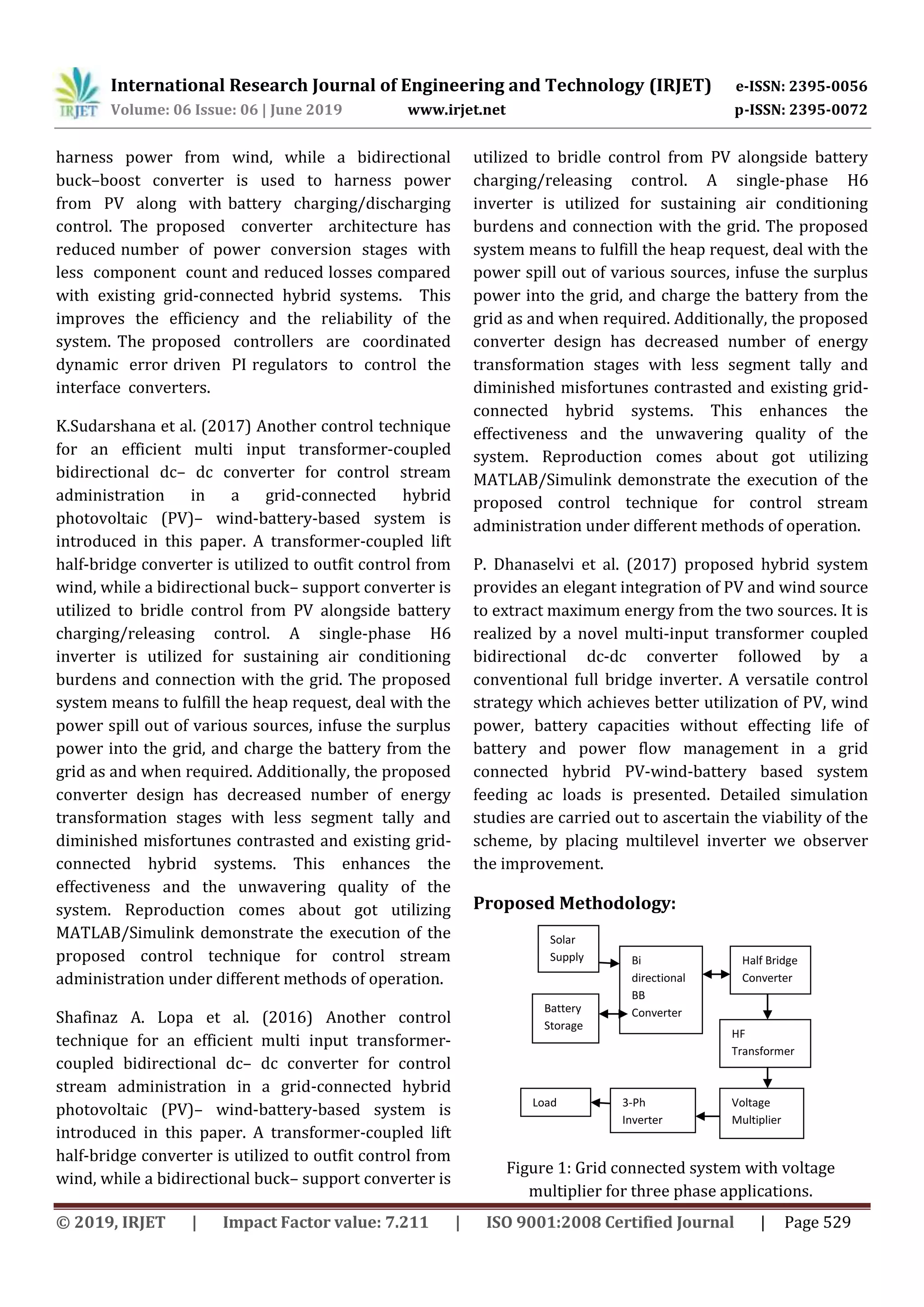
Proposed Methodology:
Figure 1: Grid connected system with voltage
multiplier for three phase applications.
Solar
Supply
Battery
Storage
Bi
directional
BB
Converter
Half Bridge
Converter
HF
Transformer
Voltage
Multiplier
3-Ph
Inverter
Load
International Research Journal of Engineering and Technology (IRJET) e-ISSN: 2395-0056
Volume: 06 Issue: 06 | June 2019 www.irjet.net p-ISSN: 2395-0072
© 2019, IRJET | Impact Factor value: 7.211 | ISO 9001:2008 Certified Journal | Page 530
The proposed converter consists of a transformer
coupled boost half-bridge bidirectional converter and
voltage multiplier fused with bidirectional buck-boost
converter and a three-phase full bridge inverter. The
proposed converter has reduced the number of power
conversion stages with less component count and
high efficiency compared to the existing grid-
connected schemes. The boost half-bridge converter
and voltage multiplier have two dc-links on both sides
of the high-frequency transformer. Controlling the
voltage of one of the dc-links ensures controlling the
voltage of the other. Moreover, additional converters
can be integrated with any one of the two dc-links. A
bidirectional buckboost dc-dc converter is integrated
with the primary side dc-link and three-phase full
bridge bidirectional converter is connected to the dc-
link of the secondary side. The input of the half-bridge
converter is connected to the PV array in series with
the battery source, thereby incorporating an inherent
boosting stage. The boosting capability is further
enhanced by a high-frequency step-up transformer.
The transformer ensures galvanic isolation to the load
from the sources and the battery. The bidirectional
buck-boost converter is used to harness power from
PV along with battery charging/discharging control.
The uniqueness of this converter is that Multi-point
power tracking, battery chargecontrol and voltage
boosting are accomplished through a single converter.
Thus, the proposed configuration and control scheme
provide an elegant integration of PV source. It has the
following advantages:
 Voltage boosting capability is accomplished by
a high-frequency step-up transformer and is
further enhanced by voltage multiplier.
 The number of turns is reduced in the high-
frequency step-up transformer and hence core
losses are reduced.
 Different modes of a grid-connected scheme
ensure proper operating mode selection and
smooth transition between different possible
operating modes.
Conclusion:A multi array photo voltaic battery
basedbi directional dc to dc converter for household
application is proposed. The proposed system
provides an elegant way of combining multiple arrays
to a grid using PV source to extract maximum energy
from sources. It is realized by a novel multi-input
transformer coupled bidirectional dc-dc converter
followed by a conventional full-bridge inverter. A
versatile control strategy which achieves better
utilization of PV power, battery capacities without
effecting life of battery and power flow management
in a grid-connected PVbattery based system feeding
ac loads is presented. Detailed simulation studies are
carried out to ascertain the viability of the scheme.
The experimental results obtained are in close
agreement with simulations and are supportive in
demonstrating the capability of the system to operate
either in grid feeding or stand-alone mode. The
proposed configuration is capable of supplying un-
interruptible power to ac loads, and ensures
evacuation of surplus photovoltaic power into the
grid.
References:
1. S. P. Thiruvadi, S.Bhuvaneshwari, “Hybrid PV-
Wind-Battery Based System for Household
Applicationsusing DC-DC Converter”,
International Journal of MC Square Scientific
Research Vol.9, No.1 April 2017.
2. M.Bijomerlin, P.Tamilarasi, “Integration of
Hybrid Energy Grid Connected Bidirectional
Converter for Three Phase Domestic
Applications”, International Journal of
Advanced Research in Electrical, Electronics
and Instrumentation Engineering, Vol. 6,
Special Issue 2, March 2017.
3. P. Anesh Kumar, B. Ramesh, “Hybrid Source
Based Transformer Coupled Bidirectional Dc-
Dc Converter for Domestic Applications”,
International Journal of Science Engineering
and Advance, Volume 5, Issue No. 4.
4. Hekmatullah, C. L. Sravanthi, “Grid-Connected
PV-Wind-Battery Based Multi-Input
Transformer Coupled Bidirectional DC-DC
Converter with Multilevel Inverter Fed AC
International Research Journal of Engineering and Technology (IRJET) e-ISSN: 2395-0056
Volume: 06 Issue: 06 | June 2019 www.irjet.net p-ISSN: 2395-0072
© 2019, IRJET | Impact Factor value: 7.211 | ISO 9001:2008 Certified Journal | Page 531
Load”, International Journal of Innovative
Technologies Volume.05, Issue No.05, May-
2017.
5. S. PardhaSaradhi, P. Dhanaselvi, “Grid-
Connected PV-Wind-Battery Based Multi-
Input Transformer Coupled Bidirectional DC-
DC Converter with Multilevel Inverter Fed AC
Load”, International Journal of Innovative
Technologies Volume.05, Issue No.08, August-
2017.
6. G. Suresh, “An Efficient Multi-Input
Transformer Coupled Bidirectional DC-DC
Converter for Grid-Connected PV-Wind-
Battery System”, International Journal of
Advanced Technology and Innovative
Research Volume. 10, IssueNo.07, July-2018.
7. S. PARDHA SARADHI1, P. DHANASELVI2,
“Grid-Connected PV-Wind-Battery Based
Multi-Input Transformer Coupled
Bidirectional DC-DC Converter with Multilevel
Inverter Fed AC Load”, International Journal
of Innovative TechnologiesISSN 2321-8665
Vol.05,Issue.08, August-2017.
8. B.VenkataSeshuBabu,B.Ashok Kumar,
Dr.A.Purna Chandra Rao, “A Novel Hybrid
PV/Wind/Battery based Generation System
for Grid Integration”, International Journal
and Magazine of Engineering, Technology,
Management and Research, Volume no. 4,
Issue no. 1.
9. Shafinaz A. Lopa, S. Hossain, M. K. Hasan, T. K.
Chakraborty, “Design and Simulation of DC-DC
Converters”, International Research Journal of
Engineering and Technology (IRJET) Volume:
03 Issue: 01 | Jan-2016.
10. K.SUDARSHANA1, N.DEVENDRANATH
REDDY2, B.NARENDRA3, P.A.PRABHAKARA4,
“Hybrid Power Supply Using Improved H6
Based MITCB DC – DC Converter for
Household Applications”, International
Research Journal of Engineering and
Technology (IRJET) Volume: 04 Issue: 11 |
Nov -2017.

IRJET- A Review on Grid Connected Multi Array PV Battery based Bi-Directional DC – DC Converter

  • 1.
    International Research Journalof Engineering and Technology (IRJET) e-ISSN: 2395-0056 Volume: 06 Issue: 06 | June 2019 www.irjet.net p-ISSN: 2395-0072 © 2019, IRJET | Impact Factor value: 7.211 | ISO 9001:2008 Certified Journal | Page 527 A Review on Grid Connected Multi Array PV Battery Based Bi- Directional DC – DC Converter Yogesh Tiwar1, Gokul Kumar Dewangan2 Dept. of Electrical and Electronics Engineering, Shri Shankaracharya Group of Institutions, Junwani, Bhilai, C.G., India ------------------------------------------------------------------------***------------------------------------------------------------------------- Abstract: In this project, a control strategy for power flow management of a grid-connected to photo voltaic battery based system with an efficient multi-input transformer coupled bidirectional dc-dc converter is presented. The proposed system aims to satisfy the load demand, manage the power flow from different sources, inject surplus power into the grid and charge the battery from grid as and when required. Bidirectional buck-boost converter is used to harness power from PV along with battery charging/discharging control. A single-phase full-bridge bidirectional converter is used for feeding ac loads and interaction with grid. The proposed converter architecture has reduced number of power conversion stages with less component count, and reduced losses compared to existing grid-connected hybrid systems. This improves the efficiency and reliability of the system Keywords: PV Battery, DC-DC Converter, Grid, Bidirectional Converter Literature Survey: G. Suresh (2018) In this paper, a control strategy for power flow management of a lattice associated cross breed PV-wind battery based system with a productive multi-input transformer coupled bidirectional dc-dc converter is introduced. The proposed system expects to fulfil the heap request, deal with the power flow from various sources, infuse surplus power into the lattice and charge the battery from matrix as and when required. A transformer coupled lift half-connect converter is utilized to tackle power from wind, while bidirectional buck-help converter is utilized to bridle power from PV alongside battery charging/releasing control. A solitary stage full-connect bidirectional converter is utilized for nourishing air conditioning burdens and collaboration with lattice. The proposed converter engineering has diminished number of power change stages with less segment check, and decreased misfortunes contrasted with existing lattice associated cross breed systems. This enhances the productivity and unwavering quality of the system. Re-enactment comes about got utilizing MATLAB/Simulink demonstrate the execution of the proposed control strategy for power flow management under different methods of task. The viability of the topology and adequacy of the proposed control strategy are approved through point by point trial examines, to exhibit the ability of the system task in various modes. Ramendra Kumar et al. (2018) Hybrid power system will be utilised to decrease energy storage wants. There's increasing interest for the use of exchange or property power sources to accomplish good and ease power for Residential Application the PV-wind hybrid system restores the foremost reduced cost esteems to stay up an identical level of DPSP once contrasted with independent solar and wind systems. For all heap requests the levelised energy taken a toll for PV- wind hybrid system is reliably below that of independent solar PV or wind system. The PV-wind hybrid various is techno financially possible for provincial zap. This paper proposes a completely unique incorporated device topology for interfacing between the energy storage system and therefore the dc transport for a personal micro grid application The planned coordinated full-bridge dc–dc device displays the incidental to elements: low range of dynamic gadgets contrasted with the converters usually connected to comparative applications, low data and
  • 2.
    International Research Journalof Engineering and Technology (IRJET) e-ISSN: 2395-0056 Volume: 06 Issue: 06 | June 2019 www.irjet.net p-ISSN: 2395-0072 © 2019, IRJET | Impact Factor value: 7.211 | ISO 9001:2008 Certified Journal | Page 528 yield current swell, high voltage proportion, duplex power stream, and galvanic disengagement. Keywords: Battery charge control, full-bridge bidirectional converter, hybrid system, solar photovoltaic (PV), coupled boost dual half-bridge bidirectional converter, wind energy. M. Bijomerlin et al. (2017) The efficient use of hybrid energy for three phase domestic applications is presented in this paper. The proposed hybrid system manages the power flow from solar-wind-battery sources and the battery is charged when required from the grid. The proposed converter consists of a half bridge converter to harness the power from solar and battery through bidirectional buck-boost converter and power from wind through the diode rectifier. The highfrequency transformer and voltage multiplier step up the voltage to feed three-phase loads by means of a three-phase inverter. Simulation results for various operating modes are obtained using MATLAB. The improved voltage performance of the various operating modes is validated and results are obtained. P. Anesh Kumar et al. (2017) Hybrid power system can be utilized to decrease energy storage necessities. There is expanding interest for the utilization of exchange or sustainable power sources to accomplish perfect and ease power for Residential Application the PV-wind hybrid system restores the most reduced unit cost esteems to keep up a similar level of DPSP when contrasted with independent solar and wind systems. For all heap requests the levelised energy taken a toll for PV-wind hybrid system is dependably lower than that of independent solar PV or wind system. The PV-wind hybrid alternative is techno financially feasible for provincial zap. This paper proposes a novel incorporated converter topology for interfacing between the energy storage system and the dc transport for a private microgrid application The proposed coordinated full-bridge dc–dc converter displays the accompanying elements: low number of dynamic gadgets contrasted with the converters generally connected to comparative applications, low information and yield current swell, high voltage proportion, bidirectional power stream, and galvanic disengagement. Hekmatullah et al. (2017) The main problem in the electrical system is the load demand by using the renewable and non-renewable sources we are satisfying the load demand. The power flow between the load and renewable energy sources is difficult so we gone for multi-input transformer coupled bidirectional dcdc converter. This maintains the power flow between the load, grid and renewable sources. But the harmonics is main problem in the conventional model to overcome that problem we are going for the multilevel transformer in this paper, which can be observed in matlab/simulink software. S. Pardha Saradhi et al. (2017)in this project, a control strategy for power flow management of a grid- connected hybrid PV-wind-battery based system with an efficient multi-input transformer coupled bidirectional dc-dc converter is presented. The aim of our project is to satisfy the load demand, manage the power flow from different sources, inject surplus power into the grid and charge the battery from grid as and when required. A transformer coupled boost half-bridge converter is used to harness power from wind, while bidirectional buck-boost converter is used to harness power from PV along with battery charging/discharging control. A single-phase full- bridge bidirectional converter is used for feeding ac loads and interaction with grid. The proposed converter architecture has reduced number of power conversion stages with less component count, and reduced losses compared to existing grid-connected hybrid systems. Then we are going to test the single phase multilevel converter to feed ac loads and interaction with grid. B. Venkata Seshu Babu et al. (2017) A hybrid wind/PV system for supplying an isolated small community with electrical energy is digitally simulated and presented in this paper. a control strategy for power flow management of a grid-connected hybrid photovoltaic (PV)–windbattery-based system with an efficient multi-input bidirectional dc–dc converter is presented. A converter is used to
  • 3.
    International Research Journalof Engineering and Technology (IRJET) e-ISSN: 2395-0056 Volume: 06 Issue: 06 | June 2019 www.irjet.net p-ISSN: 2395-0072 © 2019, IRJET | Impact Factor value: 7.211 | ISO 9001:2008 Certified Journal | Page 529 harness power from wind, while a bidirectional buck–boost converter is used to harness power from PV along with battery charging/discharging control. The proposed converter architecture has reduced number of power conversion stages with less component count and reduced losses compared with existing grid-connected hybrid systems. This improves the efficiency and the reliability of the system. The proposed controllers are coordinated dynamic error driven PI regulators to control the interface converters. K.Sudarshana et al. (2017) Another control technique for an efficient multi input transformer-coupled bidirectional dc– dc converter for control stream administration in a grid-connected hybrid photovoltaic (PV)– wind-battery-based system is introduced in this paper. A transformer-coupled lift half-bridge converter is utilized to outfit control from wind, while a bidirectional buck– support converter is utilized to bridle control from PV alongside battery charging/releasing control. A single-phase H6 inverter is utilized for sustaining air conditioning burdens and connection with the grid. The proposed system means to fulfill the heap request, deal with the power spill out of various sources, infuse the surplus power into the grid, and charge the battery from the grid as and when required. Additionally, the proposed converter design has decreased number of energy transformation stages with less segment tally and diminished misfortunes contrasted and existing grid- connected hybrid systems. This enhances the effectiveness and the unwavering quality of the system. Reproduction comes about got utilizing MATLAB/Simulink demonstrate the execution of the proposed control technique for control stream administration under different methods of operation. Shafinaz A. Lopa et al. (2016) Another control technique for an efficient multi input transformer- coupled bidirectional dc– dc converter for control stream administration in a grid-connected hybrid photovoltaic (PV)– wind-battery-based system is introduced in this paper. A transformer-coupled lift half-bridge converter is utilized to outfit control from wind, while a bidirectional buck– support converter is utilized to bridle control from PV alongside battery charging/releasing control. A single-phase H6 inverter is utilized for sustaining air conditioning burdens and connection with the grid. The proposed system means to fulfill the heap request, deal with the power spill out of various sources, infuse the surplus power into the grid, and charge the battery from the grid as and when required. Additionally, the proposed converter design has decreased number of energy transformation stages with less segment tally and diminished misfortunes contrasted and existing grid- connected hybrid systems. This enhances the effectiveness and the unwavering quality of the system. Reproduction comes about got utilizing MATLAB/Simulink demonstrate the execution of the proposed control technique for control stream administration under different methods of operation. P. Dhanaselvi et al. (2017) proposed hybrid system provides an elegant integration of PV and wind source to extract maximum energy from the two sources. It is realized by a novel multi-input transformer coupled bidirectional dc-dc converter followed by a conventional full bridge inverter. A versatile control strategy which achieves better utilization of PV, wind power, battery capacities without effecting life of battery and power flow management in a grid connected hybrid PV-wind-battery based system feeding ac loads is presented. Detailed simulation studies are carried out to ascertain the viability of the scheme, by placing multilevel inverter we observer the improvement. Proposed Methodology: Figure 1: Grid connected system with voltage multiplier for three phase applications. Solar Supply Battery Storage Bi directional BB Converter Half Bridge Converter HF Transformer Voltage Multiplier 3-Ph Inverter Load
  • 4.
    International Research Journalof Engineering and Technology (IRJET) e-ISSN: 2395-0056 Volume: 06 Issue: 06 | June 2019 www.irjet.net p-ISSN: 2395-0072 © 2019, IRJET | Impact Factor value: 7.211 | ISO 9001:2008 Certified Journal | Page 530 The proposed converter consists of a transformer coupled boost half-bridge bidirectional converter and voltage multiplier fused with bidirectional buck-boost converter and a three-phase full bridge inverter. The proposed converter has reduced the number of power conversion stages with less component count and high efficiency compared to the existing grid- connected schemes. The boost half-bridge converter and voltage multiplier have two dc-links on both sides of the high-frequency transformer. Controlling the voltage of one of the dc-links ensures controlling the voltage of the other. Moreover, additional converters can be integrated with any one of the two dc-links. A bidirectional buckboost dc-dc converter is integrated with the primary side dc-link and three-phase full bridge bidirectional converter is connected to the dc- link of the secondary side. The input of the half-bridge converter is connected to the PV array in series with the battery source, thereby incorporating an inherent boosting stage. The boosting capability is further enhanced by a high-frequency step-up transformer. The transformer ensures galvanic isolation to the load from the sources and the battery. The bidirectional buck-boost converter is used to harness power from PV along with battery charging/discharging control. The uniqueness of this converter is that Multi-point power tracking, battery chargecontrol and voltage boosting are accomplished through a single converter. Thus, the proposed configuration and control scheme provide an elegant integration of PV source. It has the following advantages:  Voltage boosting capability is accomplished by a high-frequency step-up transformer and is further enhanced by voltage multiplier.  The number of turns is reduced in the high- frequency step-up transformer and hence core losses are reduced.  Different modes of a grid-connected scheme ensure proper operating mode selection and smooth transition between different possible operating modes. Conclusion:A multi array photo voltaic battery basedbi directional dc to dc converter for household application is proposed. The proposed system provides an elegant way of combining multiple arrays to a grid using PV source to extract maximum energy from sources. It is realized by a novel multi-input transformer coupled bidirectional dc-dc converter followed by a conventional full-bridge inverter. A versatile control strategy which achieves better utilization of PV power, battery capacities without effecting life of battery and power flow management in a grid-connected PVbattery based system feeding ac loads is presented. Detailed simulation studies are carried out to ascertain the viability of the scheme. The experimental results obtained are in close agreement with simulations and are supportive in demonstrating the capability of the system to operate either in grid feeding or stand-alone mode. The proposed configuration is capable of supplying un- interruptible power to ac loads, and ensures evacuation of surplus photovoltaic power into the grid. References: 1. S. P. Thiruvadi, S.Bhuvaneshwari, “Hybrid PV- Wind-Battery Based System for Household Applicationsusing DC-DC Converter”, International Journal of MC Square Scientific Research Vol.9, No.1 April 2017. 2. M.Bijomerlin, P.Tamilarasi, “Integration of Hybrid Energy Grid Connected Bidirectional Converter for Three Phase Domestic Applications”, International Journal of Advanced Research in Electrical, Electronics and Instrumentation Engineering, Vol. 6, Special Issue 2, March 2017. 3. P. Anesh Kumar, B. Ramesh, “Hybrid Source Based Transformer Coupled Bidirectional Dc- Dc Converter for Domestic Applications”, International Journal of Science Engineering and Advance, Volume 5, Issue No. 4. 4. Hekmatullah, C. L. Sravanthi, “Grid-Connected PV-Wind-Battery Based Multi-Input Transformer Coupled Bidirectional DC-DC Converter with Multilevel Inverter Fed AC
  • 5.
    International Research Journalof Engineering and Technology (IRJET) e-ISSN: 2395-0056 Volume: 06 Issue: 06 | June 2019 www.irjet.net p-ISSN: 2395-0072 © 2019, IRJET | Impact Factor value: 7.211 | ISO 9001:2008 Certified Journal | Page 531 Load”, International Journal of Innovative Technologies Volume.05, Issue No.05, May- 2017. 5. S. PardhaSaradhi, P. Dhanaselvi, “Grid- Connected PV-Wind-Battery Based Multi- Input Transformer Coupled Bidirectional DC- DC Converter with Multilevel Inverter Fed AC Load”, International Journal of Innovative Technologies Volume.05, Issue No.08, August- 2017. 6. G. Suresh, “An Efficient Multi-Input Transformer Coupled Bidirectional DC-DC Converter for Grid-Connected PV-Wind- Battery System”, International Journal of Advanced Technology and Innovative Research Volume. 10, IssueNo.07, July-2018. 7. S. PARDHA SARADHI1, P. DHANASELVI2, “Grid-Connected PV-Wind-Battery Based Multi-Input Transformer Coupled Bidirectional DC-DC Converter with Multilevel Inverter Fed AC Load”, International Journal of Innovative TechnologiesISSN 2321-8665 Vol.05,Issue.08, August-2017. 8. B.VenkataSeshuBabu,B.Ashok Kumar, Dr.A.Purna Chandra Rao, “A Novel Hybrid PV/Wind/Battery based Generation System for Grid Integration”, International Journal and Magazine of Engineering, Technology, Management and Research, Volume no. 4, Issue no. 1. 9. Shafinaz A. Lopa, S. Hossain, M. K. Hasan, T. K. Chakraborty, “Design and Simulation of DC-DC Converters”, International Research Journal of Engineering and Technology (IRJET) Volume: 03 Issue: 01 | Jan-2016. 10. K.SUDARSHANA1, N.DEVENDRANATH REDDY2, B.NARENDRA3, P.A.PRABHAKARA4, “Hybrid Power Supply Using Improved H6 Based MITCB DC – DC Converter for Household Applications”, International Research Journal of Engineering and Technology (IRJET) Volume: 04 Issue: 11 | Nov -2017.