
LECTURE L03
EXPONENTIAL WORLD
“Everything that can be invented 

has been invented”
- Purportedly said by Charles H. Duell, Commissioner, 

U.S. Office of Patents, 1899
http://wallpoper.com/
1899
Alternating Current Power Plant 

at World's Fair, Chicago, 1893.
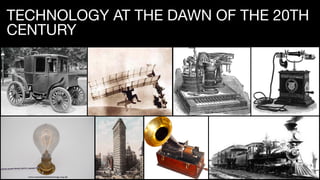
TECHNOLOGY AT THE DAWN OF THE 20TH
CENTURY
Now explain to someone technology today
TECHNOLOGY AT THE DAWN OF THE 21ST
CENTURY
OUR VIEW
ON TECHNOLOGY
IS VERY CONTEMPORARY
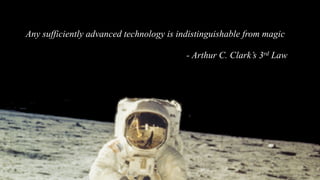
Any sufficiently advanced technology is indistinguishable from magic
- Arthur C. Clark’s 3rd Law
CENTURY OF SCIENCE AND TECHNOLOGY
Radio

Messages
Airplanes
Ice lolly
Ford
model T
Talking
pictures
Zipper
Stainless

steel
Tanks
Penicillin
FM Radio
Computers
Nuclear 

fission
Ballistic
missile
Transistor
Atom
bomb
Solar
battery
PC
Integrated
circuit
Video
game
consoles
GUIs
TV
ARPANET
Laser
Altair
CD-ROM
Mosaic
DVD
WWW
Internet
VCR
Digital
cameras
Satellites
Mircochip
“He was the pre-eminent scientist in a
century dominated by science. The
touchstones of the era — the Bomb, the
Big Bang, quantum physics and
electronics — all bear his imprint.”
special theory of relativity
model of the atom
discovery of the electron
theory of continental drift
nuclear chain reaction
discovery of the positron, neutron
big bang theory
quantum theory
uncertainty principle
COMPLEXITY OF TECHNOLOGY
EXPONENTIAL GROWTH
Product Development
Mainframe
1947
Minicomputer
1965
PC
1981 1995
Internet Smartphone
2007
Waves of technologies
Product Development
Products that are built based on older
technologies follow a specific path from initial
idea to a mature stable product
The S-curve
Based on the notion of the
Technical Life Cycle
Improvements in
performance varies
throughout the life of the
technology
Improvements in
performance varies
throughout the life of the
technology
Problem is that people in
the R&D phase may
not be right in the growth
phase
The S-curve
Exponential trends
can be composed of
a sequence of S-
curves where each
curve is faster
The S-curve
Exponential trends
can be composed of
a sequence of S-
curves where each
curve is faster
The S-curve
Technology Life Cycle
Describes the
commercial gain of a
product through the
expense of research
and development
phase, and the
financial return during
its "vital life"
In the early days
The innovators and technology
enthusiasts drive the market
They demand technology
Small percentage of the market
In the later days
The pragmatists and conservatives
dominate; they want solutions and
convenience
The big market
Technology Life Cycle
THE DIGITAL REVOLUTION
IBM System/360
360/20 with 24K of memory
Computers in 1964
Transistor, 1947
Vacuum tube, 1904
THE DIGITAL REVOLUTION
Transistor, 1947
Integrated circuit, 1959
Intel 4004, 1971
Vacuum tube, 1904
THE DIGITAL REVOLUTION
Gordon Moore
published an article
in 1965 called
“Cramming More
Components onto
Integrated Circuits”
Number of transistors on

an integrated circuit will double 

in about 18-24 months
Moore’s Law
Number of transistors on

an integrated circuit will double 

in about 18-24 months
Moore’s Law
Technological growth

accelerates
EXPONENTIAL GROWTH
The Fifth Paradigm
1977
Apple II $1,298
4000 bytes memory
Motorola 6502 1MHz
2007
iMac 17-inch $1,199
1GB memory
Intel 2.0GHz
30 years of product improvements
iPad 2 as fast as Cray 2
supercomputer, fraction of the size

Read	more:	http://www.electronista.com/articles/11/05/10/ipad.2.benches.as.fast.as.cray.2.from.1985/#ixzz1jdOS0Es4
Cray 2 1985 Apple iPad 2 2011
30 years of product improvements
Slow growth in the beginning
than accelerates
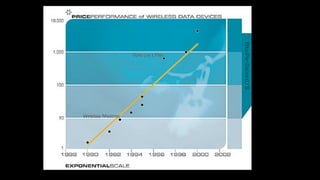
Exponential Growth
IF PRODUCT PERFORMANCE DOUBLES EVERY YEAR
IN 10 YEARS WE HAVE 1,000 FOLD 

INCREASE IN PERFOMANCE
IN 30 YEARS WE HAVE 1,000,000,000 FOLD 

INCREASE IN PERFOMANCE
Flickr	picture	by	spwelton
SECOND HALF OF THE CHESSBOARD
The Legend of the

Ambalappuzha Paal Payasam
The total amount of rice required to fill a 64-
squared chess board is (2^ (64) - 1), which
is equal to 18446744073709551615 grains
460 billion tons
Number of transistors on

an integrated circuit will double 

in about 18-24 months
Moore’s Law
EXPONENTIAL GROWTH
COMPUTERS WILL BE FASTER
COMPUTERS WILL BE SMALLER
COMPUTERS WILL BE CHEAPER
THINGS THAT ONCE WHERE IMPOSSIBLE
BECOME POSSIBLE
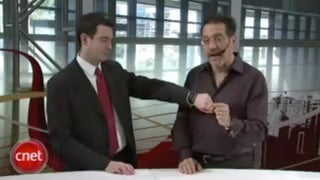
From a 1946 Comic strip to CES 2009
And from 2009 to 2014
ANY NEW TECHNOLOGY

THAT COMES TO THE MARKET

IS LIKELY TO BE AT LEAST 10 YEARS OLD
Source:	http://www.businessweek.com/innovate/content/jan2008/
id2008012_297369.htm	
Bill Buxton’s 

Long nose of Innovation
The Long Nose of Innovation
Growth of
Technology
Evolutionary processes – both

biology and technology, tend to 

a c c e l e r a t e
Ray Kurzweil on how technology will transform us (from TED.com)
PLANS USUALLY ASUME

LINAR GROWTH
DESIGN PRODUCTS WITH TECHNOLOGY OF

THE FUTURE IN MIND
TECHNOLOGICAL PREDICTIONS 

ARE USUALLY RIGHT,
JUST WRONG IN TIME
MOST PRODUCTS FAIL
BECAUSE ALL THE
ENABLING FACTORS

ARE IN PLACE WHEN NEEDED
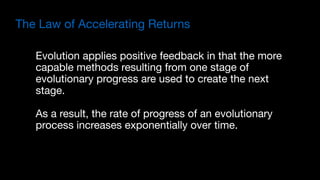
The Law of Accelerating Returns
	Evolution applies positive feedback in that the more
capable methods resulting from one stage of
evolutionary progress are used to create the next
stage.


	As a result, the rate of progress of an evolutionary
process increases exponentially over time.
“An analysis of the history of technology
shows that technological change is
exponential, contrary to the common-
sense ‘intuitive linear’ view. So we won't
experience 100 years of progress in the
21st century -- it will be more like 20,000
years of progress 

(at today's rate).”
- Ray Kurzweil
Working in an exponential industry with a
liner view is deadly
Disruption
Peter Diamandis, Zeitgeist 2012
Finance Healthcare Retail
Transportation Education
?
Any industry
Disruptive stress or

opportunity
Growth of technology
Our view of the world
DISRUPTIVE STRESS
TECHNOLOGY IS CAUSING PROBLEMS

ESTABLISHED COMPANIES ARE THREATENED

BUSINESS MODELS BECOME IRRELEVANT

LAWS BECOME USELESS
DISRUPTIVE OPPURTINTY
NEVER BEFORE IN HISTORY HAS SOME 

MUCH OPPORTUNITY BE AVAILABLE TO

SO MANY PEOPLE
Is this evolution of technology good?
Technology is neither
good nor bad; nor is
it neutral
Kranzberg’s 1. law of technology
Why did smartwatches appear in 2014

when the idea came in the 50s
QUESTION
Adjacent Possible
NEXT

New Technology 2017 L04 Exponential World