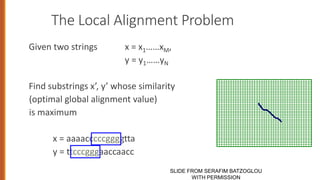
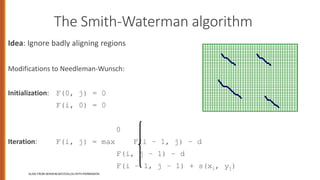
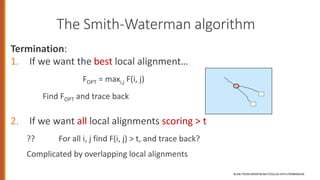
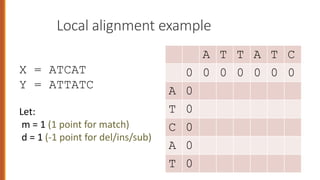
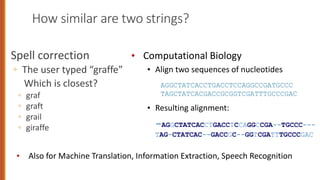
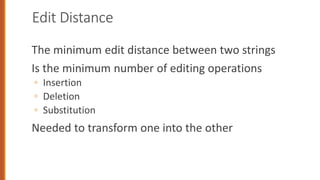
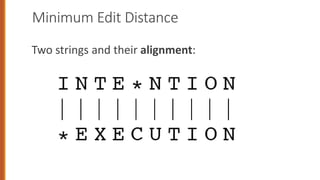
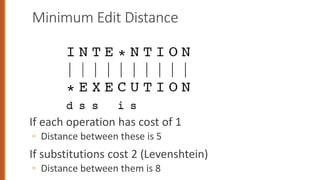
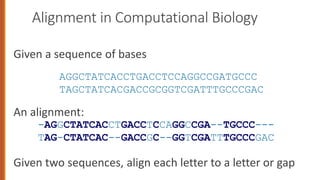
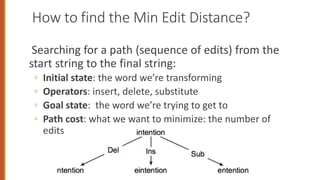
The document discusses minimum edit distance, a measure of similarity between two strings defined by the minimum number of operations (insertion, deletion, substitution) required to transform one string into another. It covers its applications in spell correction, computational biology, and natural language processing, including algorithms like Levenshtein for computing this distance efficiently using dynamic programming, as well as methods for sequence alignment like Needleman-Wunsch and Smith-Waterman. The document also highlights the significance of alignment in comparing biological sequences and the need for weighted edit distance in certain contexts.


![Defining Min Edit Distance
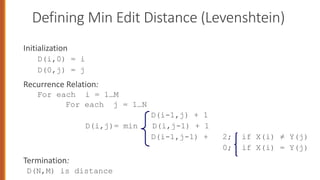
For two strings
◦ X of length n
◦ Y of length m
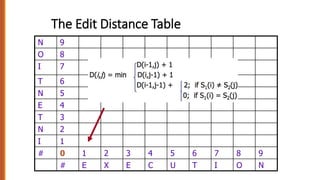
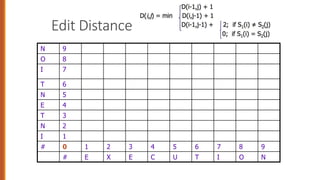
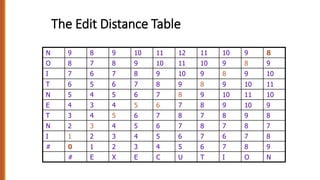
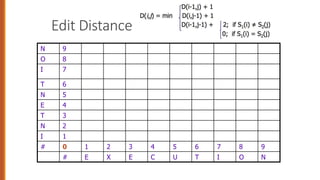
We define D(i,j)
◦ the edit distance between X[1..i] and Y[1..j]
◦ i.e., the first i characters of X and the first j characters of Y
◦ The edit distance between X and Y is thus D(n,m)](https://image.slidesharecdn.com/21editdistance-221121094957-fc932e8a/85/2_1-Edit-Distance-pptx-10-320.jpg)
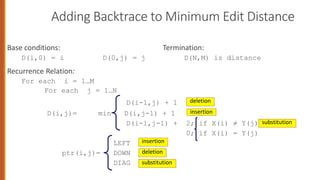
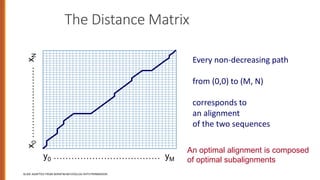
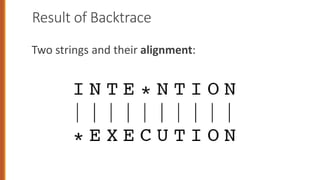
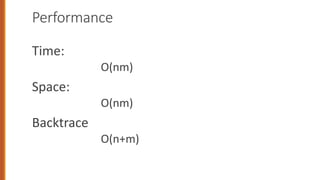
![Weighted Min Edit Distance
Initialization:
D(0,0) = 0
D(i,0) = D(i-1,0) + del[x(i)]; 1 < i ≤ N
D(0,j) = D(0,j-1) + ins[y(j)]; 1 < j ≤ M
Recurrence Relation:
D(i-1,j) + del[x(i)]
D(i,j)= min D(i,j-1) + ins[y(j)]
D(i-1,j-1) + sub[x(i),y(j)]
Termination:
D(N,M) is distance](https://image.slidesharecdn.com/21editdistance-221121094957-fc932e8a/85/2_1-Edit-Distance-pptx-33-320.jpg)
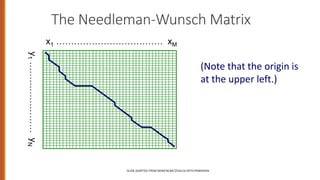
![The Needleman-Wunsch Algorithm
Initialization:
D(i,0) = -i * d
D(0,j) = -j * d
Recurrence Relation:
D(i-1,j) - d
D(i,j)= min D(i,j-1) - d
D(i-1,j-1) + s[x(i),y(j)]
Termination:
D(N,M) is distance](https://image.slidesharecdn.com/21editdistance-221121094957-fc932e8a/85/2_1-Edit-Distance-pptx-39-320.jpg)