Minimum
Edit
Distance
Definition of Minimum Edit
Distance
How similar are two strings?
Spell correction
◦ The user typed “graffe”
Which is closest?
◦ graf
◦ graft
◦ grail
◦ giraffe
• Computational Biology
• Align two sequences of nucleotides
• Resulting alignment:
• Also for Machine Translation, Information Extraction, Speech Recognition
AGGCTATCACCTGACCTCCAGGCCGATGCCC
TAGCTATCACGACCGCGGTCGATTTGCCCGAC
-AGGCTATCACCTGACCTCCAGGCCGA--TGCCC---
TAG-CTATCAC--GACCGC--GGTCGATTTGCCCGAC
Edit Distance
The minimum edit distance between two strings
Is the minimum number of editing operations
◦ Insertion
◦ Deletion
◦ Substitution
Needed to transform one into the other
Minimum Edit Distance
Two strings and their alignment:
Minimum Edit Distance
If each operation has cost of 1
◦ Distance between these is 5
If substitutions cost 2 (Levenshtein)
◦ Distance between them is 8
Alignment in Computational Biology
Given a sequence of bases
An alignment:
Given two sequences, align each letter to a letter or gap
-AGGCTATCACCTGACCTCCAGGCCGA--TGCCC---
TAG-CTATCAC--GACCGC--GGTCGATTTGCCCGAC
AGGCTATCACCTGACCTCCAGGCCGATGCCC
TAGCTATCACGACCGCGGTCGATTTGCCCGAC
Other uses of Edit Distance in NLP
Evaluating Machine Translation and speech recognition
R Spokesman confirms senior government adviser was appointed
H Spokesman said the senior adviser was appointed
S I D I
Named Entity Extraction and Entity Coreference
◦ IBM Inc. announced today
◦ IBM profits
◦ Stanford Professor Jennifer Eberhardt announced yesterday
◦ for Professor Eberhardt…
How to find the Min Edit Distance?
Searching for a path (sequence of edits) from the
start string to the final string:
◦ Initial state: the word we’re transforming
◦ Operators: insert, delete, substitute
◦ Goal state: the word we’re trying to get to
◦ Path cost: what we want to minimize: the number of
edits
Minimum Edit as Search
But the space of all edit sequences is huge!
◦ We can’t afford to navigate naïvely
◦ Lots of distinct paths wind up at the same state.
◦ We don’t have to keep track of all of them
◦ Just the shortest path to each of those revisted states.
Defining Min Edit Distance
For two strings
◦ X of length n
◦ Y of length m
We define D(i,j)
◦ the edit distance between X[1..i] and Y[1..j]
◦ i.e., the first i characters of X and the first j characters of Y
◦ The edit distance between X and Y is thus D(n,m)
Minimum
Edit
Distance
Definition of Minimum Edit
Distance
Minimum
Edit
Distance
Computing Minimum Edit
Distance
Dynamic Programming for Minimum Edit Distance
Dynamic programming: A tabular computation of D(n,m)
Solving problems by combining solutions to subproblems.
Bottom-up
◦ We compute D(i,j) for small i,j
◦ And compute larger D(i,j) based on previously computed smaller
values
◦ i.e., compute D(i,j) for all i (0 < i < n) and j (0 < j < m)
Defining Min Edit Distance (Levenshtein)
Initialization
D(i,0) = i
D(0,j) = j
Recurrence Relation:
For each i = 1…M
For each j = 1…N
D(i-1,j) + 1
D(i,j)= min D(i,j-1) + 1
D(i-1,j-1) + 2; if X(i) ≠ Y(j)
0; if X(i) = Y(j)
Termination:
D(N,M) is distance
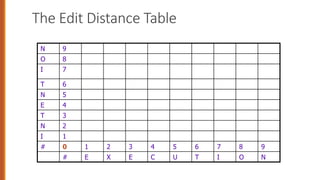
N 9
O 8
I 7
T 6
N 5
E 4
T 3
N 2
I 1
# 0 1 2 3 4 5 6 7 8 9
# E X E C U T I O N
The Edit Distance Table
N 9
O 8
I 7
T 6
N 5
E 4
T 3
N 2
I 1
# 0 1 2 3 4 5 6 7 8 9
# E X E C U T I O N
The Edit Distance Table
N 9
O 8
I 7
T 6
N 5
E 4
T 3
N 2
I 1
# 0 1 2 3 4 5 6 7 8 9
# E X E C U T I O N
Edit Distance
N 9 8 9 10 11 12 11 10 9 8
O 8 7 8 9 10 11 10 9 8 9
I 7 6 7 8 9 10 9 8 9 10
T 6 5 6 7 8 9 8 9 10 11
N 5 4 5 6 7 8 9 10 11 10
E 4 3 4 5 6 7 8 9 10 9
T 3 4 5 6 7 8 7 8 9 8
N 2 3 4 5 6 7 8 7 8 7
I 1 2 3 4 5 6 7 6 7 8
# 0 1 2 3 4 5 6 7 8 9
# E X E C U T I O N
The Edit Distance Table
Minimum
Edit
Distance
Computing Minimum Edit
Distance
Minimum
Edit
Distance
Backtrace for Computing
Alignments
Computing alignments
Edit distance isn’t sufficient
◦ We often need to align each character of the two strings to
each other
We do this by keeping a “backtrace”
Every time we enter a cell, remember where we came
from
When we reach the end,
◦ Trace back the path from the upper right corner to read off the
alignment
N 9
O 8
I 7
T 6
N 5
E 4
T 3
N 2
I 1
# 0 1 2 3 4 5 6 7 8 9
# E X E C U T I O N
Edit Distance
MinEdit with Backtrace
Adding Backtrace to Minimum Edit Distance
Base conditions: Termination:
D(i,0) = i D(0,j) = j D(N,M) is distance
Recurrence Relation:
For each i = 1…M
For each j = 1…N
D(i-1,j) + 1
D(i,j)= min D(i,j-1) + 1
D(i-1,j-1) + 2; if X(i) ≠ Y(j)
0; if X(i) = Y(j)
LEFT
ptr(i,j)= DOWN
DIAG
insertion
deletion
substitution
insertion
deletion
substitution
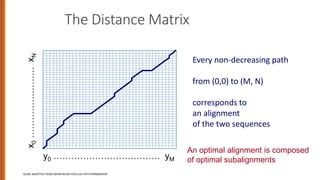
The Distance Matrix
SLIDE ADAPTED FROM SERAFIM BATZOGLOU WITH PERMISSION
y0 ……………………………… yM
x
0
……………………
x
N
Every non-decreasing path
from (0,0) to (M, N)
corresponds to
an alignment
of the two sequences
An optimal alignment is composed
of optimal subalignments
Result of Backtrace
Two strings and their alignment:
Performance
Time:
O(nm)
Space:
O(nm)
Backtrace
O(n+m)
Minimum
Edit
Distance
Backtrace for Computing
Alignments
Minimum
Edit
Distance
Weighted Minimum Edit
Distance
Weighted Edit Distance
Why would we add weights to the computation?
◦ Spell Correction: some letters are more likely to be
mistyped than others
◦ Biology: certain kinds of deletions or insertions are more
likely than others
Confusion matrix for spelling errors
Weighted Min Edit Distance
Initialization:
D(0,0) = 0
D(i,0) = D(i-1,0) + del[x(i)]; 1 < i ≤ N
D(0,j) = D(0,j-1) + ins[y(j)]; 1 < j ≤ M
Recurrence Relation:
D(i-1,j) + del[x(i)]
D(i,j)= min D(i,j-1) + ins[y(j)]
D(i-1,j-1) + sub[x(i),y(j)]
Termination:
D(N,M) is distance
Where did the name, dynamic programming,
come from?
…The 1950s were not good years for mathematical research. [the] Secretary
of Defense …had a pathological fear and hatred of the word, research…
I decided therefore to use the word, “programming”.
I wanted to get across the idea that this was dynamic, this was multistage… I
thought, let’s … take a word that has an absolutely precise meaning, namely
dynamic… it’s impossible to use the word, dynamic, in a pejorative sense.
Try thinking of some combination that will possibly give it a pejorative
meaning. It’s impossible.
Thus, I thought dynamic programming was a good name. It was something
not even a Congressman could object to.”
Richard Bellman, “Eye of the Hurricane: an autobiography” 1984.
Minimum
Edit
Distance
Weighted Minimum Edit
Distance
Minimum
Edit
Distance
Minimum Edit Distance in
Computational Biology
Sequence Alignment
-AGGCTATCACCTGACCTCCAGGCCGA--TGCCC---
TAG-CTATCAC--GACCGC--GGTCGATTTGCCCGAC
AGGCTATCACCTGACCTCCAGGCCGATGCCC
TAGCTATCACGACCGCGGTCGATTTGCCCGAC
Why sequence alignment?
Comparing genes or regions from different species
◦ to find important regions
◦ determine function
◦ uncover evolutionary forces
Assembling fragments to sequence DNA
Compare individuals to looking for mutations
Alignments in two fields
In Natural Language Processing
◦ We generally talk about distance (minimized)
◦ And weights
In Computational Biology
◦ We generally talk about similarity
(maximized)
◦ And scores
The Needleman-Wunsch Algorithm
Initialization:
D(i,0) = -i * d
D(0,j) = -j * d
Recurrence Relation:
D(i-1,j) - d
D(i,j)= min D(i,j-1) - d
D(i-1,j-1) + s[x(i),y(j)]
Termination:
D(N,M) is distance
The Needleman-Wunsch Matrix
SLIDE ADAPTED FROM SERAFIM BATZOGLOU WITH PEMISSION
x1 ……………………………… xM
y
1
……………………
y
N
(Note that the origin is
at the upper left.)
A variant of the basic algorithm:
Maybe it is OK to have an unlimited # of gaps in the beginning and
end:
SLIDE FROM SERAFIM BATZOGLOU WITH PERMISSION
----------CTATCACCTGACCTCCAGGCCGATGCCCCTTCCGGC
GCGAGTTCATCTATCAC--GACCGC--GGTCG--------------
• If so, we don’t want to penalize gaps at the ends
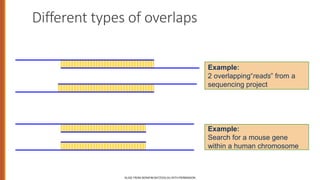
Different types of overlaps
SLIDE FROM SERAFIM BATZOGLOU WITH PERMISSION
Example:
2 overlapping“reads” from a
sequencing project
Example:
Search for a mouse gene
within a human chromosome
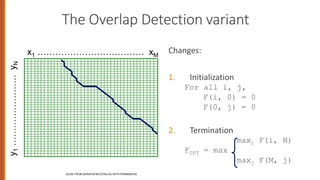
The Overlap Detection variant
Changes:
1. Initialization
For all i, j,
F(i, 0) = 0
F(0, j) = 0
2. Termination
maxi F(i, N)
FOPT = max
maxj F(M, j)
SLIDE FROM SERAFIM BATZOGLOU WITH PERMISSION
x1 ……………………………… xM
y
1
……………………
y
N
The Local Alignment Problem
Given two strings x = x1……xM,
y = y1……yN
Find substrings x’, y’ whose similarity
(optimal global alignment value)
is maximum
x = aaaacccccggggtta
y = ttcccgggaaccaacc
SLIDE FROM SERAFIM BATZOGLOU
WITH PERMISSION
The Smith-Waterman algorithm
Idea: Ignore badly aligning regions
Modifications to Needleman-Wunsch:
Initialization: F(0, j) = 0
F(i, 0) = 0
0
Iteration: F(i, j) = max F(i – 1, j) – d
F(i, j – 1) – d
F(i – 1, j – 1) + s(xi, yj)
SLIDE FROM SERAFIM BATZOGLOU WITH PERMISSION
The Smith-Waterman algorithm
Termination:
1. If we want the best local alignment…
FOPT = maxi,j F(i, j)
Find FOPT and trace back
2. If we want all local alignments scoring > t
?? For all i, j find F(i, j) > t, and trace back?
Complicated by overlapping local alignments
SLIDE FROM SERAFIM BATZOGLOU WITH PERMISSION
Local alignment example
A T T A T C
0 0 0 0 0 0 0
A 0
T 0
C 0
A 0
T 0
X = ATCAT
Y = ATTATC
Let:
m = 1 (1 point for match)
d = 1 (-1 point for del/ins/sub)
Local alignment example
A T T A T C
0 0 0 0 0 0 0
A 0 1 0 0 1 0 0
T 0 0 2 1 0 2 0
C 0 0 1 1 0 1 3
A 0 1 0 0 2 1 2
T 0 0 2 0 1 3 2
X = ATCAT
Y = ATTATC
Local alignment example
A T T A T C
0 0 0 0 0 0 0
A 0 1 0 0 1 0 0
T 0 0 2 1 0 2 0
C 0 0 1 1 0 1 3
A 0 1 0 0 2 1 2
T 0 0 2 0 1 3 2
X = ATCAT
Y = ATTATC
Local alignment example
A T T A T C
0 0 0 0 0 0 0
A 0 1 0 0 1 0 0
T 0 0 2 1 0 2 0
C 0 0 1 1 0 1 3
A 0 1 0 0 2 1 2
T 0 0 2 0 1 3 2
X = ATCAT
Y = ATTATC
Minimum
Edit
Distance
Minimum Edit Distance in
Computational Biology

2_EditDistance_Jan_08_2020.pptx

  • 1.
  • 2.
    How similar aretwo strings? Spell correction ◦ The user typed “graffe” Which is closest? ◦ graf ◦ graft ◦ grail ◦ giraffe • Computational Biology • Align two sequences of nucleotides • Resulting alignment: • Also for Machine Translation, Information Extraction, Speech Recognition AGGCTATCACCTGACCTCCAGGCCGATGCCC TAGCTATCACGACCGCGGTCGATTTGCCCGAC -AGGCTATCACCTGACCTCCAGGCCGA--TGCCC--- TAG-CTATCAC--GACCGC--GGTCGATTTGCCCGAC
  • 3.
    Edit Distance The minimumedit distance between two strings Is the minimum number of editing operations ◦ Insertion ◦ Deletion ◦ Substitution Needed to transform one into the other
  • 4.
    Minimum Edit Distance Twostrings and their alignment:
  • 5.
    Minimum Edit Distance Ifeach operation has cost of 1 ◦ Distance between these is 5 If substitutions cost 2 (Levenshtein) ◦ Distance between them is 8
  • 6.
    Alignment in ComputationalBiology Given a sequence of bases An alignment: Given two sequences, align each letter to a letter or gap -AGGCTATCACCTGACCTCCAGGCCGA--TGCCC--- TAG-CTATCAC--GACCGC--GGTCGATTTGCCCGAC AGGCTATCACCTGACCTCCAGGCCGATGCCC TAGCTATCACGACCGCGGTCGATTTGCCCGAC
  • 7.
    Other uses ofEdit Distance in NLP Evaluating Machine Translation and speech recognition R Spokesman confirms senior government adviser was appointed H Spokesman said the senior adviser was appointed S I D I Named Entity Extraction and Entity Coreference ◦ IBM Inc. announced today ◦ IBM profits ◦ Stanford Professor Jennifer Eberhardt announced yesterday ◦ for Professor Eberhardt…
  • 8.
    How to findthe Min Edit Distance? Searching for a path (sequence of edits) from the start string to the final string: ◦ Initial state: the word we’re transforming ◦ Operators: insert, delete, substitute ◦ Goal state: the word we’re trying to get to ◦ Path cost: what we want to minimize: the number of edits
  • 9.
    Minimum Edit asSearch But the space of all edit sequences is huge! ◦ We can’t afford to navigate naïvely ◦ Lots of distinct paths wind up at the same state. ◦ We don’t have to keep track of all of them ◦ Just the shortest path to each of those revisted states.
  • 10.
    Defining Min EditDistance For two strings ◦ X of length n ◦ Y of length m We define D(i,j) ◦ the edit distance between X[1..i] and Y[1..j] ◦ i.e., the first i characters of X and the first j characters of Y ◦ The edit distance between X and Y is thus D(n,m)
  • 11.
  • 12.
  • 13.
    Dynamic Programming forMinimum Edit Distance Dynamic programming: A tabular computation of D(n,m) Solving problems by combining solutions to subproblems. Bottom-up ◦ We compute D(i,j) for small i,j ◦ And compute larger D(i,j) based on previously computed smaller values ◦ i.e., compute D(i,j) for all i (0 < i < n) and j (0 < j < m)
  • 14.
    Defining Min EditDistance (Levenshtein) Initialization D(i,0) = i D(0,j) = j Recurrence Relation: For each i = 1…M For each j = 1…N D(i-1,j) + 1 D(i,j)= min D(i,j-1) + 1 D(i-1,j-1) + 2; if X(i) ≠ Y(j) 0; if X(i) = Y(j) Termination: D(N,M) is distance
  • 15.
    N 9 O 8 I7 T 6 N 5 E 4 T 3 N 2 I 1 # 0 1 2 3 4 5 6 7 8 9 # E X E C U T I O N The Edit Distance Table
  • 16.
    N 9 O 8 I7 T 6 N 5 E 4 T 3 N 2 I 1 # 0 1 2 3 4 5 6 7 8 9 # E X E C U T I O N The Edit Distance Table
  • 17.
    N 9 O 8 I7 T 6 N 5 E 4 T 3 N 2 I 1 # 0 1 2 3 4 5 6 7 8 9 # E X E C U T I O N Edit Distance
  • 18.
    N 9 89 10 11 12 11 10 9 8 O 8 7 8 9 10 11 10 9 8 9 I 7 6 7 8 9 10 9 8 9 10 T 6 5 6 7 8 9 8 9 10 11 N 5 4 5 6 7 8 9 10 11 10 E 4 3 4 5 6 7 8 9 10 9 T 3 4 5 6 7 8 7 8 9 8 N 2 3 4 5 6 7 8 7 8 7 I 1 2 3 4 5 6 7 6 7 8 # 0 1 2 3 4 5 6 7 8 9 # E X E C U T I O N The Edit Distance Table
  • 19.
  • 20.
  • 21.
    Computing alignments Edit distanceisn’t sufficient ◦ We often need to align each character of the two strings to each other We do this by keeping a “backtrace” Every time we enter a cell, remember where we came from When we reach the end, ◦ Trace back the path from the upper right corner to read off the alignment
  • 22.
    N 9 O 8 I7 T 6 N 5 E 4 T 3 N 2 I 1 # 0 1 2 3 4 5 6 7 8 9 # E X E C U T I O N Edit Distance
  • 23.
  • 24.
    Adding Backtrace toMinimum Edit Distance Base conditions: Termination: D(i,0) = i D(0,j) = j D(N,M) is distance Recurrence Relation: For each i = 1…M For each j = 1…N D(i-1,j) + 1 D(i,j)= min D(i,j-1) + 1 D(i-1,j-1) + 2; if X(i) ≠ Y(j) 0; if X(i) = Y(j) LEFT ptr(i,j)= DOWN DIAG insertion deletion substitution insertion deletion substitution
  • 25.
    The Distance Matrix SLIDEADAPTED FROM SERAFIM BATZOGLOU WITH PERMISSION y0 ……………………………… yM x 0 …………………… x N Every non-decreasing path from (0,0) to (M, N) corresponds to an alignment of the two sequences An optimal alignment is composed of optimal subalignments
  • 26.
    Result of Backtrace Twostrings and their alignment:
  • 27.
  • 28.
  • 29.
  • 30.
    Weighted Edit Distance Whywould we add weights to the computation? ◦ Spell Correction: some letters are more likely to be mistyped than others ◦ Biology: certain kinds of deletions or insertions are more likely than others
  • 31.
    Confusion matrix forspelling errors
  • 33.
    Weighted Min EditDistance Initialization: D(0,0) = 0 D(i,0) = D(i-1,0) + del[x(i)]; 1 < i ≤ N D(0,j) = D(0,j-1) + ins[y(j)]; 1 < j ≤ M Recurrence Relation: D(i-1,j) + del[x(i)] D(i,j)= min D(i,j-1) + ins[y(j)] D(i-1,j-1) + sub[x(i),y(j)] Termination: D(N,M) is distance
  • 34.
    Where did thename, dynamic programming, come from? …The 1950s were not good years for mathematical research. [the] Secretary of Defense …had a pathological fear and hatred of the word, research… I decided therefore to use the word, “programming”. I wanted to get across the idea that this was dynamic, this was multistage… I thought, let’s … take a word that has an absolutely precise meaning, namely dynamic… it’s impossible to use the word, dynamic, in a pejorative sense. Try thinking of some combination that will possibly give it a pejorative meaning. It’s impossible. Thus, I thought dynamic programming was a good name. It was something not even a Congressman could object to.” Richard Bellman, “Eye of the Hurricane: an autobiography” 1984.
  • 35.
  • 36.
  • 37.
  • 38.
    Why sequence alignment? Comparinggenes or regions from different species ◦ to find important regions ◦ determine function ◦ uncover evolutionary forces Assembling fragments to sequence DNA Compare individuals to looking for mutations
  • 39.
    Alignments in twofields In Natural Language Processing ◦ We generally talk about distance (minimized) ◦ And weights In Computational Biology ◦ We generally talk about similarity (maximized) ◦ And scores
  • 40.
    The Needleman-Wunsch Algorithm Initialization: D(i,0)= -i * d D(0,j) = -j * d Recurrence Relation: D(i-1,j) - d D(i,j)= min D(i,j-1) - d D(i-1,j-1) + s[x(i),y(j)] Termination: D(N,M) is distance
  • 41.
    The Needleman-Wunsch Matrix SLIDEADAPTED FROM SERAFIM BATZOGLOU WITH PEMISSION x1 ……………………………… xM y 1 …………………… y N (Note that the origin is at the upper left.)
  • 42.
    A variant ofthe basic algorithm: Maybe it is OK to have an unlimited # of gaps in the beginning and end: SLIDE FROM SERAFIM BATZOGLOU WITH PERMISSION ----------CTATCACCTGACCTCCAGGCCGATGCCCCTTCCGGC GCGAGTTCATCTATCAC--GACCGC--GGTCG-------------- • If so, we don’t want to penalize gaps at the ends
  • 43.
    Different types ofoverlaps SLIDE FROM SERAFIM BATZOGLOU WITH PERMISSION Example: 2 overlapping“reads” from a sequencing project Example: Search for a mouse gene within a human chromosome
  • 44.
    The Overlap Detectionvariant Changes: 1. Initialization For all i, j, F(i, 0) = 0 F(0, j) = 0 2. Termination maxi F(i, N) FOPT = max maxj F(M, j) SLIDE FROM SERAFIM BATZOGLOU WITH PERMISSION x1 ……………………………… xM y 1 …………………… y N
  • 45.
    The Local AlignmentProblem Given two strings x = x1……xM, y = y1……yN Find substrings x’, y’ whose similarity (optimal global alignment value) is maximum x = aaaacccccggggtta y = ttcccgggaaccaacc SLIDE FROM SERAFIM BATZOGLOU WITH PERMISSION
  • 46.
    The Smith-Waterman algorithm Idea:Ignore badly aligning regions Modifications to Needleman-Wunsch: Initialization: F(0, j) = 0 F(i, 0) = 0 0 Iteration: F(i, j) = max F(i – 1, j) – d F(i, j – 1) – d F(i – 1, j – 1) + s(xi, yj) SLIDE FROM SERAFIM BATZOGLOU WITH PERMISSION
  • 47.
    The Smith-Waterman algorithm Termination: 1.If we want the best local alignment… FOPT = maxi,j F(i, j) Find FOPT and trace back 2. If we want all local alignments scoring > t ?? For all i, j find F(i, j) > t, and trace back? Complicated by overlapping local alignments SLIDE FROM SERAFIM BATZOGLOU WITH PERMISSION
  • 48.
    Local alignment example AT T A T C 0 0 0 0 0 0 0 A 0 T 0 C 0 A 0 T 0 X = ATCAT Y = ATTATC Let: m = 1 (1 point for match) d = 1 (-1 point for del/ins/sub)
  • 49.
    Local alignment example AT T A T C 0 0 0 0 0 0 0 A 0 1 0 0 1 0 0 T 0 0 2 1 0 2 0 C 0 0 1 1 0 1 3 A 0 1 0 0 2 1 2 T 0 0 2 0 1 3 2 X = ATCAT Y = ATTATC
  • 50.
    Local alignment example AT T A T C 0 0 0 0 0 0 0 A 0 1 0 0 1 0 0 T 0 0 2 1 0 2 0 C 0 0 1 1 0 1 3 A 0 1 0 0 2 1 2 T 0 0 2 0 1 3 2 X = ATCAT Y = ATTATC
  • 51.
    Local alignment example AT T A T C 0 0 0 0 0 0 0 A 0 1 0 0 1 0 0 T 0 0 2 1 0 2 0 C 0 0 1 1 0 1 3 A 0 1 0 0 2 1 2 T 0 0 2 0 1 3 2 X = ATCAT Y = ATTATC
  • 52.