1-1
CHAPTER 1
An Overviewof Financial
Management
Career Opportunities
Issues of the New Millennium
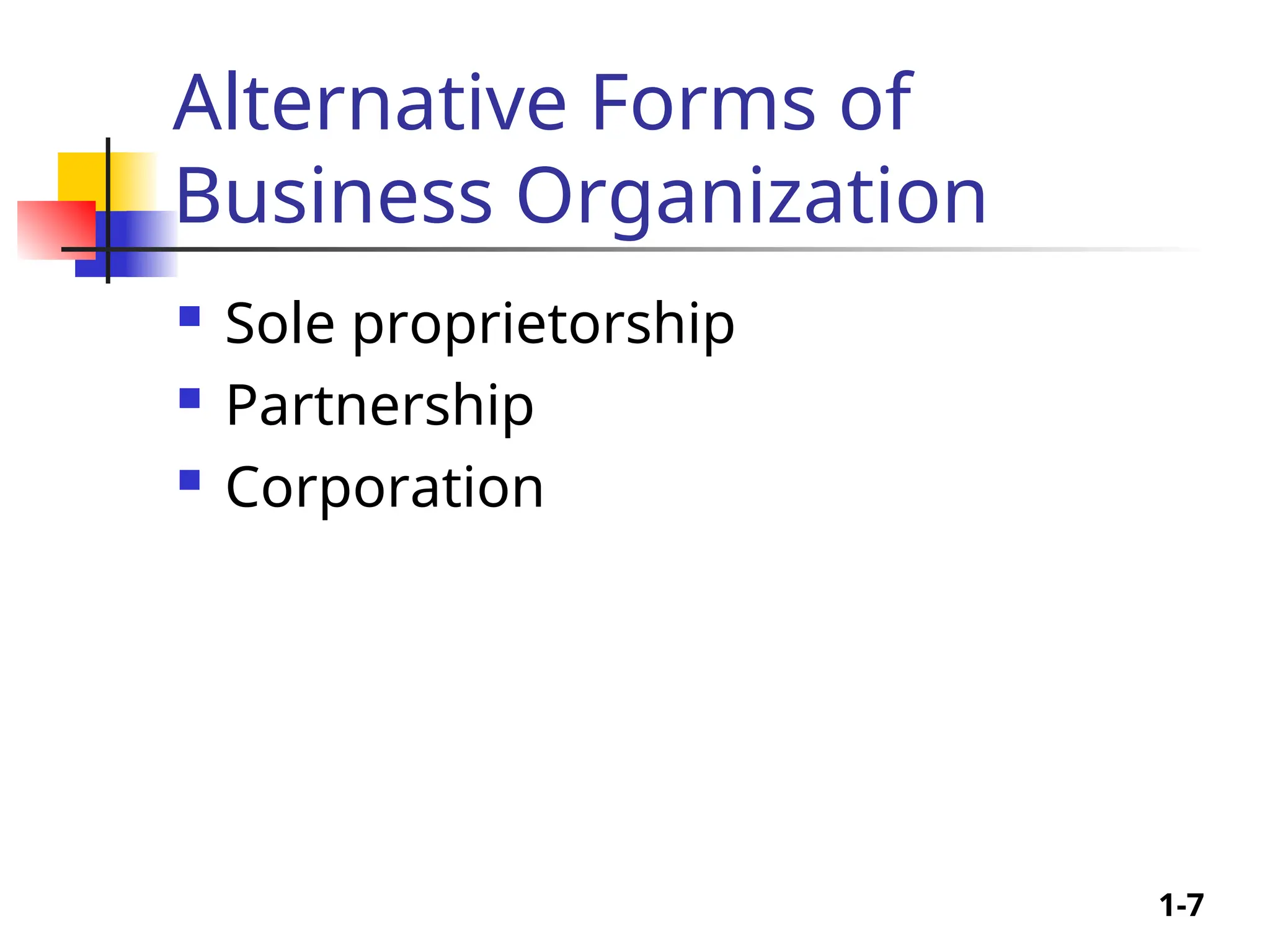
Forms of Businesses
Goals of the Corporation
Agency Relationships
2.
1-2
Career Opportunities in
Finance
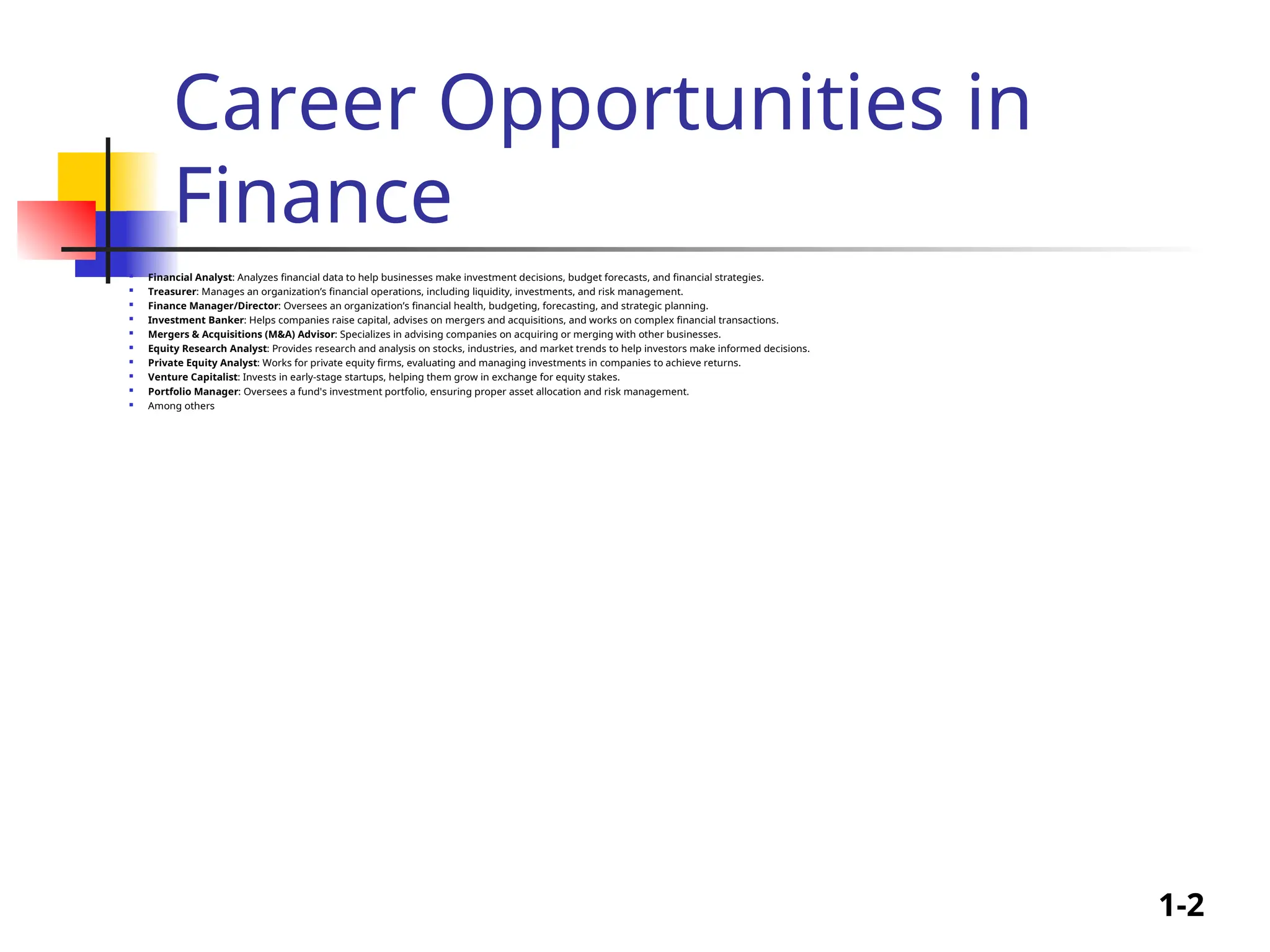
Financial Analyst: Analyzes financial data to help businesses make investment decisions, budget forecasts, and financial strategies.
Treasurer: Manages an organization’s financial operations, including liquidity, investments, and risk management.
Finance Manager/Director: Oversees an organization’s financial health, budgeting, forecasting, and strategic planning.
Investment Banker: Helps companies raise capital, advises on mergers and acquisitions, and works on complex financial transactions.
Mergers & Acquisitions (M&A) Advisor: Specializes in advising companies on acquiring or merging with other businesses.
Equity Research Analyst: Provides research and analysis on stocks, industries, and market trends to help investors make informed decisions.
Private Equity Analyst: Works for private equity firms, evaluating and managing investments in companies to achieve returns.
Venture Capitalist: Invests in early-stage startups, helping them grow in exchange for equity stakes.
Portfolio Manager: Oversees a fund's investment portfolio, ensuring proper asset allocation and risk management.
Among others
3.
1-3
Responsibility of the
FinancialStaff
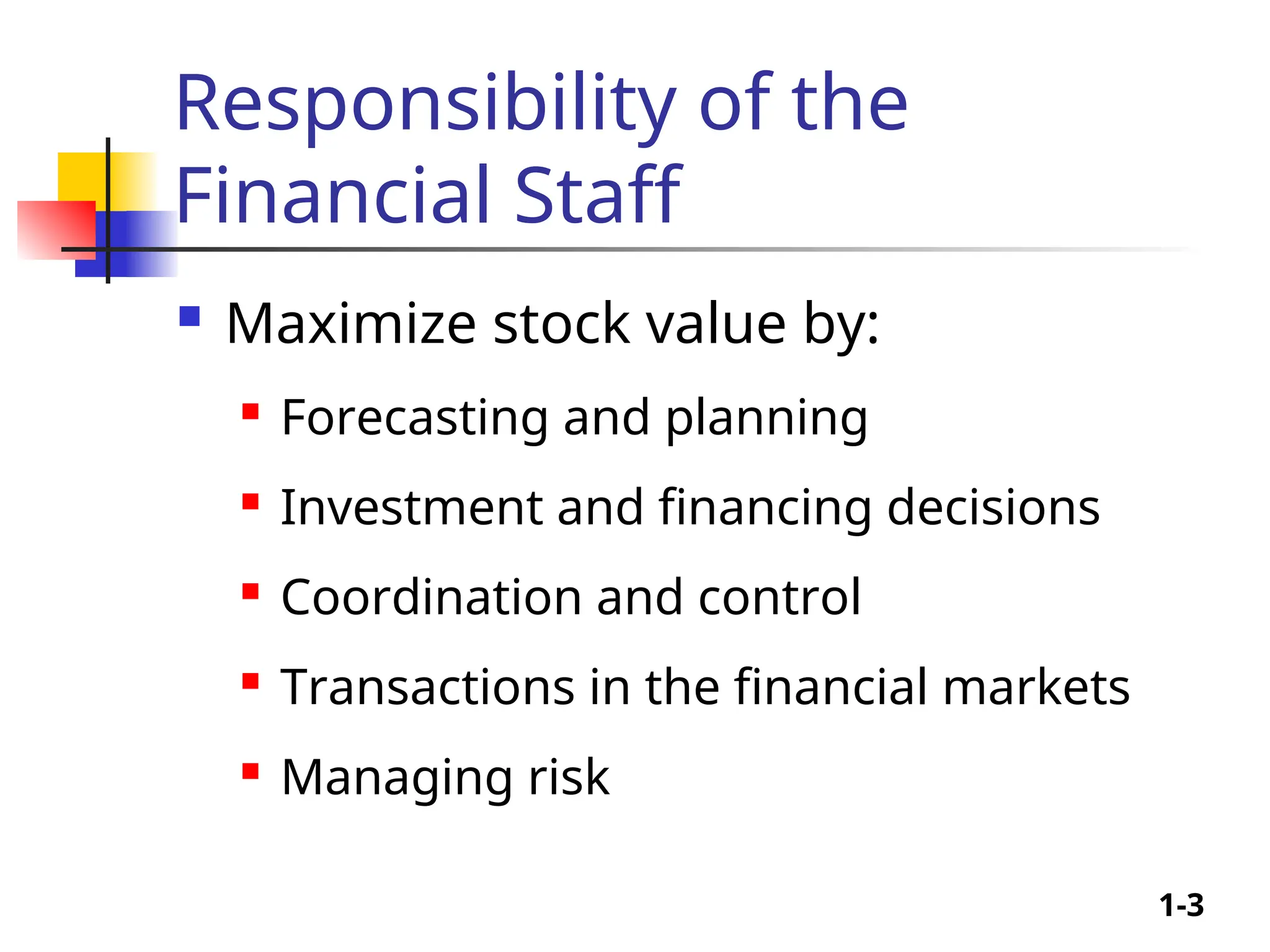
Maximize stock value by:
Forecasting and planning
Investment and financing decisions
Coordination and control
Transactions in the financial markets
Managing risk
4.
1-4
Role of Financein a Typical
Business Organization
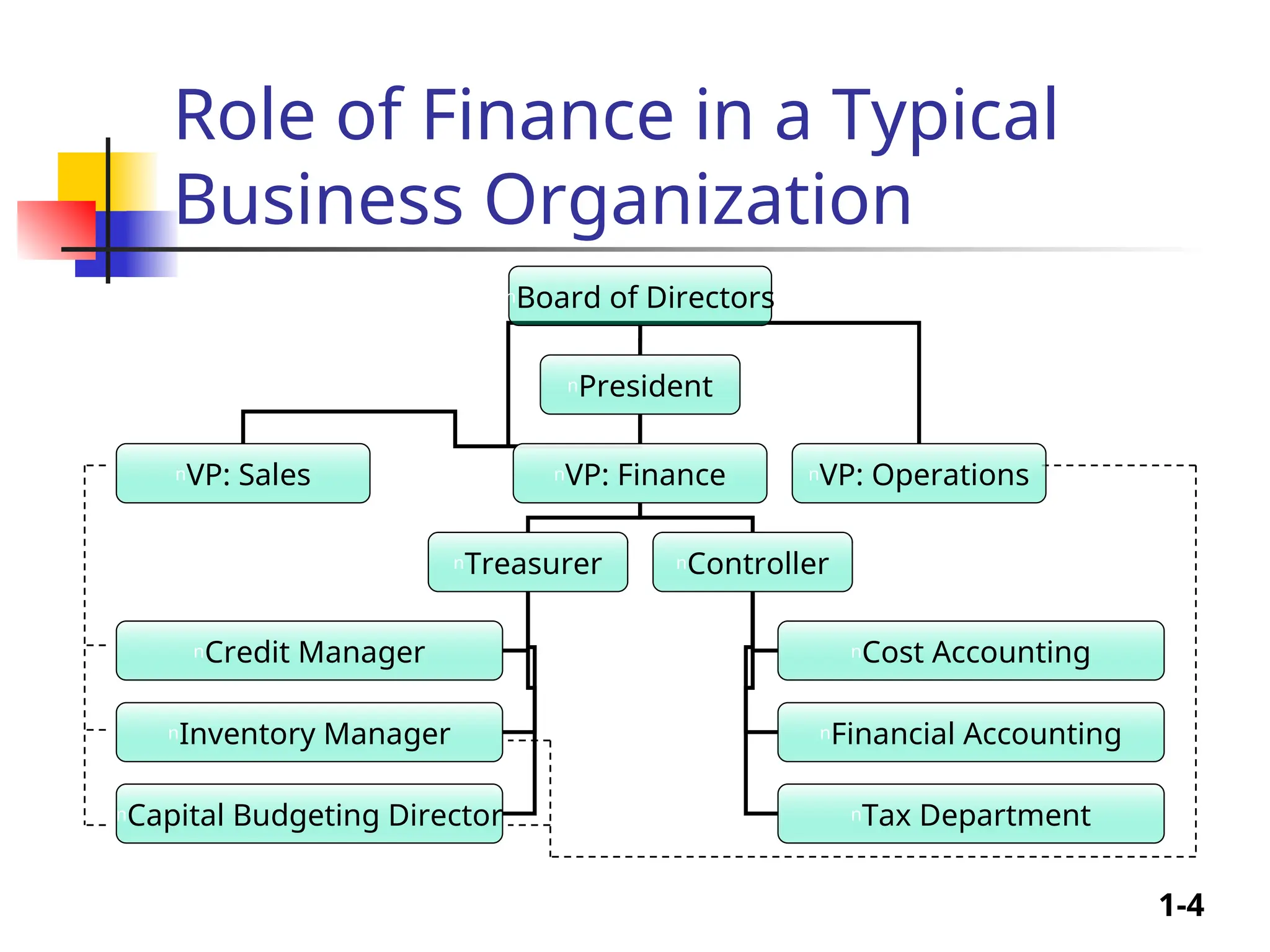
nBoard of Directors
nPresident
nVP: Sales nVP: Finance nVP: Operations
nTreasurer nController
nCredit Manager
nInventory Manager
nCapital Budgeting Director
nCost Accounting
nFinancial Accounting
nTax Department
5.
1-5
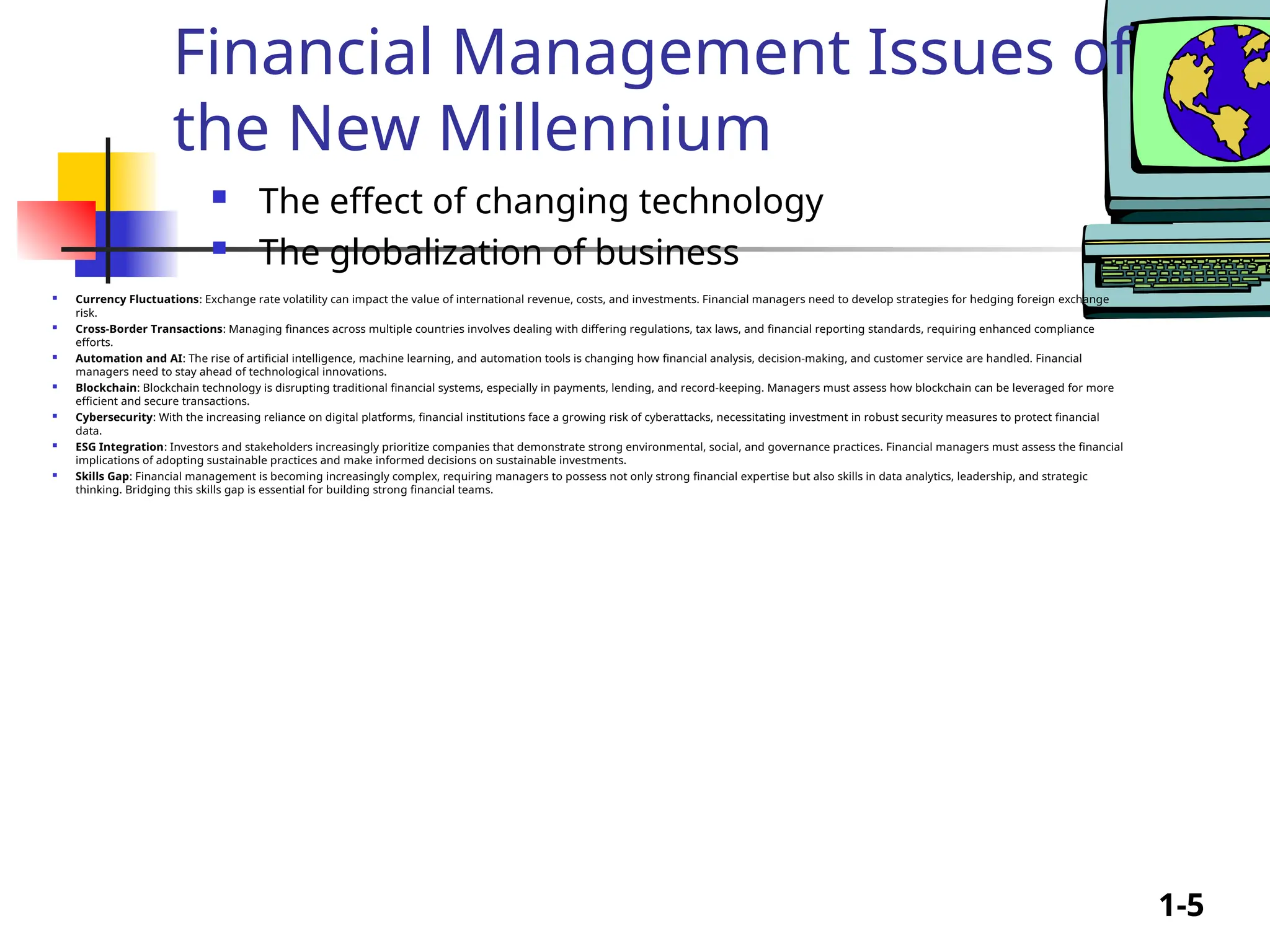
Financial Management Issuesof
the New Millennium
The effect of changing technology
The globalization of business
Currency Fluctuations: Exchange rate volatility can impact the value of international revenue, costs, and investments. Financial managers need to develop strategies for hedging foreign exchange
risk.
Cross-Border Transactions: Managing finances across multiple countries involves dealing with differing regulations, tax laws, and financial reporting standards, requiring enhanced compliance
efforts.
Automation and AI: The rise of artificial intelligence, machine learning, and automation tools is changing how financial analysis, decision-making, and customer service are handled. Financial
managers need to stay ahead of technological innovations.
Blockchain: Blockchain technology is disrupting traditional financial systems, especially in payments, lending, and record-keeping. Managers must assess how blockchain can be leveraged for more
efficient and secure transactions.
Cybersecurity: With the increasing reliance on digital platforms, financial institutions face a growing risk of cyberattacks, necessitating investment in robust security measures to protect financial
data.
ESG Integration: Investors and stakeholders increasingly prioritize companies that demonstrate strong environmental, social, and governance practices. Financial managers must assess the financial
implications of adopting sustainable practices and make informed decisions on sustainable investments.
Skills Gap: Financial management is becoming increasingly complex, requiring managers to possess not only strong financial expertise but also skills in data analytics, leadership, and strategic
thinking. Bridging this skills gap is essential for building strong financial teams.
6.
1-6
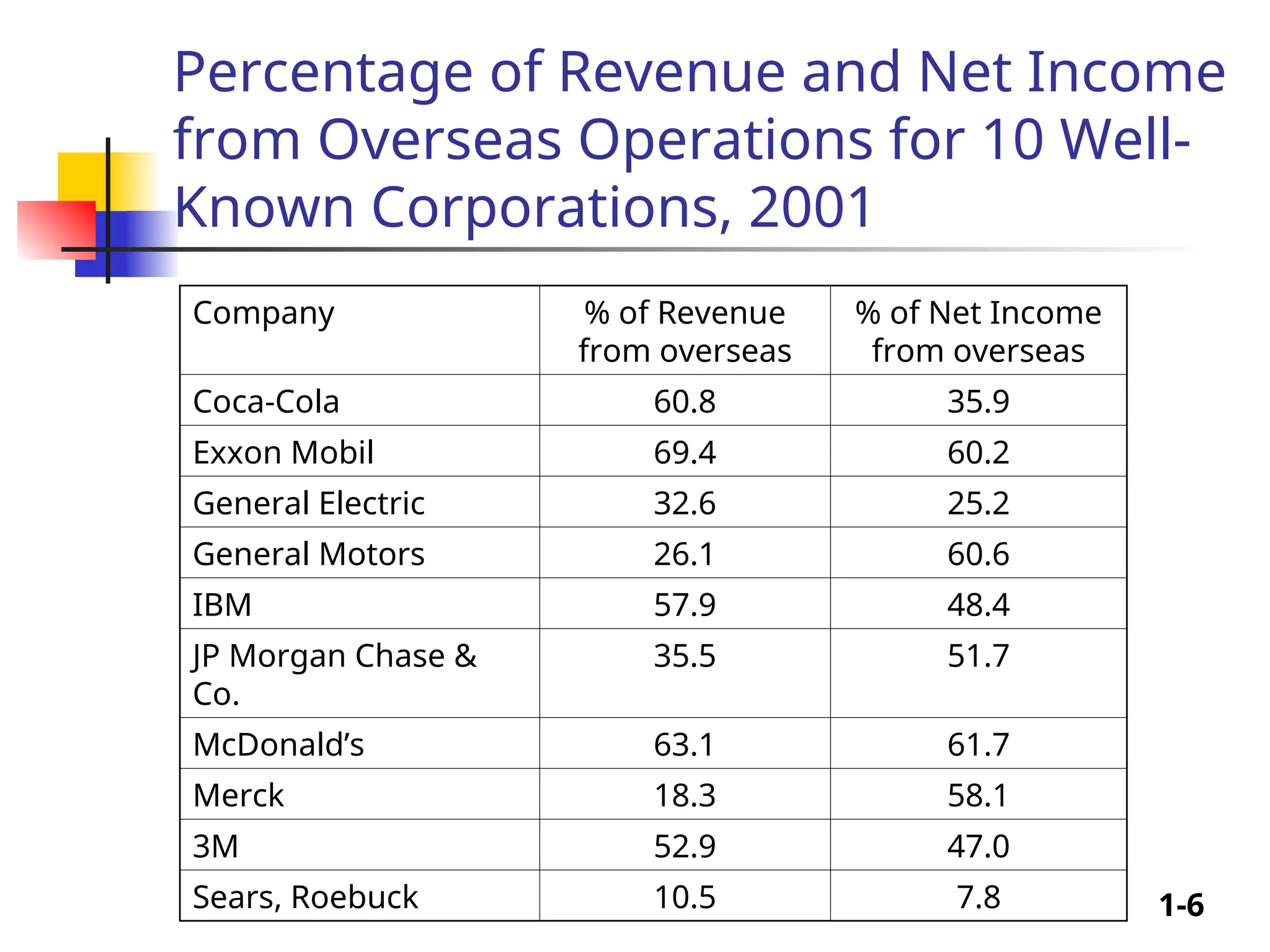
Percentage of Revenueand Net Income
from Overseas Operations for 10 Well-
Known Corporations, 2001
Company % of Revenue
from overseas
% of Net Income
from overseas
Coca-Cola 60.8 35.9
Exxon Mobil 69.4 60.2
General Electric 32.6 25.2
General Motors 26.1 60.6
IBM 57.9 48.4
JP Morgan Chase &
Co.
35.5 51.7
McDonald’s 63.1 61.7
Merck 18.3 58.1
3M 52.9 47.0
Sears, Roebuck 10.5 7.8
1-8
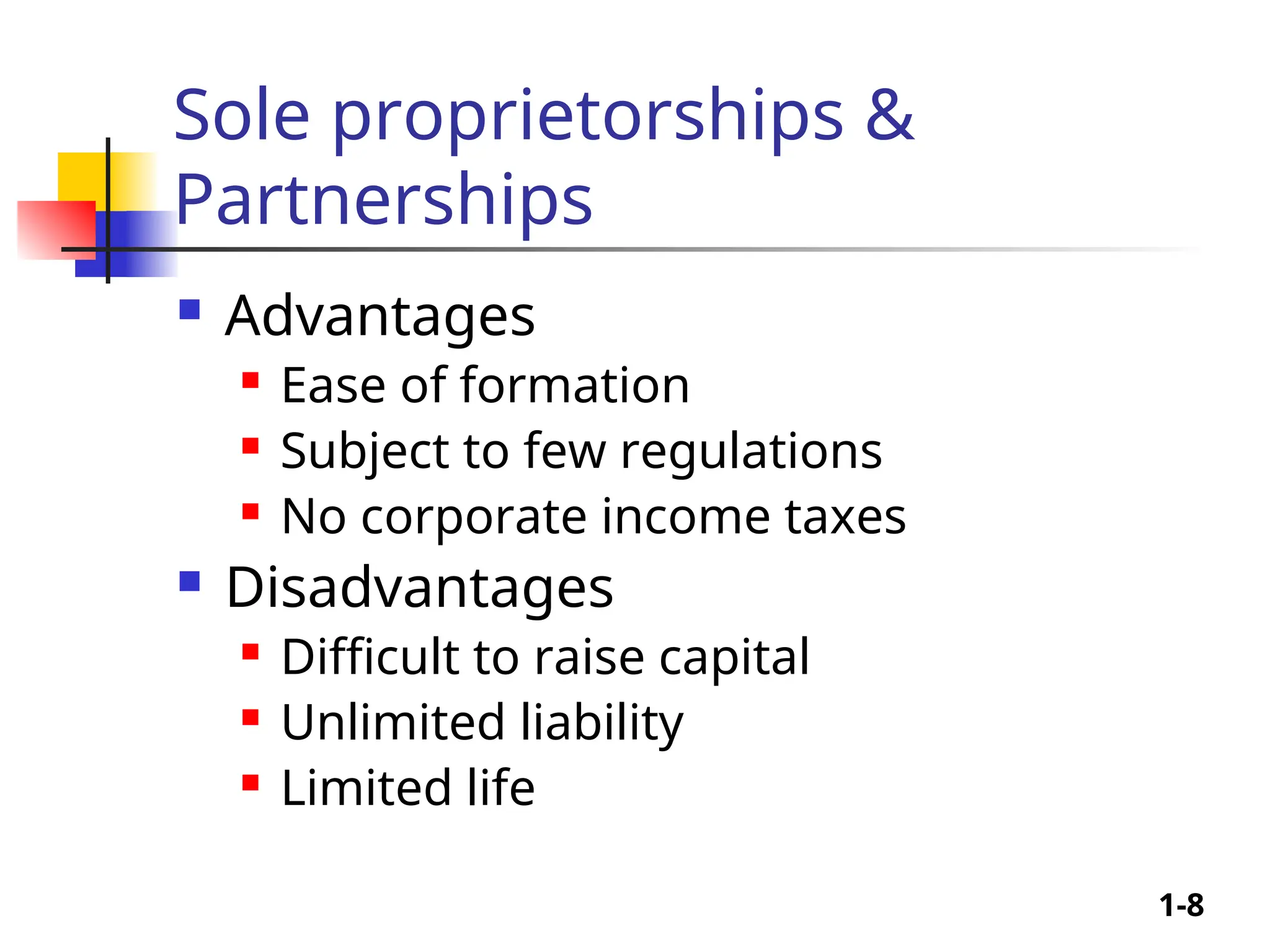
Sole proprietorships &
Partnerships
Advantages
Ease of formation
Subject to few regulations
No corporate income taxes
Disadvantages
Difficult to raise capital
Unlimited liability
Limited life
9.
1-9
Corporation
Advantages
Unlimitedlife
Easy transfer of ownership
Limited liability
Ease of raising capital
Disadvantages
Double taxation
Cost of set-up and report filing
10.
1-10
Financial Goals ofthe
Corporation
The primary financial goal is
shareholder wealth maximization,
which translates to maximizing stock
price.
Do firms have any responsibilities to
society at large?
Is stock price maximization good or
bad for society?
Should firms behave ethically?
11.
1-11
Is stock pricemaximization the
same as profit maximization?
No, despite a generally high correlation
amongst stock price, EPS, and cash flow.
Current stock price relies upon current
earnings, as well as future earnings and
cash flow.
Some actions may cause an increase in
earnings, yet cause the stock price to
decrease (and vice versa).
12.
1-12
Agency relationships
Anagency relationship exists
whenever a principal hires an agent
to act on their behalf.
Within a corporation, agency
relationships exist between:
Shareholders and managers
Shareholders and creditors
13.
1-13
Shareholders versus
Managers
Managersare naturally inclined to act
in their own best interests.
But the following factors affect
managerial behavior:
Managerial compensation plans
Direct intervention by shareholders
The threat of firing
The threat of takeover
14.
1-14
Shareholders versus
Creditors
Shareholders(through managers)
could take actions to maximize stock
price that are detrimental to
creditors.
In the long run, such actions will raise
the cost of debt and ultimately lower
stock price.
15.
1-15
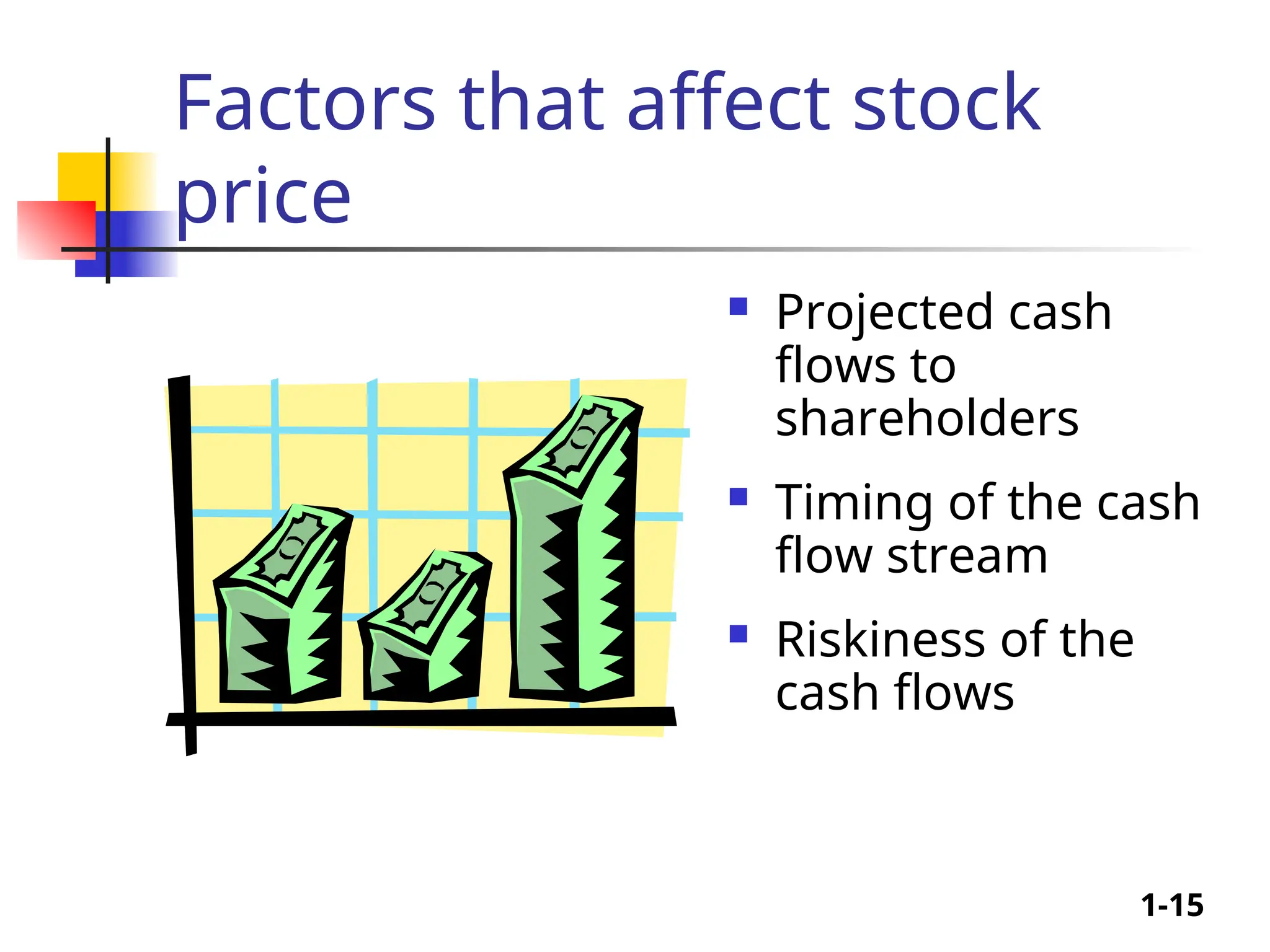
Factors that affectstock
price
Projected cash
flows to
shareholders
Timing of the cash
flow stream
Riskiness of the
cash flows
16.
1-16
Basic Valuation Model
To estimate an asset’s value, one estimates the
cash flow for each period t (CFt), the life of the
asset (n), and the appropriate discount rate (k)
Throughout the course, we discuss how to
estimate the inputs and how financial
management is used to improve them and thus
maximize a firm’s value.
n
1
t
t
t
n
n
2
2
1
1
.
k)
(1
CF
k)
(1
CF
k)
(1
CF
k)
(1
CF
Value
17.
1-17
Factors that Affectthe
Level and Riskiness of Cash
Flows
Decisions made by financial
managers:
Investment decisions
Financing decisions (the relative use of
debt financing)
Dividend policy decisions
The external environment



![[DSC Europe 25] Jon Dajci - Bridging TradFi and DeFi: Building the Future of ...](https://cdn.slidesharecdn.com/ss_thumbnails/fqmhfvlbqhkihjvqvhmu-7-251211083849-6af7e325-thumbnail.jpg?width=640&height=640&fit=bounds)


![[DSC Europe 25] Miodrag Pesovic & Vladislav Radonjic - Federated Data Archite...](https://cdn.slidesharecdn.com/ss_thumbnails/gsbe3y5it5uhndi4e08e-1-251212103249-f1008e0c-thumbnail.jpg?width=640&height=640&fit=bounds)
![[DSC Europe 25] Ivan Peric - Intelligence Swarm Logic and Techno-Functional M...](https://cdn.slidesharecdn.com/ss_thumbnails/7my7c97fsduiccadgavw-2-251212103249-5a03f7c6-thumbnail.jpg?width=640&height=640&fit=bounds)


![[DSC Europe 25] Dusan Nesic - Securing Tomorrow’s Infrastructure: Why Cyber-P...](https://cdn.slidesharecdn.com/ss_thumbnails/qikbszfftyowjm2q6duw-1-251211083848-8f2ead6b-thumbnail.jpg?width=640&height=640&fit=bounds)

![[DSC Europe 25] Kaja Kandare - LLM as a judge.pptx](https://cdn.slidesharecdn.com/ss_thumbnails/arxyccaxsdsd1ba99wjw-7-251212104007-2b4e3f64-thumbnail.jpg?width=640&height=640&fit=bounds)


![[DSC Europe 25] Katherine Forrest - AI NOW: Understanding the Velocity of Cha...](https://cdn.slidesharecdn.com/ss_thumbnails/wvvbruqfrci0sfq9xwgb-4-251212104007-e5ad1987-thumbnail.jpg?width=640&height=640&fit=bounds)
![[DSC Europe 25] Danica Soc - The Science Behind Marketing: Experimentation me...](https://cdn.slidesharecdn.com/ss_thumbnails/c0nofsggs9gw5ucmallr-3-251216103155-56bd64d1-thumbnail.jpg?width=640&height=640&fit=bounds)

