IOSR Journal of Mechanical and Civil Engineering (IOSR-JMCE)
e-ISSN: 2278-1684,p-ISSN: 2320-334X, Volume 12, Issue 3 Ver. II (May - Jun. 2015), PP 85-93
www.iosrjournals.org
DOI: 10.9790/1684-12328593 www.iosrjournals.org 85 | Page
Identification of Root Cause for Lining Thickness Variation
Defect in Brake Shoe Using Six Sigma
P. Prakash1
, Anantharaman Sriraman2
, S. Premanandh3
1
PG Student, College of Engineering, Department of Mechanical Engineering,
Anna University, Guindy, Chennai, India-600025
2
Visiting Faculty, College of Engineering, Department of Mechanical Engineering,
Anna University, Guindy, Chennai, India-600025
3
Assistant Manager, Technical, TVS – Brakes India Limited, Polambakkam, India-603309
Abstract: The aim of the project is to reduce rejection level of brake shoe assembly using six sigma technique.
Six sigma is a quality improvement tool for product. It reduces the defects, minimizes the variation and improves
the capability of the manufacturing process. The main objective of Six Sigma is to increase the profit margin,
improve financial condition through minimizing the defects rate of product. Further it increases the customer
satisfaction, retention and produces the best class product from the best process performance. The brake shoe
has more Lining Thickness Variation (LTV) defect in the production line. The current rejection level of lining
thickness variation defect is very high which leads to consumption of money in the form of rework and rejection
of the job. The aim of the project is to identify the causes for lining thickness variation defect in brake shoe.
Key words - Six sigma, Lining Thickness Variation, Brake shoe.
I. Introduction
The Six Sigma is a financial improvement strategy for an organization and now a day it is being used in
many industries. Basically it is a quality improving process of final product by reducing the defects, minimize
the variation and improve capability in the manufacturing process. In order to use the Six Sigma in an
organization, there are many things that are needed to achieve the financial goals in the organization. The main
thing of Six Sigma is taking the existing product, process and improves them in a better way. Six Sigma
provides a structured approach to solving problems through the Implementation of five phases, Define, Measure,
Analyze, Improve and Control (DMAIC). The DMAIC methodology is simple, applicable to all environments
and each phase has clear objectives, actions and outputs. Six Sigma focuses on the quality rather than the
quantity of data on which it applies statistical techniques in a practical format [1].
Lars Krogstiea (2013) conducted the application of Six Sigma in improvement of tolerances and
process variation in casting. The process variation leads to make tolerance defect in the product. The author has
found that the root cause of the problem using the six sigma. After implementing six sigma the problem has
been overcome and the product has been reached current tolerance level [2].
Keki R. Bhote (2007) using Six Sigma for the Business Excellence. Also he advises that ultimate goal
shall be customer satisfaction and also gives importance to employee involvement. Giving reference to
Maslow’s theory he suggests that employees will get motivated if all their needs get satisfied. Though the
Author gives reasons for 64 failure of Six Sigma Implementation in an organization, he doesn’t give any plan
for successful implementation [3].
Amit Kumar Singha (2010) conducted the application of Six sigma in head lamp manufacturing
company. In that, the author have found that the current level of rejection is 12%. After implementation of six
sigma, rejection level has been reduced to 6% [4].
II. Project Methodology
The manufacturer needs to produce high quality products with minimum amount of defects level. In a
company, if defect level of brake shoe production increases, it will lead to more defective products in shop floor.
It needs rework and rejection activity, which will consume more money, time, human effort and affect the
productivity. Six sigma is a technique which is used for process improvement. It is the method used to identify
the causes and eliminate the identified causes which would result in defects. So that the rejection level is
reduced in the production of brake shoe. In six sigma, various tools are used to find out the root cause of the
problem. The tools are catenaries under the different phases. Various factors like man, machine, material,
measurement system, method may be the reason for making defects.
Identification Of Root Cause For Lining Thickness Variation Defect In Brake Shoe…
DOI: 10.9790/1684-12328593 www.iosrjournals.org 86 | Page
The Fig.1 shows the systematic approach for six sigma to reduce LTV rejection level in brake shoe.
Figure 1. Six Sigma Methodology
2.1 Process Flow
The brake shoe consists of three major components. They are rim, web and lining. The brake shoe
should be manufactured by following processes which is shown below in Fig 2:
Figure 2. Process Flow
2.2 Define
This is the first phase of the six sigma which is used to define the problem statement. The various tools
used in this phase are as follows:
2.2.1 Voice of Customer
The VOC helps to understand feedback from current and future customers. A sub-assembly team meets
with their assembly plant customer to understand recurring problems and opportunities for improvement.
Customer call centers are an excellent source of information for Voice of the Customer information, and
customer service representatives who are adept at collecting VOC information tend to be highly marketable in
the customer service field
Identification Of Root Cause For Lining Thickness Variation Defect In Brake Shoe…
DOI: 10.9790/1684-12328593 www.iosrjournals.org 87 | Page
Figure 3. Voice of Customer
From the Fig 3, customer feedback is send to customer call centers which is useful to find out the
location of the problem in the process.
2.2.2 SIPOC
This is the tool that summarizes the inputs and outputs of one or more processes in table form. The
acronym SIPOC stands for suppliers, inputs, process, outputs, and customers which form the columns of the
table 1. Suppliers and customers may be internal or external to the organization that performs the process. Inputs
and outputs may be materials, services, or information. The focus is on capturing the set of inputs and outputs
rather than the individual steps in the process. This Table1 gives overview idea about the production of the
product from supplier to customer.
Table 1. SIPOC
2.3 Measure
The measure phase is focusing the data gather from current process for improvement. There are
different methods to analysis data by sampling, MSA (Measurement System Analysis), process capability and
Gauge R&R. The measure phase are as follows:
2.3.1 Data collection plan and Data collection
A data collection plan is prepared to collect required data. This plan includes what type of data to be
collected, what are the sources of data etc. The reason to collect data is to identify areas current processes need
to be improved.
2.3.2 Production Volume
The last six months data is collected for finding out the sigma level of the process which is helpful to
know the status of the defects level in the process. The volume of production of brake shoe from March 2014 to
August 2014 is shown in Table 2 which provides last six month rejection of the product which is used to find
out the sigma level of the process.
Table 2. Production volume
Month Production volume
Lining Thickness
Variation
March 14 86982 336
April 14 75873 269
May 14 98398 371
June 14 107214 386
July 14 115340 408
August 14 98919 298
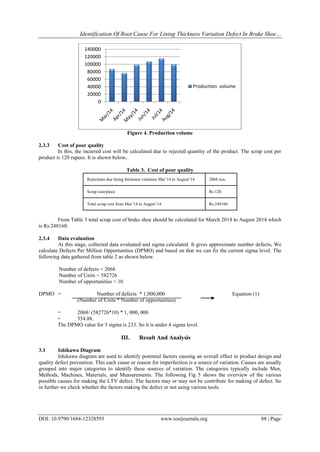
The volume of production of brake shoe from March 2014 to August 2014 is shown in the form of bar
chart in Fig 4
Supplier Input Process Output Customer
Pretreated Shoe
Bonded Lined Shoes after
Date coding
Grinding of Bonded
Lined shoes
Ground Lined shoe Final Inspection
Pretreated Lining
Shoes moved to
Visual Inspection
Packing
Warehouse
Identification Of Root Cause For Lining Thickness Variation Defect In Brake Shoe…
DOI: 10.9790/1684-12328593 www.iosrjournals.org 88 | Page
Figure 4. Production volume
2.3.3 Cost of poor quality
In this, the incurred cost will be calculated due to rejected quantity of the product. The scrap cost per
product is 120 rupees. It is shown below.
Table 3. Cost of poor quality
Rejections due lining thickness variation Mar’14 to August’14 2068 nos.
Scrap cost/piece Rs.120
Total scrap cost from Mar’14 to August’14 Rs.248160
From Table 3 total scrap cost of brake shoe should be calculated for March 2014 to August 2014 which
is Rs.248160.
2.3.4 Data evaluation
At this stage, collected data evaluated and sigma calculated. It gives approximate number defects. We
calculate Defects Per Million Opportunities (DPMO) and based on that we can fix the current sigma level. The
following data gathered from table 2 as shown below.
Number of defects = 2068
Number of Units = 582726
Number of opportunities = 10
DPMO = Number of defects * 1,000,000 Equation (1)
(Number of Units * Number of opportunities)
= 2068/ (582726*10) * 1, 000, 000
= 354.88.
The DPMO value for 5 sigma is 233. So it is under 4 sigma level.
III. Result And Analysis
3.1 Ishikawa Diagram
Ishikawa diagram are used to identify potential factors causing an overall effect in product design and
quality defect prevention. This each cause or reason for imperfection is a source of variation. Causes are usually
grouped into major categories to identify these sources of variation. The categories typically include Men,
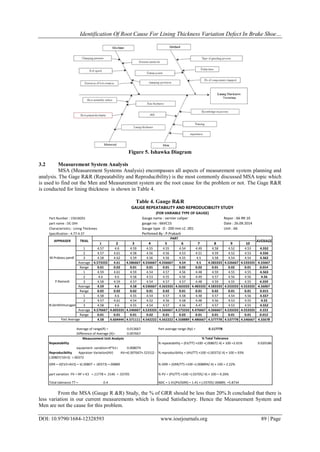
Methods, Machines, Materials, and Measurements. The following Fig 5 shows the overview of the various
possible causes for making the LTV defect. The factors may or may not be contribute for making of defect. So
in further we check whether the factors making the defect or not using various tools.
0
20000
40000
60000
80000
100000
120000
140000
Production volume
Identification Of Root Cause For Lining Thickness Variation Defect In Brake Shoe…
DOI: 10.9790/1684-12328593 www.iosrjournals.org 89 | Page
Figure 5. Ishawka Diagram
3.2 Measurement System Analysis
MSA (Measurement Systems Analysis) encompasses all aspects of measurement system planning and
analysis. The Gage R&R (Repeatability and Reproducibility) is the most commonly discussed MSA topic which
is used to find out the Men and Measurement system are the root cause for the problem or not. The Gage R&R
is conducted for lining thickness is shown in Table 4.
Table 4. Gauge R&R
From the MSA (Gauge R &R) Study, the % of GRR should be less than 20%.It concluded that there is
less variation in our current measurements which is found Satisfactory. Hence the Measurement System and
Men are not the cause for this problem.
1 2 3 4 5 6 7 8 9 10
1 4.57 4.6 4.59 4.55 4.55 4.54 4.49 4.58 4.52 4.53 4.552
2 4.57 4.61 4.58 4.56 4.56 4.53 4.51 4.59 4.52 4.53 4.556
3 4.58 4.62 4.59 4.56 4.56 4.55 4.5 4.58 4.54 4.54 4.562
Average 4.573333 4.61 4.586667 4.556667 4.556667 4.54 4.5 4.583333 4.526667 4.533333 4.55667
Range 0.01 0.02 0.01 0.01 0.01 0.02 0.02 0.01 0.02 0.01 0.014
1 4.59 4.61 4.59 4.54 4.57 4.56 4.48 4.59 4.55 4.55 4.563
2 4.6 4.6 4.58 4.53 4.55 4.56 4.49 4.57 4.56 4.56 4.56
3 4.58 4.59 4.57 4.54 4.57 4.57 4.48 4.59 4.55 4.55 4.559
Average 4.59 4.6 4.58 4.536667 4.563333 4.563333 4.483333 4.583333 4.553333 4.553333 4.56067
Range 0.02 0.02 0.02 0.01 0.02 0.01 0.01 0.02 0.01 0.01 0.015
1 4.58 4.6 4.55 4.54 4.57 4.58 4.48 4.57 4.54 4.56 4.557
2 4.57 4.61 4.54 4.52 4.56 4.58 4.48 4.56 4.53 4.55 4.55
3 4.58 4.6 4.55 4.54 4.57 4.56 4.47 4.57 4.53 4.55 4.552
Average 4.576667 4.603333 4.546667 4.533333 4.566667 4.573333 4.476667 4.566667 4.533333 4.553333 4.553
Range 0.01 0.01 0.01 0.02 0.01 0.02 0.01 0.01 0.01 0.01 0.012
4.58 4.604444 4.571111 4.542222 4.562222 4.558889 4.486667 4.577778 4.537778 4.546667 4.55678
Average of range(R) = 0.013667 Part average range (Rp) = 0.117778
Difference of Average (X)= 0.007667
Repeatability % repeatability = (EV/TT) ×100 =(.00807/.4) × 100 =2.01% 0.020186
equipment variation=R*k1= 0.008074
Total talerance TT = 0.4
part name : DC-DIH gauge no : 66VC15 Date : 26.09.2014
GAUGE REPEATABILITY AND REPRODUCIBILITY STUDY
(FOR VARIABLE TYPE OF GAUGE)
Part Number : 15618201 Gauge name : vernier caliper Repor : 66 RR 10
Characteristics : Lining Thicknees Gauge type :0 - 200 mm LC .001 Unit : 66
Specification : 4.77-4.37 Perfomed By : P.Prakash
N.Senthilmurugan
Part Average
Measurement Unit Analysis % Total Tolerance
APPRAISER TRIAL
PART
AVERAGE
M.Prakasu pandi
P.Ramesh
part variation PV = RP × K3 =.11778 × .3146 = .03705 % PV = (PV/TT) ×100 =(.03705/.4) × 100 = 9.26%
NDC = 1.41(PV/GRR) = 1.41 × (.03705/.00889) =5.8734
Reproducibility Appraiser Variation(AV) AV=√(.007667×.5231)2 -
(.00807/10×3) =.00373
% reproducibility = (AV/TT) ×100 =(.00373/.4) × 100 =.93%
GRR = √(EV2+AV2) = √(.00807 + .00373) =.00889 % GRR = (GRR/TT) ×100 =(.008894/.4) × 100 = 2.22%
Identification Of Root Cause For Lining Thickness Variation Defect In Brake Shoe…
DOI: 10.9790/1684-12328593 www.iosrjournals.org 90 | Page
3.3 Concentration chart
The concentration chart has to give clear graphical representation of LTV concentration in the brake
shoe. It will helpful to understand the severity of the defect on the product.
Figure 6. Concentration Chart
From the Fig 6, LTV in socket end (60%) is high when compare to stud end (40%). This gives
distribution of defect in brake shoe.
3.4 Suspected Source of Variation (SSV)
The material related parameters may be the reason for this defect. We can relate the material factors
with the LTV defect. The relationship between lining thickness variation and suspected source of variation are
as follows in the form of mathematical representation
Y= f(X)
Where,
Y = Lining Thickness Variation (Response)
f(X) =Suspected Source of Variation (SSV)
The Suspected source of variation for LTV is shown in Table 5
Table 5. Suspected source of variation
SSV’S Identified in Input Material f(X)
Specification Description
(Y)
Lining Thickness Variation
98.50~99.50 Shoe radius
0.45 mm Shoe perpendicularity
2.5~2.85 Rim Thickness
0.1mm Max Shoe Tip Perpendicularity
The above source of suspected variations which are related to the incoming material may cause the
defect. The paired comparison analysis used to conclude whether the SSV contribute the problem or not
3.5 Paired Comparison Analysis
The paired comparison analysis is the approach used to conclude whether the SSV contribute the
problem or not. From the production line, Good and Bad parts are selected based on the response defined in the
Cause definition. 8 BOB (Best Of Best) and 8 WOW (Worst Of Worst) parts are selected and the SSV’s are
measured. The analysis carried out which is shown below.
3.5.1 Paired comparison for radius
The paired comparison analysis for radius is shown in Table 6
Table 6. Paired comparison for radius
Sample
Radius
(98.50~99.50)
G/B
10 98.994 B
12 99.034 B
3 99.064 G
11 99.084 B
16 99.094 B
13 99.114 B
8 99.124 G
9 99.124 B
1 99.134 G
Identification Of Root Cause For Lining Thickness Variation Defect In Brake Shoe…
DOI: 10.9790/1684-12328593 www.iosrjournals.org 91 | Page
4 99.134 G
14 99.134 B
5 99.144 G
15 99.154 B
2 99.174 G
6 99.174 G
7 99.204 G
From the paired comparison analysis of Shoe Radius, Minimum and Maximum value (specification)
contains both good and bad category. Hence the SSV’s identified is not the reason for the problem.
3.5.2 Paired comparison for Rim thickness
The paired comparison analysis for rim thickness is shown in Table 7
Table 7. Paired comparison for Rim thickness
Sample
Rim Thickness
(2.5-2.85 mm)
G/B
12 2.51 B
14 2.57 B
15 2.58 B
3 2.59 G
13 2.6 B
1 2.61 G
9 2.61 B
16 2.61 B
2 2.62 G
8 2.62 G
10 2.62 B
11 2.62 B
5 2.64 G
4 2.65 G
6 2.66 G
7 2.66 G
From paired comparison analysis Rim Thickness minimum and maximum value (specification)
contains both good and bad category. Hence the SSV’s identified is not the reason for the Problem.
3.5.3 Paired comparison for perpendicularity
The Paired comparison for perpendicularity is shown in Table 8
Table 8. Paired comparison for perpendicularity
Sample
Perpendicularity
(45 mm max)
G/B
1 0.05 G
5 0.06 G
4 0.09 G
8 0.09 G
11 0.09 B
10 0.11 B
7 0.12 G
13 0.12 B
9 0.13 B
6 0.14 G
16 0.14 B
3 0.15 G
12 0.16 B
15 0.16 B
2 0.17 G
14 0.24 B
From the paired comparison analysis Shoe Perpendicularity – minimum and maximum value
(specification) contains both good and bad category. Hence the SSV’s identified is not the reason for the
problem.
Identification Of Root Cause For Lining Thickness Variation Defect In Brake Shoe…
DOI: 10.9790/1684-12328593 www.iosrjournals.org 92 | Page
3.5.4 Product and process search
After completion of grinding, 20 numbers samples have been taken. Similarly After completion of
grinding and date code, 20 numbers samples have been taken. Then shoe tip perpendicularity has been measured
which is shown in the Table 9
Table 9. Product and process search
Nos
With date code Without date code
Stud end Soc end Stud end Soc end
1 6.14 6.39 6.09 6.37
2 6.18 6.2 6.15 6.26
3 6.29 6.28 6.3 6.32
4 6.15 6.3 6.09 6.28
5 6.23 6.27 6.23 6.25
6 6.13 6.37 6.2 6.23
7 6.09 6.3 6.17 6.25
8 6.15 6.26 6.13 6.26
9 6.19 6.28 6.26 6.2
10 6.15 6.15 6.22 6.16
11 6.07 6.28 6.23 6.31
12 6.23 6.32 6.24 6.25
13 6.2 6.26 6.35 6.22
14 6.2 6.37 6.24 6.28
15 6.13 6.38 6.09 6.35
16 6.14 6.29 6.17 6.41
17 6.14 6.23 6.16 6.23
18 6.23 6.3 6.28 6.32
19 6.28 6.36 6.3 6.35
20 6.32 6.2 6.36 6.09
Min 6.07 6.15 6.09 6.09
Max 6.32 6.39 6.36 6.41
0.25 0.24 0.27 0.32
From 20 numbers taken for analysis of Shoe tip perpendicularity. All are within specification. Hence
the material related SSV is not the Reason for the Problem.
3.6 Why Why Analysis
Why Why analysis is a simple approach for exploring root causes and instilling a fix the root cause, not
the symptom culture at all levels of a company. The idea is to keep asking why until the root cause is arrived at.
The number five is a general guideline for the number of Why required to reach the root cause level. The why
why analysis is shown in the Fig 7
Figure 7. Why Why Analysis technique
From the why why analysis technique, the final root cause of the problem is butting block Fluctuation
of job during clamping causes the defects in the job, due to improper budding block design and fixture design.
Budding block design and fixture design is to be changed and implementation to be carried out.
Identification Of Root Cause For Lining Thickness Variation Defect In Brake Shoe…
DOI: 10.9790/1684-12328593 www.iosrjournals.org 93 | Page
IV. Conclusion
Lining thickness variation causes more amount of rejection in brake shoe assembly. The root cause has
been identified using six sigma. The factors Man, Machine, Method, Material and Measurement system are the
root causes, which have been shown in the Ishikawa diagram. Paired comparison analysis and gauge R & R are
conducted which result Suspected Source of Variation and measurement system are not the causes of the LTV
defect. But the major problem which causes the defects has been identified in the method of loading in grinding
fixture. Fluctuation of the job during clamping causes the defects in the job, due to datum resting in butting
block not ensured during process which is analyzing through why why analysis. The root cause of LTV defect
in brake shoe has been identified that improper budding block design and grinding fixture design.
Reference
[1]. Andreas Kraus, Implementation of the six sigma methodology in the maintenance process, university of Bedfordshire, 2012.
[2]. Lars Krogstiea, Cross-collaborative Improvement of Tolerances and Process Variations, Forty Sixth CIRP Conference on
Manufacturing Systems, 2013.
[3]. Keki R. Bhote, Ultimate Six Sigma, PHI India, 2007 and Mikel Harry, Richard Schroeder, Six Sigma- The Breakthrough
Management Strategy, Currency, New York, 2005.
[4]. Amit Kumar Singha, Defining Quality Management in Auto Sector: A Six-sigma Perception, International Conference on Advances
in Manufacturing and Materials Engineering, ICAMME 2014.
[5]. ChiaJou Lina, Continuous improvement of knowledge management systems using Six Sigma methodology, International Congress
on Interdisciplinary Business and Social Sciences, ICIBSoS 2012.
[6]. Winters-Miner, Linda A, Root Cause Analysis, Six Sigma, and Overall Quality Control and Lean Concepts, 8th International
Conference on Material Sciences, CSM8-ISM5,2009.
[7]. Muhammad Adnan Abid, How to minimize the defects rate of final product in textile plant by the implementation of DMAIC tool
of Six Sigma, Master of Industrial Engineering-Quality and Environmental Management, Final Degree Thesis 15 Ects, Sweden
Thesis Nr. 17/2010.
[8]. Steven James Thompson, Improving the performance of six sigma; A case study of six sigma process at Ford Motor Company,
university of Bedfordshire, 2007.
[9]. Mehrjerdi, Y.Z., Six Sigma: methodology, tools and its future, Assembly Automation, Vol. 31, No. 1, pp. 79–88, 2011.
[10]. Pepper, M.P.J. and Spedding, T.A, The evolution of lean Six Sigma, International Journal of Quality & Reliability Management,
Vol. 27, No. 2, pp. 138- 155, 2010.
[11]. Braunscheidel, M.J, Hamister, J.W, Suresh, N.C. and Harold, S, An institutional theory perspective on Six Sigma adoption,
International Journal of Operations & Production Management, Vol. 31, No. 4, pp. 423-451, 2011.
[12]. Pintellon, L., Pinjala, S.K. and Vereecke, A, Evaluating the effectiveness of maintenance strategies, Journal of Quality in
Maintenance Engineering, Vol. 12, No. 1, pp. 7-20, 2010.
[13]. Pyzdek Thomas, The Six Sigma handbook; a complete guide for green belts, black belts, and managers at all levels (New York
McGraw-Hill, Chapter 1) Pages 4-5, 2003.
[14]. Liker, Jeffrey K, The Toyota Way (Tata McGraw-Hill, 2004)
[15]. Womack, James P. AND Daniel T. Jones, Lean Thinking; Banish Waste and Create Wealth in Your Corporation (Simon &
Schuster,2003)
[16]. George Byrne, Dave Lubowe, Amy Blitze, Driving Operational Innovation using Lean Six Sigma, IBM Institute for Business
Value, 2007.
[17]. Caulcutt, Roland, Why is Six Sigma so successful?, Journal of Applied Statistics, 28: 3, 301 — 306, 2001.
[18]. Ricardo Banuelas Coronado, Jiju Antony, Critical success factors for the successful implementation of six sigma projects in
organizations, The TQM Magazine, Volume 14, 2002.
[19]. Editorial Committee, Guidebook for Six Sigma Implementation with Real Time Applications (Indian Statistical Institute,
Bangalore, 2007)
[20]. Six Sigma. (n.d). Six Sigma Overview. Retrieved July 01, 2010. From thequalityportal.com
http://www.thequalityportal.com/q_6sigma.html

L012328593

  • 1.
    IOSR Journal ofMechanical and Civil Engineering (IOSR-JMCE) e-ISSN: 2278-1684,p-ISSN: 2320-334X, Volume 12, Issue 3 Ver. II (May - Jun. 2015), PP 85-93 www.iosrjournals.org DOI: 10.9790/1684-12328593 www.iosrjournals.org 85 | Page Identification of Root Cause for Lining Thickness Variation Defect in Brake Shoe Using Six Sigma P. Prakash1 , Anantharaman Sriraman2 , S. Premanandh3 1 PG Student, College of Engineering, Department of Mechanical Engineering, Anna University, Guindy, Chennai, India-600025 2 Visiting Faculty, College of Engineering, Department of Mechanical Engineering, Anna University, Guindy, Chennai, India-600025 3 Assistant Manager, Technical, TVS – Brakes India Limited, Polambakkam, India-603309 Abstract: The aim of the project is to reduce rejection level of brake shoe assembly using six sigma technique. Six sigma is a quality improvement tool for product. It reduces the defects, minimizes the variation and improves the capability of the manufacturing process. The main objective of Six Sigma is to increase the profit margin, improve financial condition through minimizing the defects rate of product. Further it increases the customer satisfaction, retention and produces the best class product from the best process performance. The brake shoe has more Lining Thickness Variation (LTV) defect in the production line. The current rejection level of lining thickness variation defect is very high which leads to consumption of money in the form of rework and rejection of the job. The aim of the project is to identify the causes for lining thickness variation defect in brake shoe. Key words - Six sigma, Lining Thickness Variation, Brake shoe. I. Introduction The Six Sigma is a financial improvement strategy for an organization and now a day it is being used in many industries. Basically it is a quality improving process of final product by reducing the defects, minimize the variation and improve capability in the manufacturing process. In order to use the Six Sigma in an organization, there are many things that are needed to achieve the financial goals in the organization. The main thing of Six Sigma is taking the existing product, process and improves them in a better way. Six Sigma provides a structured approach to solving problems through the Implementation of five phases, Define, Measure, Analyze, Improve and Control (DMAIC). The DMAIC methodology is simple, applicable to all environments and each phase has clear objectives, actions and outputs. Six Sigma focuses on the quality rather than the quantity of data on which it applies statistical techniques in a practical format [1]. Lars Krogstiea (2013) conducted the application of Six Sigma in improvement of tolerances and process variation in casting. The process variation leads to make tolerance defect in the product. The author has found that the root cause of the problem using the six sigma. After implementing six sigma the problem has been overcome and the product has been reached current tolerance level [2]. Keki R. Bhote (2007) using Six Sigma for the Business Excellence. Also he advises that ultimate goal shall be customer satisfaction and also gives importance to employee involvement. Giving reference to Maslow’s theory he suggests that employees will get motivated if all their needs get satisfied. Though the Author gives reasons for 64 failure of Six Sigma Implementation in an organization, he doesn’t give any plan for successful implementation [3]. Amit Kumar Singha (2010) conducted the application of Six sigma in head lamp manufacturing company. In that, the author have found that the current level of rejection is 12%. After implementation of six sigma, rejection level has been reduced to 6% [4]. II. Project Methodology The manufacturer needs to produce high quality products with minimum amount of defects level. In a company, if defect level of brake shoe production increases, it will lead to more defective products in shop floor. It needs rework and rejection activity, which will consume more money, time, human effort and affect the productivity. Six sigma is a technique which is used for process improvement. It is the method used to identify the causes and eliminate the identified causes which would result in defects. So that the rejection level is reduced in the production of brake shoe. In six sigma, various tools are used to find out the root cause of the problem. The tools are catenaries under the different phases. Various factors like man, machine, material, measurement system, method may be the reason for making defects.
  • 2.
    Identification Of RootCause For Lining Thickness Variation Defect In Brake Shoe… DOI: 10.9790/1684-12328593 www.iosrjournals.org 86 | Page The Fig.1 shows the systematic approach for six sigma to reduce LTV rejection level in brake shoe. Figure 1. Six Sigma Methodology 2.1 Process Flow The brake shoe consists of three major components. They are rim, web and lining. The brake shoe should be manufactured by following processes which is shown below in Fig 2: Figure 2. Process Flow 2.2 Define This is the first phase of the six sigma which is used to define the problem statement. The various tools used in this phase are as follows: 2.2.1 Voice of Customer The VOC helps to understand feedback from current and future customers. A sub-assembly team meets with their assembly plant customer to understand recurring problems and opportunities for improvement. Customer call centers are an excellent source of information for Voice of the Customer information, and customer service representatives who are adept at collecting VOC information tend to be highly marketable in the customer service field
  • 3.
    Identification Of RootCause For Lining Thickness Variation Defect In Brake Shoe… DOI: 10.9790/1684-12328593 www.iosrjournals.org 87 | Page Figure 3. Voice of Customer From the Fig 3, customer feedback is send to customer call centers which is useful to find out the location of the problem in the process. 2.2.2 SIPOC This is the tool that summarizes the inputs and outputs of one or more processes in table form. The acronym SIPOC stands for suppliers, inputs, process, outputs, and customers which form the columns of the table 1. Suppliers and customers may be internal or external to the organization that performs the process. Inputs and outputs may be materials, services, or information. The focus is on capturing the set of inputs and outputs rather than the individual steps in the process. This Table1 gives overview idea about the production of the product from supplier to customer. Table 1. SIPOC 2.3 Measure The measure phase is focusing the data gather from current process for improvement. There are different methods to analysis data by sampling, MSA (Measurement System Analysis), process capability and Gauge R&R. The measure phase are as follows: 2.3.1 Data collection plan and Data collection A data collection plan is prepared to collect required data. This plan includes what type of data to be collected, what are the sources of data etc. The reason to collect data is to identify areas current processes need to be improved. 2.3.2 Production Volume The last six months data is collected for finding out the sigma level of the process which is helpful to know the status of the defects level in the process. The volume of production of brake shoe from March 2014 to August 2014 is shown in Table 2 which provides last six month rejection of the product which is used to find out the sigma level of the process. Table 2. Production volume Month Production volume Lining Thickness Variation March 14 86982 336 April 14 75873 269 May 14 98398 371 June 14 107214 386 July 14 115340 408 August 14 98919 298 The volume of production of brake shoe from March 2014 to August 2014 is shown in the form of bar chart in Fig 4 Supplier Input Process Output Customer Pretreated Shoe Bonded Lined Shoes after Date coding Grinding of Bonded Lined shoes Ground Lined shoe Final Inspection Pretreated Lining Shoes moved to Visual Inspection Packing Warehouse
  • 4.
    Identification Of RootCause For Lining Thickness Variation Defect In Brake Shoe… DOI: 10.9790/1684-12328593 www.iosrjournals.org 88 | Page Figure 4. Production volume 2.3.3 Cost of poor quality In this, the incurred cost will be calculated due to rejected quantity of the product. The scrap cost per product is 120 rupees. It is shown below. Table 3. Cost of poor quality Rejections due lining thickness variation Mar’14 to August’14 2068 nos. Scrap cost/piece Rs.120 Total scrap cost from Mar’14 to August’14 Rs.248160 From Table 3 total scrap cost of brake shoe should be calculated for March 2014 to August 2014 which is Rs.248160. 2.3.4 Data evaluation At this stage, collected data evaluated and sigma calculated. It gives approximate number defects. We calculate Defects Per Million Opportunities (DPMO) and based on that we can fix the current sigma level. The following data gathered from table 2 as shown below. Number of defects = 2068 Number of Units = 582726 Number of opportunities = 10 DPMO = Number of defects * 1,000,000 Equation (1) (Number of Units * Number of opportunities) = 2068/ (582726*10) * 1, 000, 000 = 354.88. The DPMO value for 5 sigma is 233. So it is under 4 sigma level. III. Result And Analysis 3.1 Ishikawa Diagram Ishikawa diagram are used to identify potential factors causing an overall effect in product design and quality defect prevention. This each cause or reason for imperfection is a source of variation. Causes are usually grouped into major categories to identify these sources of variation. The categories typically include Men, Methods, Machines, Materials, and Measurements. The following Fig 5 shows the overview of the various possible causes for making the LTV defect. The factors may or may not be contribute for making of defect. So in further we check whether the factors making the defect or not using various tools. 0 20000 40000 60000 80000 100000 120000 140000 Production volume
  • 5.
    Identification Of RootCause For Lining Thickness Variation Defect In Brake Shoe… DOI: 10.9790/1684-12328593 www.iosrjournals.org 89 | Page Figure 5. Ishawka Diagram 3.2 Measurement System Analysis MSA (Measurement Systems Analysis) encompasses all aspects of measurement system planning and analysis. The Gage R&R (Repeatability and Reproducibility) is the most commonly discussed MSA topic which is used to find out the Men and Measurement system are the root cause for the problem or not. The Gage R&R is conducted for lining thickness is shown in Table 4. Table 4. Gauge R&R From the MSA (Gauge R &R) Study, the % of GRR should be less than 20%.It concluded that there is less variation in our current measurements which is found Satisfactory. Hence the Measurement System and Men are not the cause for this problem. 1 2 3 4 5 6 7 8 9 10 1 4.57 4.6 4.59 4.55 4.55 4.54 4.49 4.58 4.52 4.53 4.552 2 4.57 4.61 4.58 4.56 4.56 4.53 4.51 4.59 4.52 4.53 4.556 3 4.58 4.62 4.59 4.56 4.56 4.55 4.5 4.58 4.54 4.54 4.562 Average 4.573333 4.61 4.586667 4.556667 4.556667 4.54 4.5 4.583333 4.526667 4.533333 4.55667 Range 0.01 0.02 0.01 0.01 0.01 0.02 0.02 0.01 0.02 0.01 0.014 1 4.59 4.61 4.59 4.54 4.57 4.56 4.48 4.59 4.55 4.55 4.563 2 4.6 4.6 4.58 4.53 4.55 4.56 4.49 4.57 4.56 4.56 4.56 3 4.58 4.59 4.57 4.54 4.57 4.57 4.48 4.59 4.55 4.55 4.559 Average 4.59 4.6 4.58 4.536667 4.563333 4.563333 4.483333 4.583333 4.553333 4.553333 4.56067 Range 0.02 0.02 0.02 0.01 0.02 0.01 0.01 0.02 0.01 0.01 0.015 1 4.58 4.6 4.55 4.54 4.57 4.58 4.48 4.57 4.54 4.56 4.557 2 4.57 4.61 4.54 4.52 4.56 4.58 4.48 4.56 4.53 4.55 4.55 3 4.58 4.6 4.55 4.54 4.57 4.56 4.47 4.57 4.53 4.55 4.552 Average 4.576667 4.603333 4.546667 4.533333 4.566667 4.573333 4.476667 4.566667 4.533333 4.553333 4.553 Range 0.01 0.01 0.01 0.02 0.01 0.02 0.01 0.01 0.01 0.01 0.012 4.58 4.604444 4.571111 4.542222 4.562222 4.558889 4.486667 4.577778 4.537778 4.546667 4.55678 Average of range(R) = 0.013667 Part average range (Rp) = 0.117778 Difference of Average (X)= 0.007667 Repeatability % repeatability = (EV/TT) ×100 =(.00807/.4) × 100 =2.01% 0.020186 equipment variation=R*k1= 0.008074 Total talerance TT = 0.4 part name : DC-DIH gauge no : 66VC15 Date : 26.09.2014 GAUGE REPEATABILITY AND REPRODUCIBILITY STUDY (FOR VARIABLE TYPE OF GAUGE) Part Number : 15618201 Gauge name : vernier caliper Repor : 66 RR 10 Characteristics : Lining Thicknees Gauge type :0 - 200 mm LC .001 Unit : 66 Specification : 4.77-4.37 Perfomed By : P.Prakash N.Senthilmurugan Part Average Measurement Unit Analysis % Total Tolerance APPRAISER TRIAL PART AVERAGE M.Prakasu pandi P.Ramesh part variation PV = RP × K3 =.11778 × .3146 = .03705 % PV = (PV/TT) ×100 =(.03705/.4) × 100 = 9.26% NDC = 1.41(PV/GRR) = 1.41 × (.03705/.00889) =5.8734 Reproducibility Appraiser Variation(AV) AV=√(.007667×.5231)2 - (.00807/10×3) =.00373 % reproducibility = (AV/TT) ×100 =(.00373/.4) × 100 =.93% GRR = √(EV2+AV2) = √(.00807 + .00373) =.00889 % GRR = (GRR/TT) ×100 =(.008894/.4) × 100 = 2.22%
  • 6.
    Identification Of RootCause For Lining Thickness Variation Defect In Brake Shoe… DOI: 10.9790/1684-12328593 www.iosrjournals.org 90 | Page 3.3 Concentration chart The concentration chart has to give clear graphical representation of LTV concentration in the brake shoe. It will helpful to understand the severity of the defect on the product. Figure 6. Concentration Chart From the Fig 6, LTV in socket end (60%) is high when compare to stud end (40%). This gives distribution of defect in brake shoe. 3.4 Suspected Source of Variation (SSV) The material related parameters may be the reason for this defect. We can relate the material factors with the LTV defect. The relationship between lining thickness variation and suspected source of variation are as follows in the form of mathematical representation Y= f(X) Where, Y = Lining Thickness Variation (Response) f(X) =Suspected Source of Variation (SSV) The Suspected source of variation for LTV is shown in Table 5 Table 5. Suspected source of variation SSV’S Identified in Input Material f(X) Specification Description (Y) Lining Thickness Variation 98.50~99.50 Shoe radius 0.45 mm Shoe perpendicularity 2.5~2.85 Rim Thickness 0.1mm Max Shoe Tip Perpendicularity The above source of suspected variations which are related to the incoming material may cause the defect. The paired comparison analysis used to conclude whether the SSV contribute the problem or not 3.5 Paired Comparison Analysis The paired comparison analysis is the approach used to conclude whether the SSV contribute the problem or not. From the production line, Good and Bad parts are selected based on the response defined in the Cause definition. 8 BOB (Best Of Best) and 8 WOW (Worst Of Worst) parts are selected and the SSV’s are measured. The analysis carried out which is shown below. 3.5.1 Paired comparison for radius The paired comparison analysis for radius is shown in Table 6 Table 6. Paired comparison for radius Sample Radius (98.50~99.50) G/B 10 98.994 B 12 99.034 B 3 99.064 G 11 99.084 B 16 99.094 B 13 99.114 B 8 99.124 G 9 99.124 B 1 99.134 G
  • 7.
    Identification Of RootCause For Lining Thickness Variation Defect In Brake Shoe… DOI: 10.9790/1684-12328593 www.iosrjournals.org 91 | Page 4 99.134 G 14 99.134 B 5 99.144 G 15 99.154 B 2 99.174 G 6 99.174 G 7 99.204 G From the paired comparison analysis of Shoe Radius, Minimum and Maximum value (specification) contains both good and bad category. Hence the SSV’s identified is not the reason for the problem. 3.5.2 Paired comparison for Rim thickness The paired comparison analysis for rim thickness is shown in Table 7 Table 7. Paired comparison for Rim thickness Sample Rim Thickness (2.5-2.85 mm) G/B 12 2.51 B 14 2.57 B 15 2.58 B 3 2.59 G 13 2.6 B 1 2.61 G 9 2.61 B 16 2.61 B 2 2.62 G 8 2.62 G 10 2.62 B 11 2.62 B 5 2.64 G 4 2.65 G 6 2.66 G 7 2.66 G From paired comparison analysis Rim Thickness minimum and maximum value (specification) contains both good and bad category. Hence the SSV’s identified is not the reason for the Problem. 3.5.3 Paired comparison for perpendicularity The Paired comparison for perpendicularity is shown in Table 8 Table 8. Paired comparison for perpendicularity Sample Perpendicularity (45 mm max) G/B 1 0.05 G 5 0.06 G 4 0.09 G 8 0.09 G 11 0.09 B 10 0.11 B 7 0.12 G 13 0.12 B 9 0.13 B 6 0.14 G 16 0.14 B 3 0.15 G 12 0.16 B 15 0.16 B 2 0.17 G 14 0.24 B From the paired comparison analysis Shoe Perpendicularity – minimum and maximum value (specification) contains both good and bad category. Hence the SSV’s identified is not the reason for the problem.
  • 8.
    Identification Of RootCause For Lining Thickness Variation Defect In Brake Shoe… DOI: 10.9790/1684-12328593 www.iosrjournals.org 92 | Page 3.5.4 Product and process search After completion of grinding, 20 numbers samples have been taken. Similarly After completion of grinding and date code, 20 numbers samples have been taken. Then shoe tip perpendicularity has been measured which is shown in the Table 9 Table 9. Product and process search Nos With date code Without date code Stud end Soc end Stud end Soc end 1 6.14 6.39 6.09 6.37 2 6.18 6.2 6.15 6.26 3 6.29 6.28 6.3 6.32 4 6.15 6.3 6.09 6.28 5 6.23 6.27 6.23 6.25 6 6.13 6.37 6.2 6.23 7 6.09 6.3 6.17 6.25 8 6.15 6.26 6.13 6.26 9 6.19 6.28 6.26 6.2 10 6.15 6.15 6.22 6.16 11 6.07 6.28 6.23 6.31 12 6.23 6.32 6.24 6.25 13 6.2 6.26 6.35 6.22 14 6.2 6.37 6.24 6.28 15 6.13 6.38 6.09 6.35 16 6.14 6.29 6.17 6.41 17 6.14 6.23 6.16 6.23 18 6.23 6.3 6.28 6.32 19 6.28 6.36 6.3 6.35 20 6.32 6.2 6.36 6.09 Min 6.07 6.15 6.09 6.09 Max 6.32 6.39 6.36 6.41 0.25 0.24 0.27 0.32 From 20 numbers taken for analysis of Shoe tip perpendicularity. All are within specification. Hence the material related SSV is not the Reason for the Problem. 3.6 Why Why Analysis Why Why analysis is a simple approach for exploring root causes and instilling a fix the root cause, not the symptom culture at all levels of a company. The idea is to keep asking why until the root cause is arrived at. The number five is a general guideline for the number of Why required to reach the root cause level. The why why analysis is shown in the Fig 7 Figure 7. Why Why Analysis technique From the why why analysis technique, the final root cause of the problem is butting block Fluctuation of job during clamping causes the defects in the job, due to improper budding block design and fixture design. Budding block design and fixture design is to be changed and implementation to be carried out.
  • 9.
    Identification Of RootCause For Lining Thickness Variation Defect In Brake Shoe… DOI: 10.9790/1684-12328593 www.iosrjournals.org 93 | Page IV. Conclusion Lining thickness variation causes more amount of rejection in brake shoe assembly. The root cause has been identified using six sigma. The factors Man, Machine, Method, Material and Measurement system are the root causes, which have been shown in the Ishikawa diagram. Paired comparison analysis and gauge R & R are conducted which result Suspected Source of Variation and measurement system are not the causes of the LTV defect. But the major problem which causes the defects has been identified in the method of loading in grinding fixture. Fluctuation of the job during clamping causes the defects in the job, due to datum resting in butting block not ensured during process which is analyzing through why why analysis. The root cause of LTV defect in brake shoe has been identified that improper budding block design and grinding fixture design. Reference [1]. Andreas Kraus, Implementation of the six sigma methodology in the maintenance process, university of Bedfordshire, 2012. [2]. Lars Krogstiea, Cross-collaborative Improvement of Tolerances and Process Variations, Forty Sixth CIRP Conference on Manufacturing Systems, 2013. [3]. Keki R. Bhote, Ultimate Six Sigma, PHI India, 2007 and Mikel Harry, Richard Schroeder, Six Sigma- The Breakthrough Management Strategy, Currency, New York, 2005. [4]. Amit Kumar Singha, Defining Quality Management in Auto Sector: A Six-sigma Perception, International Conference on Advances in Manufacturing and Materials Engineering, ICAMME 2014. [5]. ChiaJou Lina, Continuous improvement of knowledge management systems using Six Sigma methodology, International Congress on Interdisciplinary Business and Social Sciences, ICIBSoS 2012. [6]. Winters-Miner, Linda A, Root Cause Analysis, Six Sigma, and Overall Quality Control and Lean Concepts, 8th International Conference on Material Sciences, CSM8-ISM5,2009. [7]. Muhammad Adnan Abid, How to minimize the defects rate of final product in textile plant by the implementation of DMAIC tool of Six Sigma, Master of Industrial Engineering-Quality and Environmental Management, Final Degree Thesis 15 Ects, Sweden Thesis Nr. 17/2010. [8]. Steven James Thompson, Improving the performance of six sigma; A case study of six sigma process at Ford Motor Company, university of Bedfordshire, 2007. [9]. Mehrjerdi, Y.Z., Six Sigma: methodology, tools and its future, Assembly Automation, Vol. 31, No. 1, pp. 79–88, 2011. [10]. Pepper, M.P.J. and Spedding, T.A, The evolution of lean Six Sigma, International Journal of Quality & Reliability Management, Vol. 27, No. 2, pp. 138- 155, 2010. [11]. Braunscheidel, M.J, Hamister, J.W, Suresh, N.C. and Harold, S, An institutional theory perspective on Six Sigma adoption, International Journal of Operations & Production Management, Vol. 31, No. 4, pp. 423-451, 2011. [12]. Pintellon, L., Pinjala, S.K. and Vereecke, A, Evaluating the effectiveness of maintenance strategies, Journal of Quality in Maintenance Engineering, Vol. 12, No. 1, pp. 7-20, 2010. [13]. Pyzdek Thomas, The Six Sigma handbook; a complete guide for green belts, black belts, and managers at all levels (New York McGraw-Hill, Chapter 1) Pages 4-5, 2003. [14]. Liker, Jeffrey K, The Toyota Way (Tata McGraw-Hill, 2004) [15]. Womack, James P. AND Daniel T. Jones, Lean Thinking; Banish Waste and Create Wealth in Your Corporation (Simon & Schuster,2003) [16]. George Byrne, Dave Lubowe, Amy Blitze, Driving Operational Innovation using Lean Six Sigma, IBM Institute for Business Value, 2007. [17]. Caulcutt, Roland, Why is Six Sigma so successful?, Journal of Applied Statistics, 28: 3, 301 — 306, 2001. [18]. Ricardo Banuelas Coronado, Jiju Antony, Critical success factors for the successful implementation of six sigma projects in organizations, The TQM Magazine, Volume 14, 2002. [19]. Editorial Committee, Guidebook for Six Sigma Implementation with Real Time Applications (Indian Statistical Institute, Bangalore, 2007) [20]. Six Sigma. (n.d). Six Sigma Overview. Retrieved July 01, 2010. From thequalityportal.com http://www.thequalityportal.com/q_6sigma.html