SIX SIGMA
A STRATEGY FOR PERFORMANCE
EXCELLENCE
1. Anil Dhaya
2. Sanjiv Negi
3. Bulu Ghatuary
4. Sonil Pal
Project Owner:
Khushmeet_Khushi
March 16th, 2018
RBE@2018
SIX SIGMA
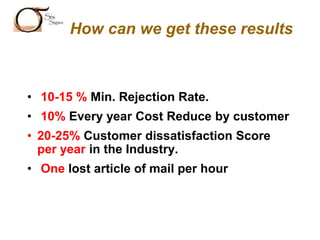
How can we get these results
• 10-15 % Min. Rejection Rate.
• 10% Every year Cost Reduce by customer
• 20-25% Customer dissatisfaction Score
per year in the Industry.
• One lost article of mail per hour
SIX SIGMA
The answer is:
Six Sigma
SIX SIGMA
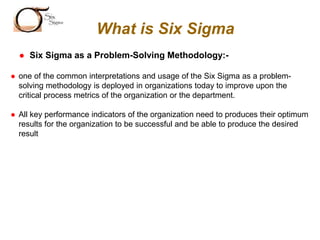
 Six Sigma as a Problem-Solving Methodology:-
What is Six Sigma
 one of the common interpretations and usage of the Six Sigma as a problem-
solving methodology is deployed in organizations today to improve upon the
critical process metrics of the organization or the department.
 All key performance indicators of the organization need to produces their optimum
results for the organization to be successful and be able to produce the desired
result
SIX SIGMA
 A Vision and Philosophical commitment
to our consumers to offer the highest quality,
lowest cost products
 A Metric that demonstrates quality levels at
99.9997% performance for products and
process
 A Benchmark of our product and process
capability for comparison to ‘best in class’
 A practical application of statistical Tools
and Methods to help us measure, analyze,
improve, and control our process
What is Six Sigma
SIX SIGMA
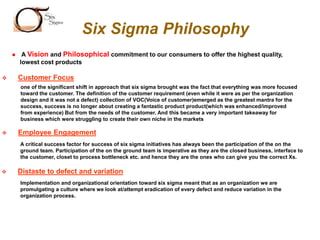
 A Vision and Philosophical commitment to our consumers to offer the highest quality,
lowest cost products
Six Sigma Philosophy
one of the significant shift in approach that six sigma brought was the fact that everything was more focused
toward the customer. The definition of the customer requirement (even while it were as per the organization
design and it was not a defect) collection of VOC(Voice of customer)emerged as the greatest mantra for the
success, success is no longer about creating a fantastic product product(which was enhanced/improved
from experience) But from the needs of the customer. And this became a very important takeaway for
business which were struggling to create their own niche in the markets
 Employee Engagement
 Customer Focus
A critical success factor for success of six sigma initiatives has always been the participation of the on the
ground team. Participation of the on the ground team is imperative as they are the closed business, interface to
the customer, closet to process bottleneck etc. and hence they are the ones who can give you the correct Xs.
 Distaste to defect and variation
Implementation and organizational orientation toward six sigma meant that as an organization we are
promulgating a culture where we look at/attempt eradication of every defect and reduce variation in the
organization process.
SIX SIGMA
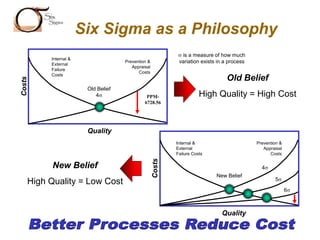
Six Sigma as a Philosophy
Internal &
External
Failure
Costs
Prevention &
Appraisal
Costs
Old Belief
4s
Costs
Internal &
External
Failure Costs
Prevention &
Appraisal
Costs
New Belief
Costs
4s
5s
6s
Quality
Quality
Old Belief
High Quality = High Cost
New Belief
High Quality = Low Cost
s is a measure of how much
variation exists in a process
PPM-
6728.56
SIX SIGMA
3 Sigma Vs. 6 Sigma
The 3 sigma Company The 6 sigma Company
• Spends 15~25% of sales dollars
on cost of failure
• Spends 5% of sales dollars on
cost of failure
• Relies on inspection to find
defects
• Relies on capable process that
don’t produce defects
• Does not have a disciplined
approach to gather and analyze
data
• Use Measure, Analyze, Improve,
Control and Measure, Analyze,
Design
• Benchmarks themselves
against their competition
• Benchmarks themselves
against the best in the world
• Believes 99% is good enough • Believes 99% is unacceptable
• Define CTQs internally • Defines CTQs externally
SIX SIGMA
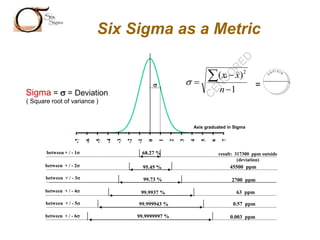
Six Sigma as a Metric
1
)
( 2




n
x
xi

s
Sigma = s = Deviation
( Square root of variance )
-7
-6
-5
-4
-3
-2
-1
0
1
2
3
4
5
6
7
Axis graduated in Sigma
68.27 %
95.45 %
99.73 %
99.9937 %
99.999943 %
99.9999997 %
result: 317300 ppm outside
(deviation)
45500 ppm
2700 ppm
63 ppm
0.57 ppm
0.003 ppm
between + / - 1s
between + / - 2s
between + / - 3s
between + / - 4s
between + / - 5s
between + / - 6s
s =
SIX SIGMA
Non-Liner Decrease
2
3
4
5
6
308,537
66,811
6,210
233
3.4
s PPM
Process
Capability
Defects per Million
Opportunities
* Includes 1.5s shift
Focusing on s requires thorough process
understanding and breakthrough thinking
0
10
20
30
40
50
60
70
80
1 2 3 4 5 6
Process Sigma
%
Change
0
100000
200000
300000
400000
500000
600000
700000
800000
PPM
From 1 to 2
From 3 to 4
From 4 to 5
From 5 to 6
% Change
PPM
SIX SIGMA
Focus: The End User
• Customer: Internal or External
• Consumer: The End User
the “Voice of the Consumer” (Consumer Cue)
must be translated into
the “Voice of the Engineer” (Technical Requirement)
SIX SIGMA
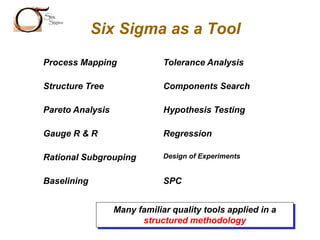
Six Sigma as a Tool
Process Mapping Tolerance Analysis
Structure Tree Components Search
Pareto Analysis Hypothesis Testing
Gauge R & R Regression
Rational Subgrouping Design of Experiments
Baselining SPC
Many familiar quality tools applied in a
structured methodology
SIX SIGMA
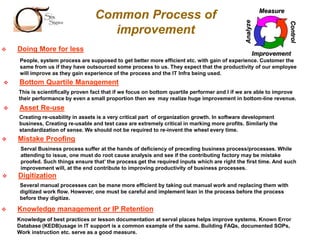
Common Process of
improvement
Measure
Improvement
People, system process are supposed to get better more efficient etc. with gain of experience. Customer the
same from us if they have outsourced some process to us. They expect that the productivity of our employee
will improve as they gain experience of the process and the IT Infra being used.
 Doing More for less
This is scientifically proven fact that if we focus on bottom quartile performer and I if we are able to improve
their performance by even a small proportion then we may realize huge improvement in bottom-line revenue.
 Bottom Quartile Management
Creating re-usability in assets is a very critical part of organization growth. In software development
business, Creating re-usable and test case are extremely critical in marking more profits. Similarly the
standardization of sense. We should not be required to re-invent the wheel every time.
 Asset Re-use
Serval Business process suffer at the hands of deficiency of preceding business process/processes. While
attending to issue, one must do root cause analysis and see if the contributing factory may be mistake
proofed. Such things ensure that’ the process get the required inputs which are right the first time. And such
improvement will, at the end contribute to improving productivity of business processes.
 Mistake Proofing
Several manual processes can be mane more efficient by taking out manual work and replacing them with
digitized work flow. However, one must be careful and implement lean in the process before the process
before they digitize.
 Digitization
Knowledge of best practices or lesson documentation at serval places helps improve systems. Known Error
Database (KEDB)usage in IT support is a common example of the same. Building FAQs, documented SOPs,
Work instruction etc. serve as a good measure.
 Knowledge management or IP Retention
SIX SIGMA
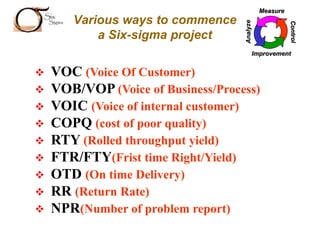
Various ways to commence
a Six-sigma project
Measure
Improvement
 VOC (Voice Of Customer)
 VOB/VOP (Voice of Business/Process)
 VOIC (Voice of internal customer)
 COPQ (cost of poor quality)
 RTY (Rolled throughput yield)
 FTR/FTY(Frist time Right/Yield)
 OTD (On time Delivery)
 RR (Return Rate)
 NPR(Number of problem report)
SIX SIGMA
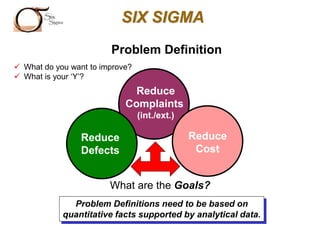
Reduce
Complaints
(int./ext.)
Reduce
Cost
Reduce
Defects
Problem Definitions need to be based on
quantitative facts supported by analytical data.
What are the Goals?
 What do you want to improve?
 What is your ‘Y’?
Problem Definition
SIX SIGMA
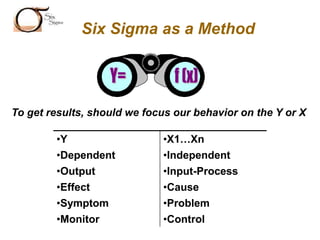
Six Sigma as a Method
To get results, should we focus our behavior on the Y or X
•Y •X1…Xn
•Dependent •Independent
•Output •Input-Process
•Effect •Cause
•Symptom •Problem
•Monitor •Control
SIX SIGMA
1. Define Objective.
2. Select the Response (Y)
3. Select the factors (Xs)
4. Choose the factor levels
5. Select the Experimental Design
6. Run Experiment and Collect the Data
7. Analyze the data
8. Conclusions
9. Perform a confirmation run.(Control)
STEPS IN PLANNING AN EXPERIMENT
SIX SIGMA
The generally accepted methodology for managing Six Sigma projects includes the following
phases:
Define: The objectives and scope of the project are defined. Relevant information about the
process and customer are collected.
Measure: Data on the current situation and process metrics are collected.
Analyze: Collected data are analyzed to find the root cause(s) of the problem.
Improve: Solution(s) to the problem are developed and implemented.
Control: The implemented solution(s) are evaluated and the mechanisms are implemented to
hold the gains, which may include standardization.
This methodology has often been referred to by its initials: DMAIC. Some are suggesting an
additional initial phase that might be called Recognize. This would occur before the Define phase,
and is intended to ensure that appropriate opportunities and problems are properly recognized.
Professionals in the project management field may find a valuable opportunity to contribute to
enhancing the Six Sigma project management methodology.
Six Sigma Project Methodology
SIX SIGMA
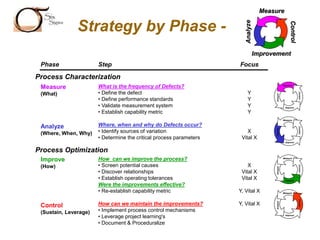
Strategy by Phase -
Phase
Measure
(What)
Analyze
(Where, When, Why)
Improve
(How)
Control
(Sustain, Leverage)
Step
What is the frequency of Defects?
• Define the defect
• Define performance standards
• Validate measurement system
• Establish capability metric
Where, when and why do Defects occur?
• Identify sources of variation
• Determine the critical process parameters
How can we improve the process?
• Screen potential causes
• Discover relationships
• Establish operating tolerances
Were the improvements effective?
• Re-establish capability metric
How can we maintain the improvements?
• Implement process control mechanisms
• Leverage project learning's
• Document & Proceduralize
Focus
Y
Y
Y
Y
X
Vital X
X
Vital X
Vital X
Y, Vital X
Y, Vital X
Process Characterization
Process Optimization
Measure
Improve
Analyze
Control
Measure
Improve
Analyze
Control
Measure
Improve
Analyze
Control
Measure
Improve
Analyze
Control
Measure
Improvement
SIX SIGMA
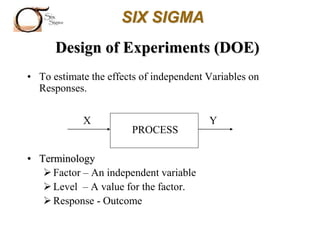
Design of Experiments (DOE)
• To estimate the effects of independent Variables on
Responses.
• Terminology
Factor – An independent variable
Level – A value for the factor.
Response - Outcome
X Y
PROCESS
SIX SIGMA
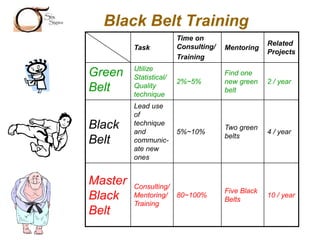
Black Belt Training
Task
Time on
Consulting/
Training
Mentoring
Related
Projects
Green
Belt
Utilize
Statistical/
Quality
technique
2%~5%
Find one
new green
belt
2 / year
Black
Belt
Lead use
of
technique
and
communic-
ate new
ones
5%~10%
Two green
belts
4 / year
Master
Black
Belt
Consulting/
Mentoring/
Training
80~100%
Five Black
Belts
10 / year
SIX SIGMA
Thanks you

Basic overview six sigma

  • 1.
    SIX SIGMA A STRATEGYFOR PERFORMANCE EXCELLENCE 1. Anil Dhaya 2. Sanjiv Negi 3. Bulu Ghatuary 4. Sonil Pal Project Owner: Khushmeet_Khushi March 16th, 2018 RBE@2018
  • 2.
    SIX SIGMA How canwe get these results • 10-15 % Min. Rejection Rate. • 10% Every year Cost Reduce by customer • 20-25% Customer dissatisfaction Score per year in the Industry. • One lost article of mail per hour
  • 3.
    SIX SIGMA The answeris: Six Sigma
  • 4.
    SIX SIGMA  SixSigma as a Problem-Solving Methodology:- What is Six Sigma  one of the common interpretations and usage of the Six Sigma as a problem- solving methodology is deployed in organizations today to improve upon the critical process metrics of the organization or the department.  All key performance indicators of the organization need to produces their optimum results for the organization to be successful and be able to produce the desired result
  • 5.
    SIX SIGMA  AVision and Philosophical commitment to our consumers to offer the highest quality, lowest cost products  A Metric that demonstrates quality levels at 99.9997% performance for products and process  A Benchmark of our product and process capability for comparison to ‘best in class’  A practical application of statistical Tools and Methods to help us measure, analyze, improve, and control our process What is Six Sigma
  • 6.
    SIX SIGMA  AVision and Philosophical commitment to our consumers to offer the highest quality, lowest cost products Six Sigma Philosophy one of the significant shift in approach that six sigma brought was the fact that everything was more focused toward the customer. The definition of the customer requirement (even while it were as per the organization design and it was not a defect) collection of VOC(Voice of customer)emerged as the greatest mantra for the success, success is no longer about creating a fantastic product product(which was enhanced/improved from experience) But from the needs of the customer. And this became a very important takeaway for business which were struggling to create their own niche in the markets  Employee Engagement  Customer Focus A critical success factor for success of six sigma initiatives has always been the participation of the on the ground team. Participation of the on the ground team is imperative as they are the closed business, interface to the customer, closet to process bottleneck etc. and hence they are the ones who can give you the correct Xs.  Distaste to defect and variation Implementation and organizational orientation toward six sigma meant that as an organization we are promulgating a culture where we look at/attempt eradication of every defect and reduce variation in the organization process.
  • 7.
    SIX SIGMA Six Sigmaas a Philosophy Internal & External Failure Costs Prevention & Appraisal Costs Old Belief 4s Costs Internal & External Failure Costs Prevention & Appraisal Costs New Belief Costs 4s 5s 6s Quality Quality Old Belief High Quality = High Cost New Belief High Quality = Low Cost s is a measure of how much variation exists in a process PPM- 6728.56
  • 8.
    SIX SIGMA 3 SigmaVs. 6 Sigma The 3 sigma Company The 6 sigma Company • Spends 15~25% of sales dollars on cost of failure • Spends 5% of sales dollars on cost of failure • Relies on inspection to find defects • Relies on capable process that don’t produce defects • Does not have a disciplined approach to gather and analyze data • Use Measure, Analyze, Improve, Control and Measure, Analyze, Design • Benchmarks themselves against their competition • Benchmarks themselves against the best in the world • Believes 99% is good enough • Believes 99% is unacceptable • Define CTQs internally • Defines CTQs externally
  • 9.
    SIX SIGMA Six Sigmaas a Metric 1 ) ( 2     n x xi  s Sigma = s = Deviation ( Square root of variance ) -7 -6 -5 -4 -3 -2 -1 0 1 2 3 4 5 6 7 Axis graduated in Sigma 68.27 % 95.45 % 99.73 % 99.9937 % 99.999943 % 99.9999997 % result: 317300 ppm outside (deviation) 45500 ppm 2700 ppm 63 ppm 0.57 ppm 0.003 ppm between + / - 1s between + / - 2s between + / - 3s between + / - 4s between + / - 5s between + / - 6s s =
  • 10.
    SIX SIGMA Non-Liner Decrease 2 3 4 5 6 308,537 66,811 6,210 233 3.4 sPPM Process Capability Defects per Million Opportunities * Includes 1.5s shift Focusing on s requires thorough process understanding and breakthrough thinking 0 10 20 30 40 50 60 70 80 1 2 3 4 5 6 Process Sigma % Change 0 100000 200000 300000 400000 500000 600000 700000 800000 PPM From 1 to 2 From 3 to 4 From 4 to 5 From 5 to 6 % Change PPM
  • 11.
    SIX SIGMA Focus: TheEnd User • Customer: Internal or External • Consumer: The End User the “Voice of the Consumer” (Consumer Cue) must be translated into the “Voice of the Engineer” (Technical Requirement)
  • 12.
    SIX SIGMA Six Sigmaas a Tool Process Mapping Tolerance Analysis Structure Tree Components Search Pareto Analysis Hypothesis Testing Gauge R & R Regression Rational Subgrouping Design of Experiments Baselining SPC Many familiar quality tools applied in a structured methodology
  • 13.
    SIX SIGMA Common Processof improvement Measure Improvement People, system process are supposed to get better more efficient etc. with gain of experience. Customer the same from us if they have outsourced some process to us. They expect that the productivity of our employee will improve as they gain experience of the process and the IT Infra being used.  Doing More for less This is scientifically proven fact that if we focus on bottom quartile performer and I if we are able to improve their performance by even a small proportion then we may realize huge improvement in bottom-line revenue.  Bottom Quartile Management Creating re-usability in assets is a very critical part of organization growth. In software development business, Creating re-usable and test case are extremely critical in marking more profits. Similarly the standardization of sense. We should not be required to re-invent the wheel every time.  Asset Re-use Serval Business process suffer at the hands of deficiency of preceding business process/processes. While attending to issue, one must do root cause analysis and see if the contributing factory may be mistake proofed. Such things ensure that’ the process get the required inputs which are right the first time. And such improvement will, at the end contribute to improving productivity of business processes.  Mistake Proofing Several manual processes can be mane more efficient by taking out manual work and replacing them with digitized work flow. However, one must be careful and implement lean in the process before the process before they digitize.  Digitization Knowledge of best practices or lesson documentation at serval places helps improve systems. Known Error Database (KEDB)usage in IT support is a common example of the same. Building FAQs, documented SOPs, Work instruction etc. serve as a good measure.  Knowledge management or IP Retention
  • 14.
    SIX SIGMA Various waysto commence a Six-sigma project Measure Improvement  VOC (Voice Of Customer)  VOB/VOP (Voice of Business/Process)  VOIC (Voice of internal customer)  COPQ (cost of poor quality)  RTY (Rolled throughput yield)  FTR/FTY(Frist time Right/Yield)  OTD (On time Delivery)  RR (Return Rate)  NPR(Number of problem report)
  • 15.
    SIX SIGMA Reduce Complaints (int./ext.) Reduce Cost Reduce Defects Problem Definitionsneed to be based on quantitative facts supported by analytical data. What are the Goals?  What do you want to improve?  What is your ‘Y’? Problem Definition
  • 16.
    SIX SIGMA Six Sigmaas a Method To get results, should we focus our behavior on the Y or X •Y •X1…Xn •Dependent •Independent •Output •Input-Process •Effect •Cause •Symptom •Problem •Monitor •Control
  • 17.
    SIX SIGMA 1. DefineObjective. 2. Select the Response (Y) 3. Select the factors (Xs) 4. Choose the factor levels 5. Select the Experimental Design 6. Run Experiment and Collect the Data 7. Analyze the data 8. Conclusions 9. Perform a confirmation run.(Control) STEPS IN PLANNING AN EXPERIMENT
  • 18.
    SIX SIGMA The generallyaccepted methodology for managing Six Sigma projects includes the following phases: Define: The objectives and scope of the project are defined. Relevant information about the process and customer are collected. Measure: Data on the current situation and process metrics are collected. Analyze: Collected data are analyzed to find the root cause(s) of the problem. Improve: Solution(s) to the problem are developed and implemented. Control: The implemented solution(s) are evaluated and the mechanisms are implemented to hold the gains, which may include standardization. This methodology has often been referred to by its initials: DMAIC. Some are suggesting an additional initial phase that might be called Recognize. This would occur before the Define phase, and is intended to ensure that appropriate opportunities and problems are properly recognized. Professionals in the project management field may find a valuable opportunity to contribute to enhancing the Six Sigma project management methodology. Six Sigma Project Methodology
  • 19.
    SIX SIGMA Strategy byPhase - Phase Measure (What) Analyze (Where, When, Why) Improve (How) Control (Sustain, Leverage) Step What is the frequency of Defects? • Define the defect • Define performance standards • Validate measurement system • Establish capability metric Where, when and why do Defects occur? • Identify sources of variation • Determine the critical process parameters How can we improve the process? • Screen potential causes • Discover relationships • Establish operating tolerances Were the improvements effective? • Re-establish capability metric How can we maintain the improvements? • Implement process control mechanisms • Leverage project learning's • Document & Proceduralize Focus Y Y Y Y X Vital X X Vital X Vital X Y, Vital X Y, Vital X Process Characterization Process Optimization Measure Improve Analyze Control Measure Improve Analyze Control Measure Improve Analyze Control Measure Improve Analyze Control Measure Improvement
  • 20.
    SIX SIGMA Design ofExperiments (DOE) • To estimate the effects of independent Variables on Responses. • Terminology Factor – An independent variable Level – A value for the factor. Response - Outcome X Y PROCESS
  • 21.
    SIX SIGMA Black BeltTraining Task Time on Consulting/ Training Mentoring Related Projects Green Belt Utilize Statistical/ Quality technique 2%~5% Find one new green belt 2 / year Black Belt Lead use of technique and communic- ate new ones 5%~10% Two green belts 4 / year Master Black Belt Consulting/ Mentoring/ Training 80~100% Five Black Belts 10 / year
  • 22.