International Research Journal of Engineering and Technology (IRJET) e-ISSN: 2395-0056
Volume: 04 Issue: 08 | Aug -2017 www.irjet.net p-ISSN: 2395-0072
© 2017, IRJET | Impact Factor value: 5.181 | ISO 9001:2008 Certified Journal | Page 1572
‘5S’implementationinaFastenersmanufacturingcompany
Mayur M Mhamunkar1, Dr. Arun Kumar2, Swapnil Raut3
1 Department of Mechanical Engineering, Student, VIVA Institute of technology, Mumbai University,
Maharashtra, India
2 Department of Mechanical Engineering, Principal at VIVA Institute of technology, Mumbai University,
Maharashtra, India
3 Department of Mechanical Engineering, Lecturer at VIVA Institute of technology, Mumbai University,
Maharashtra, India
---------------------------------------------------------------------***---------------------------------------------------------------------
Abstract -The purpose of this paper is to use 5S tool so
as to assist tiny scale producing organization to become
additional productive and additional economical. a
straightforward approachhasbeenadoptedforimplementing
5S. throughout results, it has been analyzed that
implementation of ‘5S’ resulted in overall improvement of
the organization. With the implementation of ‘5S’, Tool
looking time from workplace has been reduced from twenty
five minutes to six minutes alongside different important
advantages.
‘5S’ audit has been conducted within the organization. ‘5S’
audit score has been exaggerated at the top of the project. 5S
is powerful tool and might be enforced in numerous industries
whether or not it's small, small, medium or giant. The
publications and work bestowed in this paper can be helpful
to researchers, consultants and others considerations with
this subject to appreciate the importance of 5S.
Key Words: Lean manufacturing, 5S Audit, Red tag, log
book.
1. INTRODUCTION
In Indian economysmall-scaleproducingindustriesoccupya
key place, thanks to their employmentpotential andtheiraid
to total industrial output and exports. Now-a-days this
sector facing challenges to retain its prosperous position
as a result of conflict of recent competitors each within the
national and international market. So, continuous
improvement is needed to beat these challenges. withinthe
competitive business the producing firms have to pay
attention for the sweetening in productivity, quality,
efficacy, safety and its service.
Lean producing (LM) is that the solely techniquewiththat of
these issues is resolved. luminous flux unit is enforced by its
numerous tools like ‘5S’, ‘KAIZEN’, ‘Total Productive
Maintenance’,‘ValueStream Mapping,simplyInTime,POKA-
YOKE, ‘Overall instrumentalityEffectiveness’,‘PlanDoCheck
Act’ .Out of of these ‘5S’ being economical and effective tool
was chosen for finding involved business.
1.1 Summary of 5S methodology
5S Methodology is one in every of the essential andtherefore
the most vital tool to implement Lean producing. it's a
system to manage the work flow by systemizing the
geographic point, so supporting the culture of continuous
improvement.5S has been introduced in Japan in the main
within the producing and service industries.5S is the
signifier for 5 Japanese words Seiri, Seiton, Seiso, Seiketsu
and Shitsuke severally. the subsequenttableexplainsthese5
words in best method.
2. METHODOLOGY
The whole methodology for implementation of 5S was
framed by exploitation one in every of the lean tools i.e. set
up Do Check Act (PDCA). In this, set up was created for 5S
associate activity that was then enforced and checked i.e.
assessment was administered to search out the results of
implementation. Act refers to steps taken to fill the gap
found under control stage nothing however the advance is
completed and PDCA cycle is perennial for higher results.
2.1 Plan
Before about to the implementation part, higherofficersand
engineers are going implement 5S ought to visit industries
who have with success enforced 5S to line the benchmark.
Consequently coaching on 5S should be provided for all.
Then the 5S Council is necessary to be shaped.
2.2 Do
2.2.1 Sort: Identification of necessary things and separating
unwanted things with facilitate of red tag. Keep them away
in storage or discard them. This can produce additional free
house and hidden issues is known and this indirectly avoids
accidents thereby increasing safety.
2.2.2 Set in Order: once distinguishing the mandatory
things, decide the place for each item. make certain
everything is unbroken on its present place solely. Yellow
tape ought to be place to limit machine space and human
International Research Journal of Engineering and Technology (IRJET) e-ISSN: 2395-0056
Volume: 04 Issue: 08 | Aug -2017 www.irjet.net p-ISSN: 2395-0072
© 2017, IRJET | Impact Factor value: 5.181 | ISO 9001:2008 Certified Journal | Page 1573
interference. This activity helps in reducing accidents,
looking time for tools and different necessary things
required oftentimes.
2.2.3 Shine: This refers to improvementofone’scloseand of
him. Periodic improvement ought to be done. Improvement
makes work atmosphere higher for work. This indirectly
improves bioengineering and thereby productivity.
2.2.4 Standardise: each method in company ought to be
standardise i.e. commonplace procedure (SOP) is formed.
This includes commonplace for 5S activities too. Awareness
is made with facilitate of posters pasting on the wall.
Conjointly Vision and Mission of company similarly as 5S
ought to be displayed on walls of workplace.
2.2.5 Sustain: This activity focuses on maintaining these
four S activities. It tries to forestall fall back thanks to
tolerance of workers.
2.3 Check
In this step 5S Audit is conducted on weekly or monthly
basis for assessment of 5S work standing. Audit is
administered by third party to avoid biasing. Audit contains
five queries for every ‘S’ and every question has rating zero
to four. So most marks is given to any question is four. So for
every S most marks is twenty and for complete audit is for a
hundred marks. once Audit is administered results area unit
displayed on 5S board.
2.4 Act
For continuous improvement, the involved authority
ought to make sure that gap found in this Audit ought to get
fill until second Audit. Meeting is to be conducted to coach
workers for higher results by comparison with benchmark.
Results area unit displayed on 5S board and worker is
rewarded WHO has greatest score amongall differentzones’
worker in order that workers get impelled and that they
work more durable.
3. IMPLEMENTATION AND RESULT
3.1 Sort: the entire house offered was divided into four
zones X1, X2, X3, X4 viz. ‘Maintenance’, ‘Production’, ‘Raw
material and storage’ and last is ‘Quality and dispatch’
severally. Currently unwantedmaterialsinthosezoneswere
known and red labelled. Entry is formed into red tag log
book. Red tag contains action to love that specific item and
consequently it's sent to storage or discarded. Log book
helps America once we wish to retrieve bound itemthatwas
unbroken in storage ways back. Once removing those
unwanted things from the zones the house was saved in X3,
X4.
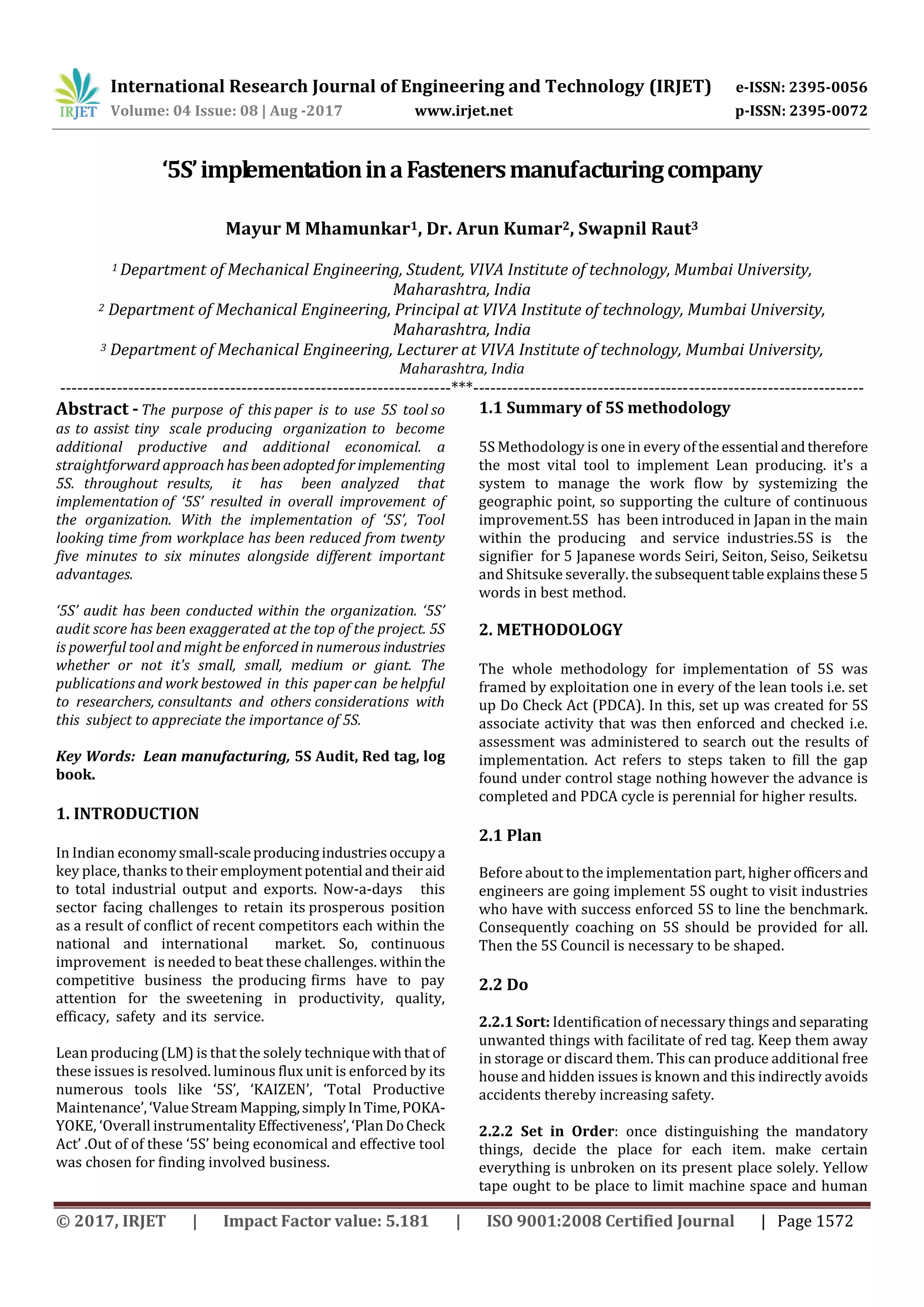
Fig. 1 Storage area before 1S implementation after and 1S
implementation
Table a pair of shows the advance in saving area on the
industrial plant floor. Same may be seen through figure one.
Table 2: Cost saving due to space clearance at company
Zones Space Saving (sq. ft) Saving in cost
X3 50.55 Rs.93517
X4 10 Rs.18500
Note: Cost is calculated in above table considering rate of
Rs. 1850/sq.ft
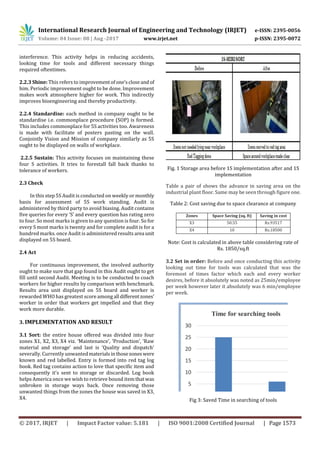
3.2 Set in order: Before and once conducting this activity
looking out time for tools was calculated that was the
foremost of times factor which each and every worker
desires, before it absolutely was noted as 25min/employee
per week however later it absolutely was 6 min/employee
per week.
0
5
10
15
20
25
30
Before after
Time for searching tools
Fig 3: Saved Time in searching of tools
International Research Journal of Engineering and Technology (IRJET) e-ISSN: 2395-0056
Volume: 04 Issue: 08 | Aug -2017 www.irjet.net p-ISSN: 2395-0072
© 2017, IRJET | Impact Factor value: 5.181 | ISO 9001:2008 Certified Journal | Page 1574
The following calculations show the cost saving in labour
cost:
Saving in time / week = 25 - 5 = 20 min.
Saving in time/ month = 20×4 = 80 min.
Salary of employee /day Rs.290/8hrs = Rs.0.60/min
Cost saving per month / employee = Rs.44
Total labour cost saving /month = Rs. 44×8 = Rs.352(since8
employees work there.)
Total labour cost saving/year =Rs.352×12=Rs. 4224
3.3 Shine: Before 5S implementation there was no specific
improvement schedule. Improvement was exhausted
associate irregular manner. Throughout 5S implementation
a improvement schedule was ready. the things that needed
improvement were known. a selected amount was allotted
once that these things should be cleansed. Theimprovement
schedule for all things is given in table 3.
Table 3: Cleaning schedule
Locations Rate of cleaning
Maintenance
Table
Once/week
Shop Floor Twice/week
Dispatch Once/week
Storage Once/week
Washroom Once / day
Office Once/week
Due to this schedule mechanically work surroundings
started rising and currently it improved workers operating
capability.
3.4 Standardize: each necessary method was standardized
with the assistance of seniors and management and it's
diagrammatic within the kind of flow charts and visual
diagrams. Labels were connected to any or all files
furthermore on all dies rack so simply it may be taken while
not mensuration it .The problem ofbeginningthemachinein
reverse direction of motor was eliminated as a result of
labels were placed on starters to begin the machine in right
direction. This decreased abundant wastage of screws
attributable to reverse threads. It conjointly helped new
employees who be a part of associated don’t work per steps
that are to be followed and find yourself with waste or an
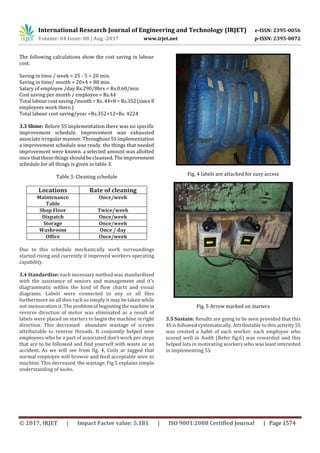
accident. As we will see from fig. 4, Coils ar tagged that
normal employee will browse and feed acceptable wire to
machine. This decreased the wastage. Fig 5 explains simple
understanding of knobs.
Fig. 4 labels are attached for easy access
Fig. 5 Arrow marked on starters
3.5 Sustain: Results are going to be seen provided that this
4S is followed systematically. Attributable to this activity 5S
was created a habit of each worker. each employee who
scored well in Audit (Refer fig.6) was rewarded and this
helped lots in motivating workers who was least interested
in implementing 5S.
International Research Journal of Engineering and Technology (IRJET) e-ISSN: 2395-0056
Volume: 04 Issue: 08 | Aug -2017 www.irjet.net p-ISSN: 2395-0072
© 2017, IRJET | Impact Factor value: 5.181 | ISO 9001:2008 Certified Journal | Page 1575
Fig. 6 5S Audit sheet
3. CONCLUSIONS
Typical manufacturing was obtaining born-again into
Lean producing attributable to implementation of 5S. Plant
layout was modified bit for implementation of 5S, operative
procedures, tool organization, and material handling and
improvement schedules were conjointly altered. The initial
part, sort, resulted in removing unwanted things, broken
tools, unused components and scrap materials. Unused
inventory was came back to buying, seldom used tools were
situated in storage and regularly required things were
situated close to machine within the reach of operator and
scrap things were discarded.
The second part, set so as, resulted in many changes within
the organization of the workplace. Everyoftheworkstations
received their own set of tools. All the tools were color
coded to their various digital computers. All equipment
had specific locations. Trashcans and different things on the
ground had floor markers to point their locations. All tools
were far away from the ground and were placed on clamps.
Ordinarily used components were placed in bins on each
digital computer. The third part, shine, resulted in removing
scrap, dirt and different unwanted things from every digital
computer. this primary clean-up helpedto envisiondifferent
problems clearly. The fourth part, standardize, resulted in
developing commonplace operating procedures for the
workers within the assembly space. Overall these activities
as an entire contributed in minimizing waste, optimizing
performance, increasing profit attributable to reduction in
losses, rising safety and therefore the last however not the
smallest amount capability of employees.
REFERENCES
[1] Kaushik Kumar,Sanjeev Kumar, “Steps For
Implementation Of 5S”, IJMIE, Volume 2, Issue 6 ISSN: 2249-
0558, 2012,pp.402-416.
[2] MohdNizam Ab Rahman, N.K. Khamis, Wan
Hasrulnizzam Wan Mahmood, Baba MdDeros ,
“Implementation of 5S Practices in the Manufacturing
Companies: A Case Study”, American Journal of Applied
Sciences, Vol. 7,ISSN 1546-9239,2010,pp.1182-1189.
[3] IlijaĐeki, “Lean Manufacturing In Two Serbian
Foodcompanies–Case Studies”, International Journal for
Quality research,Vol. 6 , Issue 6ISSN:664-670,2012,pp.131-
136.
[4] Ravikant V. Paropate, Dr. Rajeshkumar U. Sambhe,The
Implementation and Evaluation of Total Productive
Maintenance –A Case Study of mid-sized Indian Enterprise,
International Journal of Application or Innovation in
Engineering & Management (IJAIEM),Vol. 2, Issue
10,2013,pp. 435-442.
[5] A.N. M. Rose, B. Md. Deros, M. N. Ab. Rahman, “A Study
On Lean Manufacturing Implementation In Malaysian
Automotive Component Industry”, International Journal of
AutomotiveandMechanical Engineering(IJAME)ISSN:2229-
8649 (Print); ISSN: 2180-1606 (Online); Vol. 8, 2013,pp.
1467-1476.
[6]JuthamasChoomlucksanaa,MonsiriOngsaranakorna,Phro
mpongSuksabaia, “Improvingtheproductivityofsheetmetal
stamping subassembly area using the application of lean
manufacturing principles”, Application or Innovation in
Engineering & Management (IJAIEM),Vol.3,Issue8,2015, pp.
235-241.
[7]Shekhar Shahu, Lakhan Patidar, “5Stransfusiontooverall
equipment effectiveness (OEE) For enhancing
Manufacturing”, International Research Journal of
Engineering and Technology (IRJET) e-ISSN: 2395 -
0056Vol.2 Issue: 07,2015, pp.1300-1305.
[8]Mariano Jiméneza, Luis Romerob, Manuel Domínguezb,
María del Mar Espinosa,“5S methodology implementationin
the laboratories of an industrial engineering university
school”, International Journal for Quality research, Vol.6 ,
Issue 6 ISSN: 664-670,2015, pp. 430-436.
International Research Journal of Engineering and Technology (IRJET) e-ISSN: 2395-0056
Volume: 04 Issue: 08 | Aug -2017 www.irjet.net p-ISSN: 2395-0072
© 2017, IRJET | Impact Factor value: 5.181 | ISO 9001:2008 Certified Journal | Page 1576
BIOGRAPHIES
Mayur Manohar Mhamunkar
Qualification: ME in
Manufacturing System
Engineering, BE Mechanical
Engineering,
Research
Interests: Manufacturing Systems
and Lean Manufacturing, DOE,
Quality Engineering
Dr. Arun Kumar
Principal at
VIVA Institute of Technology
Shrigaon, Veer Sawarkar Road,
Virar (E) 401305
Swapnil Raut
Designation: Asst. Professor in
Mechanical Engineering Department
At Viva Institute of Technology, Virar,
Dist:palghar, Maharashtra
Qualification: ME Manufacturing
Systems
Research Interests: Manufacturing
Systems
st
Author
Photo

‘5S’ Implementation in a Fasteners Manufacturing Company

  • 1.
    International Research Journalof Engineering and Technology (IRJET) e-ISSN: 2395-0056 Volume: 04 Issue: 08 | Aug -2017 www.irjet.net p-ISSN: 2395-0072 © 2017, IRJET | Impact Factor value: 5.181 | ISO 9001:2008 Certified Journal | Page 1572 ‘5S’implementationinaFastenersmanufacturingcompany Mayur M Mhamunkar1, Dr. Arun Kumar2, Swapnil Raut3 1 Department of Mechanical Engineering, Student, VIVA Institute of technology, Mumbai University, Maharashtra, India 2 Department of Mechanical Engineering, Principal at VIVA Institute of technology, Mumbai University, Maharashtra, India 3 Department of Mechanical Engineering, Lecturer at VIVA Institute of technology, Mumbai University, Maharashtra, India ---------------------------------------------------------------------***--------------------------------------------------------------------- Abstract -The purpose of this paper is to use 5S tool so as to assist tiny scale producing organization to become additional productive and additional economical. a straightforward approachhasbeenadoptedforimplementing 5S. throughout results, it has been analyzed that implementation of ‘5S’ resulted in overall improvement of the organization. With the implementation of ‘5S’, Tool looking time from workplace has been reduced from twenty five minutes to six minutes alongside different important advantages. ‘5S’ audit has been conducted within the organization. ‘5S’ audit score has been exaggerated at the top of the project. 5S is powerful tool and might be enforced in numerous industries whether or not it's small, small, medium or giant. The publications and work bestowed in this paper can be helpful to researchers, consultants and others considerations with this subject to appreciate the importance of 5S. Key Words: Lean manufacturing, 5S Audit, Red tag, log book. 1. INTRODUCTION In Indian economysmall-scaleproducingindustriesoccupya key place, thanks to their employmentpotential andtheiraid to total industrial output and exports. Now-a-days this sector facing challenges to retain its prosperous position as a result of conflict of recent competitors each within the national and international market. So, continuous improvement is needed to beat these challenges. withinthe competitive business the producing firms have to pay attention for the sweetening in productivity, quality, efficacy, safety and its service. Lean producing (LM) is that the solely techniquewiththat of these issues is resolved. luminous flux unit is enforced by its numerous tools like ‘5S’, ‘KAIZEN’, ‘Total Productive Maintenance’,‘ValueStream Mapping,simplyInTime,POKA- YOKE, ‘Overall instrumentalityEffectiveness’,‘PlanDoCheck Act’ .Out of of these ‘5S’ being economical and effective tool was chosen for finding involved business. 1.1 Summary of 5S methodology 5S Methodology is one in every of the essential andtherefore the most vital tool to implement Lean producing. it's a system to manage the work flow by systemizing the geographic point, so supporting the culture of continuous improvement.5S has been introduced in Japan in the main within the producing and service industries.5S is the signifier for 5 Japanese words Seiri, Seiton, Seiso, Seiketsu and Shitsuke severally. the subsequenttableexplainsthese5 words in best method. 2. METHODOLOGY The whole methodology for implementation of 5S was framed by exploitation one in every of the lean tools i.e. set up Do Check Act (PDCA). In this, set up was created for 5S associate activity that was then enforced and checked i.e. assessment was administered to search out the results of implementation. Act refers to steps taken to fill the gap found under control stage nothing however the advance is completed and PDCA cycle is perennial for higher results. 2.1 Plan Before about to the implementation part, higherofficersand engineers are going implement 5S ought to visit industries who have with success enforced 5S to line the benchmark. Consequently coaching on 5S should be provided for all. Then the 5S Council is necessary to be shaped. 2.2 Do 2.2.1 Sort: Identification of necessary things and separating unwanted things with facilitate of red tag. Keep them away in storage or discard them. This can produce additional free house and hidden issues is known and this indirectly avoids accidents thereby increasing safety. 2.2.2 Set in Order: once distinguishing the mandatory things, decide the place for each item. make certain everything is unbroken on its present place solely. Yellow tape ought to be place to limit machine space and human
  • 2.
    International Research Journalof Engineering and Technology (IRJET) e-ISSN: 2395-0056 Volume: 04 Issue: 08 | Aug -2017 www.irjet.net p-ISSN: 2395-0072 © 2017, IRJET | Impact Factor value: 5.181 | ISO 9001:2008 Certified Journal | Page 1573 interference. This activity helps in reducing accidents, looking time for tools and different necessary things required oftentimes. 2.2.3 Shine: This refers to improvementofone’scloseand of him. Periodic improvement ought to be done. Improvement makes work atmosphere higher for work. This indirectly improves bioengineering and thereby productivity. 2.2.4 Standardise: each method in company ought to be standardise i.e. commonplace procedure (SOP) is formed. This includes commonplace for 5S activities too. Awareness is made with facilitate of posters pasting on the wall. Conjointly Vision and Mission of company similarly as 5S ought to be displayed on walls of workplace. 2.2.5 Sustain: This activity focuses on maintaining these four S activities. It tries to forestall fall back thanks to tolerance of workers. 2.3 Check In this step 5S Audit is conducted on weekly or monthly basis for assessment of 5S work standing. Audit is administered by third party to avoid biasing. Audit contains five queries for every ‘S’ and every question has rating zero to four. So most marks is given to any question is four. So for every S most marks is twenty and for complete audit is for a hundred marks. once Audit is administered results area unit displayed on 5S board. 2.4 Act For continuous improvement, the involved authority ought to make sure that gap found in this Audit ought to get fill until second Audit. Meeting is to be conducted to coach workers for higher results by comparison with benchmark. Results area unit displayed on 5S board and worker is rewarded WHO has greatest score amongall differentzones’ worker in order that workers get impelled and that they work more durable. 3. IMPLEMENTATION AND RESULT 3.1 Sort: the entire house offered was divided into four zones X1, X2, X3, X4 viz. ‘Maintenance’, ‘Production’, ‘Raw material and storage’ and last is ‘Quality and dispatch’ severally. Currently unwantedmaterialsinthosezoneswere known and red labelled. Entry is formed into red tag log book. Red tag contains action to love that specific item and consequently it's sent to storage or discarded. Log book helps America once we wish to retrieve bound itemthatwas unbroken in storage ways back. Once removing those unwanted things from the zones the house was saved in X3, X4. Fig. 1 Storage area before 1S implementation after and 1S implementation Table a pair of shows the advance in saving area on the industrial plant floor. Same may be seen through figure one. Table 2: Cost saving due to space clearance at company Zones Space Saving (sq. ft) Saving in cost X3 50.55 Rs.93517 X4 10 Rs.18500 Note: Cost is calculated in above table considering rate of Rs. 1850/sq.ft 3.2 Set in order: Before and once conducting this activity looking out time for tools was calculated that was the foremost of times factor which each and every worker desires, before it absolutely was noted as 25min/employee per week however later it absolutely was 6 min/employee per week. 0 5 10 15 20 25 30 Before after Time for searching tools Fig 3: Saved Time in searching of tools
  • 3.
    International Research Journalof Engineering and Technology (IRJET) e-ISSN: 2395-0056 Volume: 04 Issue: 08 | Aug -2017 www.irjet.net p-ISSN: 2395-0072 © 2017, IRJET | Impact Factor value: 5.181 | ISO 9001:2008 Certified Journal | Page 1574 The following calculations show the cost saving in labour cost: Saving in time / week = 25 - 5 = 20 min. Saving in time/ month = 20×4 = 80 min. Salary of employee /day Rs.290/8hrs = Rs.0.60/min Cost saving per month / employee = Rs.44 Total labour cost saving /month = Rs. 44×8 = Rs.352(since8 employees work there.) Total labour cost saving/year =Rs.352×12=Rs. 4224 3.3 Shine: Before 5S implementation there was no specific improvement schedule. Improvement was exhausted associate irregular manner. Throughout 5S implementation a improvement schedule was ready. the things that needed improvement were known. a selected amount was allotted once that these things should be cleansed. Theimprovement schedule for all things is given in table 3. Table 3: Cleaning schedule Locations Rate of cleaning Maintenance Table Once/week Shop Floor Twice/week Dispatch Once/week Storage Once/week Washroom Once / day Office Once/week Due to this schedule mechanically work surroundings started rising and currently it improved workers operating capability. 3.4 Standardize: each necessary method was standardized with the assistance of seniors and management and it's diagrammatic within the kind of flow charts and visual diagrams. Labels were connected to any or all files furthermore on all dies rack so simply it may be taken while not mensuration it .The problem ofbeginningthemachinein reverse direction of motor was eliminated as a result of labels were placed on starters to begin the machine in right direction. This decreased abundant wastage of screws attributable to reverse threads. It conjointly helped new employees who be a part of associated don’t work per steps that are to be followed and find yourself with waste or an accident. As we will see from fig. 4, Coils ar tagged that normal employee will browse and feed acceptable wire to machine. This decreased the wastage. Fig 5 explains simple understanding of knobs. Fig. 4 labels are attached for easy access Fig. 5 Arrow marked on starters 3.5 Sustain: Results are going to be seen provided that this 4S is followed systematically. Attributable to this activity 5S was created a habit of each worker. each employee who scored well in Audit (Refer fig.6) was rewarded and this helped lots in motivating workers who was least interested in implementing 5S.
  • 4.
    International Research Journalof Engineering and Technology (IRJET) e-ISSN: 2395-0056 Volume: 04 Issue: 08 | Aug -2017 www.irjet.net p-ISSN: 2395-0072 © 2017, IRJET | Impact Factor value: 5.181 | ISO 9001:2008 Certified Journal | Page 1575 Fig. 6 5S Audit sheet 3. CONCLUSIONS Typical manufacturing was obtaining born-again into Lean producing attributable to implementation of 5S. Plant layout was modified bit for implementation of 5S, operative procedures, tool organization, and material handling and improvement schedules were conjointly altered. The initial part, sort, resulted in removing unwanted things, broken tools, unused components and scrap materials. Unused inventory was came back to buying, seldom used tools were situated in storage and regularly required things were situated close to machine within the reach of operator and scrap things were discarded. The second part, set so as, resulted in many changes within the organization of the workplace. Everyoftheworkstations received their own set of tools. All the tools were color coded to their various digital computers. All equipment had specific locations. Trashcans and different things on the ground had floor markers to point their locations. All tools were far away from the ground and were placed on clamps. Ordinarily used components were placed in bins on each digital computer. The third part, shine, resulted in removing scrap, dirt and different unwanted things from every digital computer. this primary clean-up helpedto envisiondifferent problems clearly. The fourth part, standardize, resulted in developing commonplace operating procedures for the workers within the assembly space. Overall these activities as an entire contributed in minimizing waste, optimizing performance, increasing profit attributable to reduction in losses, rising safety and therefore the last however not the smallest amount capability of employees. REFERENCES [1] Kaushik Kumar,Sanjeev Kumar, “Steps For Implementation Of 5S”, IJMIE, Volume 2, Issue 6 ISSN: 2249- 0558, 2012,pp.402-416. [2] MohdNizam Ab Rahman, N.K. Khamis, Wan Hasrulnizzam Wan Mahmood, Baba MdDeros , “Implementation of 5S Practices in the Manufacturing Companies: A Case Study”, American Journal of Applied Sciences, Vol. 7,ISSN 1546-9239,2010,pp.1182-1189. [3] IlijaĐeki, “Lean Manufacturing In Two Serbian Foodcompanies–Case Studies”, International Journal for Quality research,Vol. 6 , Issue 6ISSN:664-670,2012,pp.131- 136. [4] Ravikant V. Paropate, Dr. Rajeshkumar U. Sambhe,The Implementation and Evaluation of Total Productive Maintenance –A Case Study of mid-sized Indian Enterprise, International Journal of Application or Innovation in Engineering & Management (IJAIEM),Vol. 2, Issue 10,2013,pp. 435-442. [5] A.N. M. Rose, B. Md. Deros, M. N. Ab. Rahman, “A Study On Lean Manufacturing Implementation In Malaysian Automotive Component Industry”, International Journal of AutomotiveandMechanical Engineering(IJAME)ISSN:2229- 8649 (Print); ISSN: 2180-1606 (Online); Vol. 8, 2013,pp. 1467-1476. [6]JuthamasChoomlucksanaa,MonsiriOngsaranakorna,Phro mpongSuksabaia, “Improvingtheproductivityofsheetmetal stamping subassembly area using the application of lean manufacturing principles”, Application or Innovation in Engineering & Management (IJAIEM),Vol.3,Issue8,2015, pp. 235-241. [7]Shekhar Shahu, Lakhan Patidar, “5Stransfusiontooverall equipment effectiveness (OEE) For enhancing Manufacturing”, International Research Journal of Engineering and Technology (IRJET) e-ISSN: 2395 - 0056Vol.2 Issue: 07,2015, pp.1300-1305. [8]Mariano Jiméneza, Luis Romerob, Manuel Domínguezb, María del Mar Espinosa,“5S methodology implementationin the laboratories of an industrial engineering university school”, International Journal for Quality research, Vol.6 , Issue 6 ISSN: 664-670,2015, pp. 430-436.
  • 5.
    International Research Journalof Engineering and Technology (IRJET) e-ISSN: 2395-0056 Volume: 04 Issue: 08 | Aug -2017 www.irjet.net p-ISSN: 2395-0072 © 2017, IRJET | Impact Factor value: 5.181 | ISO 9001:2008 Certified Journal | Page 1576 BIOGRAPHIES Mayur Manohar Mhamunkar Qualification: ME in Manufacturing System Engineering, BE Mechanical Engineering, Research Interests: Manufacturing Systems and Lean Manufacturing, DOE, Quality Engineering Dr. Arun Kumar Principal at VIVA Institute of Technology Shrigaon, Veer Sawarkar Road, Virar (E) 401305 Swapnil Raut Designation: Asst. Professor in Mechanical Engineering Department At Viva Institute of Technology, Virar, Dist:palghar, Maharashtra Qualification: ME Manufacturing Systems Research Interests: Manufacturing Systems st Author Photo