IOSR Journal of Electrical and Electronics Engineering (IOSR-JEEE)
e-ISSN: 2278-1676,p-ISSN: 2320-3331, Volume 10, Issue 2 Ver. I (Mar – Apr. 2015), PP 89-100
www.iosrjournals.org
DOI: 10.9790/1676-102189100 www.iosrjournals.org 89 | Page
Economic Effects of Technical and Non Technical Losses in
Nigeria Power Transmission System
1
Omorogiuwa Eseosa and 2
Elechi Promise
1
Department of Electrical/Electronic Engineering, University of Port Harcourt, Port Harcourt
2
Department of Electrical Engineering, Rivers State University of science and Technology, Port Harcourt
Abstract: The Nigerian 330Kv transmission network is faced with various problems. This paper has focused on
the technical and non-technical losses estimated in the network. The network is characterized by high voltage
drops and power losses which can be attributed to low generation, long and fragile radial network, making it
highly prone to failure, unreliability, inefficiency and poor performance. The network was analyzed using
Power World Simulator (PWS), the result showed that the energy loss due to the 330Kv transmission network is
about 454.73 GW amounting to over 4.4 billion naira.
Keywords:Transmission, Losses, Technical, Energy, Electricity.
I. Introduction
Electric power system involves the way in which electricity is generated and distributed. The rate of
transmission and distribution losses in Nigeria has been quite high based on an article published by the World
Bank group (2012) estimating the annuallossof Nigeria due to electricity theft to be in the billions of naira.
According to the World Bank group, about 25% of electricity generated revenues indebted are actually retrieved
making Nigeria‟s condition one of the worst. Generally, the operating cost of electric utilities is increased by
system losses therefore reflecting in the cost of electricity. It would be unfair to the consumers if alternatively,
the burden of these losses, no matter the magnitude, were passed on fully to them. Hence there would be no
incentive for utility companies to put in effect loss reduction measures. This is because the certain losses caused
by operating inefficiencies of the utility companies would be passed on also. On the other hand, unfair if the
entire burden of system losses is left for the utility companies to handle. Singh (2009) referred the term
„distribution losses‟ to the difference between the amount of energy delivered to the distribution system and the
quantity of energy consumers are actually billed. So in the end everyone is affected by system losses, the
electric utilities, the consumer and the nation as a whole. These electrical transmission and distribution line
losses that electrical utility companies are greatly affected by are made up of two major constituents: technical
and non-technical.
1.1Technical Losses
Technical losses in transmission systems are caused by the physical properties of the components of the
power system. These technical losses are normally 22.5%, and directly depend on the network characteristics
and the mode of operation (Parmar, 2013).These technical losses are of two types, Permanent technical losses
which are naturally occurring losses (internal action to the power system), basically caused by the dispersal of
heat resulting from current passing through conductors and from magnetic losses in transformers. And secondly,
Variable technical losses which vary based on the amount of electricity distributed and are, more precisely,
proportional to the square of the current.
1.2 Non-Technical Losses
These are caused by external actions not related to the physical characteristics and functions of the
power system, primarily by human error (intentional or not). This could also be caused by conditions and loads
that weren‟t considered during theevaluation of technical losses. Non-technical losses include energy lost due to
meter tampering, bypassing the meter and meter/ billing inaccuracies. Losses due to metering inaccuracies are
defined as: the difference between the amount of energy actually delivered through the meters and the amount
registered by the meters(Navani et al, 2003). The problem is that these losses are really difficult to calculate
because system operators don‟t usually account for them and hence have no recorded information.
Suriyamongkol (2002) states that, in practice, administrative losses are determinant of proper measurement, thus
the accuracy of the estimate of non-technical losses depends hugely on the accuracy of the estimation of
technical losses. In definition, therefore, non-technical losses are the residual loss remaining from the
subtraction of the precise computation of administrative and technical losses from the total distribution network
losses (Fritz and Dolores, 2002).
Economic Effects Of Technical And Non Technical Losses In Nigeria Power Distribution System
DOI: 10.9790/1676-102189100 www.iosrjournals.org 90 | Page
The major issues affecting the Nigerian power sector are losses generated during the transmission and
distribution of power and the steps taken to minimize the effects of these losses. Stated by the International
Energy Agency (2011), the value of electric power transmission and distribution losses (% of output) in Nigeria
was 17.72 as of 2010, with a maximum value of 49.27 in 1981 and a minimum value of 5.87 in 2009. These
numbers are really high in comparison to the transmission and distribution losses of about 7 – 8% in developed
countries. The reduction of these losses is important for economic growth because the utility companies such as
the Transmission Company of Nigeria (TCN) will not take entire responsibility for them hence shifting a good
percent to the consumers. An increase in losses eventually would increase the cost of electricity. Consumers
who do not comply with this increase would simply be „cut-off‟, also increases load shedding which is the
deliberate shutting off of power to parts of the electricity network, hence to consumers in that area.
Aim of this research is to study the nature of technical and non-technical losses in transmission systems
and their impact on the power sector and economic growth in Nigeria. To achieve this objectives, visits to
various TCN stations was carried out. Also data from reports, literatures, survey carried out and published by
the World Bank group, National Electricity Regulatory Commission (NERC) and other researchers‟ works were
used and simulated using Power World Simulator.
The importance of an effective and efficient energy sector to a developing economy such as Nigeria,
India etc. and how to improve on this efficiency by adopting different methodologies that conserve and eradicate
line losses, will be reviewed.Ayodele (1998), made it clear that the electricity crisis in Nigeria makes many of
her inhabitants, most especially the poor, miserable. Archibong (1997) argued that the positive side of the
Structural Adjustment Program (SAP) could not be fully established due basically to numerous bottlenecks,
rigidities and poor infrastructure especially in electricity supply. This undermined the effectiveness of fiscal and
other incentives designed to simulate the growth and diversification of the economy.Upong (1976) established
the existence of a positive relationship between electricity consumption and economic development. In addition,
he submitted that the expansion of the energy sector on the supply side is an important factor for accelerating the
growth of the industrial sector.Subair and Oke (2008), pointed out that the presence of suspicion and conflict
between power distribution officials and consumers have given rise to illegitimate activities such as electricity
theft, illegal connections to either the existing residential terminals or the national grid, under/overbilling by
officials. Onohaebi (2007) studied the Nigerian 330kV transmission network and proposed a modified network
which incorporated some additional lines to form more loops and minimal compensation, meting the acceptable
voltage limits of ±5%. It also reduces the power losses in his simulations from 337.5 MWH to 189.9 MWH,
representing 45% improvement over the existing network and enhances reliability and security of the
transmission grid. Omorogiuwa and Odiase, (2011) in their analysis of the Nigerian Transmission network
proposed the implementation of Interline Power Flow Controllers (IPFC), which is a modern control Flexible
Alternating Current Transmission System (FACTS) device on the network, using Genetic Algorithm (GA) for
its optimal placement and an option for power improvement. The result obtained showed improvement of weak
bus voltages and loss reduction with IPFC devices on incorporation in the network. Izuegbunam et al. (2011)
also proposed a fortified and expanded grid schematic of the 330kV transmission system in which after
simulation initial losses of 85.3MW were reduced substantially to 24.7MW.
1.3 Effect of Power Losses on the Nigerian Economy
Transmitting electricity at high voltage reduces the fraction of power lost due to joule heating. For a
given amount of power, a higher voltage reduces the current and thus the resistive losses in the conductor. For
example, raising the voltage by a factor of 10 reduces the current by a corresponding factor of 10 and therefore
the copper losses (I2
R) by a factor of 100, provided the same type of conductor is used in both cases.
World Bank Data of 2010 states that, Transmission and distribution losses in the US and UK were established at
7.2% and 7.4% respectively. Of this value, less than 1% can be attributed to transmission losses even across the
greatest of distances. Countries such as China that have attached importance to loss minimization to enhance
efficiency have about 13% transmission and distribution losses. India, Pakistan, Thailand, Philippines, Korea,
Japan have an estimate of about 22%, 28%, 18%, 18%, 12.5% and 9% losses respectively. This reduction in
losses in these countries can be attributed to technological advancement and installation of generating stations
near load centers.
In Nigeria, PHCN‟s severe technological deficiencies are prevalent throughout the power system both up and
down stream. For example, with the advancement of modern technology, about 40% of the energy consumed by
thermal plants can be converted to electrical energy. As Nigeria lacks the technology for such, the figure can be
as low as 12% of the power produced in which there is further loss through transmission and distribution.
Losses in transmission and distribution lines in Nigeria are peaked at 44.5% of power generated. The
transmission lines alone were estimated at 9.2% of this value. It is impossible to determine exactly how much of
this inefficiency is due to illegal power connections or under investment in technology. Lack of modern
Economic Effects Of Technical And Non Technical Losses In Nigeria Power Distribution System
DOI: 10.9790/1676-102189100 www.iosrjournals.org 91 | Page
standardized components and qualified maintenance staff pose serious problems for adequate power generation
and distribution.
II. Materials And Method
2.1 Analysis of Technical losses in power system
Technical losses in power system can be defined as power losses incurred by the physical properties of
components in the power systems‟ infrastructure. These losses include those in the conductors, transmission line
equipment, transformers, buses, distribution line and magnetic losses in transformers.
Technical losses are normally at 22.5%, and depend directly on the characteristics and mode of operation of the
network (Parmar, 2013).
Considering a transmission network of figure 1 below
Figure 1: Relationship between power received, sent and lost
The average power losses in a transmission line can be expressed as
Ploss = Psent– Preceived (1)
Where P sent is the average power that the source injects into the transmission line and P received is the power
consumed by the load. In this equation, both power and current functions are dependent on time. Energy is power
accumulated over time, or
W loss= Ploss t dt
b
a
(2)
Where a andb are the starting and ending time intervals being evaluated respectively.
We need an accurate description of P loss as a function of time to make a reliable prediction of the
energy loss. And power, in a single phase case, with sinusoidal voltage and current can be represented by
P1-φ= IV cosƟ (3)
WhereP=average power, V=rms voltage, I=rms current, cosƟ=power factor, with Ɵ being the phase difference.
2.2 Basic Load Flow and Loss Calculations
Electrical power that flows through power systems consist of real (P) and reactive (Q) power and the two
components combine to make apparent power(S)
S = P2 + Q2 (4)
The apparent power (S) generated or consumed by a given element in the power system is the product of the
phasor voltage across it and the complex conjugate of the phasor current through it. The real and reactive power
in turn, can be calculated using the apparent power and the angle representing the phase difference between the
current and voltage, known as the power factor angle (Ɵ)
S = VI*
} (5)
S = P + jQ
The voltage and current have their own relationships based on ohms law
V = IZ
} (6)
Z = R + jX
Where Z, R and X are the element‟s impedances, resistance and reactance respectively.
It is worth noting that all the quantities represent steady state, single phase operation. Through all
power systems that operate with more than 220V are 3 phase systems, the discussions and calculation here will
treat the value as a single phase equivalent. In order to do this, the 3 phase is assumed balanced i.e, all 3 phases
have exactly the same amount of power flowing through each of them.
The general practice in power flow studies is to identify three types of buses in the network.
2.3 Line Flow and Losses
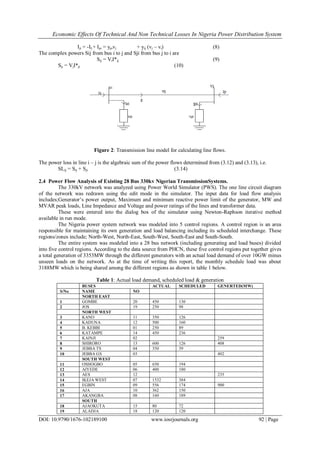
Consider the line connecting the two buses i and j in the figure 2 below. The line current Iij, measured at bus i
and defined positive in the direction i - j is given by
Iij = IL + Iio = yioVi +yij (Vi – Vj) (7)
Similarly, the line current Iij measured at bus j and defined positive in the direction j - i is given by
Preceived
P sent
P loss
Economic Effects Of Technical And Non Technical Losses In Nigeria Power Distribution System
DOI: 10.9790/1676-102189100 www.iosrjournals.org 92 | Page
Iji = -IL+ Ijo = yjovj + yij (vj – vi) (8)
The complex powers Sij from bus i to j and Sji from bus j to i are
Sij = ViI*ij (9)
Sji = VjI*ji (10)
Figure 2: Transmission line model for calculating line flows.
The power loss in line i – j is the algebraic sum of the power flows determined from (3.12) and (3.13), i.e.
SLij = Sij + Sji (3.14)
2.4 Power Flow Analysis of Existing 28 Bus 330kv Nigerian TransmissionSystems.
The 330kV network was analyzed using Power World Simulator (PWS). The one line circuit diagram
of the network was redrawn using the edit mode in the simulator. The input data for load flow analysis
includes;Generator‟s power output, Maximum and minimum reactive power limit of the generator, MW and
MVAR peak loads, Line Impedance and Voltage and power ratings of the lines and transformer data.
These were entered into the dialog box of the simulator using Newton-Raphson iterative method
available in run mode.
The Nigeria power system network was modeled into 5 control regions. A control region is an area
responsible for maintaining its own generation and load balancing including its scheduled interchange. These
regions/zones include; North-West, North-East, South-West, South-East and South-South.
The entire system was modeled into a 28 bus network (including generating and load buses) divided
into five control regions. According to the data source from PHCN, these five control regions put together gives
a total generation of 3353MW through the different generators with an actual load demand of over 10GW minus
unseen loads on the network. As at the time of writing this report, the monthly schedule load was about
3188MW which is being shared among the different regions as shown in table 1 below.
Table 1: Actual load demand, scheduled load & generation
BUSES ACTUAL SCHEDULED GENERTED(MW)
S/No NAME NO
NORTH EAST
1 GOMBE 20 450 130
2 JOS 19 250 98
NORTH WEST
3 KANO 11 350 126
4 KADUNA 12 500 160
5 B. KEBBI 01 250 89
6 KATAMPE 14 450 236
7 KAINJI 02 259
8 SHIRORO 13 600 126 408
9 JEBBA TS 04 350 39
10 JEBBA GS 03 402
SOUTH WEST
11 OSHOGBO 05 650 194
12 AIYEDE 06 400 180
13 AES 12 235
14 IKEJA WEST 07 1532 384
15 EGBIN 09 556 174 900
16 AJA 10 362 150
17 AKANGBA 08 160 189
SOUTH
18 AJAOKUTA 15 80 72
19 ALADJA 18 120 120
Economic Effects Of Technical And Non Technical Losses In Nigeria Power Distribution System
DOI: 10.9790/1676-102189100 www.iosrjournals.org 93 | Page
20 DELTA 26 160 105 281
21 SAPELE 17 140
22 BENIN 16 900 136
SOUTH EAST
23 CALABAR 21 Nil
24 AFAM 23 120 120 60
25 OKPAI 27 220 223
26 NEW HAVEN 24 200 110
27 ALAOJI 22 800 148
28 ONITSHA 25 480 102
TOTAL 10080 3188 3353
The schematic of the existing 330KV Nigeria transmission network with 52 bus and 17 generating stations is
shown in figure 3 below, with each area shown.
Table 2: Generators Installed and Available capacities.
S/N STATION STATE TURBINE INSTALLED
CAPACITY
AVAILABLE
CAPACITY
1 Kainji Niger Hydro 760 259
2 Jebba GS Niger Hydro 504 402
3 Shiroro Niger Hydro 600 408
4 Egbin Lagos Steam 1320 900
5 Sapele Delta Gas 1020 170
6 Okpai Delta Gas 900 223
7 AfamGS Rivers Gas 726 60
9 Delta Delta Gas 912 281
10 Calabar Cross River Gas 563 Nil
Figure 3: Existing 330KV Nigeria Transmission Network
Economic Effects Of Technical And Non Technical Losses In Nigeria Power Distribution System
DOI: 10.9790/1676-102189100 www.iosrjournals.org 94 | Page
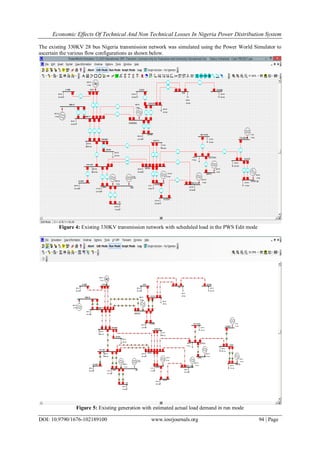
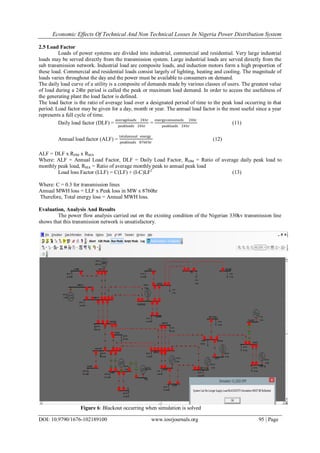
The existing 330KV 28 bus Nigeria transmission network was simulated using the Power World Simulator to
ascertain the various flow configurations as shown below.
Figure 4: Existing 330KV transmission network with scheduled load in the PWS Edit mode
Figure 5: Existing generation with estimated actual load demand in run mode
Economic Effects Of Technical And Non Technical Losses In Nigeria Power Distribution System
DOI: 10.9790/1676-102189100 www.iosrjournals.org 95 | Page
2.5 Load Factor
Loads of power systems are divided into industrial, commercial and residential. Very large industrial
loads may be served directly from the transmission system. Large industrial loads are served directly from the
sub transmission network. Industrial load are composite loads, and induction motors form a high proportion of
these load. Commercial and residential loads consist largely of lighting, heating and cooling. The magnitude of
loads varies throughout the day and the power must be available to consumers on demand.
The daily load curve of a utility is a composite of demands made by various classes of users. The greatest value
of load during a 24hr period is called the peak or maximum load demand. In order to access the usefulness of
the generating plant the load factor is defined.
The load factor is the ratio of average load over a designated period of time to the peak load occurring in that
period. Load factor may be given for a day, month or year. The annual load factor is the most useful since a year
represents a full cycle of time.
Daily load factor (DLF) =
averageloadx 24hr
peakloadx 24hr
=
energyconsumedx 24hr
peakloadx 24hr
(11)
Annual load factor (ALF) =
totalannual energy
peakloadx 8760hr
(12)
ALF = DLF x RDM x RMA
Where: ALF = Annual Load Factor, DLF = Daily Load Factor, RDM = Ratio of average daily peak load to
monthly peak load, RMA = Ratio of average monthly peak to annual peak load
Load loss Factor (LLF) = C(LF) + (I-C)LF2
(13)
Where: C = 0.3 for transmission lines
Annual MWH loss = LLF x Peak loss in MW x 8760hr
Therefore, Total energy loss = Annual MWH loss.
Evaluation, Analysis And Results
The power flow analysis carried out on the existing condition of the Nigerian 330kv transmission line
shows that this transmission network is unsatisfactory.
Figure 6: Blackout occurring when simulation is solved
Economic Effects Of Technical And Non Technical Losses In Nigeria Power Distribution System
DOI: 10.9790/1676-102189100 www.iosrjournals.org 96 | Page
With the present generation capacity of about 3353MW which is far less than one thirds of the actual load
demand, when simulated a BLACKOUT occurred. It was observed that part of the reasons for that was as a
result of:
 Limit voltage violations in majority of the lines
 Any fault in two of the triple circuit line linking Oshogbo and Jebba buses (the major Tie line between the
south and north) can result into failure or separation of the grid network.
 A fault in the transmission line connecting Benin and Onitsha buses (Tie-Line connecting South-South and
South-East)
 A fault in any of the three major buses in the grid network (Benin, Ikeja west, and Oshogbo).
Table 3: Power flow simulations by Newton-Raphson method
After a thorough study of the topology of the grid, it was observed that there is only one viable loop in
the entire system, which ran from Benin-IkejaWest-Aiyede-Oshogbo-Benin. The consequences of this is that in
case of a fault condition in any line or bus, there would be severe consequences on the grid system as a whole
resulting in major loss of power.
Secondly, the distances between the generating stations and the load centers where very long, leading
to a high power loss along the transmission lines. The real power loss in the network under the existing
scheduled load condition amounted to about 154.4MW; this is a fraction of about 7% of the actual real power
generated in the system.
Table 4: Transmission Line and loss Information
BUS INFORMATION
FROM TO
Line
Arrangement
Bus
No
Bus Name Bus
No
Bus Name Line(Km) Circuit
type
Power
Sending
End(MW)
Power
Receiving
End(MW)
Losses
(MW)
A 5 OSHOBGO 16 BENIN 251 S 53.7 50.8 2.9
B 5 OSHOGBO 7 IKJ-WEST 252 S 20.8 20.6 0.2
C 5 OSHOGBO 25 AIYEDE 115 S 79.1 78.1 1.0
D1 4 JEBBA TS 5 OSHOGBO 157 T 102.5 100.9 1.6
D2 4 JEBBA TS 5 OSHOGBO 157 T 102.5 100.9 1.6
D3 4 JEBBA TS 5 OSHOGBO 157 T 102.5 100.9 1.6
Economic Effects Of Technical And Non Technical Losses In Nigeria Power Distribution System
DOI: 10.9790/1676-102189100 www.iosrjournals.org 97 | Page
E1 16 BENIN 7 IKJ-WEST 280 D 31.7 29.8 1.9
E2 16 BENIN 7 IKJ-WEST 137 D 31.7 29.8 1.9
F 25 ONITSHA 16 BENIN 107 S 172.4 155.3 17.1
G 26 DELTA PS 16 BENIN 107 S 107.2 105.9 1.3
H1 17 SAPELE 16 BENIN 50 D 32.3 32.1 0.2
H2 17 SAPELE 16 BENIN 50 D 32.3 32.1 0.2
I1 16 BENIN 15 AJAOKUTA 195 D 36.2 36.0 0.2
I2 16 BENIN 15 AJAOKUTA 195 D 36.2 36.0 0.2
J 7 IKJ-WEST 6 AIYEDE 137 S 104.2 101.9 2.3
K 7 IKJ-WEST 8 AKANGBA 17 S 189.9 189.0 0.9
L1 9 EGBIN PS 7 IKJ-WEST 62 D 325.8 319.7 6.1
L2 9 EGBIN PS 7 IKJ-WEST 62 D 325.8 319.7 6.1
M 5 JOS 20 GOMBE 264 S 155.4 130.0 25.4
N 28 KADUNA 19 JOS 196 S 282.7 253.4 29.3
O 27 OKPAI 25 ONITSHA 28 S 371.7 369.4 2.3
P 25 ONITSHA 24 N.HAVEN 96 S 110.4 110.0 0.4
Q 25 ONITSHA 22 ALAOJI 138 S 15.4 15.4 0.0
R1 13 SHIRORO 14 ABUJA 144 D 118.3 118.0 0.3
R2 13 SHIRORO 14 ABUJA 144 D 118.3 118.0 0.3
S 28 AES 9 EGBIN PS S 235.0 220.0 15.0
T1 9 EGBIN PS 10 AJA 16 D 75.0 75.0 0.0
T2 9 EGBIN PS 10 AJA 16 D 75.0 75.0 0.0
U 26 DELTA PS 18 ALADJA 32 S 185.8 185.0 0.8
V 21 CALABAR 22 ALAOJI S 0.0 0.0 0.0
W 18 ALADJA 17 SAPELE 63 S 65.0 64.6 0.4
X 12 KADUNA 11 KANO 230 S 127.0 126.0 1.0
Y1 23 AFAM GS 22 ALAOJI 25 D 82.5 81.7 0.8
Y2 23 AFAM GS 22 ALAOJI 25 D 82.5 81.7 0.8
Z1 3 JEBBA GS 4 JEBBA TS 8 D 169.5 168.6 0.9
Z2 3 JEBBA GS 4 JEBBA TS 8 D 169.5 168.6 0.9
AA1 2 KAINJI 4 JEBBA TS 81 D 219.3 218.2 1.1
AA2 2 KAINJI 4 JEBBA TS 81 D 219.3 218.2 1.1
BB1 4 JEBBA TS 13 SHIRORO 244 D 272.8 265.6 7.2
BB2 4 JEBBA TS 13 SHIRORO 244 D 272.8 265.6 7.2
CC 2 KAINJI 1 B. KEBBI 310 S 89.9 89.0 0.9
DD1 13 SHIRORO 12 KADUNA 96 D 290.7 285.2 5.5
DD2 13 SHIRORO 12 KADUNA 96 D 290.7 285.2 5.5
Figure 7: Graphical representation of line losses
Table 5: Regional losses
REGION TOTAL LOSS(MW) % LOSS
SOUTH WEST 42.8 39.41068
SOUTH SOUTH 3.3 3.038674
SOUTH EAST 4.3 3.959484
NORTH WEST 32.6 30.01842
NORTH EAST 25.6 23.57274
108.6
Economic Effects Of Technical And Non Technical Losses In Nigeria Power Distribution System
DOI: 10.9790/1676-102189100 www.iosrjournals.org 98 | Page
Figure 8: Chart showing the zonal losses
Table 6: Tie Line losses in transmission network
TIE LINE LOSSES
SW/SS 6.7
SW/NW 4.8
SS/SE 17.1
NW/NE 29
TOTAL 57.6
Figure 9: Pie chart representation of losses in the tie-lines.
From the figure 9, it was observed that the Tie-line from Kaduna to Jos (NW/NE Zone) presented the
highest amount of loss of 29.3MW which is about 50.35% of the total loss in the network. This large amount of
loss can be linked to the long length of the transmission line which was 196km, the fairness of these buses from
a generating station, the single circuit line used for transmission and the limit voltage violation at these buses.
The Tie line from Oshogbo to Jebba (SW/NW) has the lowest amount of power loss of 4.8MW; this is
about 8.3% of the total losses in the network. This low loss is attributed to the closeness of these buses from the
generating stations in the grid, the triple circuit transmission line running from Jebba to Oshogbo.
Looking at the losses in the grid from the zoning perspective, it would be observed in Figure 7 that the
South-South zone has the lowest amount of loss of 3.3MW which is about 3.04% of the total loss in the
network, this was not strange because there are over 3 generators in this region and secondly the transmission
lines linking buses in this zone are of the medium type. While the South-West zone has the highest amount of
loss of 42.8MW which is about 39.41% of the total loss in the network.
From Table 3, it was observed that the transmission line linking Jos to Gombe has the highest loss in a single
region of 25.4MW which is about 16.45% of the total loss in the network.
Economic Effects Of Technical And Non Technical Losses In Nigeria Power Distribution System
DOI: 10.9790/1676-102189100 www.iosrjournals.org 99 | Page
Table 7: Hourly load demand for Ajaokuta bus
Time(hour) 1 2 3 4 5 6 7 8 9 10 11 12
Load(MW) 30 25 27 27 27 32 38 35 32 25 23 25
Time(hour) 13 14 15 16 17 18 19 20 21 22 23 24
Load(MW) 27 41 41 52 25 25 38 47 43 38 32 25
Table 8: Daily load demand for Ajaokuta bus
Time(days) 1 2 3 4 5 6 7 8 9 10 11
Load(MW) 59 63 62 64 58 58 50 56 57 47 49
Time(days) 12 13 14 15 16 17 18 19 20 21 22
Load(MW) 48 45 55 57 70 72 70 55 55 65 50
Time(days) 23 24 25 26 27 28 29 30 31
Load(MW) 64 55 60 61 50 58 54 70 72
Table 9: Monthly load demand for Ajaokuta bus
Time(months) 1 2 3 4 5 6 7 8 9 10 11 12
70 62 68 67 62 55 59 72 71 70 68 64
From table 6, the daily load factor is calculated as:
Daily average load =
𝑡𝑜𝑡𝑎𝑙𝑙𝑜𝑎𝑑
24 ℎ𝑜𝑢𝑟
=
700
24
= 32.5 MW
Daily load factor =
𝑑𝑎𝑖𝑙𝑦𝑎𝑣𝑒𝑟𝑎𝑔𝑒𝑙𝑜𝑎𝑑
𝑝𝑒𝑎𝑘𝑙𝑜𝑎𝑑
=
32.5
47
= 0.6915
From Table 7, the monthly load factor is calculated as:
Monthly average load =
𝑡𝑜𝑡𝑎𝑙𝑙𝑜𝑎𝑑
31 ℎ𝑜𝑢𝑟
=
1809
31
= 58.35MW
Monthly load factor =
𝑚𝑜𝑛𝑡 ℎ𝑙𝑦𝑎𝑣𝑒𝑟𝑎𝑔𝑒𝑙𝑜𝑎𝑑
𝑝𝑒𝑎𝑘𝑙𝑜𝑎𝑑
= RDM
=
58.35
72
= 0.8104
From Table 8, the annual load factor is calculated as:
Average monthly load =
𝑡𝑜𝑡𝑎𝑙𝑚𝑜𝑛𝑡 ℎ𝑙𝑦𝑙𝑜𝑎𝑑
12 𝑚𝑜𝑛𝑡 ℎ
=
788
12
= 65.67 MW
RMA=
𝑎𝑣𝑒𝑟𝑎𝑔𝑒𝑚𝑜𝑛𝑡 ℎ𝑙𝑦𝑙𝑜𝑎𝑑
𝑝𝑒𝑎𝑘𝑙𝑜𝑎𝑑
=
65.67
72
= 0.912
Thus Annual Load Factor = DLF xRDMx RMA
= 0.6915 x 0.8104 x 0.912
= 0.5111
Load Loss Factor (LLF) = C (LF) + (1-C) LF2
Where C = 0.3 for transmission lines
LLF = 0.3(0.5111) + (1 – 0.3)0.51112
= 0.3362
Annual MWH Loss = LLF x Peak Loss in MW x 8760
= 0.3362 x 154.4 x 8760
= 454.73GW
Thus the real power losses in the network under the existing condition amounted to 154.4MW. The energy loss
estimated as at October 2012 due to 330kV transmission lines was found to be 454.73GW which amounted to
over 4.4 billion naira using the average billing rate of that year which was at
N11.10 = 1kW.
III. Conclusion And Recommendation
The Nigerian 330Kv transmission network is faced with various problems. This paper has focused on
the technical and non-technical losses estimated in the network. The network is characterized by high voltage
Economic Effects Of Technical And Non Technical Losses In Nigeria Power Distribution System
DOI: 10.9790/1676-102189100 www.iosrjournals.org 100 | Page
drops and power losses which can be attributed to low generation, long and fragile radial network, making it
highly prone to failure, unreliability, inefficiency and poor performance. The energy loss at October 2012 due to
the 330Kv transmission network is about 454.73 GW amounting to over 4.4 billion naira.
The technical information provided in this paper forms a veritable database for future work towards improving
Nigeria‟s power system operation. It is highly recommended that
 The length of transmission and distribution lines should be as short as possible by introducing more
substations in the network. Voltage drops and power losses increase with increase in the line length and
loading.
 While the expanded network is graduallybeing implemented, the existing transmission lines and substations
should be upgraded to improve voltage profile of vulnerable buses like Gombe, Damaturu, Jos and
Kumbotso buses with appropriately sized VAR compensators.
 By fortifying the expanded grid, that is, double and triple circuits should be used to replace those lines with
single circuits to increase the efficiency and the reliability of the network.
 Provision of multiple loops in a fortified network will guarantee continuity of supply in the event of any
contingency or fault.
 Provision of two double circuit transmission lines to interconnect Egbin and Oshogbo, and double circuit
lines to connect Oshogbo to Aieyede and Kainji to Birin-Kebbi will greatly enhance the efficient operation
of the grid.
 Provision of adequate generation capacity in each zone of the Federation through distributed generation
scheme to minimize line losses and cost of power spiraling.
 The government should implement the Independent Power Projects for lack of political will and policy
inconsistency was responsible for the power sector to deliver 6,000MW last December
 Existing power stations should be rehabilitated and the transmission lines that are over age should be
replaced
 Planned and routine maintenance should be carried out on the network.
If all these recommendations are looked into as well as those from future research on this topic by
stakeholders in the power sector, then we can look forward to having a system with reliable and efficient
power supply.
References
[1]. Archibong P.E. (1997): The Status of Supporting Infrastructural Facilities and Services for non-oil sector Development, CBN
Economic and Financial review, 28(21): 23-42.
[2]. Ayodele A.S. (1998): Energy Crisis in Nigeria: The case of Electric Energy Market, Bullion Publication of CBN, 22(4): 19-23.
[3]. Izuegbunam F.I, Duruibe S.I and Ojukwu G.G (2011): Power flow and Contingency Assessment Simulation of the expanding
330KV Nigerian Grid Using Power World Simulator, JETEAS 2(6): 1002-1008, ISSN: 2141-7016.
[4]. Jiguparmar (2013): Total Losses in Power Distribution and Transmission Lines, Electrical Engineering Portal.
[5]. Navani J.P., Sharma N.K. and SonalSarpa (2003): “A Case Study of analysis of Technical and Non-Technical Losses in Power
System and its Impact on Power Sector”, International Journal of Advances in Engineering Science and Technology, Vol 1, Issue 2,
pp. 137-146, ISSN: 2319-1120.
[6]. Odumosu T. (2005): Africa needs power for NEPAD to work in Energy in Africa 2(1): 34.
[7]. Omorogiuwa E. and Odiase O. F. (2011): Optimal Location of IPFC in Nigeria 330KV Integrated Power Network Using GA
Technique, University of Port Harcourt: 35-39.
[8]. Onohaebi O.S (2007): Reduction of the High Technical Power Losses Associated with the Nigerian 330KV Transmission Network,
IJEPE 4(5): 421-431.
[9]. P.H.C.N Control Centre, Abuja (2012): Generation and Transmission Grid Operations; Annual Technical Report for 2012.
[10]. Power World Co-operation, Power World Simulator, Version 12.0, Glover/Sarma Build, March 30, 2007, licensed only for
Evaluation and University Educational use, 1996 – 2007.
[11]. Subair K. and Oke D.M. (2008): Privatization and Trends of Aggregate Consumption of Electricity in Nigeria: An Emperical
Analysis, African Journal of Accounting, Economics, Finance and Banking Research 3(3) 18-27.
[12]. Suriyamongkol D. (2002):Non-Technical Losses in Electrical Power Systems, In Fritz I. and Dolores H. Russ College of
Engineering and Technology, Ohio University.
[13]. Upong I.I. (1976): “An Analysis of the causes of Power Shortage in Nigeria”, The Nigerian Journal of Economic and Social studies,
Vol.18, pp. 34-49.
[14]. Wikipedia Encyclopedia: “Electrical Power Transmission”.
[15]. World Bank Group Energy Sector Strategy (2009): Reducing Technical and Non-Technical Losses in the Power Sector.
[16]. World Energy Council (2007):African Forum on Energy Efficiency, Abuja, Nigeria.

L0102189100

  • 1.
    IOSR Journal ofElectrical and Electronics Engineering (IOSR-JEEE) e-ISSN: 2278-1676,p-ISSN: 2320-3331, Volume 10, Issue 2 Ver. I (Mar – Apr. 2015), PP 89-100 www.iosrjournals.org DOI: 10.9790/1676-102189100 www.iosrjournals.org 89 | Page Economic Effects of Technical and Non Technical Losses in Nigeria Power Transmission System 1 Omorogiuwa Eseosa and 2 Elechi Promise 1 Department of Electrical/Electronic Engineering, University of Port Harcourt, Port Harcourt 2 Department of Electrical Engineering, Rivers State University of science and Technology, Port Harcourt Abstract: The Nigerian 330Kv transmission network is faced with various problems. This paper has focused on the technical and non-technical losses estimated in the network. The network is characterized by high voltage drops and power losses which can be attributed to low generation, long and fragile radial network, making it highly prone to failure, unreliability, inefficiency and poor performance. The network was analyzed using Power World Simulator (PWS), the result showed that the energy loss due to the 330Kv transmission network is about 454.73 GW amounting to over 4.4 billion naira. Keywords:Transmission, Losses, Technical, Energy, Electricity. I. Introduction Electric power system involves the way in which electricity is generated and distributed. The rate of transmission and distribution losses in Nigeria has been quite high based on an article published by the World Bank group (2012) estimating the annuallossof Nigeria due to electricity theft to be in the billions of naira. According to the World Bank group, about 25% of electricity generated revenues indebted are actually retrieved making Nigeria‟s condition one of the worst. Generally, the operating cost of electric utilities is increased by system losses therefore reflecting in the cost of electricity. It would be unfair to the consumers if alternatively, the burden of these losses, no matter the magnitude, were passed on fully to them. Hence there would be no incentive for utility companies to put in effect loss reduction measures. This is because the certain losses caused by operating inefficiencies of the utility companies would be passed on also. On the other hand, unfair if the entire burden of system losses is left for the utility companies to handle. Singh (2009) referred the term „distribution losses‟ to the difference between the amount of energy delivered to the distribution system and the quantity of energy consumers are actually billed. So in the end everyone is affected by system losses, the electric utilities, the consumer and the nation as a whole. These electrical transmission and distribution line losses that electrical utility companies are greatly affected by are made up of two major constituents: technical and non-technical. 1.1Technical Losses Technical losses in transmission systems are caused by the physical properties of the components of the power system. These technical losses are normally 22.5%, and directly depend on the network characteristics and the mode of operation (Parmar, 2013).These technical losses are of two types, Permanent technical losses which are naturally occurring losses (internal action to the power system), basically caused by the dispersal of heat resulting from current passing through conductors and from magnetic losses in transformers. And secondly, Variable technical losses which vary based on the amount of electricity distributed and are, more precisely, proportional to the square of the current. 1.2 Non-Technical Losses These are caused by external actions not related to the physical characteristics and functions of the power system, primarily by human error (intentional or not). This could also be caused by conditions and loads that weren‟t considered during theevaluation of technical losses. Non-technical losses include energy lost due to meter tampering, bypassing the meter and meter/ billing inaccuracies. Losses due to metering inaccuracies are defined as: the difference between the amount of energy actually delivered through the meters and the amount registered by the meters(Navani et al, 2003). The problem is that these losses are really difficult to calculate because system operators don‟t usually account for them and hence have no recorded information. Suriyamongkol (2002) states that, in practice, administrative losses are determinant of proper measurement, thus the accuracy of the estimate of non-technical losses depends hugely on the accuracy of the estimation of technical losses. In definition, therefore, non-technical losses are the residual loss remaining from the subtraction of the precise computation of administrative and technical losses from the total distribution network losses (Fritz and Dolores, 2002).
  • 2.
    Economic Effects OfTechnical And Non Technical Losses In Nigeria Power Distribution System DOI: 10.9790/1676-102189100 www.iosrjournals.org 90 | Page The major issues affecting the Nigerian power sector are losses generated during the transmission and distribution of power and the steps taken to minimize the effects of these losses. Stated by the International Energy Agency (2011), the value of electric power transmission and distribution losses (% of output) in Nigeria was 17.72 as of 2010, with a maximum value of 49.27 in 1981 and a minimum value of 5.87 in 2009. These numbers are really high in comparison to the transmission and distribution losses of about 7 – 8% in developed countries. The reduction of these losses is important for economic growth because the utility companies such as the Transmission Company of Nigeria (TCN) will not take entire responsibility for them hence shifting a good percent to the consumers. An increase in losses eventually would increase the cost of electricity. Consumers who do not comply with this increase would simply be „cut-off‟, also increases load shedding which is the deliberate shutting off of power to parts of the electricity network, hence to consumers in that area. Aim of this research is to study the nature of technical and non-technical losses in transmission systems and their impact on the power sector and economic growth in Nigeria. To achieve this objectives, visits to various TCN stations was carried out. Also data from reports, literatures, survey carried out and published by the World Bank group, National Electricity Regulatory Commission (NERC) and other researchers‟ works were used and simulated using Power World Simulator. The importance of an effective and efficient energy sector to a developing economy such as Nigeria, India etc. and how to improve on this efficiency by adopting different methodologies that conserve and eradicate line losses, will be reviewed.Ayodele (1998), made it clear that the electricity crisis in Nigeria makes many of her inhabitants, most especially the poor, miserable. Archibong (1997) argued that the positive side of the Structural Adjustment Program (SAP) could not be fully established due basically to numerous bottlenecks, rigidities and poor infrastructure especially in electricity supply. This undermined the effectiveness of fiscal and other incentives designed to simulate the growth and diversification of the economy.Upong (1976) established the existence of a positive relationship between electricity consumption and economic development. In addition, he submitted that the expansion of the energy sector on the supply side is an important factor for accelerating the growth of the industrial sector.Subair and Oke (2008), pointed out that the presence of suspicion and conflict between power distribution officials and consumers have given rise to illegitimate activities such as electricity theft, illegal connections to either the existing residential terminals or the national grid, under/overbilling by officials. Onohaebi (2007) studied the Nigerian 330kV transmission network and proposed a modified network which incorporated some additional lines to form more loops and minimal compensation, meting the acceptable voltage limits of ±5%. It also reduces the power losses in his simulations from 337.5 MWH to 189.9 MWH, representing 45% improvement over the existing network and enhances reliability and security of the transmission grid. Omorogiuwa and Odiase, (2011) in their analysis of the Nigerian Transmission network proposed the implementation of Interline Power Flow Controllers (IPFC), which is a modern control Flexible Alternating Current Transmission System (FACTS) device on the network, using Genetic Algorithm (GA) for its optimal placement and an option for power improvement. The result obtained showed improvement of weak bus voltages and loss reduction with IPFC devices on incorporation in the network. Izuegbunam et al. (2011) also proposed a fortified and expanded grid schematic of the 330kV transmission system in which after simulation initial losses of 85.3MW were reduced substantially to 24.7MW. 1.3 Effect of Power Losses on the Nigerian Economy Transmitting electricity at high voltage reduces the fraction of power lost due to joule heating. For a given amount of power, a higher voltage reduces the current and thus the resistive losses in the conductor. For example, raising the voltage by a factor of 10 reduces the current by a corresponding factor of 10 and therefore the copper losses (I2 R) by a factor of 100, provided the same type of conductor is used in both cases. World Bank Data of 2010 states that, Transmission and distribution losses in the US and UK were established at 7.2% and 7.4% respectively. Of this value, less than 1% can be attributed to transmission losses even across the greatest of distances. Countries such as China that have attached importance to loss minimization to enhance efficiency have about 13% transmission and distribution losses. India, Pakistan, Thailand, Philippines, Korea, Japan have an estimate of about 22%, 28%, 18%, 18%, 12.5% and 9% losses respectively. This reduction in losses in these countries can be attributed to technological advancement and installation of generating stations near load centers. In Nigeria, PHCN‟s severe technological deficiencies are prevalent throughout the power system both up and down stream. For example, with the advancement of modern technology, about 40% of the energy consumed by thermal plants can be converted to electrical energy. As Nigeria lacks the technology for such, the figure can be as low as 12% of the power produced in which there is further loss through transmission and distribution. Losses in transmission and distribution lines in Nigeria are peaked at 44.5% of power generated. The transmission lines alone were estimated at 9.2% of this value. It is impossible to determine exactly how much of this inefficiency is due to illegal power connections or under investment in technology. Lack of modern
  • 3.
    Economic Effects OfTechnical And Non Technical Losses In Nigeria Power Distribution System DOI: 10.9790/1676-102189100 www.iosrjournals.org 91 | Page standardized components and qualified maintenance staff pose serious problems for adequate power generation and distribution. II. Materials And Method 2.1 Analysis of Technical losses in power system Technical losses in power system can be defined as power losses incurred by the physical properties of components in the power systems‟ infrastructure. These losses include those in the conductors, transmission line equipment, transformers, buses, distribution line and magnetic losses in transformers. Technical losses are normally at 22.5%, and depend directly on the characteristics and mode of operation of the network (Parmar, 2013). Considering a transmission network of figure 1 below Figure 1: Relationship between power received, sent and lost The average power losses in a transmission line can be expressed as Ploss = Psent– Preceived (1) Where P sent is the average power that the source injects into the transmission line and P received is the power consumed by the load. In this equation, both power and current functions are dependent on time. Energy is power accumulated over time, or W loss= Ploss t dt b a (2) Where a andb are the starting and ending time intervals being evaluated respectively. We need an accurate description of P loss as a function of time to make a reliable prediction of the energy loss. And power, in a single phase case, with sinusoidal voltage and current can be represented by P1-φ= IV cosƟ (3) WhereP=average power, V=rms voltage, I=rms current, cosƟ=power factor, with Ɵ being the phase difference. 2.2 Basic Load Flow and Loss Calculations Electrical power that flows through power systems consist of real (P) and reactive (Q) power and the two components combine to make apparent power(S) S = P2 + Q2 (4) The apparent power (S) generated or consumed by a given element in the power system is the product of the phasor voltage across it and the complex conjugate of the phasor current through it. The real and reactive power in turn, can be calculated using the apparent power and the angle representing the phase difference between the current and voltage, known as the power factor angle (Ɵ) S = VI* } (5) S = P + jQ The voltage and current have their own relationships based on ohms law V = IZ } (6) Z = R + jX Where Z, R and X are the element‟s impedances, resistance and reactance respectively. It is worth noting that all the quantities represent steady state, single phase operation. Through all power systems that operate with more than 220V are 3 phase systems, the discussions and calculation here will treat the value as a single phase equivalent. In order to do this, the 3 phase is assumed balanced i.e, all 3 phases have exactly the same amount of power flowing through each of them. The general practice in power flow studies is to identify three types of buses in the network. 2.3 Line Flow and Losses Consider the line connecting the two buses i and j in the figure 2 below. The line current Iij, measured at bus i and defined positive in the direction i - j is given by Iij = IL + Iio = yioVi +yij (Vi – Vj) (7) Similarly, the line current Iij measured at bus j and defined positive in the direction j - i is given by Preceived P sent P loss
  • 4.
    Economic Effects OfTechnical And Non Technical Losses In Nigeria Power Distribution System DOI: 10.9790/1676-102189100 www.iosrjournals.org 92 | Page Iji = -IL+ Ijo = yjovj + yij (vj – vi) (8) The complex powers Sij from bus i to j and Sji from bus j to i are Sij = ViI*ij (9) Sji = VjI*ji (10) Figure 2: Transmission line model for calculating line flows. The power loss in line i – j is the algebraic sum of the power flows determined from (3.12) and (3.13), i.e. SLij = Sij + Sji (3.14) 2.4 Power Flow Analysis of Existing 28 Bus 330kv Nigerian TransmissionSystems. The 330kV network was analyzed using Power World Simulator (PWS). The one line circuit diagram of the network was redrawn using the edit mode in the simulator. The input data for load flow analysis includes;Generator‟s power output, Maximum and minimum reactive power limit of the generator, MW and MVAR peak loads, Line Impedance and Voltage and power ratings of the lines and transformer data. These were entered into the dialog box of the simulator using Newton-Raphson iterative method available in run mode. The Nigeria power system network was modeled into 5 control regions. A control region is an area responsible for maintaining its own generation and load balancing including its scheduled interchange. These regions/zones include; North-West, North-East, South-West, South-East and South-South. The entire system was modeled into a 28 bus network (including generating and load buses) divided into five control regions. According to the data source from PHCN, these five control regions put together gives a total generation of 3353MW through the different generators with an actual load demand of over 10GW minus unseen loads on the network. As at the time of writing this report, the monthly schedule load was about 3188MW which is being shared among the different regions as shown in table 1 below. Table 1: Actual load demand, scheduled load & generation BUSES ACTUAL SCHEDULED GENERTED(MW) S/No NAME NO NORTH EAST 1 GOMBE 20 450 130 2 JOS 19 250 98 NORTH WEST 3 KANO 11 350 126 4 KADUNA 12 500 160 5 B. KEBBI 01 250 89 6 KATAMPE 14 450 236 7 KAINJI 02 259 8 SHIRORO 13 600 126 408 9 JEBBA TS 04 350 39 10 JEBBA GS 03 402 SOUTH WEST 11 OSHOGBO 05 650 194 12 AIYEDE 06 400 180 13 AES 12 235 14 IKEJA WEST 07 1532 384 15 EGBIN 09 556 174 900 16 AJA 10 362 150 17 AKANGBA 08 160 189 SOUTH 18 AJAOKUTA 15 80 72 19 ALADJA 18 120 120
  • 5.
    Economic Effects OfTechnical And Non Technical Losses In Nigeria Power Distribution System DOI: 10.9790/1676-102189100 www.iosrjournals.org 93 | Page 20 DELTA 26 160 105 281 21 SAPELE 17 140 22 BENIN 16 900 136 SOUTH EAST 23 CALABAR 21 Nil 24 AFAM 23 120 120 60 25 OKPAI 27 220 223 26 NEW HAVEN 24 200 110 27 ALAOJI 22 800 148 28 ONITSHA 25 480 102 TOTAL 10080 3188 3353 The schematic of the existing 330KV Nigeria transmission network with 52 bus and 17 generating stations is shown in figure 3 below, with each area shown. Table 2: Generators Installed and Available capacities. S/N STATION STATE TURBINE INSTALLED CAPACITY AVAILABLE CAPACITY 1 Kainji Niger Hydro 760 259 2 Jebba GS Niger Hydro 504 402 3 Shiroro Niger Hydro 600 408 4 Egbin Lagos Steam 1320 900 5 Sapele Delta Gas 1020 170 6 Okpai Delta Gas 900 223 7 AfamGS Rivers Gas 726 60 9 Delta Delta Gas 912 281 10 Calabar Cross River Gas 563 Nil Figure 3: Existing 330KV Nigeria Transmission Network
  • 6.
    Economic Effects OfTechnical And Non Technical Losses In Nigeria Power Distribution System DOI: 10.9790/1676-102189100 www.iosrjournals.org 94 | Page The existing 330KV 28 bus Nigeria transmission network was simulated using the Power World Simulator to ascertain the various flow configurations as shown below. Figure 4: Existing 330KV transmission network with scheduled load in the PWS Edit mode Figure 5: Existing generation with estimated actual load demand in run mode
  • 7.
    Economic Effects OfTechnical And Non Technical Losses In Nigeria Power Distribution System DOI: 10.9790/1676-102189100 www.iosrjournals.org 95 | Page 2.5 Load Factor Loads of power systems are divided into industrial, commercial and residential. Very large industrial loads may be served directly from the transmission system. Large industrial loads are served directly from the sub transmission network. Industrial load are composite loads, and induction motors form a high proportion of these load. Commercial and residential loads consist largely of lighting, heating and cooling. The magnitude of loads varies throughout the day and the power must be available to consumers on demand. The daily load curve of a utility is a composite of demands made by various classes of users. The greatest value of load during a 24hr period is called the peak or maximum load demand. In order to access the usefulness of the generating plant the load factor is defined. The load factor is the ratio of average load over a designated period of time to the peak load occurring in that period. Load factor may be given for a day, month or year. The annual load factor is the most useful since a year represents a full cycle of time. Daily load factor (DLF) = averageloadx 24hr peakloadx 24hr = energyconsumedx 24hr peakloadx 24hr (11) Annual load factor (ALF) = totalannual energy peakloadx 8760hr (12) ALF = DLF x RDM x RMA Where: ALF = Annual Load Factor, DLF = Daily Load Factor, RDM = Ratio of average daily peak load to monthly peak load, RMA = Ratio of average monthly peak to annual peak load Load loss Factor (LLF) = C(LF) + (I-C)LF2 (13) Where: C = 0.3 for transmission lines Annual MWH loss = LLF x Peak loss in MW x 8760hr Therefore, Total energy loss = Annual MWH loss. Evaluation, Analysis And Results The power flow analysis carried out on the existing condition of the Nigerian 330kv transmission line shows that this transmission network is unsatisfactory. Figure 6: Blackout occurring when simulation is solved
  • 8.
    Economic Effects OfTechnical And Non Technical Losses In Nigeria Power Distribution System DOI: 10.9790/1676-102189100 www.iosrjournals.org 96 | Page With the present generation capacity of about 3353MW which is far less than one thirds of the actual load demand, when simulated a BLACKOUT occurred. It was observed that part of the reasons for that was as a result of:  Limit voltage violations in majority of the lines  Any fault in two of the triple circuit line linking Oshogbo and Jebba buses (the major Tie line between the south and north) can result into failure or separation of the grid network.  A fault in the transmission line connecting Benin and Onitsha buses (Tie-Line connecting South-South and South-East)  A fault in any of the three major buses in the grid network (Benin, Ikeja west, and Oshogbo). Table 3: Power flow simulations by Newton-Raphson method After a thorough study of the topology of the grid, it was observed that there is only one viable loop in the entire system, which ran from Benin-IkejaWest-Aiyede-Oshogbo-Benin. The consequences of this is that in case of a fault condition in any line or bus, there would be severe consequences on the grid system as a whole resulting in major loss of power. Secondly, the distances between the generating stations and the load centers where very long, leading to a high power loss along the transmission lines. The real power loss in the network under the existing scheduled load condition amounted to about 154.4MW; this is a fraction of about 7% of the actual real power generated in the system. Table 4: Transmission Line and loss Information BUS INFORMATION FROM TO Line Arrangement Bus No Bus Name Bus No Bus Name Line(Km) Circuit type Power Sending End(MW) Power Receiving End(MW) Losses (MW) A 5 OSHOBGO 16 BENIN 251 S 53.7 50.8 2.9 B 5 OSHOGBO 7 IKJ-WEST 252 S 20.8 20.6 0.2 C 5 OSHOGBO 25 AIYEDE 115 S 79.1 78.1 1.0 D1 4 JEBBA TS 5 OSHOGBO 157 T 102.5 100.9 1.6 D2 4 JEBBA TS 5 OSHOGBO 157 T 102.5 100.9 1.6 D3 4 JEBBA TS 5 OSHOGBO 157 T 102.5 100.9 1.6
  • 9.
    Economic Effects OfTechnical And Non Technical Losses In Nigeria Power Distribution System DOI: 10.9790/1676-102189100 www.iosrjournals.org 97 | Page E1 16 BENIN 7 IKJ-WEST 280 D 31.7 29.8 1.9 E2 16 BENIN 7 IKJ-WEST 137 D 31.7 29.8 1.9 F 25 ONITSHA 16 BENIN 107 S 172.4 155.3 17.1 G 26 DELTA PS 16 BENIN 107 S 107.2 105.9 1.3 H1 17 SAPELE 16 BENIN 50 D 32.3 32.1 0.2 H2 17 SAPELE 16 BENIN 50 D 32.3 32.1 0.2 I1 16 BENIN 15 AJAOKUTA 195 D 36.2 36.0 0.2 I2 16 BENIN 15 AJAOKUTA 195 D 36.2 36.0 0.2 J 7 IKJ-WEST 6 AIYEDE 137 S 104.2 101.9 2.3 K 7 IKJ-WEST 8 AKANGBA 17 S 189.9 189.0 0.9 L1 9 EGBIN PS 7 IKJ-WEST 62 D 325.8 319.7 6.1 L2 9 EGBIN PS 7 IKJ-WEST 62 D 325.8 319.7 6.1 M 5 JOS 20 GOMBE 264 S 155.4 130.0 25.4 N 28 KADUNA 19 JOS 196 S 282.7 253.4 29.3 O 27 OKPAI 25 ONITSHA 28 S 371.7 369.4 2.3 P 25 ONITSHA 24 N.HAVEN 96 S 110.4 110.0 0.4 Q 25 ONITSHA 22 ALAOJI 138 S 15.4 15.4 0.0 R1 13 SHIRORO 14 ABUJA 144 D 118.3 118.0 0.3 R2 13 SHIRORO 14 ABUJA 144 D 118.3 118.0 0.3 S 28 AES 9 EGBIN PS S 235.0 220.0 15.0 T1 9 EGBIN PS 10 AJA 16 D 75.0 75.0 0.0 T2 9 EGBIN PS 10 AJA 16 D 75.0 75.0 0.0 U 26 DELTA PS 18 ALADJA 32 S 185.8 185.0 0.8 V 21 CALABAR 22 ALAOJI S 0.0 0.0 0.0 W 18 ALADJA 17 SAPELE 63 S 65.0 64.6 0.4 X 12 KADUNA 11 KANO 230 S 127.0 126.0 1.0 Y1 23 AFAM GS 22 ALAOJI 25 D 82.5 81.7 0.8 Y2 23 AFAM GS 22 ALAOJI 25 D 82.5 81.7 0.8 Z1 3 JEBBA GS 4 JEBBA TS 8 D 169.5 168.6 0.9 Z2 3 JEBBA GS 4 JEBBA TS 8 D 169.5 168.6 0.9 AA1 2 KAINJI 4 JEBBA TS 81 D 219.3 218.2 1.1 AA2 2 KAINJI 4 JEBBA TS 81 D 219.3 218.2 1.1 BB1 4 JEBBA TS 13 SHIRORO 244 D 272.8 265.6 7.2 BB2 4 JEBBA TS 13 SHIRORO 244 D 272.8 265.6 7.2 CC 2 KAINJI 1 B. KEBBI 310 S 89.9 89.0 0.9 DD1 13 SHIRORO 12 KADUNA 96 D 290.7 285.2 5.5 DD2 13 SHIRORO 12 KADUNA 96 D 290.7 285.2 5.5 Figure 7: Graphical representation of line losses Table 5: Regional losses REGION TOTAL LOSS(MW) % LOSS SOUTH WEST 42.8 39.41068 SOUTH SOUTH 3.3 3.038674 SOUTH EAST 4.3 3.959484 NORTH WEST 32.6 30.01842 NORTH EAST 25.6 23.57274 108.6
  • 10.
    Economic Effects OfTechnical And Non Technical Losses In Nigeria Power Distribution System DOI: 10.9790/1676-102189100 www.iosrjournals.org 98 | Page Figure 8: Chart showing the zonal losses Table 6: Tie Line losses in transmission network TIE LINE LOSSES SW/SS 6.7 SW/NW 4.8 SS/SE 17.1 NW/NE 29 TOTAL 57.6 Figure 9: Pie chart representation of losses in the tie-lines. From the figure 9, it was observed that the Tie-line from Kaduna to Jos (NW/NE Zone) presented the highest amount of loss of 29.3MW which is about 50.35% of the total loss in the network. This large amount of loss can be linked to the long length of the transmission line which was 196km, the fairness of these buses from a generating station, the single circuit line used for transmission and the limit voltage violation at these buses. The Tie line from Oshogbo to Jebba (SW/NW) has the lowest amount of power loss of 4.8MW; this is about 8.3% of the total losses in the network. This low loss is attributed to the closeness of these buses from the generating stations in the grid, the triple circuit transmission line running from Jebba to Oshogbo. Looking at the losses in the grid from the zoning perspective, it would be observed in Figure 7 that the South-South zone has the lowest amount of loss of 3.3MW which is about 3.04% of the total loss in the network, this was not strange because there are over 3 generators in this region and secondly the transmission lines linking buses in this zone are of the medium type. While the South-West zone has the highest amount of loss of 42.8MW which is about 39.41% of the total loss in the network. From Table 3, it was observed that the transmission line linking Jos to Gombe has the highest loss in a single region of 25.4MW which is about 16.45% of the total loss in the network.
  • 11.
    Economic Effects OfTechnical And Non Technical Losses In Nigeria Power Distribution System DOI: 10.9790/1676-102189100 www.iosrjournals.org 99 | Page Table 7: Hourly load demand for Ajaokuta bus Time(hour) 1 2 3 4 5 6 7 8 9 10 11 12 Load(MW) 30 25 27 27 27 32 38 35 32 25 23 25 Time(hour) 13 14 15 16 17 18 19 20 21 22 23 24 Load(MW) 27 41 41 52 25 25 38 47 43 38 32 25 Table 8: Daily load demand for Ajaokuta bus Time(days) 1 2 3 4 5 6 7 8 9 10 11 Load(MW) 59 63 62 64 58 58 50 56 57 47 49 Time(days) 12 13 14 15 16 17 18 19 20 21 22 Load(MW) 48 45 55 57 70 72 70 55 55 65 50 Time(days) 23 24 25 26 27 28 29 30 31 Load(MW) 64 55 60 61 50 58 54 70 72 Table 9: Monthly load demand for Ajaokuta bus Time(months) 1 2 3 4 5 6 7 8 9 10 11 12 70 62 68 67 62 55 59 72 71 70 68 64 From table 6, the daily load factor is calculated as: Daily average load = 𝑡𝑜𝑡𝑎𝑙𝑙𝑜𝑎𝑑 24 ℎ𝑜𝑢𝑟 = 700 24 = 32.5 MW Daily load factor = 𝑑𝑎𝑖𝑙𝑦𝑎𝑣𝑒𝑟𝑎𝑔𝑒𝑙𝑜𝑎𝑑 𝑝𝑒𝑎𝑘𝑙𝑜𝑎𝑑 = 32.5 47 = 0.6915 From Table 7, the monthly load factor is calculated as: Monthly average load = 𝑡𝑜𝑡𝑎𝑙𝑙𝑜𝑎𝑑 31 ℎ𝑜𝑢𝑟 = 1809 31 = 58.35MW Monthly load factor = 𝑚𝑜𝑛𝑡 ℎ𝑙𝑦𝑎𝑣𝑒𝑟𝑎𝑔𝑒𝑙𝑜𝑎𝑑 𝑝𝑒𝑎𝑘𝑙𝑜𝑎𝑑 = RDM = 58.35 72 = 0.8104 From Table 8, the annual load factor is calculated as: Average monthly load = 𝑡𝑜𝑡𝑎𝑙𝑚𝑜𝑛𝑡 ℎ𝑙𝑦𝑙𝑜𝑎𝑑 12 𝑚𝑜𝑛𝑡 ℎ = 788 12 = 65.67 MW RMA= 𝑎𝑣𝑒𝑟𝑎𝑔𝑒𝑚𝑜𝑛𝑡 ℎ𝑙𝑦𝑙𝑜𝑎𝑑 𝑝𝑒𝑎𝑘𝑙𝑜𝑎𝑑 = 65.67 72 = 0.912 Thus Annual Load Factor = DLF xRDMx RMA = 0.6915 x 0.8104 x 0.912 = 0.5111 Load Loss Factor (LLF) = C (LF) + (1-C) LF2 Where C = 0.3 for transmission lines LLF = 0.3(0.5111) + (1 – 0.3)0.51112 = 0.3362 Annual MWH Loss = LLF x Peak Loss in MW x 8760 = 0.3362 x 154.4 x 8760 = 454.73GW Thus the real power losses in the network under the existing condition amounted to 154.4MW. The energy loss estimated as at October 2012 due to 330kV transmission lines was found to be 454.73GW which amounted to over 4.4 billion naira using the average billing rate of that year which was at N11.10 = 1kW. III. Conclusion And Recommendation The Nigerian 330Kv transmission network is faced with various problems. This paper has focused on the technical and non-technical losses estimated in the network. The network is characterized by high voltage
  • 12.
    Economic Effects OfTechnical And Non Technical Losses In Nigeria Power Distribution System DOI: 10.9790/1676-102189100 www.iosrjournals.org 100 | Page drops and power losses which can be attributed to low generation, long and fragile radial network, making it highly prone to failure, unreliability, inefficiency and poor performance. The energy loss at October 2012 due to the 330Kv transmission network is about 454.73 GW amounting to over 4.4 billion naira. The technical information provided in this paper forms a veritable database for future work towards improving Nigeria‟s power system operation. It is highly recommended that  The length of transmission and distribution lines should be as short as possible by introducing more substations in the network. Voltage drops and power losses increase with increase in the line length and loading.  While the expanded network is graduallybeing implemented, the existing transmission lines and substations should be upgraded to improve voltage profile of vulnerable buses like Gombe, Damaturu, Jos and Kumbotso buses with appropriately sized VAR compensators.  By fortifying the expanded grid, that is, double and triple circuits should be used to replace those lines with single circuits to increase the efficiency and the reliability of the network.  Provision of multiple loops in a fortified network will guarantee continuity of supply in the event of any contingency or fault.  Provision of two double circuit transmission lines to interconnect Egbin and Oshogbo, and double circuit lines to connect Oshogbo to Aieyede and Kainji to Birin-Kebbi will greatly enhance the efficient operation of the grid.  Provision of adequate generation capacity in each zone of the Federation through distributed generation scheme to minimize line losses and cost of power spiraling.  The government should implement the Independent Power Projects for lack of political will and policy inconsistency was responsible for the power sector to deliver 6,000MW last December  Existing power stations should be rehabilitated and the transmission lines that are over age should be replaced  Planned and routine maintenance should be carried out on the network. If all these recommendations are looked into as well as those from future research on this topic by stakeholders in the power sector, then we can look forward to having a system with reliable and efficient power supply. References [1]. Archibong P.E. (1997): The Status of Supporting Infrastructural Facilities and Services for non-oil sector Development, CBN Economic and Financial review, 28(21): 23-42. [2]. Ayodele A.S. (1998): Energy Crisis in Nigeria: The case of Electric Energy Market, Bullion Publication of CBN, 22(4): 19-23. [3]. Izuegbunam F.I, Duruibe S.I and Ojukwu G.G (2011): Power flow and Contingency Assessment Simulation of the expanding 330KV Nigerian Grid Using Power World Simulator, JETEAS 2(6): 1002-1008, ISSN: 2141-7016. [4]. Jiguparmar (2013): Total Losses in Power Distribution and Transmission Lines, Electrical Engineering Portal. [5]. Navani J.P., Sharma N.K. and SonalSarpa (2003): “A Case Study of analysis of Technical and Non-Technical Losses in Power System and its Impact on Power Sector”, International Journal of Advances in Engineering Science and Technology, Vol 1, Issue 2, pp. 137-146, ISSN: 2319-1120. [6]. Odumosu T. (2005): Africa needs power for NEPAD to work in Energy in Africa 2(1): 34. [7]. Omorogiuwa E. and Odiase O. F. (2011): Optimal Location of IPFC in Nigeria 330KV Integrated Power Network Using GA Technique, University of Port Harcourt: 35-39. [8]. Onohaebi O.S (2007): Reduction of the High Technical Power Losses Associated with the Nigerian 330KV Transmission Network, IJEPE 4(5): 421-431. [9]. P.H.C.N Control Centre, Abuja (2012): Generation and Transmission Grid Operations; Annual Technical Report for 2012. [10]. Power World Co-operation, Power World Simulator, Version 12.0, Glover/Sarma Build, March 30, 2007, licensed only for Evaluation and University Educational use, 1996 – 2007. [11]. Subair K. and Oke D.M. (2008): Privatization and Trends of Aggregate Consumption of Electricity in Nigeria: An Emperical Analysis, African Journal of Accounting, Economics, Finance and Banking Research 3(3) 18-27. [12]. Suriyamongkol D. (2002):Non-Technical Losses in Electrical Power Systems, In Fritz I. and Dolores H. Russ College of Engineering and Technology, Ohio University. [13]. Upong I.I. (1976): “An Analysis of the causes of Power Shortage in Nigeria”, The Nigerian Journal of Economic and Social studies, Vol.18, pp. 34-49. [14]. Wikipedia Encyclopedia: “Electrical Power Transmission”. [15]. World Bank Group Energy Sector Strategy (2009): Reducing Technical and Non-Technical Losses in the Power Sector. [16]. World Energy Council (2007):African Forum on Energy Efficiency, Abuja, Nigeria.