


Belinda Baardsen, American Ex Pat
1. Get your pens out
                      2. Get your paper out
                      3. Listen to the
                         vocabulary words
Vocabulary review –   4. Listen carefully
     Dictation        5. Remember spelling
     Listening
                      6. Please wait quietly
     Spelling
                         when you are
                         finished.
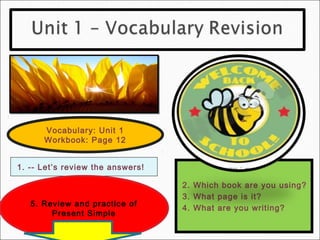
Vocabulary: Unit 1
      Workbook: Page 12


1. -- Let’s review the answers!

                                  2. Which book are you using?
                                  3. What page is it?
   5. Review and practice of
                                  4. What are you writing?
        Present Simple
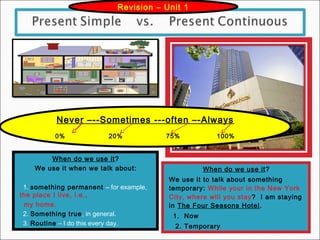
Revision – Unit 1


             Never –--Sometimes ---often –-Always
            0%              20%           75%             100%


           When do we use it?
       We use it when we talk about:                   When do we use it?
                                          We use it to talk about something
1.1. something permanent – for example,   temporary: While your in the New York
the place I live, i.e.,                   City, where will you stay ? I am staying
2.my home.                                in The Four Seasons Hotel.
3.2. Something true, in general.          1.1.   Now
4.3. Routine – I do this every day.
                                          2.   2. Temporary
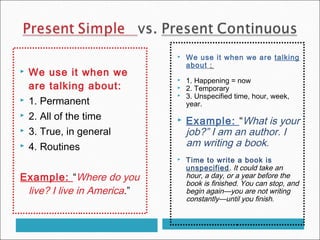
   We use it when we are talking
                                 about :
   We use it when we
                                1. Happening = now
    are talking about:          2. Temporary
                                3. Unspecified time, hour, week,
   1. Permanent                 year.
   2. All of the time          Example: “What is your
   3. True, in general          job?” I am an author. I
   4. Routines                  am writing a book.
                                Time to write a book is
                                 unspecified. It could take an
Example: “Where do you           hour, a day, or a year before the
                                 book is finished. You can stop, and
 live? I live in America.”       begin again—you are not writing
                                 constantly—until you finish.
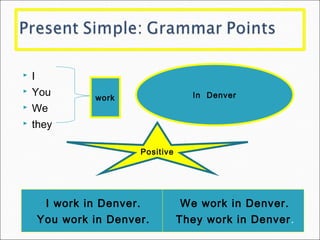
   I
   You          work                     In Denver
   We
   they

                             Positive


         I work in Denver.              We work in Denver.
        You work in Denver.             They work in Denver .
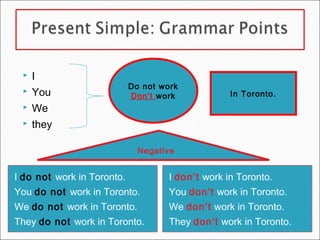
   I
                            Do not work
    You                    Don’t work             In Toronto.
    We
    they

                              Negative


I do not work in Toronto.            I don’t work in Toronto.
You do not work in Toronto.          You don’t work in Toronto.
We do not work in Toronto.           We don’t work in Toronto.
They do not work in Toronto.         They don’t work in Toronto.
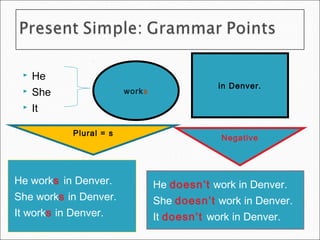
   He
                                              in Denver.
    She                 works
    It

            Plural = s
                                              Negative


He works in Denver.              He doesn’t work in Denver.
She works in Denver.             She doesn’t work in Denver.
It works in Denver.              It doesn’t work in Denver.
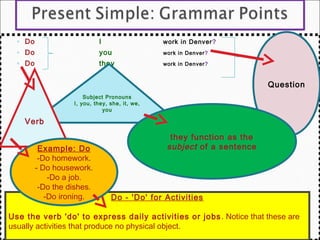
◦ Do                      I                   work in Denver ?
  ◦ Do                      you                 work in Denver?

  ◦ Do                      they                work in Denver?


                                                                         Question
                       Subject Pronouns
                   I, you, they, she, it, we,
                              you

    Verb
                                                  they function as the
          Example: Do                            subject of a sentence
          -Do homework.
         - Do housework.
             -Do a job.
          -Do the dishes.
            -Do ironing.         Do - 'Do' for Activities

Use the verb 'do' to express daily activities or jobs . Notice that these are
usually activities that produce no physical object.
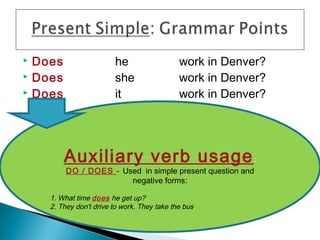
 Does                   he                  work in Denver?
 Does                   she                 work in Denver?
 Does                   it                  work in Denver?


         Auxiliary verb usage :
         DO / DOES - Used in simple present question and
                       negative forms:

    1. What time does he get up?
    2. They don't drive to work. They take the bus.
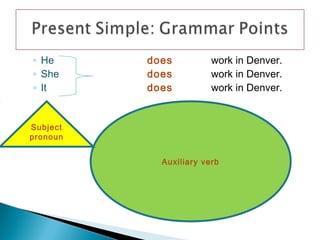
◦ He      does          work in Denver.
◦ She     does          work in Denver.
◦ It      does          work in Denver.


Subject
pronoun


            Auxiliary verb
Review & Practice Present
         Simple


  Teacher demo:

    1. Hello, I am
                                     Topic: Introductions
         Belinda          Elicit – What do people do when they first
2. Invite students to     meet someone? How do they greet them?
     say their own      What sort of things do they say? Write on the
      names: brief       board – Using those comments & hand out
                           new names – have them work in pairs –
                                     asking hello, I am…
                        Give examples: Hi, I’m Belinda, how are you.
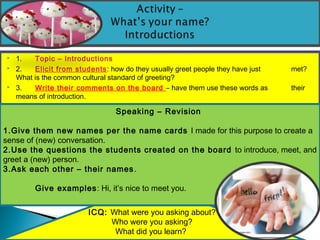
   1.   Topic – Introductions
   2.   Elicit from students : how do they usually greet people they have just   met?
    What is the common cultural standard of greeting?
   3.   Write their comments on the board – have them use these words as         their
    means of introduction.

                                 Speaking – Revision

1.Give them new names per the name cards I made for this purpose to create a
sense of (new) conversation.
2.Use the questions the students created on the board to introduce, meet, and
greet a (new) person.
3.Ask each other – their names .

         Give examples: Hi, it’s nice to meet you.


                         ICQ: What were you asking about?
                              Who were you asking?
                               What did you learn?
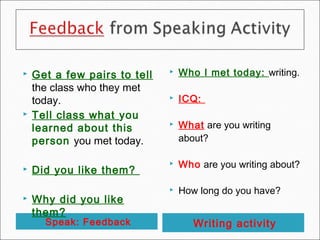
   Get a few pairs to tell      Who I met today: writing.
    the class who they met
    today.                       ICQ:
   Tell class what you
    learned about this           What are you writing
    person you met today.         about?

                                 Who are you writing about?
   Did you like them?
                                 How long do you have?
   Why did you like
    them?
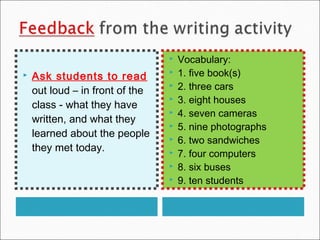
      Speak: Feedback                Writing activity
   Vocabulary:
   Ask students to read            1. five book(s)
    out loud – in front of the
                                    2. three cars
                                    3. eight houses
    class - what they have
                                    4. seven cameras
    written, and what they
                                    5. nine photographs
    learned about the people        6. two sandwiches
    they met today.                 7. four computers
                                    8. six buses
                                    9. ten students
Ksu   unit 1 - outline - lesson plan - present simple

Ksu unit 1 - outline - lesson plan - present simple

  • 1.
  • 2.
    1. Get yourpens out 2. Get your paper out 3. Listen to the vocabulary words Vocabulary review – 4. Listen carefully Dictation 5. Remember spelling Listening 6. Please wait quietly Spelling when you are finished.
  • 3.
    Vocabulary: Unit 1 Workbook: Page 12 1. -- Let’s review the answers! 2. Which book are you using? 3. What page is it? 5. Review and practice of 4. What are you writing? Present Simple
  • 4.
    Revision – Unit1 Never –--Sometimes ---often –-Always 0% 20% 75% 100% When do we use it? We use it when we talk about: When do we use it? We use it to talk about something 1.1. something permanent – for example, temporary: While your in the New York the place I live, i.e., City, where will you stay ? I am staying 2.my home. in The Four Seasons Hotel. 3.2. Something true, in general. 1.1. Now 4.3. Routine – I do this every day. 2. 2. Temporary
  • 5.
    We use it when we are talking about :  We use it when we  1. Happening = now are talking about:  2. Temporary  3. Unspecified time, hour, week,  1. Permanent year.  2. All of the time  Example: “What is your  3. True, in general job?” I am an author. I  4. Routines am writing a book.  Time to write a book is unspecified. It could take an Example: “Where do you hour, a day, or a year before the book is finished. You can stop, and live? I live in America.” begin again—you are not writing constantly—until you finish.
  • 6.
    I  You work In Denver  We  they Positive I work in Denver. We work in Denver. You work in Denver. They work in Denver .
  • 7.
    I Do not work  You Don’t work In Toronto.  We  they Negative I do not work in Toronto. I don’t work in Toronto. You do not work in Toronto. You don’t work in Toronto. We do not work in Toronto. We don’t work in Toronto. They do not work in Toronto. They don’t work in Toronto.
  • 8.
    He in Denver.  She works  It Plural = s Negative He works in Denver. He doesn’t work in Denver. She works in Denver. She doesn’t work in Denver. It works in Denver. It doesn’t work in Denver.
  • 9.
    ◦ Do I work in Denver ? ◦ Do you work in Denver? ◦ Do they work in Denver? Question Subject Pronouns I, you, they, she, it, we, you Verb they function as the Example: Do subject of a sentence -Do homework. - Do housework. -Do a job. -Do the dishes. -Do ironing. Do - 'Do' for Activities Use the verb 'do' to express daily activities or jobs . Notice that these are usually activities that produce no physical object.
  • 10.
     Does he work in Denver?  Does she work in Denver?  Does it work in Denver? Auxiliary verb usage : DO / DOES - Used in simple present question and negative forms: 1. What time does he get up? 2. They don't drive to work. They take the bus.
  • 11.
    ◦ He does work in Denver. ◦ She does work in Denver. ◦ It does work in Denver. Subject pronoun Auxiliary verb
  • 12.
    Review & PracticePresent Simple Teacher demo: 1. Hello, I am Topic: Introductions Belinda Elicit – What do people do when they first 2. Invite students to meet someone? How do they greet them? say their own What sort of things do they say? Write on the names: brief board – Using those comments & hand out new names – have them work in pairs – asking hello, I am… Give examples: Hi, I’m Belinda, how are you.
  • 13.
    1. Topic – Introductions  2. Elicit from students : how do they usually greet people they have just met? What is the common cultural standard of greeting?  3. Write their comments on the board – have them use these words as their means of introduction. Speaking – Revision 1.Give them new names per the name cards I made for this purpose to create a sense of (new) conversation. 2.Use the questions the students created on the board to introduce, meet, and greet a (new) person. 3.Ask each other – their names . Give examples: Hi, it’s nice to meet you. ICQ: What were you asking about? Who were you asking? What did you learn?
  • 14.
    Get a few pairs to tell  Who I met today: writing. the class who they met today.  ICQ:  Tell class what you learned about this  What are you writing person you met today. about?  Who are you writing about?  Did you like them?  How long do you have?  Why did you like them? Speak: Feedback Writing activity
  • 15.
    Vocabulary:  Ask students to read  1. five book(s) out loud – in front of the  2. three cars  3. eight houses class - what they have  4. seven cameras written, and what they  5. nine photographs learned about the people  6. two sandwiches they met today.  7. four computers  8. six buses  9. ten students