Final Exam
                           ENG 135 (Humanities)

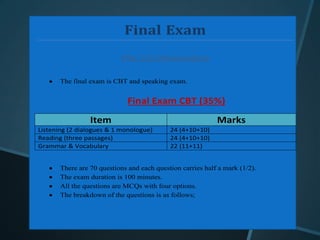
       The final exam is CBT and speaking exam.


                              Final Exam CBT (35%)
                 Item                                       Marks
Listening (2 dialogues & 1 monologue)       24 (4+10+10)
Reading (three passages)                    24 (4+10+10)
Grammar & Vocabulary                        22 (11+11)


       There are 70 questions and each question carries half a mark (1/2).
       The exam duration is 100 minutes.
       All the questions are MCQs with four options.
       The breakdown of the questions is as follows;
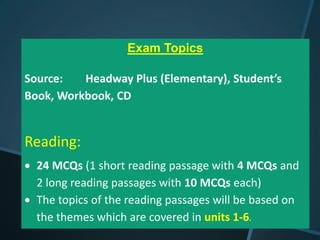
Exam Topics

Source:   Headway Plus (Elementary), Student’s
Book, Workbook, CD


Reading:
  24 MCQs (1 short reading passage with 4 MCQs and
  2 long reading passages with 10 MCQs each)
  The topics of the reading passages will be based on
  the themes which are covered in units 1-6.
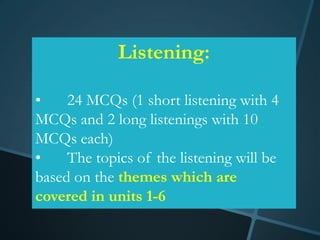
Listening:

•    24 MCQs (1 short listening with 4
MCQs and 2 long listenings with 10
MCQs each)
•    The topics of the listening will be
based on the themes which are
covered in units 1-6
Grammar:
• 11 MCQs.
• Most of the grammar questions will
be based on all the grammar points from
Units 1-6.
• In addition to the above units, the
following points also need to be covered
for the exam.
1.0 Present Simple ‘to be,’ in ‘I am, you are, he/she/it is’ used
with ‘from [a place]’ or ‘Where are you from? I am from X.’

1.1 Possessive adjectives, ‘my, your, his, her’ used with nouns, as
in ‘my name, your brother, his name.’

1.2 Contraction of ‘to be’ in ‘what’s, they’re, he’s, she’s’ and in
‘my name’s [x]’;
called ‘long’ and short’ forms in the text, i.e., ‘I am a student,’ and
‘I’m a student.’

1.3 Indefinite articles a/an for consonants and vowels, ‘a bag, an
ice-cream, a camera, an apple.’
2.0 Present Simple and questions using Wh-
words, ‘What is your job,’ ‘Where are you from?’ ‘How old
are you?’

2.1 Negatives with questions, ‘Are you English?’ and
‘No, I’m not.’ as ‘short answers.’

2.2 Long and short form answers: ‘I am not married’
and ‘I’m not married.’

2.3 Possessive (genitive) form of ‘s, as in ‘John’s car is
new’ versus the contracted form of the simple present.
3.0 3rd Person singular –s inflection, ‘he/she/it’
starts, goes, flies, used in simple sentences.

3.1 Basic verbs: ‘have, go, start, watch, leave, get,’ used
in simple sentences with questions.

3.2 Wh-questions with ‘to do’ and negatives, as in
‘No, he doesn’t and ‘No, we don’t.’

3.3 Yes and No answers in reply to questions, as in ‘My
X is very clever, Where does he/she work?, He has one son.’
4.0 Full inflection of present simple, ‘I/you/we/they’ as
in ‘I work, you work, we work, they work.’

4.1 Adverbs of
frequency, ‘never, sometimes, often, usually, always,’
used in a gradable way (i.e., 0% to 100% probability), either
at beginning or elsewhere in sentences: ‘Usually I go home
early,’ or ‘I usually go home early.’

4.2 Prepositions of time, ‘in, on, at,’ used as ‘In
winter, on Saturday, at 9:45.’
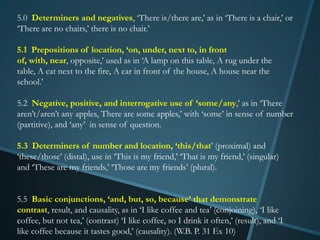
5.0 Determiners and negatives, ‘There is/there are,’ as in ‘There is a chair,’ or
‘There are no chairs,’ there is no chair.’

5.1 Prepositions of location, ‘on, under, next to, in front
of, with, near, opposite,’ used as in ‘A lamp on this table, A rug under the
table, A cat next to the fire, A car in front of the house, A house near the
school.’

5.2 Negative, positive, and interrogative use of ‘some/any,’ as in ‘There
aren’t/aren’t any apples, There are some apples,’ with ‘some’ in sense of number
(partitive), and ‘any’ in sense of question.

5.3 Determiners of number and location, ‘this/that’ (proximal) and
‘these/those’ (distal), use in ‘This is my friend,’ ‘That is my friend,’ (singular)
and ‘These are my friends,’ ‘Those are my friends’ (plural).


5.5 Basic conjunctions, ‘and, but, so, because’ that demonstrate
contrast, result, and causality, as in ‘I like coffee and tea’ (conjoining), ‘I like
coffee, but not tea,’ (contrast) ‘I like coffee, so I drink it often,’ (result), and ‘I
like coffee because it tastes good,’ (causality). (W.B. P. 31 Ex 10)
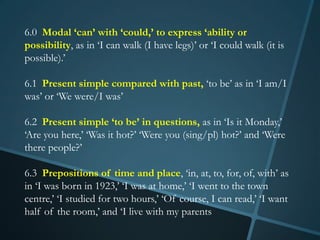
6.0 Modal ‘can’ with ‘could,’ to express ‘ability or
possibility, as in ‘I can walk (I have legs)’ or ‘I could walk (it is
possible).’

6.1 Present simple compared with past, ‘to be’ as in ‘I am/I
was’ or ‘We were/I was’

6.2 Present simple ‘to be’ in questions, as in ‘Is it Monday,’
‘Are you here,’ ‘Was it hot?’ ‘Were you (sing/pl) hot?’ and ‘Were
there people?’

6.3 Prepositions of time and place, ‘in, at, to, for, of, with’ as
in ‘I was born in 1923,’ ‘I was at home,’ ‘I went to the town
centre,’ ‘I studied for two hours,’ ‘Of course, I can read,’ ‘I want
half of the room,’ and ‘I live with my parents
Vocabulary:

• 11 MCQs.
• The vocabulary questions will
be based on all the word lists from
Units 1-6
• In addition to that the following
vocabulary list also needs to be
covered for the exam
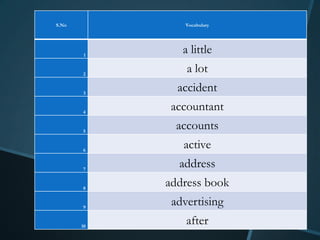
S.No            Vocabulary


        1
               a little
       2
                a lot
       3
              accident
       4
             accountant
       5
              accounts
       6
               active
       7
              address
       8
            address book
       9
             advertising
       10
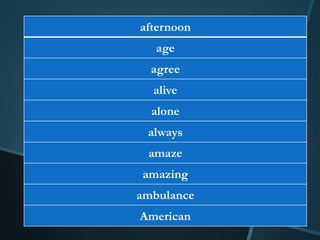
                after
afternoon
   age
  agree
  alive
  alone
 always
 amaze
amazing
ambulance
American
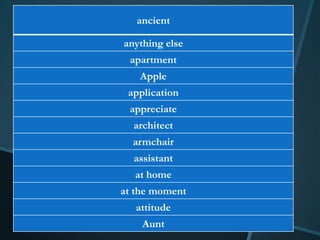
ancient

anything else
 apartment
   Apple
 application
 appreciate
  architect
  armchair
  assistant
  at home
at the moment
   attitude
    Aunt
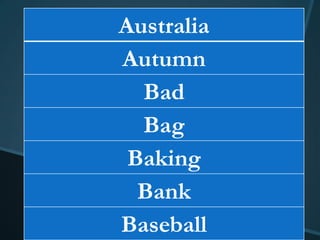
Australia
Autumn
  Bad
  Bag
 Baking
  Bank
Baseball
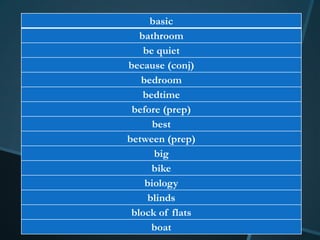
basic
   bathroom
    be quiet
because (conj)
   bedroom
    bedtime
 before (prep)
      best
between (prep)
      big
      bike
    biology
     blinds
 block of flats
      boat
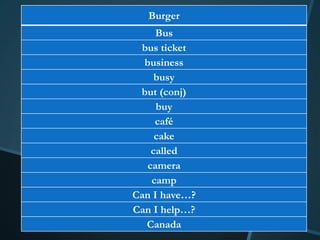
Burger
     Bus
 bus ticket
  business
     busy
 but (conj)
     buy
     café
     cake
    called
   camera
    camp
Can I have…?
Can I help…?
  Canada
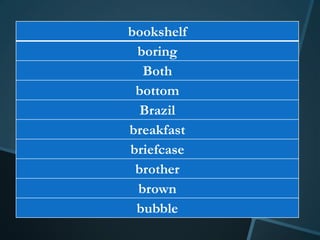
bookshelf
 boring
  Both
 bottom
  Brazil
breakfast
briefcase
 brother
 brown
 bubble
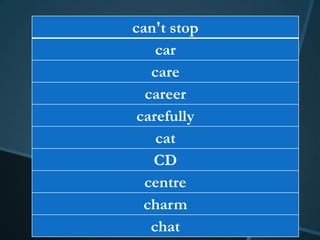
can't stop
    car
   care
  career
 carefully
    cat
   CD
  centre
  charm
   chat
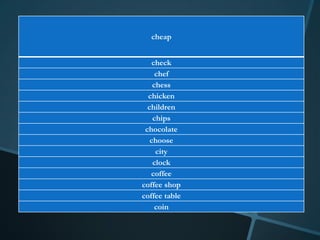
cheap


   check
     chef
    chess
  chicken
  children
    chips
 chocolate
   choose
     city
    clock
   coffee
coffee shop
coffee table
     coin
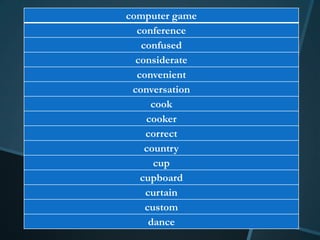
computer game
  conference
   confused
  considerate
  convenient
 conversation
     cook
    cooker
    correct
    country
      cup
   cupboard
    curtain
    custom
     dance
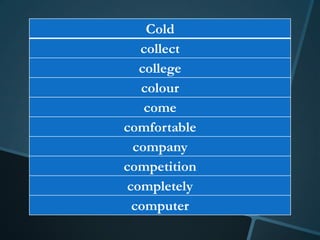
Cold
   collect
   college
   colour
    come
comfortable
  company
competition
 completely
  computer
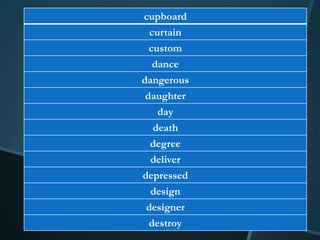
cupboard
  curtain
  custom
   dance
dangerous
 daughter
    day
   death
  degree
  deliver
depressed
  design
 designer
  destroy
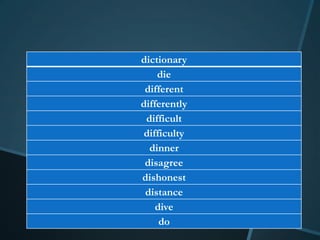
dictionary
    die
 different
differently
 difficult
difficulty
  dinner
 disagree
dishonest
 distance
    dive
     do
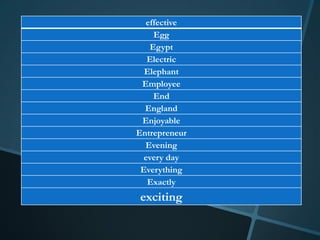
effective
    Egg
   Egypt
   Electric
  Elephant
 Employee
    End
  England
 Enjoyable
Entrepreneur
  Evening
  every day
 Everything
   Exactly
exciting
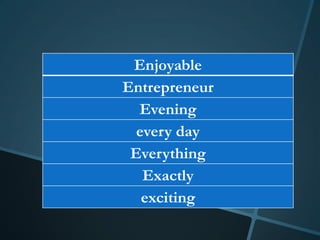
Enjoyable
Entrepreneur
  Evening
  every day
 Everything
   Exactly
   exciting
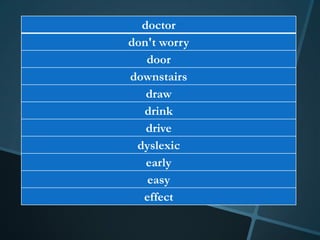
doctor
don't worry
   door
downstairs
   draw
  drink
   drive
 dyslexic
   early
   easy
  effect
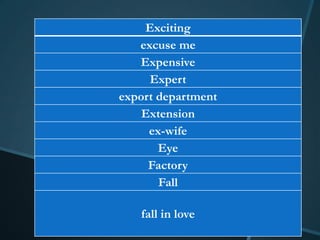
Exciting
   excuse me
   Expensive
     Expert
export department
    Extension
     ex-wife
       Eye
     Factory
       Fall

   fall in love
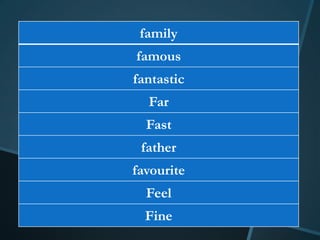
family
famous
fantastic
  Far
  Fast
 father
favourite
  Feel
  Fine
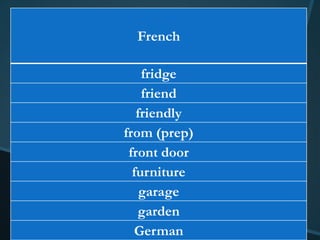
French

    fridge
    friend
   friendly
from (prep)
 front door
  furniture
    garage
   garden
  German
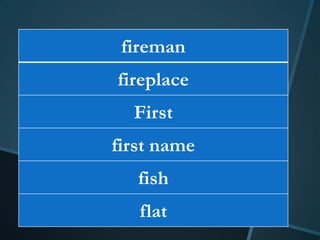
fireman
fireplace
  First
first name
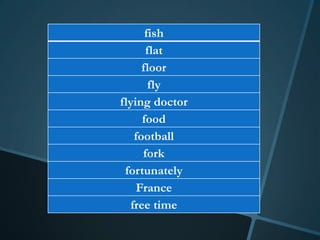
   fish
   flat
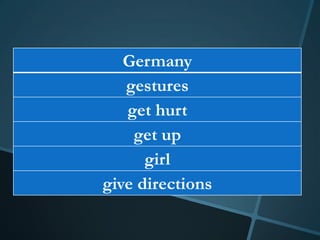
Germany
   gestures
   get hurt
    get up
      girl
give directions
fish
      flat
     floor
       fly
flying doctor
     food
   football
     fork
 fortunately
    France
  free time
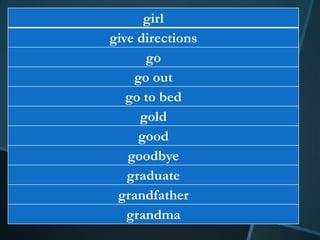
girl
give directions
      go
    go out
   go to bed
     gold
     good
   goodbye
   graduate
 grandfather
   grandma
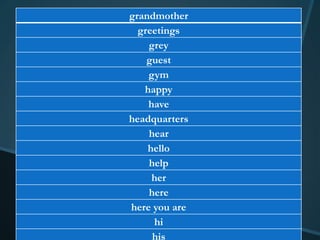
grandmother
  greetings
    grey
    guest
    gym
   happy
    have
headquarters
    hear
    hello
    help
     her
    here
here you are
     hi
     his
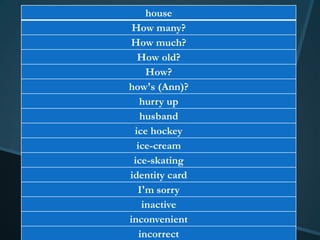
house
 How many?
How much?
  How old?
     How?
how's (Ann)?
   hurry up
   husband
 ice hockey
  ice-cream
 ice-skating
identity card
  I'm sorry
    inactive
inconvenient
   incorrect
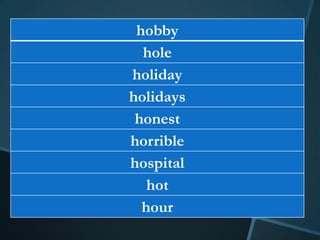
hobby
  hole
holiday
holidays
 honest
horrible
hospital
   hot
  hour
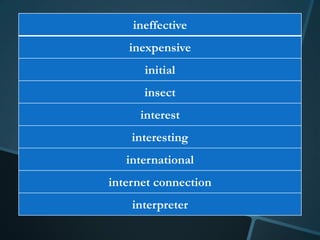
ineffective
   inexpensive
      initial
      insect
     interest
    interesting
   international
internet connection
    interpreter
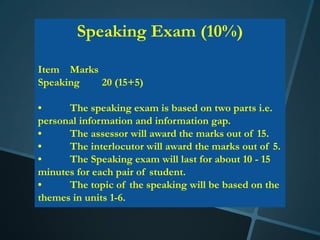
Speaking Exam (10%)

Item Marks
Speaking   20 (15+5)

•     The speaking exam is based on two parts i.e.
personal information and information gap.
•     The assessor will award the marks out of 15.
•     The interlocutor will award the marks out of 5.
•     The Speaking exam will last for about 10 - 15
minutes for each pair of student.
•     The topic of the speaking will be based on the
themes in units 1-6.
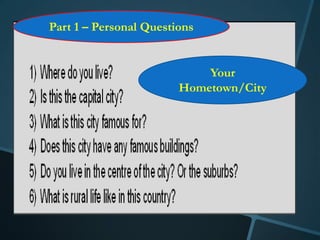
Part 1 – Personal Questions


                            Your
                        Hometown/City
Your Home
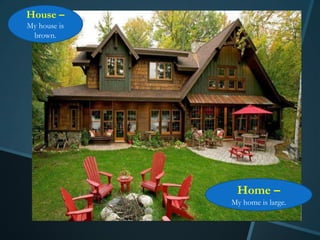
House –
My house is
 brown.


               Home –
              My home is large.
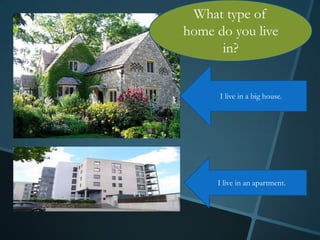
What type of
home do you live
      in?


      I live in a big house.


     I live in an apartment.
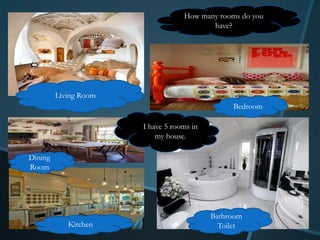
How many rooms do you
                                          have?


         Living Room
                                                Bedroom

                       I have 5 rooms in
                           my house.

Dining
Room


                                           Bathroom
            Kitchen                          Toilet
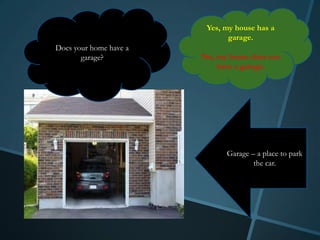
Yes, my house has a
                               garage.
Does your home have a
       garage?          No, my house does not
                            have a garage.


                              Garage – a place to park
                                      the car.
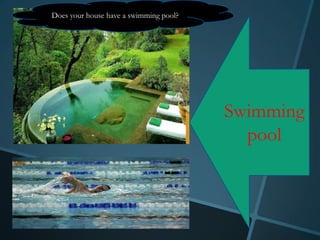
Does your house have a swimming pool?


                                        Swimming
                                          pool
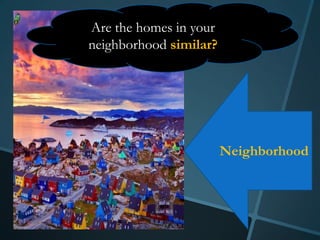
Are the homes in your
neighborhood similar?


                        Neighborhood
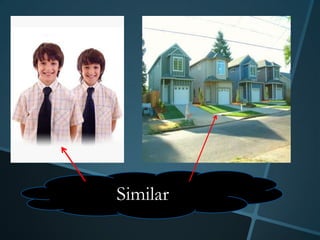
Similar
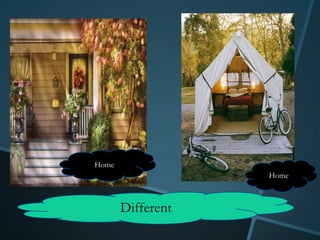
Home
                   Home


       Different
How is your home different from
 other homes in your neighborhood?
Part 2 – Information Gap
                           Card 1a


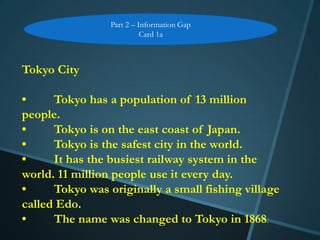
Tokyo City

•     Tokyo has a population of 13 million
people.
•     Tokyo is on the east coast of Japan.
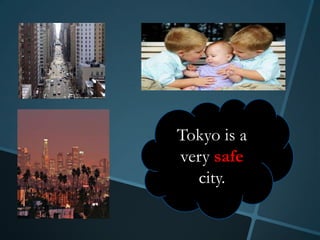
•     Tokyo is the safest city in the world.
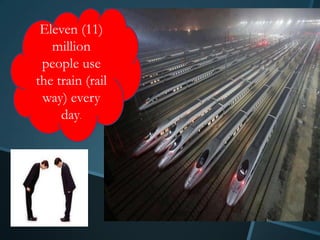
•     It has the busiest railway system in the
world. 11 million people use it every day.
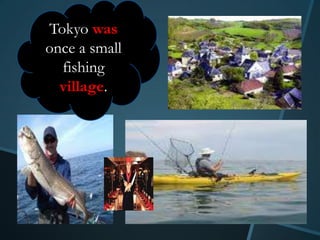
•     Tokyo was originally a small fishing village
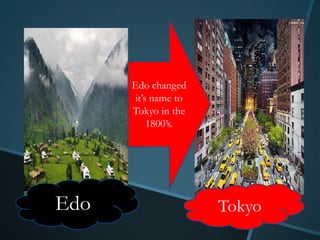
called Edo.
•     The name was changed to Tokyo in 1868.
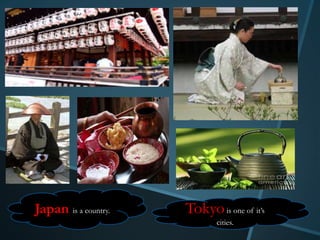
Japan is a country.   Tokyo is one of it’s
                             cities.
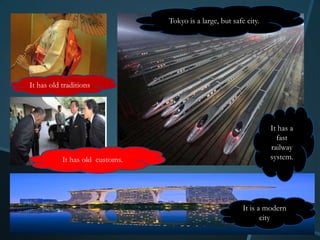
Tokyo is a large, but safe city.


It has old traditions


                                                                    It has a
                                                                      fast
                                                                    railway
           It has old customs.                                      system.


                                                           It is a modern
                                                                  city
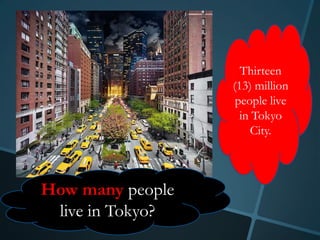
Thirteen
                  (13) million
                   people live
                    in Tokyo
                      City.


How many people
 live in Tokyo?
Tokyo was
once a small
  fishing
  village.
Tokyo is a
very safe
  city.
Eleven (11)
   million
 people use
the train (rail
 way) every
     day.
Edo changed
       it’s name to
      Tokyo in the
           1800’s.


Edo                   Tokyo
Card 1b

Tokyo City

•    Tokyo/many people?

•    Tokyo/where?

•    City/safe?

•    Many people/railway?

•    Name/before?
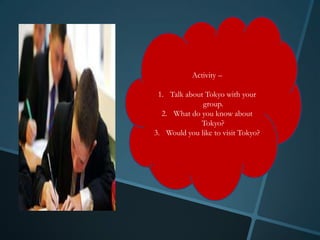
Activity –

 1. Talk about Tokyo with your
              group.
  2. What do you know about
             Tokyo?
3. Would you like to visit Tokyo?
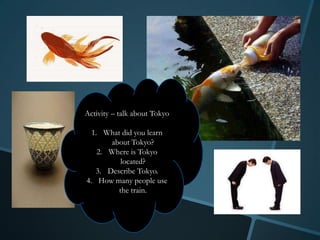
Activity – talk about Tokyo

  1. What did you learn
       about Tokyo?
    2. Where is Tokyo
          located?
   3. Describe Tokyo.
4. How many people use
         the train.
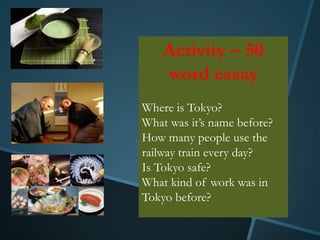
Activity – 50
    word essay
Where is Tokyo?
What was it’s name before?
How many people use the
railway train every day?
Is Tokyo safe?
What kind of work was in
Tokyo before?

4 8-13 - 135 ksu preparation midterm exam details

  • 2.
    Final Exam ENG 135 (Humanities) The final exam is CBT and speaking exam. Final Exam CBT (35%) Item Marks Listening (2 dialogues & 1 monologue) 24 (4+10+10) Reading (three passages) 24 (4+10+10) Grammar & Vocabulary 22 (11+11) There are 70 questions and each question carries half a mark (1/2). The exam duration is 100 minutes. All the questions are MCQs with four options. The breakdown of the questions is as follows;
  • 3.
    Exam Topics Source: Headway Plus (Elementary), Student’s Book, Workbook, CD Reading: 24 MCQs (1 short reading passage with 4 MCQs and 2 long reading passages with 10 MCQs each) The topics of the reading passages will be based on the themes which are covered in units 1-6.
  • 4.
    Listening: • 24 MCQs (1 short listening with 4 MCQs and 2 long listenings with 10 MCQs each) • The topics of the listening will be based on the themes which are covered in units 1-6
  • 5.
    Grammar: • 11 MCQs. •Most of the grammar questions will be based on all the grammar points from Units 1-6. • In addition to the above units, the following points also need to be covered for the exam.
  • 6.
    1.0 Present Simple‘to be,’ in ‘I am, you are, he/she/it is’ used with ‘from [a place]’ or ‘Where are you from? I am from X.’ 1.1 Possessive adjectives, ‘my, your, his, her’ used with nouns, as in ‘my name, your brother, his name.’ 1.2 Contraction of ‘to be’ in ‘what’s, they’re, he’s, she’s’ and in ‘my name’s [x]’; called ‘long’ and short’ forms in the text, i.e., ‘I am a student,’ and ‘I’m a student.’ 1.3 Indefinite articles a/an for consonants and vowels, ‘a bag, an ice-cream, a camera, an apple.’
  • 7.
    2.0 Present Simpleand questions using Wh- words, ‘What is your job,’ ‘Where are you from?’ ‘How old are you?’ 2.1 Negatives with questions, ‘Are you English?’ and ‘No, I’m not.’ as ‘short answers.’ 2.2 Long and short form answers: ‘I am not married’ and ‘I’m not married.’ 2.3 Possessive (genitive) form of ‘s, as in ‘John’s car is new’ versus the contracted form of the simple present.
  • 8.
    3.0 3rd Personsingular –s inflection, ‘he/she/it’ starts, goes, flies, used in simple sentences. 3.1 Basic verbs: ‘have, go, start, watch, leave, get,’ used in simple sentences with questions. 3.2 Wh-questions with ‘to do’ and negatives, as in ‘No, he doesn’t and ‘No, we don’t.’ 3.3 Yes and No answers in reply to questions, as in ‘My X is very clever, Where does he/she work?, He has one son.’
  • 9.
    4.0 Full inflectionof present simple, ‘I/you/we/they’ as in ‘I work, you work, we work, they work.’ 4.1 Adverbs of frequency, ‘never, sometimes, often, usually, always,’ used in a gradable way (i.e., 0% to 100% probability), either at beginning or elsewhere in sentences: ‘Usually I go home early,’ or ‘I usually go home early.’ 4.2 Prepositions of time, ‘in, on, at,’ used as ‘In winter, on Saturday, at 9:45.’
  • 10.
    5.0 Determiners andnegatives, ‘There is/there are,’ as in ‘There is a chair,’ or ‘There are no chairs,’ there is no chair.’ 5.1 Prepositions of location, ‘on, under, next to, in front of, with, near, opposite,’ used as in ‘A lamp on this table, A rug under the table, A cat next to the fire, A car in front of the house, A house near the school.’ 5.2 Negative, positive, and interrogative use of ‘some/any,’ as in ‘There aren’t/aren’t any apples, There are some apples,’ with ‘some’ in sense of number (partitive), and ‘any’ in sense of question. 5.3 Determiners of number and location, ‘this/that’ (proximal) and ‘these/those’ (distal), use in ‘This is my friend,’ ‘That is my friend,’ (singular) and ‘These are my friends,’ ‘Those are my friends’ (plural). 5.5 Basic conjunctions, ‘and, but, so, because’ that demonstrate contrast, result, and causality, as in ‘I like coffee and tea’ (conjoining), ‘I like coffee, but not tea,’ (contrast) ‘I like coffee, so I drink it often,’ (result), and ‘I like coffee because it tastes good,’ (causality). (W.B. P. 31 Ex 10)
  • 11.
    6.0 Modal ‘can’with ‘could,’ to express ‘ability or possibility, as in ‘I can walk (I have legs)’ or ‘I could walk (it is possible).’ 6.1 Present simple compared with past, ‘to be’ as in ‘I am/I was’ or ‘We were/I was’ 6.2 Present simple ‘to be’ in questions, as in ‘Is it Monday,’ ‘Are you here,’ ‘Was it hot?’ ‘Were you (sing/pl) hot?’ and ‘Were there people?’ 6.3 Prepositions of time and place, ‘in, at, to, for, of, with’ as in ‘I was born in 1923,’ ‘I was at home,’ ‘I went to the town centre,’ ‘I studied for two hours,’ ‘Of course, I can read,’ ‘I want half of the room,’ and ‘I live with my parents
  • 12.
    Vocabulary: • 11 MCQs. •The vocabulary questions will be based on all the word lists from Units 1-6 • In addition to that the following vocabulary list also needs to be covered for the exam
  • 13.
    S.No Vocabulary 1 a little 2 a lot 3 accident 4 accountant 5 accounts 6 active 7 address 8 address book 9 advertising 10 after
  • 14.
    afternoon age agree alive alone always amaze amazing ambulance American
  • 15.
    ancient anything else apartment Apple application appreciate architect armchair assistant at home at the moment attitude Aunt
  • 16.
    Australia Autumn Bad Bag Baking Bank Baseball
  • 17.
    basic bathroom be quiet because (conj) bedroom bedtime before (prep) best between (prep) big bike biology blinds block of flats boat
  • 18.
    Burger Bus bus ticket business busy but (conj) buy café cake called camera camp Can I have…? Can I help…? Canada
  • 19.
    bookshelf boring Both bottom Brazil breakfast briefcase brother brown bubble
  • 20.
    can't stop car care career carefully cat CD centre charm chat
  • 21.
    cheap check chef chess chicken children chips chocolate choose city clock coffee coffee shop coffee table coin
  • 22.
    computer game conference confused considerate convenient conversation cook cooker correct country cup cupboard curtain custom dance
  • 23.
    Cold collect college colour come comfortable company competition completely computer
  • 24.
    cupboard curtain custom dance dangerous daughter day death degree deliver depressed design designer destroy
  • 25.
    dictionary die different differently difficult difficulty dinner disagree dishonest distance dive do
  • 26.
    effective Egg Egypt Electric Elephant Employee End England Enjoyable Entrepreneur Evening every day Everything Exactly exciting
  • 27.
    Enjoyable Entrepreneur Evening every day Everything Exactly exciting
  • 28.
    doctor don't worry door downstairs draw drink drive dyslexic early easy effect
  • 29.
    Exciting excuse me Expensive Expert export department Extension ex-wife Eye Factory Fall fall in love
  • 30.
    family famous fantastic Far Fast father favourite Feel Fine
  • 31.
    French fridge friend friendly from (prep) front door furniture garage garden German
  • 32.
  • 33.
    Germany gestures get hurt get up girl give directions
  • 34.
    fish flat floor fly flying doctor food football fork fortunately France free time
  • 35.
    girl give directions go go out go to bed gold good goodbye graduate grandfather grandma
  • 36.
    grandmother greetings grey guest gym happy have headquarters hear hello help her here here you are hi his
  • 37.
    house How many? Howmuch? How old? How? how's (Ann)? hurry up husband ice hockey ice-cream ice-skating identity card I'm sorry inactive inconvenient incorrect
  • 38.
    hobby hole holiday holidays honest horrible hospital hot hour
  • 39.
    ineffective inexpensive initial insect interest interesting international internet connection interpreter
  • 40.
    Speaking Exam (10%) ItemMarks Speaking 20 (15+5) • The speaking exam is based on two parts i.e. personal information and information gap. • The assessor will award the marks out of 15. • The interlocutor will award the marks out of 5. • The Speaking exam will last for about 10 - 15 minutes for each pair of student. • The topic of the speaking will be based on the themes in units 1-6.
  • 41.
    Part 1 –Personal Questions Your Hometown/City
  • 42.
  • 43.
    House – My houseis brown. Home – My home is large.
  • 44.
    What type of homedo you live in? I live in a big house. I live in an apartment.
  • 45.
    How many roomsdo you have? Living Room Bedroom I have 5 rooms in my house. Dining Room Bathroom Kitchen Toilet
  • 46.
    Yes, my househas a garage. Does your home have a garage? No, my house does not have a garage. Garage – a place to park the car.
  • 47.
    Does your househave a swimming pool? Swimming pool
  • 48.
    Are the homesin your neighborhood similar? Neighborhood
  • 49.
  • 50.
    Home Home Different
  • 51.
    How is yourhome different from other homes in your neighborhood?
  • 52.
    Part 2 –Information Gap Card 1a Tokyo City • Tokyo has a population of 13 million people. • Tokyo is on the east coast of Japan. • Tokyo is the safest city in the world. • It has the busiest railway system in the world. 11 million people use it every day. • Tokyo was originally a small fishing village called Edo. • The name was changed to Tokyo in 1868.
  • 53.
    Japan is acountry. Tokyo is one of it’s cities.
  • 54.
    Tokyo is alarge, but safe city. It has old traditions It has a fast railway It has old customs. system. It is a modern city
  • 55.
    Thirteen (13) million people live in Tokyo City. How many people live in Tokyo?
  • 56.
    Tokyo was once asmall fishing village.
  • 57.
    Tokyo is a verysafe city.
  • 58.
    Eleven (11) million people use the train (rail way) every day.
  • 59.
    Edo changed it’s name to Tokyo in the 1800’s. Edo Tokyo
  • 60.
    Card 1b Tokyo City • Tokyo/many people? • Tokyo/where? • City/safe? • Many people/railway? • Name/before?
  • 61.
    Activity – 1.Talk about Tokyo with your group. 2. What do you know about Tokyo? 3. Would you like to visit Tokyo?
  • 62.
    Activity – talkabout Tokyo 1. What did you learn about Tokyo? 2. Where is Tokyo located? 3. Describe Tokyo. 4. How many people use the train.
  • 63.
    Activity – 50 word essay Where is Tokyo? What was it’s name before? How many people use the railway train every day? Is Tokyo safe? What kind of work was in Tokyo before?