Prepared By:
 HANI.N.M.ALATTUG

P71059

 MOSAB M A ALJADI

P71044

 DUAA YIHEYA

P71078
Hannover, Kronsberg, Germany
Introduction
Kronsberg city is suburb of Hannover .It will showcase of creativities
on urban development ecological and social planning a new city district
created for the future to make manifest the world exposition themes,
'Humankind, Nature, Technology' in everyday community life.
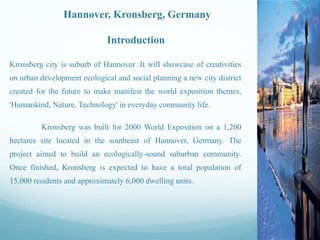
Kronsberg was built for 2000 World Exposition on a 1,200

hectares site located in the southeast of Hannover, Germany. The
project aimed to build an ecologically-sound suburban community.
Once finished, Kronsberg is expected to have a total population of
15,000 residents and approximately 6,000 dwelling units.
Objectives
 Reduce CO2 emissions by 60% compared to current standards for
conventional residential buildings, primarily Kronsberg through Low
Energy House (LEH) construction methods.

 Reduce household waste by 50% and construction waste
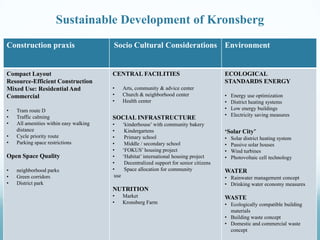
Sustainable Development of Kronsberg
Construction praxis

Socio Cultural Considerations Environment

Compact Layout
Resource-Efficient Construction
Mixed Use: Residential And
Commercial

CENTRAL FACILITIES

•
•
•
•
•

Tram route D
Traffic calming
All amenities within easy walking
distance
Cycle priority route
Parking space restrictions

Open Space Quality
•
•
•

neighborhood parks
Green corridors
District park

•
•
•

Arts, community & advice center
Church & neighborhood center
Health center

SOCIAL INFRASTRUCTURE
•
‘kinderhouse’ with community bakery
•
Kindergartens
•
Primary school
•
Middle / secondary school
•
‘FOKUS’ housing project
•
‘Habitat’ international housing project
•
Decentralized support for senior citizens
•
Space allocation for community
use

NUTRITION
•
•

Market
Kronsberg Farm

ECOLOGICAL
STANDARDS ENERGY
•
•
•
•

Energy use optimization
District heating systems
Low energy buildings
Electricity saving measures

‘Solar City’
•
•
•
•

Solar district heating system
Passive solar houses
Wind turbines
Photovoltaic cell technology

WATER
• Rainwater management concept
• Drinking water economy measures

WASTE
• Ecologically compatible building
materials
• Building waste concept
• Domestic and commercial waste
concept
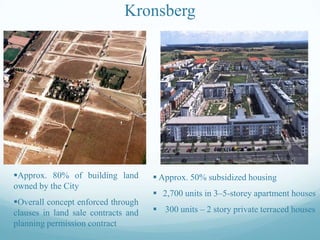
Kronsberg

Approx. 80% of building land
owned by the City

 Approx. 50% subsidized housing

Overall concept enforced through
clauses in land sale contracts and
planning permission contract

 300 units – 2 story private terraced houses

 2,700 units in 3–5-storey apartment houses
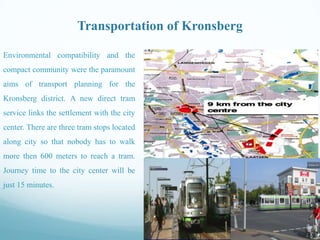
Transportation of Kronsberg
Environmental compatibility and the

compact community were the paramount
aims of transport planning for the
Kronsberg district. A new direct tram
service links the settlement with the city
center. There are three tram stops located
along city so that nobody has to walk
more then 600 meters to reach a tram.
Journey time to the city center will be
just 15 minutes.
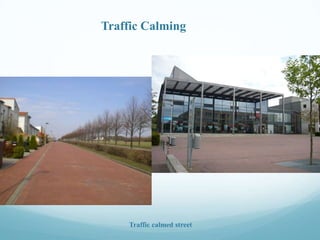
Traffic Calming

Traffic calmed street
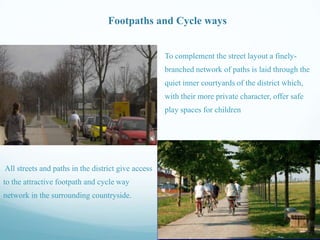
Footpaths and Cycle ways

To complement the street layout a finelybranched network of paths is laid through the
quiet inner courtyards of the district which,
with their more private character, offer safe
play spaces for children

All streets and paths in the district give access
to the attractive footpath and cycle way
network in the surrounding countryside.
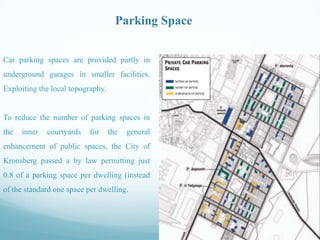
Parking Space
Car parking spaces are provided partly in
underground garages in smaller facilities.

Exploiting the local topography.

To reduce the number of parking spaces in
the

inner

courtyards

for

the

general

enhancement of public spaces, the City of
Kronsberg passed a by law permitting just
0.8 of a parking space per dwelling (instead
of the standard one space per dwelling.
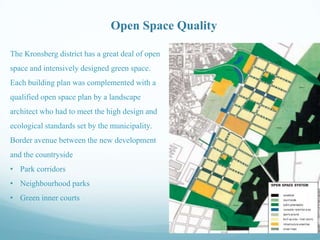
Open Space Quality
The Kronsberg district has a great deal of open
space and intensively designed green space.
Each building plan was complemented with a
qualified open space plan by a landscape
architect who had to meet the high design and
ecological standards set by the municipality.
Border avenue between the new development

and the countryside
• Park corridors
• Neighbourhood parks
• Green inner courts
Environment
Ecological Standards Energy
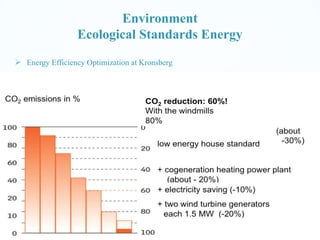
 Energy Efficiency Optimization at Kronsberg
Co2 Reduction
60% less CO emissions through:

 Low Energy House (LEH) construction methods with quality assurance
monitoring

 district heating network, supplied from CHP plants
 electricity saving programme
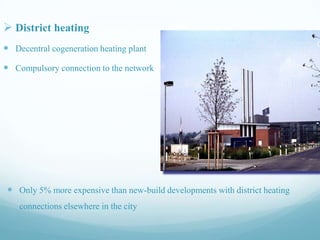
 District heating
 Decentral cogeneration heating plant
 Compulsory connection to the network

 Only 5% more expensive than new-build developments with district heating
connections elsewhere in the city
 Low Energy Houses
All buildings in the Kronsberg district have been erected as Low Energy Houses

(LEH). Every building must use less than 55 kWh per m2 and year for space heating, verified
through a quality assurance programme.

 Electricity Saving Measures
A wide –ranging electricity saving programme is implemented at Kronsberg,
aiming to reduce the usual domestic electricity consumption by 30% from an average
consumption of 2,500 kWh to 1750 kWh per household and year , the national average lies
between 2,800 and 3,000 kWh
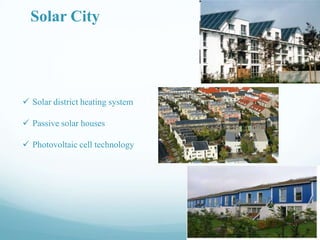
Solar City

 Solar district heating system
 Passive solar houses

 Photovoltaic cell technology
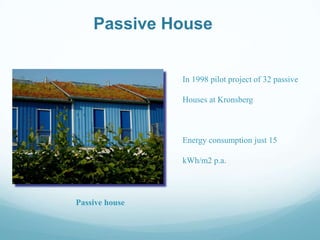
Passive House

In 1998 pilot project of 32 passive

Houses at Kronsberg

Energy consumption just 15
kWh/m2 p.a.

Passive house
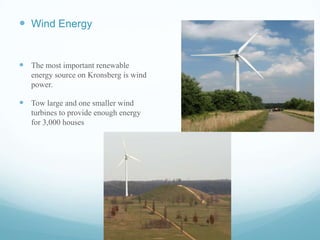
 Wind Energy

 The most important renewable
energy source on Kronsberg is wind
power.

 Tow large and one smaller wind
turbines to provide enough energy
for 3,000 houses
WATER MANAGEMENT
The Kronsberg water concept, based on this ideal, takes three courses:

1. a rainwater management system following natural principles as part of the
registered EXPO project

2. drinking water economies across the entire district
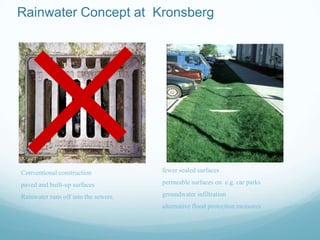
Rainwater Concept at Kronsberg

Conventional construction

fewer sealed surfaces

paved and built-up surfaces

permeable surfaces on e.g. car parks

Rainwater runs off into the sewers.

groundwater infiltration
alternative flood protection measures
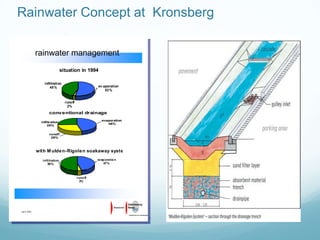
Rainwater Concept at Kronsberg
rainwater management
situation in 1994
infiltration
45 %

ev aporation
53 %

runoff
2%

conventional drainage
evaporation
46%

infiltration
25%
runoff
29%

with M ulde n-Rigole n soakaway syste m
evap oratio n
47%

infiltration
50%

r uno ff
3%

April 2000
Eigenbetrieb der Landeshauptstadt
Waste Management
 Waste avoidance (- 380,000 t)
1.000.000
900.000

 Dumping of soil, building rubble, sewage

800.000
700.000

Menge [t]

sludge (- 340,000 t)

 Recycling, composting of organic waste

Avoidance

600.000
500.000
400.000

(+ 72,000 t)

Recycling

300.000
200.000

 Recycling of glass, paper, packaging and

100.000

Disposal

0

scrap metal (+ 41,700 t)

1989

2002
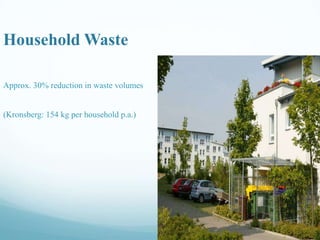
Household Waste
Approx. 30% reduction in waste volumes

(Kronsberg: 154 kg per household p.a.)
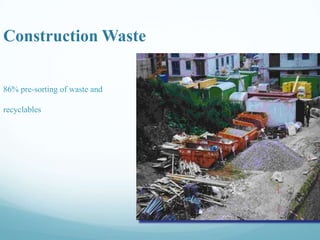
Construction Waste
86% pre-sorting of waste and

recyclables
Kronsberg

Kronsberg

  • 1.
    Prepared By:  HANI.N.M.ALATTUG P71059 MOSAB M A ALJADI P71044  DUAA YIHEYA P71078
  • 2.
    Hannover, Kronsberg, Germany Introduction Kronsbergcity is suburb of Hannover .It will showcase of creativities on urban development ecological and social planning a new city district created for the future to make manifest the world exposition themes, 'Humankind, Nature, Technology' in everyday community life. Kronsberg was built for 2000 World Exposition on a 1,200 hectares site located in the southeast of Hannover, Germany. The project aimed to build an ecologically-sound suburban community. Once finished, Kronsberg is expected to have a total population of 15,000 residents and approximately 6,000 dwelling units.
  • 3.
    Objectives  Reduce CO2emissions by 60% compared to current standards for conventional residential buildings, primarily Kronsberg through Low Energy House (LEH) construction methods.  Reduce household waste by 50% and construction waste
  • 4.
    Sustainable Development ofKronsberg Construction praxis Socio Cultural Considerations Environment Compact Layout Resource-Efficient Construction Mixed Use: Residential And Commercial CENTRAL FACILITIES • • • • • Tram route D Traffic calming All amenities within easy walking distance Cycle priority route Parking space restrictions Open Space Quality • • • neighborhood parks Green corridors District park • • • Arts, community & advice center Church & neighborhood center Health center SOCIAL INFRASTRUCTURE • ‘kinderhouse’ with community bakery • Kindergartens • Primary school • Middle / secondary school • ‘FOKUS’ housing project • ‘Habitat’ international housing project • Decentralized support for senior citizens • Space allocation for community use NUTRITION • • Market Kronsberg Farm ECOLOGICAL STANDARDS ENERGY • • • • Energy use optimization District heating systems Low energy buildings Electricity saving measures ‘Solar City’ • • • • Solar district heating system Passive solar houses Wind turbines Photovoltaic cell technology WATER • Rainwater management concept • Drinking water economy measures WASTE • Ecologically compatible building materials • Building waste concept • Domestic and commercial waste concept
  • 5.
    Kronsberg Approx. 80% ofbuilding land owned by the City  Approx. 50% subsidized housing Overall concept enforced through clauses in land sale contracts and planning permission contract  300 units – 2 story private terraced houses  2,700 units in 3–5-storey apartment houses
  • 6.
    Transportation of Kronsberg Environmentalcompatibility and the compact community were the paramount aims of transport planning for the Kronsberg district. A new direct tram service links the settlement with the city center. There are three tram stops located along city so that nobody has to walk more then 600 meters to reach a tram. Journey time to the city center will be just 15 minutes.
  • 7.
  • 8.
    Footpaths and Cycleways To complement the street layout a finelybranched network of paths is laid through the quiet inner courtyards of the district which, with their more private character, offer safe play spaces for children All streets and paths in the district give access to the attractive footpath and cycle way network in the surrounding countryside.
  • 9.
    Parking Space Car parkingspaces are provided partly in underground garages in smaller facilities. Exploiting the local topography. To reduce the number of parking spaces in the inner courtyards for the general enhancement of public spaces, the City of Kronsberg passed a by law permitting just 0.8 of a parking space per dwelling (instead of the standard one space per dwelling.
  • 10.
    Open Space Quality TheKronsberg district has a great deal of open space and intensively designed green space. Each building plan was complemented with a qualified open space plan by a landscape architect who had to meet the high design and ecological standards set by the municipality. Border avenue between the new development and the countryside • Park corridors • Neighbourhood parks • Green inner courts
  • 11.
    Environment Ecological Standards Energy Energy Efficiency Optimization at Kronsberg
  • 12.
    Co2 Reduction 60% lessCO emissions through:  Low Energy House (LEH) construction methods with quality assurance monitoring  district heating network, supplied from CHP plants  electricity saving programme
  • 13.
     District heating Decentral cogeneration heating plant  Compulsory connection to the network  Only 5% more expensive than new-build developments with district heating connections elsewhere in the city
  • 14.
     Low EnergyHouses All buildings in the Kronsberg district have been erected as Low Energy Houses (LEH). Every building must use less than 55 kWh per m2 and year for space heating, verified through a quality assurance programme.  Electricity Saving Measures A wide –ranging electricity saving programme is implemented at Kronsberg, aiming to reduce the usual domestic electricity consumption by 30% from an average consumption of 2,500 kWh to 1750 kWh per household and year , the national average lies between 2,800 and 3,000 kWh
  • 15.
    Solar City  Solardistrict heating system  Passive solar houses  Photovoltaic cell technology
  • 16.
    Passive House In 1998pilot project of 32 passive Houses at Kronsberg Energy consumption just 15 kWh/m2 p.a. Passive house
  • 17.
     Wind Energy The most important renewable energy source on Kronsberg is wind power.  Tow large and one smaller wind turbines to provide enough energy for 3,000 houses
  • 18.
    WATER MANAGEMENT The Kronsbergwater concept, based on this ideal, takes three courses: 1. a rainwater management system following natural principles as part of the registered EXPO project 2. drinking water economies across the entire district
  • 19.
    Rainwater Concept atKronsberg Conventional construction fewer sealed surfaces paved and built-up surfaces permeable surfaces on e.g. car parks Rainwater runs off into the sewers. groundwater infiltration alternative flood protection measures
  • 20.
    Rainwater Concept atKronsberg rainwater management situation in 1994 infiltration 45 % ev aporation 53 % runoff 2% conventional drainage evaporation 46% infiltration 25% runoff 29% with M ulde n-Rigole n soakaway syste m evap oratio n 47% infiltration 50% r uno ff 3% April 2000 Eigenbetrieb der Landeshauptstadt
  • 21.
    Waste Management  Wasteavoidance (- 380,000 t) 1.000.000 900.000  Dumping of soil, building rubble, sewage 800.000 700.000 Menge [t] sludge (- 340,000 t)  Recycling, composting of organic waste Avoidance 600.000 500.000 400.000 (+ 72,000 t) Recycling 300.000 200.000  Recycling of glass, paper, packaging and 100.000 Disposal 0 scrap metal (+ 41,700 t) 1989 2002
  • 22.
    Household Waste Approx. 30%reduction in waste volumes (Kronsberg: 154 kg per household p.a.)
  • 23.
    Construction Waste 86% pre-sortingof waste and recyclables