presented bypresented by
Institut für die Förderung von Mehrsprachigkeit,
interkulturellen Kompetenzen und Gleichbehandlung
For the project meeting of the project EU Treasure Hunt in
Nicosia february 2012
Music of Austria
Vienna, the capital city of Austria has long been an important
center of musical innovation. Composers of the 18th and 19th
centuries were drawn to the city by the patronage of the
Habsburgs, and made Vienna the European capital of classicalHabsburgs, and made Vienna the European capital of classical
music. Wolfgang Amadeus Mozart, Ludwig van Beethoven,
and Johann Strauss, Jr.,among others, were associated with the
city. During the Baroque period, Slavic and Hungarian folk
forms influenced Austrian music. Vienna's status began its rise
as a cultural center in the early 16th century, and was focused
around instruments including the lute.
Classical music
During the 18th century, the
classical-music era dominated
European classical music, and the
city of Vienna was an especially
important place for musicalimportant place for musical
innovation. Three composers
arose, making lasting innovations:
Ludwig van Beethoven's
symphonic patterns, Wolfgang
Amadeus Mozart's balance
between melody and form, and
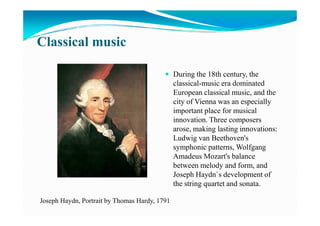
Joseph Haydn`s development of
the string quartet and sonata.
Joseph Haydn, Portrait by Thomas Hardy, 1791
Wolfgang Amadeus Mozart
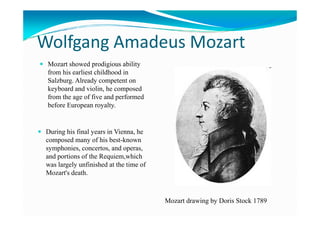
Mozart showed prodigious ability
from his earliest childhood in
Salzburg. Already competent on
keyboard and violin, he composed
from the age of five and performed
before European royalty.
During his final years in Vienna, he
composed many of his best-known
symphonies, concertos, and operas,
and portions of the Requiem,which
was largely unfinished at the time of
Mozart's death.
Mozart drawing by Doris Stock 1789
Ludwig van Beethoven
Born in Bonn, then the capital of the
Electorate of Cologne and part of the
Holy Roman Empire, Beethoven
moved to Vienna in his early 20s,
studying with Joseph Haydn and
quickly gaining a reputation as aquickly gaining a reputation as a
virtuoso pianist. His hearing began to
deteriorate in his late twenties, yet he
continued to compose, conduct, and
perform, even after becoming
completly deaf. The rythm of EU one
of the famous melody by Beethoven.
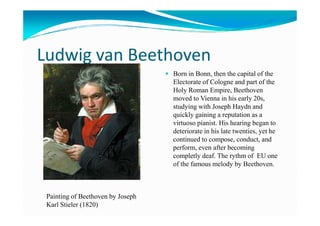
Painting of Beethoven by Joseph
Karl Stieler (1820)
Johann Strauss, Jr,
An Austian composer of light music,
particularly dance music and operettas.
He composed over 500 waltzes,
polkas, quadrilles and other types of
dance music, as well as several
operettas and a ballet. In his lifetime,operettas and a ballet. In his lifetime,
he was known as "The Waltz King",
and was largely then responsible for
the popularity of the waltz in Vienna
during the 19th century.
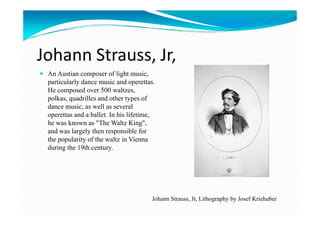
Johann Strauss, Jr, Lithography by Josef Kriehuber
Folk Music and Dancing
Schrammelmusic:
is a style of Viennese folk music
originating in the late nineteenth
century and still performed in
present-day Austria. The style is
named for the prolific folk
composers Johann and Josefcomposers Johann and Josef
Schrammel.
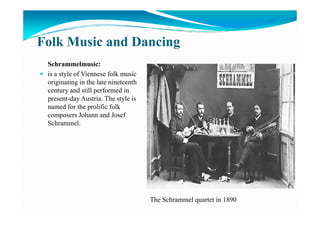
The Schrammel quartet in 1890
The Blue Danube…
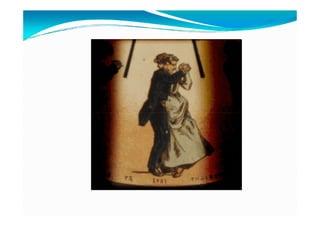
Waltz: is a ballroom and folk
dance of Austrian origin in 3/4
time , performed primarily in
closed position.
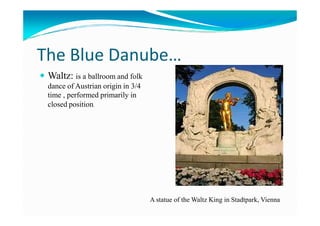
A statue of the Waltz King in Stadtpark, Vienna
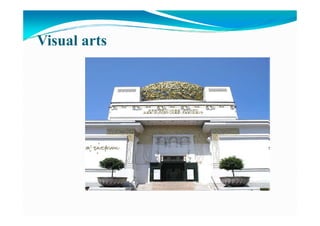
Visual arts
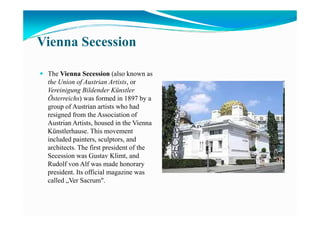
Vienna Secession
The Vienna Secession (also known as
the Union of Austrian Artists, or
Vereinigung Bildender Künstler
Österreichs) was formed in 1897 by a
group of Austrian artists who had
resigned from the Association ofresigned from the Association of
Austrian Artists, housed in the Vienna
Künstlerhause. This movement
included painters, sculptors, and
architects. The first president of the
Secession was Gustav Klimt, and
Rudolf von Alf was made honorary
president. Its official magazine was
called „Ver Sacrum".
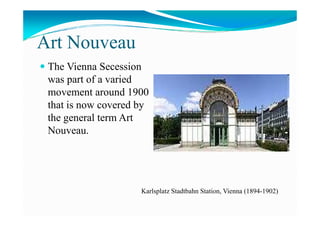
Art Nouveau
The Vienna Secession
was part of a varied
movement around 1900
that is now covered by
the general term Artthe general term Art
Nouveau.
Karlsplatz Stadtbahn Station, Vienna (1894-1902)
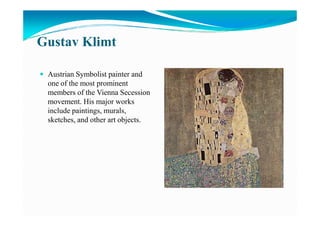
Gustav Klimt
Austrian Symbolist painter and
one of the most prominent
members of the Vienna Secession
movement. His major works
include paintings, murals,include paintings, murals,
sketches, and other art objects.
Egon Schiele
An Austrian painter. A protégé
of Gustav Klimt, Schiele was a
major figurative painter of the
early 20th century. His work is
noted for its intensity, and the
many self-portraits the artistmany self-portraits the artist
produced. The twisted body
shapes and the expressive line
that characterize Schiele's
paintings and drawings mark
the artist as an early exponent
of Expressionism.
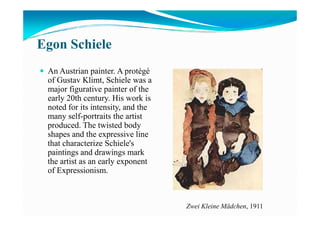
Zwei Kleine Mädchen, 1911
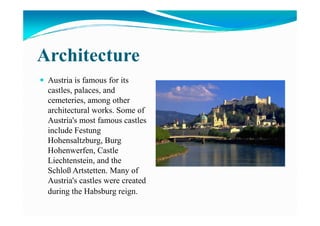
Architecture
Austria is famous for its
castles, palaces, and
cemeteries, among other
architectural works. Some ofarchitectural works. Some of
Austria's most famous castles
include Festung
Hohensaltzburg, Burg
Hohenwerfen, Castle
Liechtenstein, and the
Schloß Artstetten. Many of
Austria's castles were created
during the Habsburg reign.
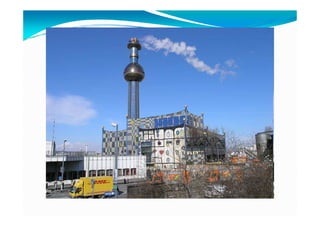
Friedensreich Hundertwasser
An Austrian artist. Born
Friedrich Stowasser in
Vienna, he became one of
the best-knownthe best-known
contemporary Austrian
artists, although
controversial, by the end
of the 20th century.
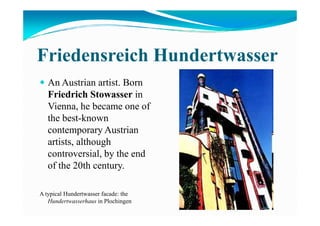
A typical Hundertwasser facade: the
Hundertwasserhaus in Plochingen
A-1140 Vienna, Penzingerstr.125/3
ContactContact detailsdetails:
Thank you for your attention!
A-1140 Vienna, Penzingerstr.125/3
0043-699-17194869
@ ifmik@hotmail.com
Short course of Viennese waltz
http://www.youtube.com/watch?feature=player_det
ailpage&v=AaG4dHJoFBU

Visual arts in Austria - IFMIK Wien

  • 1.
    presented bypresented by Institutfür die Förderung von Mehrsprachigkeit, interkulturellen Kompetenzen und Gleichbehandlung For the project meeting of the project EU Treasure Hunt in Nicosia february 2012
  • 2.
    Music of Austria Vienna,the capital city of Austria has long been an important center of musical innovation. Composers of the 18th and 19th centuries were drawn to the city by the patronage of the Habsburgs, and made Vienna the European capital of classicalHabsburgs, and made Vienna the European capital of classical music. Wolfgang Amadeus Mozart, Ludwig van Beethoven, and Johann Strauss, Jr.,among others, were associated with the city. During the Baroque period, Slavic and Hungarian folk forms influenced Austrian music. Vienna's status began its rise as a cultural center in the early 16th century, and was focused around instruments including the lute.
  • 3.
    Classical music During the18th century, the classical-music era dominated European classical music, and the city of Vienna was an especially important place for musicalimportant place for musical innovation. Three composers arose, making lasting innovations: Ludwig van Beethoven's symphonic patterns, Wolfgang Amadeus Mozart's balance between melody and form, and Joseph Haydn`s development of the string quartet and sonata. Joseph Haydn, Portrait by Thomas Hardy, 1791
  • 4.
    Wolfgang Amadeus Mozart Mozartshowed prodigious ability from his earliest childhood in Salzburg. Already competent on keyboard and violin, he composed from the age of five and performed before European royalty. During his final years in Vienna, he composed many of his best-known symphonies, concertos, and operas, and portions of the Requiem,which was largely unfinished at the time of Mozart's death. Mozart drawing by Doris Stock 1789
  • 5.
    Ludwig van Beethoven Bornin Bonn, then the capital of the Electorate of Cologne and part of the Holy Roman Empire, Beethoven moved to Vienna in his early 20s, studying with Joseph Haydn and quickly gaining a reputation as aquickly gaining a reputation as a virtuoso pianist. His hearing began to deteriorate in his late twenties, yet he continued to compose, conduct, and perform, even after becoming completly deaf. The rythm of EU one of the famous melody by Beethoven. Painting of Beethoven by Joseph Karl Stieler (1820)
  • 6.
    Johann Strauss, Jr, AnAustian composer of light music, particularly dance music and operettas. He composed over 500 waltzes, polkas, quadrilles and other types of dance music, as well as several operettas and a ballet. In his lifetime,operettas and a ballet. In his lifetime, he was known as "The Waltz King", and was largely then responsible for the popularity of the waltz in Vienna during the 19th century. Johann Strauss, Jr, Lithography by Josef Kriehuber
  • 7.
    Folk Music andDancing Schrammelmusic: is a style of Viennese folk music originating in the late nineteenth century and still performed in present-day Austria. The style is named for the prolific folk composers Johann and Josefcomposers Johann and Josef Schrammel. The Schrammel quartet in 1890
  • 8.
    The Blue Danube… Waltz:is a ballroom and folk dance of Austrian origin in 3/4 time , performed primarily in closed position. A statue of the Waltz King in Stadtpark, Vienna
  • 10.
  • 11.
    Vienna Secession The ViennaSecession (also known as the Union of Austrian Artists, or Vereinigung Bildender Künstler Österreichs) was formed in 1897 by a group of Austrian artists who had resigned from the Association ofresigned from the Association of Austrian Artists, housed in the Vienna Künstlerhause. This movement included painters, sculptors, and architects. The first president of the Secession was Gustav Klimt, and Rudolf von Alf was made honorary president. Its official magazine was called „Ver Sacrum".
  • 12.
    Art Nouveau The ViennaSecession was part of a varied movement around 1900 that is now covered by the general term Artthe general term Art Nouveau. Karlsplatz Stadtbahn Station, Vienna (1894-1902)
  • 13.
    Gustav Klimt Austrian Symbolistpainter and one of the most prominent members of the Vienna Secession movement. His major works include paintings, murals,include paintings, murals, sketches, and other art objects.
  • 14.
    Egon Schiele An Austrianpainter. A protégé of Gustav Klimt, Schiele was a major figurative painter of the early 20th century. His work is noted for its intensity, and the many self-portraits the artistmany self-portraits the artist produced. The twisted body shapes and the expressive line that characterize Schiele's paintings and drawings mark the artist as an early exponent of Expressionism. Zwei Kleine Mädchen, 1911
  • 15.
    Architecture Austria is famousfor its castles, palaces, and cemeteries, among other architectural works. Some ofarchitectural works. Some of Austria's most famous castles include Festung Hohensaltzburg, Burg Hohenwerfen, Castle Liechtenstein, and the Schloß Artstetten. Many of Austria's castles were created during the Habsburg reign.
  • 16.
    Friedensreich Hundertwasser An Austrianartist. Born Friedrich Stowasser in Vienna, he became one of the best-knownthe best-known contemporary Austrian artists, although controversial, by the end of the 20th century. A typical Hundertwasser facade: the Hundertwasserhaus in Plochingen
  • 18.
    A-1140 Vienna, Penzingerstr.125/3 ContactContactdetailsdetails: Thank you for your attention! A-1140 Vienna, Penzingerstr.125/3 0043-699-17194869 @ ifmik@hotmail.com
  • 19.
    Short course ofViennese waltz http://www.youtube.com/watch?feature=player_det ailpage&v=AaG4dHJoFBU