BY-
DEEPTI
HARMAN
KHUSHBOO
SHREYA
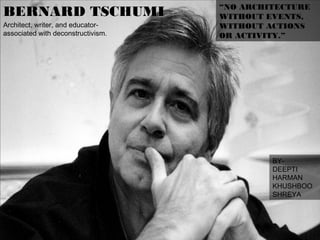
BERNARD TSCHUMI
Architect, writer, and educator-
associated with deconstructivism.
“NO ARCHITECTURE
WITHOUT EVENTS,
WITHOUT ACTIONS
OR ACTIVITY.”
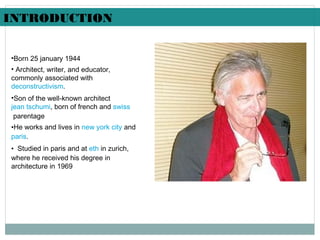
•Born 25 january 1944
• Architect, writer, and educator,
commonly associated with 
deconstructivism.
•Son of the well-known architect 
jean tschumi, born of french and swiss
 parentage
•He works and lives in new york city and 
paris.
• Studied in paris and at eth in zurich,
where he received his degree in
architecture in 1969
INTRODUCTION
• It  is the artistic technique of presenting
audiences common things in an unfamiliar
or strange way in order to enhance
perception of the familiar.
EXAMPLE -If the design of windows only
reflects the superficiality of the skin's
decoration, we might start to look for a way
to do without windows. If the design of
pillars reflects the conventionality of a
supporting frame, maybe we might get rid of
pillars altogether.
• He took advantage of dismantling, celebrate
fragmentation by celebrating the culture of
differences, by accelerating and intensifying
the loss of certainty, of center, of history.
PHILOSOPHIES
DEFAMILIARIZATION CROSS PROGRAMMING
 If architecture is both concept
and experience, space and use,
structure and superficial image –
non hierarchically -- then
architecture should cease to
separate these categories and
instead merge them into
combinations of programs and
spaces.
 It needs interchangeability of
form and function.
PHILOSOPHIES
EVENT SHOCK
• Loss of shock makes images
interchangeable, and that in an age
of pure information the only thing
that counted was the “shock” -- the
shock of images, their surprise
factor.
• This shock factor was what allowed
an image to stand out.
•The increase in change strengthens
architecture as a form of domination,
power and authority.
•There was no architecture without
event, action, activities or functions.
• Architecture is seen as the
combination of spaces, events, and
movements without any hierarchy
among these concepts.
• The event here is seen as a turning
point - not an origin or an end ,as
opposed to such propositions as “form
follows function.”
•Architecture is not about the
conditions of design, but about the
design of conditions.
PHILOSOPHIES
DESTRUCTURING SUPERIMPOSITION
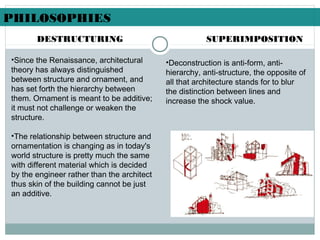
•Since the Renaissance, architectural
theory has always distinguished
between structure and ornament, and
has set forth the hierarchy between
them. Ornament is meant to be additive;
it must not challenge or weaken the
structure.
•The relationship between structure and
ornamentation is changing as in today's
world structure is pretty much the same
with different material which is decided
by the engineer rather than the architect
thus skin of the building cannot be just
an additive.
•Deconstruction is anti-form, anti-
hierarchy, anti-structure, the opposite of
all that architecture stands for to blur
the distinction between lines and
increase the shock value.
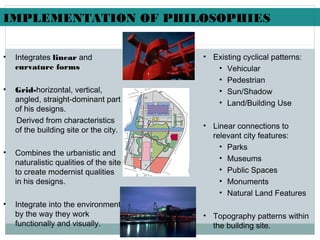
• Integrates linear and
curvature forms
• Grid-horizontal, vertical,
angled, straight-dominant part
of his designs.
Derived from characteristics
of the building site or the city.
• Combines the urbanistic and
naturalistic qualities of the site
to create modernist qualities
in his designs.
• Integrate into the environment
by the way they work
functionally and visually.
IMPLEMENTATION OF PHILOSOPHIES
• Existing cyclical patterns:
• Vehicular
• Pedestrian
• Sun/Shadow
• Land/Building Use
• Linear connections to
relevant city features:
• Parks
• Museums
• Public Spaces
• Monuments
• Natural Land Features
• Topography patterns within
the building site.
•International competition design- cultural park with
activities that include workshops, gymnasium and bath
facilities, playgrounds, exhibitions, concerts, science
experiments, games etc.
•It is built on a 125 acre site earlier acting as a slaughter
house. FORM
•He proposed an architecture of
disjunction
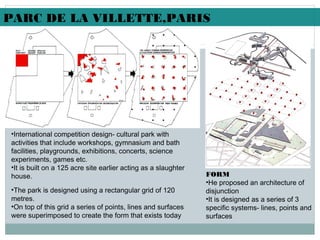
•It is designed as a series of 3
specific systems- lines, points and
surfaces
PARC DE LA VILLETTE,PARIS
•The park is designed using a rectangular grid of 120
metres.
•On top of this grid a series of points, lines and surfaces
were superimposed to create the form that exists today
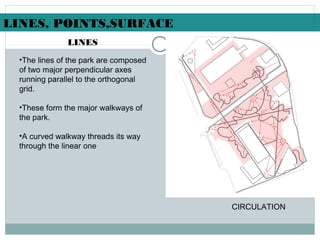
•The lines of the park are composed
of two major perpendicular axes
running parallel to the orthogonal
grid.
•These form the major walkways of
the park.
•A curved walkway threads its way
through the linear one
CIRCULATION
LINES, POINTS,SURFACE
LINES
LINES, POINTS,SURFACE
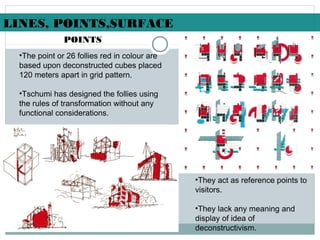
•The point or 26 follies red in colour are
based upon deconstructed cubes placed
120 meters apart in grid pattern.
•Tschumi has designed the follies using
the rules of transformation without any
functional considerations.
•They act as reference points to
visitors.
•They lack any meaning and
display of idea of
deconstructivism.
POINTS
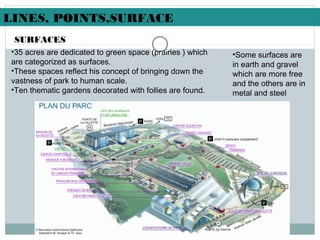
•35 acres are dedicated to green space (prairies ) which
are categorized as surfaces.
•These spaces reflect his concept of bringing down the
vastness of park to human scale.
•Ten thematic gardens decorated with follies are found.
SURFACES
LINES, POINTS,SURFACE
•Some surfaces are
in earth and gravel
which are more free
and the others are in
metal and steel
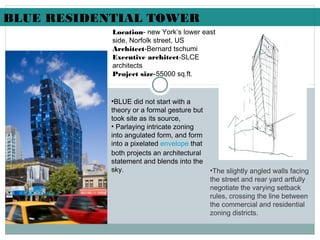
Location- new York’s lower east
side, Norfolk street, US
Architect-Bernard tschumi
Executive architect-SLCE
architects
Project size-55000 sq.ft.
•BLUE did not start with a
theory or a formal gesture but
took site as its source,
• Parlaying intricate zoning
into angulated form, and form
into a pixelated envelope that
both projects an architectural
statement and blends into the
sky. •The slightly angled walls facing
the street and rear yard artfully
negotiate the varying setback
rules, crossing the line between
the commercial and residential
zoning districts. 
BLUE RESIDENTIAL TOWER
FACADE
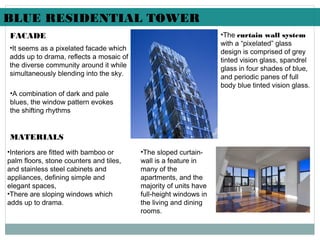
•It seems as a pixelated facade which
adds up to drama, reflects a mosaic of
the diverse community around it while
simultaneously blending into the sky.
•A combination of dark and pale
blues, the window pattern evokes
the shifting rhythms
MATERIALS
•Interiors are fitted with bamboo or
palm floors, stone counters and tiles,
and stainless steel cabinets and
appliances, defining simple and
elegant spaces,
•There are sloping windows which
adds up to drama.
•The curtain wall system
with a “pixelated” glass
design is comprised of grey
tinted vision glass, spandrel
glass in four shades of blue,
and periodic panes of full
body blue tinted vision glass.
•The sloped curtain-
wall is a feature in
many of the
apartments, and the
majority of units have
full-height windows in
the living and dining
rooms.
BLUE RESIDENTIAL TOWER
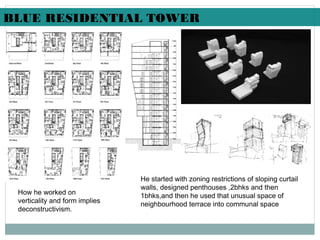
He started with zoning restrictions of sloping curtail
walls, designed penthouses ,2bhks and then
1bhks,and then he used that unusual space of
neighbourhood terrace into communal space
How he worked on
verticality and form implies
deconstructivism.
BLUE RESIDENTIAL TOWER
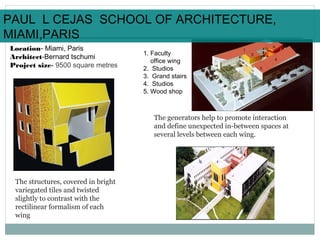
Location- Miami, Paris
Architect-Bernard tschumi
Project size- 9500 square metres
1
3
2
4
1. Faculty
office wing
2. Studios
3. Grand stairs
4. Studios
5. Wood shop
The structures, covered in bright
variegated tiles and twisted
slightly to contrast with the
rectilinear formalism of each
wing
The generators help to promote interaction
and define unexpected in-between spaces at
several levels between each wing.
5
PAUL L CEJAS SCHOOL OF ARCHITECTURE,
MIAMI,PARIS
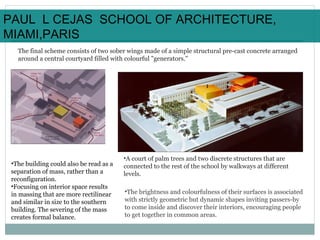
•The building could also be read as a
separation of mass, rather than a
reconfiguration.
•Focusing on interior space results
in massing that are more rectilinear
and similar in size to the southern
building. The severing of the mass
creates formal balance.
The final scheme consists of two sober wings made of a simple structural pre-cast concrete arranged
around a central courtyard filled with colourful "generators."
1
2
•A court of palm trees and two discrete structures that are
connected to the rest of the school by walkways at different
levels.
•The brightness and colourfulness of their surfaces is associated
with strictly geometric but dynamic shapes inviting passers-by
to come inside and discover their interiors, encouraging people
to get together in common areas.
PAUL L CEJAS SCHOOL OF ARCHITECTURE,
MIAMI,PARIS
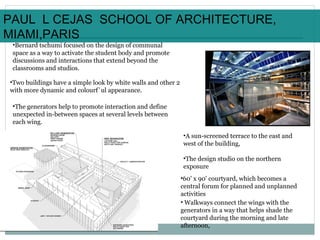
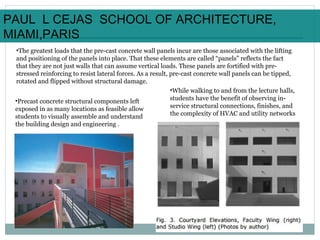
•Bernard tschumi focused on the design of communal
space as a way to activate the student body and promote
discussions and interactions that extend beyond the
classrooms and studios.
•Two buildings have a simple look by white walls and other 2
with more dynamic and colourf`ul appearance.
•The generators help to promote interaction and define
unexpected in-between spaces at several levels between
each wing.
•60' x 90' courtyard, which becomes a
central forum for planned and unplanned
activities
• Walkways connect the wings with the
generators in a way that helps shade the
courtyard during the morning and late
afternoon,
•A sun-screened terrace to the east and
west of the building,
•The design studio on the northern
exposure
PAUL L CEJAS SCHOOL OF ARCHITECTURE,
MIAMI,PARIS
•The greatest loads that the pre-cast concrete wall panels incur are those associated with the lifting
and positioning of the panels into place. That these elements are called “panels” reflects the fact
that they are not just walls that can assume vertical loads. These panels are fortified with pre-
stressed reinforcing to resist lateral forces. As a result, pre-cast concrete wall panels can be tipped,
rotated and flipped without structural damage.
•Precast concrete structural components left
exposed in as many locations as feasible allow
students to visually assemble and understand
the building design and engineering .
•While walking to and from the lecture halls,
students have the benefit of observing in-
service structural connections, finishes, and
the complexity of HVAC and utility networks
PAUL L CEJAS SCHOOL OF ARCHITECTURE,
MIAMI,PARIS
SOURCES
http://www.designbuild-network.com/projects/blue-tower/
http://pyramidbeach.com/tag/blue-residental-tower/
http://www.tschumi.com/projects/65/
http://www.mindfulwalker.com/explore-new-
york/a-riveting-blue-in-the-lower-east-side
http://www.architravel.com/architravel/building/bl
ue-tower/
http://www.floornature.com/projects-buildings-and-public-places/project-
paul-l-cejas-school-of-architecture-bernard-tschumi-miami-2003-4926/
https://mjard005.files.wordpress.com/2014/03/annotated-bibliography-
bernard-tschumi_s-school-of-architecture.pdf

Bernard tschumi

  • 1.
    BY- DEEPTI HARMAN KHUSHBOO SHREYA BERNARD TSCHUMI Architect, writer,and educator- associated with deconstructivism. “NO ARCHITECTURE WITHOUT EVENTS, WITHOUT ACTIONS OR ACTIVITY.”
  • 2.
    •Born 25 january1944 • Architect, writer, and educator, commonly associated with  deconstructivism. •Son of the well-known architect  jean tschumi, born of french and swiss  parentage •He works and lives in new york city and  paris. • Studied in paris and at eth in zurich, where he received his degree in architecture in 1969 INTRODUCTION
  • 3.
    • It  isthe artistic technique of presenting audiences common things in an unfamiliar or strange way in order to enhance perception of the familiar. EXAMPLE -If the design of windows only reflects the superficiality of the skin's decoration, we might start to look for a way to do without windows. If the design of pillars reflects the conventionality of a supporting frame, maybe we might get rid of pillars altogether. • He took advantage of dismantling, celebrate fragmentation by celebrating the culture of differences, by accelerating and intensifying the loss of certainty, of center, of history. PHILOSOPHIES DEFAMILIARIZATION CROSS PROGRAMMING  If architecture is both concept and experience, space and use, structure and superficial image – non hierarchically -- then architecture should cease to separate these categories and instead merge them into combinations of programs and spaces.  It needs interchangeability of form and function.
  • 4.
    PHILOSOPHIES EVENT SHOCK • Lossof shock makes images interchangeable, and that in an age of pure information the only thing that counted was the “shock” -- the shock of images, their surprise factor. • This shock factor was what allowed an image to stand out. •The increase in change strengthens architecture as a form of domination, power and authority. •There was no architecture without event, action, activities or functions. • Architecture is seen as the combination of spaces, events, and movements without any hierarchy among these concepts. • The event here is seen as a turning point - not an origin or an end ,as opposed to such propositions as “form follows function.” •Architecture is not about the conditions of design, but about the design of conditions.
  • 5.
    PHILOSOPHIES DESTRUCTURING SUPERIMPOSITION •Since theRenaissance, architectural theory has always distinguished between structure and ornament, and has set forth the hierarchy between them. Ornament is meant to be additive; it must not challenge or weaken the structure. •The relationship between structure and ornamentation is changing as in today's world structure is pretty much the same with different material which is decided by the engineer rather than the architect thus skin of the building cannot be just an additive. •Deconstruction is anti-form, anti- hierarchy, anti-structure, the opposite of all that architecture stands for to blur the distinction between lines and increase the shock value.
  • 6.
    • Integrates linearand curvature forms • Grid-horizontal, vertical, angled, straight-dominant part of his designs. Derived from characteristics of the building site or the city. • Combines the urbanistic and naturalistic qualities of the site to create modernist qualities in his designs. • Integrate into the environment by the way they work functionally and visually. IMPLEMENTATION OF PHILOSOPHIES • Existing cyclical patterns: • Vehicular • Pedestrian • Sun/Shadow • Land/Building Use • Linear connections to relevant city features: • Parks • Museums • Public Spaces • Monuments • Natural Land Features • Topography patterns within the building site.
  • 7.
    •International competition design-cultural park with activities that include workshops, gymnasium and bath facilities, playgrounds, exhibitions, concerts, science experiments, games etc. •It is built on a 125 acre site earlier acting as a slaughter house. FORM •He proposed an architecture of disjunction •It is designed as a series of 3 specific systems- lines, points and surfaces PARC DE LA VILLETTE,PARIS •The park is designed using a rectangular grid of 120 metres. •On top of this grid a series of points, lines and surfaces were superimposed to create the form that exists today
  • 8.
    •The lines ofthe park are composed of two major perpendicular axes running parallel to the orthogonal grid. •These form the major walkways of the park. •A curved walkway threads its way through the linear one CIRCULATION LINES, POINTS,SURFACE LINES
  • 9.
    LINES, POINTS,SURFACE •The pointor 26 follies red in colour are based upon deconstructed cubes placed 120 meters apart in grid pattern. •Tschumi has designed the follies using the rules of transformation without any functional considerations. •They act as reference points to visitors. •They lack any meaning and display of idea of deconstructivism. POINTS
  • 10.
    •35 acres arededicated to green space (prairies ) which are categorized as surfaces. •These spaces reflect his concept of bringing down the vastness of park to human scale. •Ten thematic gardens decorated with follies are found. SURFACES LINES, POINTS,SURFACE •Some surfaces are in earth and gravel which are more free and the others are in metal and steel
  • 11.
    Location- new York’slower east side, Norfolk street, US Architect-Bernard tschumi Executive architect-SLCE architects Project size-55000 sq.ft. •BLUE did not start with a theory or a formal gesture but took site as its source, • Parlaying intricate zoning into angulated form, and form into a pixelated envelope that both projects an architectural statement and blends into the sky. •The slightly angled walls facing the street and rear yard artfully negotiate the varying setback rules, crossing the line between the commercial and residential zoning districts.  BLUE RESIDENTIAL TOWER
  • 12.
    FACADE •It seems asa pixelated facade which adds up to drama, reflects a mosaic of the diverse community around it while simultaneously blending into the sky. •A combination of dark and pale blues, the window pattern evokes the shifting rhythms MATERIALS •Interiors are fitted with bamboo or palm floors, stone counters and tiles, and stainless steel cabinets and appliances, defining simple and elegant spaces, •There are sloping windows which adds up to drama. •The curtain wall system with a “pixelated” glass design is comprised of grey tinted vision glass, spandrel glass in four shades of blue, and periodic panes of full body blue tinted vision glass. •The sloped curtain- wall is a feature in many of the apartments, and the majority of units have full-height windows in the living and dining rooms. BLUE RESIDENTIAL TOWER
  • 13.
    He started withzoning restrictions of sloping curtail walls, designed penthouses ,2bhks and then 1bhks,and then he used that unusual space of neighbourhood terrace into communal space How he worked on verticality and form implies deconstructivism. BLUE RESIDENTIAL TOWER
  • 14.
    Location- Miami, Paris Architect-Bernardtschumi Project size- 9500 square metres 1 3 2 4 1. Faculty office wing 2. Studios 3. Grand stairs 4. Studios 5. Wood shop The structures, covered in bright variegated tiles and twisted slightly to contrast with the rectilinear formalism of each wing The generators help to promote interaction and define unexpected in-between spaces at several levels between each wing. 5 PAUL L CEJAS SCHOOL OF ARCHITECTURE, MIAMI,PARIS
  • 15.
    •The building couldalso be read as a separation of mass, rather than a reconfiguration. •Focusing on interior space results in massing that are more rectilinear and similar in size to the southern building. The severing of the mass creates formal balance. The final scheme consists of two sober wings made of a simple structural pre-cast concrete arranged around a central courtyard filled with colourful "generators." 1 2 •A court of palm trees and two discrete structures that are connected to the rest of the school by walkways at different levels. •The brightness and colourfulness of their surfaces is associated with strictly geometric but dynamic shapes inviting passers-by to come inside and discover their interiors, encouraging people to get together in common areas. PAUL L CEJAS SCHOOL OF ARCHITECTURE, MIAMI,PARIS
  • 16.
    •Bernard tschumi focusedon the design of communal space as a way to activate the student body and promote discussions and interactions that extend beyond the classrooms and studios. •Two buildings have a simple look by white walls and other 2 with more dynamic and colourf`ul appearance. •The generators help to promote interaction and define unexpected in-between spaces at several levels between each wing. •60' x 90' courtyard, which becomes a central forum for planned and unplanned activities • Walkways connect the wings with the generators in a way that helps shade the courtyard during the morning and late afternoon, •A sun-screened terrace to the east and west of the building, •The design studio on the northern exposure PAUL L CEJAS SCHOOL OF ARCHITECTURE, MIAMI,PARIS
  • 17.
    •The greatest loadsthat the pre-cast concrete wall panels incur are those associated with the lifting and positioning of the panels into place. That these elements are called “panels” reflects the fact that they are not just walls that can assume vertical loads. These panels are fortified with pre- stressed reinforcing to resist lateral forces. As a result, pre-cast concrete wall panels can be tipped, rotated and flipped without structural damage. •Precast concrete structural components left exposed in as many locations as feasible allow students to visually assemble and understand the building design and engineering . •While walking to and from the lecture halls, students have the benefit of observing in- service structural connections, finishes, and the complexity of HVAC and utility networks PAUL L CEJAS SCHOOL OF ARCHITECTURE, MIAMI,PARIS
  • 18.