




1
Methodology to calculate embodied carbon
in a building’s construction life cycle
2
Glossary
Carbon
emissions/ CO2e
emissions/ CO2e
equivalent/
Greenhouse gas
emissions
Shorthand for emissions of any of the basket of greenhouse gases (GHG) that
affect climate change. Carbon emissions are usually expressed as CO2e (i.e. CO2
equivalent), which is a unit of measurement based on the relative impact of a
given gas on global warming (the so-called global warming potential). For
example, if methane has a global warming potential of 25, it means that 1 kg of
methane has the same impact on climate change as 25 kg of carbon dioxide and
thus 1 kg of methane would count as 25 kg of CO2e. The global warming potential
of greenhouse gases are presented in the table below:
Table 1: Global warming potentials (GWP) of greenhouse gases
Greenhouse gas GWP over 100 years Typical sources
Carbon dioxide (CO2) 1 Energy combustion, biochemical reactions
Methane (CH4) 25 Decomposition
Nitrous oxide (N2O) 298 Fertilizers, car emissions, manufacturing
Sulfur hexafluoride (SF6) 22,800 Switch gears, substations
Perfluorocarbon (PFC) 7,390–12,200 Aluminium smelting
Hydrofluorocarbon (HFC) 124–14,800 Refrigerants, industrial gases
Taken from IPCC Fourth Assessment Report: Climate Change 2007
Carbon hotspot Carbon significant aspect of a project that should be targeted for reduction.
Carbon hotspots represent not only carbon-intense elements but also ‘quick wins’
where measurement data is more easily available and where carbon reductions
are possible.
Product stage
carbon
Carbon emissions between the confines of the ‘cradle’ (earth) up to the factory
gate of the final product processing operation. This includes mining, raw materials
extraction and processing, transportation and final product manufacturing.
Product stage emissions are often referred to as cradle-to-gate carbon emissions.
Product stage carbon is sometimes referred to as ‘CapCarb’ (capital carbon).
Construction Carbon emissions associated with construction site energy consumption and
3
stage carbon transport of construction materials and waste to/from site.
Use stage
carbon
Carbon emissions associated with the operational phase of the building: in-use
energy consumption, maintenance, repairs, replacements, refurbishments.
End of life stage
carbon
Carbon emissions associated with demolition, materials/waste transport,
processing and disposal.
Cradle-to-grave
carbon
Carbon emissions associated with all building life cycle stages: product,
construction, use, end of life.
Cradle-to-
cradle
The process of making a component or product and then, at the end of its life,
converting it into a new component of either the same quality (e.g. recycling of
aluminium cans) or a lesser quality (e.g. downcycling of a computer plastic case
into a plastic container, which is then turned into a building insulation board,
eventually becoming waste).
Embodied
carbon
Carbon emissions associated with energy consumption (embodied energy) and
chemical processes during the extraction, manufacture, transportation, assembly,
replacement and deconstruction of construction materials or products. Embodied
carbon can be measured from cradle-to-gate, cradle-to-site, cradle-to-end of
construction, cradle-to-grave, or even cradle-to-cradle. The typical embodied
carbon datasets are cradle-to-gate. Embodied carbon is usually expressed in
kilograms of CO2e per kilogram of product or material.
Life cycle
carbon
Another term for cradle-to-grave carbon emissions.
Operational
carbon
Carbon emissions associated with energy consumption (operational energy) while
the building is occupied. This includes the so-called regulated load (e.g. heating,
cooling, ventilation, lighting) and unregulated/plug load (e.g. ICT equipment,
cooking and refrigeration appliances). Operational carbon is sometimes referred
to as ‘Op Carb’.
Global
Warming
Potential (GWP)
A relative measure of how much a given mass of greenhouse gas is estimated to
contribute to global warming. It is measured against CO2e which has a GWP of 1
(see table 1).
Recycled The portion of a product that contains materials that have been recovered or
4
content otherwise diverted from the solid waste stream.
Sequestration Accumulation and storage of atmospheric carbon by bio-renewable building
materials (e.g. timber).
5
Introduction
Most of the focus on reducing carbon emissions from the built environment to date
has been on managing and reducing the energy consumption from building’s energy
load such as: lighting, heating, ventilation and air conditioning through better design
and management in use (regulated and un-regulated loads). However, the emissions
that occur resulting from the production, installation, maintenance and disposal of a
building’s materials remain largely unchecked and as more buildings are constructed
to higher energy efficiency standards the proportion of the carbon emissions created
shifts from the operational emissions (from gas and electricity and the like) to energy
consumed during other life cycle stages of projects such as the carbon emissions
created in the manufacture of the materials used, their transportation, the
construction activities themselves and the eventual demolition and disposal (see
Figure 5).
Calculations of emissions associated with one of these stages – product manufacture
– are based on the quantity of construction materials that make up a building. The
research (HM Government 2010) has shown that this stage is the second most
significant area of carbon emissions from the entire life cycle of a building (after the
operational emissions).
Some local authorities in the UK have already included mandatory cradle-to-gate
embodied carbon assessments as part of the planning process (Brighton and Hove
City Council 2011). The latest international version of BREEAM (the Building
Research Establishment’s Environmental Assessment Method) awards points for
calculating and reducing embodied carbon emissions. Also, the LEED (Leadership in
Energy and Environmental Design) and Green Star assessment tools recognise
embodied carbon measurement and its mitigation as part of minimising the building
life cycle impacts.
A number of clients (e.g. developers, utility companies, banks, retailers) are also
starting to include embodied carbon quantification and mitigation on their projects.
This is done mostly for competitive reasons, as part of their CSR responsibilities and
increasingly as part of planning requirements. As pioneers and early adopters of the
carbon calculation, they have started capitalising on the added value gains.
In recent years it has become a standard practice to employ dedicated
sustainability/green consultants to undertake the embodied carbon studies. However,
since quantity surveyors are typically involved in measuring and analysing the
quantities of materials in the generation of cost plans or life cycle costing studies,
they are very well placed professionally to add an embodied carbon dimension to
their reports. Linking embodied carbon estimates with cost plans and life cycle
costing will not only achieve cost efficiency but, more importantly, it will allow clients
to make more informed design decisions.
The aim of this guidance note
In 2012 RICS released the Methodology to calculate embodied carbon of materials,
1st
edition information paper. Apart from providing background information on
embodied carbon, the focus here was explaining how to estimate carbon emissions
associated with manufacturing of building materials or cradle-to-gate with a particular
emphasis on the construction industry.
6
This guidance note builds on that knowledge and expands the scope to cover
emissions during other life cycle stages (i.e. construction, use, end of life). The main
aim is to provide a framework of practical guidance for quantity surveyors on how to
calculate embodied carbon emissions associated with their projects. Additionally,
some good practice carbon reduction solutions have been listed. This presents an
opportunity for the QS to offer this advice as part of the standard cost planning
service. This guidance should help the project teams and clients make decisions
about embodied carbon.
RICS expects BIM (Building Information Modelling) to have a major impact in carbon
quantification and mitigation in future, however, there will always be a need for early
feasibility studies. This guidance note is not intended to replace any of the guides
that already exist (e.g. PAS 2050, Green House Gas Protocol), but to make carbon
calculation more accessible to the QS community. It is acknowledged that embodied
carbon is a complex and relatively new area of research and therefore a number of
assumptions have to be made, which affect the accuracy of the outcome. However,
considering that the primary objective of measuring carbon emissions is to improve
sustainability performance, it is felt that this guidance note will provide a valuable
resource for the construction industry.
7
1 What is embodied carbon in the built environment?
Embodied carbon is the carbon impact associated with materials production,
transport, assembly, use and disposal. It does not include the carbon emissions
associated with the energy used for heating, lighting or cooling in the completed
building.
The final report on low carbon construction for HM Government by the Innovation
and Growth Team (IGT) (HM Government 2010) concludes that embodied carbon is
an important factor that needs to be brought into the systems used for appraisal of
projects and hence into the design decisions made in developing projects. This
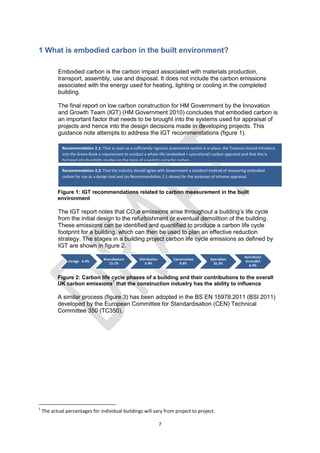
guidance note attempts to address the IGT recommendations (figure 1).
Figure 1: IGT recommendations related to carbon measurement in the built
environment
The IGT report notes that CO2e emissions arise throughout a building’s life cycle
from the initial design to the refurbishment or eventual demolition of the building.
These emissions can be identified and quantified to produce a carbon life cycle
footprint for a building, which can then be used to plan an effective reduction
strategy. The stages in a building project carbon life cycle emissions as defined by
IGT are shown in figure 2.
Figure 2: Carbon life cycle phases of a building and their contributions to the overall
UK carbon emissions
1
that the construction industry has the ability to influence
A similar process (figure 3) has been adopted in the BS EN 15978:2011 (BSI 2011)
developed by the European Committee for Standardisation (CEN) Technical
Committee 350 (TC350).
1
The actual percentages for individual buildings will vary from project to project.
Recommendation 2.2: That the industry should agree with Government a standard method of measuring embodied
carbon for use as a design tool and (as Recommendation 2.1 above) for the purposes of scheme appraisal.
Recommendation 2.1: That as soon as a sufficiently rigorous assessment system is in place, the Treasury should introduce
into the Green Book a requirement to conduct a whole-life (embodied + operational) carbon appraisal and that this is
factored into feasibility studies on the basis of a realistic price for carbon.
8
Included in
cradle-to-gate
Materials or product
manufacture cradle-
to-gate emissions
are those associated
with the production of
construction
products/materials.
The emissions arise
from the energy used
in extracting
materials, refining
them (i.e. primary
manufacture),
transporting and
processing them to
produce a finished
product (i.e.
secondary
manufacture). The
CO2e emissions
resulting from these
processed are often
referred to as
embodied carbon.
Included in
cradle-to-site
and
cradle-to-end
of
construction
Emissions from
the
construction
phase include
energy and fuel
consumption
during:
transportation
of material to
site (cradle-to-
site), as well as
enabling works,
remediation,
clearance,
removal/demoli
tion of existing
structures
ground
improvements,
earthworks,
assembly
(cradle-to-end
of construction)
The use carbon emissions from the
building include operations
emissions resulting from energy
consumed for heating, lighting,
ventilation, air conditioning, etc.
These are typically responsible for
around 75 per cent of the life cycle
carbon emissions. The actual figure
will be heavily influenced by
occupier behaviour as well as by
the building type. Emissions
associated with this phase are
usually estimated by mechanical
engineers who use software
packages designed to calculate
operational impacts.
There will also be additional
embodied carbon arising from
maintenance, repair, replacements
and refurbishments of building
elements (e.g. fabric or services).
Lifecycle specialists will be able to
advise on predicted lifespans of
building elements.
Included in cradle-to-grave
End of life emissions are those
associated with energy
consumed during building
demolition and waste disposal
processes. However, unless a
planned deconstruction is
scheduled it is advised that
these impacts are not assessed
as part of the project’s
emissions. Demolition
emissions are best assessed at
the beginning of the life cycle
as part emissions associated
with the new building.
Included in cradle-
to-cradle
Module D quantifies
the carbon impacts
beyond the building
lifecycle emissions. It
acknowledges the
‘design for reuse and
recycling’ concept as
it allows to
demonstrate the
benefits resulting
from reuse, recycling
and energy recovery.
Figure 3: Building life cycle stages (adapted from the BS EN 15978:2011)
The BS EN 15978:2011 method is likely to be the dominant calculation method used
by the construction industry (Construction Products Association 2012). Therefore the
life cycle classification in this guidance note has been based on BS EN 15978:2011.
As shown in figure 2 operational emissions contribute the most to the UK building
industry carbon footprint. Typically around 70–80 per cent is associated with the use
phase and the rest is associated primarily with the embodied carbon from the
materials manufacturing process. However, the ratio between operational and
embodied carbon varies according to building type. For example, a low energy-
intensive facility such as a warehouse (where no heating or cooling may be required)
operating carbon emissions are likely to account for only 20 per cent of the building
carbon footprint (over 30 years). The relationship between different types of
emissions for different building types is illustrated in figure 4.
9
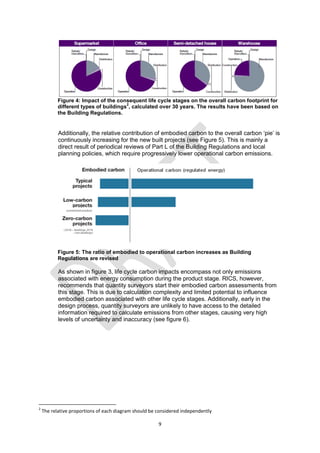
Figure 4: Impact of the consequent life cycle stages on the overall carbon footprint for
different types of buildings
2
, calculated over 30 years. The results have been based on
the Building Regulations.
Additionally, the relative contribution of embodied carbon to the overall carbon ‘pie’ is
continuously increasing for the new built projects (see Figure 5). This is mainly a
direct result of periodical reviews of Part L of the Building Regulations and local
planning policies, which require progressively lower operational carbon emissions.
Figure 5: The ratio of embodied to operational carbon increases as Building
Regulations are revised
As shown in figure 3, life cycle carbon impacts encompass not only emissions
associated with energy consumption during the product stage. RICS, however,
recommends that quantity surveyors start their embodied carbon assessments from
this stage. This is due to calculation complexity and limited potential to influence
embodied carbon associated with other life cycle stages. Additionally, early in the
design process, quantity surveyors are unlikely to have access to the detailed
information required to calculate emissions from other stages, causing very high
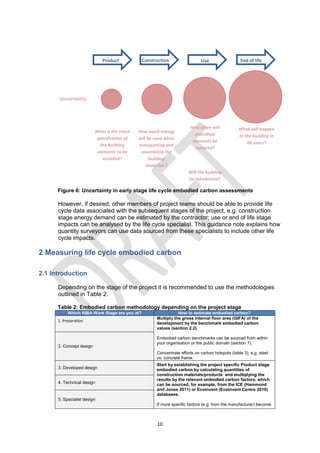
levels of uncertainty and inaccuracy (see figure 6).
2
The relative proportions of each diagram should be considered independently
10
Figure 6: Uncertainty in early stage life cycle embodied carbon assessments
However, if desired, other members of project teams should be able to provide life
cycle data associated with the subsequent stages of the project, e.g. construction
stage energy demand can be estimated by the contractor; use or end of life stage
impacts can be analysed by the life cycle specialist. This guidance note explains how
quantity surveyors can use data sourced from these specialists to include other life
cycle impacts.
2 Measuring life cycle embodied carbon
2.1 Introduction
Depending on the stage of the project it is recommended to use the methodologies
outlined in Table 2.
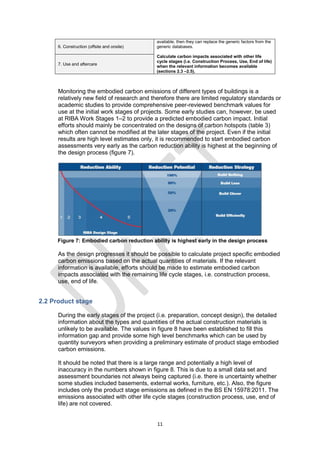
Table 2: Embodied carbon methodology depending on the project stage
Which RIBA Work Stage are you at? How to estimate embodied carbon?
1. Preparation
Multiply the gross internal floor area (GIFA) of the
development by the benchmark embodied carbon
values (section 2.2).
Embodied carbon benchmarks can be sourced from within
your organisation or the public domain (section 7).
Concentrate efforts on carbon hotspots (table 3), e.g. steel
vs. concrete frame.
2. Concept design
3. Developed design
Start by establishing the project specific Product stage
embodied carbon by calculating quantities of
construction materials/products and multiplying the
results by the relevant embodied carbon factors, which
can be sourced, for example, from the ICE (Hammond
and Jones 2011) or Ecoinvent (Ecoinvent Centre 2010)
databases.
If more specific factors (e.g. from the manufacturer) become
4. Technical design
5. Specialist design
Product Construction Use End of life
Uncertainty
What is the exact
specification of
the building
elements to be
installed?
How much energy
will be used when
transporting and
assembling the
building
materials?
How often will
individual
elements be
replaced?
Will the building
be refurbished?
What will happen
to the building in
60 years?
11
6. Construction (offsite and onsite)
available, then they can replace the generic factors from the
generic databases.
Calculate carbon impacts associated with other life
cycle stages (i.e. Construction Process, Use, End of life)
when the relevant information becomes available
(sections 2.3 –2.5).
7. Use and aftercare
Monitoring the embodied carbon emissions of different types of buildings is a
relatively new field of research and therefore there are limited regulatory standards or
academic studies to provide comprehensive peer-reviewed benchmark values for
use at the initial work stages of projects. Some early studies can, however, be used
at RIBA Work Stages 1–2 to provide a predicted embodied carbon impact. Initial
efforts should mainly be concentrated on the designs of carbon hotspots (table 3)
which often cannot be modified at the later stages of the project. Even if the initial
results are high level estimates only, it is recommended to start embodied carbon
assessments very early as the carbon reduction ability is highest at the beginning of
the design process (figure 7).
Figure 7: Embodied carbon reduction ability is highest early in the design process
As the design progresses it should be possible to calculate project specific embodied
carbon emissions based on the actual quantities of materials. If the relevant
information is available, efforts should be made to estimate embodied carbon
impacts associated with the remaining life cycle stages, i.e. construction process,
use, end of life.
2.2 Product stage
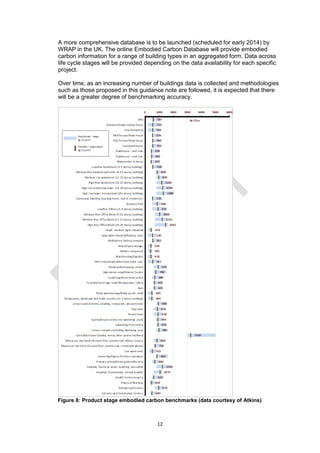
During the early stages of the project (i.e. preparation, concept design), the detailed
information about the types and quantities of the actual construction materials is
unlikely to be available. The values in figure 8 have been established to fill this
information gap and provide some high level benchmarks which can be used by
quantity surveyors when providing a preliminary estimate of product stage embodied
carbon emissions.
It should be noted that there is a large range and potentially a high level of
inaccuracy in the numbers shown in figure 8. This is due to a small data set and
assessment boundaries not always being captured (i.e. there is uncertainty whether
some studies included basements, external works, furniture, etc.). Also, the figure
includes only the product stage emissions as defined in the BS EN 15978:2011. The
emissions associated with other life cycle stages (construction process, use, end of
life) are not covered.
12
A more comprehensive database is to be launched (scheduled for early 2014) by
WRAP in the UK. The online Embodied Carbon Database will provide embodied
carbon information for a range of building types in an aggregated form. Data across
life cycle stages will be provided depending on the data availability for each specific
project.
Over time, as an increasing number of buildings data is collected and methodologies
such as those proposed in this guidance note are followed, it is expected that there
will be a greater degree of benchmarking accuracy.
Figure 8: Product stage embodied carbon benchmarks (data courtesy of Atkins)
13
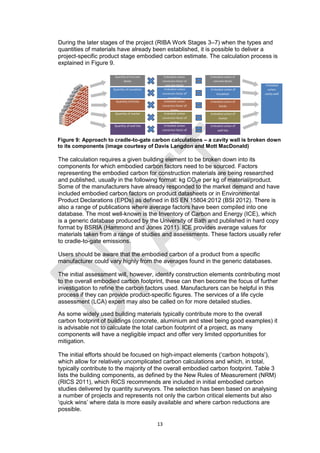
During the later stages of the project (RIBA Work Stages 3–7) when the types and
quantities of materials have already been established, it is possible to deliver a
project-specific product stage embodied carbon estimate. The calculation process is
explained in Figure 9.
Figure 9: Approach to cradle-to-gate carbon calculations – a cavity wall is broken down
to its components (image courtesy of Davis Langdon and Mott MacDonald)
The calculation requires a given building element to be broken down into its
components for which embodied carbon factors need to be sourced. Factors
representing the embodied carbon for construction materials are being researched
and published, usually in the following format: kg CO2e per kg of material/product.
Some of the manufacturers have already responded to the market demand and have
included embodied carbon factors on product datasheets or in Environmental
Product Declarations (EPDs) as defined in BS EN 15804:2012 (BSI 2012). There is
also a range of publications where average factors have been compiled into one
database. The most well-known is the Inventory of Carbon and Energy (ICE), which
is a generic database produced by the University of Bath and published in hard copy
format by BSRIA (Hammond and Jones 2011). ICE provides average values for
materials taken from a range of studies and assessments. These factors usually refer
to cradle-to-gate emissions.
Users should be aware that the embodied carbon of a product from a specific
manufacturer could vary highly from the averages found in the generic databases.
The initial assessment will, however, identify construction elements contributing most
to the overall embodied carbon footprint, these can then become the focus of further
investigation to refine the carbon factors used. Manufacturers can be helpful in this
process if they can provide product-specific figures. The services of a life cycle
assessment (LCA) expert may also be called on for more detailed studies.
As some widely used building materials typically contribute more to the overall
carbon footprint of buildings (concrete, aluminium and steel being good examples) it
is advisable not to calculate the total carbon footprint of a project, as many
components will have a negligible impact and offer very limited opportunities for
mitigation.
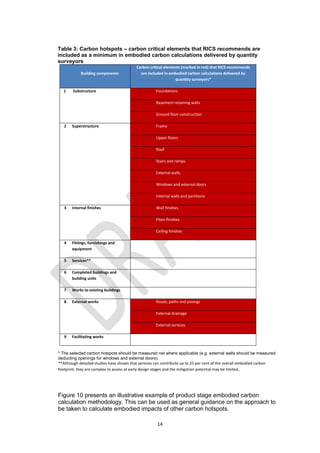
The initial efforts should be focused on high-impact elements (‘carbon hotspots’),
which allow for relatively uncomplicated carbon calculations and which, in total,
typically contribute to the majority of the overall embodied carbon footprint. Table 3
lists the building components, as defined by the New Rules of Measurement (NRM)
(RICS 2011), which RICS recommends are included in initial embodied carbon
studies delivered by quantity surveyors. The selection has been based on analysing
a number of projects and represents not only the carbon critical elements but also
‘quick wins’ where data is more easily available and where carbon reductions are
possible.
Quantity of concrete
blocks
Quantity of insulation
Quantity of bricks
Quantity of mortar
Quantity of wall ties
Embodied carbon
conversion factor of
concrete blocks
Embodied carbon
conversion factor of
insulation
Embodied carbon
conversion factor of
bricks
Embodied carbon
conversion factor of
mortar
Embodied carbon
conversion factor of
wall ties
Embodied carbon of
concrete blocks
Embodied carbon of
insulation
Embodied carbon of
bricks
Embodied carbon of
mortar
Embodied carbon of
wall ties
Embodied
carbon
cavity wall
14
Table 3: Carbon hotspots – carbon critical elements that RICS recommends are
included as a minimum in embodied carbon calculations delivered by quantity
surveyors
Building components
Carbon critical elements (marked in red) that RICS recommends
are included in embodied carbon calculations delivered by
quantity surveyors*
1 Substructure Foundations
Basement retaining walls
Ground floor construction
2 Superstructure Frame
Upper floors
Roof
Stairs and ramps
External walls
Windows and external doors
Internal walls and partitions
3 Internal finishes Wall finishes
Floor finishes
Ceiling finishes
4 Fittings, furnishings and
equipment
5 Services**
6 Completed buildings and
building units
7 Works to existing buildings
8 External works Roads, paths and pavings
External drainage
External services
9 Facilitating works
* The selected carbon hotspots should be measured net where applicable (e.g. external walls should be measured
deducting openings for windows and external doors).
**Although detailed studies have shown that services can contribute up to 25 per cent of the overall embodied carbon
footprint, they are complex to assess at early design stages and the mitigation potential may be limited..
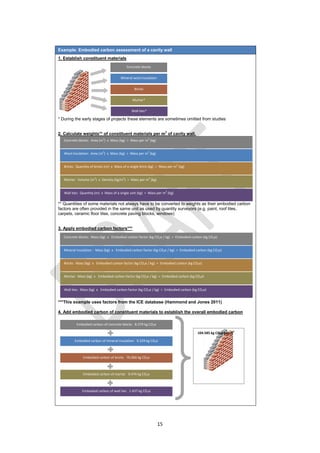
Figure 10 presents an illustrative example of product stage embodied carbon
calculation methodology. This can be used as general guidance on the approach to
be taken to calculate embodied impacts of other carbon hotspots.
15
Example: Embodied carbon assessment of a cavity wall
1. Establish constituent materials
* During the early stages of projects these elements are sometimes omitted from studies
2. Calculate weights** of constituent materials per m2
of cavity wall.
** Quantities of some materials not always have to be converted to weights as their embodied carbon
factors are often provided in the same unit as used by quantity surveyors (e.g. paint, roof tiles,
carpets, ceramic floor tiles, concrete paving blocks, windows)
3. Apply embodied carbon factors***
***This example uses factors from the ICE database (Hammond and Jones 2011)
4. Add embodied carbon of constituent materials to establish the overall embodied carbon
Embodied carbon of concrete blocks 8.379 kg CO2e
Embodied carbon of mineral insulation 9.229 kg CO2e
Embodied carbon of bricks 76.066 kg CO2e
Embodied carbon of mortar 9.474 kg CO2e
104.585 kg CO2e per m
2
Concrete blocks: Mass (kg) x Embodied carbon factor (kg CO2e / kg) = Embodied carbon (kg CO2e)
63 kg x 0.133 kg CO2e / kg = 8.379 kg CO2e
Mineral insulation : Mass (kg) x Embodied carbon factor (kg CO2e / kg) = Embodied carbon (kg CO2e)
7.21 kg x 1.28 kg CO2e / kg = 9.229 kg CO2e
Bricks: Mass (kg) x Embodied carbon factor (kg CO2e / kg) = Embodied carbon (kg CO2e)
138 kg x 0.5512 kg CO2e / kg = 76.066 kg CO2e
Mortar: Mass (kg) x Embodied carbon factor (kg CO2e / kg) = Embodied carbon (kg CO2e)
54.45 kg x 0.174 kg CO2e / kg = 9.474 kg CO2e
Wall ties: Mass (kg) x Embodied carbon factor (kg CO2e / kg) = Embodied carbon (kg CO2e)
0.22045 kg x 6.519 kg CO2e / kg = 1.437 kg CO2e
Wall ties: Quantity (nr) x Mass of a single unit (kg) = Mass per m2
(kg)
5 nr x 0.04409 kg = 0.22045 kg
Mortar: Volume (m
3
) x Density (kg/m
3
) = Mass per m
2
(kg)
0.033 m2
x 1650 kg/m3
= 54.45 kg
Bricks: Quantity of bricks (nr) x Mass of a single brick (kg) = Mass per m
2
(kg)
60 nr x 2.3 kg = 138 kg
Wool insulation: Area (m
2
) x Mass (kg) = Mass per m
2
(kg)
1.03 m
2
x 7 kg = 7.21 kg
Concrete blocks
Mineral wool insulation
Bricks
Mortar*
Wall ties*
Concrete blocks: Area (m2
) x Mass (kg) = Mass per m2
(kg)
1.05 m
2
x 60 kg = 63 kg
Embodied carbon of wall ties 1.437 kg CO2e
16
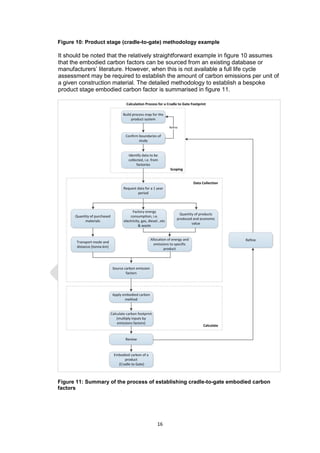
Figure 10: Product stage (cradle-to-gate) methodology example
It should be noted that the relatively straightforward example in figure 10 assumes
that the embodied carbon factors can be sourced from an existing database or
manufacturers’ literature. However, when this is not available a full life cycle
assessment may be required to establish the amount of carbon emissions per unit of
a given construction material. The detailed methodology to establish a bespoke
product stage embodied carbon factor is summarised in figure 11.
Figure 11: Summary of the process of establishing cradle-to-gate embodied carbon
factors
17
Table 4: How to reduce embodied carbon impacts of the product stage?
Product stage carbon mitigation
More efficient building design (e.g. compact building form).
Change the specification for building elements (e.g. lower-weight roof design).
Select materials with lower carbon intensities (e.g. cement substitutes such as PFA, sustainably-sourced
timber, prefabricated elements).
Select reused or higher recycled content products and materials (e.g. reclaimed bricks, higher recycled
content blocks, locally recycled aggregates) offering lower carbon intensities.
Engage with suppliers to avoid excessive packaging.
2.3 Construction process stage
Emissions during the construction process phase include energy and fuel
consumption during the site activities such as: enabling works, remediation,
clearance, removal/demolition of existing structures ground improvements,
earthworks, assembly, piling, asphalt laying. Also included are transport of materials
to/ from construction site, lighting, temporary works and site offices. These are
summarised in table 5.
Table 5: Construction process stage embodied carbon sources
Construction
process stage
A4
Transport
 A4 Transportation from the production gate to the construction
site.
 A4-A5 Storage of products, including the provision of heating,
cooling, humidity control, etc.
 A4-A5 Wastage of construction products (additional
production processes to compensate for the loss of wastage
of products).
 A4-A5 Waste processing of the waste from product packaging
and product wastage during the construction processes up to
the end-of-waste state or disposal of final residues.
 A5 Installation of the product into the building including
manufacture and transportation of ancillary materials and any
energy or water required for installation or operation of the
construction site. It also includes on-site operations to the
product.
A5
Construction-installation
process
The embodied carbon calculations will mainly rely on the actual or estimated energy
consumption during the processes associated with the construction phase of a
project. Although early embodied carbon research efforts have mainly been focused
on emissions during the product stage of a project, many leading contractors have
now started to collect carbon data associated with construction site activities.
18
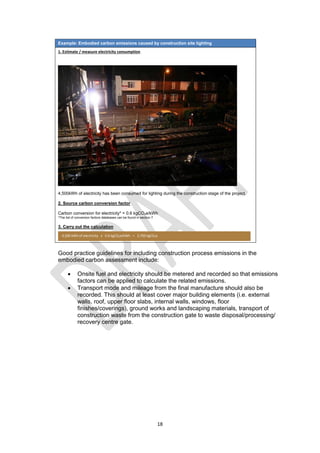
Example: Embodied carbon emissions caused by construction site lighting
1. Estimate / measure electricity consumption
4,500kWh of electricity has been consumed for lighting during the construction stage of the project.
2. Source carbon conversion factor
Carbon conversion for electricity* = 0.6 kgCO2e/kWh
*The list of conversion factors databases can be found in section 7
3. Carry out the calculation
Good practice guidelines for including construction process emissions in the
embodied carbon assessment include:
 Onsite fuel and electricity should be metered and recorded so that emissions
factors can be applied to calculate the related emissions.
 Transport mode and mileage from the final manufacture should also be
recorded. This should at least cover major building elements (i.e. external
walls, roof, upper floor slabs, internal walls, windows, floor
finishes/coverings), ground works and landscaping materials, transport of
construction waste from the construction gate to waste disposal/processing/
recovery centre gate.
4,500 kWh of electricity x 0.6 kgCO2e/kWh = 2,700 kgCO2e
19
Table 6: How to reduce embodied carbon impacts of the construction stage?
Construction stage carbon mitigation
Design out waste – design for less waste on site (e.g. designing buildings and infrastructure that can be
constructed efficiently; specifying work procedures and methods that avoid waste and allow use of waste
arising).
Select materials with lower transport-related carbon emissions (e.g. locally-sourced aggregates).
Use a concrete batching plant rather than ordering liquid concrete delivered by lorry.
Use a consolidation site to minimise half full deliveries.
Specify a delivery vehicle that suits load sizes so the smallest possible vehicle is used.
Implement Just in Time (JIT) delivery.
Avoid arranging deliveries during peak traffic times.
Ensure regular vehicle maintenance (vehicles that are well maintained, tuned, serviced and running correct
tyre pressures use less fuel).
Provide adequate protection to fragile materials to minimise damage during the construction process.
Avoid waste caused by excessive customisation and fitting on site.
Planning work sequences to minimise waste and re-work.
Ensure that tools, equipment and construction plant used on-site are well maintained and kept in a good
working order.
Use energy efficient site offices.
When not required, always turn off the lights and any other energy consuming equipment.
Supply the construction site with renewable energy.
Work with suppliers to implement the ‘take-back’ schemes for material surpluses and off-cuts.
2.4 Use stage
During the lifetime of a building, materials will be required to be maintained, repaired,
replaced and refurbished as aspects wear out or a use changes. Embodied carbon
emissions will be caused by making and transporting these materials and the
emissions will vary depending on the intensity of these processes.
20
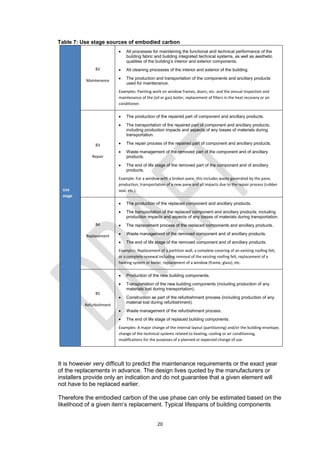
Table 7: Use stage sources of embodied carbon
Use
stage
B2
Maintenance
 All processes for maintaining the functional and technical performance of the
building fabric and building integrated technical systems, as well as aesthetic
qualities of the building’s interior and exterior components.
 All cleaning processes of the interior and exterior of the building.
 The production and transportation of the components and ancillary products
used for maintenance.
Examples: Painting work on window frames, doors, etc. and the annual inspection and
maintenance of the (oil or gas) boiler, replacement of filters in the heat recovery or air
conditioner.
B3
Repair
 The production of the repaired part of component and ancillary products.
 The transportation of the repaired part of component and ancillary products,
including production impacts and aspects of any losses of materials during
transportation.
 The repair process of the repaired part of component and ancillary products.
 Waste management of the removed part of the component and of ancillary
products.
 The end of life stage of the removed part of the component and of ancillary
products.
Example: For a window with a broken pane, this includes waste generated by the pane,
production, transportation of a new pane and all impacts due to the repair process (rubber
seal, etc.).
B4
Replacement
 The production of the replaced component and ancillary products.
 The transportation of the replaced component and ancillary products, including
production impacts and aspects of any losses of materials during transportation.
 The replacement process of the replaced components and ancillary products.
 Waste management of the removed component and of ancillary products.
 The end of life stage of the removed component and of ancillary products.
Examples: Replacement of a partition wall, a complete covering of an existing roofing felt,
or a complete renewal including removal of the existing roofing felt, replacement of a
heating system or boiler, replacement of a window (frame, glass), etc.
B5
Refurbishment
 Production of the new building components.
 Transportation of the new building components (including production of any
materials lost during transportation).
 Construction as part of the refurbishment process (including production of any
material lost during refurbishment).
 Waste management of the refurbishment process.
 The end of life stage of replaced building components.
Examples: A major change of the internal layout (partitioning) and/or the building envelope,
change of the technical systems related to heating, cooling or air conditioning,
modifications for the purposes of a planned or expected change of use.
It is however very difficult to predict the maintenance requirements or the exact year
of the replacements in advance. The design lives quoted by the manufacturers or
installers provide only an indication and do not guarantee that a given element will
not have to be replaced earlier.
Therefore the embodied carbon of the use phase can only be estimated based on the
likelihood of a given item’s replacement. Typical lifespans of building components
21
can be estimated using data sources such as the BCIS life expectancy data (BCIS
2006). Resource intensity of the maintenance and repair strategy can be estimated
with the help of a facilities management advisor.
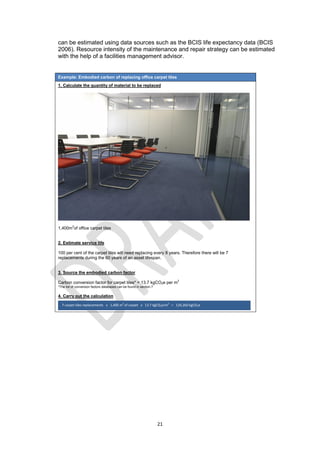
Example: Embodied carbon of replacing office carpet tiles
1. Calculate the quantity of material to be replaced
1,400m2
of office carpet tiles
2. Estimate service life
100 per cent of the carpet tiles will need replacing every 8 years. Therefore there will be 7
replacements during the 60 years of an asset lifespan.
3. Source the embodied carbon factor
Carbon conversion factor for carpet tiles* = 13.7 kgCO2e per m2
*The list of conversion factors databases can be found in section 7
4. Carry out the calculation
7 carpet tiles replacements x 1,400 m
2
of carpet x 13.7 kgCO2e/m
2
= 134,260 kgCO2e
22
Table 8: How to reduce embodied carbon impacts of the use stage?
Use stage carbon mitigation
Select materials with high levels of durability and low through-life maintenance (e.g. facades and fixing
components which last as long as the building frame).
Ensure high quality finishing of the building components to avoid premature failure.
Design to allow easy reconfiguration/remodelling of the building to meet changing needs.
Design that allows the easy replacement of aspects (e.g. example replace a few carpet tiles in high traffic
areas).
Develop a proactive maintenance, servicing and repair strategy.
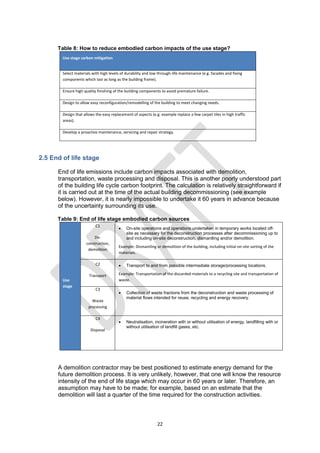
2.5 End of life stage
End of life emissions include carbon impacts associated with demolition,
transportation, waste processing and disposal. This is another poorly understood part
of the building life cycle carbon footprint. The calculation is relatively straightforward if
it is carried out at the time of the actual building decommissioning (see example
below). However, it is nearly impossible to undertake it 60 years in advance because
of the uncertainty surrounding its use.
Table 9: End of life stage embodied carbon sources
Use
stage
C1
De-
construction,
demolition
 On-site operations and operations undertaken in temporary works located off-
site as necessary for the deconstruction processes after decommissioning up to
and including on-site deconstruction, dismantling and/or demolition.
Example: Dismantling or demolition of the building, including initial on-site sorting of the
materials.
C2
Transport
 Transport to and from possible intermediate storage/processing locations.
Example: Transportation of the discarded materials to a recycling site and transportation of
waste.
C3
Waste
processing
 Collection of waste fractions from the deconstruction and waste processing of
material flows intended for reuse, recycling and energy recovery.
C4
Disposal
 Neutralisation, incineration with or without utilisation of energy, landfilling with or
without utilisation of landfill gases, etc.
A demolition contractor may be best positioned to estimate energy demand for the
future demolition process. It is very unlikely, however, that one will know the resource
intensity of the end of life stage which may occur in 60 years or later. Therefore, an
assumption may have to be made; for example, based on an estimate that the
demolition will last a quarter of the time required for the construction activities.
23
Unless a planned demolition is scheduled it may be advisable to exclude end of life
impacts from the project’s emissions. Demolition emissions could be assessed at the
beginning of the subsequent life cycle as part of construction emissions associated
with a new project.
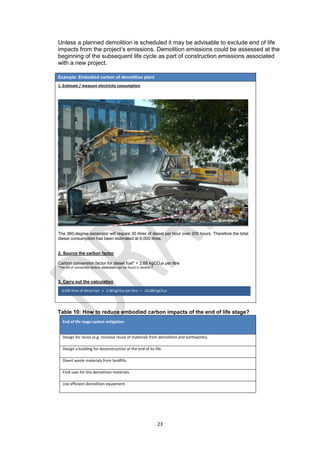
Example: Embodied carbon of demolition plant
1. Estimate / measure electricity consumption
The 360-degree excavator will require 30 litres of diesel per hour over 200 hours. Therefore the total
diesel consumption has been estimated at 6,000 litres.
2. Source the carbon factor
Carbon conversion factor for diesel fuel* = 2.68 kgCO2e per litre
*The list of conversion factors databases can be found in section 7
3. Carry out the calculation
Table 10: How to reduce embodied carbon impacts of the end of life stage?
End of life stage carbon mitigation
Design for reuse (e.g. increase reuse of materials from demolition and earthworks).
Design a building for deconstruction at the end of its life.
Divert waste materials from landfills.
Find uses for the demolition materials.
Use efficient demolition equipment.
6,000 litres of diesel fuel x 2.68 kgCO2e per litre = 16,080 kgCO2e
24
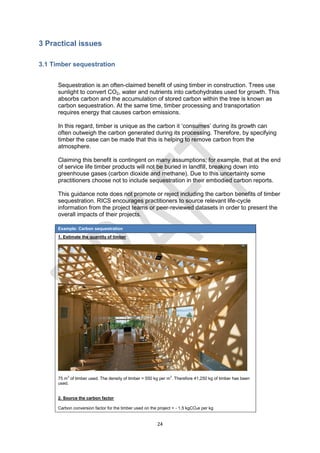
3 Practical issues
3.1 Timber sequestration
Sequestration is an often-claimed benefit of using timber in construction. Trees use
sunlight to convert CO2, water and nutrients into carbohydrates used for growth. This
absorbs carbon and the accumulation of stored carbon within the tree is known as
carbon sequestration. At the same time, timber processing and transportation
requires energy that causes carbon emissions.
In this regard, timber is unique as the carbon it ‘consumes’ during its growth can
often outweigh the carbon generated during its processing. Therefore, by specifying
timber the case can be made that this is helping to remove carbon from the
atmosphere.
Claiming this benefit is contingent on many assumptions; for example, that at the end
of service life timber products will not be buried in landfill, breaking down into
greenhouse gases (carbon dioxide and methane). Due to this uncertainty some
practitioners choose not to include sequestration in their embodied carbon reports.
This guidance note does not promote or reject including the carbon benefits of timber
sequestration. RICS encourages practitioners to source relevant life-cycle
information from the project teams or peer-reviewed datasets in order to present the
overall impacts of their projects.
Example: Carbon sequestration
1. Estimate the quantity of timber
75 m3
of timber used. The density of timber = 550 kg per m3
. Therefore 41,250 kg of timber has been
used.
2. Source the carbon factor
Carbon conversion factor for the timber used on the project = - 1.5 kgCO2e per kg
25
Example: Carbon sequestration
(Sustainably sourced timber has been specified. The contract confirms that the timber will not be
landfilled or burnt without energy recovery at the end of service life).
3. Carry out the calculation
Therefore, -61,875 kgCO2e could potentially be reported in the embodied carbon assessment.
Good practice carbon sequestration includes:
 All timber should be sourced in accordance with the UK Government’s Timber
Procurement Policy. This ensures that timber comes from sustainably
managed forests, certified by the FSC (Forest Stewardship Council) or PEFC
(Programme for the Endorsement of Forest Certification).
 At the end of service life, timber should not be landfilled or incinerated without
energy recovery.
3.2 Steel recycling
Manufacture of steel from virgin materials involves a series of energy intensive
processes. However, at the same time most of the scrap steel is recovered from end-
of-life buildings and used to make new products. Exclusion of this information may
misinform some of the embodied carbon comparisons.
Highly recycled materials, such as metals, can be penalised by limiting the analysis
to cradle-to-gate processes only, whereas materials that are more often disposed of
as waste (e.g. timber) or downcycled (e.g. concrete) can be advantaged. The benefit
of cradle-to-gate analysis is that it covers processes that are fairly well defined and
don’t change significantly. The cradle-to-grave analysis in turn requires a series of
assumptions on what happens once the project leaves the factory gate. However, as
one of the roles of measuring embodied carbon is to find the biggest mitigation
opportunities, it is recommended that all stages of building life cycle are analysed.
3.3 Thermal mass of concrete
Thermal mass is a property that enables building materials to absorb, store and later release
significant amounts of heat. Concrete can absorb energy slowly and hold it for much longer
periods of time than lightweight materials do. This means that adding large thermal mass
materials may increase product stage embodied carbon, or it may reduce cooling/heating
loads, thus lowering the use stage carbon emissions. For this reason, the impacts of design
decisions should be considered on embodied and operational carbon together rather than
separately.
41,250 kg of timber x -1.5 kgCO2e per kg = - 61,875 kgCO2e
26
4 Analysing the results
In order to verify the results and also to indicatively measure the performance of a
project it would be useful to compare your final result (i.e. tonnes of CO2e per m2
of a
building) with the industry benchmarks in the same way mechanical engineers
compare the results of their operational carbon calculations with well-established
datasets (e.g. CIBSE Energy Benchmarks TM46) or even energy consumption
monitoring of actual buildings.
Unfortunately embodied carbon is a relatively new and still unregulated indicator in
the building industry and there are no comprehensive and peer reviewed datasets
covering embodied carbon emissions associated with different building types. There
are, however, some early databases emerging:
 The WRAP Embodied Carbon Database will allow practitioners to understand
results achieved for a number of similar projects. The industry data has been
compiled in a comprehensive manner and facilitates input across all life cycle
stages as defined in BS EN 15978:2011. Additionally, practitioners will be
able to contribute to developing the database by sharing their results.
 Atkins Masterplanning Tool (Atkins 2010) includes a range of cradle-to-gate
embodied carbon benchmarks. As opposed to the ICE database, the figures
have not been compiled in a statistical way and have not been peer-reviewed.
It is suggested that in absence of any other source, these datasets can provide a
useful benchmarking opportunity for the practitioner.
It should also be stressed that the ultimate goal of carbon footprinting is to reduce
environmental impacts rather than deliberating on the level of accuracy of the results.
Therefore the embodied carbon figures obtained should be used to inform the decision
making process. It is recommended that quick wins for high impact building elements
are researched and implemented.
Figure 12 shows an example of embodied carbon results along with an indication of
the carbon mitigation potential.
Figure 12: An example of how carbon reduction measures can affect the embodied
carbon of a project
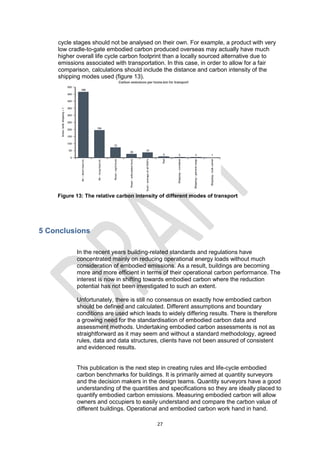
Examples of how we can reduce embodied carbon during the individual life cycle
stages have been presented throughout this guidance note. It should, however, be
noted that when trying to improve carbon performance of a project, individual life
27
cycle stages should not be analysed on their own. For example, a product with very
low cradle-to-gate embodied carbon produced overseas may actually have much
higher overall life cycle carbon footprint than a locally sourced alternative due to
emissions associated with transportation. In this case, in order to allow for a fair
comparison, calculations should include the distance and carbon intensity of the
shipping modes used (figure 13).
Figure 13: The relative carbon intensity of different modes of transport
5 Conclusions
In the recent years building-related standards and regulations have
concentrated mainly on reducing operational energy loads without much
consideration of embodied emissions. As a result, buildings are becoming
more and more efficient in terms of their operational carbon performance. The
interest is now in shifting towards embodied carbon where the reduction
potential has not been investigated to such an extent.
Unfortunately, there is still no consensus on exactly how embodied carbon
should be defined and calculated. Different assumptions and boundary
conditions are used which leads to widely differing results. There is therefore
a growing need for the standardisation of embodied carbon data and
assessment methods. Undertaking embodied carbon assessments is not as
straightforward as it may seem and without a standard methodology, agreed
rules, data and data structures, clients have not been assured of consistent
and evidenced results.
This publication is the next step in creating rules and life-cycle embodied
carbon benchmarks for buildings. It is primarily aimed at quantity surveyors
and the decision makers in the design teams. Quantity surveyors have a good
understanding of the quantities and specifications so they are ideally placed to
quantify embodied carbon emissions. Measuring embodied carbon will allow
owners and occupiers to easily understand and compare the carbon value of
different buildings. Operational and embodied carbon work hand in hand.
28
Acquiring a complete understanding of both allows design teams and
consultants to create the best possible design plans and specifications for a
low carbon building.
29
6 Case studies
6.1 Embodied carbon assessment of the Marks & Spencer Cheshire Oaks store
6.1.1 About the project
Cheshire Oaks is one of the biggest M&S store. It was designed with an architectural
and design strategy that addresses several areas of sustainability at once. The
development generated lots of local interest as the site is located in close proximity to
600 homes and a range of businesses. It is also M&S’ third Sustainable Learning
Store, which aims as part of the Plan A commitment3
to build a strong bank of
knowledge and experience in sustainable building practices. One of the key aims of
the project was to create a positive store environment which improves the health &
well being of staff, customers and the local community.
In order to minimise the embodied carbon impact of the store a series of mitigation
measures were implemented. The store’s design team achieved 30 per cent recycled
content by value including 100 per cent recycled aluminium roof, fermacell dry lining
board and 40 per cent recycled ceramic floor tiles. Concrete mix designs were
adapted to include recycled content and recycled insulation was used in the roof
lining. There were also several carbon sequestration benefits from the timber frame
and the Hempcrete panels.
A number of subcontractors were helped through the FSC certification process
ensuring that all timber products delivered to site were accompanied by full chain of
custody. Over 60 per cent of aggregates used in the ground works were from locally
recycled sources, with virgin aggregates and gabion infill natural stone also locally
sourced.
Scope of the assessment: Cradle-to-grave
3
Plan A is major M&S initiative to improve the sustainability performance of the business operations
30
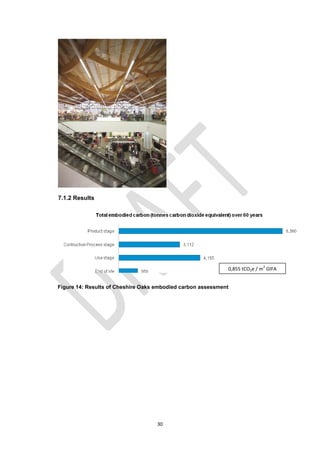
7.1.2 Results
Figure 14: Results of Cheshire Oaks embodied carbon assessment
0,855 tCO2e / m
2
GIFA
31
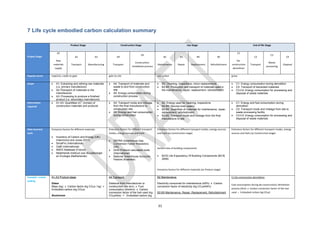
7 Life cycle embodied carbon calculation summary
Project Stage
Product Stage Construction Stage Use Stage End of life Stage
A1
Raw
materials
supply
A2
Transport
A3
Manufacturing
A4
Transport
A5
Construction-
installation process
B2
Maintenance
B3
Repair
B4
Replacement
B5
Refurbishment
C1
De-
construction
demolition
C2
Transport
C3
Waste
processing
C4
Disposal
Popular terms CapCarb, cradle-to-gate gate-to-site use carbon grave
Scope  A1: Extracting and refining raw materials
(i.e. primary manufacture)
 A2:Ttransport of materials to the
manufacturer
 A3: Processing to produce a finished
product (i.e. secondary manufacture)
 A4: Transport of materials and
waste to and from construction
site
 A5: Energy consumption during
construction process
 B2: Cleaning, inspections, minor replacements
 B2-B5: Production and transport of materials used in
the maintenance, repair, replacement, refurbishment
 C1: Energy consumption during demolition
 C2: Transport of discarded materials
 C3-C4: Energy consumption for processing and
disposal of waste materials
Information
required
 A1-A3: Quantities (m
3
, tonnes) of
construction materials and products
 A4: Transport mode and mileage
from the final manufacture to
construction site
 A5: Energy and fuel consumption
during construction
 B2: Energy used for cleaning, inspections
 B2-B5: Service lives (years)
 B2:B5: Quantities of materials for maintenance, repair,
replacement, refurbishment
 B2:B5: Transport mode and mileage from the final
manufacture to site
 C1: Energy and fuel consumption during
demolition
 C2: Transport mode and mileage from site to
waste processing facility
 C3-C4: Energy consumption for processing and
disposal of waste materials
Data sources/
tools
Emissions factors for different materials:
 Inventory of Carbon and Energy (UK)
(Hammond and Jones 2011)
 SimaPro (International)
 GaBi (International)
 INIES Database (France)
 Nederlands Instituut voor Bouwbiologie
en Ecologie (Netherlands)
Emissions factors for different transport
modes, energy sources and fuels:
 DEFRA Greenhouse Gas
Conversion Factor Repository
(UK)
 GHG Protocol calculation tools
(International)
 National Greenhouse Accounts
Factors (Australia)
Emissions factors for different transport modes, energy sources
and fuels (as Construction stage)
Service lives of building components:
 BCIS Life Expectancy Of Building Components (BCIS
2006)
Emissions factors for different materials (as Product stage)
Emissions factors for different transport modes, energy
sources and fuels (as Construction stage)
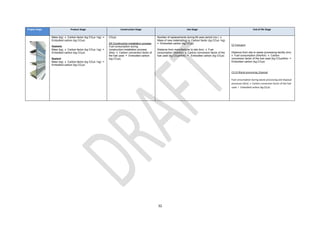
Example: curtain
walling
A1-A3 Product stage
Glass
Mass (kg) x Carbon factor (kg CO2e / kg) =
Embodied carbon (kg CO2e)
Aluminium
A4 Transport
Distance from manufacturer to
construction site (km) x Fuel
consumption (litre/km) x Carbon
conversion factor of the fuel used (kg
CO2e/litre) = Embodied carbon (kg
B2 Maintenance
Electricity consumed for maintenance (kWh) x Carbon
conversion factor of electricity (kg CO2e/kWh)
B2-B5 Maintenance, Repair, Replacement, Refurbishment
C1 De-construction demolition
Fuel consumption during de-construction/ demolition
process (litre) x Carbon conversion factor of the fuel
used = Embodied carbon (kg CO2e)
32
Project Stage Product Stage Construction Stage Use Stage End of life Stage
Mass (kg) x Carbon factor (kg CO2e / kg) =
Embodied carbon (kg CO2e)
Gaskets
Mass (kg) x Carbon factor (kg CO2e / kg) =
Embodied carbon (kg CO2e)
Sealant
Mass (kg) x Carbon factor (kg CO2e / kg) =
Embodied carbon (kg CO2e)
CO2e)
A5 Construction-installation process
Fuel consumption during
construction-installation process
(litre) x Carbon conversion factor of
the fuel used = Embodied carbon
(kg CO2e)
Number of replacements during 60-year period (no.) x
Mass of new material(kg) x Carbon factor (kg CO2e / kg)
= Embodied carbon (kg CO2e)
Distance from manufacturer to site (km) x Fuel
consumption (litre/km) x Carbon conversion factor of the
fuel used (kg CO2e/litre) = Embodied carbon (kg CO2e)
C2 Transport
Distance from site to waste processing facility (km)
x Fuel consumption (litre/km) x Carbon
conversion factor of the fuel used (kg CO2e/litre) =
Embodied carbon (kg CO2e)
C3-C4 Waste processing, Disposal
Fuel consumption during waste processing and disposal
processes (litre) x Carbon conversion factor of the fuel
used = Embodied carbon (kg CO2e)
33
References and information sources
Atkins, Masterplanning Tool, 2010, can be viewed at: www.atkinsglobal.com/corporate-
responsibility/carbon-reduction/carbon-critical-design/carbon-tools
Australian Government, National Greenhouse Accounts Factors, can be viewed at:
www.climatechange.gov.au/publications
BCIS, Life Expectancy of Building Components: Surveyors' Experiences of Buildings in Use: a Practical
Guide, BCIS, 2006
Brighton and Hove City Council, Brighton and Hove City Council Climate Change Strategy, Brighton
and Hove City Council, 2011
British Constructional Steelwork Association, The carbon footprint of steel, 2010
BSI, BS EN 15978:2011, Sustainability of construction works - Assessment of environmental
performance of buildings - Calculation method, BSI, London, 2011
BS EN 15804:2012, Sustainability of construction works. Environmental product
declarations. Core rules for the product category of construction products, BSI, London,
2012
Concrete Centre, Embodied CO2, can be downloaded at: www.
concretecentre.com/sustainability/energy_efficiency/embodied_c02.aspx
Construction Products Association, A guide to understanding the embodied impacts of construction
products, 2012, can be downloaded at: www.constructionproducts-
sustainability.org.uk/products/embodied-impacts
DEFRA Greenhouse Gas Conversion Factor Repository, can be viewed at: www.
ukconversionfactorscarbonsmart.co.uk
Environmental Agency, Carbon calculator for construction activities, 2011, can be downloaded at:
www.environment-agency.gov.uk/business/sectors/136252.aspx
Ecoinvent Centre, Ecoinvent Database, 2010, can be viewed at: www.ecoinvent.org/database
European Network of Construction Companies for Research and Development (ENCORD),
Construction CO2e Measurement Protocol, can be viewed at: www.encord.org/?page_id=260
Franklin+Andrews, UK Building Blackbook: The capital cost and embodied CO2 guide. Volume 2:
Major works. Hutchins 2010 edition, Franklin+Andrews Ltd, Norwich, 2009 (978 1 901856 24 8)
GHG Protocol calculation tools, can be viewed at: www. ghgprotocol.org/calculation-tools/all-tools
Hammond G., Jones C., Inventory of Carbon and Energy (ICE), BSRIA, 2011, can be viewed at:
www.bsria.co.uk/bookshop/books/embodied-carbon-the-inventory-of-carbon-and-energy-ice/
34
HM Government, Low Carbon Construction Innovation & Growth Team: Final Report, BIS, London,
2010
IPCC, Net Global Radiative Forcing, Global Warming Potentials and Patterns of Forcing, in IPCC
Fourth Assessment Report: Climate Change 2007, can be viewed at:
www.ipcc.ch/publications_and_data/ar4/wg1/en/tssts-2-5.html
HM Government, The Building and Approved Inspectors (Amendment) Regulations 2006, TSO, 2006
RICS, New Rules of Measurement. Volume 1 - Order of cost estimating and elemental cost planning,
RICS, London, 2011
Roberts G., Li Q., Whole-life carbon: New-build schools, Building, 2012
SimaPro, can be viewed at: www.pre-sustainability.com/global-partner-network
Tata Steel, The Whole Story: From Cradle to Grave, 2011, can be viewed at:
www.tatasteelconstruction.com/en/sustainability/the_whole_story/
Timber Research and Development Association, Timber carbon footprints, 2009, can be downloaded
at www.trada.co.uk/news/view/22C2AE1D-98CB-471E-841A-
E136E818D694/New_study_quantifies_timbers_carbon_footprint
Waste and Resources Action Programme, Cutting embodied carbon in construction projects, can be
downloaded at www.wrap.org.uk/sites/files/wrap/FINAL%20PRO095-
009%20Embodied%20Carbon%20Annex.pdf

Embedded carbon data

  • 1.
    1 Methodology to calculateembodied carbon in a building’s construction life cycle
  • 2.
    2 Glossary Carbon emissions/ CO2e emissions/ CO2e equivalent/ Greenhousegas emissions Shorthand for emissions of any of the basket of greenhouse gases (GHG) that affect climate change. Carbon emissions are usually expressed as CO2e (i.e. CO2 equivalent), which is a unit of measurement based on the relative impact of a given gas on global warming (the so-called global warming potential). For example, if methane has a global warming potential of 25, it means that 1 kg of methane has the same impact on climate change as 25 kg of carbon dioxide and thus 1 kg of methane would count as 25 kg of CO2e. The global warming potential of greenhouse gases are presented in the table below: Table 1: Global warming potentials (GWP) of greenhouse gases Greenhouse gas GWP over 100 years Typical sources Carbon dioxide (CO2) 1 Energy combustion, biochemical reactions Methane (CH4) 25 Decomposition Nitrous oxide (N2O) 298 Fertilizers, car emissions, manufacturing Sulfur hexafluoride (SF6) 22,800 Switch gears, substations Perfluorocarbon (PFC) 7,390–12,200 Aluminium smelting Hydrofluorocarbon (HFC) 124–14,800 Refrigerants, industrial gases Taken from IPCC Fourth Assessment Report: Climate Change 2007 Carbon hotspot Carbon significant aspect of a project that should be targeted for reduction. Carbon hotspots represent not only carbon-intense elements but also ‘quick wins’ where measurement data is more easily available and where carbon reductions are possible. Product stage carbon Carbon emissions between the confines of the ‘cradle’ (earth) up to the factory gate of the final product processing operation. This includes mining, raw materials extraction and processing, transportation and final product manufacturing. Product stage emissions are often referred to as cradle-to-gate carbon emissions. Product stage carbon is sometimes referred to as ‘CapCarb’ (capital carbon). Construction Carbon emissions associated with construction site energy consumption and
  • 3.
    3 stage carbon transportof construction materials and waste to/from site. Use stage carbon Carbon emissions associated with the operational phase of the building: in-use energy consumption, maintenance, repairs, replacements, refurbishments. End of life stage carbon Carbon emissions associated with demolition, materials/waste transport, processing and disposal. Cradle-to-grave carbon Carbon emissions associated with all building life cycle stages: product, construction, use, end of life. Cradle-to- cradle The process of making a component or product and then, at the end of its life, converting it into a new component of either the same quality (e.g. recycling of aluminium cans) or a lesser quality (e.g. downcycling of a computer plastic case into a plastic container, which is then turned into a building insulation board, eventually becoming waste). Embodied carbon Carbon emissions associated with energy consumption (embodied energy) and chemical processes during the extraction, manufacture, transportation, assembly, replacement and deconstruction of construction materials or products. Embodied carbon can be measured from cradle-to-gate, cradle-to-site, cradle-to-end of construction, cradle-to-grave, or even cradle-to-cradle. The typical embodied carbon datasets are cradle-to-gate. Embodied carbon is usually expressed in kilograms of CO2e per kilogram of product or material. Life cycle carbon Another term for cradle-to-grave carbon emissions. Operational carbon Carbon emissions associated with energy consumption (operational energy) while the building is occupied. This includes the so-called regulated load (e.g. heating, cooling, ventilation, lighting) and unregulated/plug load (e.g. ICT equipment, cooking and refrigeration appliances). Operational carbon is sometimes referred to as ‘Op Carb’. Global Warming Potential (GWP) A relative measure of how much a given mass of greenhouse gas is estimated to contribute to global warming. It is measured against CO2e which has a GWP of 1 (see table 1). Recycled The portion of a product that contains materials that have been recovered or
  • 4.
    4 content otherwise divertedfrom the solid waste stream. Sequestration Accumulation and storage of atmospheric carbon by bio-renewable building materials (e.g. timber).
  • 5.
    5 Introduction Most of thefocus on reducing carbon emissions from the built environment to date has been on managing and reducing the energy consumption from building’s energy load such as: lighting, heating, ventilation and air conditioning through better design and management in use (regulated and un-regulated loads). However, the emissions that occur resulting from the production, installation, maintenance and disposal of a building’s materials remain largely unchecked and as more buildings are constructed to higher energy efficiency standards the proportion of the carbon emissions created shifts from the operational emissions (from gas and electricity and the like) to energy consumed during other life cycle stages of projects such as the carbon emissions created in the manufacture of the materials used, their transportation, the construction activities themselves and the eventual demolition and disposal (see Figure 5). Calculations of emissions associated with one of these stages – product manufacture – are based on the quantity of construction materials that make up a building. The research (HM Government 2010) has shown that this stage is the second most significant area of carbon emissions from the entire life cycle of a building (after the operational emissions). Some local authorities in the UK have already included mandatory cradle-to-gate embodied carbon assessments as part of the planning process (Brighton and Hove City Council 2011). The latest international version of BREEAM (the Building Research Establishment’s Environmental Assessment Method) awards points for calculating and reducing embodied carbon emissions. Also, the LEED (Leadership in Energy and Environmental Design) and Green Star assessment tools recognise embodied carbon measurement and its mitigation as part of minimising the building life cycle impacts. A number of clients (e.g. developers, utility companies, banks, retailers) are also starting to include embodied carbon quantification and mitigation on their projects. This is done mostly for competitive reasons, as part of their CSR responsibilities and increasingly as part of planning requirements. As pioneers and early adopters of the carbon calculation, they have started capitalising on the added value gains. In recent years it has become a standard practice to employ dedicated sustainability/green consultants to undertake the embodied carbon studies. However, since quantity surveyors are typically involved in measuring and analysing the quantities of materials in the generation of cost plans or life cycle costing studies, they are very well placed professionally to add an embodied carbon dimension to their reports. Linking embodied carbon estimates with cost plans and life cycle costing will not only achieve cost efficiency but, more importantly, it will allow clients to make more informed design decisions. The aim of this guidance note In 2012 RICS released the Methodology to calculate embodied carbon of materials, 1st edition information paper. Apart from providing background information on embodied carbon, the focus here was explaining how to estimate carbon emissions associated with manufacturing of building materials or cradle-to-gate with a particular emphasis on the construction industry.
  • 6.
    6 This guidance notebuilds on that knowledge and expands the scope to cover emissions during other life cycle stages (i.e. construction, use, end of life). The main aim is to provide a framework of practical guidance for quantity surveyors on how to calculate embodied carbon emissions associated with their projects. Additionally, some good practice carbon reduction solutions have been listed. This presents an opportunity for the QS to offer this advice as part of the standard cost planning service. This guidance should help the project teams and clients make decisions about embodied carbon. RICS expects BIM (Building Information Modelling) to have a major impact in carbon quantification and mitigation in future, however, there will always be a need for early feasibility studies. This guidance note is not intended to replace any of the guides that already exist (e.g. PAS 2050, Green House Gas Protocol), but to make carbon calculation more accessible to the QS community. It is acknowledged that embodied carbon is a complex and relatively new area of research and therefore a number of assumptions have to be made, which affect the accuracy of the outcome. However, considering that the primary objective of measuring carbon emissions is to improve sustainability performance, it is felt that this guidance note will provide a valuable resource for the construction industry.
  • 7.
    7 1 What isembodied carbon in the built environment? Embodied carbon is the carbon impact associated with materials production, transport, assembly, use and disposal. It does not include the carbon emissions associated with the energy used for heating, lighting or cooling in the completed building. The final report on low carbon construction for HM Government by the Innovation and Growth Team (IGT) (HM Government 2010) concludes that embodied carbon is an important factor that needs to be brought into the systems used for appraisal of projects and hence into the design decisions made in developing projects. This guidance note attempts to address the IGT recommendations (figure 1). Figure 1: IGT recommendations related to carbon measurement in the built environment The IGT report notes that CO2e emissions arise throughout a building’s life cycle from the initial design to the refurbishment or eventual demolition of the building. These emissions can be identified and quantified to produce a carbon life cycle footprint for a building, which can then be used to plan an effective reduction strategy. The stages in a building project carbon life cycle emissions as defined by IGT are shown in figure 2. Figure 2: Carbon life cycle phases of a building and their contributions to the overall UK carbon emissions 1 that the construction industry has the ability to influence A similar process (figure 3) has been adopted in the BS EN 15978:2011 (BSI 2011) developed by the European Committee for Standardisation (CEN) Technical Committee 350 (TC350). 1 The actual percentages for individual buildings will vary from project to project. Recommendation 2.2: That the industry should agree with Government a standard method of measuring embodied carbon for use as a design tool and (as Recommendation 2.1 above) for the purposes of scheme appraisal. Recommendation 2.1: That as soon as a sufficiently rigorous assessment system is in place, the Treasury should introduce into the Green Book a requirement to conduct a whole-life (embodied + operational) carbon appraisal and that this is factored into feasibility studies on the basis of a realistic price for carbon.
  • 8.
    8 Included in cradle-to-gate Materials orproduct manufacture cradle- to-gate emissions are those associated with the production of construction products/materials. The emissions arise from the energy used in extracting materials, refining them (i.e. primary manufacture), transporting and processing them to produce a finished product (i.e. secondary manufacture). The CO2e emissions resulting from these processed are often referred to as embodied carbon. Included in cradle-to-site and cradle-to-end of construction Emissions from the construction phase include energy and fuel consumption during: transportation of material to site (cradle-to- site), as well as enabling works, remediation, clearance, removal/demoli tion of existing structures ground improvements, earthworks, assembly (cradle-to-end of construction) The use carbon emissions from the building include operations emissions resulting from energy consumed for heating, lighting, ventilation, air conditioning, etc. These are typically responsible for around 75 per cent of the life cycle carbon emissions. The actual figure will be heavily influenced by occupier behaviour as well as by the building type. Emissions associated with this phase are usually estimated by mechanical engineers who use software packages designed to calculate operational impacts. There will also be additional embodied carbon arising from maintenance, repair, replacements and refurbishments of building elements (e.g. fabric or services). Lifecycle specialists will be able to advise on predicted lifespans of building elements. Included in cradle-to-grave End of life emissions are those associated with energy consumed during building demolition and waste disposal processes. However, unless a planned deconstruction is scheduled it is advised that these impacts are not assessed as part of the project’s emissions. Demolition emissions are best assessed at the beginning of the life cycle as part emissions associated with the new building. Included in cradle- to-cradle Module D quantifies the carbon impacts beyond the building lifecycle emissions. It acknowledges the ‘design for reuse and recycling’ concept as it allows to demonstrate the benefits resulting from reuse, recycling and energy recovery. Figure 3: Building life cycle stages (adapted from the BS EN 15978:2011) The BS EN 15978:2011 method is likely to be the dominant calculation method used by the construction industry (Construction Products Association 2012). Therefore the life cycle classification in this guidance note has been based on BS EN 15978:2011. As shown in figure 2 operational emissions contribute the most to the UK building industry carbon footprint. Typically around 70–80 per cent is associated with the use phase and the rest is associated primarily with the embodied carbon from the materials manufacturing process. However, the ratio between operational and embodied carbon varies according to building type. For example, a low energy- intensive facility such as a warehouse (where no heating or cooling may be required) operating carbon emissions are likely to account for only 20 per cent of the building carbon footprint (over 30 years). The relationship between different types of emissions for different building types is illustrated in figure 4.
  • 9.
    9 Figure 4: Impactof the consequent life cycle stages on the overall carbon footprint for different types of buildings 2 , calculated over 30 years. The results have been based on the Building Regulations. Additionally, the relative contribution of embodied carbon to the overall carbon ‘pie’ is continuously increasing for the new built projects (see Figure 5). This is mainly a direct result of periodical reviews of Part L of the Building Regulations and local planning policies, which require progressively lower operational carbon emissions. Figure 5: The ratio of embodied to operational carbon increases as Building Regulations are revised As shown in figure 3, life cycle carbon impacts encompass not only emissions associated with energy consumption during the product stage. RICS, however, recommends that quantity surveyors start their embodied carbon assessments from this stage. This is due to calculation complexity and limited potential to influence embodied carbon associated with other life cycle stages. Additionally, early in the design process, quantity surveyors are unlikely to have access to the detailed information required to calculate emissions from other stages, causing very high levels of uncertainty and inaccuracy (see figure 6). 2 The relative proportions of each diagram should be considered independently
  • 10.
    10 Figure 6: Uncertaintyin early stage life cycle embodied carbon assessments However, if desired, other members of project teams should be able to provide life cycle data associated with the subsequent stages of the project, e.g. construction stage energy demand can be estimated by the contractor; use or end of life stage impacts can be analysed by the life cycle specialist. This guidance note explains how quantity surveyors can use data sourced from these specialists to include other life cycle impacts. 2 Measuring life cycle embodied carbon 2.1 Introduction Depending on the stage of the project it is recommended to use the methodologies outlined in Table 2. Table 2: Embodied carbon methodology depending on the project stage Which RIBA Work Stage are you at? How to estimate embodied carbon? 1. Preparation Multiply the gross internal floor area (GIFA) of the development by the benchmark embodied carbon values (section 2.2). Embodied carbon benchmarks can be sourced from within your organisation or the public domain (section 7). Concentrate efforts on carbon hotspots (table 3), e.g. steel vs. concrete frame. 2. Concept design 3. Developed design Start by establishing the project specific Product stage embodied carbon by calculating quantities of construction materials/products and multiplying the results by the relevant embodied carbon factors, which can be sourced, for example, from the ICE (Hammond and Jones 2011) or Ecoinvent (Ecoinvent Centre 2010) databases. If more specific factors (e.g. from the manufacturer) become 4. Technical design 5. Specialist design Product Construction Use End of life Uncertainty What is the exact specification of the building elements to be installed? How much energy will be used when transporting and assembling the building materials? How often will individual elements be replaced? Will the building be refurbished? What will happen to the building in 60 years?
  • 11.
    11 6. Construction (offsiteand onsite) available, then they can replace the generic factors from the generic databases. Calculate carbon impacts associated with other life cycle stages (i.e. Construction Process, Use, End of life) when the relevant information becomes available (sections 2.3 –2.5). 7. Use and aftercare Monitoring the embodied carbon emissions of different types of buildings is a relatively new field of research and therefore there are limited regulatory standards or academic studies to provide comprehensive peer-reviewed benchmark values for use at the initial work stages of projects. Some early studies can, however, be used at RIBA Work Stages 1–2 to provide a predicted embodied carbon impact. Initial efforts should mainly be concentrated on the designs of carbon hotspots (table 3) which often cannot be modified at the later stages of the project. Even if the initial results are high level estimates only, it is recommended to start embodied carbon assessments very early as the carbon reduction ability is highest at the beginning of the design process (figure 7). Figure 7: Embodied carbon reduction ability is highest early in the design process As the design progresses it should be possible to calculate project specific embodied carbon emissions based on the actual quantities of materials. If the relevant information is available, efforts should be made to estimate embodied carbon impacts associated with the remaining life cycle stages, i.e. construction process, use, end of life. 2.2 Product stage During the early stages of the project (i.e. preparation, concept design), the detailed information about the types and quantities of the actual construction materials is unlikely to be available. The values in figure 8 have been established to fill this information gap and provide some high level benchmarks which can be used by quantity surveyors when providing a preliminary estimate of product stage embodied carbon emissions. It should be noted that there is a large range and potentially a high level of inaccuracy in the numbers shown in figure 8. This is due to a small data set and assessment boundaries not always being captured (i.e. there is uncertainty whether some studies included basements, external works, furniture, etc.). Also, the figure includes only the product stage emissions as defined in the BS EN 15978:2011. The emissions associated with other life cycle stages (construction process, use, end of life) are not covered.
  • 12.
    12 A more comprehensivedatabase is to be launched (scheduled for early 2014) by WRAP in the UK. The online Embodied Carbon Database will provide embodied carbon information for a range of building types in an aggregated form. Data across life cycle stages will be provided depending on the data availability for each specific project. Over time, as an increasing number of buildings data is collected and methodologies such as those proposed in this guidance note are followed, it is expected that there will be a greater degree of benchmarking accuracy. Figure 8: Product stage embodied carbon benchmarks (data courtesy of Atkins)
  • 13.
    13 During the laterstages of the project (RIBA Work Stages 3–7) when the types and quantities of materials have already been established, it is possible to deliver a project-specific product stage embodied carbon estimate. The calculation process is explained in Figure 9. Figure 9: Approach to cradle-to-gate carbon calculations – a cavity wall is broken down to its components (image courtesy of Davis Langdon and Mott MacDonald) The calculation requires a given building element to be broken down into its components for which embodied carbon factors need to be sourced. Factors representing the embodied carbon for construction materials are being researched and published, usually in the following format: kg CO2e per kg of material/product. Some of the manufacturers have already responded to the market demand and have included embodied carbon factors on product datasheets or in Environmental Product Declarations (EPDs) as defined in BS EN 15804:2012 (BSI 2012). There is also a range of publications where average factors have been compiled into one database. The most well-known is the Inventory of Carbon and Energy (ICE), which is a generic database produced by the University of Bath and published in hard copy format by BSRIA (Hammond and Jones 2011). ICE provides average values for materials taken from a range of studies and assessments. These factors usually refer to cradle-to-gate emissions. Users should be aware that the embodied carbon of a product from a specific manufacturer could vary highly from the averages found in the generic databases. The initial assessment will, however, identify construction elements contributing most to the overall embodied carbon footprint, these can then become the focus of further investigation to refine the carbon factors used. Manufacturers can be helpful in this process if they can provide product-specific figures. The services of a life cycle assessment (LCA) expert may also be called on for more detailed studies. As some widely used building materials typically contribute more to the overall carbon footprint of buildings (concrete, aluminium and steel being good examples) it is advisable not to calculate the total carbon footprint of a project, as many components will have a negligible impact and offer very limited opportunities for mitigation. The initial efforts should be focused on high-impact elements (‘carbon hotspots’), which allow for relatively uncomplicated carbon calculations and which, in total, typically contribute to the majority of the overall embodied carbon footprint. Table 3 lists the building components, as defined by the New Rules of Measurement (NRM) (RICS 2011), which RICS recommends are included in initial embodied carbon studies delivered by quantity surveyors. The selection has been based on analysing a number of projects and represents not only the carbon critical elements but also ‘quick wins’ where data is more easily available and where carbon reductions are possible. Quantity of concrete blocks Quantity of insulation Quantity of bricks Quantity of mortar Quantity of wall ties Embodied carbon conversion factor of concrete blocks Embodied carbon conversion factor of insulation Embodied carbon conversion factor of bricks Embodied carbon conversion factor of mortar Embodied carbon conversion factor of wall ties Embodied carbon of concrete blocks Embodied carbon of insulation Embodied carbon of bricks Embodied carbon of mortar Embodied carbon of wall ties Embodied carbon cavity wall
  • 14.
    14 Table 3: Carbonhotspots – carbon critical elements that RICS recommends are included as a minimum in embodied carbon calculations delivered by quantity surveyors Building components Carbon critical elements (marked in red) that RICS recommends are included in embodied carbon calculations delivered by quantity surveyors* 1 Substructure Foundations Basement retaining walls Ground floor construction 2 Superstructure Frame Upper floors Roof Stairs and ramps External walls Windows and external doors Internal walls and partitions 3 Internal finishes Wall finishes Floor finishes Ceiling finishes 4 Fittings, furnishings and equipment 5 Services** 6 Completed buildings and building units 7 Works to existing buildings 8 External works Roads, paths and pavings External drainage External services 9 Facilitating works * The selected carbon hotspots should be measured net where applicable (e.g. external walls should be measured deducting openings for windows and external doors). **Although detailed studies have shown that services can contribute up to 25 per cent of the overall embodied carbon footprint, they are complex to assess at early design stages and the mitigation potential may be limited.. Figure 10 presents an illustrative example of product stage embodied carbon calculation methodology. This can be used as general guidance on the approach to be taken to calculate embodied impacts of other carbon hotspots.
  • 15.
    15 Example: Embodied carbonassessment of a cavity wall 1. Establish constituent materials * During the early stages of projects these elements are sometimes omitted from studies 2. Calculate weights** of constituent materials per m2 of cavity wall. ** Quantities of some materials not always have to be converted to weights as their embodied carbon factors are often provided in the same unit as used by quantity surveyors (e.g. paint, roof tiles, carpets, ceramic floor tiles, concrete paving blocks, windows) 3. Apply embodied carbon factors*** ***This example uses factors from the ICE database (Hammond and Jones 2011) 4. Add embodied carbon of constituent materials to establish the overall embodied carbon Embodied carbon of concrete blocks 8.379 kg CO2e Embodied carbon of mineral insulation 9.229 kg CO2e Embodied carbon of bricks 76.066 kg CO2e Embodied carbon of mortar 9.474 kg CO2e 104.585 kg CO2e per m 2 Concrete blocks: Mass (kg) x Embodied carbon factor (kg CO2e / kg) = Embodied carbon (kg CO2e) 63 kg x 0.133 kg CO2e / kg = 8.379 kg CO2e Mineral insulation : Mass (kg) x Embodied carbon factor (kg CO2e / kg) = Embodied carbon (kg CO2e) 7.21 kg x 1.28 kg CO2e / kg = 9.229 kg CO2e Bricks: Mass (kg) x Embodied carbon factor (kg CO2e / kg) = Embodied carbon (kg CO2e) 138 kg x 0.5512 kg CO2e / kg = 76.066 kg CO2e Mortar: Mass (kg) x Embodied carbon factor (kg CO2e / kg) = Embodied carbon (kg CO2e) 54.45 kg x 0.174 kg CO2e / kg = 9.474 kg CO2e Wall ties: Mass (kg) x Embodied carbon factor (kg CO2e / kg) = Embodied carbon (kg CO2e) 0.22045 kg x 6.519 kg CO2e / kg = 1.437 kg CO2e Wall ties: Quantity (nr) x Mass of a single unit (kg) = Mass per m2 (kg) 5 nr x 0.04409 kg = 0.22045 kg Mortar: Volume (m 3 ) x Density (kg/m 3 ) = Mass per m 2 (kg) 0.033 m2 x 1650 kg/m3 = 54.45 kg Bricks: Quantity of bricks (nr) x Mass of a single brick (kg) = Mass per m 2 (kg) 60 nr x 2.3 kg = 138 kg Wool insulation: Area (m 2 ) x Mass (kg) = Mass per m 2 (kg) 1.03 m 2 x 7 kg = 7.21 kg Concrete blocks Mineral wool insulation Bricks Mortar* Wall ties* Concrete blocks: Area (m2 ) x Mass (kg) = Mass per m2 (kg) 1.05 m 2 x 60 kg = 63 kg Embodied carbon of wall ties 1.437 kg CO2e
  • 16.
    16 Figure 10: Productstage (cradle-to-gate) methodology example It should be noted that the relatively straightforward example in figure 10 assumes that the embodied carbon factors can be sourced from an existing database or manufacturers’ literature. However, when this is not available a full life cycle assessment may be required to establish the amount of carbon emissions per unit of a given construction material. The detailed methodology to establish a bespoke product stage embodied carbon factor is summarised in figure 11. Figure 11: Summary of the process of establishing cradle-to-gate embodied carbon factors
  • 17.
    17 Table 4: Howto reduce embodied carbon impacts of the product stage? Product stage carbon mitigation More efficient building design (e.g. compact building form). Change the specification for building elements (e.g. lower-weight roof design). Select materials with lower carbon intensities (e.g. cement substitutes such as PFA, sustainably-sourced timber, prefabricated elements). Select reused or higher recycled content products and materials (e.g. reclaimed bricks, higher recycled content blocks, locally recycled aggregates) offering lower carbon intensities. Engage with suppliers to avoid excessive packaging. 2.3 Construction process stage Emissions during the construction process phase include energy and fuel consumption during the site activities such as: enabling works, remediation, clearance, removal/demolition of existing structures ground improvements, earthworks, assembly, piling, asphalt laying. Also included are transport of materials to/ from construction site, lighting, temporary works and site offices. These are summarised in table 5. Table 5: Construction process stage embodied carbon sources Construction process stage A4 Transport  A4 Transportation from the production gate to the construction site.  A4-A5 Storage of products, including the provision of heating, cooling, humidity control, etc.  A4-A5 Wastage of construction products (additional production processes to compensate for the loss of wastage of products).  A4-A5 Waste processing of the waste from product packaging and product wastage during the construction processes up to the end-of-waste state or disposal of final residues.  A5 Installation of the product into the building including manufacture and transportation of ancillary materials and any energy or water required for installation or operation of the construction site. It also includes on-site operations to the product. A5 Construction-installation process The embodied carbon calculations will mainly rely on the actual or estimated energy consumption during the processes associated with the construction phase of a project. Although early embodied carbon research efforts have mainly been focused on emissions during the product stage of a project, many leading contractors have now started to collect carbon data associated with construction site activities.
  • 18.
    18 Example: Embodied carbonemissions caused by construction site lighting 1. Estimate / measure electricity consumption 4,500kWh of electricity has been consumed for lighting during the construction stage of the project. 2. Source carbon conversion factor Carbon conversion for electricity* = 0.6 kgCO2e/kWh *The list of conversion factors databases can be found in section 7 3. Carry out the calculation Good practice guidelines for including construction process emissions in the embodied carbon assessment include:  Onsite fuel and electricity should be metered and recorded so that emissions factors can be applied to calculate the related emissions.  Transport mode and mileage from the final manufacture should also be recorded. This should at least cover major building elements (i.e. external walls, roof, upper floor slabs, internal walls, windows, floor finishes/coverings), ground works and landscaping materials, transport of construction waste from the construction gate to waste disposal/processing/ recovery centre gate. 4,500 kWh of electricity x 0.6 kgCO2e/kWh = 2,700 kgCO2e
  • 19.
    19 Table 6: Howto reduce embodied carbon impacts of the construction stage? Construction stage carbon mitigation Design out waste – design for less waste on site (e.g. designing buildings and infrastructure that can be constructed efficiently; specifying work procedures and methods that avoid waste and allow use of waste arising). Select materials with lower transport-related carbon emissions (e.g. locally-sourced aggregates). Use a concrete batching plant rather than ordering liquid concrete delivered by lorry. Use a consolidation site to minimise half full deliveries. Specify a delivery vehicle that suits load sizes so the smallest possible vehicle is used. Implement Just in Time (JIT) delivery. Avoid arranging deliveries during peak traffic times. Ensure regular vehicle maintenance (vehicles that are well maintained, tuned, serviced and running correct tyre pressures use less fuel). Provide adequate protection to fragile materials to minimise damage during the construction process. Avoid waste caused by excessive customisation and fitting on site. Planning work sequences to minimise waste and re-work. Ensure that tools, equipment and construction plant used on-site are well maintained and kept in a good working order. Use energy efficient site offices. When not required, always turn off the lights and any other energy consuming equipment. Supply the construction site with renewable energy. Work with suppliers to implement the ‘take-back’ schemes for material surpluses and off-cuts. 2.4 Use stage During the lifetime of a building, materials will be required to be maintained, repaired, replaced and refurbished as aspects wear out or a use changes. Embodied carbon emissions will be caused by making and transporting these materials and the emissions will vary depending on the intensity of these processes.
  • 20.
    20 Table 7: Usestage sources of embodied carbon Use stage B2 Maintenance  All processes for maintaining the functional and technical performance of the building fabric and building integrated technical systems, as well as aesthetic qualities of the building’s interior and exterior components.  All cleaning processes of the interior and exterior of the building.  The production and transportation of the components and ancillary products used for maintenance. Examples: Painting work on window frames, doors, etc. and the annual inspection and maintenance of the (oil or gas) boiler, replacement of filters in the heat recovery or air conditioner. B3 Repair  The production of the repaired part of component and ancillary products.  The transportation of the repaired part of component and ancillary products, including production impacts and aspects of any losses of materials during transportation.  The repair process of the repaired part of component and ancillary products.  Waste management of the removed part of the component and of ancillary products.  The end of life stage of the removed part of the component and of ancillary products. Example: For a window with a broken pane, this includes waste generated by the pane, production, transportation of a new pane and all impacts due to the repair process (rubber seal, etc.). B4 Replacement  The production of the replaced component and ancillary products.  The transportation of the replaced component and ancillary products, including production impacts and aspects of any losses of materials during transportation.  The replacement process of the replaced components and ancillary products.  Waste management of the removed component and of ancillary products.  The end of life stage of the removed component and of ancillary products. Examples: Replacement of a partition wall, a complete covering of an existing roofing felt, or a complete renewal including removal of the existing roofing felt, replacement of a heating system or boiler, replacement of a window (frame, glass), etc. B5 Refurbishment  Production of the new building components.  Transportation of the new building components (including production of any materials lost during transportation).  Construction as part of the refurbishment process (including production of any material lost during refurbishment).  Waste management of the refurbishment process.  The end of life stage of replaced building components. Examples: A major change of the internal layout (partitioning) and/or the building envelope, change of the technical systems related to heating, cooling or air conditioning, modifications for the purposes of a planned or expected change of use. It is however very difficult to predict the maintenance requirements or the exact year of the replacements in advance. The design lives quoted by the manufacturers or installers provide only an indication and do not guarantee that a given element will not have to be replaced earlier. Therefore the embodied carbon of the use phase can only be estimated based on the likelihood of a given item’s replacement. Typical lifespans of building components
  • 21.
    21 can be estimatedusing data sources such as the BCIS life expectancy data (BCIS 2006). Resource intensity of the maintenance and repair strategy can be estimated with the help of a facilities management advisor. Example: Embodied carbon of replacing office carpet tiles 1. Calculate the quantity of material to be replaced 1,400m2 of office carpet tiles 2. Estimate service life 100 per cent of the carpet tiles will need replacing every 8 years. Therefore there will be 7 replacements during the 60 years of an asset lifespan. 3. Source the embodied carbon factor Carbon conversion factor for carpet tiles* = 13.7 kgCO2e per m2 *The list of conversion factors databases can be found in section 7 4. Carry out the calculation 7 carpet tiles replacements x 1,400 m 2 of carpet x 13.7 kgCO2e/m 2 = 134,260 kgCO2e
  • 22.
    22 Table 8: Howto reduce embodied carbon impacts of the use stage? Use stage carbon mitigation Select materials with high levels of durability and low through-life maintenance (e.g. facades and fixing components which last as long as the building frame). Ensure high quality finishing of the building components to avoid premature failure. Design to allow easy reconfiguration/remodelling of the building to meet changing needs. Design that allows the easy replacement of aspects (e.g. example replace a few carpet tiles in high traffic areas). Develop a proactive maintenance, servicing and repair strategy. 2.5 End of life stage End of life emissions include carbon impacts associated with demolition, transportation, waste processing and disposal. This is another poorly understood part of the building life cycle carbon footprint. The calculation is relatively straightforward if it is carried out at the time of the actual building decommissioning (see example below). However, it is nearly impossible to undertake it 60 years in advance because of the uncertainty surrounding its use. Table 9: End of life stage embodied carbon sources Use stage C1 De- construction, demolition  On-site operations and operations undertaken in temporary works located off- site as necessary for the deconstruction processes after decommissioning up to and including on-site deconstruction, dismantling and/or demolition. Example: Dismantling or demolition of the building, including initial on-site sorting of the materials. C2 Transport  Transport to and from possible intermediate storage/processing locations. Example: Transportation of the discarded materials to a recycling site and transportation of waste. C3 Waste processing  Collection of waste fractions from the deconstruction and waste processing of material flows intended for reuse, recycling and energy recovery. C4 Disposal  Neutralisation, incineration with or without utilisation of energy, landfilling with or without utilisation of landfill gases, etc. A demolition contractor may be best positioned to estimate energy demand for the future demolition process. It is very unlikely, however, that one will know the resource intensity of the end of life stage which may occur in 60 years or later. Therefore, an assumption may have to be made; for example, based on an estimate that the demolition will last a quarter of the time required for the construction activities.
  • 23.
    23 Unless a planneddemolition is scheduled it may be advisable to exclude end of life impacts from the project’s emissions. Demolition emissions could be assessed at the beginning of the subsequent life cycle as part of construction emissions associated with a new project. Example: Embodied carbon of demolition plant 1. Estimate / measure electricity consumption The 360-degree excavator will require 30 litres of diesel per hour over 200 hours. Therefore the total diesel consumption has been estimated at 6,000 litres. 2. Source the carbon factor Carbon conversion factor for diesel fuel* = 2.68 kgCO2e per litre *The list of conversion factors databases can be found in section 7 3. Carry out the calculation Table 10: How to reduce embodied carbon impacts of the end of life stage? End of life stage carbon mitigation Design for reuse (e.g. increase reuse of materials from demolition and earthworks). Design a building for deconstruction at the end of its life. Divert waste materials from landfills. Find uses for the demolition materials. Use efficient demolition equipment. 6,000 litres of diesel fuel x 2.68 kgCO2e per litre = 16,080 kgCO2e
  • 24.
    24 3 Practical issues 3.1Timber sequestration Sequestration is an often-claimed benefit of using timber in construction. Trees use sunlight to convert CO2, water and nutrients into carbohydrates used for growth. This absorbs carbon and the accumulation of stored carbon within the tree is known as carbon sequestration. At the same time, timber processing and transportation requires energy that causes carbon emissions. In this regard, timber is unique as the carbon it ‘consumes’ during its growth can often outweigh the carbon generated during its processing. Therefore, by specifying timber the case can be made that this is helping to remove carbon from the atmosphere. Claiming this benefit is contingent on many assumptions; for example, that at the end of service life timber products will not be buried in landfill, breaking down into greenhouse gases (carbon dioxide and methane). Due to this uncertainty some practitioners choose not to include sequestration in their embodied carbon reports. This guidance note does not promote or reject including the carbon benefits of timber sequestration. RICS encourages practitioners to source relevant life-cycle information from the project teams or peer-reviewed datasets in order to present the overall impacts of their projects. Example: Carbon sequestration 1. Estimate the quantity of timber 75 m3 of timber used. The density of timber = 550 kg per m3 . Therefore 41,250 kg of timber has been used. 2. Source the carbon factor Carbon conversion factor for the timber used on the project = - 1.5 kgCO2e per kg
  • 25.
    25 Example: Carbon sequestration (Sustainablysourced timber has been specified. The contract confirms that the timber will not be landfilled or burnt without energy recovery at the end of service life). 3. Carry out the calculation Therefore, -61,875 kgCO2e could potentially be reported in the embodied carbon assessment. Good practice carbon sequestration includes:  All timber should be sourced in accordance with the UK Government’s Timber Procurement Policy. This ensures that timber comes from sustainably managed forests, certified by the FSC (Forest Stewardship Council) or PEFC (Programme for the Endorsement of Forest Certification).  At the end of service life, timber should not be landfilled or incinerated without energy recovery. 3.2 Steel recycling Manufacture of steel from virgin materials involves a series of energy intensive processes. However, at the same time most of the scrap steel is recovered from end- of-life buildings and used to make new products. Exclusion of this information may misinform some of the embodied carbon comparisons. Highly recycled materials, such as metals, can be penalised by limiting the analysis to cradle-to-gate processes only, whereas materials that are more often disposed of as waste (e.g. timber) or downcycled (e.g. concrete) can be advantaged. The benefit of cradle-to-gate analysis is that it covers processes that are fairly well defined and don’t change significantly. The cradle-to-grave analysis in turn requires a series of assumptions on what happens once the project leaves the factory gate. However, as one of the roles of measuring embodied carbon is to find the biggest mitigation opportunities, it is recommended that all stages of building life cycle are analysed. 3.3 Thermal mass of concrete Thermal mass is a property that enables building materials to absorb, store and later release significant amounts of heat. Concrete can absorb energy slowly and hold it for much longer periods of time than lightweight materials do. This means that adding large thermal mass materials may increase product stage embodied carbon, or it may reduce cooling/heating loads, thus lowering the use stage carbon emissions. For this reason, the impacts of design decisions should be considered on embodied and operational carbon together rather than separately. 41,250 kg of timber x -1.5 kgCO2e per kg = - 61,875 kgCO2e
  • 26.
    26 4 Analysing theresults In order to verify the results and also to indicatively measure the performance of a project it would be useful to compare your final result (i.e. tonnes of CO2e per m2 of a building) with the industry benchmarks in the same way mechanical engineers compare the results of their operational carbon calculations with well-established datasets (e.g. CIBSE Energy Benchmarks TM46) or even energy consumption monitoring of actual buildings. Unfortunately embodied carbon is a relatively new and still unregulated indicator in the building industry and there are no comprehensive and peer reviewed datasets covering embodied carbon emissions associated with different building types. There are, however, some early databases emerging:  The WRAP Embodied Carbon Database will allow practitioners to understand results achieved for a number of similar projects. The industry data has been compiled in a comprehensive manner and facilitates input across all life cycle stages as defined in BS EN 15978:2011. Additionally, practitioners will be able to contribute to developing the database by sharing their results.  Atkins Masterplanning Tool (Atkins 2010) includes a range of cradle-to-gate embodied carbon benchmarks. As opposed to the ICE database, the figures have not been compiled in a statistical way and have not been peer-reviewed. It is suggested that in absence of any other source, these datasets can provide a useful benchmarking opportunity for the practitioner. It should also be stressed that the ultimate goal of carbon footprinting is to reduce environmental impacts rather than deliberating on the level of accuracy of the results. Therefore the embodied carbon figures obtained should be used to inform the decision making process. It is recommended that quick wins for high impact building elements are researched and implemented. Figure 12 shows an example of embodied carbon results along with an indication of the carbon mitigation potential. Figure 12: An example of how carbon reduction measures can affect the embodied carbon of a project Examples of how we can reduce embodied carbon during the individual life cycle stages have been presented throughout this guidance note. It should, however, be noted that when trying to improve carbon performance of a project, individual life
  • 27.
    27 cycle stages shouldnot be analysed on their own. For example, a product with very low cradle-to-gate embodied carbon produced overseas may actually have much higher overall life cycle carbon footprint than a locally sourced alternative due to emissions associated with transportation. In this case, in order to allow for a fair comparison, calculations should include the distance and carbon intensity of the shipping modes used (figure 13). Figure 13: The relative carbon intensity of different modes of transport 5 Conclusions In the recent years building-related standards and regulations have concentrated mainly on reducing operational energy loads without much consideration of embodied emissions. As a result, buildings are becoming more and more efficient in terms of their operational carbon performance. The interest is now in shifting towards embodied carbon where the reduction potential has not been investigated to such an extent. Unfortunately, there is still no consensus on exactly how embodied carbon should be defined and calculated. Different assumptions and boundary conditions are used which leads to widely differing results. There is therefore a growing need for the standardisation of embodied carbon data and assessment methods. Undertaking embodied carbon assessments is not as straightforward as it may seem and without a standard methodology, agreed rules, data and data structures, clients have not been assured of consistent and evidenced results. This publication is the next step in creating rules and life-cycle embodied carbon benchmarks for buildings. It is primarily aimed at quantity surveyors and the decision makers in the design teams. Quantity surveyors have a good understanding of the quantities and specifications so they are ideally placed to quantify embodied carbon emissions. Measuring embodied carbon will allow owners and occupiers to easily understand and compare the carbon value of different buildings. Operational and embodied carbon work hand in hand.
  • 28.
    28 Acquiring a completeunderstanding of both allows design teams and consultants to create the best possible design plans and specifications for a low carbon building.
  • 29.
    29 6 Case studies 6.1Embodied carbon assessment of the Marks & Spencer Cheshire Oaks store 6.1.1 About the project Cheshire Oaks is one of the biggest M&S store. It was designed with an architectural and design strategy that addresses several areas of sustainability at once. The development generated lots of local interest as the site is located in close proximity to 600 homes and a range of businesses. It is also M&S’ third Sustainable Learning Store, which aims as part of the Plan A commitment3 to build a strong bank of knowledge and experience in sustainable building practices. One of the key aims of the project was to create a positive store environment which improves the health & well being of staff, customers and the local community. In order to minimise the embodied carbon impact of the store a series of mitigation measures were implemented. The store’s design team achieved 30 per cent recycled content by value including 100 per cent recycled aluminium roof, fermacell dry lining board and 40 per cent recycled ceramic floor tiles. Concrete mix designs were adapted to include recycled content and recycled insulation was used in the roof lining. There were also several carbon sequestration benefits from the timber frame and the Hempcrete panels. A number of subcontractors were helped through the FSC certification process ensuring that all timber products delivered to site were accompanied by full chain of custody. Over 60 per cent of aggregates used in the ground works were from locally recycled sources, with virgin aggregates and gabion infill natural stone also locally sourced. Scope of the assessment: Cradle-to-grave 3 Plan A is major M&S initiative to improve the sustainability performance of the business operations
  • 30.
    30 7.1.2 Results Figure 14:Results of Cheshire Oaks embodied carbon assessment 0,855 tCO2e / m 2 GIFA
  • 31.
    31 7 Life cycleembodied carbon calculation summary Project Stage Product Stage Construction Stage Use Stage End of life Stage A1 Raw materials supply A2 Transport A3 Manufacturing A4 Transport A5 Construction- installation process B2 Maintenance B3 Repair B4 Replacement B5 Refurbishment C1 De- construction demolition C2 Transport C3 Waste processing C4 Disposal Popular terms CapCarb, cradle-to-gate gate-to-site use carbon grave Scope  A1: Extracting and refining raw materials (i.e. primary manufacture)  A2:Ttransport of materials to the manufacturer  A3: Processing to produce a finished product (i.e. secondary manufacture)  A4: Transport of materials and waste to and from construction site  A5: Energy consumption during construction process  B2: Cleaning, inspections, minor replacements  B2-B5: Production and transport of materials used in the maintenance, repair, replacement, refurbishment  C1: Energy consumption during demolition  C2: Transport of discarded materials  C3-C4: Energy consumption for processing and disposal of waste materials Information required  A1-A3: Quantities (m 3 , tonnes) of construction materials and products  A4: Transport mode and mileage from the final manufacture to construction site  A5: Energy and fuel consumption during construction  B2: Energy used for cleaning, inspections  B2-B5: Service lives (years)  B2:B5: Quantities of materials for maintenance, repair, replacement, refurbishment  B2:B5: Transport mode and mileage from the final manufacture to site  C1: Energy and fuel consumption during demolition  C2: Transport mode and mileage from site to waste processing facility  C3-C4: Energy consumption for processing and disposal of waste materials Data sources/ tools Emissions factors for different materials:  Inventory of Carbon and Energy (UK) (Hammond and Jones 2011)  SimaPro (International)  GaBi (International)  INIES Database (France)  Nederlands Instituut voor Bouwbiologie en Ecologie (Netherlands) Emissions factors for different transport modes, energy sources and fuels:  DEFRA Greenhouse Gas Conversion Factor Repository (UK)  GHG Protocol calculation tools (International)  National Greenhouse Accounts Factors (Australia) Emissions factors for different transport modes, energy sources and fuels (as Construction stage) Service lives of building components:  BCIS Life Expectancy Of Building Components (BCIS 2006) Emissions factors for different materials (as Product stage) Emissions factors for different transport modes, energy sources and fuels (as Construction stage) Example: curtain walling A1-A3 Product stage Glass Mass (kg) x Carbon factor (kg CO2e / kg) = Embodied carbon (kg CO2e) Aluminium A4 Transport Distance from manufacturer to construction site (km) x Fuel consumption (litre/km) x Carbon conversion factor of the fuel used (kg CO2e/litre) = Embodied carbon (kg B2 Maintenance Electricity consumed for maintenance (kWh) x Carbon conversion factor of electricity (kg CO2e/kWh) B2-B5 Maintenance, Repair, Replacement, Refurbishment C1 De-construction demolition Fuel consumption during de-construction/ demolition process (litre) x Carbon conversion factor of the fuel used = Embodied carbon (kg CO2e)
  • 32.
    32 Project Stage ProductStage Construction Stage Use Stage End of life Stage Mass (kg) x Carbon factor (kg CO2e / kg) = Embodied carbon (kg CO2e) Gaskets Mass (kg) x Carbon factor (kg CO2e / kg) = Embodied carbon (kg CO2e) Sealant Mass (kg) x Carbon factor (kg CO2e / kg) = Embodied carbon (kg CO2e) CO2e) A5 Construction-installation process Fuel consumption during construction-installation process (litre) x Carbon conversion factor of the fuel used = Embodied carbon (kg CO2e) Number of replacements during 60-year period (no.) x Mass of new material(kg) x Carbon factor (kg CO2e / kg) = Embodied carbon (kg CO2e) Distance from manufacturer to site (km) x Fuel consumption (litre/km) x Carbon conversion factor of the fuel used (kg CO2e/litre) = Embodied carbon (kg CO2e) C2 Transport Distance from site to waste processing facility (km) x Fuel consumption (litre/km) x Carbon conversion factor of the fuel used (kg CO2e/litre) = Embodied carbon (kg CO2e) C3-C4 Waste processing, Disposal Fuel consumption during waste processing and disposal processes (litre) x Carbon conversion factor of the fuel used = Embodied carbon (kg CO2e)
  • 33.
    33 References and informationsources Atkins, Masterplanning Tool, 2010, can be viewed at: www.atkinsglobal.com/corporate- responsibility/carbon-reduction/carbon-critical-design/carbon-tools Australian Government, National Greenhouse Accounts Factors, can be viewed at: www.climatechange.gov.au/publications BCIS, Life Expectancy of Building Components: Surveyors' Experiences of Buildings in Use: a Practical Guide, BCIS, 2006 Brighton and Hove City Council, Brighton and Hove City Council Climate Change Strategy, Brighton and Hove City Council, 2011 British Constructional Steelwork Association, The carbon footprint of steel, 2010 BSI, BS EN 15978:2011, Sustainability of construction works - Assessment of environmental performance of buildings - Calculation method, BSI, London, 2011 BS EN 15804:2012, Sustainability of construction works. Environmental product declarations. Core rules for the product category of construction products, BSI, London, 2012 Concrete Centre, Embodied CO2, can be downloaded at: www. concretecentre.com/sustainability/energy_efficiency/embodied_c02.aspx Construction Products Association, A guide to understanding the embodied impacts of construction products, 2012, can be downloaded at: www.constructionproducts- sustainability.org.uk/products/embodied-impacts DEFRA Greenhouse Gas Conversion Factor Repository, can be viewed at: www. ukconversionfactorscarbonsmart.co.uk Environmental Agency, Carbon calculator for construction activities, 2011, can be downloaded at: www.environment-agency.gov.uk/business/sectors/136252.aspx Ecoinvent Centre, Ecoinvent Database, 2010, can be viewed at: www.ecoinvent.org/database European Network of Construction Companies for Research and Development (ENCORD), Construction CO2e Measurement Protocol, can be viewed at: www.encord.org/?page_id=260 Franklin+Andrews, UK Building Blackbook: The capital cost and embodied CO2 guide. Volume 2: Major works. Hutchins 2010 edition, Franklin+Andrews Ltd, Norwich, 2009 (978 1 901856 24 8) GHG Protocol calculation tools, can be viewed at: www. ghgprotocol.org/calculation-tools/all-tools Hammond G., Jones C., Inventory of Carbon and Energy (ICE), BSRIA, 2011, can be viewed at: www.bsria.co.uk/bookshop/books/embodied-carbon-the-inventory-of-carbon-and-energy-ice/
  • 34.
    34 HM Government, LowCarbon Construction Innovation & Growth Team: Final Report, BIS, London, 2010 IPCC, Net Global Radiative Forcing, Global Warming Potentials and Patterns of Forcing, in IPCC Fourth Assessment Report: Climate Change 2007, can be viewed at: www.ipcc.ch/publications_and_data/ar4/wg1/en/tssts-2-5.html HM Government, The Building and Approved Inspectors (Amendment) Regulations 2006, TSO, 2006 RICS, New Rules of Measurement. Volume 1 - Order of cost estimating and elemental cost planning, RICS, London, 2011 Roberts G., Li Q., Whole-life carbon: New-build schools, Building, 2012 SimaPro, can be viewed at: www.pre-sustainability.com/global-partner-network Tata Steel, The Whole Story: From Cradle to Grave, 2011, can be viewed at: www.tatasteelconstruction.com/en/sustainability/the_whole_story/ Timber Research and Development Association, Timber carbon footprints, 2009, can be downloaded at www.trada.co.uk/news/view/22C2AE1D-98CB-471E-841A- E136E818D694/New_study_quantifies_timbers_carbon_footprint Waste and Resources Action Programme, Cutting embodied carbon in construction projects, can be downloaded at www.wrap.org.uk/sites/files/wrap/FINAL%20PRO095- 009%20Embodied%20Carbon%20Annex.pdf