KROMOSOM 17 & KROMOSOM 18 KELOMPOK 9 Rizqiani Amalia Kusumasari Satrio Wicaksono Samuel Sandy Siti Ruqayyah
CHARACTERISTICS  Chromosome 17 one copy inherited from each parent    one of the pairs rich in protein coding genes, having the second highest gene density in the genome Chromosome 17 spans about 79 million DNA building blocks (base pairs) and represents between 2.5 percent and 3 percent of the total DNA in cells.
Cont’d Chromosome 17 likely contains between 1,200 and 1,500 genes. These genes perform a variety of different roles in the body. Ideogram
Jenis-jenis kelainan terkait kromosom 17 acute promyelocytic leukemia  Alexander disease  Amish lethal microcephaly  Andersen-Tawil syndrome  Birt-Hogg-Dubé syndrome  bladder cancer  breast cancer  campomelic dysplasia  Canavan disease  Carney complex  Charcot-Marie-Tooth disease  common variable immune deficiency  cystinosis  dermatofibrosarcoma protuberans  Ehlers-Danlos syndrome  epidermolysis bullosa simplex  epidermolysis bullosa with pyloric atresia  familial atrial fibrillation  familial hemophagocytic lymphohistiocytosis  Freeman-Sheldon syndrome  frontotemporal dementia with parkinsonism-17   galactosemia   glycogen storage disease type I   GRN-related frontotemporal dementia   hereditary folate malabsorption   hereditary neuralgic amyotrophy   hereditary neuropathy with liability to pressure palsies   hyperkalemic periodic paralysis   hypokalemic periodic paralysis   Job syndrome   Leber congenital amaurosis   Li-Fraumeni syndrome   limb-girdle muscular dystrophy   Miller-Dieker syndrome   mucopolysaccharidosis type III   N-acetylglutamate synthase deficiency   neuroblastoma   neurofibromatosis type 1  nonbullous congenital ichthyosiform erythroderma  nonsyndromic deafness  osteogenesis imperfecta  pachyonychia congenita  paramyotonia congenita  Pompe disease  pontocerebellar hypoplasia  potassium-aggravated myotonia  progressive supranuclear palsy  pyridoxal 5'-phosphate-dependent epilepsy  short QT syndrome  Smith-Magenis syndrome  SOST-related sclerosing bone dysplasia  spondylocostal dysostosis  tetra-amelia syndrome  Usher syndrome  very long-chain acyl-CoA dehydrogenase deficiency  vitiligo
Genes  on chromosome 17 ACADVL ACTG1 ALOX12B ALOXE3 ASPA BRCA1 BRIP1 COL1A1 CTNS ERBB2 FLCN G6PC GAA GALK1 GFAP GRN GUCY2D HES7 ITGB4 KCNJ2 KRT14 KRT16 KRT17 MAPT MYH3 MYO15A NAGLU NAGS NF1 NLRP1 PAFAH1B1 PMP22 PNPO PRKAR1A RAI1 RARA SCN4A SEPT9 SGCA SGSH SLC25A19 SLC46A1 SOST SOX9 STAT3 TNFRSF13B TP53 TSEN54 UNC13D USH1G WNT3 YWHAE
Changes in conditions of Chr-17 ACUTE PROMYELOCYTIC LEUKEMIA     caused by a rearrangement (translocation) of genetic material between chromosomes 15 and 17 [t(15;17)]    fuses part of the PML gene from chromosome 15 with part of the RARA gene from chromosome 17.  somatic mutation   not inherited.  The t(15;17) translocation is called a balanced reciprocal translocation  The protein produced from this fused gene is known as PML-RARα.
Scheme of  acute promyelocytic leukemia PML gene (chr-15) >< RARA gene (chr-17) [t(15;17) balanced reciprocal translocation] PML-RARα RARα a protein    tumor suppressor blood cells are stuck at the promyelocyte stage, and they proliferate abnormally. Excess promyelocytes accumulate in the bone marrow and normal white blood cells cannot form, leading to acute promyelocytic leukemia.
Chromosome 18 one copy inherited from each parent, form one of the pairs.  Chromosome 18 spans about 76 million DNA building blocks (base pairs) and represents approximately 2.7 percent of the total DNA in cells. CHARACTERISTICS
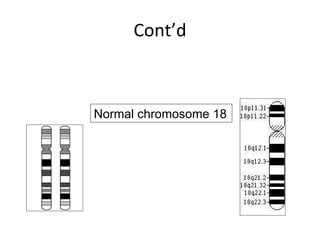
Cont’d Normal chromosome 18
Major conditions changes in chr-18 18 p- There is a missing piece from the short arm of chromosome 18. 18q- There is a missing piece from the long arm of chromosome 18.  If the missing piece is close to the centromere, it is called proximal 18q-.  If the missing piece is close to the end of the chromosome, it is called distal 18q-.
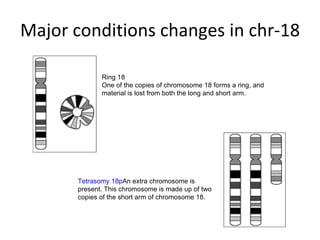
Major conditions changes in chr-18 Ring 18 One of the copies of chromosome 18 forms a ring, and material is lost from both the long and short arm. Tetrasomy 18p An extra chromosome is present. This chromosome is made up of two copies of the short arm of chromosome 18.
Major conditions changes in chr-18 Trisomy 18 There are three copies instead of the usual two.
Genes on chromosome 18 ATP8B1 CTDP1 FECH LAMA3 LPIN2 NPC1 SMAD4 TCF4 TGIF1 TNFRSF11A TTR
Jenis-jenis kelainan terkait kromosom 18 congenital cataracts, facial dysmorphism, and neuropathy  Fuchs endothelial dystrophy  hereditary hemorrhagic telangiectasia  junctional epidermolysis bullosa  juvenile polyposis syndrome  Majeed syndrome  Niemann-Pick disease  nonsyndromic holoprosencephaly  osteopetrosis  Paget disease of bone  Pitt-Hopkins syndrome  porphyria  progressive familial intrahepatic cholestasis  Transthyretin amyloidosis
Pitt-Hopkins Syndrome (PTHS) caused by a mutation within or a complete deletion of the  TCF4  gene.  instructions that tell the body how to grow and develop.  The  TCF4  gene is located on the long arm of chromosome 18.  Some individuals that have distal 18q- are missing the  TCF4  gene.  Changes in conditions of Chr-18
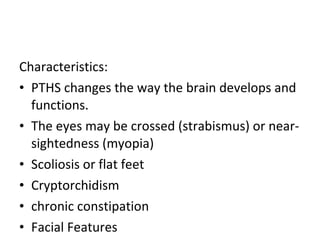
Characteristics:  PTHS changes the way the brain develops and functions.  The eyes may be crossed (strabismus) or near-sightedness (myopia) Scoliosis or flat feet Cryptorchidism chronic constipation  Facial Features
Pitt-Hopkins Syndrome (PTHS)
THANK YOU TERIMA KASIH ARIGATO GOZAIMASHITA JAZAKILLAH KHAIRAN KATSIRA KAMSAHAMNIDA

Kromosom 17 & 18

  • 1.
    KROMOSOM 17 &KROMOSOM 18 KELOMPOK 9 Rizqiani Amalia Kusumasari Satrio Wicaksono Samuel Sandy Siti Ruqayyah
  • 2.
    CHARACTERISTICS Chromosome17 one copy inherited from each parent  one of the pairs rich in protein coding genes, having the second highest gene density in the genome Chromosome 17 spans about 79 million DNA building blocks (base pairs) and represents between 2.5 percent and 3 percent of the total DNA in cells.
  • 3.
    Cont’d Chromosome 17likely contains between 1,200 and 1,500 genes. These genes perform a variety of different roles in the body. Ideogram
  • 4.
    Jenis-jenis kelainan terkaitkromosom 17 acute promyelocytic leukemia Alexander disease Amish lethal microcephaly Andersen-Tawil syndrome Birt-Hogg-Dubé syndrome bladder cancer breast cancer campomelic dysplasia Canavan disease Carney complex Charcot-Marie-Tooth disease common variable immune deficiency cystinosis dermatofibrosarcoma protuberans Ehlers-Danlos syndrome epidermolysis bullosa simplex epidermolysis bullosa with pyloric atresia familial atrial fibrillation familial hemophagocytic lymphohistiocytosis Freeman-Sheldon syndrome frontotemporal dementia with parkinsonism-17 galactosemia glycogen storage disease type I GRN-related frontotemporal dementia hereditary folate malabsorption hereditary neuralgic amyotrophy hereditary neuropathy with liability to pressure palsies hyperkalemic periodic paralysis hypokalemic periodic paralysis Job syndrome Leber congenital amaurosis Li-Fraumeni syndrome limb-girdle muscular dystrophy Miller-Dieker syndrome mucopolysaccharidosis type III N-acetylglutamate synthase deficiency neuroblastoma neurofibromatosis type 1 nonbullous congenital ichthyosiform erythroderma nonsyndromic deafness osteogenesis imperfecta pachyonychia congenita paramyotonia congenita Pompe disease pontocerebellar hypoplasia potassium-aggravated myotonia progressive supranuclear palsy pyridoxal 5'-phosphate-dependent epilepsy short QT syndrome Smith-Magenis syndrome SOST-related sclerosing bone dysplasia spondylocostal dysostosis tetra-amelia syndrome Usher syndrome very long-chain acyl-CoA dehydrogenase deficiency vitiligo
  • 5.
    Genes onchromosome 17 ACADVL ACTG1 ALOX12B ALOXE3 ASPA BRCA1 BRIP1 COL1A1 CTNS ERBB2 FLCN G6PC GAA GALK1 GFAP GRN GUCY2D HES7 ITGB4 KCNJ2 KRT14 KRT16 KRT17 MAPT MYH3 MYO15A NAGLU NAGS NF1 NLRP1 PAFAH1B1 PMP22 PNPO PRKAR1A RAI1 RARA SCN4A SEPT9 SGCA SGSH SLC25A19 SLC46A1 SOST SOX9 STAT3 TNFRSF13B TP53 TSEN54 UNC13D USH1G WNT3 YWHAE
  • 6.
    Changes in conditionsof Chr-17 ACUTE PROMYELOCYTIC LEUKEMIA  caused by a rearrangement (translocation) of genetic material between chromosomes 15 and 17 [t(15;17)]  fuses part of the PML gene from chromosome 15 with part of the RARA gene from chromosome 17. somatic mutation  not inherited. The t(15;17) translocation is called a balanced reciprocal translocation The protein produced from this fused gene is known as PML-RARα.
  • 7.
    Scheme of acute promyelocytic leukemia PML gene (chr-15) >< RARA gene (chr-17) [t(15;17) balanced reciprocal translocation] PML-RARα RARα a protein  tumor suppressor blood cells are stuck at the promyelocyte stage, and they proliferate abnormally. Excess promyelocytes accumulate in the bone marrow and normal white blood cells cannot form, leading to acute promyelocytic leukemia.
  • 8.
    Chromosome 18 onecopy inherited from each parent, form one of the pairs. Chromosome 18 spans about 76 million DNA building blocks (base pairs) and represents approximately 2.7 percent of the total DNA in cells. CHARACTERISTICS
  • 9.
  • 10.
    Major conditions changesin chr-18 18 p- There is a missing piece from the short arm of chromosome 18. 18q- There is a missing piece from the long arm of chromosome 18.  If the missing piece is close to the centromere, it is called proximal 18q-.  If the missing piece is close to the end of the chromosome, it is called distal 18q-.
  • 11.
    Major conditions changesin chr-18 Ring 18 One of the copies of chromosome 18 forms a ring, and material is lost from both the long and short arm. Tetrasomy 18p An extra chromosome is present. This chromosome is made up of two copies of the short arm of chromosome 18.
  • 12.
    Major conditions changesin chr-18 Trisomy 18 There are three copies instead of the usual two.
  • 13.
    Genes on chromosome18 ATP8B1 CTDP1 FECH LAMA3 LPIN2 NPC1 SMAD4 TCF4 TGIF1 TNFRSF11A TTR
  • 14.
    Jenis-jenis kelainan terkaitkromosom 18 congenital cataracts, facial dysmorphism, and neuropathy Fuchs endothelial dystrophy hereditary hemorrhagic telangiectasia junctional epidermolysis bullosa juvenile polyposis syndrome Majeed syndrome Niemann-Pick disease nonsyndromic holoprosencephaly osteopetrosis Paget disease of bone Pitt-Hopkins syndrome porphyria progressive familial intrahepatic cholestasis Transthyretin amyloidosis
  • 15.
    Pitt-Hopkins Syndrome (PTHS)caused by a mutation within or a complete deletion of the TCF4 gene. instructions that tell the body how to grow and develop. The TCF4 gene is located on the long arm of chromosome 18. Some individuals that have distal 18q- are missing the TCF4 gene. Changes in conditions of Chr-18
  • 16.
    Characteristics: PTHSchanges the way the brain develops and functions. The eyes may be crossed (strabismus) or near-sightedness (myopia) Scoliosis or flat feet Cryptorchidism chronic constipation Facial Features
  • 17.
  • 18.
    THANK YOU TERIMAKASIH ARIGATO GOZAIMASHITA JAZAKILLAH KHAIRAN KATSIRA KAMSAHAMNIDA