BOTANY PRESENTATION
VIII SEM
B.Sc.Ed
CBZ
RIE,Mysore
Under guidance of :
Prof.G.GEETHA NAIR
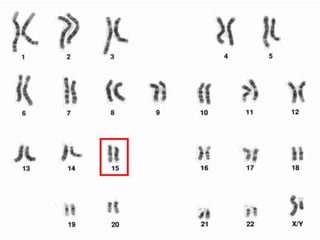
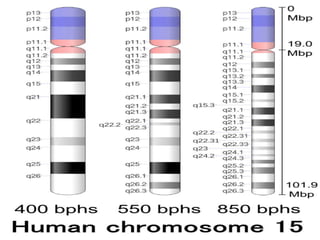
Chromosome 15 is one of the 23 pairs of chromosomes in humans .
Human chromosome 15 is an acrocentric chromosome that
represents approximately 3% of the genetic material in the human
genome.
Although it remains comparatively gene‐poor, chromosome 15
contains a ribosomal ribonucleic acid (rRNA) gene cluster and a number
of imprinted genes.
Over 900 genes were mapped to chromosome 15, some of which
have been traced to various diseases including Prader–Willi syndrome
(PWS), Angelman syndrome (AS) and many others.
The euchromatic region of this chromosome has been entirely
sequenced.
A total of 301 Yeast artificial chromosomes, 306 bacterial artificial
chromosomes, and 6493 sequence tagged sites have been identified on
chromosome 15.
The genetic map length for chromosome 15 is 137 cm in the human
female and 99 cm in the human male.
People normally have two copies of this chromosome.
Chromosome 15 spans about 101 million base pairs (the building
material of DNA) and represents between 3% and 3.5% of the total DNA
Number of genes
The following are some of the gene count estimates of human
chromosome 15.
Because researchers use different approaches to genome annotation
their predictions of the number of genes on each chromosome varies.
Among various projects, the collaborative consensus coding
sequence project (CCDS) takes an extremely conservative strategy.
So CCDS's gene number prediction represents a lower bound on the
total number of human protein-coding genes.
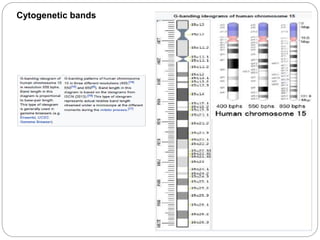
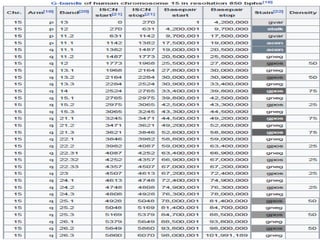
Cytogenetic bands
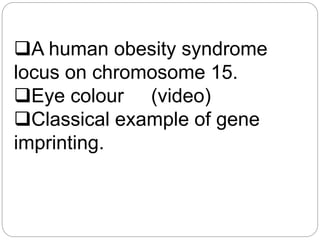
A human obesity syndrome
locus on chromosome 15.
Eye colour (video)
Classical example of gene
imprinting.
Genomic Imprinting
 Maternal and Paternal genetic contributions not
equivalent.
 Genetic contributions from both parents are
needed for normal development.
 Involves the silencing of certain genes that are
“stamped” with an imprint during gamete
production
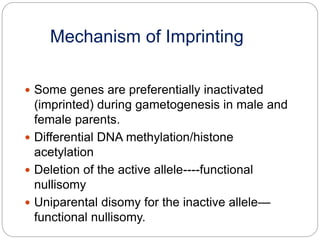
Mechanism of Imprinting
 Some genes are preferentially inactivated
(imprinted) during gametogenesis in male and
female parents.
 Differential DNA methylation/histone
acetylation
 Deletion of the active allele----functional
nullisomy
 Uniparental disomy for the inactive allele—
functional nullisomy.
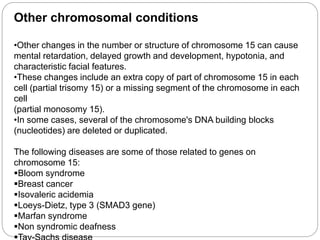
Other chromosomal conditions
•Other changes in the number or structure of chromosome 15 can cause
mental retardation, delayed growth and development, hypotonia, and
characteristic facial features.
•These changes include an extra copy of part of chromosome 15 in each
cell (partial trisomy 15) or a missing segment of the chromosome in each
cell
(partial monosomy 15).
•In some cases, several of the chromosome's DNA building blocks
(nucleotides) are deleted or duplicated.
The following diseases are some of those related to genes on
chromosome 15:
Bloom syndrome
Breast cancer
Isovaleric acidemia
Loeys-Dietz, type 3 (SMAD3 gene)
Marfan syndrome
Non syndromic deafness
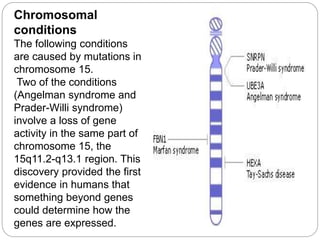
Chromosomal
conditions
The following conditions
are caused by mutations in
chromosome 15.
Two of the conditions
(Angelman syndrome and
Prader-Willi syndrome)
involve a loss of gene
activity in the same part of
chromosome 15, the
15q11.2-q13.1 region. This
discovery provided the first
evidence in humans that
something beyond genes
could determine how the
genes are expressed.
Prader-Willi syndrome(video)
The main characteristics of this condition include polyphagia (extreme,
insatiable appetite), mild to moderate developmental delay, hypogonadism
resulting in delayed to no puberty, and hypotonia.
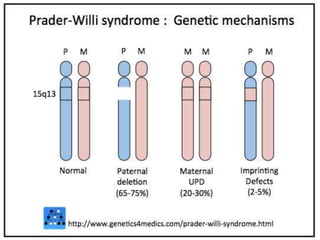
Prader-Willi syndrome is caused by the loss of active genes in a specific
part of chromosome 15, the 15q11-q13 region.
People normally have two copies of this chromosome in each cell, one
copy from each parent.
Prader-Willi syndrome occurs when the paternal copy is partly or entirely
missing.
In about 70% of cases Prader-Willi syndrome occurs when the 15q11-q13
region of the paternal chromosome 15 is deleted. The genes in this region
are normally active on the paternal copy of the chromosome and are
inactive on the maternal copy. Therefore, a person with a deletion in the
paternal chromosome 15 will have no active genes in this region.
In about 25% of cases, a person with Prader-Willi syndrome has two
maternal copies of chromosome 15 in each cell instead of one copy from
each parent. This phenomenon
is called maternal Uniparental disomy.
Because some genes are normally active only on the paternal copy of this
chromosome, a person with two maternal copies of chromosome 15 will have
no active copies of these genes.
In a small percentage of cases, Prader-Willi syndrome is caused by a
chromosomal rearrangement called a translocation.
 Rarely, the condition is caused by an abnormality in the DNA region that
controls the activity of genes on the paternal chromosome 15.
Because patients almost always have difficulty reproducing, Prader-
Willi syndrome is generally not hereditary.
PWS del(15)q11-q13
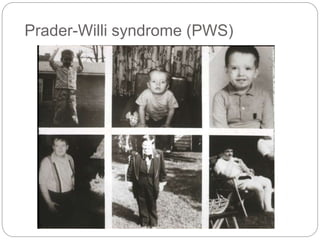
Prader-Willi syndrome (PWS)
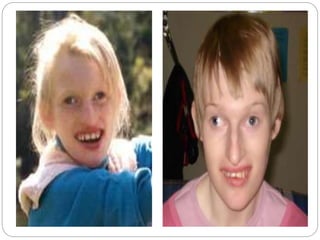
Angelman syndrome(video)
The main characteristics of Angelman syndrome are severe mental
retardation, ataxia, lack of speech, and excessively happy demeanor.
Angelman syndrome results from a loss of gene activity in a specific part of
chromosome 15, the 15q11-q13 region. This region contains a gene called
UBE3A that, when mutated or absent, likely causes the characteristic
features of this condition.
 People normally have two copies of the UBE3A gene, one from each
parent. Both copies of this gene are active in many of the body's tissues.
 In the brain, however, only the copy inherited from a person's mother (the
maternal copy) is active. If the maternal copy is lost because of a
chromosomal change or a gene mutation, a person will have no working
copies of the UBE3A gene in the brain.
In most cases (about 70%), people with Angelman syndrome have a
deletion in the maternal copy of chromosome 15. This chromosomal change
deletes the region of chromosome 15 that includes the UBE3A gene.
Because the copy of the UBE3A gene inherited from a person's father (the
paternal copy) is normally inactive in the brain, a deletion in the maternal
chromosome 15 results in no active copies of the UBE3A gene in the brain.
In 3% to 7% of cases,[citation needed] Angelman syndrome occurs when
a person has two copies of the paternal chromosome 15 instead of one
copy from each parent. This
phenomenon is called paternal Uniparental disomy (UPD). People with
paternal UPD for chromosome 15 have two copies of the UBE3A gene, but
they are both inherited from
the father and are therefore inactive in the brain.
About 10% of Angelman syndrome cases are caused by a mutation in
the UBE3A gene, and
 another 3% result from a defect in the DNA region that controls the
activation of
the UBE3A gene and other genes on the maternal copy of chromosome
15. In a small percentage of cases, Angelman syndrome may be caused
by a chromosomal
rearrangement called a translocation or by a mutation in a gene other than
UBE3A.
These genetic changes can abnormally inactivate the UBE3A gene.
THANK
YOU

Human chromosome 15

  • 1.
  • 6.
    Chromosome 15 isone of the 23 pairs of chromosomes in humans . Human chromosome 15 is an acrocentric chromosome that represents approximately 3% of the genetic material in the human genome. Although it remains comparatively gene‐poor, chromosome 15 contains a ribosomal ribonucleic acid (rRNA) gene cluster and a number of imprinted genes. Over 900 genes were mapped to chromosome 15, some of which have been traced to various diseases including Prader–Willi syndrome (PWS), Angelman syndrome (AS) and many others. The euchromatic region of this chromosome has been entirely sequenced. A total of 301 Yeast artificial chromosomes, 306 bacterial artificial chromosomes, and 6493 sequence tagged sites have been identified on chromosome 15. The genetic map length for chromosome 15 is 137 cm in the human female and 99 cm in the human male. People normally have two copies of this chromosome. Chromosome 15 spans about 101 million base pairs (the building material of DNA) and represents between 3% and 3.5% of the total DNA
  • 7.
    Number of genes Thefollowing are some of the gene count estimates of human chromosome 15. Because researchers use different approaches to genome annotation their predictions of the number of genes on each chromosome varies. Among various projects, the collaborative consensus coding sequence project (CCDS) takes an extremely conservative strategy. So CCDS's gene number prediction represents a lower bound on the total number of human protein-coding genes.
  • 10.
  • 13.
    A human obesitysyndrome locus on chromosome 15. Eye colour (video) Classical example of gene imprinting.
  • 14.
    Genomic Imprinting  Maternaland Paternal genetic contributions not equivalent.  Genetic contributions from both parents are needed for normal development.  Involves the silencing of certain genes that are “stamped” with an imprint during gamete production
  • 15.
    Mechanism of Imprinting Some genes are preferentially inactivated (imprinted) during gametogenesis in male and female parents.  Differential DNA methylation/histone acetylation  Deletion of the active allele----functional nullisomy  Uniparental disomy for the inactive allele— functional nullisomy.
  • 16.
    Other chromosomal conditions •Otherchanges in the number or structure of chromosome 15 can cause mental retardation, delayed growth and development, hypotonia, and characteristic facial features. •These changes include an extra copy of part of chromosome 15 in each cell (partial trisomy 15) or a missing segment of the chromosome in each cell (partial monosomy 15). •In some cases, several of the chromosome's DNA building blocks (nucleotides) are deleted or duplicated. The following diseases are some of those related to genes on chromosome 15: Bloom syndrome Breast cancer Isovaleric acidemia Loeys-Dietz, type 3 (SMAD3 gene) Marfan syndrome Non syndromic deafness
  • 17.
    Chromosomal conditions The following conditions arecaused by mutations in chromosome 15. Two of the conditions (Angelman syndrome and Prader-Willi syndrome) involve a loss of gene activity in the same part of chromosome 15, the 15q11.2-q13.1 region. This discovery provided the first evidence in humans that something beyond genes could determine how the genes are expressed.
  • 18.
    Prader-Willi syndrome(video) The maincharacteristics of this condition include polyphagia (extreme, insatiable appetite), mild to moderate developmental delay, hypogonadism resulting in delayed to no puberty, and hypotonia. Prader-Willi syndrome is caused by the loss of active genes in a specific part of chromosome 15, the 15q11-q13 region. People normally have two copies of this chromosome in each cell, one copy from each parent. Prader-Willi syndrome occurs when the paternal copy is partly or entirely missing. In about 70% of cases Prader-Willi syndrome occurs when the 15q11-q13 region of the paternal chromosome 15 is deleted. The genes in this region are normally active on the paternal copy of the chromosome and are inactive on the maternal copy. Therefore, a person with a deletion in the paternal chromosome 15 will have no active genes in this region.
  • 19.
    In about 25%of cases, a person with Prader-Willi syndrome has two maternal copies of chromosome 15 in each cell instead of one copy from each parent. This phenomenon is called maternal Uniparental disomy. Because some genes are normally active only on the paternal copy of this chromosome, a person with two maternal copies of chromosome 15 will have no active copies of these genes. In a small percentage of cases, Prader-Willi syndrome is caused by a chromosomal rearrangement called a translocation.  Rarely, the condition is caused by an abnormality in the DNA region that controls the activity of genes on the paternal chromosome 15. Because patients almost always have difficulty reproducing, Prader- Willi syndrome is generally not hereditary.
  • 20.
  • 21.
  • 23.
    Angelman syndrome(video) The maincharacteristics of Angelman syndrome are severe mental retardation, ataxia, lack of speech, and excessively happy demeanor. Angelman syndrome results from a loss of gene activity in a specific part of chromosome 15, the 15q11-q13 region. This region contains a gene called UBE3A that, when mutated or absent, likely causes the characteristic features of this condition.  People normally have two copies of the UBE3A gene, one from each parent. Both copies of this gene are active in many of the body's tissues.  In the brain, however, only the copy inherited from a person's mother (the maternal copy) is active. If the maternal copy is lost because of a chromosomal change or a gene mutation, a person will have no working copies of the UBE3A gene in the brain. In most cases (about 70%), people with Angelman syndrome have a deletion in the maternal copy of chromosome 15. This chromosomal change deletes the region of chromosome 15 that includes the UBE3A gene. Because the copy of the UBE3A gene inherited from a person's father (the paternal copy) is normally inactive in the brain, a deletion in the maternal chromosome 15 results in no active copies of the UBE3A gene in the brain.
  • 24.
    In 3% to7% of cases,[citation needed] Angelman syndrome occurs when a person has two copies of the paternal chromosome 15 instead of one copy from each parent. This phenomenon is called paternal Uniparental disomy (UPD). People with paternal UPD for chromosome 15 have two copies of the UBE3A gene, but they are both inherited from the father and are therefore inactive in the brain. About 10% of Angelman syndrome cases are caused by a mutation in the UBE3A gene, and  another 3% result from a defect in the DNA region that controls the activation of the UBE3A gene and other genes on the maternal copy of chromosome 15. In a small percentage of cases, Angelman syndrome may be caused by a chromosomal rearrangement called a translocation or by a mutation in a gene other than UBE3A. These genetic changes can abnormally inactivate the UBE3A gene.
  • 27.