Representing Knowledge
using Rules
Deeksha Arya
(Reference: Artificial Intelligence – Rich & Knight)
Predicate Logic (Limitations)
• “It is very hot today.”
• How can relative degrees of heat be represented?
• “Blonde-haired people often have blue eyes.”
• How can the amount of certainty be represented?
• “If there is no evidence to the contrary, assume that any adult you
meet knows how to read.”
• How can we represent that one fact should be inferred from the absence of
another?
• “I know John thinks Bill will win but I think he is going to loose.”
• How can several different belief systems be represented at once?
KR using Rules
• Provides the flexibility of combining declarative and procedural
representation for using them in a unified form.
• Examples of production rules :
− IF condition THEN action
− IF premise THEN conclusion
− IF proposition p1 and proposition p2 are true THEN
proposition p3 is true
Advantage of Production Rules
− they are modular,
− each rule define a small and independent piece of knowledge.
− new rules may be added and old ones deleted.
− rules are usually independent of other rules.
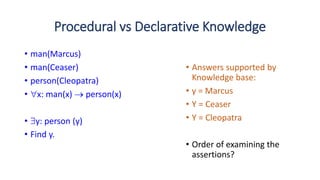
Procedural vs Declarative Knowledge
• man(Marcus)
• man(Ceaser)
• person(Cleopatra)
• x: man(x)  person(x)
• y: person (y)
• Find y.
• Answers supported by
Knowledge base:
• y = Marcus
• Y = Ceaser
• Y = Cleopatra
• Order of examining the
assertions?
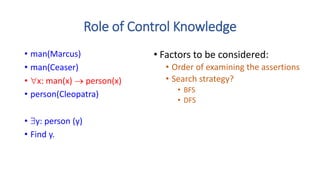
Role of Control Knowledge
• man(Marcus)
• man(Ceaser)
• x: man(x)  person(x)
• person(Cleopatra)
• y: person (y)
• Find y.
• Factors to be considered:
• Order of examining the assertions
• Search strategy?
• BFS
• DFS
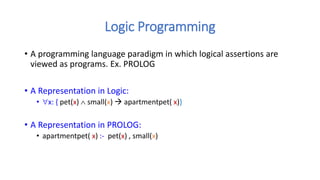
Logic Programming
• A programming language paradigm in which logical assertions are
viewed as programs. Ex. PROLOG
• A Representation in Logic:
• x: { pet(x)  small(x)  apartmentpet( x)}
• A Representation in PROLOG:
• apartmentpet( x) :- pet(x) , small(x)
Forward vs Backward Reasoning
Q. Find a value of X that satisfies the predicate apartmentpet(X).
• Two directions in which a search could proceed:
• Forward, from the start states
• Backward, from the goal states
Factors to be considered
• Are there more possible start states or goal states?
• In which direction is the branching factor greater?
• Will the program be asked to justify its reasoning process to a user?
• What kind of event is going to trigger a problem-solving episode?
• Arrival of a new fact?
• A query to which a response is desired?
Combining Forward & Backward reasoning
• Medical Diagnosis Program
• 9 out of 10 pre-conditions satisfied.
• Conclusion?
Matching
• Indexing
• Matching with Variables
• Complex and Approximate Matching
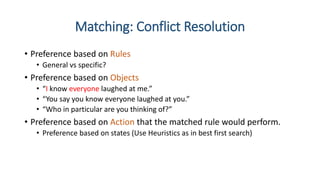
Matching: Conflict Resolution
• Preference based on Rules
• General vs specific?
• Preference based on Objects
• “I know everyone laughed at me.”
• “You say you know everyone laughed at you.”
• “Who in particular are you thinking of?”
• Preference based on Action that the matched rule would perform.
• Preference based on states (Use Heuristics as in best first search)
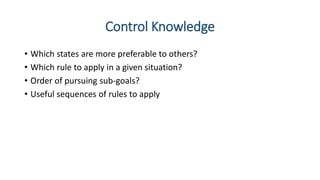
Control Knowledge
• Which states are more preferable to others?
• Which rule to apply in a given situation?
• Order of pursuing sub-goals?
• Useful sequences of rules to apply

Kr using rules

  • 1.
    Representing Knowledge using Rules DeekshaArya (Reference: Artificial Intelligence – Rich & Knight)
  • 2.
    Predicate Logic (Limitations) •“It is very hot today.” • How can relative degrees of heat be represented? • “Blonde-haired people often have blue eyes.” • How can the amount of certainty be represented? • “If there is no evidence to the contrary, assume that any adult you meet knows how to read.” • How can we represent that one fact should be inferred from the absence of another? • “I know John thinks Bill will win but I think he is going to loose.” • How can several different belief systems be represented at once?
  • 3.
    KR using Rules •Provides the flexibility of combining declarative and procedural representation for using them in a unified form. • Examples of production rules : − IF condition THEN action − IF premise THEN conclusion − IF proposition p1 and proposition p2 are true THEN proposition p3 is true
  • 4.
    Advantage of ProductionRules − they are modular, − each rule define a small and independent piece of knowledge. − new rules may be added and old ones deleted. − rules are usually independent of other rules.
  • 5.
    Procedural vs DeclarativeKnowledge • man(Marcus) • man(Ceaser) • person(Cleopatra) • x: man(x)  person(x) • y: person (y) • Find y. • Answers supported by Knowledge base: • y = Marcus • Y = Ceaser • Y = Cleopatra • Order of examining the assertions?
  • 6.
    Role of ControlKnowledge • man(Marcus) • man(Ceaser) • x: man(x)  person(x) • person(Cleopatra) • y: person (y) • Find y. • Factors to be considered: • Order of examining the assertions • Search strategy? • BFS • DFS
  • 7.
    Logic Programming • Aprogramming language paradigm in which logical assertions are viewed as programs. Ex. PROLOG • A Representation in Logic: • x: { pet(x)  small(x)  apartmentpet( x)} • A Representation in PROLOG: • apartmentpet( x) :- pet(x) , small(x)
  • 8.
    Forward vs BackwardReasoning Q. Find a value of X that satisfies the predicate apartmentpet(X). • Two directions in which a search could proceed: • Forward, from the start states • Backward, from the goal states
  • 9.
    Factors to beconsidered • Are there more possible start states or goal states? • In which direction is the branching factor greater? • Will the program be asked to justify its reasoning process to a user? • What kind of event is going to trigger a problem-solving episode? • Arrival of a new fact? • A query to which a response is desired?
  • 10.
    Combining Forward &Backward reasoning • Medical Diagnosis Program • 9 out of 10 pre-conditions satisfied. • Conclusion?
  • 11.
    Matching • Indexing • Matchingwith Variables • Complex and Approximate Matching
  • 12.
    Matching: Conflict Resolution •Preference based on Rules • General vs specific? • Preference based on Objects • “I know everyone laughed at me.” • “You say you know everyone laughed at you.” • “Who in particular are you thinking of?” • Preference based on Action that the matched rule would perform. • Preference based on states (Use Heuristics as in best first search)
  • 13.
    Control Knowledge • Whichstates are more preferable to others? • Which rule to apply in a given situation? • Order of pursuing sub-goals? • Useful sequences of rules to apply