Being a Paper Delivered at a Workshop Organised by Joeson Consult Ltd for Management of NPMCS Held at Plaza De Aruna, Oyo on Wednesday, September 3, 2025.
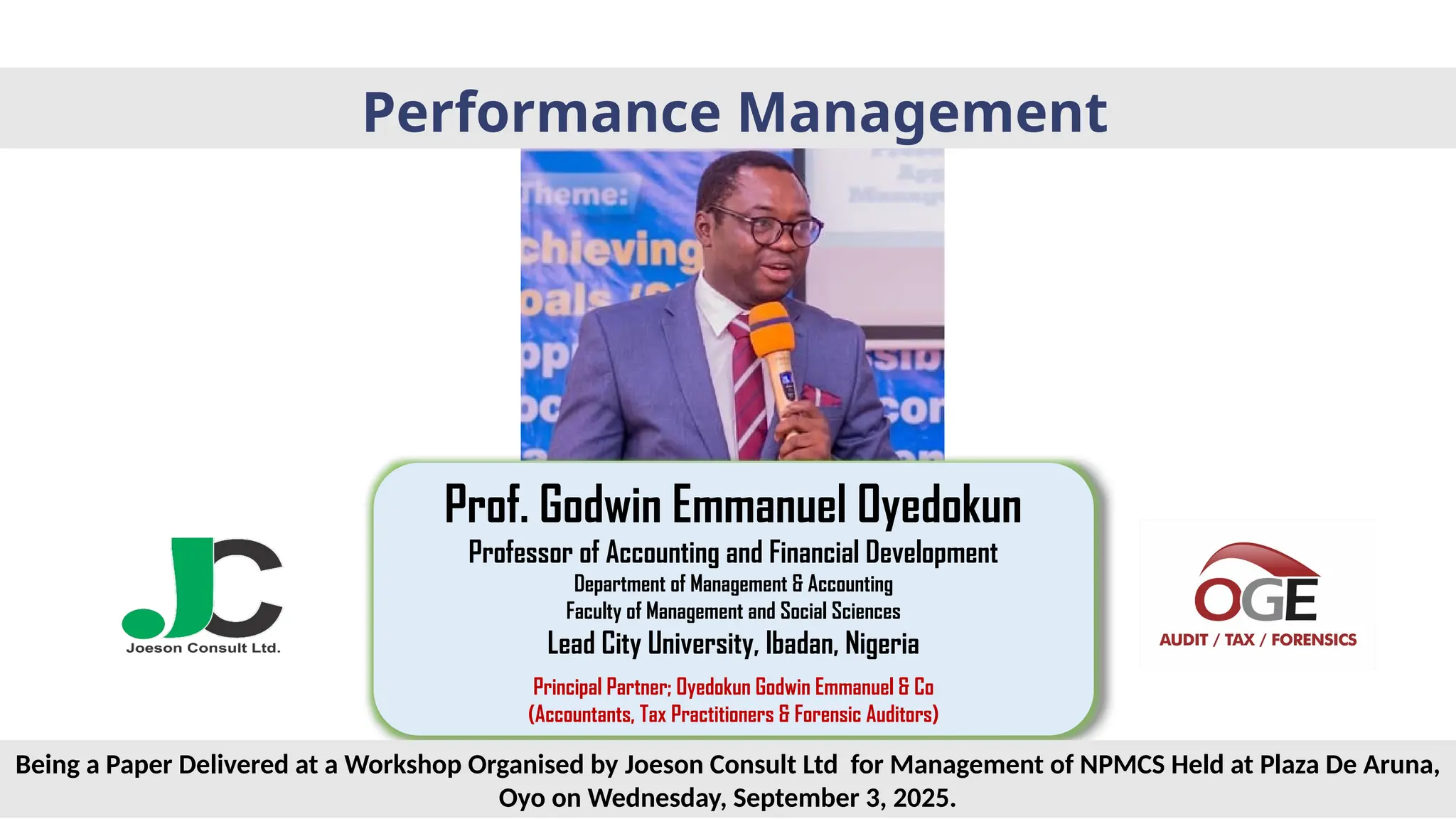
Performance Management
Prof. GodwinEmmanuel Oyedokun
Professor of Accounting and Financial Development
Department of Management & Accounting
Faculty of Management and Social Sciences
Lead City University, Ibadan, Nigeria
Principal Partner; Oyedokun Godwin Emmanuel & Co
(Accountants, Tax Practitioners & Forensic Auditors)
Being a Paper Delivered at a Workshop Organised by Joeson Consult Ltd for Management of NPMCS Held at Plaza De Aruna,
Oyo on Wednesday, September 3, 2025.
2.
ND (Fin), HND(Acct.), BSc. (Acct. Ed), BSc (Fin.), LLB., LLM, MBA (Acct. & Fin.), MSc. (Acct.), MSc. (Bus &Econs), MSc. (Fin), MSc.
(Econs), Ph.D. (Acct), Ph.D. (Fin), Ph.D. (FA), CICA, CFA, CFE, CIPFA, CPFA, CertIFR, ACS, ACIS, ACIArb, ACAMS, ABR, IPA, IFA,
MNIM, FCA, FCTI, FCIB, FCNA, FCFIP, FCE, FERP, FFAR, FPD-CR, FSEAN, FNIOAIM, FCCrFA, FCCFI, FICA, FCECFI, JP
Prof. Godwin Emmanuel Oyedokun
Professor of Accounting and Financial Development
Department of Management & Accounting
Faculty of Management and Social Sciences
Lead City University, Ibadan, Nigeria
Principal Partner; Oyedokun Godwin Emmanuel & Co
(Accountants, Tax Practitioners & Forensic Auditors)
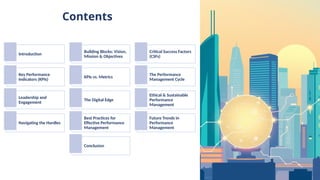
Contents
Introduction
Building Blocks: Vision,
Mission& Objectives
Critical Success Factors
(CSFs)
Key Performance
Indicators (KPIs)
KPIs vs. Metrics
The Performance
Management Cycle
Leadership and
Engagement
The Digital Edge
Ethical & Sustainable
Performance
Management
Navigating the Hurdles
Best Practices for
Effective Performance
Management
Future Trends in
Performance
Management
Conclusion
5.
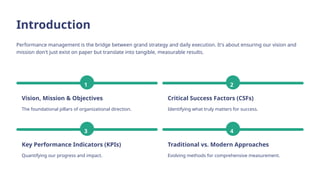
Introduction
Performance management isthe bridge between grand strategy and daily execution. It's about ensuring our vision and
mission don't just exist on paper but translate into tangible, measurable results.
1
Vision, Mission & Objectives
The foundational pillars of organizational direction.
2
Critical Success Factors (CSFs)
Identifying what truly matters for success.
3
Key Performance Indicators (KPIs)
Quantifying our progress and impact.
4
Traditional vs. Modern Approaches
Evolving methods for comprehensive measurement.
6.
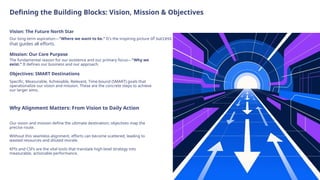
Defining the BuildingBlocks: Vision, Mission & Objectives
Vision: The Future North Star
Our long-term aspiration—"Where we want to be." It's the inspiring picture of success
that guides all efforts.
Mission: Our Core Purpose
The fundamental reason for our existence and our primary focus—"Why we
exist." It defines our business and our approach.
Objectives: SMART Destinations
Specific, Measurable, Achievable, Relevant, Time-bound (SMART) goals that
operationalize our vision and mission. These are the concrete steps to achieve
our larger aims.
Why Alignment Matters: From Vision to Daily Action
Our vision and mission define the ultimate destination; objectives map the
precise route.
Without this seamless alignment, efforts can become scattered, leading to
wasted resources and diluted morale.
KPIs and CSFs are the vital tools that translate high-level strategy into
measurable, actionable performance.
7.
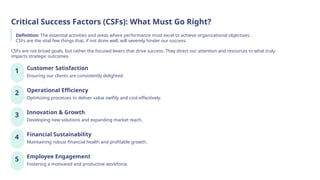
Critical Success Factors(CSFs): What Must Go Right?
Definition: The essential activities and areas where performance must excel to achieve organizational objectives.
CSFs are the vital few things that, if not done well, will severely hinder our success.
CSFs are not broad goals, but rather the focused levers that drive success. They direct our attention and resources to what truly
impacts strategic outcomes.
1 Customer Satisfaction
Ensuring our clients are consistently delighted.
2 Operational Efficiency
Optimizing processes to deliver value swiftly and cost-effectively.
3 Innovation & Growth
Developing new solutions and expanding market reach.
4 Financial Sustainability
Maintaining robust financial health and profitable growth.
5 Employee Engagement
Fostering a motivated and productive workforce.
8.
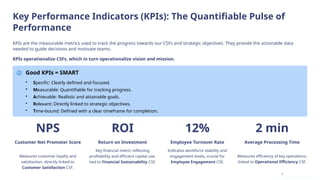
Key Performance Indicators(KPIs): The Quantifiable Pulse of
Performance
KPIs are the measurable metrics used to track the progress towards our CSFs and strategic objectives. They provide the actionable data
needed to guide decisions and motivate teams.
KPIs operationalize CSFs, which in turn operationalize vision and mission.
Good KPIs = SMART
• Specific: Clearly defined and focused.
• Measurable: Quantifiable for tracking progress.
• Achievable: Realistic and attainable goals.
• Relevant: Directly linked to strategic objectives.
• Time-bound: Defined with a clear timeframe for completion.
NPS
Customer Net Promoter Score
Measures customer loyalty and
satisfaction, directly linked to
Customer Satisfaction CSF.
ROI
Return on Investment
Key financial metric reflecting
profitability and efficient capital use,
tied to Financial Sustainability CSF.
12%
Employee Turnover Rate
Indicates workforce stability and
engagement levels, crucial for
Employee Engagement CSF.
2 min
Average Processing Time
Measures efficiency of key operations,
linked to Operational Efficiency CSF.
9.
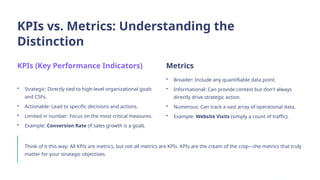
KPIs vs. Metrics:Understanding the
Distinction
KPIs (Key Performance Indicators)
• Strategic: Directly tied to high-level organizational goals
and CSFs.
• Actionable: Lead to specific decisions and actions.
• Limited in number: Focus on the most critical measures.
• Example: Conversion Rate (if sales growth is a goal).
Metrics
• Broader: Include any quantifiable data point.
• Informational: Can provide context but don't always
directly drive strategic action.
• Numerous: Can track a vast array of operational data.
• Example: Website Visits (simply a count of traffic).
Think of it this way: All KPIs are metrics, but not all metrics are KPIs. KPIs are the cream of the crop—the metrics that truly
matter for your strategic objectives.
10.
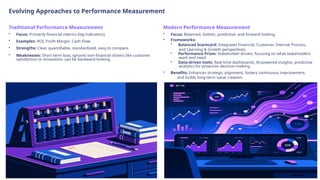
Evolving Approaches toPerformance Measurement
Traditional Performance Measurement
• Focus: Primarily financial metrics (lag indicators).
• Examples: ROI, Profit Margin, Cash Flow.
• Strengths: Clear, quantifiable, standardized, easy to compare.
• Weaknesses: Short-term bias, ignores non-financial drivers like customer
satisfaction or innovation, can be backward-looking.
Modern Performance Measurement
• Focus: Balanced, holistic, predictive, and forward-looking.
• Frameworks:
• Balanced Scorecard: Integrates Financial, Customer, Internal Process,
and Learning & Growth perspectives.
• Performance Prism: Stakeholder-driven, focusing on what stakeholders
want and need.
• Data-driven tools: Real-time dashboards, AI-powered insights, predictive
analytics for proactive decision-making.
• Benefits: Enhances strategic alignment, fosters continuous improvement,
and builds long-term value creation.
11.
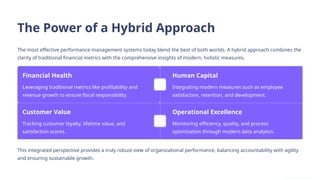
The Power ofa Hybrid Approach
The most effective performance management systems today blend the best of both worlds. A hybrid approach combines the
clarity of traditional financial metrics with the comprehensive insights of modern, holistic measures.
Financial Health
Leveraging traditional metrics like profitability and
revenue growth to ensure fiscal responsibility.
Human Capital
Integrating modern measures such as employee
satisfaction, retention, and development.
Customer Value
Tracking customer loyalty, lifetime value, and
satisfaction scores.
Operational Excellence
Monitoring efficiency, quality, and process
optimization through modern data analytics.
This integrated perspective provides a truly robust view of organizational performance, balancing accountability with agility
and ensuring sustainable growth.
12.
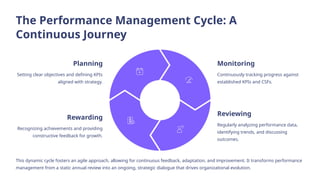
The Performance ManagementCycle: A
Continuous Journey
Planning
Setting clear objectives and defining KPIs
aligned with strategy.
Monitoring
Continuously tracking progress against
established KPIs and CSFs.
Reviewing
Regularly analyzing performance data,
identifying trends, and discussing
outcomes.
Rewarding
Recognizing achievements and providing
constructive feedback for growth.
This dynamic cycle fosters an agile approach, allowing for continuous feedback, adaptation, and improvement. It transforms performance
management from a static annual review into an ongoing, strategic dialogue that drives organizational evolution.
13.
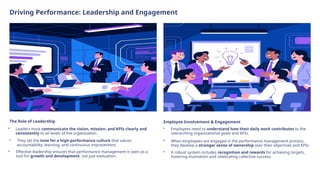
Driving Performance: Leadershipand Engagement
The Role of Leadership
• Leaders must communicate the vision, mission, and KPIs clearly and
consistently to all levels of the organization.
• They set the tone for a high-performance culture that values
accountability, learning, and continuous improvement.
• Effective leadership ensures that performance management is seen as a
tool for growth and development, not just evaluation.
Employee Involvement & Engagement
• Employees need to understand how their daily work contributes to the
overarching organizational goals and KPIs.
• When employees are engaged in the performance management process,
they develop a stronger sense of ownership over their objectives and KPIs.
• A robust system includes recognition and rewards for achieving targets,
fostering motivation and celebrating collective success.
14.
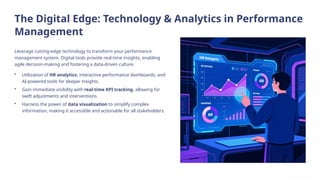
The Digital Edge:Technology & Analytics in Performance
Management
Leverage cutting-edge technology to transform your performance
management system. Digital tools provide real-time insights, enabling
agile decision-making and fostering a data-driven culture.
• Utilization of HR analytics, interactive performance dashboards, and
AI-powered tools for deeper insights.
• Gain immediate visibility with real-time KPI tracking, allowing for
swift adjustments and interventions.
• Harness the power of data visualization to simplify complex
information, making it accessible and actionable for all stakeholders.
15.
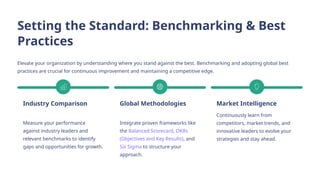
Setting the Standard:Benchmarking & Best
Practices
Elevate your organization by understanding where you stand against the best. Benchmarking and adopting global best
practices are crucial for continuous improvement and maintaining a competitive edge.
Industry Comparison
Measure your performance
against industry leaders and
relevant benchmarks to identify
gaps and opportunities for growth.
Global Methodologies
Integrate proven frameworks like
the Balanced Scorecard, OKRs
(Objectives and Key Results), and
Six Sigma to structure your
approach.
Market Intelligence
Continuously learn from
competitors, market trends, and
innovative leaders to evolve your
strategies and stay ahead.
16.
Fueling Ambition: Linking
Performanceto Rewards & Career
Development
A robust performance management system directly connects achievement with
incentives, fostering a culture of motivation, growth, and continuous
improvement for every employee.
Incentivize Success
Establish a clear and strong link
between high performance and
tangible incentives, driving
motivation and commitment.
Clear Progression Paths
Tie career advancement and
progression directly to the
achievement of specific KPIs,
offering clear pathways for
growth.
Performance Culture
Cultivate an environment where high achievement is recognized, rewarded,
and becomes an integral part of the organizational ethos.
17.
Beyond Profit: Ethical&
Sustainable Performance
Management
Modern performance management extends beyond financial metrics to encompass social
responsibility and ethical considerations, ensuring long-term value creation.
Balance profit with purpose, ensuring your
performance framework contributes positively to
society and the environment.
• Integrate sustainability into your KPIs, including ESG (Environmental, Social,
and Governance) metrics and CSR (Corporate Social Responsibility)
initiatives.
• Actively avoid creating a "toxic performance culture" that prioritizes output
over employee well-being, fostering a healthier and more productive work
environment.
18.
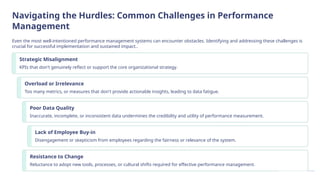
Navigating the Hurdles:Common Challenges in Performance
Management
Even the most well-intentioned performance management systems can encounter obstacles. Identifying and addressing these challenges is
crucial for successful implementation and sustained impact..
Strategic Misalignment
KPIs that don't genuinely reflect or support the core organizational strategy.
Overload or Irrelevance
Too many metrics, or measures that don't provide actionable insights, leading to data fatigue.
Poor Data Quality
Inaccurate, incomplete, or inconsistent data undermines the credibility and utility of performance measurement.
Lack of Employee Buy-in
Disengagement or skepticism from employees regarding the fairness or relevance of the system.
Resistance to Change
Reluctance to adopt new tools, processes, or cultural shifts required for effective performance management.
19.
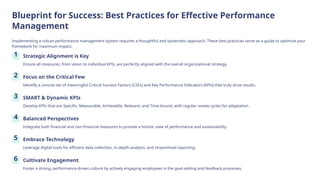
Blueprint for Success:Best Practices for Effective Performance
Management
Implementing a robust performance management system requires a thoughtful and systematic approach. These best practices serve as a guide to optimize your
framework for maximum impact.
1 Strategic Alignment is Key
Ensure all measures, from vision to individual KPIs, are perfectly aligned with the overall organizational strategy.
2 Focus on the Critical Few
Identify a concise set of meaningful Critical Success Factors (CSFs) and Key Performance Indicators (KPIs) that truly drive results.
3 SMART & Dynamic KPIs
Develop KPIs that are Specific, Measurable, Achievable, Relevant, and Time-bound, with regular review cycles for adaptation.
4 Balanced Perspectives
Integrate both financial and non-financial measures to provide a holistic view of performance and sustainability.
5 Embrace Technology
Leverage digital tools for efficient data collection, in-depth analysis, and streamlined reporting.
6 Cultivate Engagement
Foster a strong, performance-driven culture by actively engaging employees in the goal-setting and feedback processes.
20.
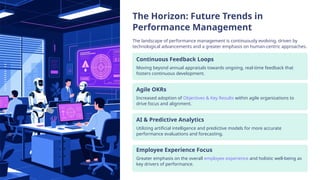
The Horizon: FutureTrends in
Performance Management
The landscape of performance management is continuously evolving, driven by
technological advancements and a greater emphasis on human-centric approaches.
Continuous Feedback Loops
Moving beyond annual appraisals towards ongoing, real-time feedback that
fosters continuous development.
Agile OKRs
Increased adoption of Objectives & Key Results within agile organizations to
drive focus and alignment.
AI & Predictive Analytics
Utilizing artificial intelligence and predictive models for more accurate
performance evaluations and forecasting.
Employee Experience Focus
Greater emphasis on the overall employee experience and holistic well-being as
key drivers of performance.
21.
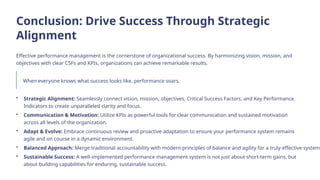
Conclusion: Drive SuccessThrough Strategic
Alignment
Effective performance management is the cornerstone of organizational success. By harmonizing vision, mission, and
objectives with clear CSFs and KPIs, organizations can achieve remarkable results.
When everyone knows what success looks like, performance soars.
• Strategic Alignment: Seamlessly connect vision, mission, objectives, Critical Success Factors, and Key Performance
Indicators to create unparalleled clarity and focus.
• Communication & Motivation: Utilize KPIs as powerful tools for clear communication and sustained motivation
across all levels of the organization.
• Adapt & Evolve: Embrace continuous review and proactive adaptation to ensure your performance system remains
agile and on course in a dynamic environment.
• Balanced Approach: Merge traditional accountability with modern principles of balance and agility for a truly effective system.
• Sustainable Success: A well-implemented performance management system is not just about short-term gains, but
about building capabilities for enduring, sustainable success.
22.
Prof. Godwin EmmanuelOyedokun
Professor of Accounting & Financial Development
Lead City University, Ibadan, Nigeria
Principal Partner; Oyedokun Godwin Emmanuel & Co
(Accountants, Tax Practitioners & Forensic Auditors)
godwinoye@yahoo.com; godwinoye@oyedokungodwin.com
+2348033737184 & 2348055863944