Business Breakthroughs
Robert Osborne
Business Breakthroughs Inc.
Business
Breakthroughs
• Overview of the Enterprise Business Model and the
Governance Layer
• Performance and Change Management as the Link Between
Governance and Operations
• KPIs – the Strategic Gap Measure for BPM
• Performance Management – from Discovery to Assignment
• Change Management – from Assignment to Resolution
• Quick Hits vs the BPM Portfolio – How to Choose the Path
• Success Factors for Management Adoption
Business
Breakthroughs
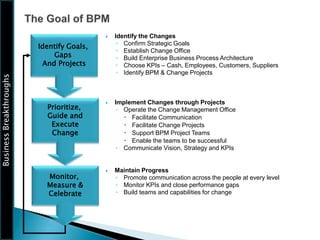
 Identify the Changes
◦ Confirm Strategic Goals
◦ Establish Change Office
◦ Build Enterprise Business Process Architecture
◦ Choose KPIs – Cash, Employees, Customers, Suppliers
◦ Identify BPM & Change Projects
 Implement Changes through Projects
◦ Operate the Change Management Office
 Facilitate Communication
 Facilitate Change Projects
 Support BPM Project Teams
 Enable the teams to be successful
◦ Communicate Vision, Strategy and KPIs
 Maintain Progress
◦ Promote communication across the people at every level
◦ Monitor KPIs and close performance gaps
◦ Build teams and capabilities for change
Identify Goals,
Gaps
And Projects
Prioritize,
Guide and
Execute
Change
Monitor,
Measure &
Celebrate
Business
Breakthroughs
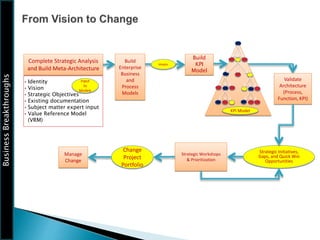
Complete Strategic Analysis
and Build Meta-Architecture
Build
Enterprise
Business
and
Process
Models
Validate
Architecture
(Process,
Function, KPI)
Strategic Workshops
& Prioritization
KPI Model
Strategic Initiatives,
Gaps, and Quick Win
Opportunities
Change
Project
Portfolio
Manage
Change
•Identity
•Vision
•Strategic Objectives
•Existing documentation
•Subject matter expert input
•Value Reference Model
(VRM)
KPI Model
Build
KPI
Model
Input
to
Models
Models
Business
Breakthroughs
Business
Breakthroughs
Product
Mgmt
Market
Segment to
Offering
Lead
Generation
Offering to
Opportunity
Sales
Opportunity
to Order
Product &
Service Delivery
Order to Cash
Post-Sale
Services
Cash to
Satisfied
Customer
Provide &
Manage
Operational
Finances
Provide &
Manage HR
Provide &
Manage
Technology
Services
Company
Governance
Company
Operations
Plan
Company
Business
Strategy
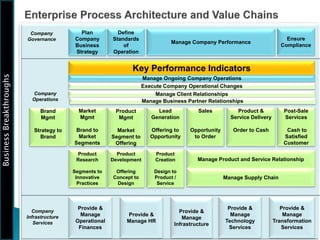
Manage Company Performance
Execute Company Operational Changes
Market
Mgmt
Brand to
Market
Segments
Manage Product and Service Relationship
Manage Supply Chain
Company
Infrastructure
Services
Manage Ongoing Company Operations
Manage Client Relationships
Provide &
Manage
Infrastructure
Ensure
Compliance
Define
Standards
of
Operation
Provide &
Manage
Transformation
Services
Product
Development
Offering
Concept to
Design
Product
Creation
Design to
Product /
Service
Manage Business Partner Relationships
Key Performance Indicators
Brand
Mgmt
Strategy to
Brand
Product
Research
Segments to
Innovative
Practices
Business
Breakthroughs
Product
Mgmt
Market
Segment to
Offering
Lead
Generation
Offering to
Opportunity
Sales
Opportunity
to Order
Product &
Service Delivery
Order to Cash
Post-Sale
Services
Cash to
Satisfied
Customer
Provide &
Manage
Operational
Finances
Provide &
Manage HR
Provide &
Manage
Technology
Services
Company
Governance
Company
Operations
Plan
Company
Business
Strategy
Manage Company Performance
Execute Company Operational Changes
Market
Mgmt
Brand to
Market
Segments
Manage Product and Service Relationship
Manage Supply Chain
Company
Infrastructure
Services
Manage Ongoing Company Operations
Manage Client Relationships
Provide &
Manage
Infrastructure
Ensure
Compliance
Define
Standards
of
Operation
Provide &
Manage
Transformation
Services
Product
Development
Offering
Concept to
Design
Product
Creation
Design to
Product /
Service
Manage Business Partner Relationships
Key Performance Indicators
Brand
Mgmt
Strategy to
Brand
Product
Research
Segments to
Innovative
Practices
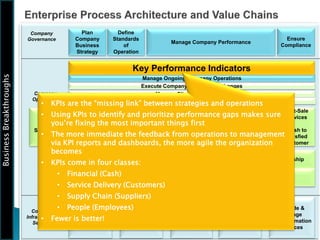
• KPIs are the “missing link” between strategies and operations
• Using KPIs to identify and prioritize performance gaps makes sure
you’re fixing the most important things first
• The more immediate the feedback from operations to management
via KPI reports and dashboards, the more agile the organization
becomes
• KPIs come in four classes:
• Financial (Cash)
• Service Delivery (Customers)
• Supply Chain (Suppliers)
• People (Employees)
• Fewer is better!
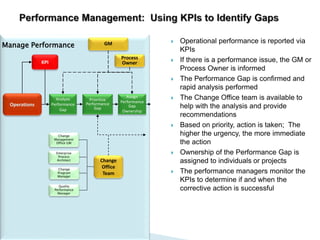
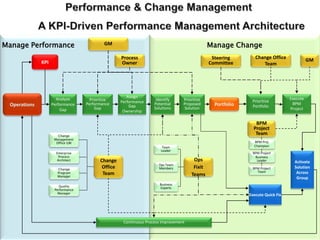
Manage Performance
 Operational performance is reported via
KPIs
 If there is a performance issue, the GM or
Process Owner is informed
 The Performance Gap is confirmed and
rapid analysis performed
 The Change Office team is available to
help with the analysis and provide
recommendations
 Based on priority, action is taken; The
higher the urgency, the more immediate
the action
 Ownership of the Performance Gap is
assigned to individuals or projects
 The performance managers monitor the
KPIs to determine if and when the
corrective action is successful
KPI
Quality
Performance
Manager
Change
Program
Manager
Change
Management
Office GM
Operations
Enterprise
Process
Architect
Prioritize
Performance
Gap
GM
Change
Office
Team
Analyze
Performance
Gap
Assign
Performance
Gap
Ownership
Process
Owner
Manage Change
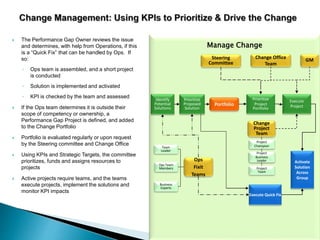
 The Performance Gap Owner reviews the issue
and determines, with help from Operations, if this
is a “Quick Fix” that can be handled by Ops. If
so:
◦ Ops team is assembled, and a short project
is conducted
◦ Solution is implemented and activated
◦ KPI is checked by the team and assessed
 If the Ops team determines it is outside their
scope of competency or ownership, a
Performance Gap Project is defined, and added
to the Change Portfolio
 Portfolio is evaluated regularly or upon request
by the Steering committee and Change Office
 Using KPIs and Strategic Targets, the committee
prioritizes, funds and assigns resources to
projects
 Active projects require teams, and the teams
execute projects, implement the solutions and
monitor KPI impacts
Ops
Fixit
Teams
Steering
Committee
Change
Project
Team
Prioritize
Proposed
Solution
Prioritize
Project
Portfolio
Identify
Potential
Solutions
Team
Leader
Ops Team
Members
Business
Experts
Activate
Solution
Across
Group
Execute Quick Fix
Change Office
Team
Portfolio
Project
Champion
Project
Business
Leader
Project
Team
GM
Execute
Project
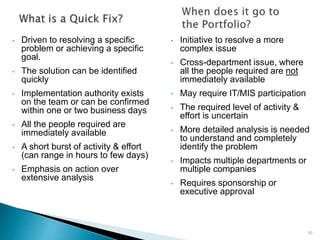
• Driven to resolving a specific
problem or achieving a specific
goal.
• The solution can be identified
quickly
• Implementation authority exists
on the team or can be confirmed
within one or two business days
• All the people required are
immediately available
• A short burst of activity & effort
(can range in hours to few days)
• Emphasis on action over
extensive analysis
• Initiative to resolve a more
complex issue
• Cross-department issue, where
all the people required are not
immediately available
• May require IT/MIS participation
• The required level of activity &
effort is uncertain
• More detailed analysis is needed
to understand and completely
identify the problem
• Impacts multiple departments or
multiple companies
• Requires sponsorship or
executive approval
10
Business
Breakthroughs
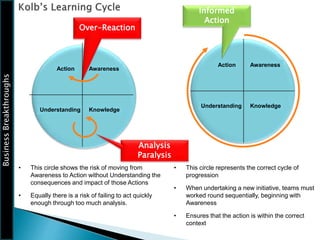
• This circle shows the risk of moving from
Awareness to Action without Understanding the
consequences and impact of those Actions
• Equally there is a risk of failing to act quickly
enough through too much analysis.
Awareness
Action
Knowledge
Understanding
Awareness
Action
Knowledge
Understanding
• This circle represents the correct cycle of
progression
• When undertaking a new initiative, teams must
worked round sequentially, beginning with
Awareness
• Ensures that the action is within the correct
context
Over-Reaction
Analysis
Paralysis
Informed
Action
Business
Breakthroughs
12
12
Move on
to Next
Issue
Improvement
Lifecycle
Identify Gaps
& Problems
Design
Solution
Confirm
Feasibility
Make
Changes
Celebrate
Success
Measure
KPI Results
Make this
the Standard
Document
Situation
Monitor
and Verify
Change
Start Here
Manage Change
Manage Performance
KPI
Quality
Performance
Manager
Change
Program
Manager
Change
Management
Office GM
Operations
Ops
Fixit
Teams
Steering
Committee
Enterprise
Process
Architect
Prioritize
Performance
Gap
BPM
Project
Team
Prioritize
Proposed
Solution
GM
Prioritize
Portfolio
Change
Office
Team
Analyze
Performance
Gap
Identify
Potential
Solutions
Team
Leader
Ops Team
Members
Business
Experts
Activate
Solution
Across
Group
Execute Quick Fix
Change Office
Team
Portfolio
BPM Proj
Champion
BPM Project
Business
Leader
BPM Project
Team
Assign
Performance
Gap
Ownership
GM
Process
Owner
Continuous Process Improvement
Execute
BPM
Project
Business
Breakthroughs
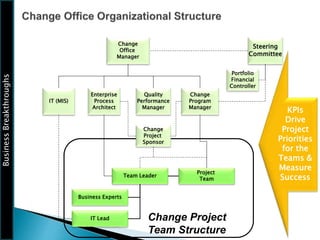
Steering
Committee
Change
Program
Manager
Change
Office
Manager
Enterprise
Process
Architect
Team Leader
Project
Team
Business Experts
IT Lead Change Project
Team Structure
IT (MIS)
Quality
Performance
Manager
Portfolio
Financial
Controller
Change
Project
Sponsor
KPIs
Drive
Project
Priorities
for the
Teams &
Measure
Success
Business
Breakthroughs
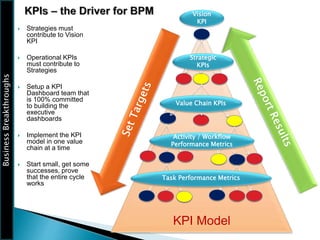
KPI Model
Vision
KPI
Strategic
KPIs
Value Chain KPIs
 Strategies must
contribute to Vision
KPI
 Operational KPIs
must contribute to
Strategies
 Setup a KPI
Dashboard team that
is 100% committed
to building the
executive
dashboards
 Implement the KPI
model in one value
chain at a time
 Start small, get some
successes, prove
that the entire cycle
works
Activity / Workflow
Performance Metrics
Task Performance Metrics
Business
Breakthroughs
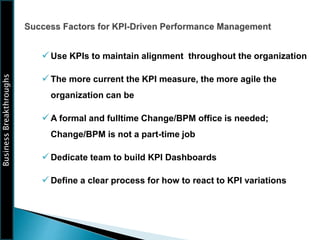
Use KPIs to maintain alignment throughout the organization
The more current the KPI measure, the more agile the
organization can be
A formal and fulltime Change/BPM office is needed;
Change/BPM is not a part-time job
Dedicate team to build KPI Dashboards
Define a clear process for how to react to KPI variations
Business Breakthroughs
Robert Osborne
Business Breakthroughs Inc.

A BPM Framework forKPI-Driven Performance Management.pptx

  • 1.
  • 2.
    Business Breakthroughs • Overview ofthe Enterprise Business Model and the Governance Layer • Performance and Change Management as the Link Between Governance and Operations • KPIs – the Strategic Gap Measure for BPM • Performance Management – from Discovery to Assignment • Change Management – from Assignment to Resolution • Quick Hits vs the BPM Portfolio – How to Choose the Path • Success Factors for Management Adoption
  • 3.
    Business Breakthroughs  Identify theChanges ◦ Confirm Strategic Goals ◦ Establish Change Office ◦ Build Enterprise Business Process Architecture ◦ Choose KPIs – Cash, Employees, Customers, Suppliers ◦ Identify BPM & Change Projects  Implement Changes through Projects ◦ Operate the Change Management Office  Facilitate Communication  Facilitate Change Projects  Support BPM Project Teams  Enable the teams to be successful ◦ Communicate Vision, Strategy and KPIs  Maintain Progress ◦ Promote communication across the people at every level ◦ Monitor KPIs and close performance gaps ◦ Build teams and capabilities for change Identify Goals, Gaps And Projects Prioritize, Guide and Execute Change Monitor, Measure & Celebrate
  • 4.
    Business Breakthroughs Complete Strategic Analysis andBuild Meta-Architecture Build Enterprise Business and Process Models Validate Architecture (Process, Function, KPI) Strategic Workshops & Prioritization KPI Model Strategic Initiatives, Gaps, and Quick Win Opportunities Change Project Portfolio Manage Change •Identity •Vision •Strategic Objectives •Existing documentation •Subject matter expert input •Value Reference Model (VRM) KPI Model Build KPI Model Input to Models Models
  • 5.
  • 6.
    Business Breakthroughs Product Mgmt Market Segment to Offering Lead Generation Offering to Opportunity Sales Opportunity toOrder Product & Service Delivery Order to Cash Post-Sale Services Cash to Satisfied Customer Provide & Manage Operational Finances Provide & Manage HR Provide & Manage Technology Services Company Governance Company Operations Plan Company Business Strategy Manage Company Performance Execute Company Operational Changes Market Mgmt Brand to Market Segments Manage Product and Service Relationship Manage Supply Chain Company Infrastructure Services Manage Ongoing Company Operations Manage Client Relationships Provide & Manage Infrastructure Ensure Compliance Define Standards of Operation Provide & Manage Transformation Services Product Development Offering Concept to Design Product Creation Design to Product / Service Manage Business Partner Relationships Key Performance Indicators Brand Mgmt Strategy to Brand Product Research Segments to Innovative Practices
  • 7.
    Business Breakthroughs Product Mgmt Market Segment to Offering Lead Generation Offering to Opportunity Sales Opportunity toOrder Product & Service Delivery Order to Cash Post-Sale Services Cash to Satisfied Customer Provide & Manage Operational Finances Provide & Manage HR Provide & Manage Technology Services Company Governance Company Operations Plan Company Business Strategy Manage Company Performance Execute Company Operational Changes Market Mgmt Brand to Market Segments Manage Product and Service Relationship Manage Supply Chain Company Infrastructure Services Manage Ongoing Company Operations Manage Client Relationships Provide & Manage Infrastructure Ensure Compliance Define Standards of Operation Provide & Manage Transformation Services Product Development Offering Concept to Design Product Creation Design to Product / Service Manage Business Partner Relationships Key Performance Indicators Brand Mgmt Strategy to Brand Product Research Segments to Innovative Practices • KPIs are the “missing link” between strategies and operations • Using KPIs to identify and prioritize performance gaps makes sure you’re fixing the most important things first • The more immediate the feedback from operations to management via KPI reports and dashboards, the more agile the organization becomes • KPIs come in four classes: • Financial (Cash) • Service Delivery (Customers) • Supply Chain (Suppliers) • People (Employees) • Fewer is better!
  • 8.
    Manage Performance  Operationalperformance is reported via KPIs  If there is a performance issue, the GM or Process Owner is informed  The Performance Gap is confirmed and rapid analysis performed  The Change Office team is available to help with the analysis and provide recommendations  Based on priority, action is taken; The higher the urgency, the more immediate the action  Ownership of the Performance Gap is assigned to individuals or projects  The performance managers monitor the KPIs to determine if and when the corrective action is successful KPI Quality Performance Manager Change Program Manager Change Management Office GM Operations Enterprise Process Architect Prioritize Performance Gap GM Change Office Team Analyze Performance Gap Assign Performance Gap Ownership Process Owner
  • 9.
    Manage Change  ThePerformance Gap Owner reviews the issue and determines, with help from Operations, if this is a “Quick Fix” that can be handled by Ops. If so: ◦ Ops team is assembled, and a short project is conducted ◦ Solution is implemented and activated ◦ KPI is checked by the team and assessed  If the Ops team determines it is outside their scope of competency or ownership, a Performance Gap Project is defined, and added to the Change Portfolio  Portfolio is evaluated regularly or upon request by the Steering committee and Change Office  Using KPIs and Strategic Targets, the committee prioritizes, funds and assigns resources to projects  Active projects require teams, and the teams execute projects, implement the solutions and monitor KPI impacts Ops Fixit Teams Steering Committee Change Project Team Prioritize Proposed Solution Prioritize Project Portfolio Identify Potential Solutions Team Leader Ops Team Members Business Experts Activate Solution Across Group Execute Quick Fix Change Office Team Portfolio Project Champion Project Business Leader Project Team GM Execute Project
  • 10.
    • Driven toresolving a specific problem or achieving a specific goal. • The solution can be identified quickly • Implementation authority exists on the team or can be confirmed within one or two business days • All the people required are immediately available • A short burst of activity & effort (can range in hours to few days) • Emphasis on action over extensive analysis • Initiative to resolve a more complex issue • Cross-department issue, where all the people required are not immediately available • May require IT/MIS participation • The required level of activity & effort is uncertain • More detailed analysis is needed to understand and completely identify the problem • Impacts multiple departments or multiple companies • Requires sponsorship or executive approval 10
  • 11.
    Business Breakthroughs • This circleshows the risk of moving from Awareness to Action without Understanding the consequences and impact of those Actions • Equally there is a risk of failing to act quickly enough through too much analysis. Awareness Action Knowledge Understanding Awareness Action Knowledge Understanding • This circle represents the correct cycle of progression • When undertaking a new initiative, teams must worked round sequentially, beginning with Awareness • Ensures that the action is within the correct context Over-Reaction Analysis Paralysis Informed Action
  • 12.
    Business Breakthroughs 12 12 Move on to Next Issue Improvement Lifecycle IdentifyGaps & Problems Design Solution Confirm Feasibility Make Changes Celebrate Success Measure KPI Results Make this the Standard Document Situation Monitor and Verify Change Start Here
  • 13.
    Manage Change Manage Performance KPI Quality Performance Manager Change Program Manager Change Management OfficeGM Operations Ops Fixit Teams Steering Committee Enterprise Process Architect Prioritize Performance Gap BPM Project Team Prioritize Proposed Solution GM Prioritize Portfolio Change Office Team Analyze Performance Gap Identify Potential Solutions Team Leader Ops Team Members Business Experts Activate Solution Across Group Execute Quick Fix Change Office Team Portfolio BPM Proj Champion BPM Project Business Leader BPM Project Team Assign Performance Gap Ownership GM Process Owner Continuous Process Improvement Execute BPM Project
  • 14.
    Business Breakthroughs Steering Committee Change Program Manager Change Office Manager Enterprise Process Architect Team Leader Project Team Business Experts ITLead Change Project Team Structure IT (MIS) Quality Performance Manager Portfolio Financial Controller Change Project Sponsor KPIs Drive Project Priorities for the Teams & Measure Success
  • 15.
    Business Breakthroughs KPI Model Vision KPI Strategic KPIs Value ChainKPIs  Strategies must contribute to Vision KPI  Operational KPIs must contribute to Strategies  Setup a KPI Dashboard team that is 100% committed to building the executive dashboards  Implement the KPI model in one value chain at a time  Start small, get some successes, prove that the entire cycle works Activity / Workflow Performance Metrics Task Performance Metrics
  • 16.
    Business Breakthroughs Use KPIs tomaintain alignment throughout the organization The more current the KPI measure, the more agile the organization can be A formal and fulltime Change/BPM office is needed; Change/BPM is not a part-time job Dedicate team to build KPI Dashboards Define a clear process for how to react to KPI variations
  • 17.