Dr. Wegdan Hagag
 Chapter 1: The scope and challenge of
international marketing
 Chapter 4: Cultural dynamic in assessing
global markets
 Chapter 8: Developing a global vision through
marketing research
 Chapter 11: Global marketing management:
planning and organization
 Chapter 12: Product and services for
consumers
 Chapter 14: International marketing channels
 Chapter 18: Pricing for international markets
 Attendance 10%
 Course work 20% (submission deadline is the
1st of May)
 Midterm exam: 20%
 Final exam 50%
 Assume you are an international marketer
and you have to market a specific product
globally (select any product, and identify the
global market to penetrate with your product,
mention why)
 Identify any controllable and uncontrollable
elements you are expecting to face in the new
market.
 Prepare cultural analysis for your potential
market.
 What type of method you may apply to
research your potential market
 How you may plan for entering your new
market and what is the entering strategy you
may adapt
 What is the marketing channel you may use
to market your product internationally.
 International marketing definition:
Business activities deigned to plan, price,
promote and direct the flow of goods and
services to consumers in more than one
nation for profit.
 Difference of definition of domestic and
international marketing:
 Marketing environment (more than one
country)
 Complexity and diversity of marketing
operation.
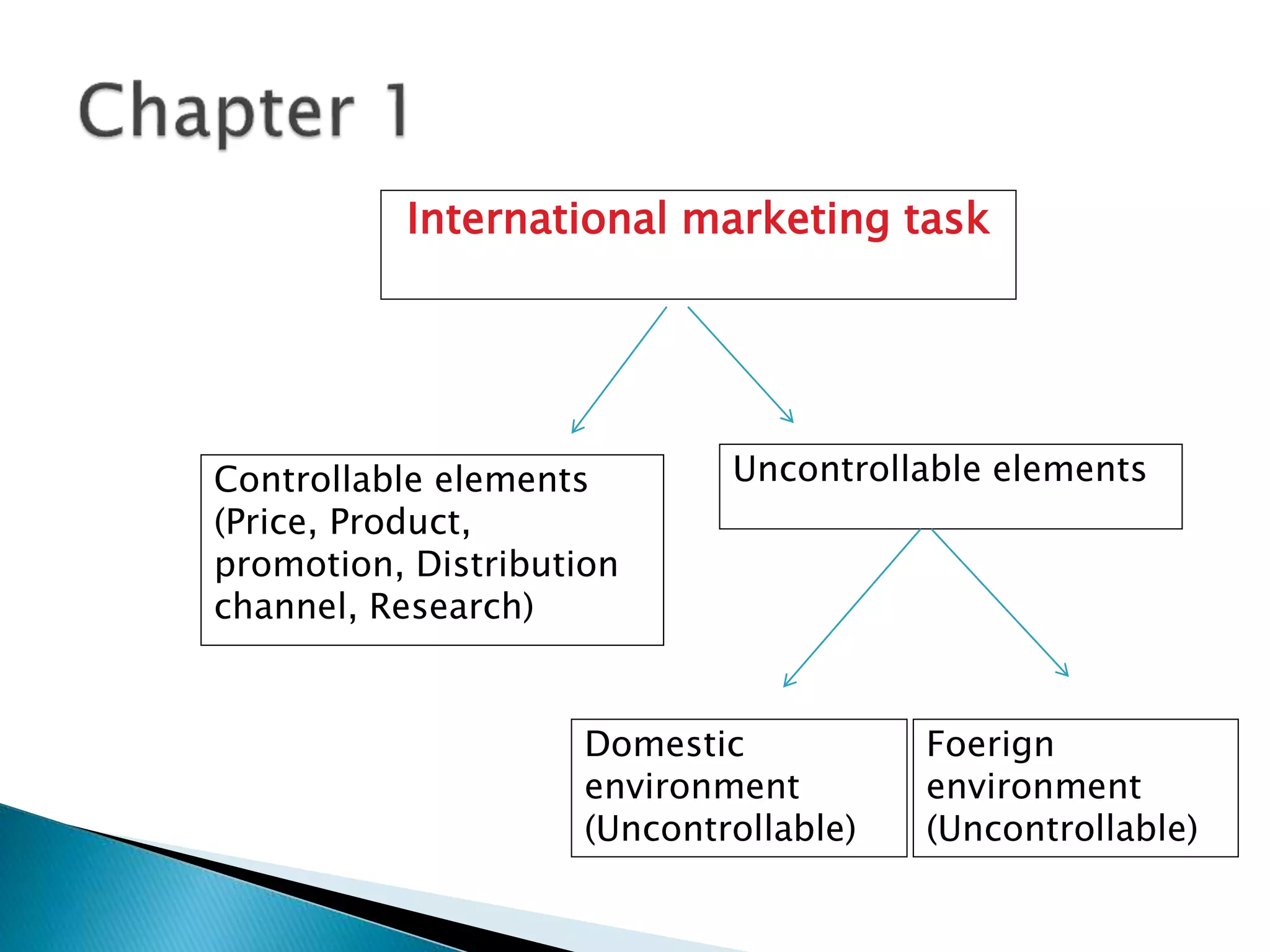
International marketing task
Controllable elements
(Price, Product,
promotion, Distribution
channel, Research)
Uncontrollable elements
Domestic
environment
(Uncontrollable)
Foerign
environment
(Uncontrollable)
 Controllable elements
Can be anticipated based on demand variation
Can be altered in the long run
Can be adjusted in the short run based on the
marketing conditions
 Uncontrollable elements
 Domestic environment (uncontrollable):
Home-country elements that can have a direct
effect on the success of foreign trade such as:
Political/legal (USA restrictions to trade with
Iraq)
Economic climate (restrictions against foreign
purchasing or investments)
Competitive forces (Kodak and Fuji film)
 Uncontrollable elements
 Foreign environment (uncontrollable):
The process of evaluating uncertainties in
foreign markets. This includes political,
economic, competitive, cultural,
infrastructure/ Geography and technology.
Example: Registration with China government.
Coca-Cola in India
 Dealing with uncontrollable elements requires
environmental adaptation
 Cross- cultural adjustments
 Example: empty beach in tourism ads.
 Meaning of words across countries (circle
with finger example)
 Developing global awareness
To be global aware is to have:
1. Tolerance of cultural differences (accepting
to work with others whose behavior may be
different from yours due to cultural
variation)
2. Knowledge of culture, history, social and
political trends in foreign markets
 Global awareness approaches:
1. Personal relationships in other countries
2. Successful long-term business
relationships with foreign customers
3. Foreign agents and partners
4. Having a culturally diverse senior executive
staff or board of directors
 Degree of international marketing
involvement:
Should be based on study and research of
1. Marketing potential
2. Company capabilities
 Factors that faster internationalization
1. Companies with high technology or excess
capacity and resources
2. Smaller home market and larger production
3. Firms with key managers having well
network.
 Stages of international marketing involvement
Not necessary to be in liner order.
 No direct foreign market
 Do not directly reach customers outside
home borders
 Products reach global markets without the
knowledge of the producers via:
1. Domestic wholesalers
2. Distributors
 Infrequent foreign marketing
 Infrequent and temporary marketing sales
overseas due to variation in demand or
production level
 Little or no intention to maintain continuous
market representation
 Foreign sales decrease or withdraws due to
domestic sales increase
 No changes is made to the product line
 Few companies fit this model today. Why?
 Regular Foreign Market
 Permanent commitment to produce at foreign
markets
 Companies may employ foreign or domestic
overseas intermediaries or have it’s own sales
distributors
 Aim is to serve foreign market needs
 Companies start to depend on foreign sales
instead of just considering it bonus beside
domestic profit.
 International marketing
 Fully committed to international marketing
 Seeks market allover the world
 Production are planned for market in various
countries
 Separate lines are directed to different
countries
 Global market
 Different between international marketing
and global market?
 Company orientation toward markets and
planning activities.
 Market orientation: treating home and world
market as one market
 Planning activities: Segmentation decision is
no longer based on national boarders instead
segmentation is based on income
 Managers strategic orientation toward
international marketing involvement
 Domestic market extension orientation
 International operation is viewed as a
secondary and extension of domestic
operation
 Firms remain basically domestic
 Very profitable
 Multidomestic market orientation
 Believes that market is different and each
market needs a separate approach
 Follow market on a country to country basic
 Uses separate marketing strategy
 Advertising campaign is localized
 Global market orientation
 Generally referred to a global company
 Marketing activity is global and the market
coverage is the world
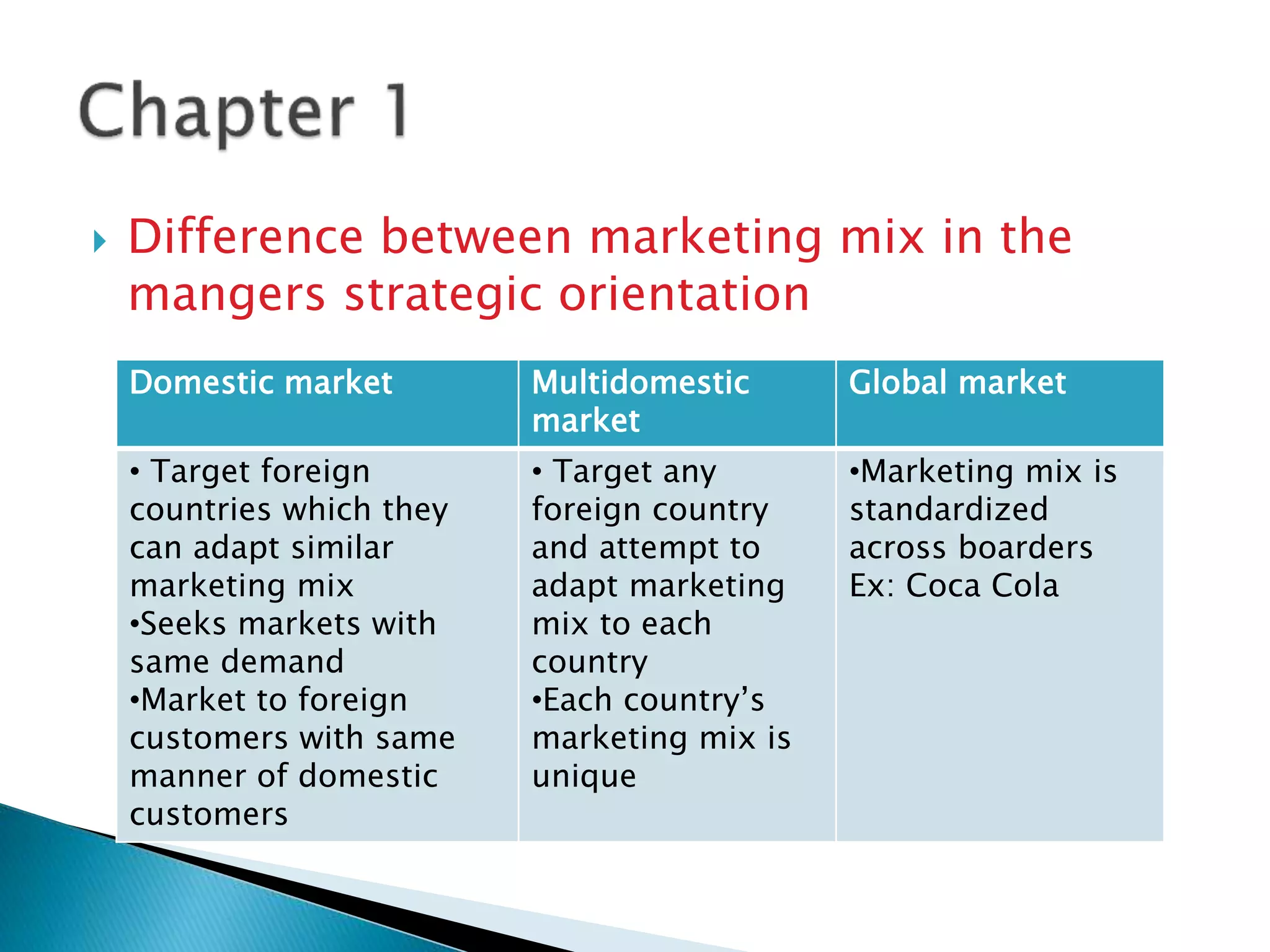
 Difference between marketing mix in the
mangers strategic orientation
Domestic market Multidomestic
market
Global market
• Target foreign
countries which they
can adapt similar
marketing mix
•Seeks markets with
same demand
•Market to foreign
customers with same
manner of domestic
customers
• Target any
foreign country
and attempt to
adapt marketing
mix to each
country
•Each country’s
marketing mix is
unique
•Marketing mix is
standardized
across boarders
Ex: Coca Cola

01

  • 1.
  • 2.
     Chapter 1:The scope and challenge of international marketing  Chapter 4: Cultural dynamic in assessing global markets  Chapter 8: Developing a global vision through marketing research  Chapter 11: Global marketing management: planning and organization  Chapter 12: Product and services for consumers
  • 3.
     Chapter 14:International marketing channels  Chapter 18: Pricing for international markets  Attendance 10%  Course work 20% (submission deadline is the 1st of May)  Midterm exam: 20%  Final exam 50%
  • 4.
     Assume youare an international marketer and you have to market a specific product globally (select any product, and identify the global market to penetrate with your product, mention why)  Identify any controllable and uncontrollable elements you are expecting to face in the new market.  Prepare cultural analysis for your potential market.
  • 5.
     What typeof method you may apply to research your potential market  How you may plan for entering your new market and what is the entering strategy you may adapt  What is the marketing channel you may use to market your product internationally.
  • 6.
     International marketingdefinition: Business activities deigned to plan, price, promote and direct the flow of goods and services to consumers in more than one nation for profit.  Difference of definition of domestic and international marketing:  Marketing environment (more than one country)  Complexity and diversity of marketing operation.
  • 7.
    International marketing task Controllableelements (Price, Product, promotion, Distribution channel, Research) Uncontrollable elements Domestic environment (Uncontrollable) Foerign environment (Uncontrollable)
  • 8.
     Controllable elements Canbe anticipated based on demand variation Can be altered in the long run Can be adjusted in the short run based on the marketing conditions
  • 9.
     Uncontrollable elements Domestic environment (uncontrollable): Home-country elements that can have a direct effect on the success of foreign trade such as: Political/legal (USA restrictions to trade with Iraq) Economic climate (restrictions against foreign purchasing or investments) Competitive forces (Kodak and Fuji film)
  • 10.
     Uncontrollable elements Foreign environment (uncontrollable): The process of evaluating uncertainties in foreign markets. This includes political, economic, competitive, cultural, infrastructure/ Geography and technology. Example: Registration with China government. Coca-Cola in India
  • 11.
     Dealing withuncontrollable elements requires environmental adaptation  Cross- cultural adjustments  Example: empty beach in tourism ads.  Meaning of words across countries (circle with finger example)
  • 12.
     Developing globalawareness To be global aware is to have: 1. Tolerance of cultural differences (accepting to work with others whose behavior may be different from yours due to cultural variation) 2. Knowledge of culture, history, social and political trends in foreign markets
  • 13.
     Global awarenessapproaches: 1. Personal relationships in other countries 2. Successful long-term business relationships with foreign customers 3. Foreign agents and partners 4. Having a culturally diverse senior executive staff or board of directors
  • 14.
     Degree ofinternational marketing involvement: Should be based on study and research of 1. Marketing potential 2. Company capabilities  Factors that faster internationalization 1. Companies with high technology or excess capacity and resources 2. Smaller home market and larger production 3. Firms with key managers having well network.
  • 15.
     Stages ofinternational marketing involvement Not necessary to be in liner order.  No direct foreign market  Do not directly reach customers outside home borders  Products reach global markets without the knowledge of the producers via: 1. Domestic wholesalers 2. Distributors
  • 16.
     Infrequent foreignmarketing  Infrequent and temporary marketing sales overseas due to variation in demand or production level  Little or no intention to maintain continuous market representation  Foreign sales decrease or withdraws due to domestic sales increase  No changes is made to the product line  Few companies fit this model today. Why?
  • 17.
     Regular ForeignMarket  Permanent commitment to produce at foreign markets  Companies may employ foreign or domestic overseas intermediaries or have it’s own sales distributors  Aim is to serve foreign market needs  Companies start to depend on foreign sales instead of just considering it bonus beside domestic profit.
  • 18.
     International marketing Fully committed to international marketing  Seeks market allover the world  Production are planned for market in various countries  Separate lines are directed to different countries
  • 19.
     Global market Different between international marketing and global market?  Company orientation toward markets and planning activities.  Market orientation: treating home and world market as one market  Planning activities: Segmentation decision is no longer based on national boarders instead segmentation is based on income
  • 20.
     Managers strategicorientation toward international marketing involvement  Domestic market extension orientation  International operation is viewed as a secondary and extension of domestic operation  Firms remain basically domestic  Very profitable
  • 21.
     Multidomestic marketorientation  Believes that market is different and each market needs a separate approach  Follow market on a country to country basic  Uses separate marketing strategy  Advertising campaign is localized
  • 22.
     Global marketorientation  Generally referred to a global company  Marketing activity is global and the market coverage is the world
  • 23.
     Difference betweenmarketing mix in the mangers strategic orientation Domestic market Multidomestic market Global market • Target foreign countries which they can adapt similar marketing mix •Seeks markets with same demand •Market to foreign customers with same manner of domestic customers • Target any foreign country and attempt to adapt marketing mix to each country •Each country’s marketing mix is unique •Marketing mix is standardized across boarders Ex: Coca Cola