Using Personality Test for
               Personnel Selection

                                                   Cornelius J. König
                                                     Saarland University

with some slides from Neil Christiansen, Central Michigan University, USA

                         Cornelius König
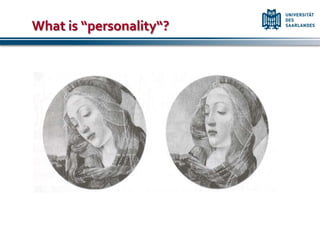
What is “personality“?
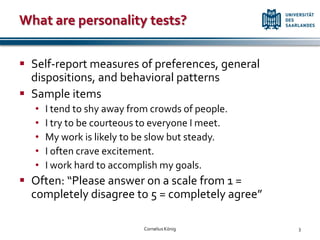
What are personality tests?


 Self-report measures of preferences, general
  dispositions, and behavioral patterns
 Sample items
   •   I tend to shy away from crowds of people.
   •   I try to be courteous to everyone I meet.
   •   My work is likely to be slow but steady.
   •   I often crave excitement.
   •   I work hard to accomplish my goals.
 Often: “Please answer on a scale from 1 =
  completely disagree to 5 = completely agree”

                             Cornelius König       3
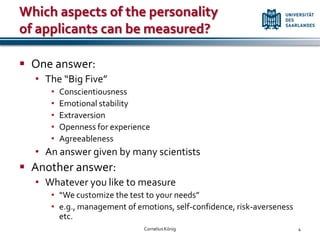
Which aspects of the personality
of applicants can be measured?

 One answer:
  • The “Big Five”
     •   Conscientiousness
     •   Emotional stability
     •   Extraversion
     •   Openness for experience
     •   Agreeableness
  • An answer given by many scientists
 Another answer:
  • Whatever you like to measure
     • “We customize the test to your needs”
     • e.g., management of emotions, self-confidence, risk-averseness
       etc.
                              Cornelius König                           4
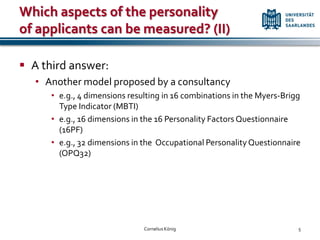
Which aspects of the personality
of applicants can be measured? (II)

 A third answer:
   • Another model proposed by a consultancy
      • e.g., 4 dimensions resulting in 16 combinations in the Myers-Brigg
        Type Indicator (MBTI)
      • e.g., 16 dimensions in the 16 Personality Factors Questionnaire
        (16PF)
      • e.g., 32 dimensions in the Occupational Personality Questionnaire
        (OPQ32)


                               Cornelius König                           5
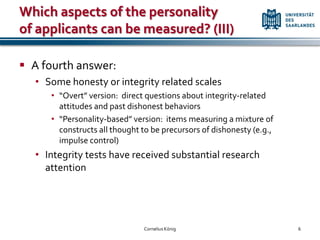
Which aspects of the personality
of applicants can be measured? (III)

 A fourth answer:
  • Some honesty or integrity related scales
     • “Overt” version: direct questions about integrity-related
       attitudes and past dishonest behaviors
     • “Personality-based” version: items measuring a mixture of
       constructs all thought to be precursors of dishonesty (e.g.,
       impulse control)
  • Integrity tests have received substantial research
    attention


                              Cornelius König                         6
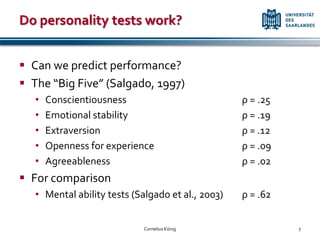
Do personality tests work?


 Can we predict performance?
 The “Big Five” (Salgado, 1997)
   •   Conscientiousness                           ρ = .25
   •   Emotional stability                         ρ = .19
   •   Extraversion                                ρ = .12
   •   Openness for experience                     ρ = .09
   •   Agreeableness                               ρ = .02
 For comparison
   • Mental ability tests (Salgado et al., 2003)   ρ = .62


                             Cornelius König                 7
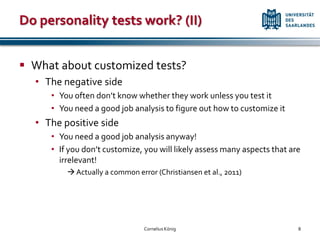
Do personality tests work? (II)


 What about customized tests?
  • The negative side
     • You often don’t know whether they work unless you test it
     • You need a good job analysis to figure out how to customize it
  • The positive side
     • You need a good job analysis anyway!
     • If you don’t customize, you will likely assess many aspects that are
       irrelevant!
          Actually a common error (Christiansen et al., 2011)


                                Cornelius König                           8
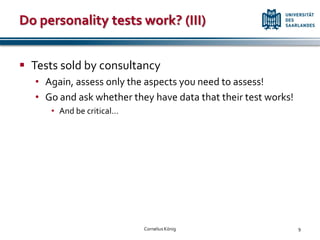
Do personality tests work? (III)


 Tests sold by consultancy
   • Again, assess only the aspects you need to assess!
   • Go and ask whether they have data that their test works!
      • And be critical…


                           Cornelius König                      9
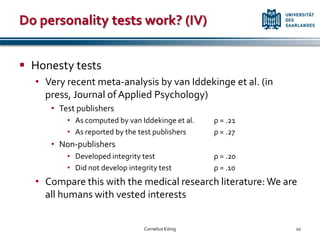
Do personality tests work? (IV)


 Honesty tests
  • Very recent meta-analysis by van Iddekinge et al. (in
    press, Journal of Applied Psychology)
     • Test publishers
         • As computed by van Iddekinge et al.    ρ = .21
         • As reported by the test publishers     ρ = .27
     • Non-publishers
         • Developed integrity test               ρ = .20
         • Did not develop integrity test         ρ = .10
  • Compare this with the medical research literature: We are
    all humans with vested interests


                                Cornelius König             10
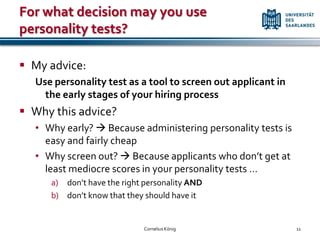
For what decision may you use
personality tests?

 My advice:
  Use personality test as a tool to screen out applicant in
    the early stages of your hiring process
 Why this advice?
  • Why early?  Because administering personality tests is
    easy and fairly cheap
  • Why screen out?  Because applicants who don’t get at
    least mediocre scores in your personality tests …
     a) don’t have the right personality AND
     b) don’t know that they should have it


                            Cornelius König                   11
Should you worry that applicants fake?


 Some research findings
  1. People can easily fake if instructed to do so
  2. A considerable number of applicant will fake
     •   But not all
     •   Maybe a bit less in Europe than in the US and in China
  3. Empirically, faking doesn’t seem to be very problematic
     •   “Faking” = actually appropriate self-presentation? Or maybe
         even a skill?


                              Cornelius König                          12
Might you encounter problems if
you use personality tests?

 Applicant reactions
   • Nikolaou & Judge (2007): personality tests are perceived
     as “okay”
      • Other selection tools are better, other tools are worse
 Legal problems
   • Especially likely if the items are work-related
      • Work-related items also work better
      • Plus: participants like them better


                               Cornelius König                    13
Common traps


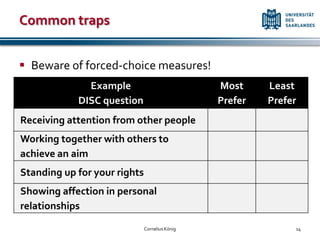
 Beware of forced-choice measures!
              Example                           Most     Least
            DISC question                       Prefer   Prefer
Receiving attention from other people
Working together with others to
achieve an aim
Standing up for your rights
Showing affection in personal
relationships
                              Cornelius König                 14
What’s the problem with
forced-choice tests?

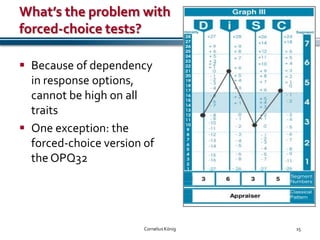
 Because of dependency
  in response options,
  cannot be high on all
  traits
 One exception: the
  forced-choice version of
  the OPQ32


                        Cornelius König   15
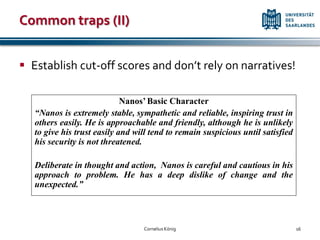
Common traps (II)


 Establish cut-off scores and don’t rely on narratives!

                             Nanos’ Basic Character
   “Nanos is extremely stable, sympathetic and reliable, inspiring trust in
   others easily. He is approachable and friendly, although he is unlikely
   to give his trust easily and will tend to remain suspicious until satisfied
   his security is not threatened.

   Deliberate in thought and action, Nanos is careful and cautious in his
   approach to problem. He has a deep dislike of change and the
   unexpected.”


                                  Cornelius König                                16
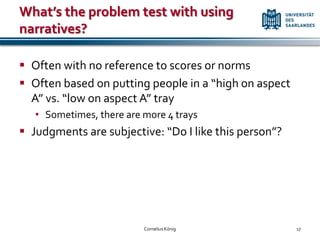
What’s the problem test with using
narratives?

 Often with no reference to scores or norms
 Often based on putting people in a “high on aspect
  A” vs. “low on aspect A” tray
   • Sometimes, there are more 4 trays
 Judgments are subjective: “Do I like this person”?


                          Cornelius König              17
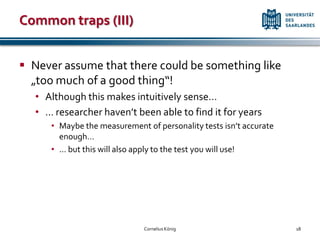
Common traps (III)


 Never assume that there could be something like
  „too much of a good thing“!
  • Although this makes intuitively sense…
  • … researcher haven’t been able to find it for years
     • Maybe the measurement of personality tests isn’t accurate
       enough…
     • … but this will also apply to the test you will use!


                             Cornelius König                       18
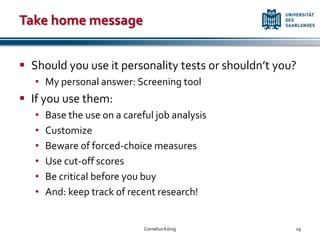
Take home message


 Should you use it personality tests or shouldn’t you?
   • My personal answer: Screening tool
 If you use them:
   •   Base the use on a careful job analysis
   •   Customize
   •   Beware of forced-choice measures
   •   Use cut-off scores
   •   Be critical before you buy
   •   And: keep track of recent research!


                              Cornelius König         19
Thank you
for your attention


                    Cornelius König
          ckoenig@mx.uni-saarland.de


                                       20

Konig

  • 1.
    Using Personality Testfor Personnel Selection Cornelius J. König Saarland University with some slides from Neil Christiansen, Central Michigan University, USA Cornelius König
  • 2.
  • 3.
    What are personalitytests?  Self-report measures of preferences, general dispositions, and behavioral patterns  Sample items • I tend to shy away from crowds of people. • I try to be courteous to everyone I meet. • My work is likely to be slow but steady. • I often crave excitement. • I work hard to accomplish my goals.  Often: “Please answer on a scale from 1 = completely disagree to 5 = completely agree” Cornelius König 3
  • 4.
    Which aspects ofthe personality of applicants can be measured?  One answer: • The “Big Five” • Conscientiousness • Emotional stability • Extraversion • Openness for experience • Agreeableness • An answer given by many scientists  Another answer: • Whatever you like to measure • “We customize the test to your needs” • e.g., management of emotions, self-confidence, risk-averseness etc. Cornelius König 4
  • 5.
    Which aspects ofthe personality of applicants can be measured? (II)  A third answer: • Another model proposed by a consultancy • e.g., 4 dimensions resulting in 16 combinations in the Myers-Brigg Type Indicator (MBTI) • e.g., 16 dimensions in the 16 Personality Factors Questionnaire (16PF) • e.g., 32 dimensions in the Occupational Personality Questionnaire (OPQ32) Cornelius König 5
  • 6.
    Which aspects ofthe personality of applicants can be measured? (III)  A fourth answer: • Some honesty or integrity related scales • “Overt” version: direct questions about integrity-related attitudes and past dishonest behaviors • “Personality-based” version: items measuring a mixture of constructs all thought to be precursors of dishonesty (e.g., impulse control) • Integrity tests have received substantial research attention Cornelius König 6
  • 7.
    Do personality testswork?  Can we predict performance?  The “Big Five” (Salgado, 1997) • Conscientiousness ρ = .25 • Emotional stability ρ = .19 • Extraversion ρ = .12 • Openness for experience ρ = .09 • Agreeableness ρ = .02  For comparison • Mental ability tests (Salgado et al., 2003) ρ = .62 Cornelius König 7
  • 8.
    Do personality testswork? (II)  What about customized tests? • The negative side • You often don’t know whether they work unless you test it • You need a good job analysis to figure out how to customize it • The positive side • You need a good job analysis anyway! • If you don’t customize, you will likely assess many aspects that are irrelevant!  Actually a common error (Christiansen et al., 2011) Cornelius König 8
  • 9.
    Do personality testswork? (III)  Tests sold by consultancy • Again, assess only the aspects you need to assess! • Go and ask whether they have data that their test works! • And be critical… Cornelius König 9
  • 10.
    Do personality testswork? (IV)  Honesty tests • Very recent meta-analysis by van Iddekinge et al. (in press, Journal of Applied Psychology) • Test publishers • As computed by van Iddekinge et al. ρ = .21 • As reported by the test publishers ρ = .27 • Non-publishers • Developed integrity test ρ = .20 • Did not develop integrity test ρ = .10 • Compare this with the medical research literature: We are all humans with vested interests Cornelius König 10
  • 11.
    For what decisionmay you use personality tests?  My advice: Use personality test as a tool to screen out applicant in the early stages of your hiring process  Why this advice? • Why early?  Because administering personality tests is easy and fairly cheap • Why screen out?  Because applicants who don’t get at least mediocre scores in your personality tests … a) don’t have the right personality AND b) don’t know that they should have it Cornelius König 11
  • 12.
    Should you worrythat applicants fake?  Some research findings 1. People can easily fake if instructed to do so 2. A considerable number of applicant will fake • But not all • Maybe a bit less in Europe than in the US and in China 3. Empirically, faking doesn’t seem to be very problematic • “Faking” = actually appropriate self-presentation? Or maybe even a skill? Cornelius König 12
  • 13.
    Might you encounterproblems if you use personality tests?  Applicant reactions • Nikolaou & Judge (2007): personality tests are perceived as “okay” • Other selection tools are better, other tools are worse  Legal problems • Especially likely if the items are work-related • Work-related items also work better • Plus: participants like them better Cornelius König 13
  • 14.
    Common traps  Bewareof forced-choice measures! Example Most Least DISC question Prefer Prefer Receiving attention from other people Working together with others to achieve an aim Standing up for your rights Showing affection in personal relationships Cornelius König 14
  • 15.
    What’s the problemwith forced-choice tests?  Because of dependency in response options, cannot be high on all traits  One exception: the forced-choice version of the OPQ32 Cornelius König 15
  • 16.
    Common traps (II) Establish cut-off scores and don’t rely on narratives! Nanos’ Basic Character “Nanos is extremely stable, sympathetic and reliable, inspiring trust in others easily. He is approachable and friendly, although he is unlikely to give his trust easily and will tend to remain suspicious until satisfied his security is not threatened. Deliberate in thought and action, Nanos is careful and cautious in his approach to problem. He has a deep dislike of change and the unexpected.” Cornelius König 16
  • 17.
    What’s the problemtest with using narratives?  Often with no reference to scores or norms  Often based on putting people in a “high on aspect A” vs. “low on aspect A” tray • Sometimes, there are more 4 trays  Judgments are subjective: “Do I like this person”? Cornelius König 17
  • 18.
    Common traps (III) Never assume that there could be something like „too much of a good thing“! • Although this makes intuitively sense… • … researcher haven’t been able to find it for years • Maybe the measurement of personality tests isn’t accurate enough… • … but this will also apply to the test you will use! Cornelius König 18
  • 19.
    Take home message Should you use it personality tests or shouldn’t you? • My personal answer: Screening tool  If you use them: • Base the use on a careful job analysis • Customize • Beware of forced-choice measures • Use cut-off scores • Be critical before you buy • And: keep track of recent research! Cornelius König 19
  • 20.
    Thank you for yourattention Cornelius König ckoenig@mx.uni-saarland.de 20