
Technology in
Employee Recruitment
and Selection
Ioannis Nikolaou
School of Business
Department of Management Science & Technology
twitter@nikolaou
inikol@aueb.gr
Technology in Employee Recruitment &
Selection
• The role of technology in the recruitment cycle
• Critical issues
• Theoretical considerations
• Ideas for future research
2
Recruitment
Screening
Selection
The "day
after"
Technology in Recruitment
3
Internet-based Recruitment
Applicant Tracking Systems (ATS)
Video CVs
Internet-based Recruitment
• Company Career Sites
– Enriched content, data and applicant tracking
• Job Boards
– More interactive, increased applicants’ attention
and credibility
• Social Networking Websites (SNWs)
– A whole new world…
4
Internet-based Recruitment & SNWs
• Increased interaction between candidates and
employers
• Approaching passive candidates / poaching (Nikolaou, 2014)
• Excessive usage numbers by both recruiters and job-
seekers
• Constantly increasing research attention, but
generally, an area where research still tries to catch
up practice (e.g. Kluemper et al., 2012; Van Iddekinge et al, 2016; Roth et al., 2013)
• Applicant reactions & employer branding (e.g.
Glassdoor.com)
5
Applicant Tracking Systems (ATS)
• Cloud-based applications managing the
administration of the recruitment process
– Cheap and efficient
• Linked with job-boards, SNWs, on-line
application forms, career sites, etc.
– Effective use of HR Metrics, e.g. success rates,
time-to-hire, recruitment sources effectiveness,
etc.
6
Video CVs
• Candidates’ self-presentation replacing
traditional resumes
• Increasing usage numbers and research
attention, especially in relation to diversity /
discrimination issues, applicant reactions &
equivalence with traditional resumes (e.g. Hiemstra &
Derous, 2015)
7
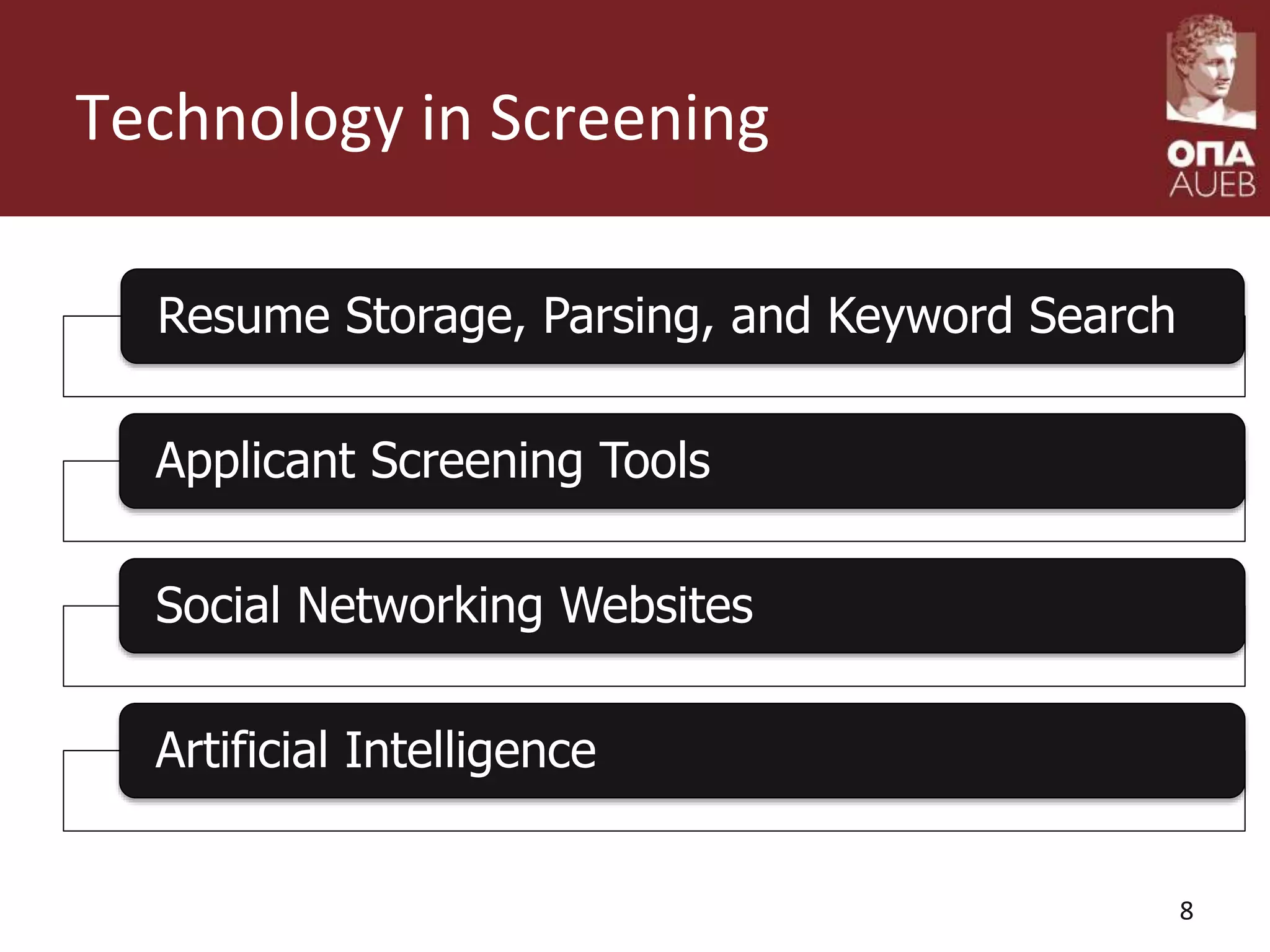
Technology in Screening
8
Resume Storage, Parsing, and Keyword Search
Applicant Screening Tools
Social Networking Websites
Artificial Intelligence
Resume Storage, Parsing, and
Keyword Search
• Large storage databases combined with ATS &
candidates’ social media profiles
• Effective resume management and resume
parsing tools (e.g. keyword searching and
profile matching)
• Data mining techniques and machine
translation technologies used to elicit
information on candidates
9
Applicant Screening Tools
• The good-old Weighted Application Blanks
– Candidates provide info on work / education
history, qualifications, licenses, certifications, etc.
– Measurable and quantifiable info
– Pressure to keep content brief
– May be linked with SNWs candidates’ profile (e.g.
retrieving candidates’ info from their LinkedIn
profiles)
10
Social Networking Websites in screening
• Used often in combination with candidates’
info (e.g. resume, application)
– Important ethical / privacy concerns and
discrimination / adverse impact issues
– Limited research on how recruiters use this info,
especially in combination with other info (e.g.
assessment)
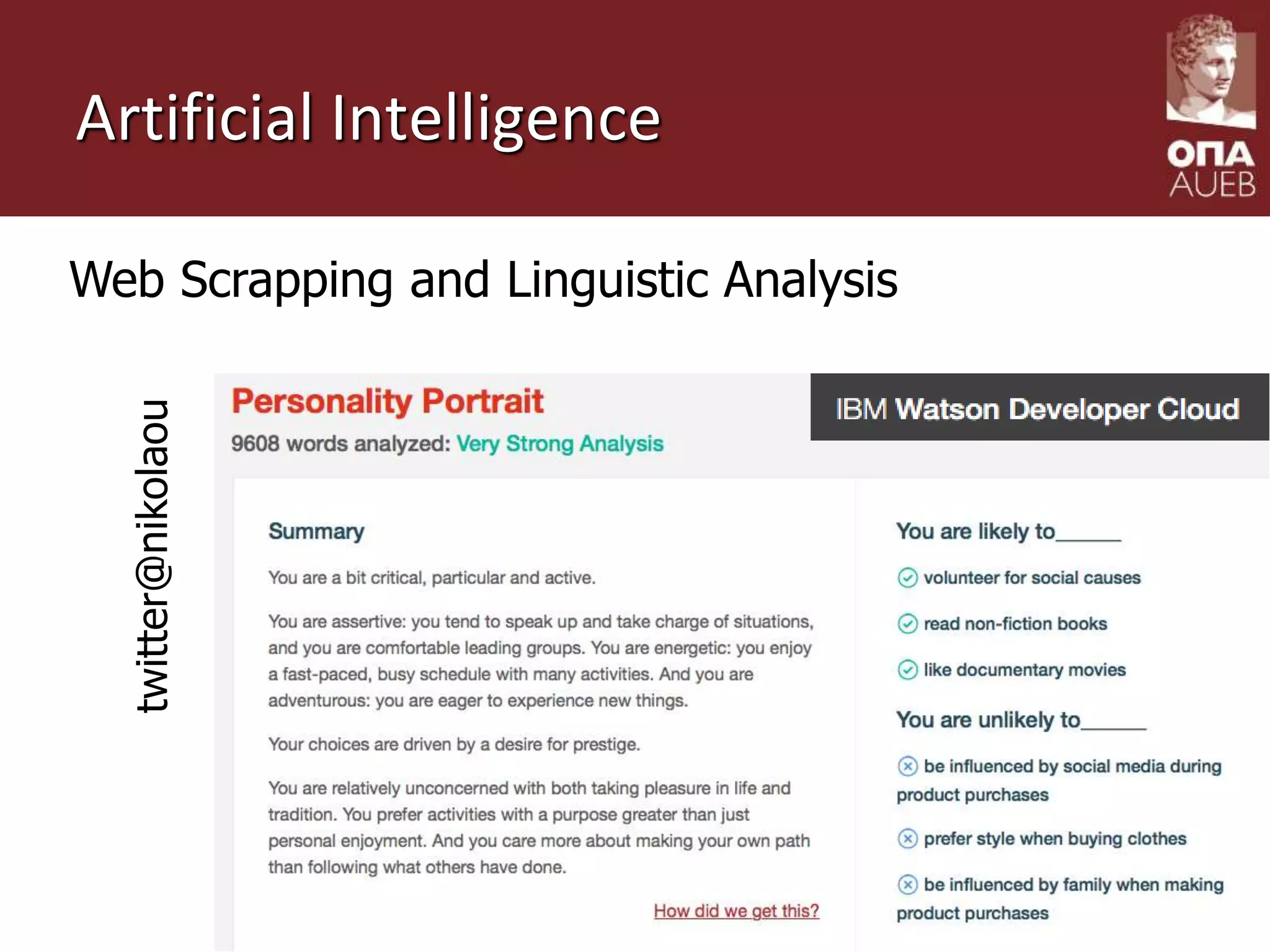
• Social Media Analytics & Web Scrapping
11
SNWs, Social Media Analytics and
Web Scraping
• FB activity related to demographic,
personality, attitudinal, and cognitive ability
variables
– Web scrapping opportunities in hiring
•Initial findings re personality (Big5), gender, religious
identity, age and intelligence
•However, do these provide any real value
above/beyond existing methods?
12
Artificial Intelligence
13
Web Scrapping and Linguistic Analysis
twitter@nikolaou
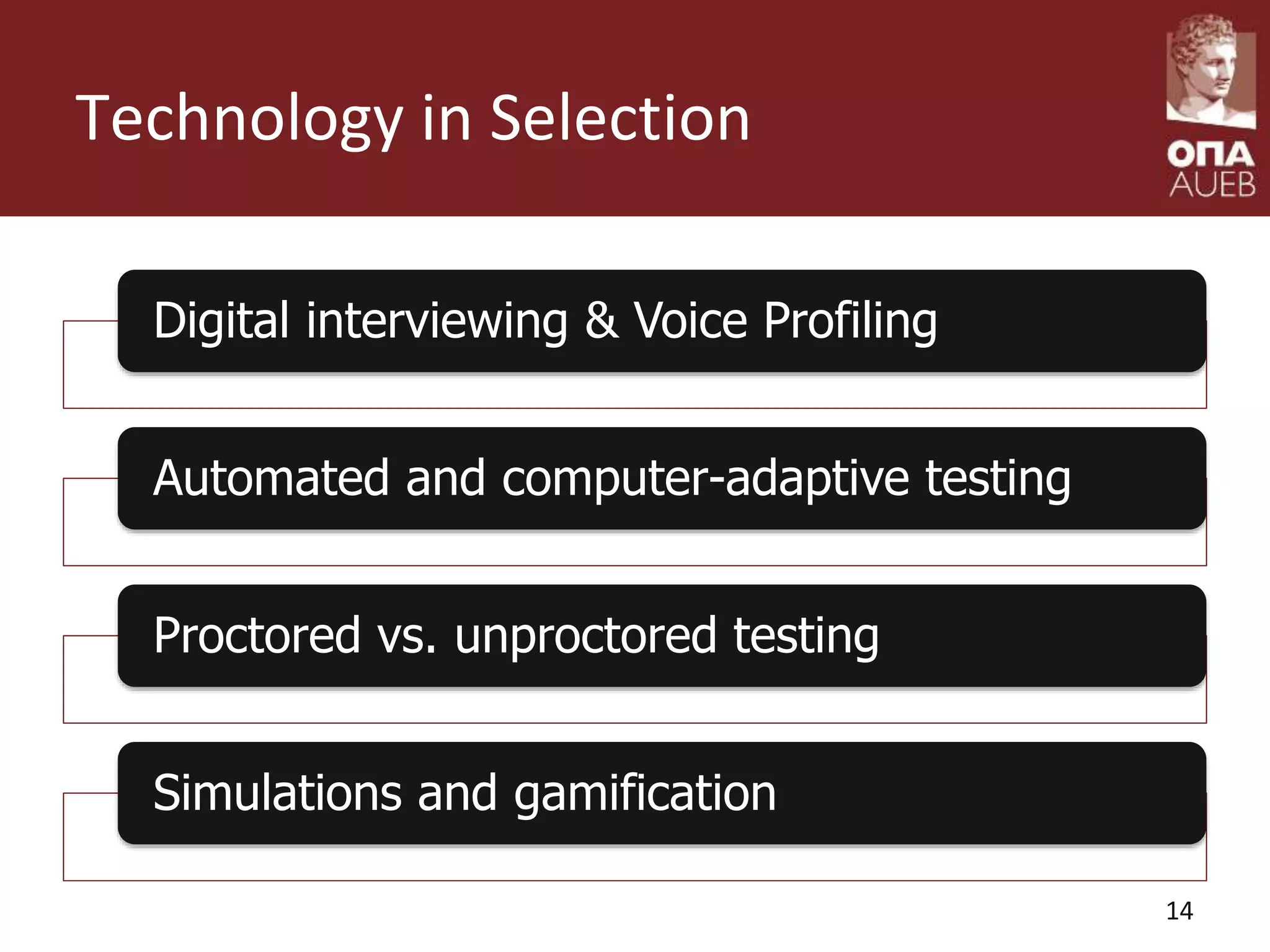
Technology in Selection
14
Digital interviewing & Voice Profiling
Automated and computer-adaptive testing
Proctored vs. unproctored testing
Simulations and gamification
Digital Interviewing & Voice Profiling
• Video-recorded structured interviews
•Benefits: increases standardization and time saving
•Limitations: impersonal
– Text analytics and Voice Mining
– Algorithmic reading of voice-generated emotions
•Micro-expressions and automated emotion reading
15
Automated and computer-adaptive
testing
• Psychometric assessment
• Little has changed in the content, most of
them recently with gamification and GBA
• Concerns over security conditions and
administration
• New psychometric approaches, e.g. increased
use of Item-Response Theory
16
Proctored vs. unproctored testing
• Technology has helped us bring objective
assessment earlier in the recruitment process
for larger number of candidates
– Issues with test security and cheating especially in
high stakes selection
• Electronic performance monitoring in
proctored testing  Negative applicant
reactions (Karim et al., 2014)
17
Simulations and gamification (1/2)
• More Americans play games than do not, half
of all gamers are under the age of 30
• Moving from a “push” to a ”pull” model
• Assessment of soft skills, hard skills,
personality, interests, etc.
18
Simulations and gamification (2/2)
• Serious games using the Situational
Judgement Test Methodology
– Soft Skills assessment
– Highly reliable, high construct validity
– Positive applicant reactions
•Now exploring predictive validity
Nikolaou, I. & Georgiou, K. (2017). Serious gaming and applicants’ reactions; the role of openness to experience. 32nd Annual
Conference of the Society for Industrial and Organizational Psychology, Orlando, USA
Georgiou, K. & Nikolaou, I. (2017). Serious gaming in employees’ selection process. 32nd Annual Conference of the Society for
Industrial and Organizational Psychology, Orlando, USA
Georgiou, K. & Nikolaou, I. (2017). Gamification in recruitment and selection. 18th congress of the European Association of Work
and Organizational Psychology (EAWOP), Dublin Ireland. 19
Technology & the “day after”
20
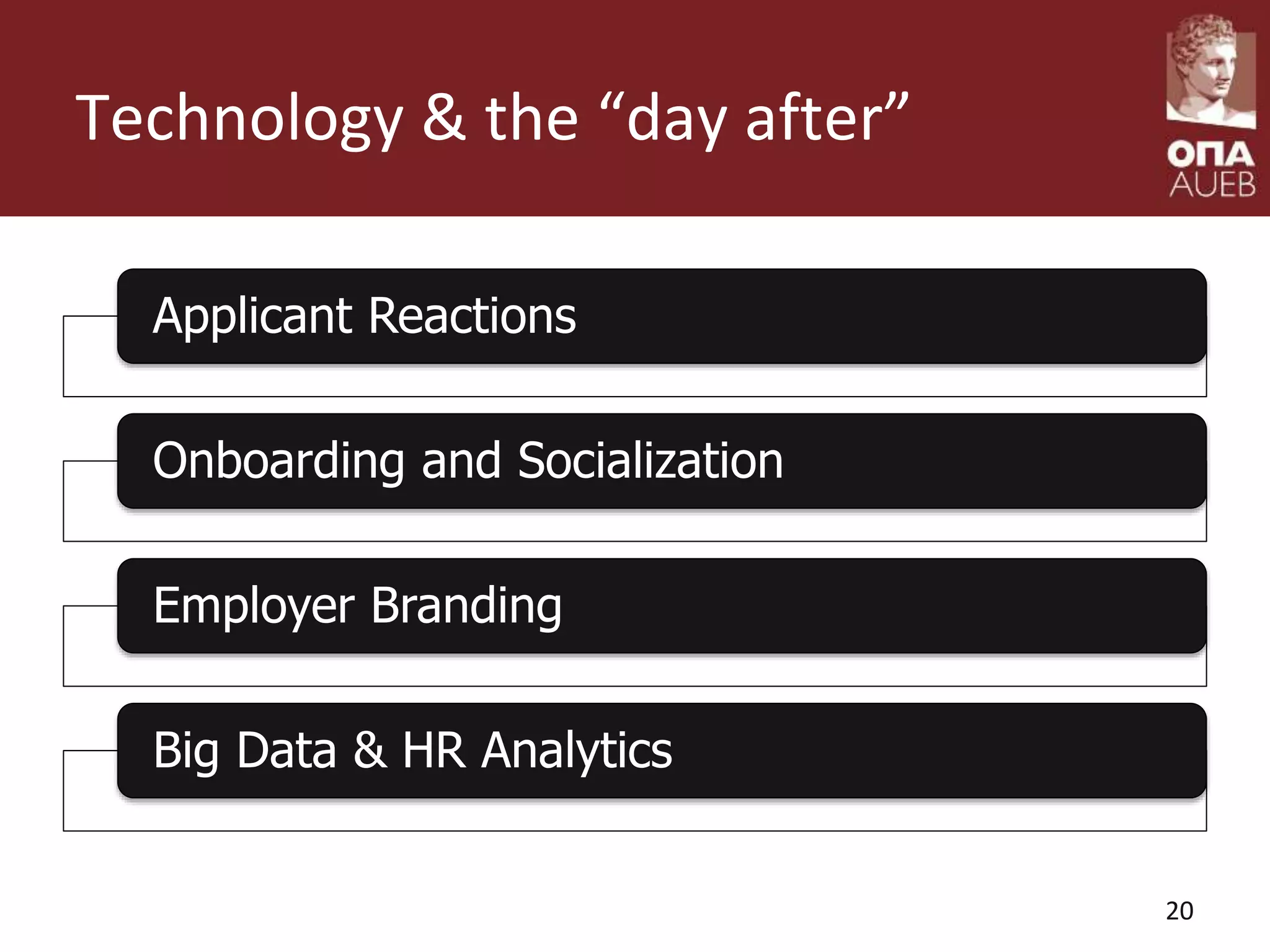
Applicant Reactions
Onboarding and Socialization
Employer Branding
Big Data & HR Analytics
Technology & Applicant Reactions
• Applicant reactions &
– New predictor methods (e.g. digital interviews,
gamification, video CVs, etc.)
– New modes of delivery of existing predictor constructs
(e.g. personality, intelligence)
– Social Networking Websites
• Impact to applicants attitudes / outcomes, compared
to traditional methods/constructs?
Nikolaou, I. Georgiou, K. Bauer, T.N, Truxillo, D. M. (under preparation). Technology and Applicant Reactions. In R. N. Landers
(Ed.). Cambridge Handbook of Technology and Employee Behavior, Cambridge University Press.
21
Technology & Onboarding / Socialization
• Familiarization with the company and
colleagues via:
– Apps, e-learning, videos etc.
– E-mentoring for career development
– Corporate intranet, e.g. Microsoft Yammer
22
Technology & Employer Branding
• Strong links with applicant reactions and
SNWs
• Word-of-mouth vs. Word-of-mouse (WOM)
– The differential impact of Positive WOM vs
Negative WOM (Van Hoye, G., 2014).
• The uncertain impact of “Best employers”
competitions (Lievens & Slaughter, 2016)
23
Big Data and HR Analytics
• Not just HR Metrics… but using advanced
statistical methods and combining HR with
business data
– Data Mining
•Combining internal and external data
– For example:
•Predicting hiring success & high potentials
•Reducing turnover and increasing employee
engagement and satisfaction
24
Technology in Employee Recruitment
& Selection
25
Critical issues 1/3
• Equivalence of measures / techniques
• Ethics
– Applicants’ consent
– Confidentiality
• Legal considerations
– Data privacy and data protection
– Test Security
26
Critical issues 2/3
• Bandwidth vs. fidelity
• Implementation and administration issues
(e.g. mobile devices, tablets)
• Unproctored testing in high stakes selection
• Predictor constructs (e.g., personality,
cognitive ability) vs. predictor methods (e.g.,
video résumés, digital interviews)
27
Critical issues 3/3
• Back to Basics:
– New methods (e.g. digital interviews,
gamification, video CVs)
– New modes of delivery of existing predictor
constructs (e.g. personality, intelligence)
•Construct / criterion-related validity
•Incremental validity over and above existing methods /
constructs
28
Theoretical considerations 1/3
• Signaling theory (Spence, 1973; Bangerter et al., 2012)
– The method sends a signal
•New methods/new modes of assessment
• Elaboration likelihood model (ELM) of
persuasion (Petty & Cacioppo; 1986)
– Peripheral processing vs. central processing &
motivation
29
Theoretical considerations 2/3
• Applicant Reactions Theories
– Gilliland’s organizational justice framework
•10 procedural rules
– Invasion of privacy model (Bauer et al., 2006)
– Deontic Outrage; the impact of mistreatment to
others, not the applicants themselves (Gilliland & Steiner,
2012)
•Applicable to SNWs research
30
Theoretical considerations 3/3
• Social Networking Websites
– Social Information Processing Theory (Walther et al., 2015)
•Overemphasis on negative information (Roth et al., 2013)
– Attribution theory (Weiner, 1985)
•Expectancy theory (Sanchez, Truxillo & Bauer, 2000),
31
Ideas for future research…
• Big data offer a promising line of research in
recruitment, selection & applicant reactions research
(McCarthy et al. 2017)
• Social Media Research – the process, the constructs,
adverse impact, applicant reactions (Roth et al., 2013)
• The interplay between technology / social media and
employer branding, e.g. positive vs. negative word of
mouth (van Hoye et al. in progress)
• The utility of new methods and new modes (e.g.
digital interviewing, gamification)
32
The future is here, but… (1/2)
• Vast data pools and improved analytic
capabilities will fundamentally disrupt the talent
identification process.
– Availability of many more talent signals
– New analytic tools and increased computing power
However…
33
The future is here, but… (2/2)
• Limited validity evidence compared to old
school methods
• Privacy and anonymity concerns may limit
access to individual data
• Trade-off between development costs and
accuracy/validity and user experience
• Adverse impact / unfair discrimination concerns
Chamorro-Premuzic, T., Winsborough, D., Sherman, R. A., & Hogan, R. (2016). New Talent Signals: Shiny New Objects or a Brave New
World? Industrial and Organizational Psychology-Perspectives on Science and Practice, 9(3), 621-640.
34
Conclusions
• We live our lives online but…
Valid, evidence-based tools and methodologies
are required in order to take fair and just hiring
decisions
35
European Network of Selection
Researchers (ENESER)
36
http://www.eneser.eu
Next meeting: Edinburgh, June 27-29, 2018.
Ioannis Nikolaou
School of Business
Department of Management Science &
Technology
twitter@nikolaou
inikolaou.gr
inikol@aueb.gr
References
• Bangerter, A., Roulin, N., & Konig, C. J. (2012). Personnel Selection as a Signaling Game. Journal of Applied
Psychology, 97(4), 719-738.
• Chamorro-Premuzic, T., Winsborough, D., Sherman, R. A., & Hogan, R. (2016). New Talent Signals: Shiny
New Objects or a Brave New World? Industrial and Organizational Psychology-Perspectives on Science and
Practice, 9(3), 621-640.
• Gilliland, S. W., & Steiner, D. D. (2012). Applicant Reactions to Testing and Selection. In N. Schmitt (Ed.),
The Oxford Handbook of Personnel Assessment and Selection (pp. 629-666). Oxrord: Oxford University
Press.
• Hiemstra, A. M., & Derous, E. (2015). Video résumés portrayed: findings and challenges. In I. Nikolaou & J.
K. Oostrom (Eds.), Employee Recruitment, Selection and Assessment. contemporary issues for theory and
practise (pp. 45-60). London: Routledge/Psychology Press.
• Karim, M. N., Kaminsky, S. E., & Behrend, T. S. (2014). Cheating, reactions, and performance in remotely
proctored testing: An exploratory experimental study. Journal of Business and Psychology, 29(4), 555-572.
• Kluemper, D. H., Rosen, P. A., & Mossholder, K. W. (2012). Social Networking Websites, Personality
Ratings, and the Organizational Context: More Than Meets the Eye? Journal of Applied Social Psychology,
42(5), 1143-1172.
• Lievens, F., & Slaughter, J. E. (2016). Employer image and employer branding: What we know and what we
need to know. Annual Review of Organizational Psychology and Organizational Behavior, 3, 407-440.
• Nikolaou, I. (2014). Social Networking Web Sites in Job Search and Employee Recruitment. International
Journal of Selection and Assessment, 22(2), 179-189.
38
References
• Nikolaou, I., Bauer, T. N., & Truxillo, D. M. (2015). Applicant Reactions to Selection Methods: An Overview
of Recent Research and Suggestions for the Future. In I. Nikolaou & J. K. Oostrom (Eds.), Employee
Recruitment, Selection, and Assessment. Contemporary Issues for Theory and Practice (pp. 80-96). Hove,
East Sussex: Routledge.
• Reynolds, D., & Dickter, D. (2017). Technology and employee selection. In J. L. Farr & N. T. Tippins (Eds.),
Handbook of employee selection (pp. 855-873). New York: Routledge.
• Reynolds, D. H., & Dickter, D. N. (2010). Technology and employee selection. In J. L. Farr & N. T. Tippins
(Eds.), Handbook of employee selection (pp. 171-194). New York: Taylor & Francis.
• Ryan, A. M., & Ployhart, R. E. (2014). A Century of Selection. Annual Review of Psychology, 65(1), 693-717.
Tippins, N. T. (2015). Technology and Assessment in Selection. Annual Review of Organizational
Psychology and Organizational Behavior, 2(1), 551-582. doi:10.1146/annurev-orgpsych-031413-091317
• Van Iddekinge, C. H., Lanivich, S. E., Roth, P. L., & Junco, E. (2016). Social media for selection? Validity and
adverse impact potential of a Facebook-based assessment. Journal of Management, 42(7), 1811-1835.
• Petty, R.E., & Cacioppo, J.T. (1986). The Elaboration Likelihood Model of persuasion. New York: Academic
Press.
• Roth, P. L., Bobko, P., Van Iddekinge, C. H., & Thatcher, J. B. (2013). Social Media in Employee-Selection-
Related Decisions: A Research Agenda for Uncharted Territory. Journal of Management, 42(1), 269-298.
• Van Hoye, G. (2014). Word-of-mouth as a recruitment source: An integrative model. In K. Y. T. Yu & D. M.
Cable (Eds.), The Oxford handbook of recruitment (pp. 251-268). New York: Oxford University Press.
• Van Hoye, G., & Lievens, F. (2007). Investigating Web‐Based Recruitment Sources: Employee testimonials
vs word‐of‐mouse. International Journal of Selection and Assessment, 15(4), 372-382.
39

Technology in Employee Recruitment and Selection

  • 1.
    Technology in Employee Recruitment andSelection Ioannis Nikolaou School of Business Department of Management Science & Technology twitter@nikolaou inikol@aueb.gr
  • 2.
    Technology in EmployeeRecruitment & Selection • The role of technology in the recruitment cycle • Critical issues • Theoretical considerations • Ideas for future research 2 Recruitment Screening Selection The "day after"
  • 3.
    Technology in Recruitment 3 Internet-basedRecruitment Applicant Tracking Systems (ATS) Video CVs
  • 4.
    Internet-based Recruitment • CompanyCareer Sites – Enriched content, data and applicant tracking • Job Boards – More interactive, increased applicants’ attention and credibility • Social Networking Websites (SNWs) – A whole new world… 4
  • 5.
    Internet-based Recruitment &SNWs • Increased interaction between candidates and employers • Approaching passive candidates / poaching (Nikolaou, 2014) • Excessive usage numbers by both recruiters and job- seekers • Constantly increasing research attention, but generally, an area where research still tries to catch up practice (e.g. Kluemper et al., 2012; Van Iddekinge et al, 2016; Roth et al., 2013) • Applicant reactions & employer branding (e.g. Glassdoor.com) 5
  • 6.
    Applicant Tracking Systems(ATS) • Cloud-based applications managing the administration of the recruitment process – Cheap and efficient • Linked with job-boards, SNWs, on-line application forms, career sites, etc. – Effective use of HR Metrics, e.g. success rates, time-to-hire, recruitment sources effectiveness, etc. 6
  • 7.
    Video CVs • Candidates’self-presentation replacing traditional resumes • Increasing usage numbers and research attention, especially in relation to diversity / discrimination issues, applicant reactions & equivalence with traditional resumes (e.g. Hiemstra & Derous, 2015) 7
  • 8.
    Technology in Screening 8 ResumeStorage, Parsing, and Keyword Search Applicant Screening Tools Social Networking Websites Artificial Intelligence
  • 9.
    Resume Storage, Parsing,and Keyword Search • Large storage databases combined with ATS & candidates’ social media profiles • Effective resume management and resume parsing tools (e.g. keyword searching and profile matching) • Data mining techniques and machine translation technologies used to elicit information on candidates 9
  • 10.
    Applicant Screening Tools •The good-old Weighted Application Blanks – Candidates provide info on work / education history, qualifications, licenses, certifications, etc. – Measurable and quantifiable info – Pressure to keep content brief – May be linked with SNWs candidates’ profile (e.g. retrieving candidates’ info from their LinkedIn profiles) 10
  • 11.
    Social Networking Websitesin screening • Used often in combination with candidates’ info (e.g. resume, application) – Important ethical / privacy concerns and discrimination / adverse impact issues – Limited research on how recruiters use this info, especially in combination with other info (e.g. assessment) • Social Media Analytics & Web Scrapping 11
  • 12.
    SNWs, Social MediaAnalytics and Web Scraping • FB activity related to demographic, personality, attitudinal, and cognitive ability variables – Web scrapping opportunities in hiring •Initial findings re personality (Big5), gender, religious identity, age and intelligence •However, do these provide any real value above/beyond existing methods? 12
  • 13.
    Artificial Intelligence 13 Web Scrappingand Linguistic Analysis twitter@nikolaou
  • 14.
    Technology in Selection 14 Digitalinterviewing & Voice Profiling Automated and computer-adaptive testing Proctored vs. unproctored testing Simulations and gamification
  • 15.
    Digital Interviewing &Voice Profiling • Video-recorded structured interviews •Benefits: increases standardization and time saving •Limitations: impersonal – Text analytics and Voice Mining – Algorithmic reading of voice-generated emotions •Micro-expressions and automated emotion reading 15
  • 16.
    Automated and computer-adaptive testing •Psychometric assessment • Little has changed in the content, most of them recently with gamification and GBA • Concerns over security conditions and administration • New psychometric approaches, e.g. increased use of Item-Response Theory 16
  • 17.
    Proctored vs. unproctoredtesting • Technology has helped us bring objective assessment earlier in the recruitment process for larger number of candidates – Issues with test security and cheating especially in high stakes selection • Electronic performance monitoring in proctored testing  Negative applicant reactions (Karim et al., 2014) 17
  • 18.
    Simulations and gamification(1/2) • More Americans play games than do not, half of all gamers are under the age of 30 • Moving from a “push” to a ”pull” model • Assessment of soft skills, hard skills, personality, interests, etc. 18
  • 19.
    Simulations and gamification(2/2) • Serious games using the Situational Judgement Test Methodology – Soft Skills assessment – Highly reliable, high construct validity – Positive applicant reactions •Now exploring predictive validity Nikolaou, I. & Georgiou, K. (2017). Serious gaming and applicants’ reactions; the role of openness to experience. 32nd Annual Conference of the Society for Industrial and Organizational Psychology, Orlando, USA Georgiou, K. & Nikolaou, I. (2017). Serious gaming in employees’ selection process. 32nd Annual Conference of the Society for Industrial and Organizational Psychology, Orlando, USA Georgiou, K. & Nikolaou, I. (2017). Gamification in recruitment and selection. 18th congress of the European Association of Work and Organizational Psychology (EAWOP), Dublin Ireland. 19
  • 20.
    Technology & the“day after” 20 Applicant Reactions Onboarding and Socialization Employer Branding Big Data & HR Analytics
  • 21.
    Technology & ApplicantReactions • Applicant reactions & – New predictor methods (e.g. digital interviews, gamification, video CVs, etc.) – New modes of delivery of existing predictor constructs (e.g. personality, intelligence) – Social Networking Websites • Impact to applicants attitudes / outcomes, compared to traditional methods/constructs? Nikolaou, I. Georgiou, K. Bauer, T.N, Truxillo, D. M. (under preparation). Technology and Applicant Reactions. In R. N. Landers (Ed.). Cambridge Handbook of Technology and Employee Behavior, Cambridge University Press. 21
  • 22.
    Technology & Onboarding/ Socialization • Familiarization with the company and colleagues via: – Apps, e-learning, videos etc. – E-mentoring for career development – Corporate intranet, e.g. Microsoft Yammer 22
  • 23.
    Technology & EmployerBranding • Strong links with applicant reactions and SNWs • Word-of-mouth vs. Word-of-mouse (WOM) – The differential impact of Positive WOM vs Negative WOM (Van Hoye, G., 2014). • The uncertain impact of “Best employers” competitions (Lievens & Slaughter, 2016) 23
  • 24.
    Big Data andHR Analytics • Not just HR Metrics… but using advanced statistical methods and combining HR with business data – Data Mining •Combining internal and external data – For example: •Predicting hiring success & high potentials •Reducing turnover and increasing employee engagement and satisfaction 24
  • 25.
    Technology in EmployeeRecruitment & Selection 25
  • 26.
    Critical issues 1/3 •Equivalence of measures / techniques • Ethics – Applicants’ consent – Confidentiality • Legal considerations – Data privacy and data protection – Test Security 26
  • 27.
    Critical issues 2/3 •Bandwidth vs. fidelity • Implementation and administration issues (e.g. mobile devices, tablets) • Unproctored testing in high stakes selection • Predictor constructs (e.g., personality, cognitive ability) vs. predictor methods (e.g., video résumés, digital interviews) 27
  • 28.
    Critical issues 3/3 •Back to Basics: – New methods (e.g. digital interviews, gamification, video CVs) – New modes of delivery of existing predictor constructs (e.g. personality, intelligence) •Construct / criterion-related validity •Incremental validity over and above existing methods / constructs 28
  • 29.
    Theoretical considerations 1/3 •Signaling theory (Spence, 1973; Bangerter et al., 2012) – The method sends a signal •New methods/new modes of assessment • Elaboration likelihood model (ELM) of persuasion (Petty & Cacioppo; 1986) – Peripheral processing vs. central processing & motivation 29
  • 30.
    Theoretical considerations 2/3 •Applicant Reactions Theories – Gilliland’s organizational justice framework •10 procedural rules – Invasion of privacy model (Bauer et al., 2006) – Deontic Outrage; the impact of mistreatment to others, not the applicants themselves (Gilliland & Steiner, 2012) •Applicable to SNWs research 30
  • 31.
    Theoretical considerations 3/3 •Social Networking Websites – Social Information Processing Theory (Walther et al., 2015) •Overemphasis on negative information (Roth et al., 2013) – Attribution theory (Weiner, 1985) •Expectancy theory (Sanchez, Truxillo & Bauer, 2000), 31
  • 32.
    Ideas for futureresearch… • Big data offer a promising line of research in recruitment, selection & applicant reactions research (McCarthy et al. 2017) • Social Media Research – the process, the constructs, adverse impact, applicant reactions (Roth et al., 2013) • The interplay between technology / social media and employer branding, e.g. positive vs. negative word of mouth (van Hoye et al. in progress) • The utility of new methods and new modes (e.g. digital interviewing, gamification) 32
  • 33.
    The future ishere, but… (1/2) • Vast data pools and improved analytic capabilities will fundamentally disrupt the talent identification process. – Availability of many more talent signals – New analytic tools and increased computing power However… 33
  • 34.
    The future ishere, but… (2/2) • Limited validity evidence compared to old school methods • Privacy and anonymity concerns may limit access to individual data • Trade-off between development costs and accuracy/validity and user experience • Adverse impact / unfair discrimination concerns Chamorro-Premuzic, T., Winsborough, D., Sherman, R. A., & Hogan, R. (2016). New Talent Signals: Shiny New Objects or a Brave New World? Industrial and Organizational Psychology-Perspectives on Science and Practice, 9(3), 621-640. 34
  • 35.
    Conclusions • We liveour lives online but… Valid, evidence-based tools and methodologies are required in order to take fair and just hiring decisions 35
  • 36.
    European Network ofSelection Researchers (ENESER) 36 http://www.eneser.eu Next meeting: Edinburgh, June 27-29, 2018.
  • 37.
    Ioannis Nikolaou School ofBusiness Department of Management Science & Technology twitter@nikolaou inikolaou.gr inikol@aueb.gr
  • 38.
    References • Bangerter, A.,Roulin, N., & Konig, C. J. (2012). Personnel Selection as a Signaling Game. Journal of Applied Psychology, 97(4), 719-738. • Chamorro-Premuzic, T., Winsborough, D., Sherman, R. A., & Hogan, R. (2016). New Talent Signals: Shiny New Objects or a Brave New World? Industrial and Organizational Psychology-Perspectives on Science and Practice, 9(3), 621-640. • Gilliland, S. W., & Steiner, D. D. (2012). Applicant Reactions to Testing and Selection. In N. Schmitt (Ed.), The Oxford Handbook of Personnel Assessment and Selection (pp. 629-666). Oxrord: Oxford University Press. • Hiemstra, A. M., & Derous, E. (2015). Video résumés portrayed: findings and challenges. In I. Nikolaou & J. K. Oostrom (Eds.), Employee Recruitment, Selection and Assessment. contemporary issues for theory and practise (pp. 45-60). London: Routledge/Psychology Press. • Karim, M. N., Kaminsky, S. E., & Behrend, T. S. (2014). Cheating, reactions, and performance in remotely proctored testing: An exploratory experimental study. Journal of Business and Psychology, 29(4), 555-572. • Kluemper, D. H., Rosen, P. A., & Mossholder, K. W. (2012). Social Networking Websites, Personality Ratings, and the Organizational Context: More Than Meets the Eye? Journal of Applied Social Psychology, 42(5), 1143-1172. • Lievens, F., & Slaughter, J. E. (2016). Employer image and employer branding: What we know and what we need to know. Annual Review of Organizational Psychology and Organizational Behavior, 3, 407-440. • Nikolaou, I. (2014). Social Networking Web Sites in Job Search and Employee Recruitment. International Journal of Selection and Assessment, 22(2), 179-189. 38
  • 39.
    References • Nikolaou, I.,Bauer, T. N., & Truxillo, D. M. (2015). Applicant Reactions to Selection Methods: An Overview of Recent Research and Suggestions for the Future. In I. Nikolaou & J. K. Oostrom (Eds.), Employee Recruitment, Selection, and Assessment. Contemporary Issues for Theory and Practice (pp. 80-96). Hove, East Sussex: Routledge. • Reynolds, D., & Dickter, D. (2017). Technology and employee selection. In J. L. Farr & N. T. Tippins (Eds.), Handbook of employee selection (pp. 855-873). New York: Routledge. • Reynolds, D. H., & Dickter, D. N. (2010). Technology and employee selection. In J. L. Farr & N. T. Tippins (Eds.), Handbook of employee selection (pp. 171-194). New York: Taylor & Francis. • Ryan, A. M., & Ployhart, R. E. (2014). A Century of Selection. Annual Review of Psychology, 65(1), 693-717. Tippins, N. T. (2015). Technology and Assessment in Selection. Annual Review of Organizational Psychology and Organizational Behavior, 2(1), 551-582. doi:10.1146/annurev-orgpsych-031413-091317 • Van Iddekinge, C. H., Lanivich, S. E., Roth, P. L., & Junco, E. (2016). Social media for selection? Validity and adverse impact potential of a Facebook-based assessment. Journal of Management, 42(7), 1811-1835. • Petty, R.E., & Cacioppo, J.T. (1986). The Elaboration Likelihood Model of persuasion. New York: Academic Press. • Roth, P. L., Bobko, P., Van Iddekinge, C. H., & Thatcher, J. B. (2013). Social Media in Employee-Selection- Related Decisions: A Research Agenda for Uncharted Territory. Journal of Management, 42(1), 269-298. • Van Hoye, G. (2014). Word-of-mouth as a recruitment source: An integrative model. In K. Y. T. Yu & D. M. Cable (Eds.), The Oxford handbook of recruitment (pp. 251-268). New York: Oxford University Press. • Van Hoye, G., & Lievens, F. (2007). Investigating Web‐Based Recruitment Sources: Employee testimonials vs word‐of‐mouse. International Journal of Selection and Assessment, 15(4), 372-382. 39

Editor's Notes

  • #16 Candidates’ speech patterns are compared with an “attractive” exemplar, derived from the voice patterns of high performing employees. Undesirable candidate voices are eliminated from the context, and those who t move to the next round. Video technology to administer scenario-based questions, image-based tests, and work-sample tests.
  • #19 We predict that the testing market will increasingly transition from the current push model—where firms require people to complete a set of assessments in order to quantify their talent—to a pull model where firms will search various talent badges to identify the people they seek to hire.
  • #21 Internet, Social Media Engagement, Performance (?)
  • #25 Evolv, an HR data analytics company, found that applicants who use Mozilla Firefox or Google Chrome as their web browsers are likely to stay in their jobs longer and perform better than those who use Internet Explorer or Safari (Pinsker, 2015). Knowing which browser candidates used to submit their online applications may prove to be a weak but useful talent signal. Evolv hypothesizes that the correlations among browser usage, performance, and employment longevity reflect the initiative required to download a nonnative browser
  • #32 σύμφωνα με τη Θεωρία Επεξεργασίας Κοινωνικών Πληροφοριών (Social Information Processing Theory) τα στελέχη κατά τη διαδικασία της αξιολόγησης υποψηφίων μέσω του διαδικτύου, έχουν στη διάθεσή τους λιγότερα στοιχεία από αυτά που θα είχαν εάν έρχονταν σε φυσική επαφή με αυτούς τους υποψήφιους, αλλά τείνουν να δίνουν πολύ μεγαλύτερη έμφαση στα διαθέσιμα αυτά στοιχεία, με αποτέλεσμα να τα υπερερμηνέουν σύμφωνα με τη θεωρία των προσδοκιών (Sanchez, Truxillo & Bauer, 2000), οι ερμηνείες των γεγονότων ή πληροφοριών επηρεάζονται από τις προσδοκίες του κάθε ατόμου οι οποίες καθορίζουν και τις αντιδράσεις του σε αυτές τις πληροφορίες ή γεγονότα.