Knowledge12 yale service management rapid maturity yale format
1.
Rapid Maturity andContinual Service
Improvement
Adriene Radcliffe
Director, Service Management
Yale University
Gerry Geddes
Executive Consultant
Fruition Partners
2.
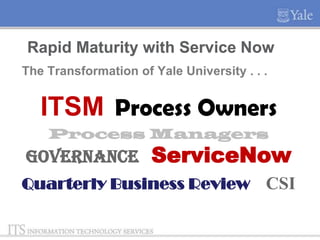
Rapid Maturity withService Now
The Transformation of Yale University . . .
ITSM Process Owners
Process Managers
Governance
ServiceNow
Quarterly Business Review
CSI
3.
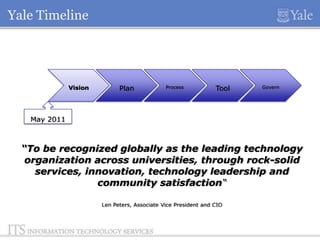
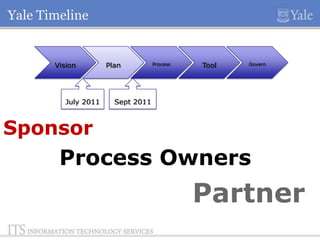
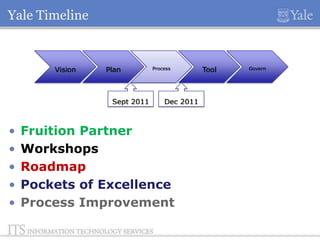
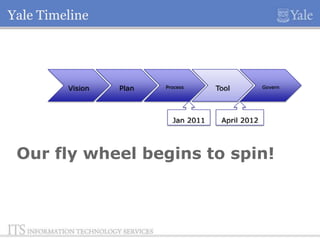
Yale Timeline
Vision
Plan
Process
Tool
Govern
May 2011
“Tobe recognized globally as the leading technology
organization across universities, through rock-solid
services, innovation, technology leadership and
community satisfaction“
Len Peters, Associate Vice President and CIO
4.
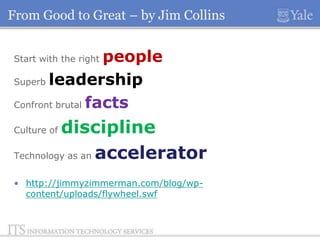
From Good toGreat – by Jim Collins
people
Superb leadership
Confront brutal facts
Start with the right
discipline
Technology as an accelerator
Culture of
• http://jimmyzimmerman.com/blog/wpcontent/uploads/flywheel.swf
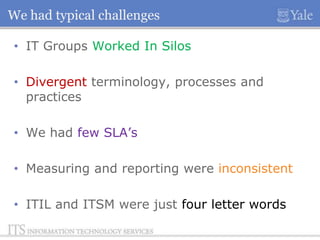
We had typicalchallenges
• IT Groups Worked In Silos
• Divergent terminology, processes and
practices
• We had few SLA’s
• Measuring and reporting were inconsistent
• ITIL and ITSM were just four letter words
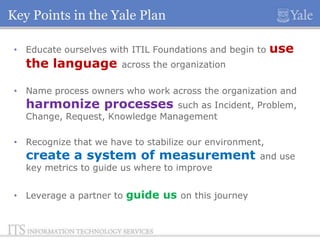
Key Points inthe Yale Plan
• Educate ourselves with ITIL Foundations and begin to
the language
use
across the organization
• Name process owners who work across the organization and
harmonize processes
such as Incident, Problem,
Change, Request, Knowledge Management
• Recognize that we have to stabilize our environment,
create a system of measurement
key metrics to guide us where to improve
• Leverage a partner to guide us on this journey
and use
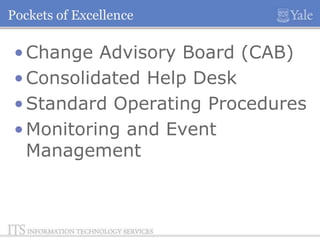
Pockets of Excellence
•Change Advisory Board (CAB)
• Consolidated Help Desk
• Standard Operating Procedures
• Monitoring and Event
Management
11.
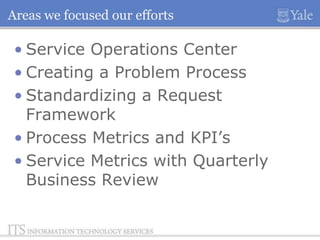
Areas we focusedour efforts
• Service Operations Center
• Creating a Problem Process
• Standardizing a Request
Framework
• Process Metrics and KPI’s
• Service Metrics with Quarterly
Business Review
Yale Timeline
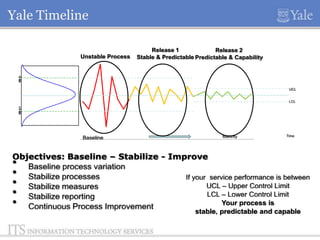
Unstable Process
Release1
Release 2
Stable & Predictable Predictable & Capability
-3 SD
UCL
LCL
+3 SD
Baseline
Maturity
Time
Objectives: Baseline – Stabilize - Improve
• Baseline process variation
• Stabilize processes
If your service performance is between
• Stabilize measures
UCL – Upper Control Limit
• Stabilize reporting
LCL – Lower Control Limit
Your process is
• Continuous Process Improvement
stable, predictable and capable
Yale Timeline
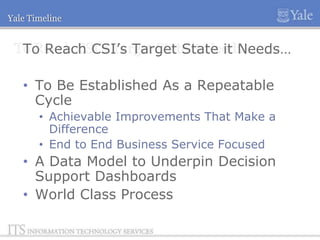
To ReachCSI’s Target State it Needs…
To Reach CSI’s Target State it Needs…
• To Be Established As a Repeatable
Cycle
• Achievable Improvements That Make a
Difference
• End to End Business Service Focused
• A Data Model to Underpin Decision
Support Dashboards
• World Class Process
17.
Yale Timeline
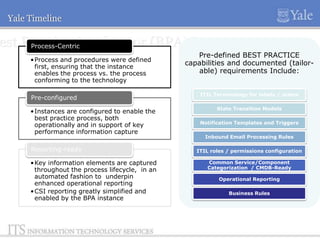
est PracticeAccelerator (BPA) Instance
Process-Centric
•Process and procedures were defined
first, ensuring that the instance
enables the process vs. the process
conforming to the technology
Pre-configured
•Instances are configured to enable the
best practice process, both
operationally and in support of key
performance information capture
Reporting-ready
•Key information elements are captured
throughout the process lifecycle, in an
automated fashion to underpin
enhanced operational reporting
•CSI reporting greatly simplified and
enabled by the BPA instance
Pre-defined BEST PRACTICE
capabilities and documented (tailorable) requirements Include:
ITIL Terminology for labels / states
State Transition Models
Notification Templates and Triggers
Inbound Email Processing Rules
ITIL roles / permissions configuration
Common Service/Component
Categorization / CMDB-Ready
Operational Reporting
Business Rules
18.
Yale Timeline
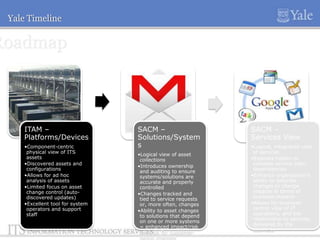
Roadmap
ITAM –
Platforms/Devices
•Component-centric
physicalview of ITS
assets
•Discovered assets and
configurations
•Allows for ad hoc
analysis of assets
•Limited focus on asset
change control (autodiscovered updates)
•Excellent tool for system
operators and support
staff
SACM –
Solutions/System
s
•Logical view of asset
collections
•Introduces ownership
and auditing to ensure
systems/solutions are
accurate and properly
controlled
•Changes tracked and
tied to service requests
or, more often, changes
•Ability to asset changes
to solutions that depend
on one or more systems
= enhanced impact/risk
analysis for customerfacing changes
SACM –
Services View
•Logical, integrated view
of services
•Exposes hidden or
complex service interdependencies
•Enhance organization’s
ability to describe
changes to change
impacts in terms of
business impacts
•Allows for businesscentric view of IT
operations, and the
relationship to services
delivered by the
business
19.
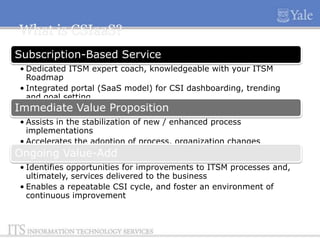
What is CSIaaS?
Subscription-BasedService
• Dedicated ITSM expert coach, knowledgeable with your ITSM
Roadmap
• Integrated portal (SaaS model) for CSI dashboarding, trending
and goal setting
Immediate Value Proposition
• Assists in the stabilization of new / enhanced process
implementations
• Accelerates the adoption of process, organization changes
Ongoing Value-Add
• Identifies opportunities for improvements to ITSM processes and,
ultimately, services delivered to the business
• Enables a repeatable CSI cycle, and foster an environment of
continuous improvement
20.
Yale Timeline
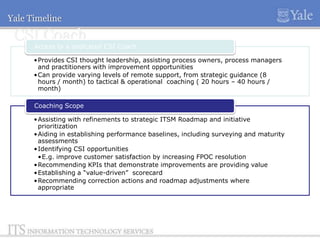
CSI Coach
Accessto a dedicated CSI Coach
•Provides CSI thought leadership, assisting process owners, process managers
and practitioners with improvement opportunities
•Can provide varying levels of remote support, from strategic guidance (8
hours / month) to tactical & operational coaching ( 20 hours – 40 hours /
month)
Coaching Scope
•Assisting with refinements to strategic ITSM Roadmap and initiative
prioritization
•Aiding in establishing performance baselines, including surveying and maturity
assessments
•Identifying CSI opportunities
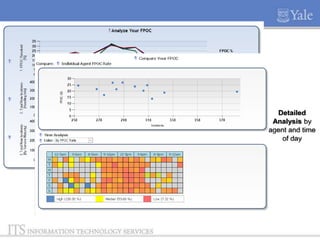
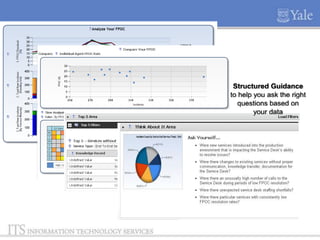
•E.g. improve customer satisfaction by increasing FPOC resolution
•Recommending KPIs that demonstrate improvements are providing value
•Establishing a “value-driven” scorecard
•Recommending correction actions and roadmap adjustments where
appropriate
21.
Yale Timeline
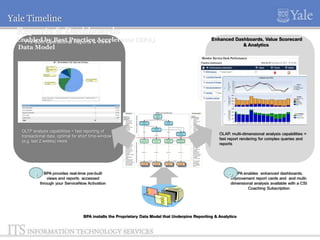
Reports &Dashboards
Enabled by Best Practice Accelerator (BPA)
Pre-Built Operational Reports & Views
Data Model
OLTP analysis capabilities = fast reporting of
transactional data, optimal for short time-window
(e.g. last 2 weeks) views
1
•
BPA provides real-time pre-built
views and reports accessed
through your ServiceNow Activation
Enhanced Dashboards, Value Scorecard
& Analytics
OLAP, multi-dimensional analysis capabilities =
fast report rendering for complex queries and
reports
•
2
improvement report cards and
BPA enables enhanced dashboards,
and multidimensional analysis available with a CSI
Coaching Subscription
BPA installs the Proprietary Data Model that Underpins Reporting & Analytics
22.
Yale Timeline
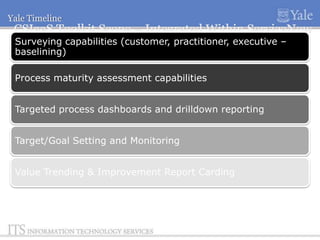
CSIaaS ToolkitScope – Integrated Within ServiceNow
Surveying
Portal capabilities (customer, practitioner, executive –
baselining)
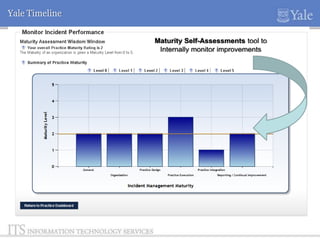
Process maturity assessment capabilities
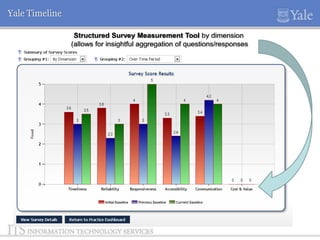
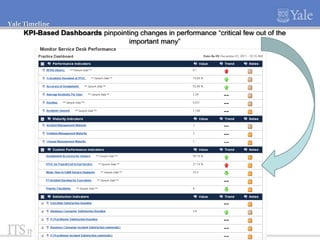
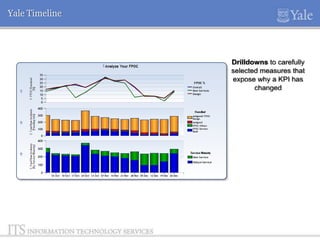
Targeted process dashboards and drilldown reporting
Target/Goal Setting and Monitoring
Value Trending & Improvement Report Carding
Yale Timeline
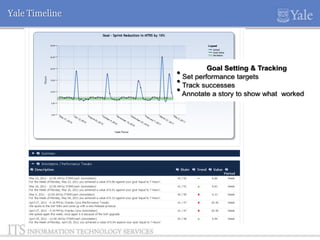
Goal Setting& Tracking
• Set performance targets
• Track successes
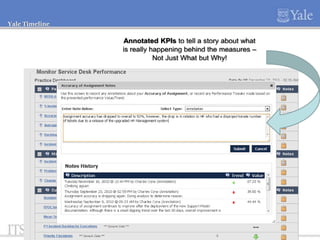
• Annotate a story to show what
worked
31.
Yale Timeline
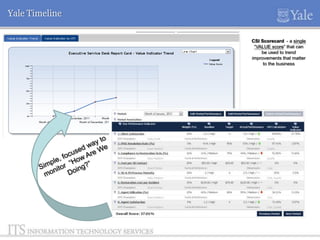
CSI Scorecard- a single
“VALUE score” that can
be used to trend
improvements that matter
to the business
32.
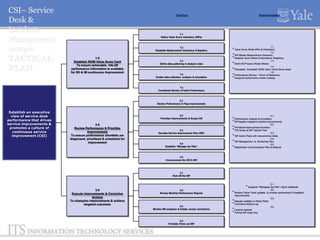
CSI– Service
Desk &
Incident
Management
sample
TACTICAL
PLAN
Tactics
Deliverables
1.1
DefineValue Score Indicators (KPIs)
1.2
Establish Measurement Dictionary & Baseline
1.0
Establish SDIM Value Score Card
To ensure actionable, VALUE
performance information is available
for SD & IM continuous improvement
1.1
• Value Score Sheet KPIs & Champions
1.2
• KPI Master Measurement Dictionary
• Baseline Score Sheet & Importance Weighting
1.3
Define data gathering & analysis roles
• Draft CSI Process Model (Roles)
1.3
1.4
• Populated, Annotated SDIM Value Trend Score sheet
1.4
Enable data collection, analysis & annotation
1.5
• Performance Review - Terms of Reference
• Inaugural performance review meeting
1.5
Coordinate Review of Initial Performance
2.1
Review Performance & Flag Improvements
Establish an executive
view of service desk
performance that drives
service improvements &
promotes a culture of
continuous service
improvement (CSI)
2.2
Prioritize Improvements & Scope CSI
2.0
Review Performance & Prioritize
Improvements
To ensure performance shortfalls are
diagnosed, prioritized & scheduled for
improvement
2.3
Develop Service Improvement Plan (SIP)
2.4
Establish “Manage the Plan”
2.1
• Performance Analysis & Annotation
• KPI targets mapped to tactical improvements
• Prioritized Improvement Inventory
• CSI Scope & SIP Tactical Tree
2.2
2.3
• SIP Action Plans with resource/due dates
2.4
& Monitoring Plan
2.5
Stakeholder Communication Plan & Material
• SIP Management
•
2.5
Communicate the CSI & SIP
3.1
Kick-off the SIP
3.1
• Inaugural “Managing the Plan” mtg & collaterals
3.0
Execute Improvements & Corrective
Actions
To champion improvements & achieve
targeted outcomes
3.2
Review Monthly Performance Reports
• Routine Value Trend updates
3.2
to monitor achievement of targeted
improvements
• Regular updates to Action Plans
• Corrective Actions Log
3.3
Monitor SIP progress & initiate course corrections
3.4
Formally Close out SIP
3.3
• Lessons learned
• Formal SIP Close Out
3.4
32
33.
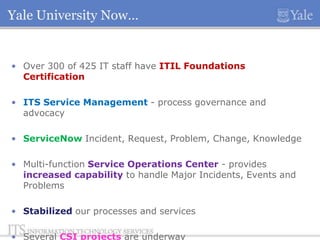
Yale University Now…
•Over 300 of 425 IT staff have ITIL Foundations
Certification
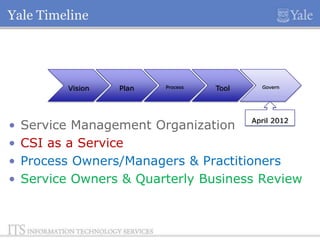
• ITS Service Management - process governance and
advocacy
• ServiceNow Incident, Request, Problem, Change, Knowledge
• Multi-function Service Operations Center - provides
increased capability to handle Major Incidents, Events and
Problems
• Stabilized our processes and services
• Several CSI projects are underway
34.
Thank You
Director, ServiceManagement
Executive Consultant
Adriene Radcliffe
Yale University
Gerry Geddes
Fruition Partner
adriene.radcliffe@yale.edu
gerry.geddes@fruitionpartners.com
Twitter: @a_radcliffe
Blog: news.its.yale.edu/itsm
Editor's Notes
#3 We established ITIL and ITSM as discipline. Process Owners and Process Managers harmonized disparate processes and participate in formal ITSM governance. Service Now has been established as our ITSM platform. A quarterly business review system of dashboards and service measurement allows us to report to the University Officers. We practice and subscribe to CSI… And we’re only one year into our plan!
#4 In the Spring of 2011, Yale welcomed a new CIO, Len Peters. His vision for Information Technology Services was clear. He had implemented ITSM as a discipline in his prior organizations and the results were always happy customers.
#5 The key concept is to have the right people on board, have great leadership, have a vision and work with a sense of single purpose. When everyone works towards the same vision or purpose, and you will begin to “move the fly wheel”
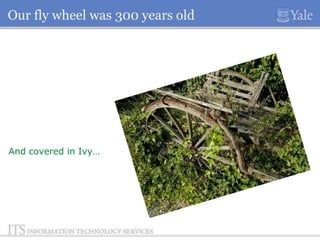
#6 And it was covered in IVY… 300 years worth of it. Client satisfaction was declining, our environment was increasing in complexity, we needed a change in our Service Management philosophy and practice and FAST
#8 We selected a sponsor and leaders throughout the organization to begin a planning process. We created a set of recommendations for Yale which included the selection of a partner who would help us navigate the journey
#9 Speak the same language – harmonize processes in workshops – know what you are measuring – partner as a compass
#10 A series of workshops with Fruition produced a Process Maturity Roadmap. We focused on our pockets of excellence and began process improvement efforts outside of the tool configuration
#13 Our fly wheel begins to spin! We configured an MVP release (Minimum Valuable Product) and began change sets to rapidly release updates and functionality.
#14 Consistent metric design and governanceConsistent data collection, monitoring and analysis of critical service and process metricsIdentification of essential operational metrics, KPI’s and tolerance levels for Phase I processes and servicesAutomated report generation and electronic alert for critical metrics exceeding tolerances for Phase I processes and services
#15 We have momentum. Yale went live with Service-Now on April 25, 2012 using the accelerator instance and CSI as a Service (CSIaaS) with Fruition Partners.
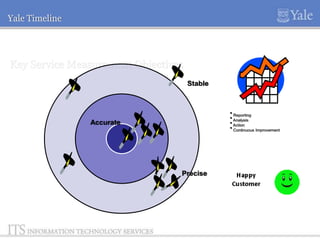
#16 Baseline performance and variationConsistent metric design and governanceConsistent data collection, monitoring and analysis of critical service and process metricsIdentification of essential operational metrics, KPI’s and tolerance levels for Phase I processes and servicesAutomated report generation and electronic alert for critical metrics exceeding tolerances for Phase I processes and services
#17 Fruition is a cloud solution provider that offers technology-enabled professional services supported by a team of 100 cloud experts. Since the company was founded in 2003, Fruition has helped more than 150 enterprises implement, build and manage mission critical cloud solutions using ServiceNow.
#34 Multi-function Service Operations Center - Data Center Operation, Help Desk, Network Operations, and Information Security provides increased capability to handle Major Incidents, Events and Problems