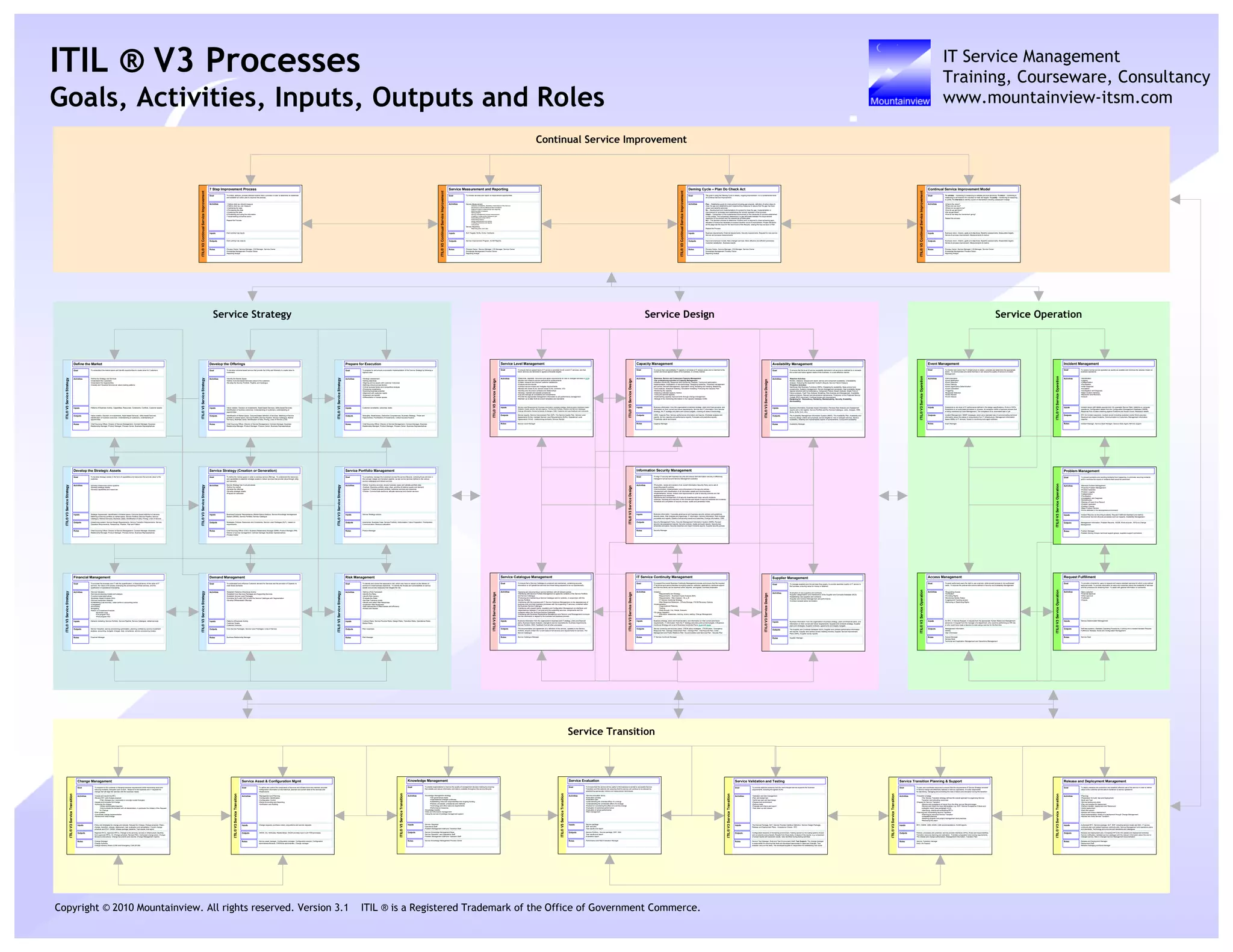
ITIL ® V3 Processes

IT Service Management
Training, Courseware, Consultancy
www.mountainview-itsm.com

Goals, Activities, Inputs, Outputs and Roles

To collect, analyze, process relevant metrics from a process in order to determine its weakness
and establish an action plan to improve the process.

Activities

1 Define what you should measure
2 Define what you can measure
3 Gathering the data
4 Processing the data
5 Analyzing the data
6 Presenting and using the information
7 Implementing corrective action
Repeat the Process

Inputs

Each activity has inputs

Outputs

Each activity has outputs

Roles

Process Owner, Service Manager, CSI Manager, Service Owner
Knowledge Management Process Owner
Reporting Analyst

Service Measurement and Reporting
Goal

To monitor services and report on improvement opportunities

Activities

Service Measurement
•Objective (Availability, Reliability, Performance of the Service)
•Developing a Service Measurement Framework
•Different levels of measurement and reporting
•Defining what to measure
•Setting targets
•Service management process measurement
•Creating a measurement framework grid
•Interpreting and using metrics
•Interpreting metrics
•Using measurement and metrics
•Creating scorecards and reports
•CSI policies

Service Reporting
•Reporting policy and rules

Inputs

SLA Targets, SLRs, OLAs, Contracts

Outputs

Service Improvement Program, SLAM Reports

Roles

Process Owner, Service Manager, CSI Manager, Service Owner
Knowledge Management Process Owner
Reporting Analyst

Service Strategy

Deming Cycle – Plan Do Check Act
Goal

The goal in using the Deming Cycle is steady, ongoing improvement. It is a fundamental tenet
of Continual Service Improvement.

Activities

ITIL® V3 Continual Service Improvement

Goal

ITIL® V3 Continual Service Improvement

7 Step Improvement Process

ITIL® V3 Continual Service Improvement

ITIL® V3 Continual Service Improvement

Continual Service Improvement

Plan – Establishes goals for improvement including gap analysis, definition of action steps to
close the gap and establishing and implementing measures to assure that the gap has been
closed and benefits achieved.
Do – Development and implementation of a project to close the gap. Implementation or
improvement of processes and establishing the smooth operation of the process.
Check – Comparison of the implemented environment to the measures of success established
in Plan phase. The comparison determines if a gap still exists between the improvement
objectives of the process and the operational process state.
Act – The decision process to determine if further work is required to close remaining gaps,
allocation of resources necessary to support another round of improvement. Project decisions
at this stage are the input for the next round of the lifecycle, closing the loop as input in Plan.
Repeat the Process

Inputs

Business requirements, External requirements, Security requirements, Request for new service
Service and process measurements

Outputs

Improved employee morale, New changed services, More effective and efficient processes,
Customer satisfaction, Business results

Roles

Process Owner, Service Manager, CSI Manager, Service Owner
Knowledge Management Process Owner
Reporting Analyst

Continual Service Improvement Model
Goal

To validate – monitoring & measuring to validate previous decisions; To direct – monitoring &
measuring to set direction for activities to meet set targets. To justify – monitoring & measuring
to justify; To intervene to identify a point of intervention including subsequent change

Activities

•What is the vision?
•Where are we now?
•Where do we want to be?
•How do we get there?
•Did we get there?
•How do we keep the momentum going?
Repeat the process

Inputs

Business vision, mission, goals and objectives, Baseline assessments, Measurable targets,
Service & process improvement, Measurements & metrics

Outputs

Business vision, mission, goals and objectives, Baseline assessments, Measurable targets
Service & process improvement, Measurements & metrics

Roles

Process Owner, Service Manager, CSI Manager, Service Owner
Knowledge Management Process Owner
Reporting Analyst

Service Design

Service Operation

To ensure that an agreed level of IT service is provided for all current IT services, and that
future services are delivered to agreed achievable targets.

Goal

To ensure that cost-justifiable IT capacity in all areas of IT always exists and is matched to the
current and future agreed needs of the business, in a timely manner

Goal

To ensure that the level of service availability delivered in all services is matched to or exceeds
the current and future agreed needs of the business, in a cost-effective manner.

Goal

To monitor and control the IT infrastructure to detect, correlate and determine the appropriate
action. To communicate all events that has or can reduce the quality of service to Incident
Management.

Goal

To restore normal service operation as quickly as possible and minimize the adverse impact on
business operations.

Activities

•Determine, negotiate, document and agree requirements for new or changed services in SLRs
•Monitor and measure service performance achievements
•Collate, measure and improve customer satisfaction
•Produce service reports
•Conduct service review and instigate improvements
•Review and revise SLAs, service scope OLAs, contracts, UCs
•Develop and document contacts and relationships
•Develop, maintain and operate procedures
•Log and manage all complaints and compliments
•Provide the appropriate management information to aid performance management
•Maintain up-to-date SLM document templates and standards

Activities

•Business, Service and Component Capacity Management
•The underpinning activities of Capacity Management:
Utilization monitoring, Response time monitoring, Analysis, Tuning and optimization,
Implementation, Exploitation of new technology, Designing resilience, Threshold management
and control, Demand Management, Application sizing, Modeling and trending, Baselining,
Trend analysis, Analytical modeling, Simulation modeling, Producing the Capacity Plan
-Monitoring the capacity
-Analyzing collected capacity metrics
-Tuning for optimal capacity
-Implementing capacity improvements through change management
-Storage of the monitoring information in the Capacity Database (CDB)

Activities

•Reactive Activities:
Monitor, measure, analyse and report, service and component availability, Unavailability
analysis, Analyzing the expanded Incident Lifecycle, Service Failure Analysis
•Proactive Activities:
Identifying Vital Business Functions (VBFs), Designing for availability, Base product and
components, Systems management, Service Management processes, High-availability design
Special solutions with full redundancy, Component Failure Impact Analysis, Single Point of
Failure analysis, Fault Tree Analysis, Modelling, Risk Analysis and Management, Availability
testing schedule, Planned and preventative maintenance, Production of the Projected Service
Outage (PSO) document, Continual review and improvement
Designing for: Redundancy, Reliability, Maintainability, Security, Scalability,
Serviceability

Activities

•Instrumentation
•Event Notification
•Event Detection
•Event Filtering
•Event Significance Determination
•Event Correlation
•Triggering
•Response Selection
•Action Review
•Event Closure

Activities

•Identification
•Logging
•Categorization
•Prioritization
•Initial Diagnosis
•Escalation
•Investigation and Diagnosis
•Major Incident Handling
•Resolution and Recovery
•Closure

Inputs

Patterns of Business Activity, Capabilities, Resources, Constraints, Conflicts, Customer assets

Inputs

Value creation, Decision on investments, Asset-based Services, Utility-based Services,
Identification of business outcomes, Understanding of customers, understanding of
opportunities

Inputs

Customer constraints, outcomes, tasks

Inputs

Service Level Requirements, Business information: business strategy, financial plans, Business Impact
Analysis: impact, priority, risk and urgency, The Service Portfolio, Pipeline and Service Catalogue,
Change information: forward schedule of changes, CMS, Customer and user feedback and comments

Inputs

Business information: from the organization’s business strategy, plans and financial plans, and
information on their current and future requirements, Service and IT information: from Service
Strategy, the IT strategy and plans and current budgets, covering all areas of technology

Inputs

Business information, Business impact information, Previous Risk Analysis and Assessment
reports and a risk register, Service Portfolio and the Service Catalogue, costs, changes, CMS,
SLAs, SLRs, OLA, UCs

Inputs

Exceptions to any level of CI performance defined in the design specifications, OLAs or SOPs
Exceptions to an automated procedure or process, An exception within a business process that
is being monitored by Event Management, The completion of an automated task or job

Inputs

Incident record with details sourced from (for example) Service Desk, networks or computer
operations, Configuration details from the Configuration Management Database (CMDB),
Response from Incident matching against Problems and Known Errors, Resolution details

Outputs

Value creation, Decision on investments, Asset-based Services, Utility-based Services,
Identification of business outcomes, Understanding of customers, understanding of
opportunities

Outputs

Identification of Market space, Outcome-based definition of services, Matching of Service
portfolio to market space, Service Portfolio (Service Pipeline, Service Catalogue, Retired
Services), Business cases, Identification of risks, Pricing, Lines of Service (LOS)

Outputs

Strengths, Weaknesses, Distinctive Competencies, Business Strategy, Threat and
Opportunities, Prioritization of Investments, Critical Success Factors

Outputs

Service reports, Service Improvement Plan (SIP), The Service Quality Plan, Service Level
Agreements (SLAs), Updated Service Level Requirements (SLRs), Operational Level
Agreements (OLAs), underpinning contracts, Service Review

Outputs

CMIS, Capacity Plan, Service performance information and reports, Workload analysis and
reports, Ad hoc capacity and performance reports, Forecasts and predictive reports,
Thresholds, alerts and events

Outputs

The Availability Management Information System (AMIS), The Availability Plan, Availability and
recovery design criteria and proposed, service targets for new or changed services, Service
availability, reliability and maintainability reports of achievements, Component availability

Outputs

Incident Management, SNMP messages, which are a standard way of communicating technical
information about the status of components of an IT Infrastructure, Management Information
Bases (MIBs) of IT devices, Vendor’s monitoring tools agent software

Outputs

RFC for Incident resolution; Incident record (including resolution and/or Work-arounds),
Resolved and closed Incidents, Communication to Customers, Management information
(reports)

Roles

Chief Sourcing Officer; Director of Service Management; Contract Manager; Business
Relationship Manager; Product Manager; Process Owner; Business Representatives

Roles

Chief Sourcing Officer; Director of Service Management; Contract Manager; Business
Relationship Manager; Product Manager; Process Owner; Business Representatives

Roles

Chief Sourcing Officer; Director of Service Management; Contract Manager; Business
Relationship Manager; Product Manager; Process Owner; Business Representatives

Roles

Service Level Manager

Roles

Capacity Manager

Roles

Availability Manager

Roles

Event Manager

Roles

Incident Manager, Service Desk Manager, Service Desk Agent, Nth-line support

ITIL® V3 Service Operation

Incident Management

Goal

•Strategic assessment
•Setting objectives
•Aligning service assets with customer Outcomes
•Defining critical success factors
•Critical success factors and competitive analysis
•Prioritizing investments
•Exploring business potential
•Alignment with customer needs
•Expansion and growth
•Differentiation in market spaces

ITIL® V3 Service Operation

Event Management

To prepare for and ensure a successful implementation of the Service Strategy by following a
rigorous plan.

Activities

ITIL® V3 Service Design

Availability Management

Goal

•Identify the Market Space
•Define Outcome-based Services (value to the customer)
•Develop the Service Portfolio, Pipeline and Catalogue

ITIL® V3 Service Design

Capacity Management

To develop outcome-based service that provide the Utility and Warranty to create value to
customers.

Activities

ITIL® V3 Service Design

Service Level Management

Goal

•Define the Strategy and Services
•Understand the Customers
•Understand the Opportunities
•Classify and Visualize Services as value-creating patterns

ITIL® V3 Service Strategy

Prepare for Execution

To understand the market space and identify opportunities to create value for Customers.

Activities

ITIL® V3 Service Strategy

Develop the Offerings

Goal

ITIL® V3 Service Strategy

Define the Market

Goal

To proactively manage the investment across the service lifecycle, including those services in
the concept, design and transition pipeline, as well as live services defined in the various
service catalogues and retired services

Goal

To align IT security with business security and ensure that information security is effectively
managed in all service and Service Management activities

Goal

To prevent problems and resulting incidents from happening, to eliminate recurring incidents
and to minimize the impact of incidents that cannot be prevented

Service Strategy has 4 sub-processes
•Define the market
•Develop the offerings
•Develop strategic assets
•Prepare for execution

Activities

•Define: Inventory services, ensure business cases and validate portfolio data
•Analyze: Maximize portfolio value, align, prioritize & balance supply and demand
•Approve: Finalize proposed portfolio, authorize services and resources
•Charter: Communicate decisions, allocate resources and charter services

Activities

•Production, review and revision of an overall Information Security Policy and a set of
supporting specific policies
•Communication, implementation and enforcement of the security policies
•Assessment and classification of all information assets and documentation
•Implementation, review, revision and improvement of a set of security controls and risk
assessment and responses
•Monitoring and management of all security breaches and major security incidents
•Analysis, reporting and reduction of the volumes and impact of security breaches and incidents
•Schedule and completion of security reviews, audits and penetration tests.

Activities

•Reactive Problem Management
•Proactive Problem Management
•Problem Detection
•Problem Logging
•Categorization
•Prioritization
•Investigation and Diagnosis
•Workarounds
•Raising a Known Error Record
•Problem resolution
•Problem Closure
•Major Problem Review
•Errors detected in the development environment

Inputs

Strategic Assessment, Identification of Market space, Outcome-based definition of services,
Matching of Service portfolio to market space, Service Portfolio (Service Pipeline, Service
Catalogue, Retired Services), Business cases, Identification of risks, Pricing, Lines of Service

Inputs

Business/Customer Requirements; Market Space Analysis; Service Knowledge Management
System (SKMS); Service Portfolio; Service Catalogue

Inputs

Service Strategy outputs

Inputs

Business information. Corporate governance and business security policies and guidelines,
security plans, Risk Analysis and responses, IT information, Service information, Risk Analysis
processes and reports, Details of all security events and breaches, Change information, CMS

Inputs

Incident Records via recurring incidents, Request Fulfillment feedback and metrics.
All proactive Service Lifecycle processes such as Capacity, Availability Management

Outputs

Closed-loop system, Service Design Requirements, Service Transition Requirements, Service
Operation Requirements, Perspective, Position, Plan and Pattern

Outputs

Strategies; Policies; Resources and Constraints; Service Level Packages (SLP) - based on
requirements

Outputs

Inventories; Business Case; Service Portfolio; Authorization; Value Proposition; Prioritization;
Communication; Resource allocation

Outputs

Security Management Policy, Security Management Information System (SMIS), Revised
security risk assessment reports, Security controls, Audits and audit reports, Security test
schedules and plans, Security breaches and major Incidents reports, Supplier security policies

Outputs

Management Information, Problem Records , KEDB, Work-arounds , RFCs to Change
Management

Roles

Chief Sourcing Officer; Director of Service Management; Contract Manager; Business
Relationship Manager; Product Manager; Process Owner; Business Representatives

Roles

Chief Sourcing Officer (CSO); Business Relationship Manager (BRM); Product Manager (PM)
Director of service management; Contract manager; Business representatives
Process Owner

Roles

Product Manager

Roles

Security Manager

Roles

Problem Manager
Problem Solving Groups: technical support groups, suppliers support contractors

ITIL® V3 Service Operation

Problem Management

To define the market space in order to develop service offerings. To understand the resources
and capabilities to establish strategic assets to deliver services that provide value through utility
and warranty

Activities

ITIL® V3 Service Design

Information Security Management

Goal

•Develop closed-loop control systems
•Develop strategic assets
•Develop capabilities and resources

ITIL® V3 Service Strategy

Service Portfolio Management

To develop strategic assets in the form of capabilities and resources that provide value to the
customer.

Activities

ITIL® V3 Service Strategy

Service Strategy (Creation or Generation)

Goal

ITIL® V3 Service Strategy

Develop the Strategic Assets

To ensure that a Service Catalogue is produced and maintained, containing accurate
information on all operational services and those being prepared to be run operationally.

Goal

To support the overall Business Continuity Management process and ensure that the required
IT technical and service facilities (including systems, networks, applications, technical support
and Service Desk) can be resumed within required, and agreed, business timescales

Goal

To manage suppliers and the services they supply, to provide seamless quality of IT service to
the business, ensuring value for money is obtained

Goal

To grant authorized users the right to use a service, while prevent access to non-authorized
users. To execute the policies and actions defined in Security and Availability Management.

Goal

To provide a channel for users to request and receive standard services for which a pre-defined
approval exists To provide information to users and customers about the availability of services
and the procedure for obtaining them. To assist with general information or comments.

Activities

•Agreeing and documenting a service definition with all relevant parties
•Interfacing with Service Portfolio Management to agree the contents of the Service Portfolio
and Service Catalogue
•Producing and maintaining a Service Catalogue and its contents, in conjunction with the
Service Portfolio
•Interfacing with the business and IT Service Continuity Management on the dependencies of
business units and their business processes with the supporting IT services, contained within
the Business Service Catalogue
•Interfacing with support teams, suppliers and Configuration Management on interfaces and
•dependencies between IT services and the supporting services, components and CIs
contained within the Technical Service Catalogue
•Interfacing with Business Relationship Management and Service Level Management to ensure
that the information is aligned to the business and business process.

Activities

•Initiation
•Requirements and Strategy
•Requirements – Business Impact Analysis (BIA)
•Requirements - Risk Analysis – M_o_R
•IT Service Continuity Strategy
•Risk Response Measures , Off-site Storage, ITSCM Recovery Options
•Implementation
•Organizational Planning
•Testing
•Walk-through, Full, Partial, Scenario
•On-going Operation
•Education, awareness, training, review, testing, Change Management
•Invocation

Activities

•Evaluation of new suppliers and contracts
•Supplier categorization and maintenance of the Supplier and Contracts Database (SCD)
•Establishing new suppliers and contracts
•Supplier and Contract Management and performance
•Contract renewal and/or termination

Activities

•Requesting Access
•Verification
•Providing Rights
•Monitoring Identity Status
•Logging and Tracking access
•Removing or Restricting Rights

Activities

•Menu selection
•Financial approval
•Other approval
•Fulfillment
•Closure

Inputs

Demand modeling, Service Portfolio, Service Pipeline, Service Catalogue, retired services

Inputs

Patterns of Business Activity
Customer Assets
Customer Outcome

Inputs

Contract Risks, Service Provider Risks, Design Risks, Transition Risks, Operational Risks,
Market Risks,

Inputs

Business information from the organization’s business and IT strategy, plans and financial
plans, Business Impact Analysis, changes to service requirements, Business requirements,
Service Portfolio, CMS, Feedback from all other processes

Inputs

Business strategy, plans and financial plans, and information on their current and future
requirements, IT information: from the IT strategy and plans and current budgets, A Business
Continuity Strategy and a set of Business Continuity Plans: SLAs and SLRs

Inputs

Business information: from the organization’s business strategy, plans and financial plans, and
information on their current and future requirements, Supplier and contracts strategy, Supplier
plans and strategies, Supplier contracts, agreements and targets, budgets

Inputs

An RFC, A Service Request, A request from the appropriate Human Resources Management
personnel, A request from the manager of a department, who could be performing an HR role,
or who could have made a decision to start using a service for the first time.

Inputs

Service Desk/Incident Management

Outputs

Service Valuation, service provisioning optimization, planning confidence, service investment
analysis, accounting, budgets, charges, fees, compliance, service provisioning models

Outputs

Core Service Packages; Service Level Packages; Lines of Service

Outputs

Risk responses

Outputs

The documentation and agreement of a ‘definition of the service’, Updates to the Service
Portfolio: should contain the current status of all services and requirements for services, The
Service Catalogue

Outputs

Service continuity and recovery plans, ITSCM policy strategies , ITSCM plans , Emergency
Response Plan, Damage Assessment Plan , Salvage Plan , Vital Records Plan, Crisis
Management and Public Relations Plan, Accommodation and Services Plan , Security Plan

Outputs

The Supplier and Contracts Database (SCD), Supplier and contract performance information
and reports, Supplier and contract review meeting minutes, Supplier Service Improvement
Plans (SIPs), Supplier survey reports

Outputs

Management Information
Identity
User information

Outputs

Self-help systems, Standard Operating Procedures, A strong link is needed between Request
Fulfillment, Release, Asset and Configuration Management

Roles

Financial Manager

Roles

Business Relationship Manager

Roles

Risk Manager

Roles

Service Catalogue Manager

Roles

IT Service Continuity Manager

Roles

Supplier Manager

Roles

Access Manager
Service Desk
Technical and Application Management and Operations Management

Roles

Service Desk

ITIL® V3 Service Operation

Request Fulfillment

Goal

•Define a Risk Framework
•Identify the Risks
•Identify Risk owners
•Evaluate the Risks
•Set Risk Tolerance levels
•Identify and select Risk Responses
•Implement Risk Responses
•Gain assurances of effectiveness and efficiency
•Embed and Review

ITIL® V3 Service Operation

Access Management

To identify and control the exposure to risk, which may have an impact on the delivery of
services to meet business objectives. To identify the threats and vulnerabilities on service
assets and provide measures that mitigate the risk

Activities

ITIL® V3 Service Design

Supplier Management

Goal

•Establish Patterns of Business Activity
•Establish Core Services Packages and Supporting Services
•Establish Service Level Packages
•Combine SLPs with CSP to build the Service Catalogue with Segmentation
•Develop Differentiated Offerings

ITIL® V3 Service Design

IT Service Continuity Management

To understand and influence Customer demand for Services and the provision of Capacity to
meet these demands

Activities

ITIL® V3 Service Design

Service Catalogue Management

Goal

•Service Valuation
•Service provisioning models and analysis
•Funding model alternatives
•Business Impact Analysis (BIA)
•Service Investment Analysis
•Establishing Cost recovery, value centre or accounting centre
•Chargeback
•Accounting
•Budgeting
•Return on Investment Analysis
•Business Case
•Pre-program ROI
•Post-program ROI

ITIL® V3 Service Strategy

Risk Management

To provides the business and IT with the quantification, in financial terms, of the value of IT
services, the value of the assets underlying the provisioning of those services, and the
qualification of operational forecasting.

Activities

ITIL® V3 Service Strategy

Demand Management

Goal

ITIL® V3 Service Strategy

Financial Management

Service Transition

Goal

To Ensure that the service will be useful to the business is central to successful Service
Transition and this extends into ensuring that the service will continue to be relevant by
establishing appropriate metrics and measurement techniques.

Goal

To provide objective evidence that the new/changed service supports the business
requirements, including the agreed SLAs.

Goal

To plan and coordinate resources to ensure that the requirements of Service Strategy encoded
in Service Design are effectively realized in Service Operations. It is also responsible
for identifying, managing and controlling the risks of failure and disruption during the transition

Goal

To deploy releases into production and establish effective use of the service in order to deliver
value to the customer and be able to handover to service operations.

•Knowledge Management strategy
•The governance model
•Organizational changes underway
•Establishing roles and responsibilities and ongoing funding
•Policies, processes, procedures and methods
•Technology and other resource requirements
•Performance measures.
•Knowledge transfer
•Data and information management
•Using the service knowledge management system

Activities

•Service evaluation terms
•Evaluation process
•Evaluation plan
•Understanding the intended effect of a change
•Understanding the unintended effect of a change
•Factors for considering the effect of a service change
•Evaluation of predicted performance
•Evaluation of actual performance
•Risk management

Activities

•Validation and test management
•Plan and design test
•Verify test plan and test design
•Prepare test environment
•Perform tests
•Evaluate exit criteria and report
•Test clean up and closure

Activities

•Transition strategy
•The Service Transition strategy defines the overall approach to organizing Service
Transition and allocating resources.
•Prepare for Service Transition
•Review and acceptance of inputs from the other service lifecycle stages
•Review and check the input deliverables, e.g. SDP, Service Acceptance Criteria and
evaluation report (see paragraph 4.6.6)
•Identifying, raising and scheduling RFCs
•Planning and coordinating Service Transition
•Planning an individual Service Transition
•Integrated planning
•Adopting program and project management best practices
•Reviewing the plans

Activities

•Planning
•Preparation for build, test and Deployment
•Build and Test
•Service testing and pilots
•Plan and prepare for deployment
•Perform transfer, deployment and Retirement
•Verify deployment
•Early life support
•Review and close a deployment
•Post implementation review of a deployment through Change Management.
•Review and close Service Transition

Inputs

Policy and strategies for change and release; Request for Change; Change proposal, Plans –
change, transition, release, deployment, test, evaluation and remediation, Current change
schedule and PSO, CMDB, release package, baseline, Test results, test report

Inputs

Change requests, purchase orders, acquisitions and service requests.

Inputs

Service Operation
Operations Staff
Problem Management Staff and Transition Staff

Inputs

Service package
SDP and SAC
Test results and report.

Inputs

The Service Package, SLP, Service Provider Interface Definition, Service Design Package,
Release and Deployment Plans , Acceptance Criteria , RFC

Inputs

RFC, CMDB, CMS, SKMS, CAB recommendations, SLAM reports

Inputs

Authorized RFC, Service package, SLP, SDP, including service model and SAC, IT service
continuity plan and related business continuity plan, Service Management and operations plans
and standards, Technology and procurement standards and catalogues

Outputs

Rejected RFCs, Approved RFCs, Change to the services, service or infrastructure resulting
from approved RFCs, CI, Change schedule, Revised PSO, Authorized change plans, Change
decisions and actions, Change documents and records, Change Management reports.

Outputs

CMDB, CIs, Attributes, Relationships, SACM provides input to all ITSM processes

Outputs

Service Knowledge Management Base
Service Operation and Operations Staff
Problem Management Staff and Transition Staff

Outputs

Service Portfolio , Service package, SDP, SAC
Test results and report
Evaluation report.

Outputs

Configuration baseline of the testing environment, Testing carried out (including options chosen
and constraints encountered), Results from those tests, Analysis of the results, e.g. comparison
of actual results with expected results, risks identified during testing activities.

Outputs

Policies, processes and practices; service provider interfaces (SPIs), Roles and responsibilities,
Transition resource planning and estimation, Transition preparation and training requirements,
The release and change authorization, Management Information, Transition Plan

Outputs

Release and deployment plan, Completed RFCs for the release and deployment activities
Service notification, Updated service catalogue with the relevant information about the new or
changed service, New or changed Service Management documentation

Roles

Change Manager
Change Authority
Change Advisory Board (CAB) and Emergency CAB (ECAB)

Roles

Service asset manager, Configuration manager, Configuration analyst, Configuration
administrator/librarian, CMS/tools administrator, Change manager

Roles

Service Knowledge Management Process Owner

Roles

Performance and Risk Evaluation Manager

Roles

Service Test Manager, Build and Test Environment Staff; Test Support: The change manager
is responsible for ensuring that tests are developed appropriate to approved changes, Test
analysts carry out the tests, The developer/supplier is responsible for establishing root cause

Roles

Service Transition manager
Early Life Support

Roles

Release and Deployment Manager
Deployment Staff
Release Packaging and Build Manager

Copyright © 2010 Mountainview. All rights reserved. Version 3.1

ITIL ® is a Registered Trademark of the Office of Government Commerce.

ITIL® V3 Service Transition

Release and Deployment Management

To enable organizations to improve the quality of management decision making by ensuring
that reliable and secure information and data is available throughout the service lifecycle.

Activities

ITIL® V3 Service Transition

Service Transition Planning & Support

Goal

•Management and Planning
•Configuration Identification
•Configuration Control
•Status Accounting and Reporting
•Verification and Auditing

ITIL® V3 Service Transition

Service Validation and Testing

To define and control the components of services and infrastructure and maintain accurate
configuration information on the historical, planned and current state of the services and
infrastructure.

Activities

ITIL® V3 Service Transition

Service Evaluation

Goal

•Create and record the RFC
•Review RFC and change proposal:
•Filter changes (e.g. incomplete or wrongly routed changes)
•Assess and evaluate the change:
•Authorize the change:
•Obtain authorization/rejection
•Communicate the decision with all stakeholders, in particular the initiator of the Request
for Change
•Plan updates
•Coordinate change implementation
•Review and close change

ITIL® V3 Service Transition

Knowledge Management

To respond to the customer’s changing business requirements while maximizing value and
reducing incidents, disruption and re-work. Respond to the business and IT requests for
change that will align the services with the business needs.

Activities

ITIL® V3 Service Transition

Service Asset & Configuration Mgmt

Goal

ITIL® V3 Service Transition

Change Management

Mountainview ITSM: ITIL Edition 2007 Process Poster

  • 1.
    ITIL ® V3Processes IT Service Management Training, Courseware, Consultancy www.mountainview-itsm.com Goals, Activities, Inputs, Outputs and Roles To collect, analyze, process relevant metrics from a process in order to determine its weakness and establish an action plan to improve the process. Activities 1 Define what you should measure 2 Define what you can measure 3 Gathering the data 4 Processing the data 5 Analyzing the data 6 Presenting and using the information 7 Implementing corrective action Repeat the Process Inputs Each activity has inputs Outputs Each activity has outputs Roles Process Owner, Service Manager, CSI Manager, Service Owner Knowledge Management Process Owner Reporting Analyst Service Measurement and Reporting Goal To monitor services and report on improvement opportunities Activities Service Measurement •Objective (Availability, Reliability, Performance of the Service) •Developing a Service Measurement Framework •Different levels of measurement and reporting •Defining what to measure •Setting targets •Service management process measurement •Creating a measurement framework grid •Interpreting and using metrics •Interpreting metrics •Using measurement and metrics •Creating scorecards and reports •CSI policies Service Reporting •Reporting policy and rules Inputs SLA Targets, SLRs, OLAs, Contracts Outputs Service Improvement Program, SLAM Reports Roles Process Owner, Service Manager, CSI Manager, Service Owner Knowledge Management Process Owner Reporting Analyst Service Strategy Deming Cycle – Plan Do Check Act Goal The goal in using the Deming Cycle is steady, ongoing improvement. It is a fundamental tenet of Continual Service Improvement. Activities ITIL® V3 Continual Service Improvement Goal ITIL® V3 Continual Service Improvement 7 Step Improvement Process ITIL® V3 Continual Service Improvement ITIL® V3 Continual Service Improvement Continual Service Improvement Plan – Establishes goals for improvement including gap analysis, definition of action steps to close the gap and establishing and implementing measures to assure that the gap has been closed and benefits achieved. Do – Development and implementation of a project to close the gap. Implementation or improvement of processes and establishing the smooth operation of the process. Check – Comparison of the implemented environment to the measures of success established in Plan phase. The comparison determines if a gap still exists between the improvement objectives of the process and the operational process state. Act – The decision process to determine if further work is required to close remaining gaps, allocation of resources necessary to support another round of improvement. Project decisions at this stage are the input for the next round of the lifecycle, closing the loop as input in Plan. Repeat the Process Inputs Business requirements, External requirements, Security requirements, Request for new service Service and process measurements Outputs Improved employee morale, New changed services, More effective and efficient processes, Customer satisfaction, Business results Roles Process Owner, Service Manager, CSI Manager, Service Owner Knowledge Management Process Owner Reporting Analyst Continual Service Improvement Model Goal To validate – monitoring & measuring to validate previous decisions; To direct – monitoring & measuring to set direction for activities to meet set targets. To justify – monitoring & measuring to justify; To intervene to identify a point of intervention including subsequent change Activities •What is the vision? •Where are we now? •Where do we want to be? •How do we get there? •Did we get there? •How do we keep the momentum going? Repeat the process Inputs Business vision, mission, goals and objectives, Baseline assessments, Measurable targets, Service & process improvement, Measurements & metrics Outputs Business vision, mission, goals and objectives, Baseline assessments, Measurable targets Service & process improvement, Measurements & metrics Roles Process Owner, Service Manager, CSI Manager, Service Owner Knowledge Management Process Owner Reporting Analyst Service Design Service Operation To ensure that an agreed level of IT service is provided for all current IT services, and that future services are delivered to agreed achievable targets. Goal To ensure that cost-justifiable IT capacity in all areas of IT always exists and is matched to the current and future agreed needs of the business, in a timely manner Goal To ensure that the level of service availability delivered in all services is matched to or exceeds the current and future agreed needs of the business, in a cost-effective manner. Goal To monitor and control the IT infrastructure to detect, correlate and determine the appropriate action. To communicate all events that has or can reduce the quality of service to Incident Management. Goal To restore normal service operation as quickly as possible and minimize the adverse impact on business operations. Activities •Determine, negotiate, document and agree requirements for new or changed services in SLRs •Monitor and measure service performance achievements •Collate, measure and improve customer satisfaction •Produce service reports •Conduct service review and instigate improvements •Review and revise SLAs, service scope OLAs, contracts, UCs •Develop and document contacts and relationships •Develop, maintain and operate procedures •Log and manage all complaints and compliments •Provide the appropriate management information to aid performance management •Maintain up-to-date SLM document templates and standards Activities •Business, Service and Component Capacity Management •The underpinning activities of Capacity Management: Utilization monitoring, Response time monitoring, Analysis, Tuning and optimization, Implementation, Exploitation of new technology, Designing resilience, Threshold management and control, Demand Management, Application sizing, Modeling and trending, Baselining, Trend analysis, Analytical modeling, Simulation modeling, Producing the Capacity Plan -Monitoring the capacity -Analyzing collected capacity metrics -Tuning for optimal capacity -Implementing capacity improvements through change management -Storage of the monitoring information in the Capacity Database (CDB) Activities •Reactive Activities: Monitor, measure, analyse and report, service and component availability, Unavailability analysis, Analyzing the expanded Incident Lifecycle, Service Failure Analysis •Proactive Activities: Identifying Vital Business Functions (VBFs), Designing for availability, Base product and components, Systems management, Service Management processes, High-availability design Special solutions with full redundancy, Component Failure Impact Analysis, Single Point of Failure analysis, Fault Tree Analysis, Modelling, Risk Analysis and Management, Availability testing schedule, Planned and preventative maintenance, Production of the Projected Service Outage (PSO) document, Continual review and improvement Designing for: Redundancy, Reliability, Maintainability, Security, Scalability, Serviceability Activities •Instrumentation •Event Notification •Event Detection •Event Filtering •Event Significance Determination •Event Correlation •Triggering •Response Selection •Action Review •Event Closure Activities •Identification •Logging •Categorization •Prioritization •Initial Diagnosis •Escalation •Investigation and Diagnosis •Major Incident Handling •Resolution and Recovery •Closure Inputs Patterns of Business Activity, Capabilities, Resources, Constraints, Conflicts, Customer assets Inputs Value creation, Decision on investments, Asset-based Services, Utility-based Services, Identification of business outcomes, Understanding of customers, understanding of opportunities Inputs Customer constraints, outcomes, tasks Inputs Service Level Requirements, Business information: business strategy, financial plans, Business Impact Analysis: impact, priority, risk and urgency, The Service Portfolio, Pipeline and Service Catalogue, Change information: forward schedule of changes, CMS, Customer and user feedback and comments Inputs Business information: from the organization’s business strategy, plans and financial plans, and information on their current and future requirements, Service and IT information: from Service Strategy, the IT strategy and plans and current budgets, covering all areas of technology Inputs Business information, Business impact information, Previous Risk Analysis and Assessment reports and a risk register, Service Portfolio and the Service Catalogue, costs, changes, CMS, SLAs, SLRs, OLA, UCs Inputs Exceptions to any level of CI performance defined in the design specifications, OLAs or SOPs Exceptions to an automated procedure or process, An exception within a business process that is being monitored by Event Management, The completion of an automated task or job Inputs Incident record with details sourced from (for example) Service Desk, networks or computer operations, Configuration details from the Configuration Management Database (CMDB), Response from Incident matching against Problems and Known Errors, Resolution details Outputs Value creation, Decision on investments, Asset-based Services, Utility-based Services, Identification of business outcomes, Understanding of customers, understanding of opportunities Outputs Identification of Market space, Outcome-based definition of services, Matching of Service portfolio to market space, Service Portfolio (Service Pipeline, Service Catalogue, Retired Services), Business cases, Identification of risks, Pricing, Lines of Service (LOS) Outputs Strengths, Weaknesses, Distinctive Competencies, Business Strategy, Threat and Opportunities, Prioritization of Investments, Critical Success Factors Outputs Service reports, Service Improvement Plan (SIP), The Service Quality Plan, Service Level Agreements (SLAs), Updated Service Level Requirements (SLRs), Operational Level Agreements (OLAs), underpinning contracts, Service Review Outputs CMIS, Capacity Plan, Service performance information and reports, Workload analysis and reports, Ad hoc capacity and performance reports, Forecasts and predictive reports, Thresholds, alerts and events Outputs The Availability Management Information System (AMIS), The Availability Plan, Availability and recovery design criteria and proposed, service targets for new or changed services, Service availability, reliability and maintainability reports of achievements, Component availability Outputs Incident Management, SNMP messages, which are a standard way of communicating technical information about the status of components of an IT Infrastructure, Management Information Bases (MIBs) of IT devices, Vendor’s monitoring tools agent software Outputs RFC for Incident resolution; Incident record (including resolution and/or Work-arounds), Resolved and closed Incidents, Communication to Customers, Management information (reports) Roles Chief Sourcing Officer; Director of Service Management; Contract Manager; Business Relationship Manager; Product Manager; Process Owner; Business Representatives Roles Chief Sourcing Officer; Director of Service Management; Contract Manager; Business Relationship Manager; Product Manager; Process Owner; Business Representatives Roles Chief Sourcing Officer; Director of Service Management; Contract Manager; Business Relationship Manager; Product Manager; Process Owner; Business Representatives Roles Service Level Manager Roles Capacity Manager Roles Availability Manager Roles Event Manager Roles Incident Manager, Service Desk Manager, Service Desk Agent, Nth-line support ITIL® V3 Service Operation Incident Management Goal •Strategic assessment •Setting objectives •Aligning service assets with customer Outcomes •Defining critical success factors •Critical success factors and competitive analysis •Prioritizing investments •Exploring business potential •Alignment with customer needs •Expansion and growth •Differentiation in market spaces ITIL® V3 Service Operation Event Management To prepare for and ensure a successful implementation of the Service Strategy by following a rigorous plan. Activities ITIL® V3 Service Design Availability Management Goal •Identify the Market Space •Define Outcome-based Services (value to the customer) •Develop the Service Portfolio, Pipeline and Catalogue ITIL® V3 Service Design Capacity Management To develop outcome-based service that provide the Utility and Warranty to create value to customers. Activities ITIL® V3 Service Design Service Level Management Goal •Define the Strategy and Services •Understand the Customers •Understand the Opportunities •Classify and Visualize Services as value-creating patterns ITIL® V3 Service Strategy Prepare for Execution To understand the market space and identify opportunities to create value for Customers. Activities ITIL® V3 Service Strategy Develop the Offerings Goal ITIL® V3 Service Strategy Define the Market Goal To proactively manage the investment across the service lifecycle, including those services in the concept, design and transition pipeline, as well as live services defined in the various service catalogues and retired services Goal To align IT security with business security and ensure that information security is effectively managed in all service and Service Management activities Goal To prevent problems and resulting incidents from happening, to eliminate recurring incidents and to minimize the impact of incidents that cannot be prevented Service Strategy has 4 sub-processes •Define the market •Develop the offerings •Develop strategic assets •Prepare for execution Activities •Define: Inventory services, ensure business cases and validate portfolio data •Analyze: Maximize portfolio value, align, prioritize & balance supply and demand •Approve: Finalize proposed portfolio, authorize services and resources •Charter: Communicate decisions, allocate resources and charter services Activities •Production, review and revision of an overall Information Security Policy and a set of supporting specific policies •Communication, implementation and enforcement of the security policies •Assessment and classification of all information assets and documentation •Implementation, review, revision and improvement of a set of security controls and risk assessment and responses •Monitoring and management of all security breaches and major security incidents •Analysis, reporting and reduction of the volumes and impact of security breaches and incidents •Schedule and completion of security reviews, audits and penetration tests. Activities •Reactive Problem Management •Proactive Problem Management •Problem Detection •Problem Logging •Categorization •Prioritization •Investigation and Diagnosis •Workarounds •Raising a Known Error Record •Problem resolution •Problem Closure •Major Problem Review •Errors detected in the development environment Inputs Strategic Assessment, Identification of Market space, Outcome-based definition of services, Matching of Service portfolio to market space, Service Portfolio (Service Pipeline, Service Catalogue, Retired Services), Business cases, Identification of risks, Pricing, Lines of Service Inputs Business/Customer Requirements; Market Space Analysis; Service Knowledge Management System (SKMS); Service Portfolio; Service Catalogue Inputs Service Strategy outputs Inputs Business information. Corporate governance and business security policies and guidelines, security plans, Risk Analysis and responses, IT information, Service information, Risk Analysis processes and reports, Details of all security events and breaches, Change information, CMS Inputs Incident Records via recurring incidents, Request Fulfillment feedback and metrics. All proactive Service Lifecycle processes such as Capacity, Availability Management Outputs Closed-loop system, Service Design Requirements, Service Transition Requirements, Service Operation Requirements, Perspective, Position, Plan and Pattern Outputs Strategies; Policies; Resources and Constraints; Service Level Packages (SLP) - based on requirements Outputs Inventories; Business Case; Service Portfolio; Authorization; Value Proposition; Prioritization; Communication; Resource allocation Outputs Security Management Policy, Security Management Information System (SMIS), Revised security risk assessment reports, Security controls, Audits and audit reports, Security test schedules and plans, Security breaches and major Incidents reports, Supplier security policies Outputs Management Information, Problem Records , KEDB, Work-arounds , RFCs to Change Management Roles Chief Sourcing Officer; Director of Service Management; Contract Manager; Business Relationship Manager; Product Manager; Process Owner; Business Representatives Roles Chief Sourcing Officer (CSO); Business Relationship Manager (BRM); Product Manager (PM) Director of service management; Contract manager; Business representatives Process Owner Roles Product Manager Roles Security Manager Roles Problem Manager Problem Solving Groups: technical support groups, suppliers support contractors ITIL® V3 Service Operation Problem Management To define the market space in order to develop service offerings. To understand the resources and capabilities to establish strategic assets to deliver services that provide value through utility and warranty Activities ITIL® V3 Service Design Information Security Management Goal •Develop closed-loop control systems •Develop strategic assets •Develop capabilities and resources ITIL® V3 Service Strategy Service Portfolio Management To develop strategic assets in the form of capabilities and resources that provide value to the customer. Activities ITIL® V3 Service Strategy Service Strategy (Creation or Generation) Goal ITIL® V3 Service Strategy Develop the Strategic Assets To ensure that a Service Catalogue is produced and maintained, containing accurate information on all operational services and those being prepared to be run operationally. Goal To support the overall Business Continuity Management process and ensure that the required IT technical and service facilities (including systems, networks, applications, technical support and Service Desk) can be resumed within required, and agreed, business timescales Goal To manage suppliers and the services they supply, to provide seamless quality of IT service to the business, ensuring value for money is obtained Goal To grant authorized users the right to use a service, while prevent access to non-authorized users. To execute the policies and actions defined in Security and Availability Management. Goal To provide a channel for users to request and receive standard services for which a pre-defined approval exists To provide information to users and customers about the availability of services and the procedure for obtaining them. To assist with general information or comments. Activities •Agreeing and documenting a service definition with all relevant parties •Interfacing with Service Portfolio Management to agree the contents of the Service Portfolio and Service Catalogue •Producing and maintaining a Service Catalogue and its contents, in conjunction with the Service Portfolio •Interfacing with the business and IT Service Continuity Management on the dependencies of business units and their business processes with the supporting IT services, contained within the Business Service Catalogue •Interfacing with support teams, suppliers and Configuration Management on interfaces and •dependencies between IT services and the supporting services, components and CIs contained within the Technical Service Catalogue •Interfacing with Business Relationship Management and Service Level Management to ensure that the information is aligned to the business and business process. Activities •Initiation •Requirements and Strategy •Requirements – Business Impact Analysis (BIA) •Requirements - Risk Analysis – M_o_R •IT Service Continuity Strategy •Risk Response Measures , Off-site Storage, ITSCM Recovery Options •Implementation •Organizational Planning •Testing •Walk-through, Full, Partial, Scenario •On-going Operation •Education, awareness, training, review, testing, Change Management •Invocation Activities •Evaluation of new suppliers and contracts •Supplier categorization and maintenance of the Supplier and Contracts Database (SCD) •Establishing new suppliers and contracts •Supplier and Contract Management and performance •Contract renewal and/or termination Activities •Requesting Access •Verification •Providing Rights •Monitoring Identity Status •Logging and Tracking access •Removing or Restricting Rights Activities •Menu selection •Financial approval •Other approval •Fulfillment •Closure Inputs Demand modeling, Service Portfolio, Service Pipeline, Service Catalogue, retired services Inputs Patterns of Business Activity Customer Assets Customer Outcome Inputs Contract Risks, Service Provider Risks, Design Risks, Transition Risks, Operational Risks, Market Risks, Inputs Business information from the organization’s business and IT strategy, plans and financial plans, Business Impact Analysis, changes to service requirements, Business requirements, Service Portfolio, CMS, Feedback from all other processes Inputs Business strategy, plans and financial plans, and information on their current and future requirements, IT information: from the IT strategy and plans and current budgets, A Business Continuity Strategy and a set of Business Continuity Plans: SLAs and SLRs Inputs Business information: from the organization’s business strategy, plans and financial plans, and information on their current and future requirements, Supplier and contracts strategy, Supplier plans and strategies, Supplier contracts, agreements and targets, budgets Inputs An RFC, A Service Request, A request from the appropriate Human Resources Management personnel, A request from the manager of a department, who could be performing an HR role, or who could have made a decision to start using a service for the first time. Inputs Service Desk/Incident Management Outputs Service Valuation, service provisioning optimization, planning confidence, service investment analysis, accounting, budgets, charges, fees, compliance, service provisioning models Outputs Core Service Packages; Service Level Packages; Lines of Service Outputs Risk responses Outputs The documentation and agreement of a ‘definition of the service’, Updates to the Service Portfolio: should contain the current status of all services and requirements for services, The Service Catalogue Outputs Service continuity and recovery plans, ITSCM policy strategies , ITSCM plans , Emergency Response Plan, Damage Assessment Plan , Salvage Plan , Vital Records Plan, Crisis Management and Public Relations Plan, Accommodation and Services Plan , Security Plan Outputs The Supplier and Contracts Database (SCD), Supplier and contract performance information and reports, Supplier and contract review meeting minutes, Supplier Service Improvement Plans (SIPs), Supplier survey reports Outputs Management Information Identity User information Outputs Self-help systems, Standard Operating Procedures, A strong link is needed between Request Fulfillment, Release, Asset and Configuration Management Roles Financial Manager Roles Business Relationship Manager Roles Risk Manager Roles Service Catalogue Manager Roles IT Service Continuity Manager Roles Supplier Manager Roles Access Manager Service Desk Technical and Application Management and Operations Management Roles Service Desk ITIL® V3 Service Operation Request Fulfillment Goal •Define a Risk Framework •Identify the Risks •Identify Risk owners •Evaluate the Risks •Set Risk Tolerance levels •Identify and select Risk Responses •Implement Risk Responses •Gain assurances of effectiveness and efficiency •Embed and Review ITIL® V3 Service Operation Access Management To identify and control the exposure to risk, which may have an impact on the delivery of services to meet business objectives. To identify the threats and vulnerabilities on service assets and provide measures that mitigate the risk Activities ITIL® V3 Service Design Supplier Management Goal •Establish Patterns of Business Activity •Establish Core Services Packages and Supporting Services •Establish Service Level Packages •Combine SLPs with CSP to build the Service Catalogue with Segmentation •Develop Differentiated Offerings ITIL® V3 Service Design IT Service Continuity Management To understand and influence Customer demand for Services and the provision of Capacity to meet these demands Activities ITIL® V3 Service Design Service Catalogue Management Goal •Service Valuation •Service provisioning models and analysis •Funding model alternatives •Business Impact Analysis (BIA) •Service Investment Analysis •Establishing Cost recovery, value centre or accounting centre •Chargeback •Accounting •Budgeting •Return on Investment Analysis •Business Case •Pre-program ROI •Post-program ROI ITIL® V3 Service Strategy Risk Management To provides the business and IT with the quantification, in financial terms, of the value of IT services, the value of the assets underlying the provisioning of those services, and the qualification of operational forecasting. Activities ITIL® V3 Service Strategy Demand Management Goal ITIL® V3 Service Strategy Financial Management Service Transition Goal To Ensure that the service will be useful to the business is central to successful Service Transition and this extends into ensuring that the service will continue to be relevant by establishing appropriate metrics and measurement techniques. Goal To provide objective evidence that the new/changed service supports the business requirements, including the agreed SLAs. Goal To plan and coordinate resources to ensure that the requirements of Service Strategy encoded in Service Design are effectively realized in Service Operations. It is also responsible for identifying, managing and controlling the risks of failure and disruption during the transition Goal To deploy releases into production and establish effective use of the service in order to deliver value to the customer and be able to handover to service operations. •Knowledge Management strategy •The governance model •Organizational changes underway •Establishing roles and responsibilities and ongoing funding •Policies, processes, procedures and methods •Technology and other resource requirements •Performance measures. •Knowledge transfer •Data and information management •Using the service knowledge management system Activities •Service evaluation terms •Evaluation process •Evaluation plan •Understanding the intended effect of a change •Understanding the unintended effect of a change •Factors for considering the effect of a service change •Evaluation of predicted performance •Evaluation of actual performance •Risk management Activities •Validation and test management •Plan and design test •Verify test plan and test design •Prepare test environment •Perform tests •Evaluate exit criteria and report •Test clean up and closure Activities •Transition strategy •The Service Transition strategy defines the overall approach to organizing Service Transition and allocating resources. •Prepare for Service Transition •Review and acceptance of inputs from the other service lifecycle stages •Review and check the input deliverables, e.g. SDP, Service Acceptance Criteria and evaluation report (see paragraph 4.6.6) •Identifying, raising and scheduling RFCs •Planning and coordinating Service Transition •Planning an individual Service Transition •Integrated planning •Adopting program and project management best practices •Reviewing the plans Activities •Planning •Preparation for build, test and Deployment •Build and Test •Service testing and pilots •Plan and prepare for deployment •Perform transfer, deployment and Retirement •Verify deployment •Early life support •Review and close a deployment •Post implementation review of a deployment through Change Management. •Review and close Service Transition Inputs Policy and strategies for change and release; Request for Change; Change proposal, Plans – change, transition, release, deployment, test, evaluation and remediation, Current change schedule and PSO, CMDB, release package, baseline, Test results, test report Inputs Change requests, purchase orders, acquisitions and service requests. Inputs Service Operation Operations Staff Problem Management Staff and Transition Staff Inputs Service package SDP and SAC Test results and report. Inputs The Service Package, SLP, Service Provider Interface Definition, Service Design Package, Release and Deployment Plans , Acceptance Criteria , RFC Inputs RFC, CMDB, CMS, SKMS, CAB recommendations, SLAM reports Inputs Authorized RFC, Service package, SLP, SDP, including service model and SAC, IT service continuity plan and related business continuity plan, Service Management and operations plans and standards, Technology and procurement standards and catalogues Outputs Rejected RFCs, Approved RFCs, Change to the services, service or infrastructure resulting from approved RFCs, CI, Change schedule, Revised PSO, Authorized change plans, Change decisions and actions, Change documents and records, Change Management reports. Outputs CMDB, CIs, Attributes, Relationships, SACM provides input to all ITSM processes Outputs Service Knowledge Management Base Service Operation and Operations Staff Problem Management Staff and Transition Staff Outputs Service Portfolio , Service package, SDP, SAC Test results and report Evaluation report. Outputs Configuration baseline of the testing environment, Testing carried out (including options chosen and constraints encountered), Results from those tests, Analysis of the results, e.g. comparison of actual results with expected results, risks identified during testing activities. Outputs Policies, processes and practices; service provider interfaces (SPIs), Roles and responsibilities, Transition resource planning and estimation, Transition preparation and training requirements, The release and change authorization, Management Information, Transition Plan Outputs Release and deployment plan, Completed RFCs for the release and deployment activities Service notification, Updated service catalogue with the relevant information about the new or changed service, New or changed Service Management documentation Roles Change Manager Change Authority Change Advisory Board (CAB) and Emergency CAB (ECAB) Roles Service asset manager, Configuration manager, Configuration analyst, Configuration administrator/librarian, CMS/tools administrator, Change manager Roles Service Knowledge Management Process Owner Roles Performance and Risk Evaluation Manager Roles Service Test Manager, Build and Test Environment Staff; Test Support: The change manager is responsible for ensuring that tests are developed appropriate to approved changes, Test analysts carry out the tests, The developer/supplier is responsible for establishing root cause Roles Service Transition manager Early Life Support Roles Release and Deployment Manager Deployment Staff Release Packaging and Build Manager Copyright © 2010 Mountainview. All rights reserved. Version 3.1 ITIL ® is a Registered Trademark of the Office of Government Commerce. ITIL® V3 Service Transition Release and Deployment Management To enable organizations to improve the quality of management decision making by ensuring that reliable and secure information and data is available throughout the service lifecycle. Activities ITIL® V3 Service Transition Service Transition Planning & Support Goal •Management and Planning •Configuration Identification •Configuration Control •Status Accounting and Reporting •Verification and Auditing ITIL® V3 Service Transition Service Validation and Testing To define and control the components of services and infrastructure and maintain accurate configuration information on the historical, planned and current state of the services and infrastructure. Activities ITIL® V3 Service Transition Service Evaluation Goal •Create and record the RFC •Review RFC and change proposal: •Filter changes (e.g. incomplete or wrongly routed changes) •Assess and evaluate the change: •Authorize the change: •Obtain authorization/rejection •Communicate the decision with all stakeholders, in particular the initiator of the Request for Change •Plan updates •Coordinate change implementation •Review and close change ITIL® V3 Service Transition Knowledge Management To respond to the customer’s changing business requirements while maximizing value and reducing incidents, disruption and re-work. Respond to the business and IT requests for change that will align the services with the business needs. Activities ITIL® V3 Service Transition Service Asset & Configuration Mgmt Goal ITIL® V3 Service Transition Change Management