The Impact of Organisational
Capabilities on Project Success
A Formicio point of view
The purpose is to share a point of view on the impact of
organisational capabilities on project success
 Delivering projects – particularly those aimed at
implementing strategy – is a challenge for most
organisations
 What is often forgotten is that the purpose of
strategy implementation projects is to change
the trajectory of the organisation – and
increasingly that of its partners
 Successfully changing an organisation’s
trajectory involves understanding the
organisational capabilities that determine its
current trajectory – and then deciding how
their impact can be altered
 Organisational capabilities are like muscles –
the more they are used the stronger they get
© 2015 Copyright Formicio Limited 1
Our point of view is based
upon insights and
experience that we have
gained over time
----------
The aim is to inform and
inspire
The majority of projects fail to deliver their intended
outcomes
 According to John P Kotter, Professor Emeritus at
the Harvard Business School, only about 5% of
large-scale change projects are successful
 Research by the Standish Group covering 175,000
projects in the USA with a combined budget of
$250 billion, found that 53% overspent and 82%
overran
 Oxford University’s Said Business School analysed
1,500 global projects worth $245bn and concluded
that IT projects are 20 times more likely to fail than
large projects in other sectors, such as construction
 The evidence spanning the last 25 years indicates
that our ability to deliver successful projects has
not improved – and is arguably getting worse
© 2015 Copyright Formicio Limited 2
Traditional approaches to improving project success – that focus on the
‘mechanics’ of project management – are necessary but not sufficient
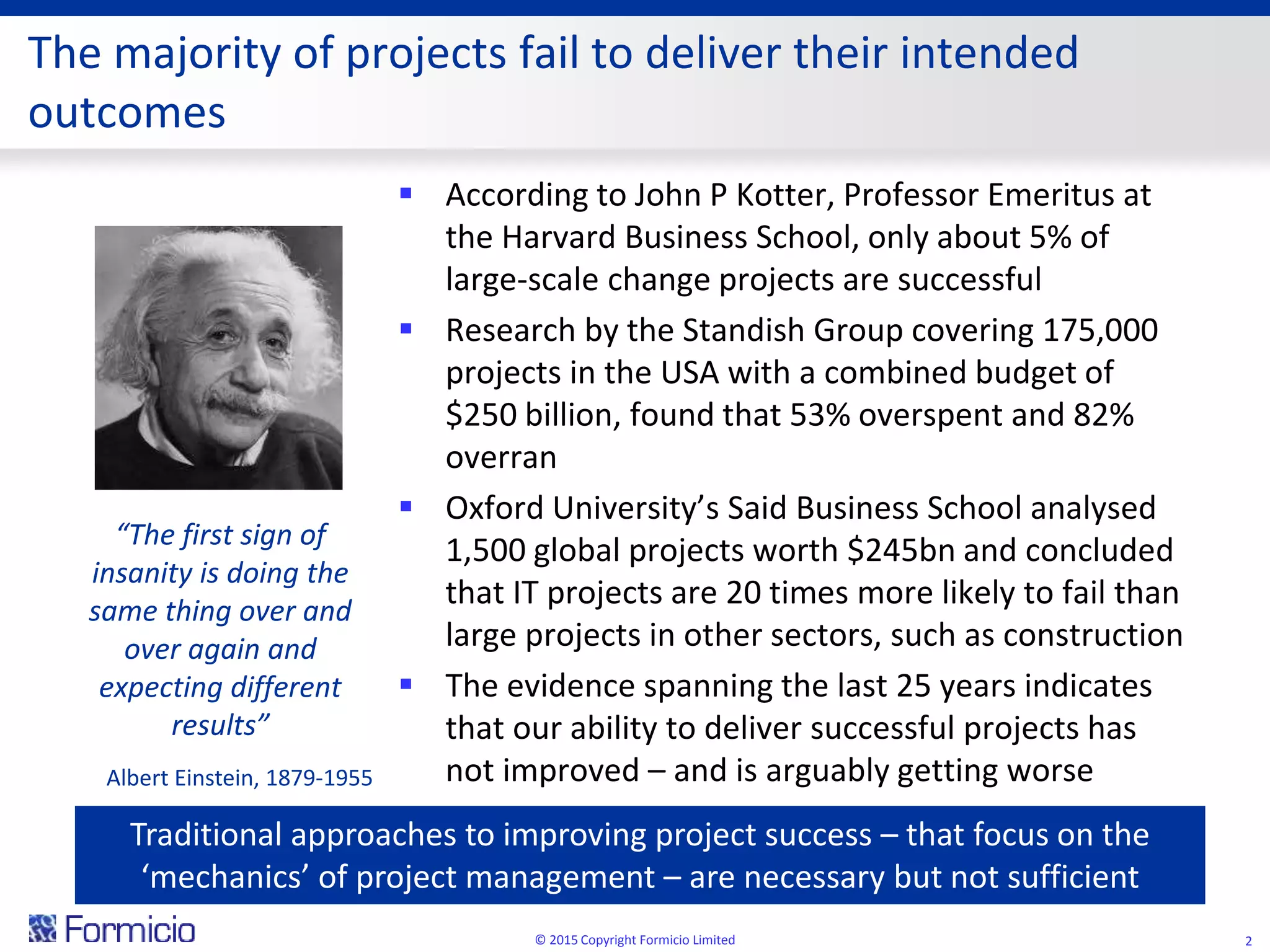
“The first sign of
insanity is doing the
same thing over and
over again and
expecting different
results”
Albert Einstein, 1879-1955
All organisations are on a trajectory, a path that takes them
from where they are now to a future state
 The purpose of a strategy implementation project
is to change the organisation’s trajectory – to one
that takes them to a target future
 Examples of such projects include:
– establishing a new business unit
– launching a new product
– introducing a new channel to market
– integrating an acquisition
– implementing a new IT platform
– reengineering core business processes
– moving production to a lower-cost geography
 In some cases, this also involves changing the
trajectory of partner organisations – as is often
the case in joint ventures
© 2015 Copyright Formicio Limited 3
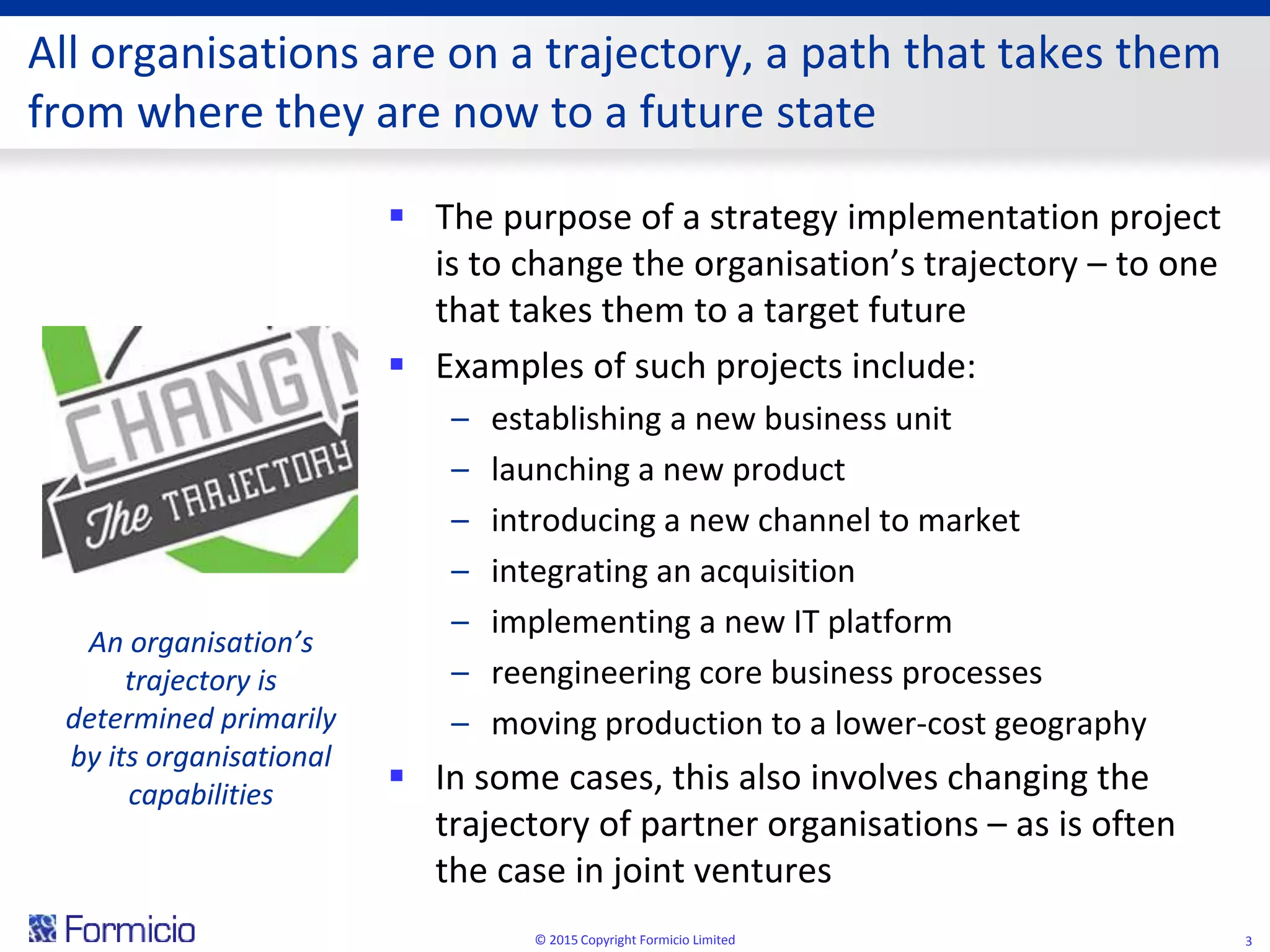
An organisation’s
trajectory is
determined primarily
by its organisational
capabilities
Organisational capabilities are a major factor in
determining an organisation’s trajectory
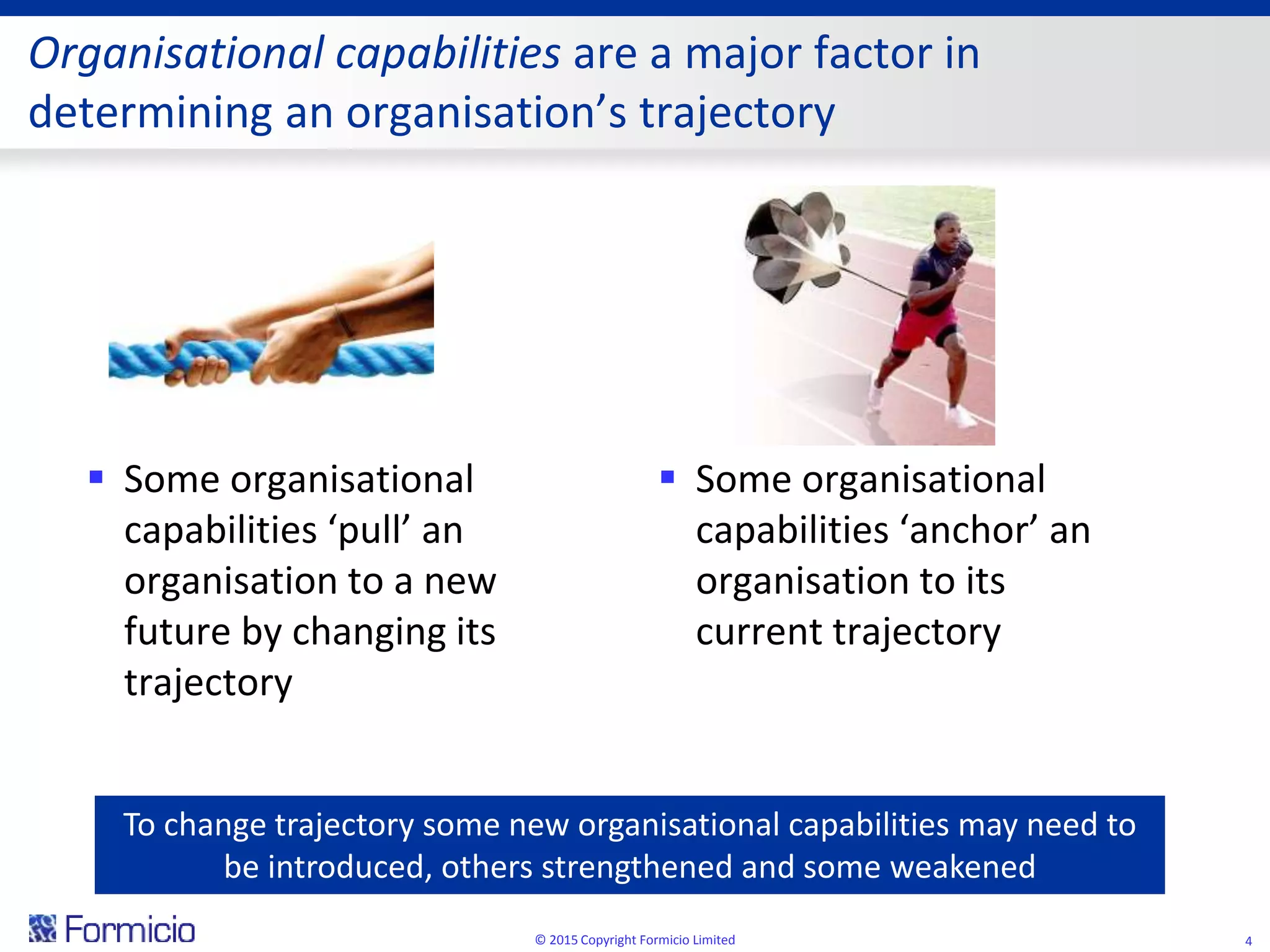
 Some organisational
capabilities ‘pull’ an
organisation to a new
future by changing its
trajectory
 Some organisational
capabilities ‘anchor’ an
organisation to its
current trajectory
© 2015 Copyright Formicio Limited 4
To change trajectory some new organisational capabilities may need to
be introduced, others strengthened and some weakened
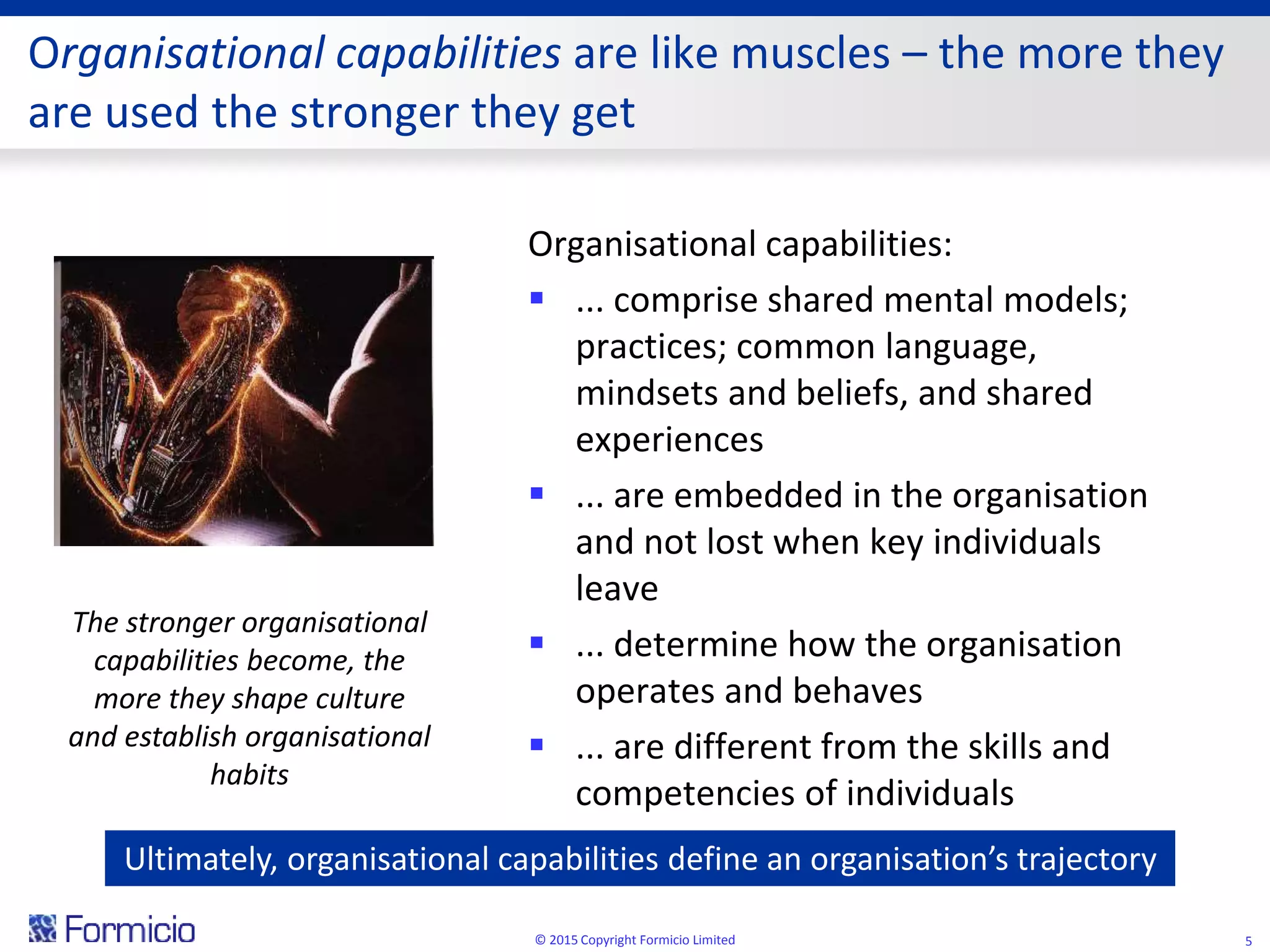
Organisational capabilities are like muscles – the more they
are used the stronger they get
Organisational capabilities:
 ... comprise shared mental models;
practices; common language,
mindsets and beliefs, and shared
experiences
 ... are embedded in the organisation
and not lost when key individuals
leave
 ... determine how the organisation
operates and behaves
 ... are different from the skills and
competencies of individuals
© 2015 Copyright Formicio Limited 5
The stronger organisational
capabilities become, the
more they shape culture
and establish organisational
habits
Ultimately, organisational capabilities define an organisation’s trajectory
Organisational capabilities are often difficult to identify –
until they are experienced
 When a project comes up against
capabilities in the organisation that are
not aligned with its intended trajectory,
the project will start to fail
 This is either as a result of the
embedded organisational capabilities
not being identified or their impact
underestimated
 These organisational capabilities are
often described as the organisation’s
antibodies to change
 Some organisational capabilities are easily
recognisable – while others only become
apparent when they are experienced
© 2015 Copyright Formicio Limited 6
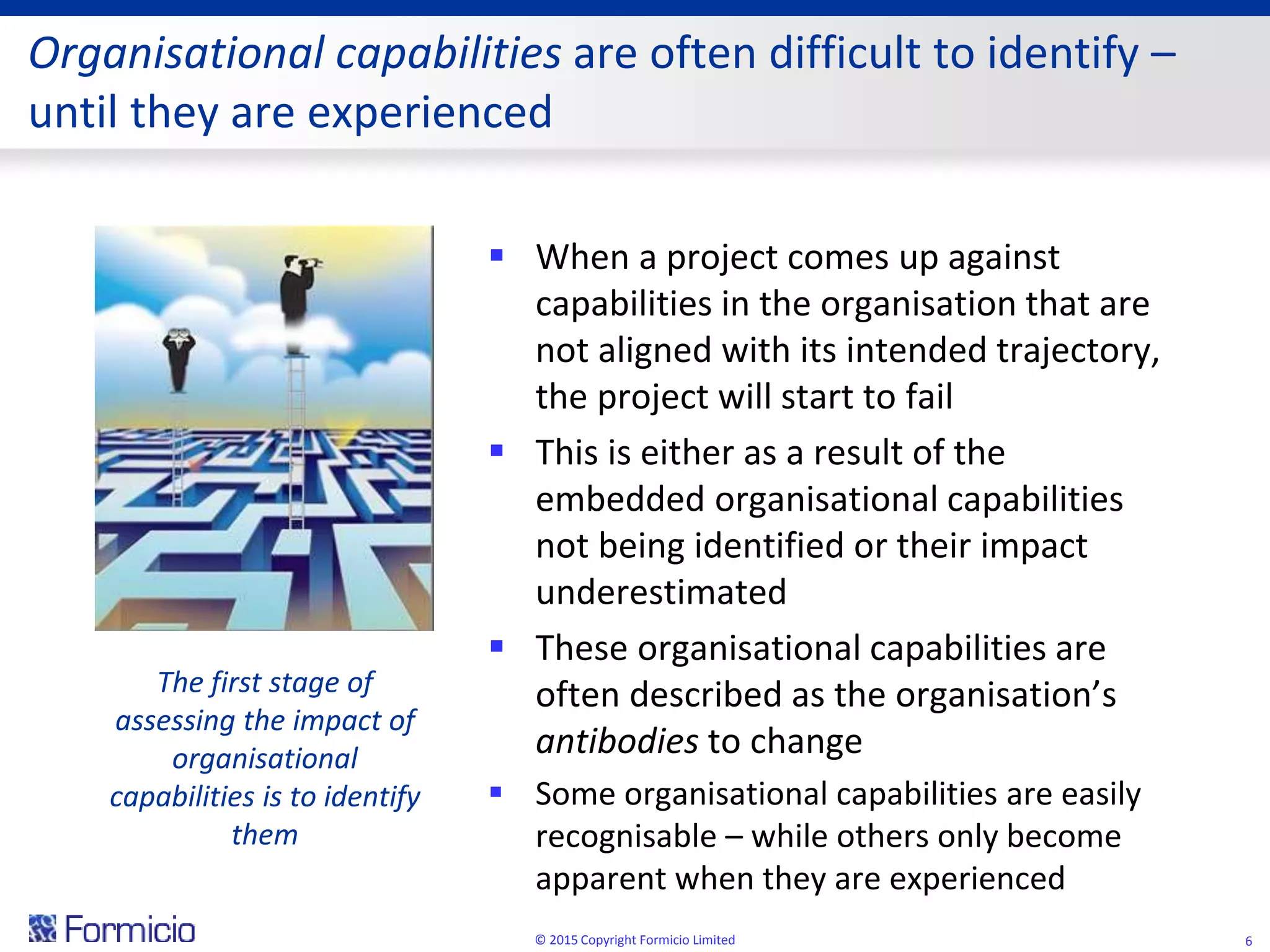
The first stage of
assessing the impact of
organisational
capabilities is to identify
them
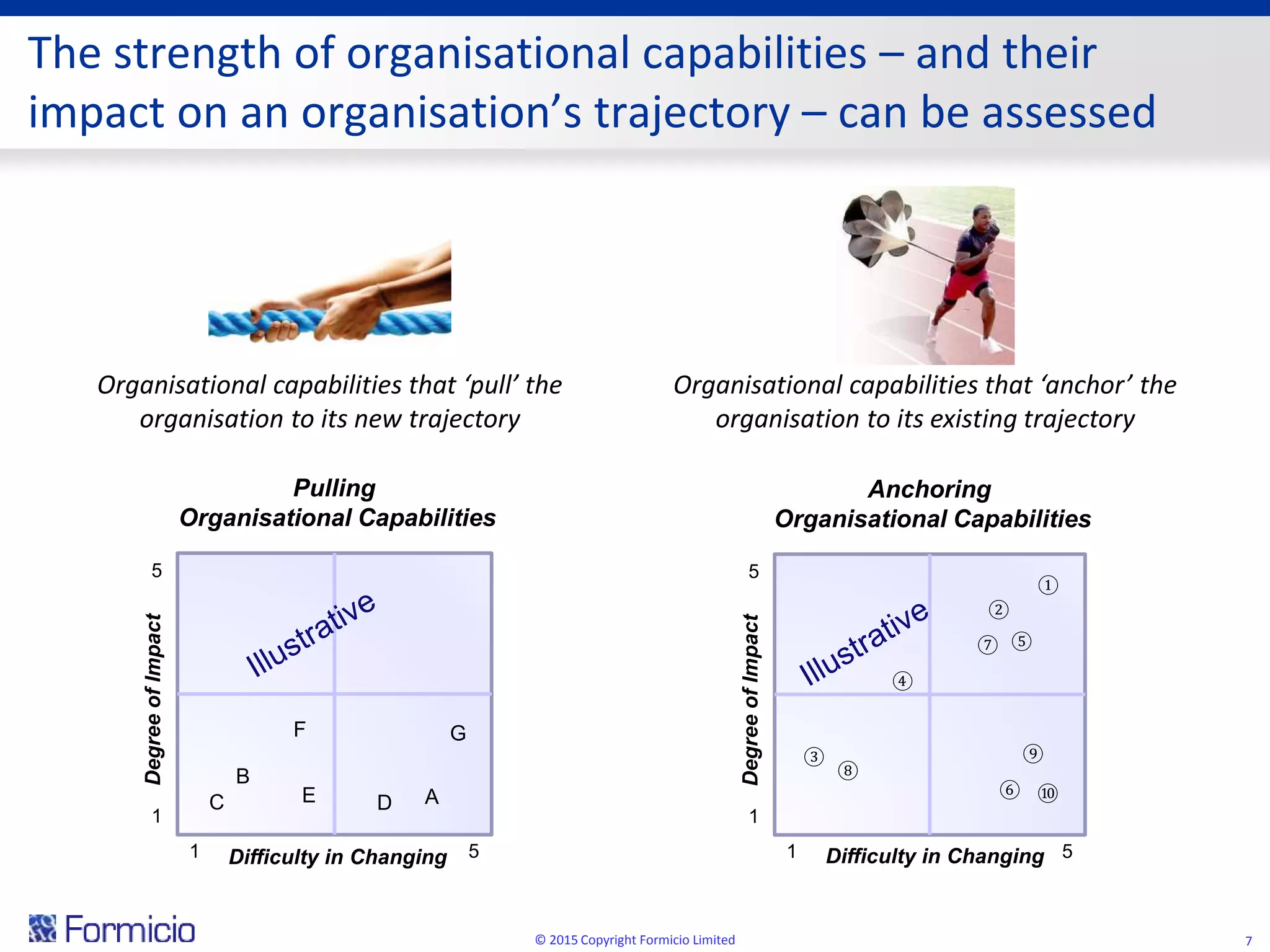
The strength of organisational capabilities – and their
impact on an organisation’s trajectory – can be assessed
© 2015 Copyright Formicio Limited 7
Organisational capabilities that ‘pull’ the
organisation to its new trajectory
Organisational capabilities that ‘anchor’ the
organisation to its existing trajectory
5
5
1
1
①
②
③
④
⑥
⑦
⑧
⑨
⑩
⑤
DegreeofImpact
Anchoring
Organisational Capabilities
Difficulty in Changing5
5
1
1
DegreeofImpact
Pulling
Organisational Capabilities
Difficulty in Changing
B
AC DE
F G
Five questions to ask if the success of your project involves
changing your – or your partners’ – organisational trajectory
1. To what extent does your project need to
shift the trajectory of your organisation – and
that of your partners?
2. Which organisational capabilities are needed
to ‘pull’ your organisation to its intended
trajectory?
3. How could these organisational capabilities
be introduced or strengthened?
4. Which organisational capabilities currently in
place have the potential of ‘anchoring’ the
organisation to its current trajectory?
5. How could these ‘anchoring’ organisational
capabilities be best weakened or eliminated?
© 2015 Copyright Formicio Limited 8
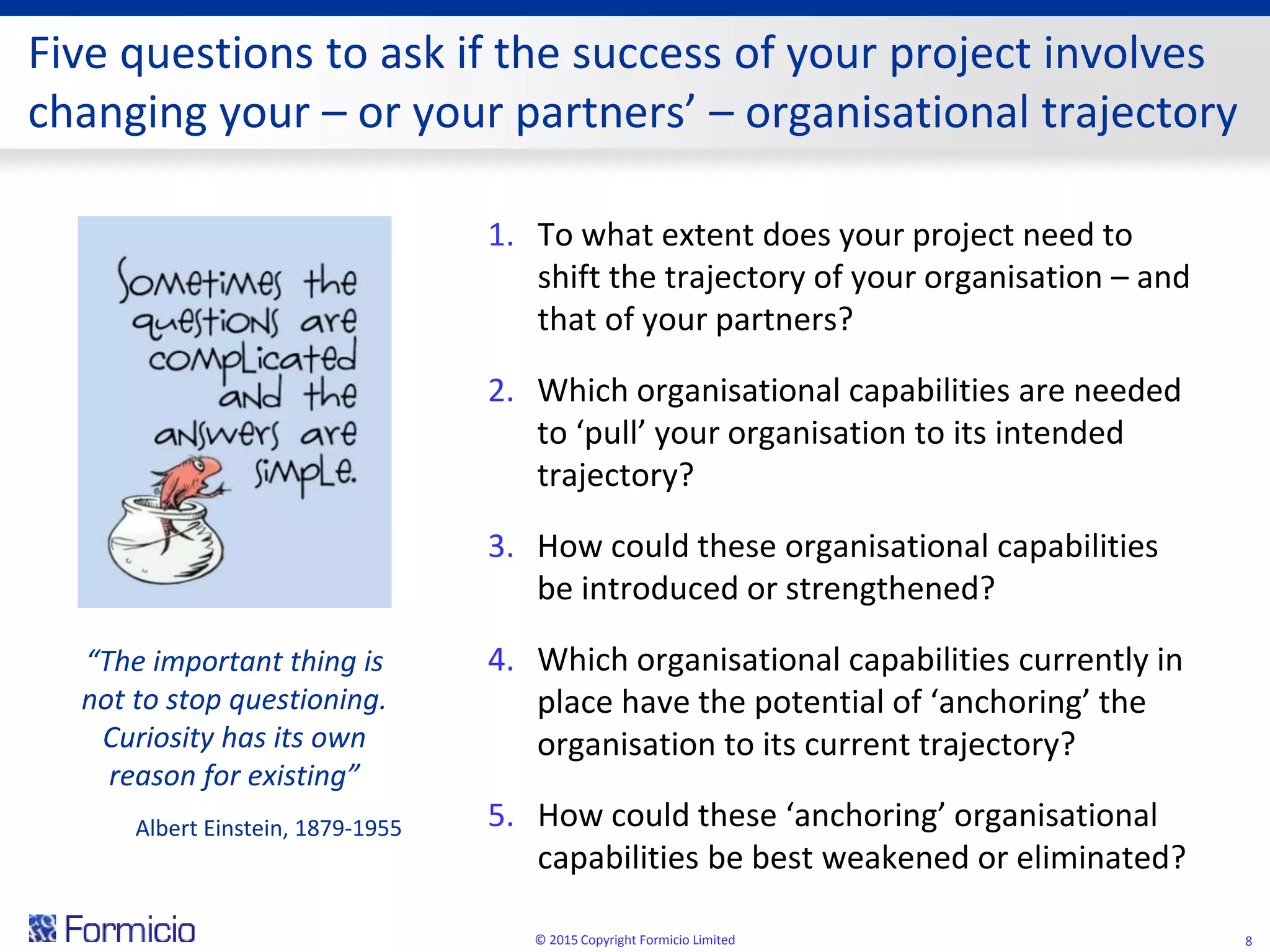
“The important thing is
not to stop questioning.
Curiosity has its own
reason for existing”
Albert Einstein, 1879-1955
The power that comes from having a shared point of view
Having a shared point of view is a powerful
tool for collective leadership. It can bring
clarity and balance. It can create a context
where everything makes sense, people know
exactly who they are, what is needed and
why they are here. Effectiveness is maximal,
yet effort is minimal. Everything flows as it
should.
Developing a point of view takes time and
effort, but the outcome will be worth it.
The Formicio Team
© 2015 Copyright Formicio Limited 9
© 2015 Copyright Formicio Limited 10
We work with people who want to improve their organisation’s
future. We can help you:
 Assess your Strategy by understanding your organisation’s
current trajectory and the factors driving it.
 Develop your New Strategy by defining an organisational
trajectory that leads to an improved future.
 Operationalise your Strategy by creating the conditions that
enables the organisation to pull itself to its target future.
Through our collaborative consulting approach we help you find
and implement solutions that work in your organisation
About Formicio
For further information contact ...
© 2015 Copyright Formicio Limited 11
David Trafford
david.trafford@formicio.com
Peter Boggis
peter.boggis@formicio.com
Frank Dannenhauer
frank.dannenhauer@formicio.com
+44 (0)20 7917 2993
www.formicio.com

The Impact of Organisational Capabilities on Project Success

  • 1.
    The Impact ofOrganisational Capabilities on Project Success A Formicio point of view
  • 2.
    The purpose isto share a point of view on the impact of organisational capabilities on project success  Delivering projects – particularly those aimed at implementing strategy – is a challenge for most organisations  What is often forgotten is that the purpose of strategy implementation projects is to change the trajectory of the organisation – and increasingly that of its partners  Successfully changing an organisation’s trajectory involves understanding the organisational capabilities that determine its current trajectory – and then deciding how their impact can be altered  Organisational capabilities are like muscles – the more they are used the stronger they get © 2015 Copyright Formicio Limited 1 Our point of view is based upon insights and experience that we have gained over time ---------- The aim is to inform and inspire
  • 3.
    The majority ofprojects fail to deliver their intended outcomes  According to John P Kotter, Professor Emeritus at the Harvard Business School, only about 5% of large-scale change projects are successful  Research by the Standish Group covering 175,000 projects in the USA with a combined budget of $250 billion, found that 53% overspent and 82% overran  Oxford University’s Said Business School analysed 1,500 global projects worth $245bn and concluded that IT projects are 20 times more likely to fail than large projects in other sectors, such as construction  The evidence spanning the last 25 years indicates that our ability to deliver successful projects has not improved – and is arguably getting worse © 2015 Copyright Formicio Limited 2 Traditional approaches to improving project success – that focus on the ‘mechanics’ of project management – are necessary but not sufficient “The first sign of insanity is doing the same thing over and over again and expecting different results” Albert Einstein, 1879-1955
  • 4.
    All organisations areon a trajectory, a path that takes them from where they are now to a future state  The purpose of a strategy implementation project is to change the organisation’s trajectory – to one that takes them to a target future  Examples of such projects include: – establishing a new business unit – launching a new product – introducing a new channel to market – integrating an acquisition – implementing a new IT platform – reengineering core business processes – moving production to a lower-cost geography  In some cases, this also involves changing the trajectory of partner organisations – as is often the case in joint ventures © 2015 Copyright Formicio Limited 3 An organisation’s trajectory is determined primarily by its organisational capabilities
  • 5.
    Organisational capabilities area major factor in determining an organisation’s trajectory  Some organisational capabilities ‘pull’ an organisation to a new future by changing its trajectory  Some organisational capabilities ‘anchor’ an organisation to its current trajectory © 2015 Copyright Formicio Limited 4 To change trajectory some new organisational capabilities may need to be introduced, others strengthened and some weakened
  • 6.
    Organisational capabilities arelike muscles – the more they are used the stronger they get Organisational capabilities:  ... comprise shared mental models; practices; common language, mindsets and beliefs, and shared experiences  ... are embedded in the organisation and not lost when key individuals leave  ... determine how the organisation operates and behaves  ... are different from the skills and competencies of individuals © 2015 Copyright Formicio Limited 5 The stronger organisational capabilities become, the more they shape culture and establish organisational habits Ultimately, organisational capabilities define an organisation’s trajectory
  • 7.
    Organisational capabilities areoften difficult to identify – until they are experienced  When a project comes up against capabilities in the organisation that are not aligned with its intended trajectory, the project will start to fail  This is either as a result of the embedded organisational capabilities not being identified or their impact underestimated  These organisational capabilities are often described as the organisation’s antibodies to change  Some organisational capabilities are easily recognisable – while others only become apparent when they are experienced © 2015 Copyright Formicio Limited 6 The first stage of assessing the impact of organisational capabilities is to identify them
  • 8.
    The strength oforganisational capabilities – and their impact on an organisation’s trajectory – can be assessed © 2015 Copyright Formicio Limited 7 Organisational capabilities that ‘pull’ the organisation to its new trajectory Organisational capabilities that ‘anchor’ the organisation to its existing trajectory 5 5 1 1 ① ② ③ ④ ⑥ ⑦ ⑧ ⑨ ⑩ ⑤ DegreeofImpact Anchoring Organisational Capabilities Difficulty in Changing5 5 1 1 DegreeofImpact Pulling Organisational Capabilities Difficulty in Changing B AC DE F G
  • 9.
    Five questions toask if the success of your project involves changing your – or your partners’ – organisational trajectory 1. To what extent does your project need to shift the trajectory of your organisation – and that of your partners? 2. Which organisational capabilities are needed to ‘pull’ your organisation to its intended trajectory? 3. How could these organisational capabilities be introduced or strengthened? 4. Which organisational capabilities currently in place have the potential of ‘anchoring’ the organisation to its current trajectory? 5. How could these ‘anchoring’ organisational capabilities be best weakened or eliminated? © 2015 Copyright Formicio Limited 8 “The important thing is not to stop questioning. Curiosity has its own reason for existing” Albert Einstein, 1879-1955
  • 10.
    The power thatcomes from having a shared point of view Having a shared point of view is a powerful tool for collective leadership. It can bring clarity and balance. It can create a context where everything makes sense, people know exactly who they are, what is needed and why they are here. Effectiveness is maximal, yet effort is minimal. Everything flows as it should. Developing a point of view takes time and effort, but the outcome will be worth it. The Formicio Team © 2015 Copyright Formicio Limited 9
  • 11.
    © 2015 CopyrightFormicio Limited 10 We work with people who want to improve their organisation’s future. We can help you:  Assess your Strategy by understanding your organisation’s current trajectory and the factors driving it.  Develop your New Strategy by defining an organisational trajectory that leads to an improved future.  Operationalise your Strategy by creating the conditions that enables the organisation to pull itself to its target future. Through our collaborative consulting approach we help you find and implement solutions that work in your organisation About Formicio
  • 12.
    For further informationcontact ... © 2015 Copyright Formicio Limited 11 David Trafford david.trafford@formicio.com Peter Boggis peter.boggis@formicio.com Frank Dannenhauer frank.dannenhauer@formicio.com +44 (0)20 7917 2993 www.formicio.com